Today’s marketing world is noisy, with most leads touching at least 20 digital marketing tactics before revealing themselves. A combination of channels and tactics must be utilized together to make sure you are hitting your audience on all levels. Omni-channel marketing combines the same message, across multiple traditional and digital marketing channels, to transmit your message to your target audience.
Where do you start? How do you choose which channels are best? What do you focus on FIRST? These questions are the reason why we created the all-new Digital Readiness Guide for Cisco Partners. This guide will help you develop a digital strategy and execution plan to tell your story, reach new customers, and grow your brand.
The guide contains the following aspects to help build your digital marketing efforts:
The more relevant, interesting, and nonintrusive your digital strategy is, the more likely it is you’ll reach your intended audience. The guide provides tips on creating a seamless conversation to boost your brand and move your business forward by looking at:
Once you have a digital strategy in place, it’s time to move forward and make it happen. Execution covers the basics of digital marketing, from search engine optimization (SEO) and social media marketing to mobile marketing and events promotion and everything in between. Start exploring the following digital tactics:
As a Cisco partner, you have a wealth of resources at your fingertips—all designed to help you stay one step ahead of the game. Be sure to explore each of these resources for even more information on digital readiness:
This introduction provides a guide on how to navigate the new community, ways to search topics, how to interact with the content, and content options. Please take a few moments to review. If you are not a member, please register today!
Have a great weekend!
Thank you,
Marc and the rest of the Cisco Small Business Team
The power of distribution partnerships should not be underestimated. For Cisco, our distribution channel continues to be a scaling and innovation engine. At the same time we focus on helping our distribution partners capitalize on new markets and technologies, while enabling channel partners to also tap new opportunities and grow their practices.
That’s why I am pleased to share the news that Cisco has been recognized by the The Global Technology Distribution Council (GTDC) as a recipient of the U.S. Rising Star Award, signaling exceptional sales growth through U.S. distributors over the past year. The awards were presented this week, kicking off GTDC’s two-day Summit in San Francisco.
Cisco received the Sector Market Share Champion in the Cloud IT Infrastructure, and Unified Communications/Collaboration (UCC) categories, as well as the Sector Growth Champion in the Hyperconverged category.
Receiving a Rising Star Award further establishes Cisco as a top vendor out of hundreds of manufacturers and publishers who rely on distributors to meet the product and service requirements of technology solution providers globally. Rising Star winners were chosen based on year-over-year sales growth rates and market share leadership, as determined by The NPD Group’s Distributor Track® service. Available by subscription, Distributor Track aggregates actual distributor sell-through data to enable sharp insight into channel sales and pricing trends.
On behalf of the entire Global Distribution team, we are proud of what these awards represent: an acknowledgement that Cisco is continuing to invest in providing superior support, innovation and growth for our distribution partners. Thank you to all our distributors for your continued partnership
The FDA recall of a medical device last week has caused a bit of a media storm as the general public scrambles to find out more. The fact that a medical device meant to help sustain life is insecure and could be hacked to kill a patient is alarming to all of us. More worrying is that the medical device subject to the recall, a cardiac rhythm management product, or “pacemaker” to the rest of us, is probably not an anomaly. Many other medical devices more than likely also lack adequate security.
To understand the risks, we first need to understand the problem. To be honest, this could require an extensive series of blog posts over weeks to fully examine and explain this properly, but here’s the 50,000-foot version.
Different types of medical devices and the risks they pose
First, there are the implantable medical devices (IMDs) like the medical pacemaker at the center of this story. This group of medical devices includes the implanted insulin pump that security researcher Barnaby Jack demonstrated live on stage at the Miami Hacker Halted Conference in 2011, hacking the device to deliver a lethal drug dose. It also includes a pacemaker that was hacked, again by Jack, at the Melbourne BreakPoint Security Conference in 2012 to deliver a lethal 830 volt electric shock to a patient.
Second are the much wider range of network-attached medical devices used in healthcare delivery. These include:
Diagnostic imaging systems: ultrasound, MRI, PET, CT scanners, and X ray machines
Treatment equipment: infusion pumps, medical lasers, and surgical machinery
Life support: ventilators, anesthetic and dialysis machines
Medical monitors for oxygen saturation, blood pressure, ECG and EEG, and many, many more.
<break>
The greatest data-security risks for medical devices
The network-attached group far outnumbers the IMD group, but both have one thing in common—a very long life span! No one wants a pacemaker that needs to be replaced every year or two, and hospitals simply can’t afford to rip and replace their multimillion-dollar investment in x-ray machines and PET and CT scanners if they still work perfectly. Many current medical devices are 15 or 20 years old already, placed into service when the rest of us were deploying Windows 95 and dial-up modems.
The greatest risk to medical devices, however, is that they lack even the basic security protections that a $200 home PC has—things like antivirus software and a host firewall. The danger is that when a malware worm gets into a hospital and spreads its way laterally across the network to reach highly vulnerable medical devices, it either quickly infects them (many of the newer models run a form of Windows XP), or the malware multicast traffic storm causes the medical device to crash or just stop working. It’s not that someone hacked and changed a parameter—although that is a distinct possibility—but it’s more likely that its battery becomes quickly drained and powers off, or the system blue screens and ceases to provide life-sustaining care.
It’s going to take years to patch or replace the arsenal of insecure medical devices and billions of dollars that healthcare providers simply don’t have. So, we need to look at alternatives to secure them for the rest of their life-spans.
How to reduce risk and protect devices
By far the most effective approach is microsegmentation, where medical devices are locked down and secured by the network they are attached to. (Attempting to manage 350,000 individual medical devices in a hospital is impossible.)
Earlier this week, a critical vulnerability in Apache Struts was publically disclosed in a security advisory. This new vulnerability, identified as CVE-2017-9805, manifests due to the way the REST plugin uses XStreamHandler with an instance of XStream for deserialization without any type filtering. As a result, a remote, unauthenticated attacker could achieve remote code execution on a host running a vulnerable version of Apache Struts.
This isn’t the only vulnerability that has been recently identified in Apache Struts. Earlier this year,Talosrespondedtoazerodayvulnerability thatwas under active exploitation inthewild. Talos has observed exploitation activity targeting CVE-2017-9805 in a way that is similar to how CVE-2017-5638 was exploited back in March 2017.
Long wait times. Out of stock challenges. Pricing inaccuracies. Dissatisfied customers. Operating in the physical world of retail can be tough. And more often than not, the retail associate takes the heat for painful situations like these given that they are on the front lines. Day after day the associate wakes up, pours a big cup of coffee, skims over social media and heads into work with a hint of frustration hiding behind their smile. They know that today bears the possibility of bringing more heart burn and chaos than the days prior. This is retail.
The days of serving understanding customers with low expectations are few and far between. Today, we operate in a digital world where technology is at the fingertips of most and complete strangers have the power to influence the consumer’s purchase decision with a single post, share or like. Consumers have a growing number of ways to build relationships with brands, and yet at the same time, a single shopping experience or interaction with an associate can make or break their trust.
Who is to blame when things take a turn for the worst within the four walls of a retail store? Where does one look for answers when same store sales decline quarter to quarter? It often feels like all fingers point to the associate. Corporate teams and consulting partners launch new studies around engagement, intent to stay and associate loyalty. But are we just looking to the associate as a scapegoat, or do intentions exist to incorporate their genuine feedback into new processes and technology decisions?
This redefined world of retail is electrifying as it happens all around us in ways that few can accurately predict where it will pivot to next. Some retailers have strategically made the decision to transform their business over time while others are holding on for survival only to see their looming fate. Increasingly, retail leaders are making the decision to categorize their associates as a pain point on their P&L, while others recognize them as their competitive advantage and secret sauce. When a retailer empowers their associates with the right mobile technology to be more knowledgeable of product information, quickly find accurate inventory and become the customer’s trusted advisor – retail magic can happen.
So, ask yourself. What category do your associates fall in – are they your money makers or do you only point to them when you have a bad quarter? I have found that a critical part of being successful in either category is making the right mobile technology a part of the associate’s day in a meaningful way. At Cisco, we are aligning non-traditional retail partners to our technologies so that our customers can unlock the power of the network. If mobile technologies and the backbone that those technologies live on are not providing the associate stability, security, and value then a key piece to your digital transformation puzzle is missing. Quickly determining where else you can place your bets to put associates in a position to be more digitally informed than today’s consumer and to be a source of truth for your in-store shoppers will accelerate your journey to success while empowering the front lines.
Join our upcoming webinar “Transforming the In-Store Experience with Mobile Technology” on September 13th at 2pm ET / 11am PT. Experts from Cisco, RSR (Retail Systems Research) and Tulip Retail will share how retailers can leverage mobile solutions to improve service, drive sales, build customer relationships and revolutionize the way that shopping is done.
In this webinar, you’ll learn:
How to improve worker productivity in the stores using mobile technology
ROI benefits from using in-store mobile apps
Case studies from some of the top brands in retail
A network powered by intent. Informed by context. Growing more intuitive every day. The Network. Intuitive.
This is Cisco’s vision, built on intent-based networking technologies that can turn days of work into hours, and hours into seconds. One way for you to get started is with centralized management. Here are the steps you can take to enter a new era of networking:
Step 1: Get Cisco DNA Center. It’s been 2 months since its launch, so you’ve probably heard of DNA Center – the centralized management application for your network. (If not, read this or watch this).
DNA Center allows you to be able to manage your end-to-end network from the campus, branch, and WAN to the cloud. It uses automation to lower costs, and assurance and analytics to improve network performance.
Step 4: Stay tuned – the list of use cases for automating network management will continue to grow. We will be announcing some exciting capabilities around assurance and analytics soon, with more “How to” videos to help demonstrate how Cisco DNA Center enables you to better manage your network.
BONUS Step: We are building our first sustainable base on Mars and we need your help setting up the network and keeping it running smoothly. Play the game here.
What are some of your network management challenges? Leave a comment below, or let us know what you think!
One web interface. One seamless telepresence experience.
It’s a sensitive subject. Some prisoners are held in remote, undisclosed locations to preserve national security. But there’s no chance of rehabilitation in total isolation. And prisons have to protect civil and human rights. Cisco developer partner CONNECT Professional Services is helping the Department of State and Ministry of Interior in a country within the gulf region keep prisoners in touch with their families via telepresence.
CONNECT says…
Until recently, families of prisoners had to travel to specific locations where a video until was set up, just to talk to their loved one. Travel times were long and often expensive. And prison officials had to work with up to six different companies just to set up the meetings.
So, the nation’s ministry of defense asked us for a telepresence solution to let families anywhere in the country connect with prisoners. One using a simple web interface on a laptop or smartphone. We worked with Cisco to build out a collaboration platform that uses Cisco telepresence endpoints and cloud services.
Here’s how it works:
A meeting date is set
The family launches the meeting with a password in a web browser
The prisoners use secure video conferencing to join the meeting
The family connects for the allotted time
All calls are monitored and recorded
It’s an easy end-to-end secure, automated telepresence service for people in an unusual situation. It keeps families connected, and prisoners secure. And it reduces IT and travel costs for all involved.
Who would have bet on a SRv6 interoperability demonstration at SIGCOMM 2017 conference this summer?
Very few of us actually… For those who are not familiar with the SIGCOMM 2017 conference, this is a highly respected conference where key networking innovations and orientations are being discussed every year by leading vendors, major web and service providers, and academic researchers.
But, why should you care about such a demo?
Well, this is the kind of proof point that should be important to you as you may consider designing your next-generation infrastructure on a nascent technology, such as SRv6. Witnessing strong support and interest from the vendor community is an assurance moving forward you won’t be trapped into any technological dead-end.
the first interoperability demo was successfully delivered at SIGCOMM 2017 conference
I’m not saying this is unprecedented but I’ve rarely seen technologies that get implemented across different vendor’s hardware platforms in less than 6 months after the first publication of the IETF draft.
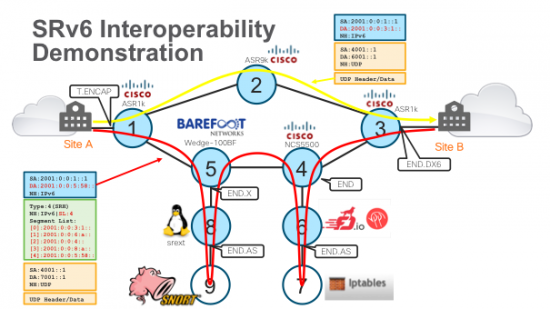
The scope of the interoperability demonstration we designed for this conference is really impressive. See below some details about the content of this demo.
An end-to-end integration of SRv6 VPN, SRv6 Traffic-Engineering and Service Chaining. All of that with data-plane interoperability across different implementations:
Three Cisco Hardware-forwarding platforms: ASR 1K, ASR 9k and NCS 5500
It runs on a small network topology formed of two non-SRv6 edge domains located on both sides of an IPv6 core domain (see below diagram).
Each edge domain consists of two Linux machines, one IPv4 only and the other IPv6 only. In the core domain:
HW node 5 is running P4 implementation of SRv6 on Barefoot Tofino
HW nodes 1 through 5 are SRv6-enabled
Node 8 is an SRv6-enabled Linux machine
Node 6 is a regular Linux machine running FD.io
Two non-SR services, Netfilter and Snort, are running respectively behind node 6 and 8.
Without getting into too many technical details here, the demo can:
Handle IPv4 or IPv6 traffic coming from both sites A and B
Isolate traffic from different VPNs
Steer the traffic over a different path from the shortest path computed by the routing protocol
Send the traffic to specific nodes where certain services can be applied to the traffic
This is a nice use case that highlights the power of SRv6 network programming concept. To make things very simple, you have now the ability to code directly into each packet header where the traffic should be sent and how the traffic should be treated. Not only is this simple but it is also extremely scalable as you don’t have to maintain any states in the network … To get more familiar with SRv6 network programming concept, read this great blog posted by Brendan Gibbs, VP Product Marketing.
You can expect to see more refined and complex use cases over the next few months as we closely work with major Service Providers, that are just about to uncover all the capabilities of SRv6 and how to make use of them to develop innovative services.







 The power of distribution partnerships should not be underestimated. For Cisco, our distribution channel continues to be a scaling and innovation engine. At the same time we focus on helping our distribution partners capitalize on new markets and technologies, while enabling channel partners to also tap new opportunities and grow their practices.