Avatar

See us at Mobile World Congress – Americas in San Francisco, Sept. 12-14

We recently published a blog discussing the ability to implement 5G in a way that made good financial sense.  The point is that 5G is very much about enabling new services and that can only be done with the right network foundation in place.  The blog framed 5G in a clever pseudo-math equation: “5G > New Radio and 5G = Digital Transformation”.  What do we mean by digital transformation really? Simply put, it’s when you leverage new digital technologies to create a better way of doing something.  For example, a factory implements 3-D printing to better manufacture a product, or a business increases its agility and improves efficiencies by using digital platforms.

Digital transformation becomes a reality when we can create and share new services almost as fast as we can visualize them.  Imagine that!  Digital transformation – if done right – will indeed require a 5G network.  Why?  Our premise is that 5G is greater than simply a new radio technology.  It requires a transformation of the entire network and business.

So what kinds of services can we expect in the near future from 5G?

  • Enhanced consumer experiences including video, gaming and retail using any screen including augmented reality/virtual reality (AR/VR).
  • Seamless mobility providing the ability to move between licensed and unlicensed wireless access without changing the experience.
  • Collaboration, for example the Cisco Spark Board, so you can wirelessly present, white board, and video or audio conference with the touch of a finger.
  • IoT that uses both static wireless and mobile wireless access. This could be the service segment with the fastest growth.
  • Mission critical and advanced real-time services. Some of which can be delivered without new radio technology.

Service providers need to deliver the speed and scale markets demand in a way that is cost-effective and sustainable to offer these new services.  They need to deliver new mobility services at the speed of “CLICK” with simplicity, security and scale to any device.  The speed of “CLICK” means as fast and easy as clicking your mouse or “Enter” button.

Cisco believes  the process of upgrading can start long before the launch of the radio.  Working with Cisco, service providers can upgrade their service infrastructure capabilities today for scalability, security and automation.  This will give them the benefits of speed, flexibility and efficiency with an infrastructure that lays the foundation for 5G-enabled services in the future. Here is the three-step roadmap Cisco developed around this:
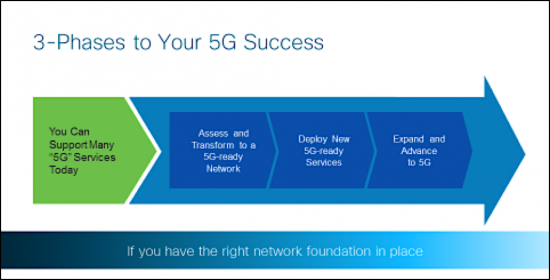
Step-1: We assess the current state of your network, operational capabilities, business realities, and future plans.

Step-2: We work with you to develop a transformation plan to build 5G-ready service delivery infrastructure that meets your goals and priorities. We typically address areas such as upgrading operational capabilities, automation and orchestration of processes and improving the scalability and programmability of your infrastructure.  The goal is to create an infrastructure that is not only faster and more flexible (the speed of “click”) but also less expensive to operate.

Step-3: Now that you have the right foundation in place, you can focus your efforts on service innovation for both current and future radio technologies… you really can deliver at the speed of “CLICK”.

This all sounds great, right? So what should you do next?

Visit us at Mobile World Congress-Americas in San Francisco, September 12-15th.

  • Meet with Cisco executives and technology experts
  • Visit our Network Operations Center (NOC) that controls the Wi-Fi and analytics for the entire event
  • Attend one of several speaking sessions and seminars (including Cisco experts)

Also, please visit these links for more information and also reach out to your friendly neighborhood Cisco representative.


Authors

Yvette Kanouff

Senior Vice President/General Manager

Service Provider Business

Avatar

Collaboration used to happen in boardrooms with whiteboards and bagels. Today, business doesn’t happen face-to-face as often as some would like. These days, I witness more teams communicating on conference calls, via email exchange, and on messaging applications. This can make it challenging to get to know co-workers, partners, and customers.

With so many employees working in virtual teams, many business relationships depend on collaboration technology. And that’s not a bad thing — as long as people are using the right technology in the right way.

Value from collaborative tool sets extends far beyond the features and functionality they provide.

Value from collaborative tool sets extends far beyond the features and functionality they provide. Achieving desired outcomes determines their value. Some of these outcomes are objective, like onboarding new employees efficiently. Some are subjective, such as an emotional connection achieved through interaction.

With 64% of the private sector digital value at stake tied to people and connections, it is critical to understand how your users define value.

As Lewis Carroll wrote in Alice’s Adventures in Wonderland, “If you don’t know where you’re going, any road will take you there.” In today’s dynamic collaborative environment, it’s imperative to know not only where you’re going but to also understand that the road is constantly changing. To reach your target, you must be clear about the following:

  • The outcome you are looking to achieve
  • The capabilities or toolsets required
  • How the capabilities will help you reach your target
  • How you will measure success

Not only do we want to identify the functionality required from our collaboration solution, we also need to define value on a personal level.  And, the way we communicate outside of work influences this personal measurement of value.

People have to have a delightful experience in their hand all behind a single plane of glass.

alice-and-rabbitIn the last 10 years, users have downloaded 140 billion apps from Apple iTunes alone. Roughly 10% of these were business related. The vast majority of applications people download and use daily are for personal use, including those for engaging on social networks. The collaborative functionality of these applications influences how business users engage and interact.

The surprising truth about social networks is that they fill the humanity gap many global workers feel in cold, impersonal email chains and conference calls. Wouldn’t people expect the same dynamic environment when at work? Whether “work” happens in an office, at a customer site, at an airport, at a Wi-Fi hotspot in a local coffee shop, on the road, or somewhere in between.

If you define value at a personal level and success at a corporate level, then it is the integration of the two that will help you avoid an unplanned journey down the rabbit hole.

Today, demand for mobile and wireless technologies in business is pervasive. The unique capabilities of mobile devices enable new ways of working that were not possible before.

And, the better that mobile technology becomes, and the more employers embrace the “bring your own device” (BYOD) philosophy, the more connected they can become to the workplace. A workplace that can now exist on the same device as their social networks and family photos.

So how do we define a strategy that will allow an architecture to align with user defined value?

For every business outcome you define, toolset you identify, and KPI you set in place, it is the people using these solutions that ultimately determine their value. After all, in an age when technology reigns supreme, people still remain a company’s greatest asset.

Working together, people can achieve extraordinary things.

Learn more about how collaboration technology can help you empower innovation and deliver business value everywhere.

Lower image: Source

Authors

Lowell Johnson

Senior Director

Advanced Services for Collaboration

Avatar

This post was written by Cisco Intern Michele Day before she completed her internship with us and returned back to school for the fall semester. 

***

Even before my very first day at Cisco, I knew this was the place for me. How? I was hooked on reading THIS Life at Cisco BLOG!

Throughout the recruiting process, I heard from a lot of companies, most of which seem to all say the same thing, “We have great culture and great people!” but, I needed to know if the culture and people were really as good as everyone said!

As I researched these companies further, I found the Life at Cisco Blog. I thought it captured the genuine stories of Cisco employees and their experiences working here. Some posts made me laugh. Some posts brought me to tears (in a good way). Every post drove me further and further into loving this company and the people behind it. In no time I was determined to land my summer internship at Cisco!

A collage of images from Michele's intern experience at Cisco.

Here are the 3 blog posts that spoke to me most, and what I learned:

1. How I Found My Cisco Family by Monica Castillo – This was the first blog post I ever read on Life at Cisco. Monica shares how she was orphaned as a teenager by her addict mother, and takes us to hearing the devastating news of her mother passing away, and how she came to find her family here at Cisco. Her story was one of heartache, but also of triumph. I clung to every word and felt inspired knowing that she had found a true family through work.

My Experience: I agree! I found a “family” at Cisco, as well. Over the course of my internship, my Office of Inclusion and Collaboration team has shown me an incredible amount of support and guidance. I even had the opportunity, as an intern, to attend Cisco Live in Las Vegas – which speaks volumes to the confidence and trust my team has in me. They’ve ensured that I have all the tools to succeed and flourish, and have been there every step of the way allowing me to learn and grow. To me, that is a family.

2. A “Blessing” Comes to Life Thanks to Cisco by Kali Pike – Something you hear a lot of is that giving back is in Cisco’s DNA. That’s not just marketing jargon, that’s truly what exists here at Cisco. The story by Kali was another that struck me to my core. Kali has been sponsoring a child in Kenya for almost a decade, and thanks to Cisco – she was actually able to travel there and meet this young girl for the first time!

My Experience: I got a taste of Cisco’s give-back vibes on my very first day here! This is where I found a local nonprofit onsite whose mission is to provide crayons to sick children in the hospital as a way to support imagination and creativity during such a rough moment in their lives. We sorted the crayons by color so they could be repackaged and sent to hospitals all over the country. My first day and Cisco was already providing opportunities to give back to our community – I can’t even imagine how awesome it feels to have FIVE days of giving back alongside these opportunities on campus!

3. Virtual Coffee through Cisco Tech by Mitja Rakar – One of the biggest concerns I had coming into Cisco was how I’d handle virtual meetings through technology. As someone who thrives on in-person communication, I was worried that virtual communication would diminish any chance of developing meaningful relationships. When I read Mitja’s blog, I learned a lot more about Cisco’s collaboration tools, such as WebEx, Jabber, and Spark, and how they help us to collaborate no matter where we are in the world! I have to admit, I thought this was really cool and it helped me with some of my initial apprehensions, but I still had to experience this for myself first!

My experience: On my second day on the job, I had my first WebEx call – and you know what? It actually felt like we were all in the same room together! I always thought technology hindered communication and relationships, but during my time here at Cisco, I found the exact opposite to be true and feel I see my co-workers’ authentic selves shine through WebEx consistently. From their home and decorations to their pets and even getting to meet their children – these are aspects of my co-workers I may never have known if it weren’t for our virtual meetings!  It also gives me an idea of what they are truly like and find most important.

Companies can always talk the talk, but Cisco truly walks the walk in everything they say and do. I could not be more grateful to work for this company and to be a part of the Cisco family.


Want to become a Cisco Intern? We’re hiring!


Authors

Cisco Interns

Accelerate

Early-in-Career Talent

Avatar

Craig Tranter is a former educator, and now serves as a technology presenter for Cisco. This blog is the first in his series on advancements and opportunities in education. All views are his own. 

What does this image mean to you?

For a lot of us, this image might symbolise a floppy disk. But, most millennials will recognize this as the ‘save’ icon. In fact, they probably won’t have a clue what a floppy disk even is, and would no doubt scoff at the miniscule amount of storage space that it provides.

So, why is this relevant? It’s not only that the digital world has evolved and moved on from this outdated technology, but our perspectives have evolved too. Whereas floppy disks were a necessity for many students in the past, they are now unrecognizable to most modern students. We need to continue to evolve and change our perspectives if we are to take full advantage of what technology has to offer.

We now live in an age where students have grown up with the internet. They are digital natives who are accustomed to being connected at all times and have always had the benefit of an entire knowledge base right at their fingertips. In fact, many millennials might now struggle to find information by using the content page in a book, because why use such archaic methods of information gathering when you can simply ask your smart phone to find it for you?

Technology has changed the way we live our day-to-day lives, how we interact with our devices and each other. So my question is: What are we doing in education to adapt to this new digital world?

Let’s face it. With rising tuition fees and our fast-paced connected world, students expect more from their universities. And rightly so! Universities need to adapt and provide learning opportunities for their students in a more personalized way that suits them. After all, students are paying for their tuition and if the university does not give them what they want, they’ll simply go somewhere else that does cater to their needs.

Location no longer defines education, as students have access to experts from all over the world via the internet. Gone are the days when universities could boast the best talent and expertise. Now we can find it online and reach out to people across vast distances. So, it’s pretty clear that universities need to adapt in order to provide the ideal digital and physical learning environment if they want to attract and retain students, as well as the best expertise from around the globe.

That being said, the way in which we approach education from an institutional standpoint doesn’t seem to have changed all that much over the last hundred years. At the higher education level, a great deal of those precious contact hours are still delivered in lecture halls where very skilled professionals impart their knowledge to a room full of students and expect them to go away and absorb that knowledge. That’s all well and good, but students are now demanding more interactive and collaborative sessions where they are able to question and challenge their lecturers with queries and new ideas. Only in this way can we continue to make significant progress and achieve more.

It’s quite clear that we are experiencing a shift in the way we work and study. We are going through a digital revolution and if we don’t adapt, we might get left behind.

So, what’s the future of education?

Watch out for the next post about flipped learning and creating visually engaging content.

Authors

Craig Tranter

Technology Presenter at Cisco

Avatar

How Avit used Cisco HyperFlex to build up their VDI compute power

It’s hard for humans to be perfect. Because we are human: short, tall, old, young, crazy, shy, etc.

Complete transformations are hard for us to achieve! After all, we must work with what we have and, unfortunately, we’re not able to replace our key organs to enhance their performance.

An enhanced Data Center gets your business noticed

Giving your Data Center a makeover, unlike a human being, is not only achievable but essential to keeping your business competitive:

Too slow? Speed up! Bloated? Gut everything! Need Rest? HA! Data Centers run optimally around the clock 24/7.

Yet, humans and Data Centers do have one thing in common when trying to reach their full potential: Great Partners who help them be the finest tuned machines they can be.

Perfect Partners create better Data Centers

Avit is a rising organization in the Netherlands who built their successful reputation by helping companies realize their digital transformations by offering flexible and exceptional Data Center IT solutions.

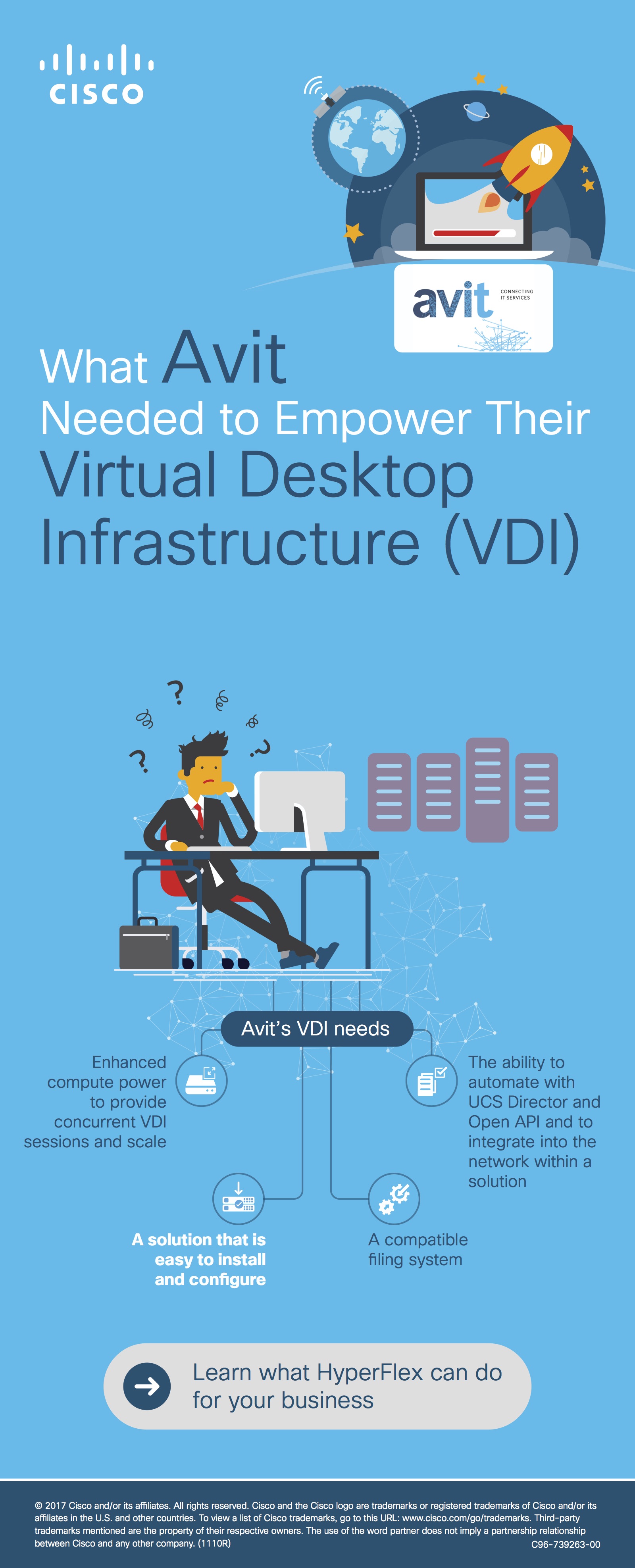
What Avit’s VDI needed

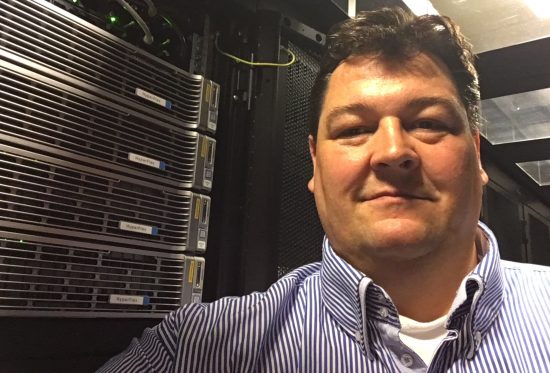
“We wanted to increase our compute power so we could provide concurrent VDI sessions and scale accordingly” said Marco Remkes, Avit’s Technical Director. “We sell cloud solutions, so we needed to find a flexible way to scale-up and enhance our capacity. Easy installation and configuration was essential.”

Marco Remkes, Avit’s Technical Director

Cisco: The Perfect Data Center Partner for Digital Transformations

As Marco and Avit were actively seeking a solution to empower their VDI network, they immediately considered Cisco, with whom they maintained a successful, longstanding relationship.

“In my experience, when you use the Cisco portfolio, good things happen! That’s why we try to build solutions around it,” Marco explained. “As a Cisco Gold partner, we love Cisco and sell 100% Cisco solutions. We had a great experience when we successfully ran our Data Center using ACI, and were one of their first partners. So naturally, I am always interested in partnering with Cisco on their latest technology.”

Meet Cisco HyperFlex: Make your VDI SUPER fast and always on

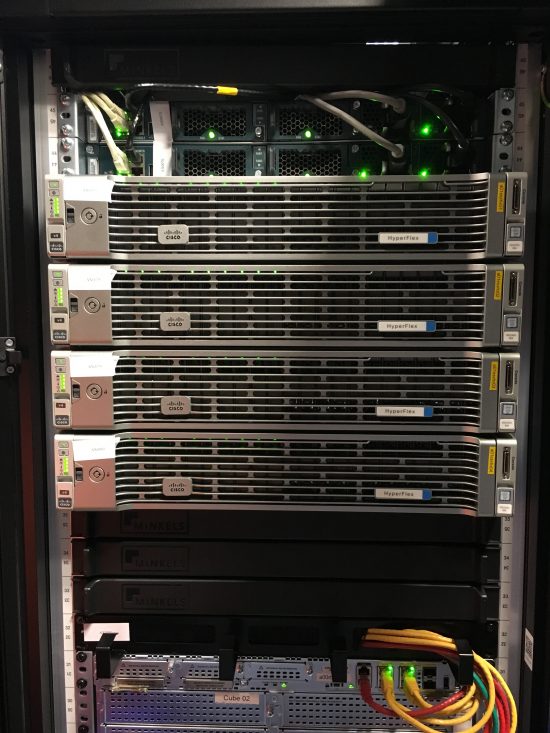
Marco contacted Cisco and learned about HyperFlex. The more he learned, the more he began to believe that this could be an ideal solution for their VDI compute issues, as Cisco HyperFlex is a Hyper Converged Infrastructure solution. Everything, including CPU, memory, network and storage is optimized in the software to work with each other. HyperFlex also uses the latest versions of the Intel CPU’s.

As a result of all these capabilities, Marco decided to purchase HyperFlex to scale their VDI desktop as a solution. He started integrating UCS blade servers with NetApp Storage and VMWare virtualization. He also extended Avit Cloud Connected Hotel with HyperFlex, in order to provide more capacity for their Desktop as a Service.

6 Ways HyperFlex enhances VDI Compute Power

The Big Reveal: New Avit VDI compute Power is easy to install and cheetah fast

“HyperFlex delivered 20% more compute power to VDI than was expected!” Marco declared. ”Our team was surprised by how easy HyperFlex was to integrate. We plan to add more nodes to the cluster for future growth and to add more nodes with NVIDIA cards to support graphics-intensive workloads such as AutoCAD. Obviously, we were extremely pleased and are now considering new lucrative business opportunities.”

Want to be the next Avit and take your Data Center to the next level? Have a look and  discover all the amazing things you can do with HyperFlex.

Authors

Richard Cashdan

No Longer with Cisco

Marketing

Avatar

What if you had a car with a powerful, turbo-charged engine that could fly along at 130 mph —until you turned on the air conditioner and watched the max speed drop to 50? Pick up two friends, and it struggles to maintain 30 mph.

This would be depressing for you as a driver, but it does make a good analogy for IT managers trying to leverage Internet Protocol Security (IPSec) for high speed link encryption requirements. In this approach, the routers’ throughput capabilities are restricted to the IPSec encryption engine limits, rather than using an encryption solution that can leverage the maximum aggregate throughput capabilities of the router.

diagram
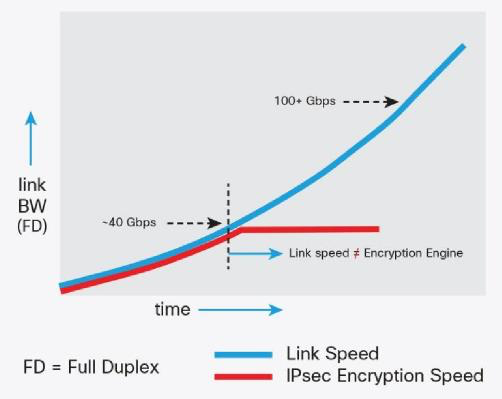
IPSec hits forwarding limitations well below what the router’s aggregate forwarding capabilities are capable of.

As is depicted in the diagram above, IPSec hits forwarding limitations well below what the router’s aggregate forwarding capabilities are capable of. This restriction basically removes IPSec as an option as the industry moves toward 25G, 40G and 100G, with 400G in the near future; smaller packet-size applications can drop this clipping point even lower.

These limitations, as well as customers needing 40/100GE link encryption, are precisely why Cisco re-introduced Media Access Control Security, or “MACSec” into its product lines for routers, data center and campus switches.

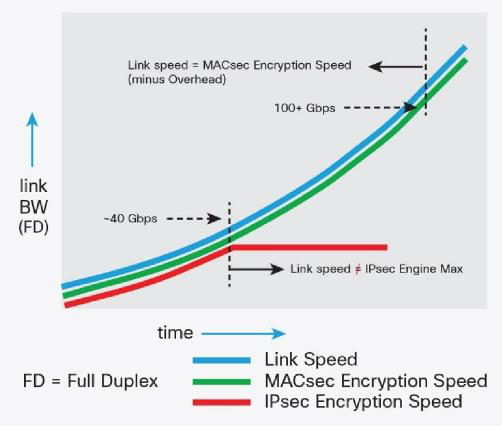
MACSec, in simple terms, provides data encryption at the Ethernet frame level, encrypting the IEEE Ethernet frame (on ingress to the wire), and de-encrypting off the wire, per-hop, and at line-rate. The real advantage for MACSec is that the encryption/de-encryption function is done at the PHY level of the router/switch, enabling the encryption rates to equal the link speed rates (minus very little encryption header overhead), as shown below.

diagram
With MACSec, encryption rates equal the link speed rates (minus a small amount of overhead).

On the other hand, IPSec is limited to an offload engine or chip, and is typically a fraction of the overall throughput capabilities of the router or switch.

For example, if a router has 200Gbps packet throughput capabilities, but the bi-directional IPSec encryption engine is 35Gbps, the real performance of the router with IPSec enabled is 35Gbps (assuming all traffic requires encryption). In the case of the same router with MACSec, if the forwarding engine of the router is 200Gb and the interfaces running MACSec are equal to the forwarding engine:

MACSec: Encrypted Throughput = Router Aggregate Throughput (e.g. 200Gbps)

You want your car to perform to its maximum capabilities, even when the air conditioner is running and you are carrying some passengers. The same applies to network encryption: You want to leverage the overall forwarding throughput of the router, regardless of whether encryption is enabled, regardless of the frame sizes being transferred. MACSec provides this capability.

While the benefits of MACSec are clear, it should be noted that designers should not consider it as a rival to IPSec. IPSec is still the dominant encryption solution in WAN designs, as well as SD-WAN moving forward. Rather, think of MACSec as another tool in the tool bag of design options when high-speed encryption is required, and Ethernet transport (or dark fiber) is an available option in the design.

Want to know more? My colleague Stephen Orr (@StephenMOrr) and I co-authored a white paper that probes much deeper into multiple areas around MACSec, its advantages, use cases, and how it can be leveraged in high-speed WAN designs for federal customers. You can download it here.

Authors

Craig Hill

Distinguished Systems Engineer

U.S. Public Sector, CTO Office

Avatar

The vulnerabilities were discovered by Nicolai Grødum of Cisco.

Today, Talos is releasing details of vulnerabilities discovered in Microsoft Edge browser as well as older versions of Google Chrome (CVE-2017-5033) and browsers based on the Webkit such as Apple Safari (CVE-2017-2419). An attacker may be able to exploit the vulnerabilities and bypass the Content Security Policy set by the server which may lead to disclosure of confidential information. Microsoft stated that this is by design and has declined to patch this issue.

Read More >>

Authors

Talos Group

Talos Security Intelligence & Research Group

Avatar

It is now safe to say that Cisco’s innovation engine is powering ahead on all six cylinders.

To our five long-time cylinders, called our “strategic innovation pillars” of build, buy, partner, invest, and co-develop, we have empowered a sixth – our employees. Not just product developers and engineers–all our employees.

We’ve experimented, learned, and rolled out an array of novel approaches to tap into each person’s own passion and bring it to life. New events, spaces, and programs the past few years have converged to help employees find their “inner innovator.” Today, we’re wittnessing unique solutions unleashed from a diverse pool of talent in all functions, geographies and grades.

It’s been thrilling to spearhead such innovation and see it thrive. I imagine it’s a little like those early 19th-century wildcatters at Spindletop. They took calculated risks to discover and drill into a rich vein, and then watched awestruck while geysers of opportunity gushed skyward and all around them. Of course, our relentless pursuit of innovation—21st century tech style–never rests.

New Cisco Innovator Award Program
One of Cisco’s latest programs adds yet another dimension to our overall innovation strategy. Set in motion at the start of this year, the Cisco Innovator Award program recognizes teams going above and beyond to turn an innovative idea into a reality that has made a tangible difference. These ideas are innovations that help to shape Cisco’s business or enhance customer results. Just like our multi-skilled workforce, these innovations can vary widely too, encompassing anything from improving internal processes and team building to creating incremental or leapfrog solutions for our customers.

The goal here is to recognize existing innovation journeys and their adventurers, as well as to promote learnings and attitudes leading to innovation. We ask all employees to submit stories that are transformational and inspirational, showing a team’s journey of novelty, ingenuity, and collaboration. The program is already a key contributor—a new cylinder–in our accelerated innovation engine.

Each quarter now, we recognize a Cisco Innovator Award team companywide and give them a $5,000 prize; our first two winners exemplify what we call our, “Attitudes of Innovation.” We spent a lot of time identifying these attitudes because we think these qualities are core to our company’s legacy of success. They distinguish who we are: Be Urgently Curious, Seek Context, Don’t Go it Alone, Empower and Support, Explore Diverse Perspectives, Celebrate Effective Failures, Iterate and Persist, Reward Action, Stay Ambitious, Create a Legacy of Value, and Discover and Engage.


Our first-year winners are:

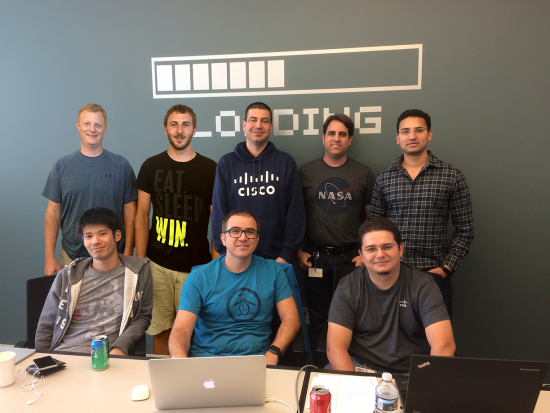
TraceLogger, last quarter’s prize winner, germinated their idea after engaging in another innovation catalyst—a Startup//Cisco workshop–more than a year ago on Lean Startup methodology. “While the idea I came to the workshop with didn’t pan out, I realized I could take the TraceLogger kernel and turn it into something real” leveraging collaboration technology, said Raees Shaikh, a founder of the eight-person TraceLogger team and technical leader in the Technical Assistance Center (TAC).

Raess and his team members from TAC incubated a new way to simplify and speed up troubleshooting responses to customers whose calls were inadvertently dropped for technical or other reasons. Today, customers often say that the TraceLogger log collection and management prototype “nailed the problem,” said Raees, with troubleshooting sometimes cut from days to minutes.
“When you feel motivated and passionate about your idea, it’s humbling to see how much people are willing to sacrifice,” added Ryan Ratliff, also a founder and technical leader with TAC, who emphasizes that people are the heart of any great idea. “We had people giving up their own resources to work on our project.”

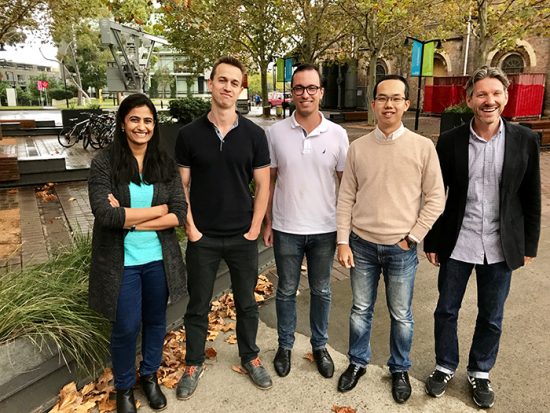
Smart Agriculture, the first-ever Cisco Innovator Award winner two quarters ago, found a new way to bridge the connectivity gap that exists on farms—especially in rural Australia where Wi-Fi is limited and digitized assets rarely exist. By brainstorming with experts and farmers, the five-person team based in Australia designed a platform using a low power wide area network, sensors, Meraki cameras and more to view a farm’s health.

The Smart Agriculture dashboard, which can be viewed on mobile devices, reports on such items as how much feed livestock need, crop yield predictions, gates that have been opened or closed, and adjustments needed to combat weather events. This helps farmers be more productive in less time—and make real-time decisions based on digitized, aggregated data. They hope to scale their prototype to other industries and geographies.

“We didn’t wait for process or a lot of approval,” said Shwetha Srinivasan, a team founder. “If a certain product line wasn’t available at Cisco, we used an open source alternative or looked to third parties. We aligned with the attitude of being urgently curious, which also meant to us keeping things moving.”

The Cisco Innovator Award is so much more than another recognition and reward program. We firmly believe that Attitude + Innovation = Success, and our award criteria help to reinforce and reflect our core values throughout the workforce. Now, after just six months, this program has emerged as a critical component of an overall innovation strategy to disrupt our entire culture and cultivate those next big game-changers. We know innovation can come from anyone, anywhere. That’s why we ignite it from different angles.

But it all starts with our company’s foundational People Deal, which is a manifesto of 11 “Moments that Matter” between employer and employee. One of those critical elements, “My Innovation,” empowers “all of us to look for better ways to get things done or create new solutions at the speed of a start-up.”

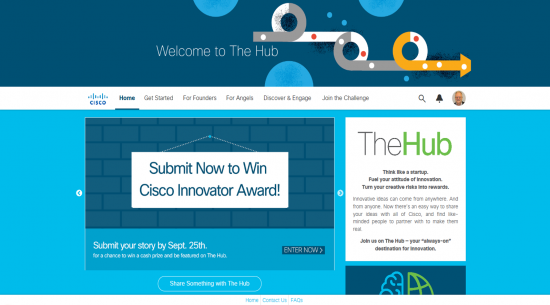
On top of that we have built The Hub, an “always-on” online gateway for each employee to engage in our expanding universe of innovation events, spaces and programs. The Cisco Innovation Award program is just one of many examples I will highlight from time to time.
There’s never been a better time to innovate. That’s because there’s never been a better time to embrace new approaches that help to drill, discover and co-develop innovation all around us.


Meanwhile, if you have questions, get stuck, or need an innovation therapist, don’t hesitate to contact me:

Email
Twitter
LinkedIn


Authors

Alex Goryachev

Senior Director, Innovation Strategy & Programs

Corporate Strategic Innovation Group

Avatar

Cisco is pleased to announce that the Cisco Milan Innovation Center (MIC) located in Vimercate, Italy has joined the GSMA Open IoT Lab initiative. The MIC is one of Cisco’s centers of innovation and technical expertise for Cisco’s mobility network solutions for Service Providers. These solutions include Cisco Ultra Services Platform – a market-leading a multi-access, virtualized mobile core – as well as various functions of the Evolved Packet Core for 3G and LTE.

Most recently, the Cisco MIC has enhanced its resources to support Cisco Ultra IoT, which expands the capabilities of Cisco Ultra Services Platform to support and be fully compliant with the 3GPP Mobile IoT architecture, including support for licensed LPWA network access (i.e., LTE-M and NB-IoT). This allows Operators to provide connectivity for IoT devices requiring low power consumption, long range, low cost and security. Cisco Ultra IoT, introduced at MWC 2017 and now in trials with several Mobile Operators, evolves the Cisco Ultra Services Platform to offer new capabilities for IoT including:

  • Cisco Serving Gateway Node (CSGN), which terminates Mobile IoT access with uniform identity, authentication, and security, with deployment flexibility and dynamic scalability that leverages Cisco leadership in Network Function Virtualization (NFV).
  • Cisco enhanced Service Capability Exposure Function (eSCEF), which includes standardized APIs to expose network capabilities to applications for new Operator monetization opportunities.

The GSMA’s Internet of Things program launched the Mobile IoT initiative to encourage the development of Mobile IoT deployments around the world. It also created the GSMA Mobile IoT Open Lab Map as a resource that provides information on the location and capabilities of Open Labs in any particular region.

As a member of the GSMA Open IoT Lab program, the Cisco MIC provides lab access and services to IoT service providers, component and device manufacturers, and application partners to trial and develop new Mobile IoT devices and services. The MIC is able to arrange and host interoperability testing, demonstrations, Proof of Concept, and more.

To find out more about the Cisco Milan Innovation Center (MIC), please contact: admin@mic-ebc.eu

Authors

Brian Walsh

Senior Marketing Manager