Avatar

Before I discovered electrical engineering, I wanted to be a teacher. I have always loved learning, so naturally I want to help others learn. For me, the most exciting part is the first time I have a light-bulb moment and real understanding of a concept begins. Consequently, seeing that same initial wave of comprehension wash over kids drives me to stay involved with STEM (science, technology, engineering, and math) education year-round.

Luckily, Cisco is great about giving us the ability to combine our passions with our work life, and I have opportunity to serve as both a security researcher and an educator while working with some amazing people along the way!

How? Recently, I volunteered with a few of Cisco’s Employee Resource Organizations (EROs), cross-functional employee groups. It’s important to note that any employee is welcome to join any ERO as an ally to show support for one another. These EROs have directly helped me turn colleagues into friends and touch more communities than I ever thought possible. Thanks to the many hours required to develop STEM workshops, I’ve built close network of colleagues across the company who are also dedicated to diversity, technology, and education. But time really flies when you’re having fun!

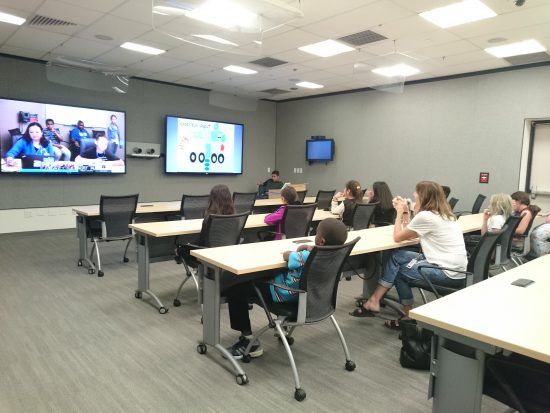
As part of Conexión, the Latino employee community, I assisted with Program Escuela which aims to inspire youth to seek higher education and careers in technology. Here in Austin, Cisco employees connected with 25 elementary school students who worked in groups to design and present the classroom of the future.  It was both exciting and impressive to view the future through these 4th and 5th grade minds as we judged their presentations. The students dreamt of robots that served custom lunches in the cafeteria, grammar-checking pens, and Internet-enabled trackers for their own safety. I’m proud to say that I was not the harshest judge on the panel! After we selected the strongest presentations, we invited the students to exchange ideas with their Program Escuela peers in Richardson, Texas via TelePresence.
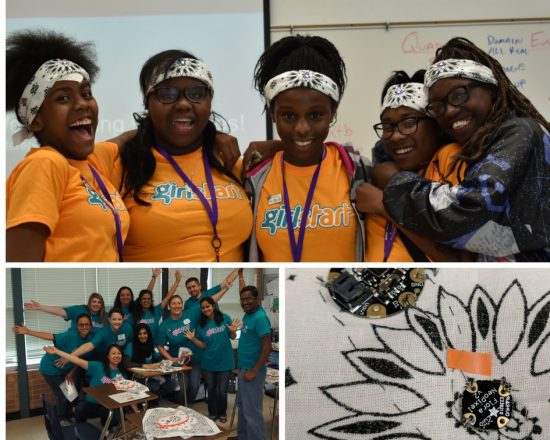
The Austin Connected Women chapter stays busy with several annual traditions each year. We are a recurring sponsor of Girlstart’s Girls in STEM Conference, a 1-day conference designed to increase middle school girls’ interest and engagement in STEM fields. Our group of techies designed an electronic wearables workshop to make circuits fun and less intimidating for middle school girls. With our help, 60 students programmed a small microcontroller and LED circuit then sewed it to a bandana using conductive thread. Each girl took home her customized LED bandana to wear as a headband, scarf, or even bracelet.
School was in recess by June, but Connected Women members Alicia Valerio, Sadaf Syed, Ellie Daw, and myself had not run out of steam yet. We had so much fun at GenCyber summer camp last year, we decided to return to the California State University, San Bernardino (CSUSB) campus, but this time to teach! Dr. Tony Coulson and CSUSB expanded the all-girls cybersecurity camp to two weeks, with 200 middle school participants the first week and 50 high school participants the second.
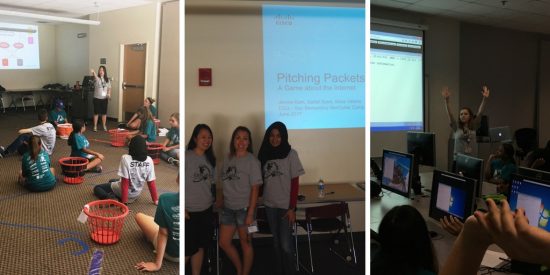
Alicia, Sadaf, and myself took turns leading our Pitchin’ Packets game until all 200 middle school girls had the chance to play. The game uses beanbags, buckets, and students to represent the components of a network such as Internet traffic, routers, and endpoints. Although the game play seemed chaotic for the adults and fun for the kids, the girls actually gained an understanding of complex cybersecurity concepts. Most importantly, we demonstrated how any router between the endpoints could read and/or make a copy of the data it passed through. This really drove home the critical lesson that nothing is truly private on the Internet, which we could see really surprised some of the younger generation. Ellie continued our mission the following week, mentoring the 50 high school girls and providing them with an introduction to cryptography.

35 Cisco volunteer peers. 3 STEM educational outreach events. 2 EROs. Nearly 300 students reached. Countless hours of fun and laughs. I’ve had a blast collaborating with my fellow Cisconians on all these STEM events, and the year is only half over!

The month of September Cisco is celebrating Global Service Month! How are YOU giving back? Tell us in the comments below!


Want to join a company that gives back? We’re hiring!


Authors

Jennie Kam

Security Researcher

Security and Trust Organization

Avatar

This post originally appeared on Triple Pundit.

This is the third article in a five-part series on how a company or organization can develop, implement, and sustain successful public-private partnerships (PPP) that achieve large-scale impact. Click to read part one on determining who to work with, part two on determining when and how long to engage, and stay tuned for next week’s post on how to ensure long-term sustainability.

Have a question or comment? Tweet at @CiscoCSR and be sure to join us September 21, from 10-11am PT, for a #CiscoChat with PPP thought-leaders Laura Quintana, Vice President, Corporate Affairs at Cisco; Sasha Kapadia, Director, International Development at Mastercard; and Keith Davis, President & CEO of the Camden Dream Center.


How does a company or organization develop and sustain successful public-private partnerships to achieve large-scale impact?

Determine how to execute: The partnership must develop a clear vision, differentiated strategy, and detailed execution plan to drive long-term success. This includes defining outcomes for the PPP that are informed through stakeholder input, establishing an effective governance structure with clearly defined and transparent operating practices, and agreeing upon roles and accountabilities in advance.

In our partnerships we’ve found it helpful to identify and fund a program management lead who is solely responsible for successful program execution. Successful PPPs have both a defined business model (eg. “build, operate, own” like Cisco’s Networking Academy model, or “invest, transfer” like our Community Knowledge Centers (CKCs) model) and a defined solutions model that considers key risks, scalability, replicability, and long-term sustainability.

Developing an exit or transition strategy is also a critical component of early discussions to ensure clear expectations from all parties. Even the best planned partnerships can be disrupted by technology transitions, government changes, or serious funding challenges, making the development of multiple exit or transition strategies necessary.

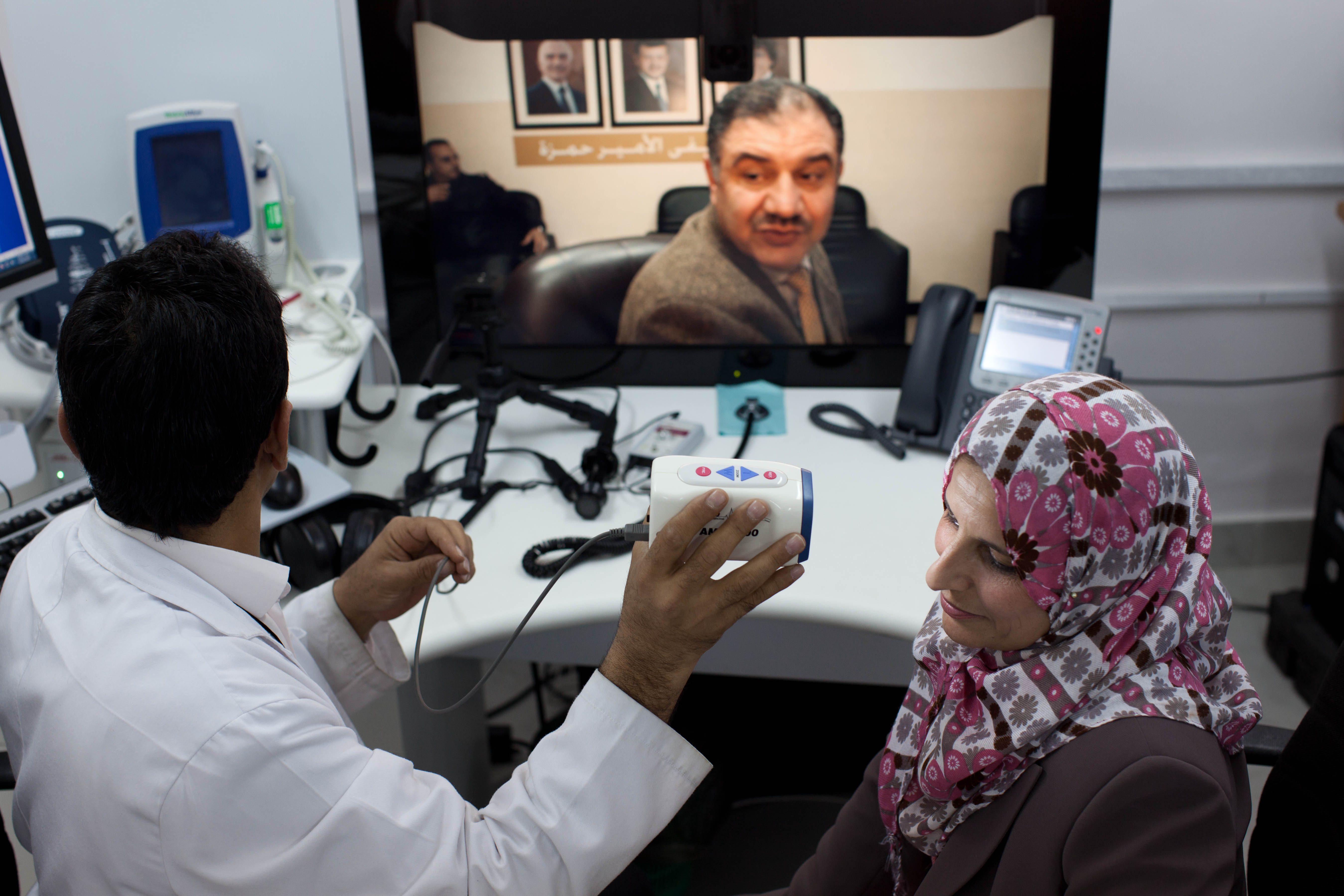
At a care-at-a-distance clinic network-connected medical devices route patient information from the clinic to a partnering hospital. Participants see and speak to one another from distant settings as if they are face-to-face.

The Jordan Healthcare Initiative (JHI) was a strategic collaboration between Cisco and the government of Jordan with a vision to improve the efficiency of and access to quality healthcare services for people in Jordan, particularly those living in rural and/or underserved areas.

Four JHI projects were clearly defined and implemented in collaboration with multiple partners, including the Jordan Ministry of Health, Jordan Ministry of ICT, and the Royal Medical Services, who each had a defined role. By collaborating closely with the Jordanian government through JHI, Cisco provided our expertise in networking, security, and collaboration technologies to enable telehealth solutions, and established our credentials as a good corporate citizen and reliable business partner.

The journey to the Jordanian capital of Amman is a daunting one for rural patients who require specialty medical care. They must leave the familiar behind to travel hundreds of kilometers to a hospital where they wait in long lines for a consultation.

In 2012, Haifa Abd-El Karim Omoush, a 34-year-old married woman with five children pictured above, was suffering from a treatable cardiac condition. Her local physician referred her to a specialist in Amman, but she missed or postponed her appointments because she had no one to care for her children and could not afford to travel to the hospital.

When Haifa learned about a new care-at-a-distance clinic in her own community, she was able to connect with a cardiac specialist in Amman, who immediately diagnosed her and adjusted her treatment plan. The care-at-a-distance clinic helped Haifa’s condition improve and this gave her more time and energy to spend caring for her family.

Connecting urban specialists with rural patients and physicians via technology extends the reach of providers, increases access to healthcare, reduces costs, and empowers patients. Through JHI, our support and solutions enabled the delivery of affordable, quality healthcare services to remote and underserved communities, contributing to the Jordanian government’s goal of improving quality of life for its people and its communities. JHI contributed to the transformation of healthcare delivery in Jordan; and from 2011 to 2015, over 176,000 patients benefited from the initiative.

The telehealth technology solution is still in use at the care-at-a-distance clinic at Al-Mafraq Government Hospital where Haifa received care. Prince Hamzah Hospital in Amman is currently connecting daily with Al-Mafraq Government Hospital and Queen Rania Hospital, a rural hospital in southern Jordan, with an average of 25-30 cardio, dermatology, and nephrology consultations a week.

Blog #2
Blog #4


Has your organization had success in determining how to execute public-private partnerships? Leave us a comment below, tweet at @CiscoCSR and stay tuned for next week’s PPP post on how to ensure long-term sustainability.

Authors

Laura Quintana

No Longer at Cisco

Avatar

IBC is here again. And so just before all the noise begins, perhaps it’s a good time to take a step back and look at where the pay video industry, and service providers in particular, are going.

So let’s get one thing clear; video is still the king of entertainment. Yes, the industry is changing, it always has.
But video is not following the same path as the music industry where content has become devalued.

Video has its own journey.

The video pie is growing. Certainly in quantity, but also in quality. Premium video is being created at a higher rate than ever before.

In fact, the quantity of scripted original series has almost doubled in the last five years. Not only that, but your average US adult now watches almost 6.5 hours of video a day (seriously, don’t they have a life?). More and more money is being poured into video production and consumers are willing to pay good money to lap it all up.

The opportunity that pay video represents is getting bigger. So it’s all about how to grab a piece of that pie.

Looking at the glass half empty, it’s tempting to say that service providers are getting less and less from this growing video pie. They are now challenged by newcomers, both direct competition from their region and also global players. Add to that growing piracy, growing content costs, direct distribution from media companies and you end up with churn rates that are rising sky high and challenging business.

While this challenge is not news to you, the question often remains “Where should I set my sights for my video business and who should I trust to take me there?”

At Cisco, our strategic investment in video has enabled us to chart a new path for the cloud video business. One that sees the glass half full.

We call it ‘Infinite Video Platform’.

At the upcoming IBC show, we’ll be showing how you can revolutionize the video experience to attract more subscribers, monetize content to get a bigger slice of the revenue pie, and streamline your operations to deliver more content for less expense. You can also discover the advances we are making in analytics and 5G mobile and obviously video quality, a key differentiator for SPs.

Above all, nothing matters more than results. You’ll have the opportunity to learn first-hand from other service providers how they evolved their business with Infinite Video Platform.

Join us at IBC at stand 1.A71 and help yourself to a glass that’s more than half-full.

Authors

Yaron Agami

Senior Manager

SP Product Marketing, Cable and Satellite Segments

Avatar

Cisco and Intel vRAN with MEC Proof of Concept

The mobile wireless industry is undergoing tremendous transformation with 5G. This enables companies to not only create new content, but also devise innovative means of delivering that content. Some of these new realities require changing the way we envision the network architecture – from centralized to disaggregated and from fixed function to open systems. Cisco and Intel have been working together to build better solutions across many business verticals. Most recently, Cisco and Intel collaborated to enable latency-sensitive services while improving quality of experiences at lower costs This has resulted in a successful proof of concept demonstrating virtualized radio access network (vRAN) with mobile edge computing (MEC) running on the same server supporting a latency-sensitive application (augmented reality).

Why are we doing this?

The radio access network (RAN) is a necessary, but expensive segment of the operator network. Today’s RAN tend to be proprietary, closed systems. Introducing a virtualized, open radio access network provides new flexibility, and scalability, while reducing the total cost of ownership (estimated at 20% – 30% by the vRAN industry).

Cisco VNI projects mobile video will make up 78% of mobile data traffic by 2021. Localizing video caching can improve the quality of experience (QoE) while reducing costs. In addition, mobile edge computing (MEC) can support new 5G services that require low latency. These new services can include:

  • Augment reality/virtual reality
  • IoT
  • Public-safety
  • Industry-critical services (robotics)
  • Mission-critical (healthcare)

What did we do?

We got “Edgy” in a 5G way. This is a multi-vendor proof of concept pairing a 4G/5G disaggregated open radio solution with a distributed virtualized packet core ready for 5G services. We used Intel’s FlexRAN reference architecture software. FlexRAN is capable of front-hauling between remote radio heads and the virtualized base station (eNodeB and gNodeB) over fiber (CPRI) and Gigabit Ethernet. Cisco’s Ultra Services Platform is used for the edge computing. This cloud-native solution leverages the SDN function of control/user plane separation (CUPS), we position the packet core user plane and services functions with the VRAN. The packet core control plane and policy functions are hosted in a cloud. There are unique advantages of using the disaggregated-virtualized packet core for edge computing. Tight integration of the packet core control plane and the edge compute/caching functions provides policy, mobile anchoring, charging, lawful intercept and authentication capabilities to services running at the edge. Intel’s consistent advancements in processor technology enables Intel’s FlexRAN and Cisco Ultra Services Platform to share a single Cisco UCS server – offering enhanced efficiency.

Ultra Services Platform is the industry leading fully-virtualized, distributed packet core services platform, Cisco Ultra has over 35 fully commercial deployments carrying over 150 million subscribers. This is a subset of the over 1 billion subscribers on all Cisco packet core solutions.

What are the benefits to the mobile operator?

VRAN and smarter edge computing can:

  • Reduce RAN expenses
  • Flexible radio platform
  • Enter new market opportunities
  • Latency-sensitive apps
  • Pay-as-you-grow model
  • Reduced network traffic
  • Improves customer satisfaction

We invite you to see the video of this proof of concept demonstration for yourself at Mobile World Congress-Americas in San Francisco, September 12-14th. Simply ask you Cisco account team to schedule a meeting with the 5G experts at the event.

Authors

Dan Kurschner

Marketing Manager, Product/Systems

Avatar

What is data science? Is it just another buzz word for applied statistics? Some statisticians certainly think so. I believe data science is much more than that. Think transformation. Think about how connecting theory to actual data can enable better business decision-making that directly impacts company growth. Transformative, indeed!

The time is now, (really, it was yesterday) to apply modern data science theory to real-world business applications. And I am not talking about an application illustrating a new methodology published in an academic journal. Real use cases grounded in how businesses are churning raw data to turn a profit already exist and are delivering millions of dollars in cost savings as well as driving up revenue. This bottom-line impact is what defines data science.

Real World Experience

Knowing your customers is important, everyone knows that.  Data Science transforms how we identify, personalize, and curate goods and services to meet individual customer needs. Data Science is also an art that can turn a bolt of fabric into a fashionista’s dream. Check out how Stich Fix does just that by delivering a tech-driven, personalization ecosystem that fine-tunes the buying experience the more a consumer uses it. Some may think of Stitch Fix as a fashion portal, but really it is a data science company that helps you find the fashions that you love by tracking your personal preferences. While using the service you visually experience the machine learning in practice. Customers love it and the business impact is obvious: in five years they’ve become nearly a $4 billion company.

As a Professor in Residence @ Cisco, I guide teams in developing and executing new processes to enable an elegant, simplified, automated purchasing experience that relies on continuous innovation to meet customer demands and, in turn, increases bottom-line results. Powerful stuff; and it is transforming how Cisco does business.

Understanding the Customer’s Customer

Cisco collects copious amounts of data every day, but collecting data is no longer enough. The value of this information is a gold mine that data science can transform into actionable solutions. Data Science teams at Cisco are building models that foresee potential delivery delays and this data informs salespeople to take action before delays even happen; thus improving customers’ experience by discovering the user journey. Data science allows us to explore customers’ actions, not only the customer perception of their experience. In the case of Stitch Fix, their simple, convenient and intuitive digital interface allows customers to rate purchases and provide instant feedback to make the next shopping experience even more tailored to their likes. All of this is transforming the way data are consumed which allows companies like Cisco and Stitch Fix to leap ahead of the market and explore new horizons.

In September, Cisco is hosting its Third Data Symposium. It is an internal, widely attended event designed to spur critical, innovative thinking that delivers intuitive outcomes to business challenges. There will be something for everyone as topics range from Blockchain, Artificial Intelligence, to predictive analytics and data security. This event embodies the essence of data science: exploring how transformative change through data enables businesses to deliver a personal, qualitative experience to customers that engenders loyalty. And loyalty my friends, turns into revenue. Who doesn’t like that?

Authors

Inga Maslova

Professor in Residence

Enterprise Data Science

Avatar

Talos has discovered two remote code execution vulnerabilities in the the FreeXL library. FreeXL is an open source C library to extract valid data from within an Excel (.xls) spreadsheet. Exploiting these vulnerabilities can potentially allow an attacker to execute arbitrary code on the victim’s machine. If an attacker builds a specially crafted XLS (Excel) file and the victim opens it with an application using the FreeXL library, the attackers code will be executed with the privileges of the local user.
Read More>>

Authors

Talos Group

Talos Security Intelligence & Research Group

Avatar

Ymasumac Marañón Davis is an educational consultant, intuitive life coach and author. This blog is the second in a series around access. All thoughts are her own. 

Recently, a local school asked me to assess their climate in preparation for implementing new professional development methods that would have profound impact on the pedagogy they employ.

I walked the campus, spent time with teachers, observed lessons and students, and most importantly, listened to the language being used. What were the word choices of the adults? What beliefs did it convey about learning and, more importantly, the students they were serving?

It was apparent love was present and there was little hostility between teachers and students. That is, until the lesson on social media came up, and then the tone shifted. Teachers were condescending toward students for how they used social media. The adults chided the students for not knowing how to communicate anymore and for being attached to their devices. Conversation stopped and communication turned one-way as teachers became the dominant voice in the classroom and students sat silently, taking in the obviously biased view of them as incompetent in communication.

Technology is the perfect amplifier. One that has uncovered many voices. The voices of our deepest fears and thoughts have now been exposed. These sentiments have always existed, just under the surface. Technology is changing this and bringing up opportunities for difficult conversations. Stepping up to this opportunity will create profound shifts in our society; doing this globally is a challenge.

Education is no exception to this shift in culture. Schools are shapers of culture, and in an ever advancing civilization, this shift is both profound and deeply challenging. Schools not only react to the cultural shifts happening around them, but actively drive the culture forward.

In an attempt to embrace the profound shifts happening in society, educators far and wide have made technology one of the central pillars in learning. This also inadvertently brings in all the issues with which society is trying to grapple by amplifying these voices in the classroom. This, in turn, brings up the issue of access and voice. Who gets access to technology and whose voices are heard? The discussion on access is broad and long with many players and entry points. In this article, my focus will be on providing access through a lens of equity. How do we address access with equity in mind?

Addressing access requires a two-pronged approach focused on technical and cultural change. Both of these require a new mindset where we question our preconceived notions, adapt our perceptions, and reexamine our biases.

Questions we need to ask ourselves: When we work with students who are low income, do we see their lack of resources as a deficit and their families unable to provide for them? When we work with diverse ethnicities, how do subconscious biases show up in our expectation of student learning and behavior? How do our perceptions of different student groups get in the way of serving our students equitably? Are our assumptions of their use of devices congruent with our biases?

Do we draw unfair conclusions about students of a particular socioeconomic status or ethnicity or family structure — and do these conclusions impede our ability to act fairly and effectively to increase access?

For those of us in education, checking our perceptions is key; we hold the lives of children in our hands. Often, in working with districts, I am told that the population they serve is low income, and therefore there is no way they can afford to buy their students devices or get high-speed internet connectivity. Again, perceptions drive behavior and decision making.

I come from a strong communal immigrant background on my father’s side of the family. I remember that when one of my cousins needed something for school my aunt would call my father, who would then call my uncle, and so on until all the adults had been consulted and it was agreed who would contribute what. Whatever it was that my cousin needed, it was purchased by everyone. Surely, my family was below the poverty line, but it didn’t matter. Education was a priority, and when any of us needed something, the family (and community) would come together. While my family was perceived as unable to pay for educational materials, they found a way, because they understood the urgency and the need for these materials. Had the school invited my family to the decision making table about materials students needed and why they needed them, they would find that low income families are more than willing to step up to the opportunity to participate and support schools in the decision making process. We continue to miss these opportunities in education because of our perceptions and biases.   

Often, in education, we solve problems through the dominant culture of our schools. In the United States, this is predominantly a white, middle-class lens. But when applied to situations where communities solve problems differently, that lens may give a distorted picture. What looks like a below-the-poverty-line income in one family actually is not when all family members ally forces, as mine did. Every community is unique and it’s important to make sure we check our perceptions at the door and include community members in the decision-making process.

We cannot afford to miss these opportunities for empowering student voices and their families in schools. We must learn to have brave conversations about race, gender, income disparities and the false perceptions we carry about each other. Where else should we have these conversations but in our schools where learning is core to its existence?  

Creating equity in access isn’t monetary; at its core, it’s a belief.

Want to hear more from Ymasumac? Read the full post on her blog, then follow her on Twitter, and visit her website, Limitless Learning Lab.


Authors

Ymasumac Marañón Davis

Educational Consultant

Avatar

Everybody knows that modernizing legacy systems brings better security along with all of the other improvements in power and efficiency. It seems, however, that despite what everybody knows, a large number of federal IT leaders don’t believe it.

A recent survey showed that 59 percent of respondents think that their modernization efforts have left them less secure than before. Another 38 percent, however, listed enhanced security as the number one advantage of modernization.

Analysts quoted here suggest that the level of mistrust — and the opposite view taken by a large minority — shows that modernization is a double-edged sword, bringing increased complexity and staffing challenges along with its advantages.

The fear isn’t entirely unjustified. Modernization usually includes connecting more systems to networks than ever before, including objects that are part of the Internet of Things. As a result, the attack surface available to malefactors increases.

Another potential cause: Modernization is complex and agencies often have to work with two sets of systems — the old and the new — during the transition, said Tony Sager, senior vice president at the Center for Internet Security, quoted in FCW.

However, cyber defense measures are up to the challenge. Cisco offers tools that detect malware in encrypted traffic, that turn the entire network into a security sensor and that provide powerful forensics tools for analysis of vulnerabilities.

With the advent of Cisco’s new intent-based network, the cybersecurity tools provide a formidable defense against anything attackers might throw against an agency.

With the new network, Cisco switches, routers, and wireless solutions powered by Cisco Digital Network Architecture are always learning and adapting. This brings a new layer of sophistication to Cisco’s already powerful array of cybersecurity tools. From access control to next-generation firewall to email encryption, Cisco can provide all the protection you need to safely embark on IT modernization.

Here are a few ways Cisco cybersecurity solutions can ease an agency IT leader’s mind:

Woman in front of computer monitors.
Modernize IT in confidence with Cisco cybersecurity solutions.

Stealthwatch with NetFlow and Encrypted Traffic Analytics: Gain Cisco visibility across the network, including the data center, the cloud and branch offices to uncover sealthy attacks. Stealthwatch turns your whole network into a security sensor and policy enforcer. The newly available Encrypted Traffic Analytics can spot malware in encrypted traffic with no decryption needed.

Advanced Malware Protection: Real-time malware blocking, global threat intelligence, advanced sandboxing and continuous monitoring of the extended network keep malicious code out.

Identity Services Engine: ISE is a robust access control solution that controls who can access your network, what features they can use and show you at glance which people and devices are logged in. ISE can even prevent ransomware from taking effect in your network.

These are just a few of the capabilities that modernization can enable you to use in strengthening your protection against threats. There’s a lot more. See all of our cybersecurity solutions here.

Authors

Michael Hardy

US Federal SME

Cisco Americas Public Sector

Avatar

You know them, you love them…Cisco UCS just released their brand new fifth generation servers. Well, I shouldn’t even call them servers, it’s really an entire system when we’re talking about UCS. We at TechWise can’t get enough of them. We had experts Arvie Martin and Jim Leach on to tell us all about what’s new.

If you’d like to hear the full workshop click HERE.

We got an awesome 3D look at the new B and C Series. As always, we have a show corresponding to this launch too, which you can check out here (even if you don’t, that picture makes it worth it):

Since in the workshop and the show we’re really “reintroducing” UCS, I wanted to talk a little bit about why I fell in love with UCS servers…even before I came to work at Cisco. Admittedly, the first time I looked at the UCS Manager I felt a bit overwhelmed. But it was one of those things where if you just used it a few times it got to be like second nature, and then you were able to realize the full power of it. In fact, I wrote several blogs about it a few years ago. I was just amazed at how you could a.) fit all of that bandwidth and compute into such a small footprint when working with the blades and b.) how a whole compute system could be stateless until you assign it a “personality.”

Of course, by “personality” I really mean Service Profile. The service profile allowed you to work above the physical layer. If I wanted to assign 4 HBAs to a server, I could do that, if I wanted it to have 8 NICs…I could do that too. More importantly, if I was going to a customer site who had a hardware failure, I could pop in another UCS server, assign it the right profile and they were off and running again (as long as they were using boot from SAN correctly…another story for another time). AND this worked for both the rackmounts and the blades if they were both being managed by UCSM.

The CIMC also made it really easy to set up, and as a channel partner at the time, that made me happy. Cisco wasn’t the first or only company to have this kind of remote management console, but it was really easy to use and I didn’t have to manage extra licensing to use it.

If you are new to UCS, definitely watch the TechWiseTV show I have embedded above because we do start with a Primer that will help you understand how the system works. Then for a deeper dive and a look at the new UCS M5s listen to the workshop, because these guys do a great job explaining it!

To see all of the questions that were asked during the live workshop just click HERE, but here are a few to get you started:

Q. Can we touch upon the characteristics and use cases for the Cisco Unified Computing System (UCS)
trusted platform module (TPM) for M5? I am looking for reasons to argue against using SkyPort as a
Trusted System core with a non-VMware virtualization schema.
A. Skyport does use Intel TPM in their SkySecure server. TPM 2.0 on Cisco UCS provides Intel TXT (Trusted
Execution Technology) w here you can secure server by encrypting on TPM.

Q. Is the Supermicro SATA DOM drive available and supported?
A. No, w e are not planning to support the Supermicro SATA DOM. They w ere mainly used for read centric use
cases. M.2 storage is much better for that and it supports the Serial Advanced Technology Attachment (SATA),
serial-attached SCSI (SAS) and nonvolatile memory express (NVMe). All M5 servers support 2 M.2 slots.

Q. Can the Cisco UCS C480 M5 Rack Server be configured with only 2 CPU?
A. Yes, you can buy single server node (2 CPU) or Dual server node (4 CPU). There w ill be limitations on the
number of PCIe slots supported w ith only 2 CPUs.

Q. Do all the Cisco UCS M5 servers require an upgrade to UCS Manager 3.2?
A. As this is a new architecture all Cisco UCS M5 servers need UCS Manager 3.2 to support.

Q. Will all the current Cisco UCS M5 boards be usable with 3D XPoint or will a new motherboard be
required?
A. No, Cisco UCS M5 servers are pre-enabled for 3D XPoint w hen Intel starts supporting it.

Q. Is the Cisco UCS M series required when total RAM is over 768 MB or can each proc address 768 MB?
Can I use a Cisco UCS B480 M5 Blade Server with 4 proc and get 3TB of RAM without requiring the M
series?
A. Yes. Only the Intel CPUs that end in M support 1.5TB. You can have sockets and 3TB