Avatar

Networkers have been building labs with networking gear for decades. Every one of us who has built their home lab has had to go through some learning curve of researching various product families, models, operating system versions, and product features supported by various hardware and software combinations. But building a home lab has often been worth the time and effort, because with that lab, we could learn more about networking at home, to get that next job, or a better job, or to pass some certification exam.

Now think about a networker’s home lab, but with the need to learn about network programmability. We thought about it as well, and created some new DevNet Learning Labs to give you some ideas and tips about your home lab.  The Learning Labs all relate in some way to answering this question:

What should an engineer add in their home lab to make it a good learning environment for learning about network programmability?

This blog post introduces a new DevNet Learning Track: “Building Your Home Networking Lab for Network Programmability”. You can read on for more details, or just watch the video version below:

New Learning Track: Building Your Home Networking Lab for Network Programmability
On the small chance you’ve not seen any DevNet Learning Labs yet, the DevNet site gives us an organized approach to using all their free DevNet Learning Labs. That approach uses the concept of a Learning Track, which lists related Learning Labs with a recommended order. To further group the lab, many Learning Tracks have Learning Modules, which are subsets of the labs within the Learning Track, just to group Learning Labs together. Then there are the Learning Labs themselves, each of which is a scripted lab exercise like what you might expect to do in a course. This figure shows the organizational concept.

We’ve created a new DevNet Learning Track called “Building Your Home Lab for Network Programmability”, with two Learning Modules planned so far. The first module focuses on APIC-EM, while the second focuses on getting your desktop PC and network devices ready for NetConf/YANG and Ansible experiments.

As for timing, the first two (of three) labs in Learning Module 1 should be posted about the same time as this blog post, just before Cisco Live US for 2017 (June 2017). Go ahead and jump in, or read a little more about what’s in the rest of the series!

Learning Module on Setting up APIC-EM in Your Home Lab
The first Learning Module focuses on APIC-EM. Why APIC-EM? Many reasons. Just to mention a few, it’s a great tool for learning about network programmability for anyone, especially for networkers who already understand a variety of Cisco networking devices. And the software is free! However, the decision to use in your home lab, or not, requires some thought and some planning. For instance, you need a lab with networking devices that are working models with specific operating system versions so that APIC-EM’s apps will work.

In short, APIC-EM can be very useful in your home lab, but it requires some thought from a couple of different directions. Hopefully the Learning Labs (listed in the next figure) will help you work through that decision making and planning.

Adding APIC-EM to your Home lab:
https://learninglabs.cisco.com/modules/home-network-lab/add-apic-home/step/1

APIC-EM Home Lab Hardware Platform lab:
https://learninglabs.cisco.com/modules/home-network-lab/home-setup/step/1

As for the individual Learning Labs, the first two have a similar theme. However, the first lab examines three separate major points, while the second lab stays focused on a single major point. For this first Learning Lab, the main topics are:

  1. The decision of whether to use APIC-EM at home or not
  2. APIC-EM software options and licenses
  3. Networking hardware/software required to make APIC-EM useful at home

The second Learning Lab then discusses the single biggest barrier to adding APIC-EM at home: The server hardware you need to run APIC-EM. This lab looks at the requirements, how much server capacity you really need, and some options to keep the price to something affordable for your budget.

Finally, the third Learning Lab in this first module, planned for release by the end of July this year, examines some key installation questions that impact your home lab, as well as advice about how to get the APIC-EM discovery process to work. We designed this Learning Lab to get you up and working quickly once you decide to move forward with adding APIC-EM in your home lab, covering topics that you do not typically need to worry about in other DevNet Learning Labs or in the Devnet Sandboxes.

Learning Module 2: Setting up PC and Network Devices
The second Learning Module in this new Learning Track focuses on the environment on your desktop or laptop PC at home, plus the networking devices you will configure and control with your network programmability experiments. By the end of each lab, if you follow the steps on hardware/software that meets the requirements for each feature, you should be ready to begin your experiments using Python, several other desktop tools, along with NETCONF/YANG and Ansible.

We expect to have the labs in this second module complete and posted within a few more months after wrapping the Learning Labs in the first Learning Module. Stay tuned for those!

Start Now – No Lab Required!
All the labs in the first Learning Module allow you to do your thinking and planning for APIC-EM, without needing to already own a server or own any networking devices that work with APIC-EM. Go ahead and jump in and start when ready! When need about 20-25 minutes to work through each lab, with some additional time required if you want to dig into a complete analysis of your own home lab. But the Learning Labs should point you in the direction to go for that analysis.

Keep an eye out for more Learning Labs in this Learning Track. You can watch for them here, or follow me on Twitter – I’ll definitely chat about each Learning Lab when they release. And given that this blog post is planned just before Cisco Live US 2017, if you’re there, look for me at the show – I’ll be at the DevNet Zone part of the show for sure!


We’d love to hear what you think. Ask a question or leave a comment below.
And stay connected with Cisco DevNet on social!

Twitter @CiscoDevNet | Facebook | LinkedIn

Visit the new Developer Video Channel

Authors

Wendell Odom

Founder, Certskills

Avatar

Every day I talk to companies who are looking for ways to use mobility to transform the way they do business. Hospitals are now replacing a nurse’s clipboard with an iPad, manufacturers use custom apps on an iPhone to increase productivity, and sales reps are now given an iPad instead of a laptop. While this kind of revolution brings huge benefits — cost savings, better insight, and competitive advantages — it also introduces new requirements around network performance, collaboration between user groups, and security.

That’s exactly why Apple and Cisco started partnering together — to create the very best app and voice experience for iPhone and iPad on corporate networks. Now, we’re adding security to help our customers become the most connected, collaborative, and secure businesses in the world. Today I’m thrilled to share the latest innovation that we are currently developing: the Cisco Security Connector app for iPhone and iPad in the enterprise.

While iOS devices are incredibly secure, organizations still need an increased level of visibility and control across all enterprise devices. Whether they’re investigating a security incident or trying to increase protection for users on the internet, visibility and control are fundamental requirements.

Expected to be released in the fall of 2017, the Cisco Security Connector is designed to deliver the deepest visibility, control, and privacy for iOS devices. The Cisco Security Connector offers organizations the most granular view of what is happening on enterprise-owned mobile devices and provides the best protection for users, anywhere they travel. With the Cisco Security Connector, businesses will now have the ability to meet risk and compliance requirements from auditors and ultimately expand iOS adoption in new ways.

The Cisco Security Connector offers security functionality from Cisco Umbrella and Cisco Clarity in a single app. It can be deployed on enterprise supervised iOS devices via a mobile device management (MDM) solution, such as the Cisco Meraki Systems Manager.

With the Cisco Security Connector, organizations gain the following:

  • Visibility: Ensure compliance of mobile users and their enterprise-owned iOS devices during incident investigations by rapidly identifying what happened, whom it affected, and the risk exposure.
  • Control: Protect users of iOS devices from connecting to malicious sites on the internet, whether on the corporate network, public Wi-Fi, or cellular networks.
  • Privacy: Safeguard corporate data and users by encrypting internet (DNS) requests.

The Cisco Security Connector is expected in the fall of 2017. We will be starting a beta program shortly, so click here if you’d like to participate.

In addition, Cisco is embarking on a new journey in cyber insurance. We’re collaborating with insurance industry heavyweights to lead the way in developing the architecture that enables cyber insurance providers to offer more robust policies to our customers. We will do this by enabling continuous security monitoring and a measurable reference architecture that includes technologies from Apple and Cisco.

This is just the beginning — stay tuned for more details in the coming months.


Authors

David Ulevitch

No Longer with Cisco

Avatar

It’s an exciting time in the networking industry. According to IDC, the worldwide programmability market will experience huge growth over the next three years and be worth nearly $12.5 billion. Cisco is leading the charge in this market and recently unveiled a new generation of intent-based networking solutions. This enables a new and programmable network that can anticipate actions, stop security threats in their tracks, and even learn to solve previously unsolvable challenges.

For IT professionals, this is life-changing news as they try to adapt their skillsets to a new era of networking, or risk being left behind. For app developers, the shift to intuitive and programmable networks is also creating a new world of opportunities. Traditionally, app developers wouldn’t think twice about the network, but as the network becomes code, the app developer gains a new platform to innovate to their hearts content.

This presents a tremendous opportunity to leverage the network as a modern software system with APIs, programmable ASICs and software layers that add analytics and intelligence. If you followed the discussions last month at DevNet Create, you understand how important this relationship between apps and infrastructure has become.

Today, we’re taking big step toward giving developers the power to unleash a new generation of network-powered applications by offering the resources a developer needs to delve right in. The new Cisco DNA Developer Center allows developers to:

Whatever you choose, your apps will thank you.

A decade ago, the iPhone created a new breed of applications for the consumer. I believe the programmable network will have the same impact for the enterprise. Over the next decade, we’ll see a new breed of network-powered applications emerge and a new category of network-powered developers will emerge.

With these new tools, developers can bring applications directly into the network and create smarter software. The combination of smart software and a programmable network provides limitless opportunities for the developer, which is especially important as cloud, IoT and mobile ecosystems grow. Through APIs, apps can talk to the network, allowing for improved performance, security and quick provisioning to get the network resources needed. In essence, apps now have super powers. How cool is that?

Success is dependent on breaking down silos between the network and app developers. Enter DevNet. We built a community of more than 450,000 developers that can grow and learn together. With more than 150 events each year, there are numerous opportunities to learn and, as a result, take advantage of a massive new market.

For Cisco, the network has become code. Just as early developers monetized the iPhone ecosystem, developers that act now will pioneer dramatically more powerful apps in IoT, analytics, AR, VR, data science and other areas incomprehensible to us now. ’m really excited to see what happens next. So, how will you make your mark?


Authors

Susie Wee

SVP & CTO

Cisco DevNet Ecosystem Success

Avatar

As we prepare for ISTE, digitization continues to be a hot topic. The relevance of my “teaching superhero” ideology will be plain to see across the packed exhibition floor and countless sessions in San Antonio. At Cisco, we are eager to inspire a new era for pedagogy, helping teachers adopt the latest digital technologies to further teaching excellence, reach new levels of success, and influence course design. Digital resources, collaboration tools, artificial intelligence, and mixed reality provide teachers with those superhero powers that keep them at the heart of education.

In every superhero story, there is a major villain or a gang of villains hell bent on bringing chaos to the universe. As we become teaching superheroes, it’s no different, we will face many villains!

Professional development is one of our main villains. This is because digital technology, like video collaboration, is treated as an “add-on” vs. an integral part of instruction. And, learning to use and fine tune techniques with these technologies is squeezed in to a short time period between semesters and in most cases, while teaching. This hampers change and weakens support by leaders and other stakeholders.

Of course, every superhero story needs a villain to test our resolve. In this case, professional development is so key to how teachers evolve their use of digital technologies, and it effects all elements of teaching, as a Boss Villain, professional development fits the bill perfectly. The professional development needed as we enter this new era of teaching will need extra patience from the stakeholders. They must also provide the funding support needed to enable adoption. When school executives are supportive and allow fine tuning, there is a positive impact as it drives a longer-term retention in teaching staff which ultimately maximizes student success. Professional development as a worthy adversary which can be defeated but this villain is daunting and needs to be addressed.

Simply waiting for technology to mature, or hoping you won’t have to use it, is not going to cut it. Ironically, the ability to adopt to new technologies is not a problem for students — they love it.

Quote on professional development

Enabling teachers to gain super powers with technology will help them to soar in meeting and exceeding educational standards, which will drive up student success. In fact, many teachers are already using their super powers in secret, and it’s time we help them to really take advantage of these tools.

Point in question is the evolution of collaboration and video in the classroom. Video and collaboration are the best superpower starting places for teachers. A gateway to virtual reality (VR), mixed reality, and augmented reality (AR) futures, many teachers are already well-versed in the rudiments and have had the necessary professional development to use these tools.

The amount of VR/AR-based edtech is growing so fast, from zSpace’s shared augmented experience and interactive stylus to Vizitech’s augmented content- delivering mind-blowing realism. Many schools are just dabbling with these tools, and the future of mixed reality solutions from Google, Facebook, and Microsoft will  accelerate it. These advances are becoming commonplace in the classroom and will help fuel teaching super powers to a new level. Imagine a teacher using glasses that recognize students in class and display digital information live in the physical space that only the teacher can see. As a teacher talks to students, he/she is always positively focused on personalizing the engagement. That is definitely a super power!

As the VR/AR space heats up, the use of video and collaboration as synchronous and asynchronous tools for teaching will adapt to link to the VR/AR super power so that distance and remote learning will be able to reach a new dimension. The ability to create a persistent conversation with context and valuable information between all students at any time is a power most teachers would love. The engagement levels of students leave a lasting impression that can shape the gradient of proficiency ahead of traditional teaching.

In some cases, the combination of hyper realistic video collaboration with some augmented information means that virtual field trips using the High Definition Telepresence takes a classroom to places that previously were not ever possible. In one school district, they have analysis that shows that this technique (superpower) has not just seen an uptick in student grades, but also a dramatic increase in teacher retention.

As newer technologies become cost effective and mainstream, a teacher’s use of today’s video technology means they are already professionally ready to utilize mixed reality. Consider it a gateway to future teaching super powers.

A good example of how the future is already appearing in classrooms around the country, Cisco’s collaboration team demonstrated the support of integrations such as Unity3D engines across its Cisco Spark platform at Enterprise Connect in March. This means all those VR and AR futures can be integrated and projected live in full HD to wherever a teacher might need it. This video ends with a live technology demo during the keynote at Enterprise Connect in March 2017.

So, as our team heads off to ISTE 2017, we expect to see a lot of discussion around the importance of digital competency for teachers to evolve the curriculum and the digitization of the school/classroom environment. Our heroes are coming together to defeat villains, such as professional development, supported by all vendors and partners. So, in the near future, teaching is winning against the villains of disruption, and students everywhere are about to begin benefiting from the era of digital pedagogy.

ISTE Booth 1540

During the same week, our Education team will also be heading to Cisco Live 2017 to interact with education customers across sessions, innovation showcases, and in workshops. Ironically, the theme for Cisco Live 2017, is superheroes! So this is not only a chance to demo live examples of teaching super powers, but an opportunity to get a heads-up on the impact to of technology for leaders of schools and universities across the world.

Next time, what did we learn from the interaction with all those educators, and how they see the digitization of education coming along in their organizations.

Up, up and away!

Authors

Neal Tilley

Cisco Education Advisor

Avatar

As we kick off Cisco Live Las Vegas, we are excited to announce the inaugural episode of #CiscoChat Podcast. #CiscoChat Podcast explores topics related to networking, IT, IoT, collaboration, security, cloud, data centers, and more.

In this first installment of the #CiscoChat Podcast, we open with an recurring series called “Ask the IoT Whiz.” On each episode of Ask the IoT Whiz, we’ll speak with experts as we address questions from you — our community of listeners. This episode’s questions will help to guide you through the common challenges that arise in migrating legacy Machine-to-Machine (M2M) networks to modern IP networks. This migration is key to digital transformation, but there are many obstacles to overcome along the way.

I’m your Ask the IoT Whiz host and in this episode I am joined by Duval Yeager, Cisco Product Marketing Manager and IoT Subject Matter Expert. Throughout the chat, we address some of your most compelling questions, including:

  • How to secure IoT devices in the wake of security hacks like the Mirai botnet
  • How to ensure mission-critical services can be prioritized when operating in a shared IP network space
  • How to overcome the challenge of small-packet processing

This first episode is full of great information to prepare you for the challenges you’ll face in your legacy M2M migration. Listen below, and join the conversation in the comments section. You can also reach Cisco IoT directly on Twitter.

Download the episode on SoundCloud, or listen here now!

To find out more about the topics discussed in this episode, stop by the IoT and Industry District at Cisco Live or visit the links below:


Authors

Stephanie Gaspar

No Longer with Cisco

Avatar

It was just one year ago that Cisco announced Tetration Analytics, an open platform that provides data center visibility at a level that’s never been achieved before, and at a scale never possible before. Tetration Analytics collects data in real-time using software and hardware sensors, analyzes the data with advanced analytics, and delivers information critical for data center operations by providing actionable insights in real-time, through easy to understand visuals.

Earlier this year, we announced new software that automates policy enforcement, enabling organizations to build secure environments for their business. With the open APIs included in this release, customers and ecosystem partners got the ability to write their own applications that access data stored on the platform. Cisco continues its tradition of open ecosystems, around our open platforms, by working with companies to build applications and integrations with their solutions.

And over the past year, we have collaborated to build ecosystem momentum with a wide variety of technology partner solutions. The choice and flexibility to leverage a full-fledged open APIs, publish-subscribe Kafka messaging system, and ability to run data-processing apps on the Tetration platform, have enabled a strong 12 ecosystem partners to build a broad set of new use cases for our customers.

Today, we are proud to congratulate our ecosystem members for their collaborative efforts and share the results. The partners include AlgoSec, Avi, Citrix, Corvil, ExtraHop, F5, IBM QRadar, Infoblox, ServiceNow, Splunk, Tufin, and Turbonomic, our valued technology alliance partners.

The key use-cases we are tackling are below. Most of these partners are demonstrating these integrations in the World of Solutions at Cisco Live! US in Las Vegas between June 26th to June 29th – be sure to check them out, if you are participating.

Insight Exchange (Avi, Citrix, Corvil, ExtraHop, F5, Infoblox): Technologies from our partners have the ability to look deep into the packet and network metadata to identify various application-level information – clients accessing resources that are load-balanced, user authentication failures, ransomware, certificate and cipher audits, DHCP attributes of the endpoint, etc. The integration brings some of these key insights into the Tetration platform to enrich Tetration flows, by annotating relevant flows that correlate to these application patterns.

Service Visibility (ServiceNow): Information from Tetration analytics about end-points are now pushed to the CMDB. With this integration, the CMDB is enriched automatically and endpoint information in the CMDB is continually and automatically kept updated.

Service Assurance (Turbonomic): Deep insights on application communication patterns and network throughput & latency enables us to deliver analytics driven automated service assurance – to quickly recover from service degradation/outages or, better still, avoid service interruption by automating proactive VM/workload movement, right-sizing, placement, etc. With this integration, we are able to leverage Tetration insights to automate decisions on optimal workload placement in a virtualized environment.

Security Visibility and Orchestration (AlgoSec, Tufin): Security compliance platforms from our partners can now provide automated, continuous compliance assurance by tapping into the comprehensive corpus of inventory and flow information hosted on the Tetration Analytics platform. Security orchestration capabilities enable our customers to push security rules down to a variety of firewall devices, both on-prem and in the cloud. With this integration, customers will be able to enforce Tetration policies not just on the host agents and Cisco ACI infrastructure, but also on third-party firewalls.

This is just the beginning of our Tetration Ecosystem journey.  We would like to sincerely thank all these partners for collaborating with us to build integrated solutions to address key customer use-cases. We will continue to focus on deeper integrations with these partners to unlock more use cases as well as build integrations with new partners with the ultimate goal to make our joint customers as successful as possible.

Thank you to all of the executive support received from our partners:

AlgoSec: “We are excited to be a part of the Cisco Tetration Analytics eco-system”, said Anner Kushnir, VP of Technology at AlgoSec. “The synergy between Tetration’s powerful application discovery capabilities and AlgoSec’s business-driven security policy management and application connectivity mapping provides customers with unprecedented visibility into security risks and vulnerabilities in the context of business applications.”

Avi Networks: “Analytics and Big Data is a driving force in responsive, automated and secure IT, allowing customers to anticipate and proactively address business needs” said Edward Sharp, CSO at Avi Networks.  “By combining Cisco’s Tetration Analytics Platform with Avi’s application services fabric, including load balancing, analytics & insights, customers improve the value and security of their infrastructure, by detection and remediation of security policy outliers and anomalous traffic flows.”

Citrix: Ash Chowdappa, Vice President/General Manager, NetScaler ADC, Citrix

“Citrix and Cisco plan to strengthen our partnership with an emphasis on Analytics by integrating NetScaler ADCs and Management and Analytics Solution (MAS) with Cisco’s Tetration Analytics solution. The two-way exchange of network, application, infrastructure state information will help us deliver a complete L2 – L7 application stack visibility to simplify, optimize and secure application deployments. We look forward to continued integrated solution offerings  across our solution portfolio including NetScaler with hybrid cloud with Cisco CloudCenter, private cloud with Cisco ACI and Microsoft AzurePack, and micro-services deployments.”

Corvil: “It truly takes an ecosystem to address today’s complex challenges of data center visibility, service assurance, and security,” said David Murray, Chief Business Development Officer for Corvil.  “Our integration with Cisco Tetration Analytics gives customers new levels of insight and context to enable them to dynamically execute effective service and security policy changes to deliver improved and more secure digital experiences for their users and customers.  Through Corvil’s unique transaction insight we can further inform application and security policies around specific users, customers, and transactions.”

ExtraHop: Through this integration with ExtraHop, Cisco customers can now realize the benefits of network traffic analysis for security,” said Raja Mukerji, CCO at ExtraHop. “By adding the real-time application layer visibility delivered by ExtraHop to Tetration’s behavioral analytics and machine learning, we offer the industry’s most targeted, accurate, rapid security policy enforcement, helping customers thwart major threats like ransomware.”

F5 Networks: “Cisco and F5 have worked together closely to help customers achieve application deployment agility in Cisco Nexus/ACI environments,” said Calvin Rowland, SVP Business Development and Public Cloud at F5. “I’m excited that we’re now extending our successful collaboration by taking advantage of the L4‐7 analytics in F5 BIG‐IP along with the security policy enforcement capabilities of Cisco Tetration Analytics. Today, we are demonstrating our joint integration that enables Tetration to do policy enforcement based on application-level insights gathered from F5 BIG-IP. Together, we will deliver comprehensive full‐stack network analytics, combined with application delivery and security solutions to micro‐segment and secure east‐west communications in the Data Center.”

Infoblox: “By combining Infoblox Actionable Network Intelligence with Tetration discovered Application insights and automatic policy enforcement capabilities, Infoblox can track the threat propagation and enforce polices across virtualized and bare-metal server environments, thereby reducing the datacenter surface that is vulnerable to attack and increasing operational efficiency through automation of routine tasks associated with datacenter security.” Prakash Nagpal, VP, Product Marketing, Infoblox.

Turbonomic: “Together, Turbonomic and Cisco Tetration deliver joint customers with a deeper understanding of data center resources through analytics for their IT environment, which is complemented with powerful enhancements to workload placement, IT optimization, and automation. The combination enables customers to power their hybrid cloud environment with network aware placement and dynamic workload optimization. We look forward to executing on our joint roadmap to extend the value of these systems even further.” – Endre Sara, Vice President, Advanced Engineering at Turbonomic.

Tufin: “Cisco Tetration Analytics and Tufin Orchestration Suite are a powerful duo,” said Reuven Harrison, CTO, Tufin. “The two solutions combined can have an immediate positive impact on our joint customers who are seeking to secure their applications in a modern IT environment with hybrid cloud platforms and micro-service architectures. Our joint customers are already benefitting from this partnership by gaining deep visibility and enforcing tight network segmentation for their dynamic applications.”

Related links:

Ranga Rao’s Blog for Tetration 2.0: https://blogs.cisco.com/datacenter/robust-ecosystem-for-tetration-analytics

DC ecosystem webpage: www.cisco.com/go/dcecosystem

Tetration webpage: www.cisco.com/go/tetration

Authors

Ranga Rao

Director of Technical Marketing

Insieme

Avatar

The Internet of Things (IoT) has introduced a burgeoning number of network connections, connecting everything from homes to cars to space stations. There are about 8.4 billion devices in use today, and industry analysts’ project there will be 63 million new connections per second in 2020. IT professionals who previously supported 200 devices are now supporting 100,000; and we expect that to grow to 1 million by 2020.

Network complexity has actually been slowing IT down at a time when business needs IT to respond faster than ever before. IT professionals spend 75 percent of their time on network changes and troubleshooting, tirelessly trying to find the root cause of user issues: device, application, network, and more. And with the explosion of applications, cloud-based services and IoT endpoints, securing the entire network infrastructure is becoming increasingly complex, but more critical than ever before. According to the Ponemon Institute, 80 percent of organizations are victims of malicious activity.

This is all about to change. You need to act today to be ready for the new era in networking.

This is where the network can take us.

Cisco is introducing a new idea in networking. It’s the first integrated networking platform in a generation of what we call intent-based networking systems. The new network provides a single system that is intuitive, secure and automated.

Cisco’s comprehensive platform turns network traffic data into actionable insights that help customers make business decisions faster, mitigate security threats and manage the unprecedented scale of connected devices and services more easily.

The network’s automation capabilities reduce today’s largely manual provisioning processes from months or weeks down to minutes, increasing security, lowering risk and reducing operating costs. IT professionals can automate mundane network tasks and confidently scale for digitization.

 Informed by context, powered by intent.

As an IT professional, software-defined automation (SDA) is poised to play an important role in your career. This next-level network automation has the potential to free you up to take on new challenges, achieve your business goals, and stand out in the digitized world.

Networking professionals will be even more in demand as millions of apps and billions of users connect with each other in the IoT.

How can you prepare?

At Learning@Cisco, we see where the network is going and we’re clearing the path ahead to prepare you with the skills you need.

Organizations will require specially trained network engineers to design and deploy the automation and orchestration features in Software Defined Networks (SDN) and SD-Access environments. IT experts must upskill, and evolve their certification status too.

For professionals who are implementing Cisco DNA today, we recently introduced DNA Implementation Essentials, a five-day boot camp that focuses on best practices of deploying DNA solutions in enterprise customer environments. Also, Network Programmability Certifications are offered for two distinct job functions:

  • For network engineers, Network Programmability Design & Implement Specialist provides comprehensive curriculum to develop & validate automation and programming skills
  • For application developers, Network Programmability Developer Specialist provides comprehensive curriculum to develop infrastructure programming skills

In addition, two exciting new training offerings covering Cisco Software Defined Access are scheduled to be available in the Aug/Sept timeframe. Both are designed to empower you to move to a secure and automated network with ease and confidence.

First, the SDA Foundation course. This is a two-day instructor-led enablement training with labs devoted to SDA. Key objectives include understanding the value of Cisco SDA, selected use cases for SDA architecture, and how to implement it. The training will also cover policy-based automation, simplified provisioning, and network assurance.

The second is an expansion of our five-day Digital Network Architecture Implementation Essentials (DNAIE) bootcamp. DNAIE v2.0 is for network engineers who are rolling out Cisco DNA with SDA in enterprises today. It provides a solution-level, lab-centric training of core DNA technologies.

As network automation predicts, adapts and protects organizations, SD-Access training for network automation expertise is essential to drive your organization forward.

Where will the network take you?

Things are changing faster than ever before. Intent-based automation is going to transform the network. With SDA, your business can trust that the network is constantly learning and evolving, intuitively understanding what is needed and delivering better experiences, more secure data and faster outcomes. The network is the driver of digital transformation, and you are playing a crucial role.

By expanding your skills in this essential area, you become a strategic asset to help your organization innovate and grow. Together, we can lead the way in the new era of networking.


For more information about these training opportunities, visit this site.


Authors

Tejas R Vashi

Senior Director, Product Strategy & Marketing

Learning@Cisco, Cisco Services

Avatar

Avi Networks & Cisco join forces by entering into a strategic reseller agreement

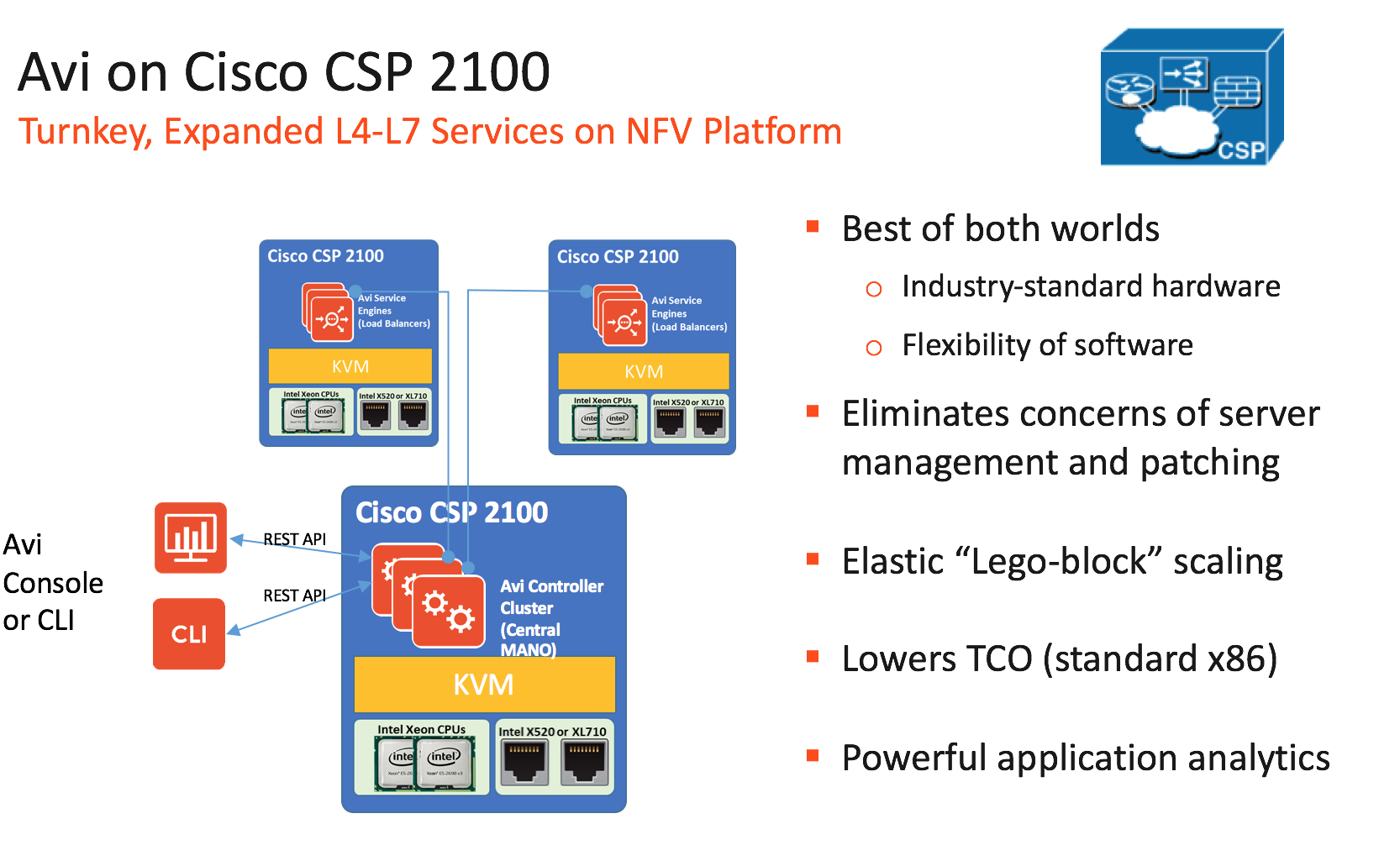
We have been working very closely with Avi Networks for more than a year now to help our joint customers achieve their goals.  This partnership spans engineering, product management, and sales.  Because of the successes we have experienced over the past year, we have jointly decided to take our partnership to the next level by entering into a strategic reseller agreement.  “Enterprises modernizing their data centers are looking for elastic, virtual network functions for their applications,” said Sharad Rastogi, vice president of product management for Enterprise Networking at Cisco.  “The combination of Avi Networks’ software-defined load balancing architecture and the Cisco CSP 2100 NFV platform delivers flexible, cost-effective, and turn-key load balancing services.”

Strategic Reseller Agreement

Today we are publicly announcing for the first time this reseller agreement as we kick off Cisco Live US.  If you happen to be attending Cisco Live this week, you can visit Avi Networks at booth #2637.  The Avi Network’s software load balancing solution called the Avi Vantage Platform will be added to Cisco’s Global Price List (GPL).  The Avi software license SKUs are available as annual or three-year subscriptions from Cisco.  These new SKUs will be available a la carte and also together with Cisco’s CSP 2100.  While the Cisco CSP 2100 and Avi Networks solution bundles address most use cases, there are some use cases for Avi in public clouds and container environments where the Avi a la carte SKUs make sense for our joint customers.  Providing choice allows both Cisco’s and Avi’s partners and sales teams to offer the best solution to our customers.  We wanted to ensure that Cisco had the ability to sell everything in the Avi portfolio.

Avi Networks

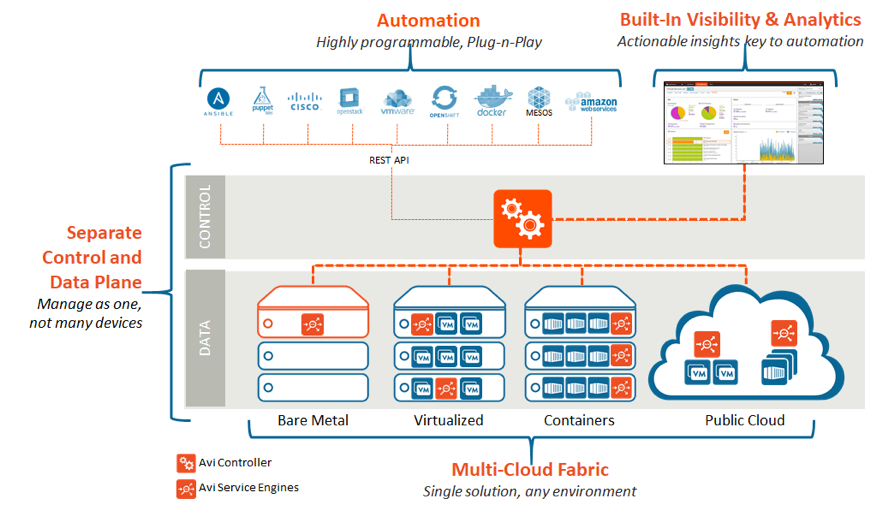
Avi Networks provides an elastic software load balancing solution that truly fulfills the promise of NFV.  With its software-defined architecture separating the control plane (Avi Controller) and data planes (Avi Service Engine or distributed load balancers), the Avi Vantage Platform provides the capabilities of an enterprise-class application delivery controller (ADC) in an elastic, software-only solution.  It goes beyond load balancing to deliver precise application analytics, security, application visibility, and predictive auto-scaling. The platform provides central management of a distributed load balancing fabric that can be deployed in a multi-tenant configuration or on a per-app basis.  “More than ever before, enterprises are demanding elastic application delivery solutions to address business and customer needs. Companies are overpaying for overprovisioned load balancers and underperforming networking tools,” said Edward Sharp, chief strategy officer and vice-president of business development at Avi Networks. “With the Cisco partnership and the CSP 2100 platform, Avi Networks delivers ready-to-use and cost-effective application networking services to enterprises.”

Avi Networks High Level Architecture


Avi Networks maintains CSP 2100 platforms in their engineering labs today for ongoing validation and they have also been officially certified by Cisco through our Open NFV Ecosystem program.

Cisco Cloud Services Platform (CSP) 2100 and SAE

The CSP 2100 high-performance NFV platform is a foundational component of the Cisco’s Secure Agile Exchange (SAE) solution. SAE securely connects employees, customers, and partners to applications across private data centers, public IaaS clouds and/or public SaaS clouds.  Over the last year Cisco and Avi Networks have partnered to deliver turn-key software load balancing services on the CSP 2100 for SAE as well as for basic load balancing use cases.  Global Financial and Global Energy companies have already taken advantage of the joint solution to deliver elastic and cost-effective load balancing as a virtual network function (VNF) on the CSP 2100 platform. These enterprises have used the solution to gain flexibility and automation replacing legacy purpose-built hardware load balancers.  Avi is only one of several VNFs running on the CSP 2100 at these customers.

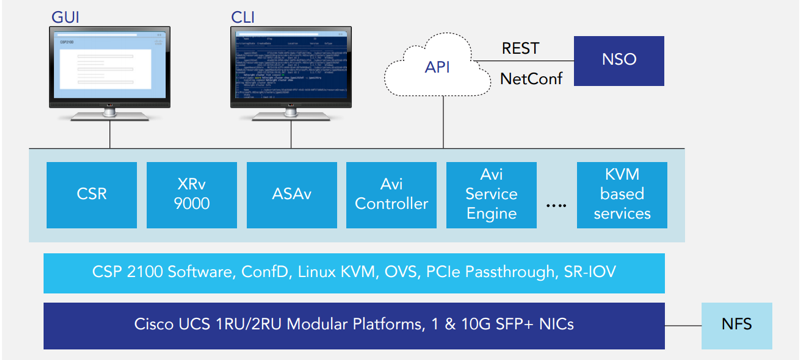
With the CSP 2100 NFV platform, Cisco has created the ideal platform to deliver flexible VNFs. The CSP 2100 is a high-performance x86 software and hardware platform that is designed to host and manage any KVM-based network virtual service.  It provides lifecycle management by offering its users the ability create, modify, upgrade, and shutdown Virtual Machines (VMs) at a moment’s notice through an easy-to-use GUI, CLI, and/or RESTful API / NetConf interfaces.

CSP 2100 NFV Platform High Level Architecture


Learn more about the joint solution by visiting the Avi Networks booth #2637 at Cisco Live this week or sign-up for LTRCLD-2121.  This is an instructor-led lab that takes place on Tuesday, at 1 pm PST for Secure Agile Exchange that incorporates Avi Networks.

Avi + CSP 2100


Additional information on our joint solution can be found here:

Cisco CSP + Avi Networks Solution Brief

Webinar and Demo: Elastic and Adaptive Load Balancing   

Migrating Cisco ACE to CSP 2100 + Avi

Avi – Cisco CSP 2100 virtual load balancing 

If you have questions/comments, please email us at csp-2100@cisco.com.  Thank You.

Authors

Gunnar Anderson

Product Manager

CNSG Product Management

Avatar

What happens in Vegas won’t stay in Vegas! The excitement is building around top transformation topics: cloud, security, optimization, analytics, and more. Be sure you’re in the know with industry-leading solutions demos and informative sessions from the Advanced Services experts at Cisco Live from June 25 to 29.

Technology is always in flux, but today we’re seeing an exceptional level of change within the shifting landscape. SaaS subscription models, hybrid-cloud solutions, security challenges, and new ways of collaborating are driving non-traditional business approaches. Organizations are making transformation decisions to survive and thrive in the digital era, all while demanding greater efficiency and cost savings.

Whether you’re attending Cisco Live in person or part of the action through our live streams and social channels, we’ve got a lot to talk about. Here are four opportunities to maximize your time with Services.

  • Learn how Services is integral to technology transformation from Cisco leaders.

Watch the opening keynote—our CEO Chuck Robbins will kick-off Cisco Live! Technology is changing everything we do, from how we run our businesses to how we work and innovate. IT professionals now have a greater opportunity than ever to be the architects of the future for their organizations. Chuck will discuss these exciting new innovations that are changing how we design and manage networks. Ready to scale and extend your business capabilities while making the #NetworkIntuitive? Learn more at #CLUS!
Monday, June 26 at 10:30 am PT at Level 1, Event Center
Add it to your schedule

Cisco Technical Services VP Denise Cox will discuss how organizations can take advantage of the new IT economy to reinvent the way you market, communicate, collaborate, and educate in a session titled, “Orchestrating Your Digital Transformation.” Attend to hear Denise share real scenarios that give you an inside look at technology roadmaps, analytics, and TAC innovations that resolve device issues before they affect your network.
Thursday, June 29 at 10:00 am PT at World of Solutions booth # 2449
Add it to your schedule

In a can’t-miss session, Cisco Advanced Services Director Ulf Vinneras will explore the explosion of data generated by the increasing number of devices coming onto the network. Join Ulf at his session, “Analytics: How to Build Value from Data,” to learn about our new Critical Insights platform that combines Advanced Services software innovation and intellectual capital.
Tuesday, June 27 at 12:45 am PT at World of Solutions booth # 4223
Add it to your calendar

  • Do. Learn. Visit the Cisco Services Zone in the World of Solutions. Don’t miss the opportunity to meet Advanced Services experts and see our services in action. Located in the World of Solutions, you’ll see product and service demonstrations for your most critical business, infrastructure, and technology needs, including:

Security and Active Threat Analytics (ATA): How do you build a security strategy that anticipates and responds to new threats, reduces complexity and fragmentation, and adapts to changing business models?

Enterprise Networking: No matter where customers are in their journey, Cisco offers Advanced Services expertise to help customers accelerate their digital network transformation. Readiness assessments. Scalable designs. Automation tools. Award-winning support.

Data Center: IT must transform to keep up with the demands in a constantly evolving digital era. Perhaps you need to explore a hybrid IT solution that increases application performance, reduces risk, and enhances operation agility. What’s new with Application Centric Infrastructure (ACI), CloudCenter, and Tetration services? Come see.

Cloud Advisory: Having a solid cloud foundation is imperative to a successful digital transformation. Enterprises risk losing market share to agile and innovative disrupters in every industry. Visit and learn how cloud advisory can help you build an actionable strategy to adapt to new pressures and stay competitive in an on-demand, digital era.

Service Provider Transformation: Service providers are under constant pressure to accelerate network transformation, enhance operational efficiencies, improve time-to-market, and mitigate risks. Explore how we help our customers to deliver valuable experiences for their customers each day.

Fun and Games: Let’s have some fun! Walk through the Services Experience Zone and step up to the challenge of our many games. Snap some pictures and get social using #InnovateWithServices and #CLUS.

In addition to the Cisco Services Zone, Advanced Services will also be featured in various technology Architecture Zones located in the World of Solutions.

  • Become a Digital Transformation Hero.

Attend one of our deep-dive sessions and get the latest on the top transformation topics.

“Next Generation Security Services” – Cisco Directors Sean Mason and Martin Nystrom will share their actionable insights and best practices on security. Organizations continue to struggle in anticipating and responding to new threats due to complex and fragmented networks, as well as agility in adapting to changing business models. Sean and Martin will reveal how Cisco helps companies like yours remain ready and resilient when addressing cyber threats.
Tuesday, June 27 at 8:00 am PT at Level 3, South Seas A
Add it to your schedule

“Automation and Analytics-driven Services” – Cisco Directors Ramesh Kaza and Laura McCarty realize that you cannot manage what you do not know. They will share the innovative steps Cisco Services has taken to use automation and analytics to help customers like you drive improved business agility and operational efficiency. Learn how these capabilities can become key enablers for both your digital transformation and customer experiences.
Monday, June 26 at 3:30 pm PST at Level 3, South Seas A
Add it to your schedule

  • Get Social!

Join us on Twitter throughout the conference to see real-time updates, insights, recommendations, and fun. Follow @CiscoServices and the many talented members of my team that will be tweeting each day. You can find me on Twitter at @BryanJPalma too! Don’t forget to use the #InnovateWithServices and #CLUS hashtags.
Join us for a special Facebook Live session on Wednesday, June 28. Our Facebook page has the details: http://www.facebook.com/CiscoServices

This year’s Cisco Live will prove to be one of our best yet. I look forward to seeing you there and talking about how, together, we can make anything possible at #CLUS and beyond!

Authors

Bryan Palma

Senior Vice President and General Manager

Cisco Advanced Services