Avatar

The first day of Cisco Live 2017 Las Vegas is in the books. It was a busy day, to say the least. The morning started with the opening keynote and jumped right into the World of Solutions and tech sessions throughout the day. It was nonstop technology.

I’m not sure the tourists visiting the Mandalay Shark Reef aquarium know quite what’s happening when they find themselves among the badge-wearing masses. It’s a bit like a cattle drive of two-legged critters.

The Keynote
As the arena filled, a DJ warmed up the crowd with some karaoke competition among audience volunteers. Honestly, I don’t know that any of the contestants will be giving up their day jobs anytime soon. I hope not, anyway.

After a loud and bright opening light show, Chuck Robbins took the stage with “If you weren’t awake, you are now!”  He delivered the keynote, bringing people up to date on Cisco’s latest announcements. He focused on how much change is coming, and how quickly.

There are 8.4 billion connected things on the Internet today. As soon as 2020, as many as 1 million connections will be made to the Internet every hour. All of these device connections require a more secure, intelligent, and intuitive platform upon which you can build your business. As Robbins describes it, it’s “the new network, powered by intent and informed by context.” Learn more about The Network. Intuitive.

Robbins introduced a guest speaker as the leader of a company with which Cisco has had an important strategic relationship for two years. It’s not often that Apple CEO Tim Cook takes the stage at another company’s event, but he and Robbins sat down to talk about how our companies are working together to improve the enterprise user experience through stronger integration of our products – Cisco Spark and WebEx in particular for the collaboration portfolio.

Also visiting the keynote was David Wichmann, CEO of UnitedHealth Group. He shared how Cisco, Optum, and UnitedHealth are working together to transform healthcare with new patient and provider collaboration with technology including messaging and video with Cisco Spark.

Watch the full keynote on demand.
Check out the Apple + Cisco page to learn more about how we’re working together.

Innovation Talk with Jens Meggers
Jens Meggers, SVP and GM for Cloud Collaboration Technology, started his session talking about how well people communicate — at Saturday gatherings compared to Monday morning at work. Outside of work, our communication is natural and interactive. Inside of work, we use the same tools we’ve been using for two decades (think email), to try to communicate and share ideas. Once upon a time — back when we sat in isolated cubicles and worked in siloed teams — that worked. As Jens put it, “in the past, we were sitting together, but we weren’t really working together.” The way our projects, teams, and workspaces are changing, so our tools should too.
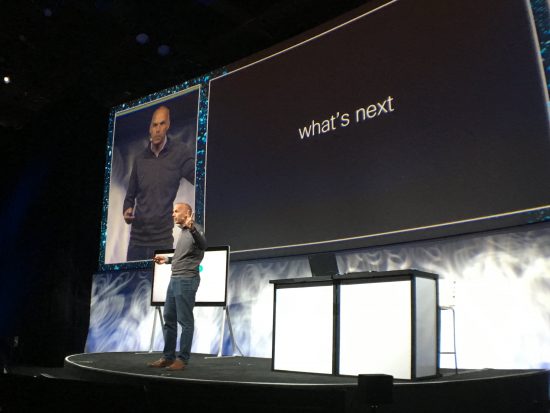
jens meggers on stage

To get to the new work reality, we need to work on three things: environment, structure, and tools. He showed side-by-side screen grabs of Microsoft office in 1995 vs. 2017. What’s changed? Honestly, not much. But the way we work has changed. We’re using tools that haven’t evolved with the way we’ve evolved our work, the way we form teams, and the communities with which we collaborate. Old tools don’t let us work the way we want to work. They don’t let us communicate in natural, interactive ways.

He shared how — and why — we developed Cisco Spark. when people aren’t using video in a meeting, about 60% disengage and do something else. When it takes multiple tools to accomplish a task with others, it takes extra time to hop between those tools. If everything is integrated into one tool with a design that emphasizes an intuitive experience, that saves time and effort. “Cisco Spark allows you to create the superhighway of communications to accelerate decision-making.”

Learn more about the Cisco Spark platform and devices.

Kilts, NotSoMiniFig, and bears – oh my!
There was more than plenty to see throughout the day, from the thousands of products in the 1 million square feet of the World of Solutions area to the fashions of the ever-growing and always popular #KiltedMonday. Making their Cisco Live debut were@NotSoMiniFig and a rather large sloth of Cisco Spark bears (the official answer to “what is a group of bears called?”) In fact, the Cisco Spark bears managed to photobomb quite a few of my pictures during the day and created quite a presence on Twitter.
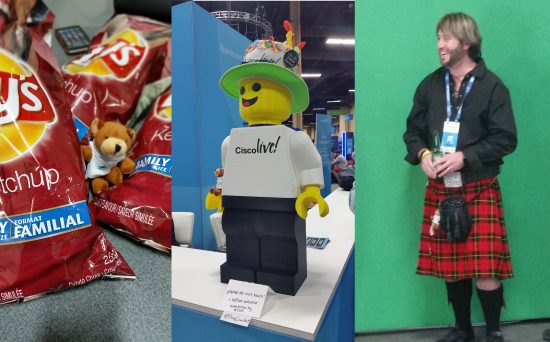
Tuesday Highlights
So we’re off and running! Bring on Day 2! (OK, with all the walking going on, there’s very little energy for running. And if the legs would even agree to do it, the feet wouldn’t allow it.)
 

Want videos and other good stuff from the Cisco Live event team? Check out the CLUS Daily Highlights page.

Learn more about the new era of networking from our friends on the enterprise networking team.

https://youtu.be/ZuJjncuptz0

Authors

Kim Austin

No Longer with Cisco

Avatar

Working allows me to provide for my family, and like for most of us, working isn’t a choice. But where I work and how I engage is my choice.  Cisco chose me and I chose Cisco.

I started my career with college summer internships as a programmer for the biggest and most well-known computer company. I enjoyed the team and the work, but felt far removed from the business. I couldn’t connect my work, my department’s work, or even my entire sites’ efforts to business impact.

After three internships, I vowed never to work for a large company. Eight startups and 25+ years later, I joined Cisco in 2015, a company with 70,000+ employees and $47B in revenue.


Never say never.

In 2015 (and today as well), staying relevant meant reinventing myself – stepping outside my comfort zone and getting comfortable with the uncomfortable. As strange as this may sound, I found comfort working in the Silicon Valley startup culture of early adopters, uncertainty, nonexistent markets, and limited (and at times no) funding. I perceived the large company would limit my ability to impact the customer and influence product direction.

Additionally, I thought everyone at a large company managed processes and politics, as opposed to creating results. We know what we know. Clearly, not all large companies are the same.


What Makes Cisco Different?  Culture.

I would like to share my experiences, fully immersed in our culture, through some of our recent #hashtags.


#WeAreCisco #LoveWhereYouWork

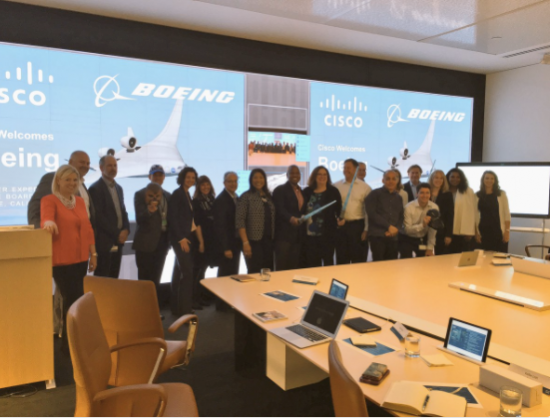
On May 4th, we welcomed Boeing’s executive leadership to San Jose, CA. The meeting’s objective focused on sharing how Cisco managed it’s digital, cultural, and operational transformations by converging operational technology (OT) with information technology (IT).

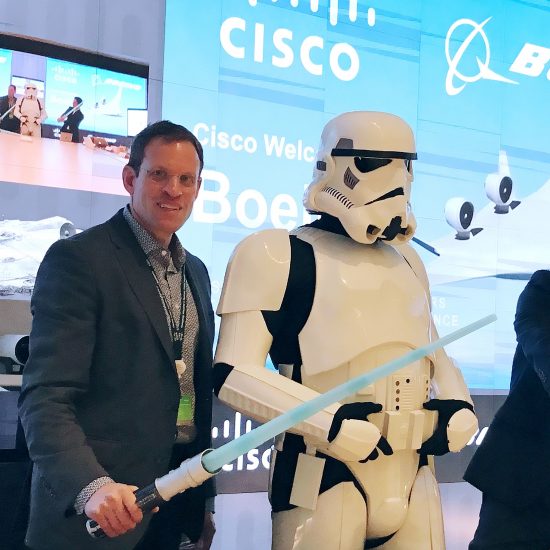
When we finalized the date, my Boeing counterpart, said, “Neil, you know, we’ve just agreed to meet on May 4th, as in May the 4th be with you – Star Wars Day.” Without missing a beat, I replied “Kellie, we’re a tech company, May the 4th is a big deal!” I figured we had two months to find a fun and simple way to engage Boeing in a #WeAreCisco #MayThe4th experience.

As the customer experience center visit drew closer, I learned Cisco’s Talent Brand team was already hard at work implementing May the 4th plans for our @WeAreCisco channels. It was exciting to learn our leadership had heard during a Cisco Beat (our all employee monthly meeting) teams around Cisco wanted to celebrate Star Wars Day, and @WeAreCisco was also listening. A partnership with NASDAQ led to an Instagram contest and Facebook Live broadcast – from Times Square! – for employees along with Star Wars photo ops and themed foods in the cafes. Fueled by The Force, this day was!

For our meeting with Boeing, I thought we could add to the experience and really wow our guests. So, our team transformed our Napa Valley executive board room into a complete May the 4th Star Wars experience. We showed the agenda just like the movie’s opening credits (with theme music), took photos with a Storm Trooper, used light sabers as pointers, wore Chewbacca masks, had a BB8 cake, and submitted photos to the @WeAreCisco Instagram competition.

We all had some fun, and Boeing learned first-hand how Cisco employees create an exciting and productive work environment.


#CiscoRocks

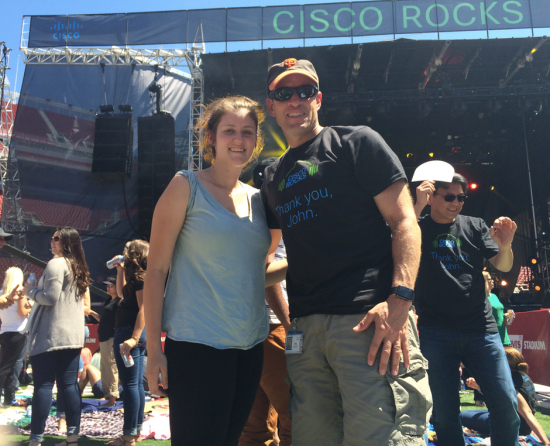
Shortly after I joined Cisco, John Chambers announced Chuck Robbins would become our CEO. Wow, my first impact: regime change. As part of the transition, we celebrated John and welcomed Chuck into his new role with exciting performances at Levi’s Stadium.

My then 18-year-old daughter Eva joined me at the concert. To me, this wasn’t just a concert; this was an awesome learning moment for Eva to experience a company at its best, bringing people together in celebration. People who work hard, play hard; as a result, they can choose to celebrate together. Since Eva would begin her college education a few weeks later, I hoped she recognized working hard matters and creates opportunities.


#ALLin

Being part of the sales organization, I attended 2015 GSX in Las Vegas. The theme: #ALLin. It was my first GSX and I was blown away. The experience began at the San Francisco airport ticket counter, where the digital signage displayed “GSX ALL IN.” It only got better from there, continuing with John’s welcome address, attending the training sessions, and culminating with another incredible concert in the largest tent ever.

I was beyond impressed with Cisco’s commitment to me and my colleagues. I left the event with a feeling of purpose, value and direction. Just before heading home from Las Vegas, I continued the opportunity to get comfortable with being uncomfortable by riding the X-Treme thrill ride dangling 300 meters over the edge of the Stratosphere hotel.


#GiveBack

Each year, Cisco employees receive five days to give back to their communities. Motivated to impact the at-risk diabetes community, I used my 2016 volunteer hours as a swim angel with PATHSTAR (www.pathstar.org), a nonprofit committed to inspiring and revitalizing sustainable health and wellbeing practices within Native American communities. The experience culminated with a swim from Alcatraz to San Francisco.

Once again, I was blown away with how Cisco supported my choice of when and where I would volunteer and how I could impact organizations important to me and my family.

Cisco published a blog about the experience here: http://weare.cisco.com/c/r/weare/amazing-stories/real-deal/neil-heller.html


I work and play #ALLin. Showing up at work isn’t enough for me. I hope you join me in bringing your passion to work and play as well.

I would choose Cisco again.


Do you want to choose Cisco? We’re hiring!


Authors

Neil Heller

Manufacturing Industry Solutions

Manufacturing

Avatar

Today’s hyperconnected hospital users—patients, clinicians, administrators, and more—expect increasingly sophisticated digital experiences, including remote consultations, in-room services, and location-aware mobile services.

Beyond user expectations, the number of IoT-enabled devices on the network—such as connected medical devices and equipment—is exploding. Globally, machine-to-machine (M2M) connections in healthcare are expected to grow 5x from 2015 (144M) to 2020 (729M), representing a huge increase in IP traffic. [1]

“The network has never been more critical to business success, but it’s also never been under more pressure,” said Cisco CEO Chuck Robbins when unveiling the network of the future. At present, 67% of organizations identify legacy network infrastructure as a bottleneck to IT. [2]

These growing expectations and connections in healthcare mean your network needs to be digital ready. It must be more flexible to enable faster innovation. Operations must be simplified to reduce network-management costs. Above all, the healthcare network must be protected against threats.

Keep up with the pace of change to ensure your continued success. Check out the infographic below to learn how hospital networks can evolve from manual, rigid, and device-centric to automated and flexible.

Stay tuned for three more installments in our Cisco DNA for Healthcare blog series, which focuses on opportunities to improve business outcomes, network security for healthcare, and what you can do to make your hospital digital ready.

Learn more about DNA for Healthcare at cisco.com/go/dnahealthcare.

[1] Cisco, Visual Networking Index, 2016 https://newsroom.cisco.com/press-release-content?type=press-release&articleId=1771211
[2] Forrester, Digital Transformation Powers Your Business, 2015 http://www.verizonenterprise.com/verizon-insights-lab/digital-transformation/2015/#report

Authors

Sarah Struble

No Longer at Cisco

Avatar

I’m psyched!

Today we’re launching IoT Threat Defense, and it’s the most comprehensive security solution yet for the Internet of Things. And it couldn’t come a moment too soon.

Let’s be frank. IoT devices, on the whole, aren’t capable of defending themselves from cyber-attacks. That means they can provide a means of access to their host networks by bad guys, or they can be weaponized to attack third parties. It’s not necessarily their fault that they’re vulnerable. Many IoT devices, whether in the consumer space, IT, or industrial, tend to have enough compute power to perform the functions for which they were designed. There just isn’t the compute capacity for security. There are also competitive pressures that force manufacturers to strip functionality, with security usually being cut first, in order to remain competitive. And sometimes, the device manufacturer is new to the security world, or the hardware was built with no intention of it ever being networked.

The reason for a vulnerability, from a defense perspective, is irrelevant. A vulnerability is a vulnerability, regardless of the cause, and it must be remediated – or at the very least, mitigated.

Another significant characteristic that must be considered in respect to defending the IoT is scale. Gartner estimates that there will be 20 billion connected things by 2020, and we are expecting even more at 25-30 billion in that timeframe. When you stop and think about it, no matter which estimate proves accurate, that’s a ton of stuff to protect. And the diversity of things – lighting, environmental control systems and sensors, building management systems, plus rogue connected coffee pots, and whatever else people sneak into their cubes – isn’t going to make it any easier.

Enter IoT Threat Defense.

Organizations are exposed to these IoT-based threats now, so we said to ourselves, “What concerns are we hearing about the most from our customers? In what verticals is there the most urgency? And what can we do for them today?” (No, I’m not aware of anybody actually saying those words, but it does sum up our approach nicely.) The first verticals we’re addressing are healthcare (specifically, connected medical devices), manufacturing, and electric utilities. We then identified four areas in which the most help is needed: Extensible, scalable segmentation, visibility and analysis, remote access, and advisory and technical services.

We identified a set of technologies and services to support the pillars of the solution, and then brought those technologies into the lab with real gear and real malware to test our integrations and efficacy in defending against those attacks. The result is IoT Threat Defense, a validated architecture of leading technologies and services, specifically tested to detect and defeat IoT threats.

https://youtu.be/Bfsm2_qx9gg

If you’re at Cisco Live this week, there are several ways to learn more:

  • You can check out the many IoT Threat Defense Learning Labs sessions in the Security Village;
  • Visit the different product and services booths for demos of the individual technologies;
  • Or, come by the Industries area to learn more about how IoT Threat Defense functions in industrial control environments.

Of course, you can visit us any time at www.cisco.com/go/iotthreatdefense.

Authors

Marc Blackmer

Product Manager, Engineering

IoT Product Mgmt Networking

Avatar

There is a big (justified) hype around containers and microservices. Indeed, many people speak about the subject but few have implemented a real project. There is also a lot of excellent resources on the web, so there is no need for my additional contribution there.

I just want to offer my few readers another proof that a great solution exists for containers networking, and it works well. Its name is Contiv and you will find evidence in this post and pointers to resources and tutorials.

I will explain it in very basic terms, as I did for Cisco ACI, here and here, because I’m not talking to network specialists (you know I’m not either) but to software developers and designers. Most of the content here is reused from my sessions at Codemotion 2017 in Rome and Amsterdam.

In this first part, we are looking to introduce the concept and what challenges it addresses and in a post soon-to-come, we will take a deeper dive.

Containers Networking

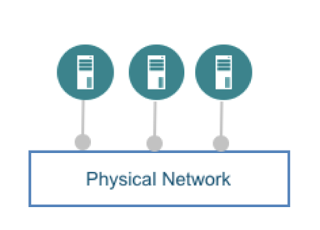
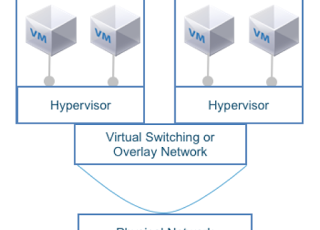
When the world moved from bare metal servers to Virtual Machines (VMs), virtual networks were also created and added great value (plus some need for management).

Initially networking was simple

Of course virtual networks make the life of developers and servers managers easier, but they also add complexity for network managers: now there are two distinct networks that need to be managed and integrated. A physical and a virtual one.

Virtual Machines connected to an overlay network

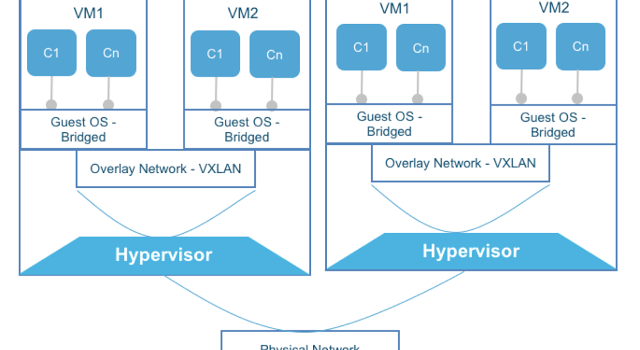
With the advent of containers, their virtual networking layered on top of the VM virtual network (the majority of containers run inside VM for a number of reasons), though there are good examples of container runtime on physical hosts.

So now you have 3 network layers stacked on top of each other, and the need to manage the network end-to-end makes it even more complex.

Containers inside VM: many layers of overlay networks
This increased abstraction creates some issues when you try to leverage the value of resources in the physical environment:

connectivity: it’s difficult to insert network services, like load balancers and firewalls, in the data path of microservices (regardless the virtual or physical nature of the appliances).

performances: every overlay tier brings its own encapsulation (e.g. vxlan). Encapsulation over encapsulation over encapsulation starts penalizing the performances… just a little  😉

hardware integration: some advanced features of your network (performances optimization, security) cannot be leveraged

Do not despair: we will see that a solution exists for this mess.


Microservices Networking

This short paragraph describes the existing implementation of the networking layer inside the containers runtime.

Generally it is based on a pluggable architecture, so that you can use a plugin that is delegated by the container engine to manage the container’s traffic. You can choose among a number of good solutions from the open source community, including the default implementation from Docker.

At minimal, the networking layer provides:

– IP Connectivity in Container’s Network Namespace

– IPAM, and Network Device Creation (eth0)

– Route Advertisement or Host NAT for external connectivity

Microservices Networking

There are two main architectures that allow to plug an external implementation for networking: CNM and CNI. Let’s have a look at them.


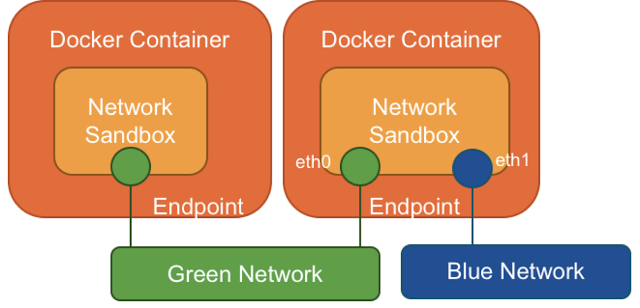
1. The Container Network Model (CNM)

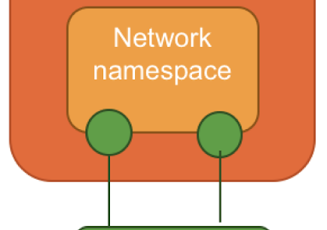
Proposed by Docker to provide networking abstractions/API for container networking, it is based on the concept of a Sandbox that contains configuration of a container’s network stack (Linux network namespace).

  • An endpoint is a container’s interface into a network (a couple of virtual Ethernet interfaces).
  • A network is collection of arbitrary endpoints that can communicate.
  • A container can belong to multiple endpoints (and therefore multiple networks).

CNM allows for co-existence of multiple drivers, with a network managed by one driver


Provides Driver APIs for IPAM and for Endpoint creation/deletion.

– IPAM Driver APIs: Create/Delete Pool, Allocate/Free IP Address Network

– Driver APIs: Network Create/Delete, Endpoint Create/Delete/Join/Leave


This approach is used by docker engine, docker swarm, and docker compose. It also works with other schedulers that runs standard containers e.g. Nomad or Mesos.

The Container Network Model

 2. The Container Network Interface (CNI)

Proposed by CoreOS as part of the APPC specification, used also by Kubernetes.

  • Common interface between container run time and network plugin.
  • Gives driver freedom to manipulate network namespace.
  • Network described by JSON configuration.

Plugins support two commands:

– Add Container to Network

– Remove Container from Network

The Container Network Interface

Many good implementations of the models above are available on the web and you can pick one to complement the default implementation with a more sophisticated solution and benefit from better features.


It looks so easy on my laptop. Why is it complex?

When a developer sets up the environment on its laptop, everything is simple. You test your code and the infrastructure just works (you can also enjoy managing… the infrastructure as code). No issues with performances, security, bandwidth, logs, conflicts on resources (ip address, vlan, names…). But when you move to an integration test environment, or to a production environment, it’s no longer that easy…

IT administrators and the operations team are well aware of the need for stability, security, multi tenancy and other enterprise grade features. So not all solutions are equal, especially for networking.

Let’s discuss their impact on Sally and Mike:

Sally (software developer) – she expects:

  • Develop and test fast
  • Agility and Elasticity
  • Does not care about other users


Mike (IT Manager) – he cares for:

  • Manage infrastructure
  • Stability and Security
  • Isolation and Compliance

These conflicting goals and priorities challenge the collaboration and the possibility to easily adopt a DevOps approach. A possible solution is a Policy-based Container Networking.

Policy based management is simpler thanks to Declarative Tags (used instead of complex commands syntax), and it is faster because you manage Groups of resources instead of single objects (think of the cattle vs pets example).


What is Contiv

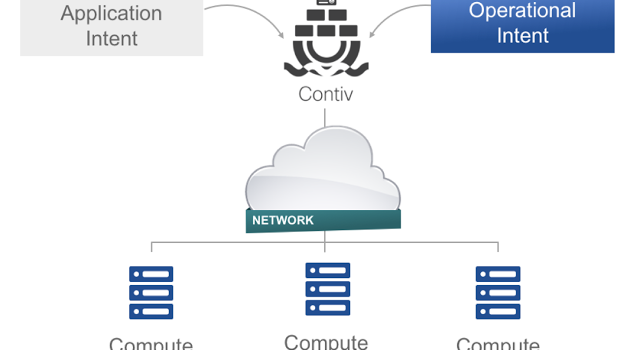
Contiv unifies containers, VMs and bare-metal servers with a single networking fabric, allowing container networks to be addressable from VM and bare-metal network endpoints. Contiv combines strong network performance, support for industry-leading hardware, and an application-oriented policy that can move across networks together with the application.

Contiv’s goal is to manage the “operational intent” of your deployment in a declarative way, as you generally do for the “application intent” of your microservices. This allows for a true infrastructure as code management and easy implementation of DevOps practices.

High-level Overview of Contiv

Contiv provides an IP address per container and eliminates the need for host-based port NAT. It works with different kinds of networks like pure layer 3 networks, overlay networks, and layer 2 networks, and provides the same virtual network view to containers regardless of the underlying technology.

It works with all major schedulers like Kubernetes, Docker Swarm, Mesos and Nomad. These schedulers provide compute resources to your containers and Contiv provides networking to them. Contiv supports both CNM (Docker networking Architecture) and CNI (CoreOS and Kubernetes networking architecture).

Contiv has L2, L3 (BGP), Overlay (VXLAN) and ACI modes. It has built in east-west service load balancing. Contiv also provides traffic isolation through control and data traffic.

It can also manage global resources: IPAM, VLAN/VXLAN pools.


Features that make Contiv the best solution for Microservices networking

  • Support for grouping applications or applications’ components.
  • Easy scale-out: instances of containerized applications are grouped together and managed consistently.
  • Policies are specified on a micro-service tier, rather than on individual container workloads.
  • Efficient forwarding between microservice tiers.
  • Contiv allows for a fixed VIP (DNS published) for a micro-service
  • Containers within the micro-services can come and go fast, as resource managers auto-scale them, but policies are already there… waiting for them.
  • Containers’ IP addresses are immediately mapped to the service IP for east-west traffic.
  • Contiv eliminates the single point of forwarding (proxy) between micro-service tiers.
  • Application visibility is provided at the services level (across the cluster).
  • Performances are great (see references below).
  • It mirrors the policy model that made Cisco ACI an easy and efficient solution for SDN, regardless the availability of an ACI fabric (Contiv also works with other hw and even with all-virtual networks).

I encourage you to have a look and test it yourself using the tutorial.
It’s easy and not invasive at all, seeing is believing 🙂

In the next post we will take a deeper dive at the architecture with some examples.

Resources

What are containers?

What is Kubernetes?


Other Resources


Authors

Luca Relandini

Principal Architect

Data Center and Cloud - EMEAR

Avatar

Cisco recently announced a major customer milestone in our data center portfolio with the news that the Unified Computing System topped more than 60,000 active customers, from literally zero in 2009. Other parts of our data center portfolio are doing just as well as we discussed in our most recent earnings call where we announced fast growth of Nexus 9000 customers that brings us to a total of more than 12,000 customers strong.

We added almost 1,200 new Nexus 9K customers in the quarter, bringing the total installed base to 12,000.  Our APIC adoption continues to increase rapidly with over 380 new ACI customers in Q3, bringing our total to nearly 3,500.

The impressive growth in the Cisco data center portfolio is strong validation of the trust customers place in our ability to both innovate and execute, even as data center trends are rapidly evolving across the vectors of application models, users, and locations. Our customers recognize that the Nexus 9K is a foundational element of that portfolio, featuring proven high performance and density, low latency, and exceptional power efficiency that are must-have features for their modern data centers.

To capitalize on this momentum and to provide customers with more choice, Cisco is expanding the Nexus 9000 fixed-configuration options with the introduction of two new Nexus 9300 fixed switches based on Cloud Scale ASIC. This advanced chip technology keeps our customers years ahead, or perhaps light years ahead as the world-champion Dubs might put it. Cloud Scale ASICs provide our customers an innovation advantage in terms of application performance, pervasive visibility, and security and truly sets Nexus 9000 apart in a crowded data center switching marketplace.

The two new Nexus 9300 models are:

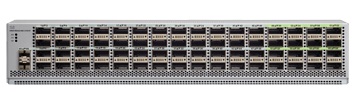
  • Cisco Nexus 9364C ACI Spine Switch: Features 64-port fixed 40/100 QSFP and 2 fixed 1/10 SFP+   available in ACI mode with NX-OS support coming later this year. This model is for spine deployments in the enterprise, service provider, large virtualized, and cloud environments. The Cisco Nexus 9364C ACI Spine Switch is a 2-rack-unit (2RU) switch that supports Layer 2 and 3 non-blocking with aggregate 12.8 Tbps of bandwidth, 16 ports of MACSEC capable hardware, and efficient handling of high-performance data center traffic for business-critical apps.

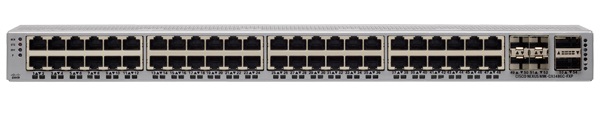
  • Cisco Nexus 9348GC-FXP: Features 48 ports of 100Mbps or 1Gbps, supports both ACI and NX-OS mode, and is best suited for customers that require a Gigabit Ethernet ToR switch with local switching. This switch is ideal for customers with big data usage with minimal data center footprint. This switch offers up to 48 1Gbps copper downlink ports that can be configured to work as 100Mbps or 1Gbps ports. The four SFP28 optical ports also can be configured as 10/25Gbps while the two QSFP28 ports can be configured as 40- and 100-Gbps ports.

Cisco Nexus 9300 Deployment Scenarios

Similar to other Nexus 9000 switches, these switches offer high degrees of architectural flexibility and can be deployed in three models:

  • in NX-OS-based stand-alone mode as a programmable network,
  • in VXLAN/EVPN-based programmable fabric,
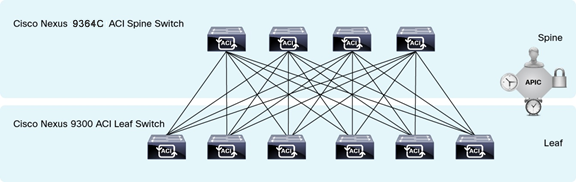
  • in highly automated ACI mode, delivering automated policy-based systems management

This combination of the Nexus ACI spine switch along with Nexus 9300 leaf nodes form the infrastructure heart of an automated and policy-driven ACI architecture. The new Cisco Nexus 9364C Switch offers advanced scalability in the smallest spine switch form factor and enables connectivity to up-to 64 Cisco Nexus 9300 leaf switches with its high port density of 64 40/100 GbE ports and 12.8 Tbps throughput.

These two new switches build on other recent Nexus 9300 successes namely the availability of N9K-C93180YC-FX and N9K-C93108TC-FX models that established several innovation benchmarks including:

  • Being the first and only switch in the market with integrated encryption (MACSEC) capabilities
  • Bolstering high-performance reliability through support for 25Gbps RS-Forward Error Correction
  • Multiprotocol storage networking with support for 8/16/32G Fibre Channel enabled on each 25Gbps SFP+ ports

Summary

Customers will choose vendors who can deliver a dynamic data center infrastructure that is easy to manage, affordable and flexible is required to meet the needs of resource-constrained IT professionals in large or small companies. More than 12000 Cisco customers now understand the Cisco Nexus 9000 offers flexible options for their different use cases and high-performance scale that supports continued growth. With the two new Nexus 9300 switches, Cisco has added two more weapons in our data center arsenal to take on the most challenging customer environments.

For more info:
http://www.cisco.com/c/en/us/products/switches/nexus-9348gc-fxp-switch/index.html
http://www.cisco.com/c/en/us/products/switches/nexus-9364c-switch/index.html

Tony Antony
Sr. Marketing Manager

Authors

Tony Antony

Marketing

Solutions

Avatar

Vendor “openness” drives better outcomes for the state of information security.  That’s why Cisco has invested and committed so heavily to our Cisco Security Technical Alliances (CSTA) program in recent years.  CSTA now has over 130 technology partners…a six-fold increase from where we started nearly four years ago.  It is a use-case driven technology partner program with certified platform-to-platform collaborations that better safeguard networks and data.  Today we are announcing several extensions and expansions to the CSTA partner program with McAfee, Algosec, cPacket, CSPi, Tufin and Verodin.

The Email Threat Vector and Cisco Email Security Interoperability with McAfee

Zero-day email threats are real, and so is the risk to today’s businesses. Spear phishing and ransomware threats via email are out of control, and as cyber criminals become more sophisticated in creating threats that evade typical defenses, it becomes an imperative for McAfee customers to enhance their threat detection with strong Email protections.

To see how bad guys use email for ransomware attacks, check out this video Ransomware, Anatomy of an Attack (it’s shocking to say the least).

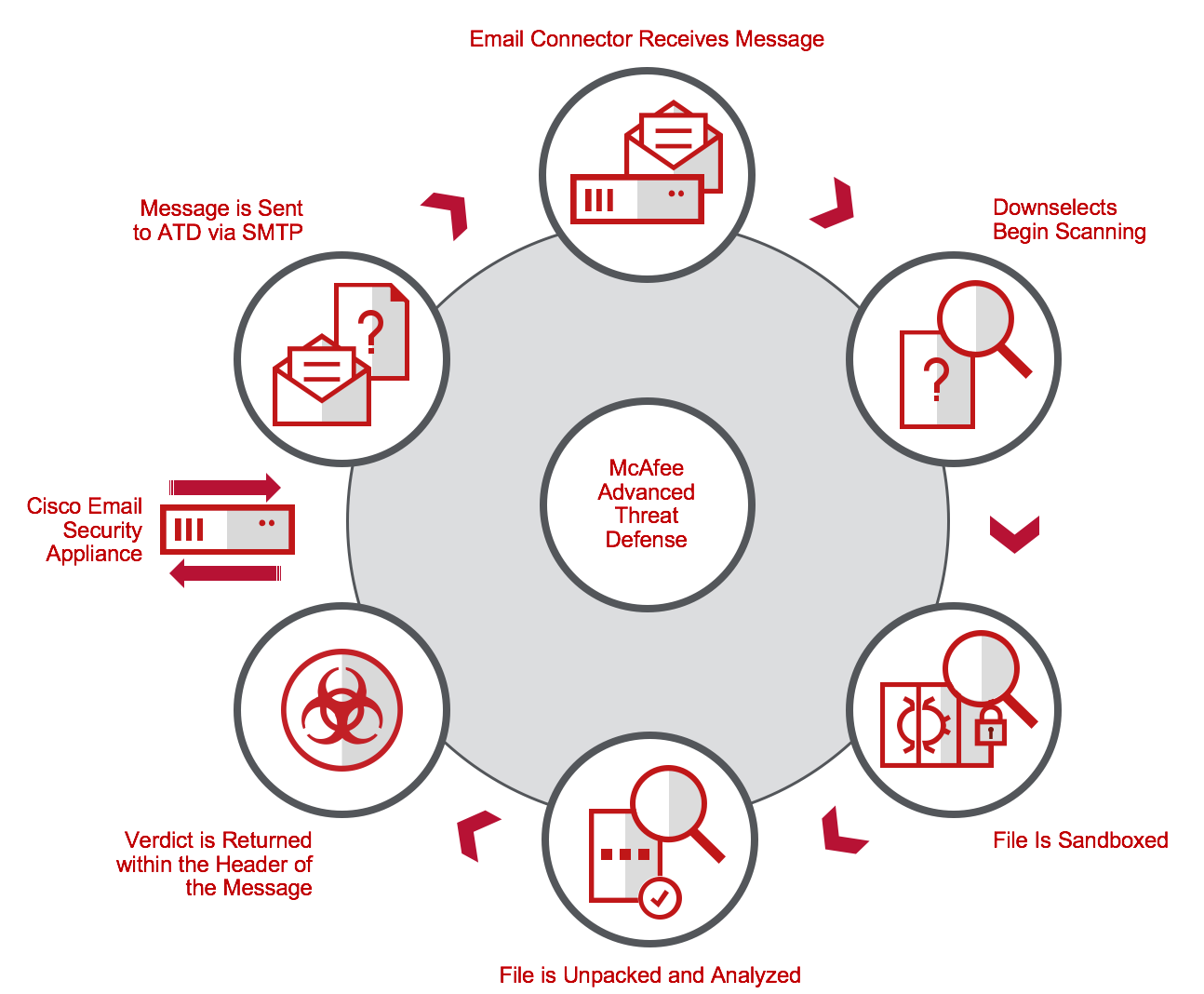
With this in mind, we are proud to announce interoperability of Cisco Email Security with the McAfee® Advanced Threat Defense (ATD) solution.  This presents a great opportunity for McAfee customers to review their current email defense strategy, and investigate how deploying Cisco’s Email Security Appliance (ESA) with McAfee’s ATD can deliver better protections for this dangerous threat vector.  This gives our joint customers a closed-loop email security solution that quickly picks-off unsafe attachments before they get to the end-user.

Here’s how it works…Cisco ESA receives an email attachment that’s actually a zero-day threat. It notifies McAfee ATD that it’s sending the file over for inspection.  Then, McAfee ATD executes the file in its sandbox while also conducting a static code analysis to determine a severity level that it sends to Cisco ESA for appropriate action, such as sanitizing the file.  To see a video demo go here.  To see a ‘How to” installation guide go here.

This complements Cisco’s integration of Cisco Advanced Malware Protection (AMP) with the Cisco ESA, which provides network-wide advanced email-based malware detection and sandboxing, enabling a defense-in-depth solution for existing McAfee ATD customers.

According to a study published by Radicati Group, Inc, the number of worldwide email users will grow from over 3.7 billion in 2017 to over 4.1 billion by 2021.  With a significant amount of data exchanged through organizations’ email infrastructure—including critical financial reports, strategic customer and partner information and even employee performance and personal details.  No wonder that email is today’s #1 threat vector and will likely continue to be so in the future. Cisco Email Security provides McAfee customers the most advanced protection against ransomware, business email compromise, spoofing, and phishing. It uses Cisco Talos advanced threat intelligence and a multilayered approach to protect inbound messages and sensitive outbound data.  With a choice of physical appliance, virtual, cloud-based or hybrid deployment, Cisco Email Security helps customers to stay one step ahead of threats, keep inbox highly secure and protect vital business assets. This couples nicely with McAfee® ATD which enables organizations to detect advanced targeted attacks and convert threat information into immediate action and protection.

Posture Modeling, Forensics and Firewall Configuration Consistency – Keys to Prevention and Mitigation

Cisco is also pleased to announce some new and some newly enhanced integrations with Algosec, cPacket, CSPi, Tufin and Verodin.  Each of these partners provides a key piece in the threat prevention and mitigation puzzle; we are pleased to work with them in creating a complete threat defense picture.

Firewall Policy Management Integration with Algosec and Tufin
Algosec and Tufin are long-time firewall platform management partners. Later this summer, these partners will be updating their integration with Cisco Firepower Management Center by supporting the latest Firepower REST API with policy “read” and “write” capabilities. This enables management of Firepower firewall configuration from these 3rd party management tools, which simplifies management of diverse firewall deployment environments and achieve audit and compliance goals.

Packet Capture Integration with cPacket and CSPi for Detailed Security Forensics
It’s one thing to have security event data.  Most networks have plenty of that. Making it actionable is the key.  cPacket and CSPi leverage Firepower intrusion event data to automatically export and store PCAPs from their full packet capture and storage solution.  Full packet capture technology helps intrusion event analysts by extending visibility into the offending traffic beyond the PCAP collected by Firepower’s Snort based IDS/IPS engine.  Pivoting from specific intrusion events, users can view a vast time window of captured traffic in the partner’s console or download large PCAPs for analysis in a decoding tool of their choice. This helps incident response analysts move from “suspicion” about a security event to “conviction” about the appropriate response.

Get Ahead of Threats: Verodin Integration Across the Cisco Security Portfolio
Verodin’s goal is to measure, manage and improve cybersecurity effectiveness with quantifiable, evidence-based data. Verodin enables security teams to observe and adjust real responses to real attacks without ever putting production systems in danger.  With broad integration across the Cisco Security portfolio—including Firepower, Stealthwatch, Umbrella, and Advanced Malware Prevention for Endpoints—Verodin is helping our joint customers get ahead of threats.  By enabling security teams to see the impact of their modeled threats, as well as security analysts response (or lack thereof) to those threats, they ultimately drive better prevention via stronger network security posture.

Cisco welcomes all these new and expanding technology partners to our CSTA ecosystem.  Deploying these solutions together enables “openness” that solves customer security issues.  Cisco Security…“Simple, Open, Automated.”

For more detail visit:

www.cisco.com/go/CSTA

https://www.mcafee.com/us/partners/security-innovation-alliance/index.aspx

www.algosec.com

www.cpacket.com

www.cspi.com

www.tufin.com

www.verodin.com

Authors

Andrew Peters

Senior Manager for Product Marketing

Avatar

Cisco’s announcement of The Network. Intuitive last week might have seemed to some like an overwhelming amount of information. As experts begin to sort through it, though, a clear consensus is emerging: Intuitive networking is important.

Many of Cisco’s customers seem to already understand just how game-changing the Network. Intuitive. is, based on the crowd reactions to Cisco CEO Chuck Robbins’ Monday keynote at Cisco Live.   They’re not alone — technology analysts are excited too.

(Note: There is no way to fully explain the meat of the announcement here. Long story short, Cisco has released a new suite of products, with a few more coming soon, that enable a network capable of learning over time to become more responsive, anticipating needs and  automating the many meticulous management tasks that an enterprise network requires. Click here for more.)

Technology Analyst Zeus Kerravala is one example. “Given Cisco has been the market leader in networking for decades now, does the launch of a new network system really warrant its own event, and is it a big deal?” he wrote in a blog post after the announcement. “I believe it does and is… and that over time we’ll look back on this launch as a seminal moment in Cisco’s next act.”

We like that vote of confidence; Kerravala is no newcomer to watching tech. I remember interviewing him several times years ago, when he was an analyst at The Yankee Group and I was a reporter at Federal Computer Week. He knows networking technology, and he’s seen enough would-be revolutionary technologies come and go that it’s safe to trust he knows the real deal when he sees it. (Also, he shares his name with the king of the Greek gods, so he must be very wise, and able to control lightning.)

Kerravala’s unreserved affirmation is welcome, but he’s hardly the only one offering it.

Patrick Moorehead in Forbes: “I think intent-based networking will likely be the wave of the future—with the proliferation of devices, and the constantly expanding surface it has to cover, networking simply must get faster and smarter. It looks like Cisco might have a winner on its hands.”

Gene Reznik, senior managing director of ecosystem & ventures for Accenture: “A different approach needs to be taken to really secure and enable the kind of network connectivity that is required. The reason why we’re excited about [Cisco’s announcement] is because we do believe that intent-based networking is really required to manage the billions of devices that our customers have.”

Cisco’s intent-based networking will move businesses and government agencies into the future, enabling capabilities never before practical. Click here for much, much more.


Authors

Michael Hardy

US Federal SME

Cisco Americas Public Sector

Avatar

Last week, Cisco ushered in a new era of networking with the announcement of intent-based technologies that constantly learn, adapt, and protect. Built around the Cisco DNA architecture, it’s a network designed to be intuitive. The new network from Cisco is a game-changer for businesses, so we needed a marketing campaign that would be equally game-changing.

Introducing The Network. Intuitive. Simple words with a powerful message.

https://www.youtube.com/watch?v=NJF1Em5lMlU

The Network. Intuitive. campaign was designed to bring the possibilities of the network to life.

Today, the Cisco networks impact us everywhere we work, live, play, and learn, and our campaign photography reflects the networks that shape our digital world; pervasive, surrounding us, always on. In a way, almost magical.

Transformational marketing takes transformational talent. For this campaign we partnered with Ogilvy, one of the world’s most imaginative agencies, to develop the concept. Joe Pytka, the award-winning commercial director known for his work with Nike, Pepsi, Apple, and other major brands, worked with us to shoot the stunning photography.

Like our brand campaign “There’s Never Been a Better Time”, we are executing digital- and mobile-first. Getting the right messages to the right customers when they want it.

However, this time we’ve gone further. Our digital approach allowed us to reach 36 countries in 21 different languages on Day 1 of launch – our largest global launch ever. And the digital touchpoints provide real value to any visitor, such as interactive 3D product imagery, competitive comparison tables, a DNA readiness advisor, and more.

We also got back to our core business – the Network. More than just making a product, securely connecting people is at the center of everything we do and that concept is front and center in this campaign. You’ll see it on the Cisco.com homepage, but also integrated deep within the product pages. Our brand, product, partner, digital, regional, and country marketing teams worked tirelessly together to make this a beautifully integrated campaign.

This week The Network. Intuitive. is taking over Cisco Live, physically in Las Vegas and digitally everywhere else. Our CEO Chuck Robbins brought the story to life this morning at his keynote.

Learn more about the power of intent-based networking by watching the videos online, exploring the product pages of Cisco.com, and tuning in this week at Cisco.com to watch Cisco Live programming. Leverage the #NetworkIntuitive on your social channels to share your own insights and stories on the future of networking.


Authors

Karen Walker

Senior Vice President and Chief Marketing Officer