Avatar

You really know what it means to #LoveWhereYouWork when you are faced with a life-threatening illness, and your team says, “Take care of your family, we’ve got this!” You see, that’s #WeAreCisco!

I came to Cisco five years ago truly believing in our vision that we wanted to change the world. I had been managing relationships with diverse global customers for many years and had experienced how disruption was changing the way they served their customers and shareholders. At Cisco Global Enterprise; our teams work with some of the most digitally disrupted industries out there. Manufacturing. Retail. Transportation. Utilities. You name it, we’re on it.

And while I loved that we are changing the world, I was also drawn to Cisco by another core value; “Respect and Care for Each Other”.

In the past five years, I have experienced how our Cisco family comes together – from small, often ordinary ways to hugely impactful, life changing ways! We really mean it when we say that giving back and supporting one another is in our DNA!

Suddenly and without warning, my family became the focus of this Cisco value.

My wife, Tracy – the mother of our five children – and I had just celebrated our 25th wedding anniversary, and aside from the huge symbolism of this day to us and our family, it was also a reminder to me that my 5th Cisco anniversary was fast approaching; I had joined the Cisco Family just days after our 20th Wedding Anniversary.

Then our world was disrupted in a way we never thought possible.

Through a series of events that led to a CT Scan of her brain, Tracy was diagnosed with a large Oligodendroglia Brain Tumor – Brain Cancer. We went from busy parents, volunteers, managers, and a scholastic/athletic team family, to this new reality that mom was going to have brain surgery, and this life was not ever going to be exactly the same.

We were blessed with terrific doctors, nurses, and hospital staff that made this terrifying process bearable for our children – four of whom were in high school, one had recently graduated from college and was just beginning her career. Through our family and friends, we all found ways to grow stronger through the process.

Our community of Saratoga Springs, NY embraced our family. Friends and the school district Tracy was a part of began a series of meal trains and fundraisers to help support us, and to help us raise funds for brain cancer research. It was “Toga vs. Cancer” as featured in our local newspaper. It was awe inspiring to see how our community rallied around us. This experience also inspired Tracy’s new mantra;

“I don’t care about things, I want experiences and to enjoy life. My mantra is ‘Burn your candles.’ I have so many candles in my house when I came home from the hospital that I thought they are too pretty to burn or I don’t want to let go of that, if it burns it’s gone. Now every candle in my house is either down to a little bit or is empty because I burn them all the time. What are you waiting for? Really? I tell all my friends, burn your candles.”

Our other family, our Cisco family, also sprang into action. Yes, most of them were a few hours away – the closest being in New York and New Jersey where many of our partners are headquartered, where I spend many of my days – and some even stretched across the globe, but…to this team, and to Cisco where you work is not so much a physical place, but a state of being. Cisco technology makes us all much closer than any literal distance between us.

And while that usually reflects how we do business here at Cisco – being physically and virtually present for our partners and each other, it was never truer in witnessing how these amazing individuals – my co-workers – came together in a moment’s notice for my family when we learned of Tracy’s diagnosis.

Collectively, they said “We’ve Got This.” They had done this many times before, for others. But this time it was for my family. This time, I had even more reason to be thankful to work for a company that cares, and that hires people who genuinely care for one another.

Flowers, meals, phone calls, telepresence sessions, words of support – they all began to pour in. From Cisco family far away, and nearby. Many I had not even met yet – shared personal experiences with me, and all extended their support in countless ways.

There is something to be said about a community of employees that comes together for joyous occasions. There may be twice as much to say about them in times of struggle, and usually – it leaves us speechless. Knowing I had their support, and the support of Cisco, left me feeling secure and confident enough to deal with a major-medical expense. Their support enabled me to truly leave work in their hands as they’ve “Got This” – to focus on who needed me the most – my wife, and family.
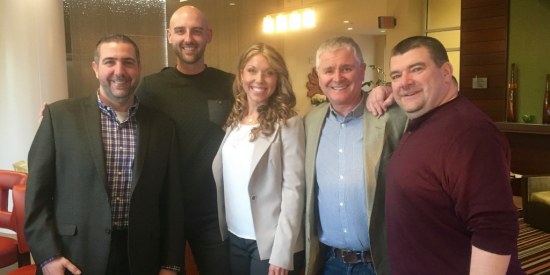
Many companies may want you to feel like your family comes first. Cisco ensures that you KNOW your family comes first. From children with colds to more sinister ills – your family is first.

This is why the Cisco family lives the #LoveWhereYouWork ethos. Where you work is how you work – and we can do that anywhere. From our incredible headquarters in San Jose, CA and our beautiful global campuses to cars, trains, and airplanes – throughout offices and within our customer’s data and distribution  centers, factories, stores, power plants, and – yes – even hospitals. When you are family physical distance is no boundary.

My family and I have a long road of recovery ahead, but we are stronger for the experience, and ready for whatever comes next. I truly know in my being that #WeAreCisco and Cisco’s pledge to “Respect and Care for Each Other” – is derived from a care and respect that knows no boundaries. It is one that I appreciate even more than I could’ve ever imagined I would.

We all now “Burn our Candles” every day, and our candles are many! With five amazing children, three of whom are 15 year old triplets, we’re kept pretty busy. From committing to and exploring colleges to playing Freshmen and Varsity Baseball and Basketball, and our eldest out of college making her way in the world, we embrace this mantra, make every moment a new memory, and continue to give back.

We were able to make a $10,000.00 donation to the Brain Tumor Research at Albany Medical Center – Thanks to the Toga vs. Cancer Basketball Fundraiser, and this Spring we’re focusing on Strike out Cancer!

As we change the world, and as our world changes us; it is ever more important to #LoveWhereYouWork, come join us!


Authors

Gordon Hogben

Global Enterprise Specialist - GES

Meraki

Avatar

The Internet is global in spirit. But the traffic associated with it is increasingly local in nature, as we found in our recent VNI study.

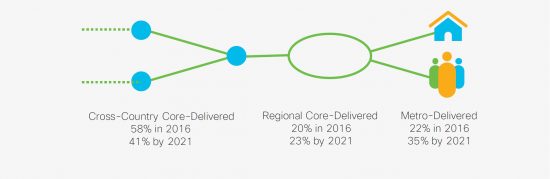
Consider a typical Internet user in North America. Today, over a third (35%) of the content accessed by this user is sent from a point within the same metropolitan area. Thanks to content delivery networks, a growing amount of Internet content is stored close to home. By 2021, over half (51%) of the average North American Internet user’s content will be delivered from within their own metro network.

The global numbers are lower, but the trend is the same. Globally, 22% of Internet traffic is delivered within the user’s own metro network today, and that will grow to 35% by 2021. Metro-delivered traffic will grow twice as fast (39% CAGR 2016-2021) as traffic traversing long-haul backbone links (19% CAGR 2016-2021).

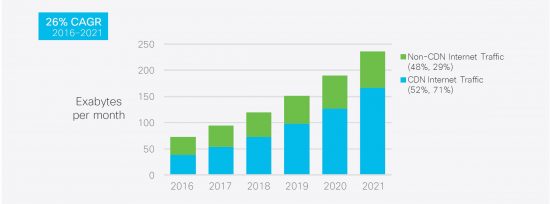
There’s no mystery about the localization of Internet traffic: content delivery networks are the primary factor responsible for the trend. (The other factor is data exchange at the edge by IoT modules – a topic for another post, perhaps.) By 2021, 71% of Internet traffic will be delivered from a content delivery network (CDN), up from 52% today. CDNs are more developed in some parts of the world than others – in North America, 93% of Internet traffic will cross CDNs by 2021, while in the Middle East & Africa the CDN traffic share will only be 34%. Even where CDNs are well-developed, CDN traffic is not automatically local. Much CDN traffic still traverses regional core networks and even cross-country core links, either due to lack of presence in the end-users local area, or due to content routing that depends on factors other than distance.

In our VNI estimates, CDN traffic includes traffic both from third-party CDNs like Akamai and Limelight, and from private CDNs. Private CDNs are those operated by content providers for their own content. Google, Amazon, Microsoft, Facebook, and Netflix are examples of content providers with their own content delivery networks. Private CDNs are currently responsible for 61% of all CDN traffic, and this will rise to 68% by 2021.

These developments can raise a bit of angst in anyone with a fondness for the decentralized early days of the Internet. The content is concentrated in the hands of a few companies, and the delivery of this content may bypass much of the Internet’s infrastructure if it is delivered from within a user’s metro area and traverses only a single service provider’s network, so it isn’t “Internet traffic” in any meaningful sense. To an Internet veteran’s ears, this sounds more like a description of a broadcast network than a description of the Internet. But the decentralized and global spirit of the Internet persists in the discovery and exchange of content and information, even if not in the hosting and delivery.

Personally, I am not bothered by the prevalence of a few in content hosting or the role of CDNs in content delivery. It does seem to me, however, that replicating a broadcast-style infrastructure is costly on a global scale. Is there an alternative? There are some early indications that the intelligence possible with software-defined networks (SDNs) may help routing become so dynamic and adaptive that CDNs don’t need to become universal in order to make low-latency responsiveness a reality for most Internet users.

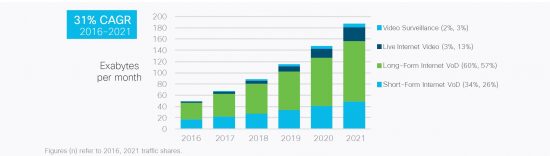
In the short-term, content delivery networks are here to stay and are likely to increase in importance with the advent of live video. VNI projects that live video is poised to grow 15-fold and will account for 13% of all Internet video by 2021. Live video will require low latency and high quality, and distributed delivery is ideal for live content such as sporting events and concerts that attract large audiences.

Video in all its forms will make up 82% of IP traffic by 2021, up from 73% today. The impact of video on the Internet has been transformative. Whenever the analysts on the VNI team are asked to explain a certain change in traffic patterns (the increase in peak to average ratios, the factors driving offload in mobile, the relative growth of upstream and downstream, to name a few), the answer usually has something to do with video. One of the most important but least visible implications of video has been the growth of CDNs and the subsequent reconfiguring the topology of Internet traffic.  Video, and the CDNs that deliver video, are bringing the Internet closer to home for billions of people around the world.

VNI Forecast Resources

Authors

Arielle Sumits

Senior Analyst

Service Provider Marketing

Avatar

Three Internet Trends that Warrant Global Service Provider Attention (and Action)

Today, consumers and business users depend on global IP networks more than ever. While it can be easy to take connectivity for granted when networks are working well, it can be a minor inconvenience or a major hardship when networks fail or provide sub-optimal experiences. Global service providers are constantly monitoring, managing, and innovating their fixed and mobile infrastructures to meet subscriber demands. As part of our annual Visual Networking Index (VNI) Complete Forecast, we have focused on analyzing Internet traffic and digital trends for more than a decade. Here are three networking and Internet trends that should be on a “watch list” for most service providers.

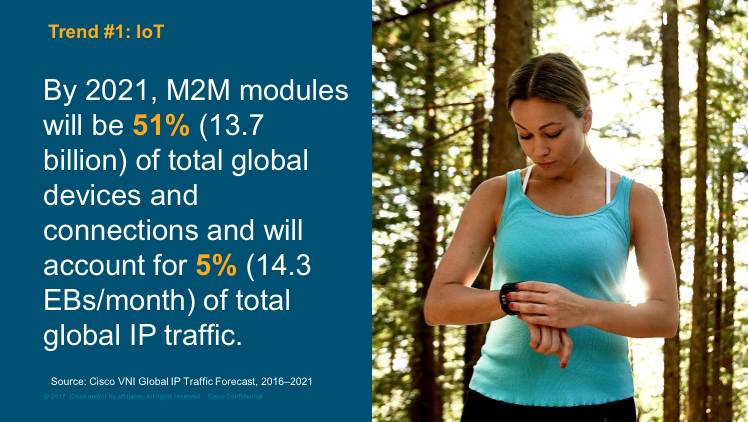
Implications: The Internet of Things (IoT) phenomenon, in which people, processes, data, and things connect to the Internet and each other, is showing tangible growth. Globally, M2M connections will grow 2.4-fold, from 5.8 billion in 2016 to 13.7 billion by 2021. There will be 1.75 M2M connections for each member of the global population by 2021.

Recommended Action: The transition from an IPv4 environment to an IPv6 environment is essential for IoT deployments. Service Providers need to have an IPv6 strategy enable new device capabilities, and activate IPv6-compatible content. The IPv6 addressing scheme also offers enhanced security features (compared to IPv4), which is also critical for IoT data integrity and success.

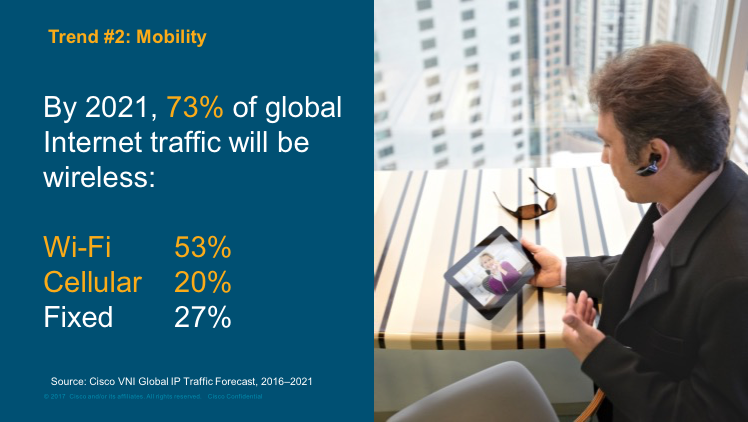
Implications: The rapid growth of mobile data traffic has been widely recognized and reported. The trend toward mobility carries over into the realm of fixed networks as well, in that an increasing portion of traffic will originate from portable or mobile devices.

Recommended Action: For mobile carriers (and other network operators as well), a migration plan to 5G is extremely important. From a Wi-Fi perspective, carriers need to be looking toward ratification of a new unlicensed spectrum standard — 802.11ax. These wireless access innovations are inherently designed to support advanced IoT connectivity as well as personal communication devices.

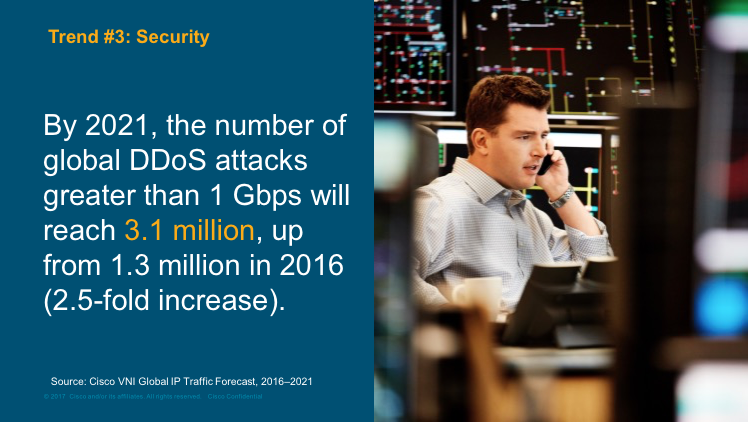
Implications: As hard as service providers work to maintain and innovate their infrastructures, there are cyber criminals working just as hard to infiltrate private networks and compromise personal or proprietary data. Distributed denial of service (DDoS) attacks that are 1.2 Gpbs or greater can inflict enough damage to take most organizations completely offline.

Recommended Action: A comprehensive security strategy is key for long-term sustainability and profitability. Various levels of protection (hardware and software) are required to prevent network breaches and to protect private records and data.

VNI Forecast Resources

Authors

Thomas Barnett, Jr.

Director, SP Thought Leadership

Worldwide Service Provider Marketing Group

Avatar

In your everyday life, it’s hard to miss the impact of wireless. We’re no longer tethered to our desktop computers or corded home phones. Our music now streams wirelessly on our headsets or in our cars. And when you’re looking at wireless platforms, you have lots of options—such as Bluetooth, Wi-Fi, and LTE.

The challenges of wireless in a factory setting

Despite its prevalence in other areas of our lives, wireless in industrial settings isn’t as ubiquitous as one might think. There are a number of reasons for this, but mainly it has to do with the environment. Have you ever driven in your car and had the signal cut out? Or listened on your headset and the sound drops our briefly? That’s usually due to some sort of interference or blocking of the signal. You could be driving under a bridge or past some tall trees. You could be running down a street near some lighting that causes signal interference with your Bluetooth headset and causes your music to cut out.

These are common issues with wireless in normal environments. But now consider the additional challenges in a dense setting like a factory—where there’s lighting, movement, heavy equipment, machinery, dust, and lots of noise in a contained area. All these scenarios make deploying wireless in an industrial setting more complicated than, say, turning on your wireless router in your house. However, there are solutions built for these kind of environments; it just takes some careful planning to implement them effectively.

https://www.youtube.com/watch?v=cnHObPi_my8

Industrial wireless: The benefits

Wireless offers many benefits in a factory. To call out a few:

  • It enables better tracking of assets and resources.
  • It helps reduce cabling costs.
  • Legacy machinery that was expensive to pull data from can be retrofitted with sensors to enable better overall equipment effectiveness (OEE).
  • Employees can become more mobile, which can lead to better collaboration and the ability to resolve issues in real time.

But with all the benefits of wireless, there are many stories out there about how a wireless project went wrong in an industrial setting. In fact, many wireless projects have to be restarted because of lack of information or poor planning.

What can go wrong—and how to avoid it

Let’s touch on three commonplace missteps:

  1. Using a standard enterprise solution. Industrial settings and enterprise settings need different types of equipment. Because of the rugged environments mentioned above, regular enterprise-grade equipment will often fail shortly after being deployed. It’s important to align equipment standards to the type of environment your wireless project is being deployed in.
  2. Not conducting a site survey. When a road is being built or altered, you often see survey engineers on the side of the road taking measurements and making calculations. The same should be done for any wireless project. It’s important to look at the layout, critical locations, and coverage when developing a plan. Effective site surveys determine the critical elements of a wireless plan.
  3. Not bringing IT and OT together. Here’s a common scenario with industrial wireless projects: The operations technology (OT) group is working on a project that involves wireless. They turn to the IT department to handle it all because they implemented wireless in the office space. But what’s often missed in this scenario are the nuances of a factory setting that the OT teams deeply understand.

Another common scenario involves “one-off” projects that don’t scale as more devices, people, and sensors begin using the wireless backbone. IT and OT need to work together and coordinate priorities as well as prepare teams for the change management that comes with new wireless technology.

To help you with your industrial wireless project, we’ve developed a guide that outlines best practices, common misconceptions, and key equipment considerations. I also encourage you to check out some of key wireless case studies and resources here.  Good luck with your project!


Authors

Eric Ehlers

No Longer at Cisco

Avatar

Here’s the truth: When Cisco acquired the startup that I worked for three-ish years ago, I was not stoked.

I loved that startup. Loved the autonomy I had to get things done, loved the agility that comes from being small, loved our mission, and loved, loved, loved the people I worked with. I was in no rush whatsoever to be sucked back in to a corporate behemoth with a rigid culture riddled with unnecessary processes and strange, uptight people that overdressed for work every day because the man said they had to. No thanks.

But the deal was already done, and I wanted to help ensure the success of our product, so I resisted the urge to flee. And I’m so glad I did.

Because as it turns out, Cisco is one of the best places I’ve ever worked. And I think that’s ultimately because it’s a very merit-based company, which is to say—they don’t care much what you dress like, how old you are, or where you do your work, as long as you rock your job. They want people who are good at what they do and passionate about doing it, and that’s the bottom line. In fact, it’s not just that they tolerate your unique nature here—they support it. They encourage you to revel in it. To fly that freak flag.

The result? A whole bunch of really cool people work—and thrive—here. Incredibly intelligent and generous people that are all doing their part to help Cisco change the world for the better.

And that’s where Carmen and Casie come in. Their job is to put a spotlight on life at Cisco. To help those outside of our company understand what it’s really like to work here. To break down the stereotypes that people like my old self might be harboring, so that more unique and talented individuals start considering Cisco as their ultimate employment destination.

Is it easy? No. Carmen acknowledges that proving we’re not a corporate dinosaur is an uphill battle. But it sure sounds fun. These ladies are having a great time doing their jobs, and their interview with Niki provides a valuable peek behind the curtain for anyone who’s considering working at Cisco. This is definitely not our cloudiest nor our most technical interview, but I think you’ll enjoy it regardless. Tune in to Episode 10 to hear Carmen and Casie talk about:

  • Cisco’s donation matching program
  • Paid volunteering days
  • Our giant social responsibility team
  • Examples of how the company puts employees first
  • Our internship program
  • Why they let a different employee take over our Snapchat account every day

See the video podcast on our YouTube page, listen to the audio version on iTunes, or check out past episodes in our archive. And if you like what you hear, we invite you to subscribe to our channel so you don’t miss any of the other exciting podcasts we have scheduled over the next several months.

Authors

Ali Amagasu

Marketing Communications Manager

Avatar

Leonardo Da Vinci once said, “It had long come to my attention that people of accomplishment rarely sat back and let things happen to them. They went out and happened to things.” Now is the time for women to make things happen.

We have created a digital world knitted together by millions of connected devices modeled after our own human brains. Every new technology opens the door for greater expansion and innovation while also breeding new challenges to solve, including security and privacy. Yet, we are not innovating fast enough to counter these challenges. There is a ton of work to do and a significant shortage of over one million cybersecurity professionals in the industry. Even more staggering, women comprise only 11 percent of the cybersecurity workforce.

Now is the time for women to “happen to things” as Da Vinci said, and seize the opportunity to contribute to an industry that is impacting the way each of us lives and works.

My own Da Vinci story began as an undergraduate in psychology at the Ohio State University. I worked in the educational robotic department and documented the behavior of students as they manipulated robotic arms. As I watched nearly every kid get a laugh out of their ability to hack into and reset the machines, I wondered what it would mean for the technology to actually make a difference in people’s lives. This early experience was the beginning of a lifelong fascination with self-efficacy and the ability of technology to solve human and worldly challenges. More importantly, it set into motion a passion for bringing kindness and humanity to an industry traditionally governed by uniform thought.

As malicious actors continue to test our technologies and develop innovative ways to break down our security and privacy barriers, the cybersecurity industry needs to get creative and expand beyond traditional roles and technologies. We can fight for and win back trust in technology, in communities and in ourselves. This includes growing the talent pool to include and embrace diverse perspectives.

Increasing the number of women in the cybersecurity profession broadens the spectrum of ideas brought to the table and strengthens every company’s position in combating the most sophisticated attack methods. But it doesn’t stop there. Retaining talented women is just as important as getting them through the door.

If every experienced professional in the industry selected one person to coach and inspired them to stretch beyond their limiting beliefs or surpass the barriers holding them back, it would take only half a generation to have enough competent people working in a respectful environment to develop an abundant, innovative workforce. At Cisco, we call that the Multiplier Effect.

With each new technology and subsequent attack method, the cybersecurity industry is growing at an exponential rate. We cannot afford to exclude major pools of job candidates, which is why it is crucial for companies and leaders to build inclusive and respectful work environments.

After all the bugs are patched, the gear is installed and the lights are blinking, the only thing left is the data and the human stories people remember about each one of us. We in the industry need to extend a helping hand to people on their journeys and build a more cohesive cybersecurity ecosystem. Let’s join together and “happen to things.” We’ve got this.

Michelle Dennedy, VP, is Cisco’s Chief Privacy Officer. Recently, she keynoted the 2017 Women in CyberSecurity (WiCyS) Conference, sharing her personal career journey and the unique opportunities that exist for women in the cybersecurity industry.

Authors

Michelle Dennedy

No Longer with Cisco

Avatar

Artificial Intelligence (AI) and Machine Learning (ML) are transforming entire industries because of higher performance and faster time to market. Part of the success is due to researchers creating and open sourcing datasets, frameworks, and algorithms (e.g., ImageNetCaffe). Current leaders are following suit by opening up their own developments (e.g., DeepMind Lab and Sonnet, OpenAI Gym and Universe). Despite this generosity, operating and developing on these components still requires large amounts of expertise and vast computational resources.

Jack Clark of OpenAI believes that this situation seems to benefit large-scale cloud providers like Amazon, Microsoft, and Google. All of these companies have an incentive to offer value-added services on top of basic graphics processing unit (GPU) farms. This is also why our data center people are working with NVIDIA to add GPUs to our Unified Computing System (UCS) line (Dec 2016).

The addition of GPUs makes it likely that each cloud/appliance will specialize around one or more particular frameworks to add value as well as services that play to each provider’s strengths. For instance, Amazon: MXNet integrated with the AWS suite. Microsoft: CNTK integrated with business-process automation and LinkedIn data. And Google: TensorFlow integrated with ecosystem ML services.

While this makes business sense in the short to medium term, it might severely limit the potential of AI in much the same way the von Neumann architecture got us all stuck onto CPUs until now. To uncover paths that might be 100 times more powerful than the current state-of-the art, it’s necessary to still provide researchers, startups, and hobbyists the possibility to experiment with low budgets.

Distributed AI Development Using Blockchain

French researchers have outlined Morpheo: A distributed data platform that specializes in ML—especially transfer learning—and uses the blockchain for securing transactions. Thus, creating a trusted compute economy. The system (outlined in this research paper) lets researchers access large amounts of distributed computers, using cryptocurrencies to buy and sell access to compute and data. The researchers announced that, “The first stable release with a blockchain backend is expected in Spring 2018.”

On the same vein, albeit not specialised in AI, there’s Golem: A decentralized, open source supercomputing system. It lets people donate their own compute cycles into a global network, and will rely on Ethereum for transactions. Every compute node in the network will have a reputation, a measure of trust that changes according to how well it completes the jobs associated with it. Using reputation as a token of value, this system is also poised to create a trusted compute economy. Golem will release its first iteration in a few months under the form of a Computer-Generated Imagery (CGI) rendering system.

There’s Plenty of Room at the Bottom

The development of a “dual AI economy” is worthwhile to follow because significant opportunities might arise in both camps. Additionally, the synergy with blockchain makes these initiatives twice as interesting. You never know what you’ll find in the long tail, especially if you’re busy trying to sum it all together…


Authors

Nicola Rohrseitz

Lead, Strategic AI Program

Chief Architecture and Technology Organization

Avatar

In our previous blog post—on the scope of illegal streaming—we analyzed one of the forums that hosts illegal streaming server offers and concluded that it reaches at least 285,000 viewers.

That’s an impressive figure. But what does it mean in financial terms? Or to be more specific, how much are pirates making on these closed illicit streaming networks and what can we anticipate in the future?

In this post, I will try to answer these questions, based on our experience and constant monitoring of the piracy scene.

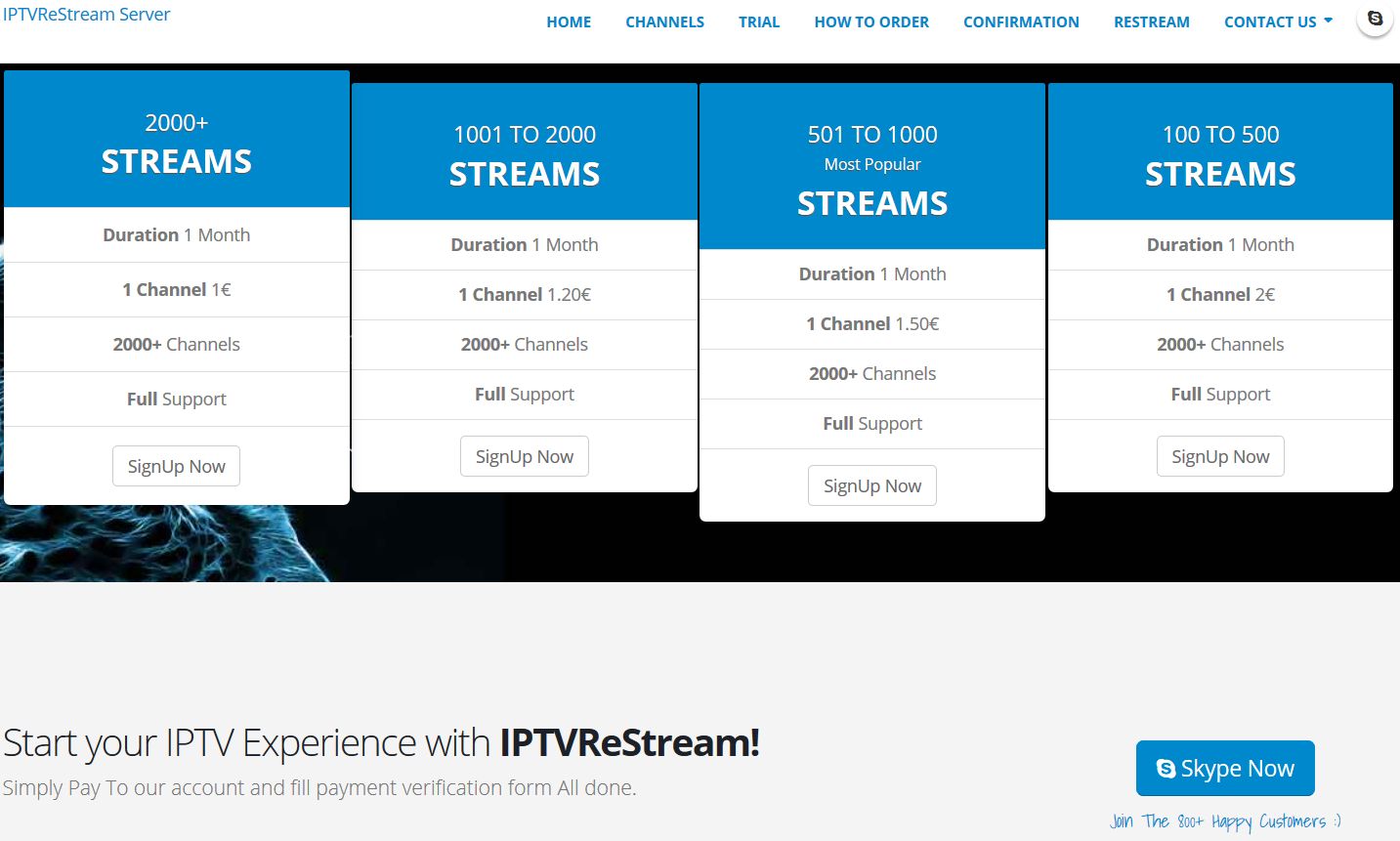
While prices vary across regions and service types, our research shows that a subscription to an illegal IPTV server costs an average of €12/month. Multiply this by 285,000 subscribers, and you have an average of €3.4 million circulated every month from this single forum!


Read that again. €3.4 million a month, from a single forum. Untaxed, unreported.

And this is clearly a growing phenomenon. Looking again at our sample forum, in April 2017, there were a total of 285 servers offered. In January 2017, there were 257. A year earlier (January 2016), there were just 101 servers. That’s an increase of 154 percent in a single year!

Our field knowledge, intelligence, and frequent conversations with customers all indicate that illegal streaming will continue to increase at high rates every year, at least for the foreseeable future.

There are many other forums like this one and plenty of other ways to advertise illegal streaming services. The total financial value of illegal streaming piracy may be subject to debate, but the numbers are clearly enormous.

To help understand the growth of streaming piracy, we explore the following question: how much profit is each pirate making from each illicit streaming server?

If, as per our previous blog post, we factor in an average of one thousand subscribers per server, and apply the same average monthly subscription of €12/month, we are talking about  a “gross revenue” of approximately €12,000 per month per server.

As for the costs – here are some of the major ones:

Bandwidth:

A cloud server with a 100 Mbps bandwidth can handle 40 subscribers at a cost as low as €3/month. We covered some of those calculations in our blog post on the shifting from card sharing to content sharing.
In order to have enough bandwidth to serve 1,000 clients, the illegal provider needs to invest minimum €75 in bandwidth. Let’s assume he will purchase some extra bandwidth and a few more cloud servers as backup.  So that’s up to €130 a month for bandwidth costs.

Server software:

Most streaming servers also use software, such as “IPTV panel”. This software includes all the necessary tools to run IPTV broadcasting operations: subscriber management, channel management, packages, prices, statistics, and more. The monthly cost of IPTV panel is around €70/ month.

Channels and Content:

There are several methods of getting the channels to the streaming server. The easiest and most common method,  “re-streaming”, involves the streaming server owners replicating and selling their content to other pirate servers. Since the streams are already in the cloud, it is very easy to transfer them from server A to server B. Server B can have exactly the same channel offer as server A, but with its own customer base. The server owner can buy 1000 channels replicated to his server for €1200 /month. This is a fixed cost regardless of the number of clients. As the number of paying subscribers increases over time, this initial cost is easily recovered.

Other costs:

A typical illegal streaming service may have additional costs that can improve their service. For example, websites, advertising on forums, human resources and support. While it is difficult to accurately calculate this cost, an average pirate usually won’t invest beyond 5% of total revenue for those purposes. In our case, that translates to €600/month.
Now let’s calculate the net profit of such a pirate server.

Based on our analysis above, the average monthly cost for an illicit streaming server with 1000 subscribers + 1000 channels, can be as low as €2,000 per month, while the estimated income is €12,000.

That’s a profit of over €10,000 per month for an average server, or around 80% profitability!

It’s no wonder then that additional illegal streaming providers are popping up every month! The more subscribers, the higher the profit.

Beyond the allure of high profit for pirates, we see multiple additional reasons for the significant increase in illegal streaming:

  • Growing acceptance among consumers. Young generations are the biggest consumers of illegal streaming services. They see nothing wrong in streaming content “freely,” and they will continue doing so. Others will also join this trend. According to this recent survey, 54% of millennials have watched illegal streams of live sports and a third admit to regularly watching them, compared to only 4% of over-35s.
  • Older methods of pay-TV piracy are declining. Card sharing/Control Word sharing is on the wane. Broadcasters and conditional access providers are introducing effective new technologies that can permanently stop illegal sharing of Pay TV subscriptions from set top boxes. Pirates then turn to the current weakest link and easiest option: illegal streaming.
  • Pirates offer complete services. Pirate streaming servers often offer more features than legit services, such as watching “catch up” recordings of live channels up to 14 days back, VOD content with whole seasons of TV series and the latest movies, support for almost any device and operating system, integration with Kodi, no geo-location restrictions, and 24/7 support. Pirate streaming providers have become a real and material threat to legitimate operators and broadcasters.
  • Increasing broadband availability. High speed internet use continues to grow all over the world, making stable illicit streaming more accessible and more convenient.

Looks like pirates have found their treasure island! Will their treasure chests continue to pile up?
Feel free to use the comment box below to share your thoughts with us.

For more on our piracy intelligence research findings, please see these related blog posts:

Authors

Miro Pinkas

Information Security Engineer and Analyst

Anti-Piracy at SPPA (Service Provider Platforms and Applications)

Avatar

Together, Cisco and Pure Storage are extending the definition of converged infrastructure to deliver flexible growth. Easy implementation. And choice and transformation. Solutions such as Cisco UCS and Pure Storage’s FlashStack have revolutionized the deployment of converged infrastructure by creating powerful efficiencies for the data center and the business.

Customer Lifescript bolsters IT health with the help of FlashStack. Lifescript is the number one ranked website dedicated to women’s health. The site inspires women to be proactive about their health and helps them build a support network of experts and other users. Since its founding in 1999, Lifescript has gone through several format and business model transitions. With the help of FlashStack, Lifescript went from a vitamin plan provider to the #1 website dedicated to women’s health in a few short years. Today, it attracts 18 million unique visitors and 100+ million page views monthly.

Jack Hogan, CTO of Lifescript will be sharing his story at Pure Accelerate in San Francisco next week. Planning to attend? Join Jack and Cisco Executive, Siva Sivakumar on June 13th at 12pm PT. Full case study can be found here.

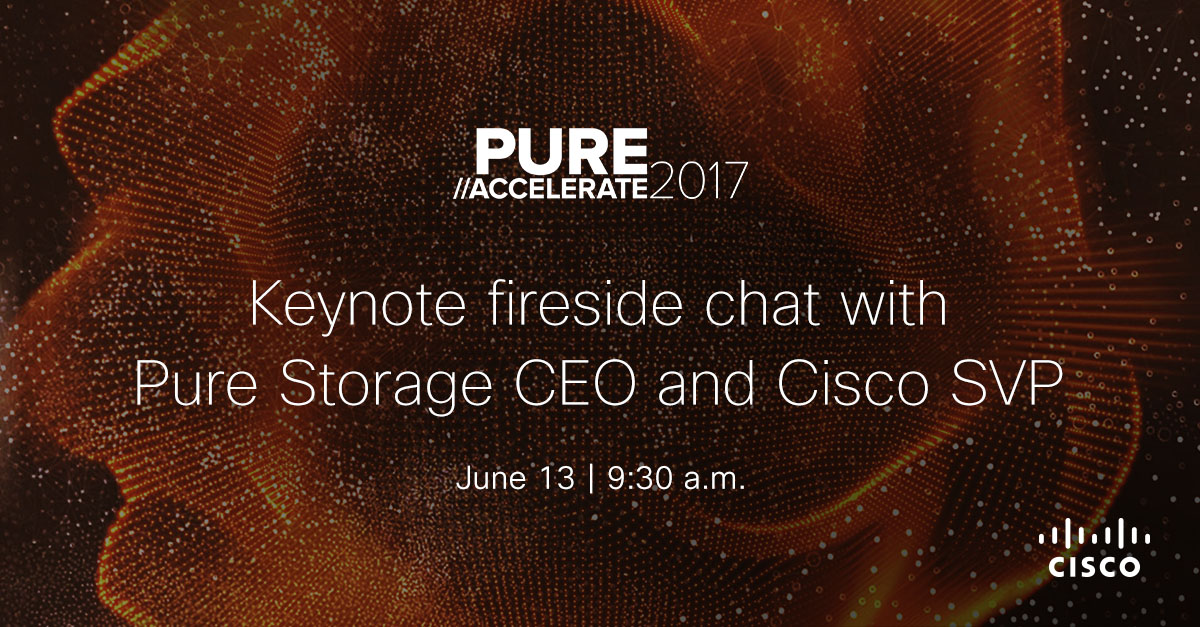
You also won’t want to miss the Fireside Keynote Chat with Pure Storage CEO, Scott Dietzen and Cisco Senior Vice President and General Manager of Computing Systems Group, Liz Centoni.

Attending the Global Partner Forum prior to the conference? Join us for Cisco Executive Nirav Sheth’s opening keynote – Partnering for Success in Today’s Hybrid Cloud World. Monday, June 12th at 8:30am PT.

For a full list of FlashStack sessions at Pure Accelerate, click here.

Want to learn more and have a chance to win an Amazon Dot or Apple Watch? Visit Cisco at booth 6 and attend a mini theater session or get a demo from one of our subject matter experts.

To schedule a 1:1 meeting with Cisco at Pure Accelerate, please contact us at: ciscopuremeetings@cisco.com

For more information on FlashStack solutions, visit: cisco.com/go/flashstack

For live social media coverage of Cisco at Pure Accelerate, follow #CiscoUCS

We look forward to seeing you next week!


Authors

Reesha Dedhia

No Longer with Cisco