Avatar

If President Trump gets his way in the next fiscal budget, Federal Agencies will get nearly $100 billion to spend on IT. The problem: The president never gets his budget request passed as written, and this president is attracting an unusual number of Congressional critics from within his own party, says Cisco Fellow Alan Balutis. There is no shortage of critique from outside analysts either.

However, Balutis notes that the budget process in Congress might leave IT funding in place. In fact, “Congress has a history of appropriating more for IT than the administration has requested. So prospects are positive for this community,” Balutis wrote in an article for MeriTalk.

Alan Balutis

Most press coverage of the FY 2018 budget proposal has focused on its deep cuts to various programs and organizations; federal IT, however, would total $95.8 billion, $5.4 billion more than the FY 2016 budget and 1.7 billion more than 2017. The total would include a $228 million pool earmarked for modernization and overseen by a board that would allocate the fund to the highest priority projects.

There’s no way to know what the final budget will look like after both houses of Congress have their opportunities to debate and amend it; it’s nice to see a focus on IT modernization, though, given how urgent the need is in many agencies.


Authors

Michael Hardy

US Federal SME

Cisco Americas Public Sector

Avatar

Everyday networks are being hammered with multiple types of threats, coming from a variety of sources. To make matters worse, these threats often use sophisticated techniques to be undetected by traditional security methods. Proliferation of IoT devices increase these risks as most IoT devices often use non-standard protocols, non-standard stacks and limited or no support for supplicants.

Cisco is always ahead of the curve when it comes to providing the defensive mechanisms and security tools way before the competition. One such mechanism, Cisco Digital Network Architecture (DNA) offers the scalability, resiliency and ease of operations all while strengthening your network security.

Accuracy and speed of detection is the key in detecting and mitigating attacks. So it’s essential to analyze every packet flowing through the network, whether its east-west traffic or north-south traffic. The larger the number of data set, the more accurate the attack prediction and the quicker the attacker detection will be realized. This also means less false positives.

Recently, the independent testing lab Miercom pitted Cisco against HPE/Aruba in a test to see who had the best level of visibility to provide stronger securiry. Spoiler alert: it was Cisco!

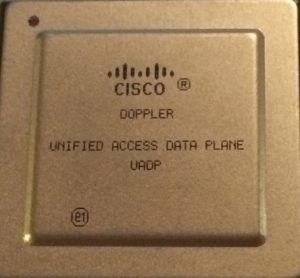
Cisco NetFlow is a powerful technology that gives you visibility into your entire network activity—from the wired switches to the wireless controller to your access points. Cisco Unified Access Data Plane (UADP) ASIC is designed to handle large packet analysis without compromising the switching performance.

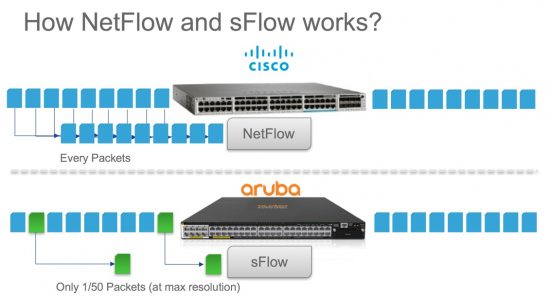
Contrary to Cisco, HPE-Aruba relies on sampled flow (sFlow) information to identify threats in the network. But sFlow has a flaw in its name—that the the packet flows are sampled out of a large dataset. What does this mean? It means that there’s a huge probability that attacks or anomalies in the network can easily go undetected because sFlow did not analyzing the entire packet set.

At its highest resolution, sFlow can monitor only 1 out of 50 packets! That’s on the good side as the range can be as high as 50 packets to as low as 16,441,700 packets. So, 49 packets are forwarded over the network without getting detected! As an attacker, I have a great chance to inject malware or anomalies in those unscanned packets in order to be undetected by the system.

What does this mean to the network administrator? The lack of accuracy ultimately leads to blurred analysis and false alarms. How do you know if you’re under attack when there are various traffic patterns on the network? Some of these traffic patterns are volumetric, or some are short and in bursts. Miercom ran a number of traffic sets on the wire and compared how Cisco with Full Netflow compared to Aruba’s sFlow implementation.

It wasn’t good – for Aruba.

Cisco achieved 100% accuracy as oppose to HPE-Aruba’s 2% accuracy (at most aggressive configuration). Furthermore, Cisco precisely identified the attack signatures, source of attacks and the attackers. HPE-Aruba did not support the sFlow on wireless offering. So, for HPE-Aruba’s solution, it’s always hit or miss and often depended on traffic type and volume.

As you know, traffic type and volume are two variables that a network administrator can never count on as being consistent.

Once the threat is identified, Cisco can employ mitigation techniques like quarantining either the attacker or the infected user device by use of a sophisticated techniques like CoA (Change of Authorization) using Scalable Group Tags.

Miercom also evaluated Cisco’s Network as a Sensor (NaaS) and Network as an Enforcer (NaaE) solution against the HPE-Aruba’s crippled security offering. The report proved that Cisco is much reliable, accurate and dependable when it comes to network security.

Bottom-line: Cisco’s heavy investment in the custom silicon ASIC offers the peak performance with the granular traffic analysis without impacting switching & forwarding performance. Network as a Sensor & Network as an Enforcer offers complete solution to identify threats and anomalies and take immediate action to secure entire network infrastructure.

Download the complete Miercom report here.

Authors

Richard Licon

Principal Technical Marketing, Engineering

Product Management - Competitive Insights

Avatar

Last year, we announced our successful certification of Cisco ACI Inventory Management App with ServiceNow. The application can be found in ServiceNow store. Since then we have advanced our ACI integration use-cases and building newer solutions such as Tetration-ServiceNow.

In this blog, I want to provide a refresher on the existing ACI use-cases and as well a quick walkthrough of newer ones and how customers can leverage these advancements as they turn to cloud to accelerate innovation, expand market reach and reduce IT costs.

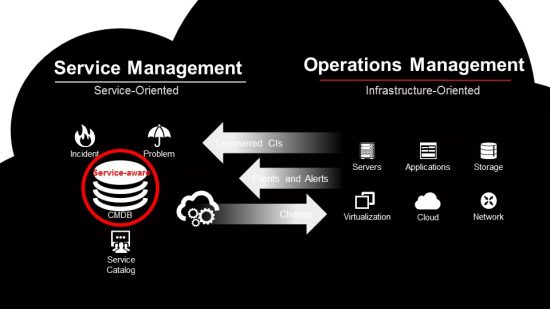
Challenges Facing IT Operations: ITSM Stakeholders are increasingly contemplating over how to create a unified operation model for next generation ITSM. Traditional IT spending is shifting over to the Cloud to accelerate innovation and reduce IT costs. Challenges the IT department faces to meet the increasing demands of providing quick and flexible business services include:

  • Manual service mapping
  • Lack of correlation between infrastructure changes and the business services
  • Disconnected infrastructure tools and portals for change management and troubleshooting
  • Inefficient root-cause analysis for service outages

Cisco ACI and ServiceNow joint solution provides a fully-automated policy based enterprise service management solution to address these challenges.

ServiceNow is a leader in ITSM/ITOM business services and Cisco in DC/Cloud infrastructure fabric. Our ACI customers at Customer Advisory Board (CAB) meetings have been telling us that the ITOM/ITSM layers have been trickling down to DC/Cloud infrastructure for quite some time. In fact, these customers have been using ServiceNow to extract business critical information from the network and in some cases they have been actually provisioning and managing the underlying infrastructure. This blog presents the ACI-ServiceNow solution use-cases and their key benefits in this context.

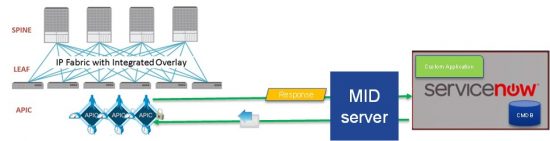
The diagram above shows the conceptual integration architetcure of ACI-ServiceNow joint solution. The key integration use-cases fall under :

Populate and enrich CMDBBroadly, physical inventory tracking, configuration and endpoint tracking, configuration rollback, delta tracking and intgeration fall under this use-case.

The Cisco ACI Inventory Management application initiates a discovery of Cisco ACI infrastructure using scheduled jobs and scripts. The application uses Cisco API REST APIs to import the object model information from ACI and map them to different CMDB tables resident in ServiceNow. The Cisco ACI Inventory Management Application uses MID server interfaces to communicate with Cisco ACI Fabric controller (APIC).

There are two broad discoveries, one the Cisco ACI Physical topology discovery (switches, APIC controller, node links, chassis information, etc) and the other Application topology discovery (logical information such as tenants, EPGs, Contracts, configurations, Policies etc) both initiated through the scheduled jobs by the user.

Change Management – Using the ServiceNow app available on ACI App Center, all the changes made to the infrastructure can be tracked automatically and ServiceNow ‘s CMDB will be updated with the most recent changes.

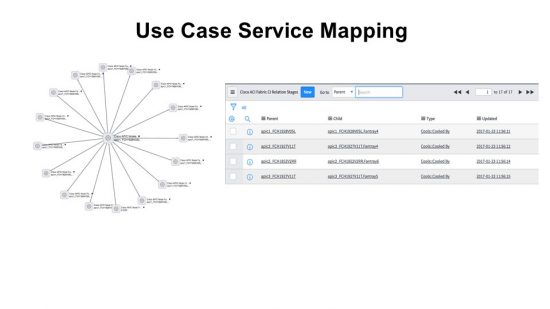
Service Mapping: The service mapping is automated, which gives a graphical view of all the services that a component relies on and the relationships between business services. This gives a more real time visibility to the infrastructure thus helping the IT Operations team to respond to the issues quickly and be more proactive. This unique approach eliminates irrelevant data points and creates accurate service maps in minutes.

Configuration and workflow management:

Component Configuration – ACI components can also be configured from ServiceNow instance using the ‘Cisco ACI Application’ plugin available on ServiceNow Store.

Custom Activity Packs – Workflows can be built using the available custom activity packs to automate the component configuration process using the application on ServiceNow instance. ServiceNow core packs can be used in the workflows to customize the workflows according to requirements (e.g. Approval Workflow process)

Benefits of ACI-ServiceNow solution

Automation: With the ServiceNow and Cisco ACI solution, IT organizations can drastically reduce the time required to map new services and detect changes for existing ones. The solution not only enables fast and accurate service mapping process, but also enables you to reclaim or retire applications, servers, and storage and networking resources when they are no longer needed, resulting in operational agility and efficient use of resources.

Visibility: Cisco ACI enables ServiceNow to provide real-time visibility across scale-out cloud, virtual, and physical infrastructure. When service and infrastructure changes occur, including actions related to change requests, infrastructure events, and service outages, IT teams can quickly identify the root cause and determine the best way to remediate the issue, leading to drastically reduced mean time to recovery (MTTR).

Operational efficiency: IT operations teams respond more quickly and become more proactive with Cisco ACI keeping an up-to-date view of service-aware infrastructure and informing ServiceNow about the services that are available and the ways that they are connected. Improved automation, visibility, and compliance, coupled with dynamic and accurate service mapping, enable IT organizations to create realistic SLAs that can be met and to easily share them with stakeholders across the organization.

Conclusion: As customer adoption of ACI-ServiceNow become widespread, we will continue to cover newer use-cases to address IT operational pain-points in DC/Cloud. Cisco is actively engaging ServiceNow across a broad spectrum of products in networking (ACI, ACI App Center) and emerging analytics (Tetration analytics) to track baseline business service flows in compliance with policies and detect where deviations from baseline occur for automated policy enforcement.

If you happen to be in Las Vegas during Cisco Live (June 25-29), please visit us at the Data center world of solution demo pods to get a close view of how we work with ServiceNow. We have a great line up of technical presentations highlighting ServiceNow and Cisco integrations and also hands-on demo session showcasing how these integrations work in real life pragmatic use cases.

Related Links:

DC ecosystem: www.cisco.com/go/dcecosystem

ACI homepage: www.cisco.com/go/aci

Servicenow home page: www.servicenow.com

ACI Inventory Management App at ServiceNow Store

DC Blog: http://blogs.cisco.com/datacenter/cisco-cloudcenter-achieves-certified-integration-with-servicenow

Authors

Ravi Balakrishnan

Senior Product Marketing Manager

Datacenter Solutions

Avatar

Cisco will be at the 5G World and Connected Car events organized by TechXLR8 next week, June 13-15th in London’s ExCel Exhibition Center.

Not to miss highlights:

  • Keynote presentation on 5G advanced automation that optimized user experience from device through network
  • Live demo of Cloud Native 5G ready Ultra Services Platform
  • Demo of 5G ready self-optimizing network
  • Cisco executives and 5G experts available to meet and answer questions
  • Cisco-Jasper will be represented at a companion TechXLR8 event – Connected Car

Meet with us at Stand 5G136 to learn more about 5G, IoT, and networking in general. Hear our keynote titled “5G Automatic Self-Optimization” by Alon Ben-Ami, CTO for SON. This is going to be a great presentation that highlights more Cisco 5G innovations with advanced automation that optimizes (?) user experience from device through network. As we move towards network slicing and delivering critical video and IoT services it is important that the network can deliver automated per device quality control. This innovative capability will also be demonstrated at our stand at 5G World.

While you are visiting our stand, you will have the opportunity to meet Cisco executives from Development, Sales and Marketing. We also have several technical experts on hand, so please do stop by and talk with us.

5G World offers a Demo Zone and Cisco will be delivering live demonstrations of our 5G ready cloud native Ultra Services Platform. Do not miss our cloud-based edge computing enabling sub 1ms roundtrip latency over existing radio access technologies. The demonstration is given by our Ultra Services Platform architect who can answer any questions you might have about this solution.

While you are at the ExCel center you can also walk over to the Connected Car exhibit to see Cisco-Jasper IoT solutions and meet our IoT Jasper experts.

You can find more information about Cisco 5G and mobility here and here.

Authors

Dan Kurschner

Marketing Manager, Product/Systems

Avatar

You know the familiar adage about looking at the past to predict the future, right? That’s all well and good, but it doesn’t always work when you’re dealing with something that’s unchartered, unproven, and not to mention disruptive. Yet as businesses running technology companies in today’s hyper-changing world, that’s what we’re up against almost every day.

This was made clear to me through the many interactions I’ve had with partners since the beginning of the year. Starting with the Greater China Partner Conference in Guangzhou, China in January to yesterday’s Partner Technical Advisory Board in San Francisco, the topics that came up time and again was around how Cisco and our partners are going to capture more business opportunity from digitization, including updating customers’ outdated networks, shifting to recurring and predictive revenue models and the increasingly loud alarm bell around security.

While there’s no magic playbook for capturing growth opportunities out of change, this is where that old adage about looking at the past to predict the future actually does have merit. Over the course of 30 years, Cisco extended our relevance and value to customers by evolving and staying ahead of market transitions. Whether that’s VoIP, Telepresence, software defined networking, unified computing, security or others, anticipating and capturing market transitions is a core part of Cisco’s legacy and a big reason why you, our partners, have been so successful. It’s also why we’ve been able to maintain our leading competitive edge.

But equally important is making sure you are fully equipped and enabled to make these transitions with us. Representing approximately 85 percent of our entire bookings, you and our collective partner ecosystem are a vital link to not only advancing Cisco’s strategy, but also ensuring we deliver on the changing needs of our customers. It’s critical that we provide you the necessary tools and capabilities that enable you to capture the growth opportunities that market transitions present. This has always been – and will continue to be – a priority for us.

For example, when we saw the opportunity presented by developing professional services built around Cisco’s innovation, we made sure you had the tools, training, and resources to be successful. To this day, it’s not uncommon for a long-standing partner to mention the effectiveness of the return on invested capital model (ROIC) we developed that helped them understand their profitability, costs, and cash flow in a services environment.

There’s no question that digitization is a mega market transition unto itself and represents tremendous opportunity for Cisco and you. We began laying the groundwork a year ago with Cisco’s Digital Network Architecture (Cisco DNA).  Cisco DNA is foundational for customers who want to fully exploit the advantages of digitization. Open, extensible, and software-driven, the Cisco DNA architecture provides real-time insights, personalized experiences, automation and assurance. What’s more, Cisco DNA can turn a network into an intelligent security system that provides multilayered protection.

As we extend our heritage in network innovation with ongoing investments in Cisco DNA, intensify our focus on creating more recurring revenue subscription models and continue to invest in breakthrough security capabilities, you can rest assured we remain committed to your success. It’s no wonder independent research shows you’re exceptionally loyal to us. Your confidence and trust in us is a reflection of our commitment to your success.

I’d like to think we are your constant in a storm of digital change. Together, I know we’ll own the next market transition. Bring it on. We’ve done it before, we’ll do it again.

Want to learn more about Digital Network Architecture?

If you are not a partner with Cisco, learn how to get started today.

Questions or Comments? Feel free to connect with me on Twitter.

Authors

Wendy Bahr

No Longer with Cisco

Avatar

It’s Tuesday, and an orthopedic surgeon in Vail, Colorado and a research scientist in Oslo, Norway are discussing results of the latest study on reconstructive knee surgery. Together, they look at data, review x-rays, and sketch ideas on a whiteboard. By the time they’re done, the surgeon has a new plan for treating a complex case–and no one had endure a long, expensive transatlantic flight to make it happen.

Yes, the meeting was virtual. But the experience was almost exactly the same as a face-to-face meeting around a conference table.

Connecting surgeons and scientists

Thanks to Cisco Spark, real-life scenarios like this are playing out daily at The Steadman Clinic, a unique Colorado-based organization that mixes sports medicine and orthopedic surgeons with scientists from the Steadman Philippon Research Institute.

The clinic has a long history of successfully treating patients from around the globe: famous professional athletes, weekend endurance warriors, and everyone in between. And they firmly believe that strong collaboration and communication are the keys to positive patient outcomes.

So when it was time to upgrade their organization’s aging phone system, they knew that an ordinary solution wouldn’t be enough. That’s why they decided to implement Spark and Spark Board.

What exactly is Spark?

Cisco Spark is a simple, secure space where you can get things done from anywhere in the world. (Check out this video to see Spark Board in action.) By connecting your endpoints to the cloud, Spark allows you to call, meet, message, whiteboard, file share, and more–all of the things a busy medical practice and research institute need to do every day.

The result: A stronger team (and a drastically reduced phone bill).

So far, Steadman Clinic’s results are pretty impressive. They’ve cut their phone expenses in half. Access to critical documentation is quicker and easier. Scientists and providers have a closer, more productive working relationship. And the patients–all those people happily schussing down the slopes in the winter, bombing down mountain-bike trails in the summer, or just ambling around town without pain–are reaping the rewards.

Get an inside look at the story by watching the video:

https://www.youtube.com/watch?v=6vF97IeLtms&feature=youtu.be

Learn more about Cisco Spark and other remote care and collaboration solutions for healthcare organizations.

Authors

Amy Young

Marketing Manager

Healthcare

Avatar

We showcased our innovation at CommunicAsia in Singapore a week ago, highlighting the changing digital landscape and sharing insights on how companies should be ready for the future.

Our senior executives were on hand to address topics and trends impacting organizations across the region, from strategies to migrate to 5G, the importance of IoT/M2M in this transition and learning how to orchestrate network services in the age of the cloud.

I believe the industry is currently accelerating the shift towards digital transformation that is fast changing how businesses will be run in the next five years.

Buoyant outlook for mobility and smart devices

In Asia Pacific, mobility is seeing rapid growth. Cisco’s latest VNI forecasts show that by 2021, there will be 3 billion Asia Pacific mobile users accounting for 47 per cent of global mobile traffic.

From 2016 to 2021, data traffic from smart devices in the region will increase 23.5 times and M2M traffic grow 15-fold.

This is significant and a huge jump, and highlights the tremendous opportunities for growth in video, mobility and digitization in the ASEAN region.

Over the next few years, I see the ICT market and digital economy continuing to mature, as infrastructure spending and broadband penetration take off across many countries. The ever-changing mix and growth of smart devices makes the region one of the most exciting to watch this year. In Indonesia, for example, smart devices will make up 73% of total mobile connections in 2021, compared to only 34% in 2016.

Our forecast expects that the average mobile data growth for the Asia Pacific will rise 49%* year-on-year over the next few years, with several emerging country markets doubling every year.

How you can get ready for the future?

Today, most companies have a mix of business processes that were developed over time and are becoming difficult to manage. As business processes become increasingly digitized, new demands on the network architecture will rise. Over the next few years, for them to remain relevant, their networks must evolve to support more digital service offerings.

With 5G on the horizon, a whole new digital infrastructure is also needed to support high and ultra-high definition video and rich media telecommunications.

At the same time, the complexity of network operations is expected to increase as they become more dynamic.

Service Providers and Enterprises will need to future-proof and find a solution where the network infrastructure is fast and agile, and can facilitate the implementation of new services.

I believe that the next generation of enterprise mobility will ultimately be characterized by seamless services and pervasive collaboration, and that speed and agility will determine an organization’s future competitiveness.

One question many customers have been asking me has been – what are the practical steps they can take to evolve and transform their operations into a digital organization?

I think that as a business, if you want to forge ahead, you need to start by building the right foundations, step-by-step, to meet the demands of the future.

To do this, there are four areas where you can develop your digital strategy around:

  1. Simplification

Simpler networks enable your business to scale more efficiently when more devices are added to the network. It is also easier and faster for IT to come together to deliver new and innovative services when they are working in harmony.

  1. Virtualization

You can expand and grow your service offerings and reduce cost by decoupling network functions from hardware, separating control and user plane functions. This enables your organization to be able to think outside the box and innovate.

  1. Automation

You can innovate faster and reduce complexity and human error in configuration and provisioning, and use orchestration tools to rapidly create new and manage services and customize your customer experience.

  1. Programmability

You can leverage programmability to deliver a contextual and higher quality user experience by extracting real time or near real time data, analyse the data, apply policy and program the network and applications in real time.

Employing the four areas above in your network strategy will address the most pressing priorities of speed, efficiency, growth and security, and will help your organization thrive in a fast-changing environment.

The time to act is now

I feel that this is an exciting time for enterprises, consumers and service providers.

Countries in the ASEAN region are now experiencing the next wave of ICT growth and taking the steps to transform their businesses. It is time for you to do the same.

The team at Cisco will be helping to transform strategic industries and playing a key role in enabling businesses in the region to innovate and adapt for the future. Successful digitization, however, requires that companies improve their levels of service and network quality to provide seamless and higher quality experiences for their customers.

To achieve this, Service Providers  need to build simplified, automated and virtualized network platforms of the future based on industry-leading software, systems, silicon and services. This will enable your organization and business to reduce costs, speed time-to-market, secure their networks and sustain profitable growth in the years to come.

Authors

Dharmesh Malhotra

Managing Director Service Provider, ASEAN

Avatar

Out of respect for the incident in Virginia on Wednesday morning, we decided to postpone the #CiscoChat originally scheduled at that time. The chat will now be held on Friday, June 16, from 9-10a.m. PT. We apologize for any inconvenience, and hope you can join us on Friday.

All too often, very large numbers are thrown around to describe the growth of internet traffic and services. Here’s just a few from recent articles:

1) Annual global IP traffic from cloud-based deployments will quadruple to 8.6 zettabytes in 2019.

2) There will be almost 30 billion connected devices by the end of this decade.

3) Public cloud services will grow to be a $380 billion market globally by 2020.

While these predictions will likely come true (and, in fact, some may be underestimates), they don’t really give us an idea of “what’s in it for us?” We all know that videos on social media, Netflix streaming, and greater use of platforms like Amazon Web Services are a huge drivers of all these trends. But how do we prepare ourselves to work and thrive in this era?

Let me share a few data points that are more meaningful for those of us considering careers in information technology:

  • Python has been ranked the number one programming language in popularity by the popular site CodeEval for five years in a row.
  • In an international study by Infosys, almost three quarters of senior business decision makers said artificial intelligence will be fundamental to their business and product strategy. International Data Corp estimates that Artificial Intelligence-related hardware, software, and services will grow more than five-fold to be a $47 billion market by 2020.
  • Using insights gained from “big data” and analytics is completely changing the very process of decision making at companies. This industry is expected to grow into a $187 billion market by 2019.

There is not a single industry that won’t be impacted by these trends.

The underlying trend in all of these statistics is the rise of software and data to enable business operations, help companies become more competitive, and help them gather insights quickly to make changes. As Forbes magazine proclaimed in 2014, “The reality is that most firms today are already software companies … and will steadily become more so.  There is a new strategic imperative: agile.” Cisco CEO Chuck Robbins himself stated, “We have begun the journey to morph into a software company. In the digital world, data – and the insights it provides – is our customers most strategic asset.”

In the networking space, these trends will also have a profound impact. Gone are devices and networks that are closed, proprietary, difficult to manage, and hard to get data from. They are being replaced by networks that are open and programmable in order to make them easier to manage and adapt to changing traffic patterns and to cyberattacks.

If this excites and scares you at the same time, then good! Because with every challenge there lies an opportunity. To prepare for this new world, STEM-related skills are more important than ever. Specifically, understanding computer science and programming languages is becoming a key skill that has broad applicability.

We don’t expect new college graduates to be experts in OpenStack, containers, bots, or Netconf. The good news is that anyone with a solid background in programming fundamentals, computer science, and Linux, just to name a few, would have the ability to easily learn the core technologies that have now become the building blocks of networks. Thankfully, these skills are not out of reach.  In fact, many colleges and universities are starting to introduce these into their curricula.

Join us for a #CiscoChat on Friday, June 16, from 9-10a.m. PT as we discuss hiring and developing early-in-career talent in an industry where products and services delivered are evolving at an exciting pace. We look forward to discussing how you can be prepared to innovate “full speed ahead!”

Links and Additional Information:

Participants:

To participate in the chat:

  • Make sure you’re logged into your Twitter account.
  • Search for the #CiscoChat hashtag and click on the Latest
  • The chat will be moderated by the Cisco NetAcad channel (@CiscoNetAcad) on Twitter. Be sure to follow the account to participate. They will begin welcoming guests at 9am PT (12pm ET) and posting questions for discussion.
  • For @ replies to specific participants in the discussion, please use a “.” at the beginning of the Tweet. This way, your question or comment will appear in your public Twitter feed.
  • If you need multiple Tweets to answer a question, please preface each tweet with “1A, 2A,” etc., to make it easier for others to follow along with the conversation.
  • Be sure to use the #CiscoChat hashtag at the end of each Tweet so others can find your contributions to the discussion.

Don’t forget to bring your own questions to the discussion as well! We look forward to seeing you there.


Authors

Gaurav Khanna

Engineering Manager

Global Sales - Virtual Systems

Avatar

The rapid and inevitable hyper connectivity manifesting in the evolving digital world, while opening up massively impressive opportunities, leave many organizations exposed to new entry points where nefarious cyber actors can inflict damage. Recently, we just watched this unfold across the world with a major ransomware attack known as ‘WannaCry’. However, even as high profile cyber-attacks like WannaCry become more and more frequent, security initiatives are still not up to par. Particularly for government organizations, which also face growing public safety threats that require more immediate action. And although proper cybersecurity strategy is complex to deliver, cyber-attacks are becoming more sophisticated, and more than ever, it is imperative that security challenges be effectively addressed.

In urban environments, this is presenting a unique challenge. The growth of smart, connected technologies that capture both public and private data can threaten privacy if breached. And the interconnectivity of smart devices across cities and communities means that the compromise of a single point, makes the entire network ecosystem vulnerable to attack. But, both of these qualities similarly define what helps to make cities ‘smart’. How, then, do city and government leaders achieve the ultimate security balancing act?

Cybersecurity is and will continue to be critical to the success and growth of smart, digital cities with an estimated $29 billion value at stake over the next decade.

That means, protecting opportunities afforded by unlocking treasure troves of city data, like we see in London Borough of Hillingdon. Equally as important will be to ensure livability and vitality for residents by securing the day-to-day functions of what make communities tick. For example, Mexico City’s Universidad Panamericana uses Cisco CloudLock to protect students, educators, administrators, and trainees without the limitation of physical barriers. This can also mean keeping transport modalities safe, like the airports in Bucharest, Romania that secured their digital infrastructure to combat malware threats.

The lists of risk and reward can go on and on, especially as cyber-threats evolve alongside cities and communities. One thing is very clear; security can no longer be an afterthought or an add-on. Instead, cybersecurity must be an integral part of the smart city process.


Each week, the Cisco team and some amazing smart city advocates will be posting here on Tuesday to bring you the latest. Stay tuned until then by:

Following us on Twitter @CiscoGovt;

Finding more information on Cisco.com;

Reading up on the value of digital transformation.

Or by quizzing yourself to see if you’re game-ready for your own digital transformation journey.


Authors

Brenda Germundson

Global Industry Marketing Leader

Revenue Marketing