Avatar

Marines

I entered the United States Marine Corps as a communications radio repair guy, which sounds pretty easy, right? But once you get in country, none of that really matters and during three tours in support of Operation Iraqi Freedom I saw combat each time. Life has a way of always changing regardless of the plan you had set for it, and after 11 years with the military and an injury my plan of entering law enforcement had to be realigned.

At 30 years old, I decided to go back to school for Cyber Security & Information Systems – something many might write off just due to age alone. Most of my classmates had dreams of working for Cisco, and I was no different. So I set my eyes on the target, and went for it. Almost a year after graduation, after five interviews in six months, I finally began living the Cisco Life. I knew this is where I wanted to be because of their great culture, and an extremely supportive veteran community.

Eventually I was asked to speak at veteran events, and recently have been doing engagements with NC4ME (North Carolina 4 Military Employment) where I encourage employers (like Cisco!) and veterans to come together and showcase the unique skill-sets our military men and women have that benefit the workforce. Most people today have a stereotype in mind when they hear the word “veteran” – but I’m not Rambo, I look just like everyone else – so take a good look, because I am what a veteran looks like.

The military world is much different than the commercial world, it’s true, and this is why I do my best to translate the world of military life to that of the Cisco life. Veterans are trained to have an unshakable sense of determination and to work well under pressure – some of these brave men and women are very young, but they’ve commanded their peers through life threatening situations! This is a unique skill-set you’re not going to find from a college graduate.

Cisco is always looking for the best and the brightest, and the folks coming out of the military are just that. They have to be. Cisco is great at looking at veterans and breaking down those stereotypes. When I was hired, my team lead expressed to me that what impressed them most about my background and throughout my interviews was my attitude and confidence – two traits I learned in the military. I was confident in who I was and where I wanted to go in life. I was confident that, while I didn’t know everything, what I did know I knew well. Sit up straight, look people in the eyes, don’t be afraid to talk to people – that was just everyday life for us in the Marine Corps. Immediately, I felt at home with Cisco.

Two of my team members were also veterans, and there’s even a veteran’s mailer that has hundreds of us on it — Cisco is brimming with ex-military! Not to mention, there are get-togethers, luncheons, and lots of other opportunities to connect with your fellow veterans working at Cisco. The Veteran Mentor Program allows veterans to shadow their mentor as well to see if that particular position is something that interests them at Cisco and it’s been quite successful.

Many ask how I could overcome all that I have, or are maybe struggling to see the light in the tunnel for themselves.  I speak to much of this when I meet with other veterans, and find the advice applies to everyone from time to time as life changes us all and we all go through moments of struggle.

1. Somewhere deep down within you is a fire, and if you feed it everything it will serve you well. Determination inside can get you what you need, be willing to do the work. Sometimes that’s not easy, but it’s worth it. Hard work always pays off, so it will eventually come to you. What drives you? What are you passionate about? Find that fire and fuel it – learn everything you can, surround yourself with positive people, and don’t stop until you’re exactly where you want to be!


2. If I can do it, you can do it. I’m a skinny, one-legged veteran that came from a poverty stricken family and worked my way up to where I am today – I’m successful because I never gave up. Sometimes the light at the end of the tunnel is far away, but you can get there. Just remembered what you’ve been trained to do – that will get you very far in life and in your career. The goals are not unattainable although you sometimes feel as if they are.

The things the military has trained us to do can get veterans through just about anything. Never been in the military? This still applies to you! What have you been TRAINED to do – everyone has a foundation to their training. What is that and how can you apply it to get to your next step? Just do the work, and use the advice of mentors, parents and friends to help guide you.


3. It’s never too late to start. I went back to school when I was 30 for my four year degree. Sometimes you have to rebuild your entire plan when life throws you a curve-ball. You just need to adjust. Re-evaluate, develop a new plan, and then go for it. Many people get stuck on how it’s supposed to be or how they envisioned their life being vs. being able to realign their course of action – take what you can from the experience, both positive and negative, and grow from there.

Your plan should be ever-evolving as life is evolving around you so be ready to change at any point. If you don’t change and progress, you get left behind.


Are you ready to step into the future? Join us!



Authors

Stan Roberts

Customer Support Engineer

SP-Video, WW-Cable

Avatar
Icon_2_Data_StorytellersData Storytellers: Each month we’ll be highlighting experts and advocates to share their data stories, knowledge, and insights into the future of data and analytics. Subscribe to the RSS feed to get the latest updates.
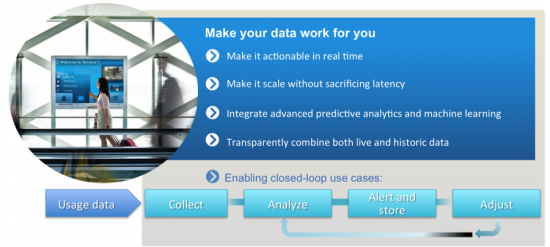
In every industry data is being created in places it never has before, creating hyper-distributed data environments. It is becoming increasingly hard to reach that data, secure that data, and much less draw an insight and enable a person or process to take action on the data. But data is not the problem – connected data is the problem.

The ability to secure, aggregate, automate, and draw insights from an organization’s own data – with speed – will define value for that organization. When you connect people, process, data and things, technology becomes an enabler and new opportunities emerge:

  • New market opportunities
  • New business models
  • New way to operate
  • New ways to consume technology

Streaming Analytics at the Edge

The value of data increases when it can be used proactively, and in real time, to promote actionable events for modern business processes. The streaming analytics movement is of extreme value to multiple groups within an organization: marketing and sales for revenue-generating use cases, network management for root-cause analysis and fault prediction, security for fraud detection and more. Streaming platforms enable real-time business decisions and immediate action by processing billions of events per day from billions of data producers. Common stream platforms combine a publish-subscribe messaging pattern and event driven stream-processing engine.  The big assumption here is that the data is produced near the cluster. Put another way, stream platforms do not provide a facility to move physically distributed data over the network.

Location is key to understanding Cisco’s contribution to analytics. In our latest push to expand the network, Cisco and our partner service providers have pushed the network edge to include a set of devices that already have a lot of critical local data – from sensors miles underground, underwater, in the air, or even at speed on the highway. Creating an opportunity to transform business decision making by joining data from those oil platforms, mines, planes, and cars to existing, centralized data. But in many cases there is a significant gap between the amount of data in these systems and the bandwidth available to move it.

Cisco’s Connected Streaming Analytics (CSA) installs a scale stream processing platform in the network near each data producer to facilitate smart decisions about if, when, and how to move the data and to identify and take immediate action on the most critical events. No matter how big or how remote, CSA allows you to detect urgent business situations, risks, and opportunities with true real time alerting, integrated machine learning, and predictive analytics.

DataStorytellerBlog-BryanWilliamsConnected Data Analytics
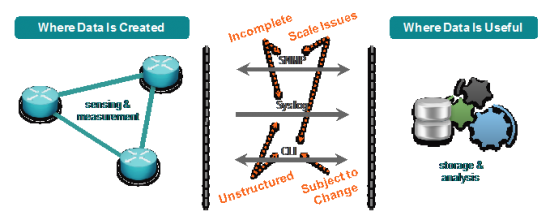
Data is massive, messy and spread everywhere across an organization. The infrastructure over which data travels stretches from the data center, to the branch office, to the cloud and to the network edge. Connect analytics to the data in the data center and streaming at the edge to take immediate action on the most critical events. Change behavior, capture opportunities, respond to threats, and improve your business.


Join the Conversation

Follow @bryancw and @CiscoAnalytics.

Learn More from My Colleagues

Check out the blogs of Mala AnandMike Flannagan and Kevin Ott to learn more.

Authors

Bryan Williams

Technical Lead

Data and Analytics

Avatar

It’s a fast-paced digital society. Your customers carry their entire world on their smartphone or tablet. As consumers and businesses balance their online worlds with the physical world, how are financial services institutions changing to deliver more personalized customer experiences?

Relationships are everything and it’s time to go beyond simple video and give customers face time. I’m looking forward to hosting our upcoming #CiscoChat with Alyson Clarke from Forrester Research on April 26th from 1:00 pm EST/10:00 am PST. Continue reading “Live #CiscoChat April 26th – Give Banking Customers Face Time”

Authors

Leni Selvaggio

Global Senior Manager

Financial Services Industry

Avatar

Cloud computing has reached a tipping point as many organizations have either adopted, or are planning to adopt, some form of cloud computing technology – whether IT knows and manages it or not. “Speed to capability” is one of the primary reasons that individuals, business units and departments are using cloud technology and service providers with increasing frequency. Yet, despite the rapidly increasing use of cloud services, many IT executives remain hesitant to endorse a “cloud-first” approach.

What’s worse is that there are some organizations that are not convinced they should adopt cloud-based services, citing security and privacy concerns, operational challenges or inability to control information. Unfortunately, the reluctance to migrate to the cloud can increase an organization’s risk rather than mitigating it.


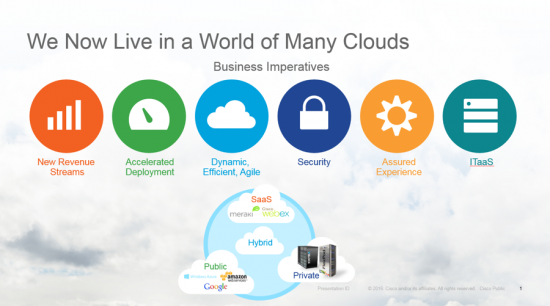
Cloud Consumption – A World of Many Clouds

However, in the 2014 KPMG Cloud Security Report, more than 80 technology industry leaders ranked cloud as the technology that will have the greatest impact in driving business transformation for enterprises.

McKinsey & Company’s report, Disruptive Technologies: Advances that will transform life, business, and the global economy, projects that the total economic impact of cloud technology could be $1.7 trillion to $6.2 trillion annually in 2025. Of this total, $1.2 trillion to $5.5 trillion could be in the form of surplus from use of cloud-enabled Internet services, while $500 billion to $700 billion could come through productivity improvements for enterprise IT.

Over the past five years Cisco’s growth in cloud adoption has been at a rate of 30% year over year. Currently about 500 reviewed/approved cloud providers are in use at Cisco. Approximately 50% of all cloud providers we assess consume Cisco’s highly confidential or restricted data, which is the highest classification at Cisco.

world of many clouds


The world of many clouds is here to stay: private, public, hybrid infrastructure or Platform-as-a-Service and Software-as-a-Service applications. Over the last decade, Cisco has enabled all forms of clouds through our leading DC and network products and our partners. We are now focused on providing you with workload portability solutions that make it easier for you to manage and migrate workloads seamlessly in the world of many clouds. Our focus is to make it easier for IT to become a broker for all cloud services based on your business imperatives.


Building Secure Cloud Services

Ultimately, the customer must ensure that the cloud security vendor can offer a cloud security lifecycle that protects data at every part of the process. When data and brand are in the hands of a third-party cloud service provider, we want to make sure there are adequate controls to ensure security and fiscal responsibility.

Cisco IT has established a global governance process to oversee policy and processes for risk assessment and remediation and coordinate the framework for IT service owners and business partners to work closely together in the selection of cloud service providers. This process, called Cloud/Application Service Provider Remediation (CASPR), is how Cisco ensures cloud service providers are properly assessed, and the appropriate visibility is available to critical stakeholders around Cloud Service Provider usage.

As part of the CASPR process, IT teams (via IT service owners) partner with business stakeholders to find approved cloud service capabilities whenever they are required. The Cisco InfoSec is a strategic partner in helping to protect Cisco’s information and brand by setting data security standards, conducting security risk assessments and establishing remediation plans when necessary. It is a co-dependent relationship between IT, InfoSec, procurement and the business to ensure relevant oversight of our CSP suppliers.


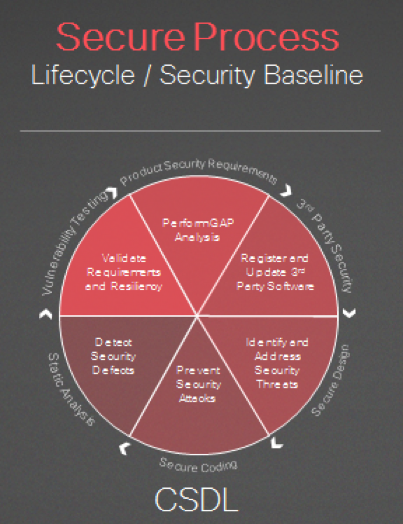
The Cisco Secure Development Lifecycle

The cloud security market continues to grow at a 14 percent CAGR, according to industry analysts, as security is a top concern with regard to hosting the cloud. It has become vast and complex and it must have a seamless ecosystem. Security automation and transparency are key to building & operating clouds securely. The Cloud requires security to be built-in and continuous throughout the lifecycle. Let’s take a closer look at what that means.

secure process

Before adopting any cloud offering, ask two important questions.

  • Given the sensitivity of the data I’m putting into the cloud, does the cloud operator have the proper controls – and do I have the right visibility – to adequately protect my data?
  • Will I be able to respond to incidents when they happen?

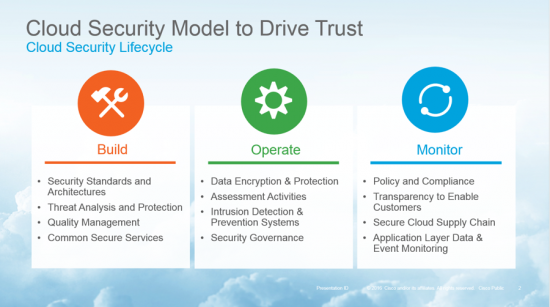
Cisco’s Secure Development Lifecycle process sets a high bar for security expectations that customers can place on Cisco-based cloud offerings. The lifecycle ensures that not only are the offerings built to high standards, but they also ensure consistency, resilience and data protection through security operations and monitoring. We follow a three-pronged approach:

model to drive trust


  • Build Secure Cloud: We use the Secure Development Lifecycle to ensure standards and quality expectations are clearly defined across all cloud offerings. We use Cisco’s security baseline and common security modules and services to help enable DevOps teams to build and operate secure offerings in the Cloud. The security baseline standards take input from Cisco’s mature internal security development standards as well as established security best practices, such as CSA, FedRAMP, etc.
  • Operate Secure Cloud: To run secure cloud offerings, we use an ongoing security operations and governance model which consists of 24X7 vulnerability scans, network and application layer protections, aggressive penetration/attack testing and driving accountability to stated goals and SLAs.
  • Monitor Secure Cloud: We monitor our cloud offerings by using Cisco’s monitoring and incident response process and telemetry from the industry. Our offerings, processes and sites are audited by third parties to ensure we are accountable to the expectations we set for ourselves and our customers. For example, our WebEx offerings are ISO 27001 and SSAE-16 SOC/2 certified.


A Reputation Built on Trust

As the Cloud continues to drive disruption in the business world across the globe, organizations are increasingly placing their trust in third-party cloud service providers (CSPs). A holistic approach to building security into the cloud enables trust throughout the lifecycle. At Cisco, we believe that transparency also leads to trust. Transparency to our customers includes rapid and open communications and is critical in earning and maintaining a trusted relationship. By offering a level of threat research and intelligence beyond that available from most companies, Cisco provides an unmatched security ecosystem. It’s another example of how we remain firmly committed to maintaining leadership in cloud security.


Authors

Steve Martino

No Longer with Cisco

Avatar

In a few weeks thousands of IT leaders, telco operators, cloud administrators, app developers and OpenStack contributors will arrive in Austin, Texas for the OpenStack Summit. As you may know, Austin was the location of the very first OpenStack Summit six years ago and it will be exciting for everyone present to see just how far the developer and user community have come in that time.

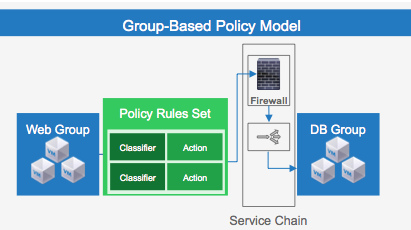
The past two years have also been quite an exciting period for Cisco as well. During that time, we launched our Application Centric Infrastructure (ACI) solution and have seen it adopted by over 1400 customers. ACI was designed to offer policy-based automation, multi-tenancy, and security across any physical or virtual environment and as part of that effort, our team has been working tirelessly to build the best possible OpenStack solution on the market today. We’ve leveraged the capabilities of the Cisco Application Policy Infrastructure Controller (APIC), Nexus 9000, and OpFlex to deliver a fully distributed, hardware accelerated neutron networking solution, integrated overlay and underlay, advanced operations and visibility, and network service integration. We have also been contributing to upstream efforts such as Group-Based Policy to help OpenStack users adopt policy-based approaches regardless of their underlying infrastructure.

Group-Based Policy Model

To learn more about what we’ve been up to and hear directly from the team at Sungard Availability Services about their experience deploying OpenStack, Cisco ACI, and Group-Based Policy, come see our session at the OpenStack summit.

Sungard and Cisco Deliver an Enterprise Cloud Featuring Policy-Based Automation – Monday 12:05-12:45, Austin Convention Center, Level 4, MR 19 A/B

If you are interested in getting hands on experience, I also recommend you check out Group-Based Policy hands on lab in Austin as well. GBP was created to offer intent-based policy and automation on any infrastructure environment and the special will offer a chance to both learn about and try out the upstream project.

Developing, Deploying, and Consuming L4-7 Network Services in an OpenStack Cloud- Thursday 4:10pm-5:40pm, JW Marriott Austin – 110 East 2nd Street, Austin, TX 78701

Aside from these sessions we will of course be showcasing demos featuring Group-Based Policy, ACI, and OpenStack in our booth and will have subject matter experts on hand to answer specific questions. If you are interested in having a more focused engagement on these topics at the summit, please reach out to your Cisco account representatives.

Look forward to seeing everyone in Austin to tell you more about ACI and OpenStack and reflect on the progress we’ve made as an open source community. For more information, visit cisco.com/go/openstacksummit

Authors

Mike Cohen

No Longer with Cisco

Avatar

DevNet Gamification Mission

How can gamification help to drive ongoing engagement and participation within your online community? As a follow up to a previous gamification case study and blog post, I’d like to update you on the results.  When you are managing a community, driving ongoing engagement and understanding program health are CRITICAL. How do you motivate, monitor and measure the health of your community? What can you do to sustain interest and engagement? And finally…what performance strategies help drive community and business success?

Continue reading “WEBINAR: How Gamification Can Build Enduring Community Engagement”

Authors

Deanna Belle

No Longer with Cisco

Avatar

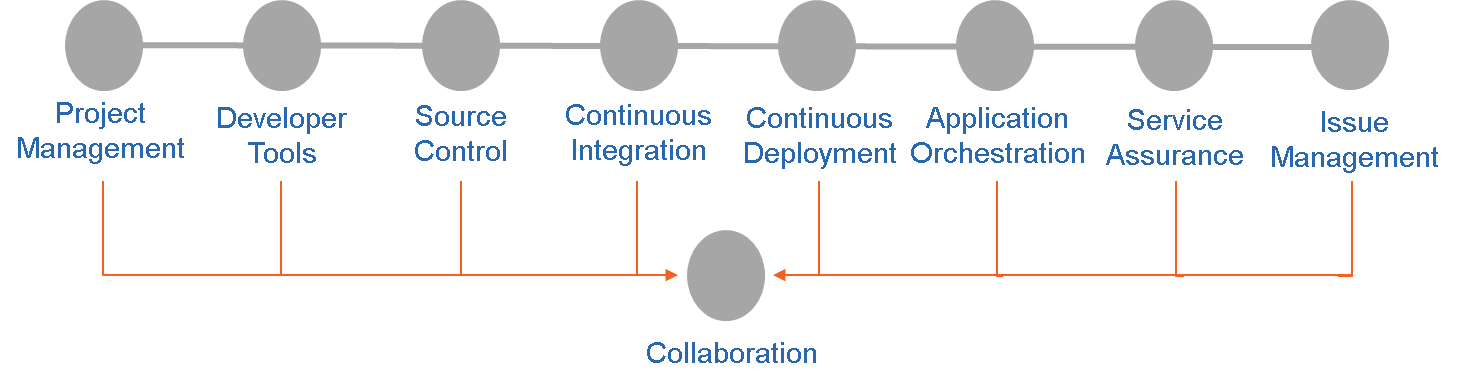
Software engineering and developer communities are driving the market for cloud consumption and leading each industry into a new era of software-defined disruption. There are no longer questions about elastic and flexible agile development as the way to innovate and reduce time to market for businesses. Open source software plays a key role in the transformation taking place to cloud native and understanding how your business strategy needs to address this next disruption in software development is crucial to the success of your business. The first key area is to automate your Software Development Life Cycle (SDLC). The modern SDLC for software disruption is shown below.

kenblog1

Build, Deploy, Run Orchestration

This SDLC consists of:

  • Build components for project management (GITHub way and Enterprise), the development tools and frameworks that enable developers to develop leveraging their existing development methodologies while exploring or adopting new Cloud Native methodologies, all while leverage existing source control policies and secure code reviews.
  • Deploy components to automatically take the source control check-in of code and start the CI/CD process immediately. This enables the developer to continuously deploy and improve code quality and security. A key component in Deploy is Application Orchestration. There are several options to choose from here with Mesos/Marathon being the primary orchestration framework for data platforms and Kubernetes for cloud native development. This is where above the stack is important because it is really not about the orchestration as much as it’s about the service composition, discovery, and enhancing the performance of the service leveraging the data created by the Deploy components. Last but not least, the ability to abstract the Cloud (IaaS) providers, Platform (PaaS) providers, and infrastructure APIs and services to enable application portability is at the crux of this orchestration model.
  • Run components provide the single application development interface for service assurance and issue management. This orchestration framework will automatically feed the data collected about the application back into the Build and Deploy process to allow the developer to continuously improve and immediately visualize the enhancements.

Each of these components has open source projects that are of great interest to the software development community. With open source as the de facto standard for software architecture and development, it’s more important than ever to take a look at strategies around infrastructure, security, performance, collaboration and community, architecture, open hardware, and data analytics. The innovations happening in these areas are changing the way we think about business strategy and how competitive we can be in this continuously evolving business cycle.

Cloud Native Model

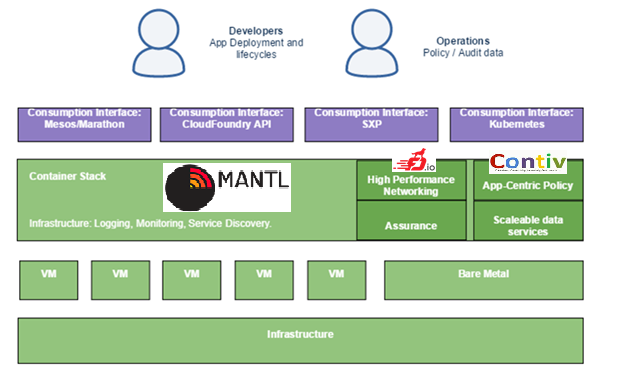
As Cisco continues to innovate in this area, we have defined a Cloud Native Platform (CNP). We use the term platform to represent both the hardware and software associated with delivering the software disruption transformation the enterprise is undertaking. The CNP is shown below:

kenblog 2

A platform can only be a strong as the physical systems that comprise the hardware architecture of the platform. The security and performance of the underlying physical infrastructure is how your business differentiates. The infrastructure layer is still important to the overall experience as performance and security aspects of the stack require full integration of the physical and logical security components. Being able to optimize the network, compute, and storage resources in a fully automatic and the consumption-based economic model has been optimized to meet the business requirements.

The next layer above the infrastructure can be virtual or bare metal orchestration. Virtualization has never been the definition of cloud. This layer provides access to the underlying infrastructure resources and presents methods to the Container Stack for 3 distinct use cases:

  • System Administrator/IT Architect
  • Cloud Native Application Developer
  • Data Scientist

The container stack layer consists of the innovation coming out of the Cisco’s Cloud Platform, Enterprise, and Networking Engineering. Mantl provides the cloud native open source platform with fully integrated development plug-ins, secure DevOps, Mesos and Kubernetes orchestration, CI/CD, and a fully integrated data platform. We have hardened the microservices infrastructure and created differentiation in the orchestration, service discovery, and networking areas. Specifically, we have improved the performance of the network in both the user and control planes.

The user plane with FD.io, takes the approach that containers must have portability. With FD.io, you take your known-good net stack with you everywhere. We tackle the IP per container, which has become the norm, vs. NAT (overlays, native IPs, etc.) to provide near wire speed routing. We incorporate high-performance API’s to address the state of the containers and address the possibility that a container change could potentially result in a route change. For network administrators, we have added a number of advanced container network functions ‘in stack’ (Multipath, VRF) and with a multi-million entry FIBs you can rest assured that scalability is addressed.

For the control plane, our innovation in application policy and Application Intent from Contiv and Shipped are enabling enterprises to extend their network control to multiple clouds while, at the same time, abstracting the complexity from developers.

Flexibility and extensibility are required capabilities for the cloud native model and the concepts of Consumption Interfaces have been architected to allow some choices and extensibility to be added into the consumption model for the developer of the cloud native application or service(s). This model allows us to support Kubernetes for the developer and Mesos frameworks for the data scientist. This is also how we integrate with Platform as a Service (PaaS) offerings.

However, physical and cloud infrastructure does not enable application development platforms natively nor provide the ability to create applications that are cloud native with elastic services. In addition, businesses are moving to application development architectures that leverage open source, which are becoming more strategic to their business strategy. When making the decision to build and operate an application on physical or on a cloud platform, open source strategy becomes central to your application architecture and strategy.

Above the Stack takes into account the new Container Stack, Consumption interfaces, SDLC, OSS, and BSS components of the cloud native platform.

Come Join Us

We will be at the OpenStack Summit (booth C11) with live demos of these technologies. Please stop by and learn how you can accelerate your business. Additionally, Cisco has a keynote on day 2, three sponsored track sessions on day 1, including one on cloud native development.CiscoOSSignFinal

We also welcome you to our 16 conference track sessions, multiple vBrownBag sessions. Cisco is also a Headline sponsor of Community event that will be held on Tuesday night.

For more information, visit cisco.com/go/openstacksummit

Authors

Kenneth Owens

Chief Technical Officer, Cloud Infrastructure Services

Avatar

Co-written with Frederic Trate, Sr. Marketing Manager

Let me start by asking you a couple questions:

  • Does your network grow in size and complexity every year?
  • Are you still largely operating your network manually?
  • Do frequent customer complaints make you wonder if you really know what’s going on in your network?
  • Do you often hear that the network is impacting your organization’s ability to achieve its business goals?

If you have answered yes to some of these questions, you likely need more data about your network and you need it much faster!

Let’s be candid here – gone are the days when a network engineer could understand the network by typing CLI and eyeballing the results. Automation is the only way to manage the scale and complexity of today’s large networks.

What Is Going On?

For the last 25 years, network operators have heavily relied on SNMP polling and CLI screen-scraping to extract operational data from the network. But the new and automated demands of today’s networks have pushed these mechanisms to the breaking point.

Network operators often poll data from their network on the order of every five to thirty minutes. With careful tuning and testing, the bravest can push that interval down to one minute. But with today’s speeds and scales, even that’s not low enough to capture important network events. And as we move to higher density platforms, the amount of important operational data becomes truly staggering.

I bet what I’ve just described rings a bell to you, doesn’t it? Wouldn’t it be the right time to look at a new approach?

image 1 for blog

Time to Change Paradigms: Forget about Pull, Embrace Push

Telemetry was born of the question “How can we get as much data off the router as fast as possible in a way that makes it easy to use?”

As a first step, we needed to get rid of the inefficiencies associated with a polling mechanism like SNMP. Network operators poll periodically because they want the data at regular intervals. So why not just send them the data they want when they want it and skip the overhead of polling? Thus the idea of “streaming” was born.

Instead of pulling data off the network, sit back and let the network push it to you.

Driven by Models

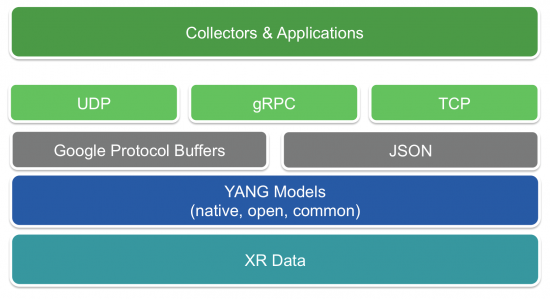
Of course, it’s not enough to just push a lot of data off the device. Telemetry data must be structured in a sensible way to make it easy for monitoring tools to ingest.  In other words, good telemetry data must be model-based.

The good news is that the networking industry has converged on YANG as a data modeling language for networking data, making it the natural choice for telemetry. Whether you prefer your data in native, OpenConfig or IETF YANG models, model-driven telemetry will deliver it to you.

image 2 for blog

Model-Driven Telemetry

Big-Data Friendly

Of course, you want all this data to be easy to use because you know that sooner or later someone will come to your desk and ask for Data Analytics.

Telemetry data needs to be normalized for efficient consumption by Big Data tools. In the software world, encodings such as JSON and Google Protocol Buffers (GPB) are widely used to transfer data between software applications. These encodings have an abundance of open-source software APIs that make it easy to manipulate and analyze the data.

By making network data available in these formats we give you a toolkit to open up a whole new world of Big Data analytics.

What’s next with Model-Driven Telemetry?

All kinds of applications can benefit from the deep knowledge that model-driven telemetry delivers. We have created open source example scripts and collectors to enable you to quickly take advantage of this new way of exporting network data. Because of the simple, popular encodings and underlying YANG data models, telemetry can also be integrated into existing monitoring tools.

Model-driven telemetry is your first step in a journey that will transform how you monitor and operate networks. With the power of telemetry, you’ll discover things you never imagined and begin to ask more and better questions.

Network analytics is the new frontier. Start experiencing it today with Cisco IOS XR release 6.0.0. Consult Cisco.com documentation or your Cisco representative for the latest details on hardware platform support.

Authors

Shelly Cadora

Technical Marketing Engineer

Avatar

With Earth day right around the corner, I thought this would be a good time to discuss Cisco’s role in sustainability. We are proud to share that we have been awarded the 2016 Climate Leadership Award from the EPA for our work making our supply chain more sustainable. At Cisco we’re not only energy conscious and engaging in programs ourselves, but we’re also enabling our customers to be more sustainable.

Here are a few ways we’re driving change:

Reducing CO2 Emissions

We installed 1,300 sensors in one of our Malaysian factories to monitor operational energy consumption. We used our technology and analytics to reduce the carbon footprint associated with manufacturing our products – and saved money in the process.

sustainability-blog-1

We plan to use this same technology across all of our factories. In addition, we set a GHG emissions reduction goal of 40% by 2017, using the 2007 levels as a benchmark. We built this on top of a 38.7% reduction between 2007 and 2012.

Creating a Culture of Change
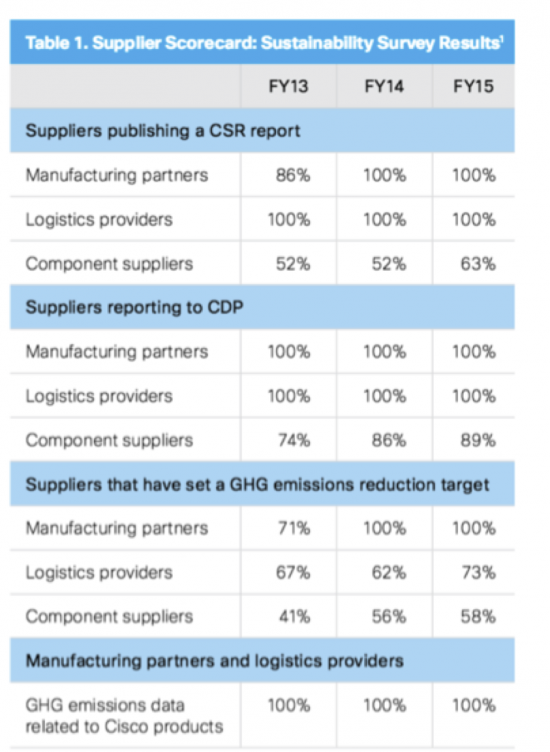
We also make reducing emissions a priority upfront when we engage with internal teams, partners, and suppliers. Last year we encouraged 130 suppliers to have strong sustainability programs, making up more than 80% of our supply chain. We also make sure carbon reduction is measured and audited across our entire supply chain (see scorecard).

sustainability-blog-2

Last year we launched an Integrated Greenhouse Gas (GHG) Reduction program that accelerates sustainability progress around carbon reduction initiatives for outsourced manufacturing.

As part of this we:

  • Encourage suppliers to publish CSR reports
  • Require suppliers to report GHG emissions and targets via CDP and our scorecard
  • Conduct site audits of high-risk supplier facilities
  • Use tools like Labor Link to gather actionable, direct feedback from factory workers

Eliminating Waste
We are moving to a circular economy by providing trade-in and take-back programs to bring back the products we or our acquired companies have sold to our partners and end-user customers. Of products sent to our e-scrap recyclers, nearly 100% are recycled, and all commodity parts go to downstream recyclers to be made into new products. During FY15, we refurbished, resold, or reused over 2903 metric tons of products that were returned to us. We also avoided using approximately 413 metric tons of material (corrugated board, plastic, wood, and other packaging materials) and 6,402 metric tons of CO2e in 2015.

Defending Human Rights

We drive the highest standards at Cisco and our suppliers. We ensure safe working conditions and safe labor practices, and drive an industry-wide code of conduct. For example, we discovered that factory workers in Malaysia were paying excessive recruitment fees at one of our supplier locations. Verite’s survey of 500 migrant IT factory workers in Malaysia reported that 77% were charged fees and had to borrow money to pay them. We acted swiftly, immediately eliminated recruitment fees, and returned $251,000 USD back to impacted migrant workers.

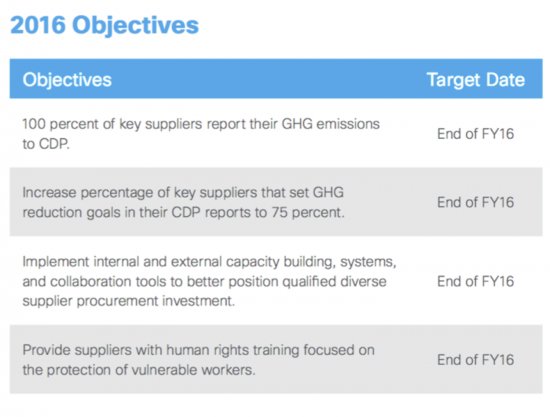
We’re Committing to More in 2016

We’re working on the following goals for this year:sustainability-blog-3We feel that sustainability is a bigger priority than ever before. As our CEO Chuck Robbins put it:
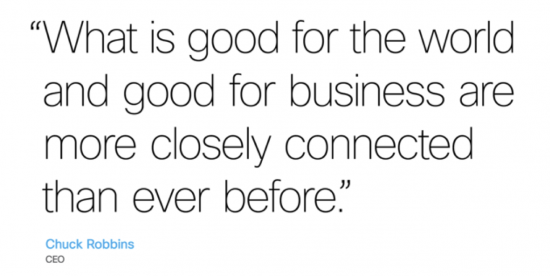
sustainability-blog-4

As we continue this journey, we want to extend a big thank you to all of our employees, partners, and teams throughout the world who make these initiatives a reality. To dive into more of the details, view our Corporate Social Responsibility Report.

Authors

Douglas Bellin

Global Lead, Industries

Manufacturing and Energy