Avatar

By Roger Sherwood, Business Development Manager, Service Provider, Cisco

Last year, as you may or may not recall, we came to NAB with a certification program for independent software vendors (ISVs) focused on media-centric applications. The idea was to make it possible to pair their apps with the Cisco Unified Computing System™ (UCS) and/or our 9000 and 3000 series switches — both to showcase their work, and to make the outcome available to our respective (and, more often than that, shared) customers.

Developing and growing something the ISV Program for Media isn’t for the faint of heart, I want to point out very specifically! The vendor ecosystem supporting the broadcast video marketplace is both gigantic, and hotly competitive.

We invited companies like Adobe Systems, Elemental Technologies, Grass Valley, Harmonic Inc., Imagine Communications, Interra Systems, Signaint and Snell Advanced Media into our fold.

We are also working to introduce these vendors to the Global Partner Organization at Cisco to help this program grow to scale and accelerate the vertical media market. This is just the start! The possibilities together are vast.

Our point in doing this was, and is, this: The right thing to do as suppliers, always and forevermore, is to do work and develop products that make life better for our customers. Products that are more reliable, more extensible, faster to market, less expensive — all of that.

Plus, with the global shift to open source techniques and IP, collaboration is faster and easier than ever before — even if it’s with somebody who competes with you, somewhere along the food chain.

Put another way, when you (individually) visit your (shared) customer base, and you hear for the hundredth time that they wish you’d work with this guy, or that guy, on this or that integration, here’s what you do: You take a deep breath and make it so. That’s what our ISV Program for Media is all about.

So much has happened since we launched the program last year, and all of it for the good: Here’s a sampling:

Deeper Relationships: Grass Valley, Imagine and EVS saw the value so much, they signed MOUs that deepen our strategic alliances — meaning we’re jointly building solutions, services and go-to-market plans. (This is pretty huge, as vendor relations go!)

Inclusive Industry Dialog: Imagine Communications invited two of our guys to participate in their “Imagine Live! Power Sessions,” which is super cool. (Details: On Tuesday, April 19 from 10-10:30, our Bryan Bedford will speak on a panel about “Open Standards That Drive Innovation — the AIMS Alliance.” Then, from 2-2:30 p.m. Dave Ward, our Chief Architect and CTO, Engineering and Service Provider business, keynotes a discussion titled “Video’s Five-Year View and What to Do About It Now.” (Thanks, Imagine peeps!) Plus! You can check out our combined demos at both of our booths.

Joint Work That’s Fun: EVS let us in on two super-fun projects since our ISV beginnings — first, its “EVS Live on Tour demo truck,” which officially launches on  Monday the 18th — before heading out to the Kentucky Derby, Indy 500, U.S. Open, and tons of NBA, MLB and NFL games. As if that wasn’t fun enough (!), we had the good fortune to participate in their “C-Cast APPlied Challenge,” which awarded four developers of cool new media experiences. Work is work, but when it’s fun, it’s even better.

Bigger, Better, Wider “Co-opetition” Relationships: Little known NAB 2016 fact: There’s a fiber link between our and Sony’s booth, and we’ll be switching video back and forth between us, to showcase a few things — an SDI to IP gateway, and a GUI instead of a router panel (to switch sources.) Nifty!

And that’s a partial list. The point is this: The ISV Program for Media momentum is happening because it was necessary for our customers, who always come first. We’re proving, every day, and highlighting at NAB, how we can work together with the video/media supplier ecosystem to build solutions that our customers want and need.

This program is a great thing for customers, and for suppliers. Plus, as a technologist, I can say with gusto that the best thing about it is being able to focus on the technical work, with like-minded colleagues (who happen to be competitors) — without the pointy elbows or the politics.

I’ll close with two calls to action: One, if you’re in the supplier community at NAB, and want to know more, the door is open! Two, if you’re our customer, and want to “put your order in” for cross-vendor integrations that you need — we’d love to help get you there. Come visit us this week at the Cisco booth, Upper South Hall, #8502.

Authors

George Tupy

Market Manager

Service Provider, Video Solutions

Avatar

I was fortunate to attend and present at the N.American Manufacturing Excellence Summit (NAMES) last week.  It was an excellent chance to listen and learn from industry leading manufacturing executives around their best practices for lean/six-sigma, attracting and training the next generation workforce, and improving operational excellence.

I was very impressed with BMW’s vision, specifically their Spartanburg plant’s focus on data analytics and IoT platforms. They had a brilliant use of 3D printing for custom thumb push asset gloves – a practical, cost-effective use of technology directly related to worker safety and productivity!

GE also stood out with their impressive factory that reduces downtime and their PREDIX platform strategy. GE is truly transforming their business and is betting their future on the Industrial Internet and connected product strategies.  As Paul Boris concisely stated, “Get connected, get insights, and optimize your business.

A common theme from many of the discussions was around improving visibility across their value chains, gaining insights, and leveraging these new insights to optimize their business performance. Brilliantly simple, but how do you start this journey?

Cisco is working with many leading manufacturing clients to provide a secure IoT platform to drive improved visibility and related outcomes.  Results like 20%+ reduced energy consumption, increased OEE (70’s to high 80’s), and significant reduction of inventory costs.

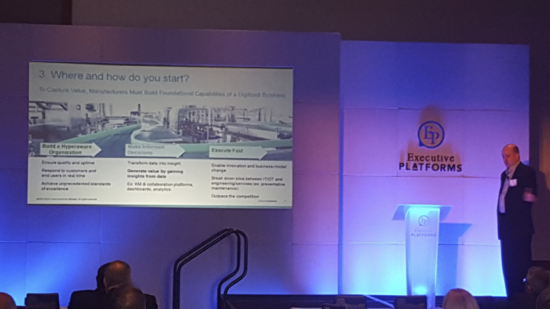
Also at NAMES I led the session “Digitization of Manufacturing – What Does This Mean for You?

names2

During it I answered the following questions:

  • What does digitization mean to manufacturing companies?
  • What specific business benefits and market opportunities does it provide?
  • Where do you start?
  • Who’s doing it? Using customer examples

My presentation from this session is available here.

We also shared our latest customer success story of how Daimler Trucks has started their Digital Transformation journey with us in partnership with Rockwell Automation. See our recent blog for more details.

If you’re interested in learning more, don’t hesitate to reach out to me here.


Authors

Mike Killian

Practice Manager

Manufacturing Business Transformation

Avatar

I’m excited to announce that we’ve completed our acquisition of CliQr Technologies Inc., a privately-held company that provides a cloud platform to model, deploy and manage applications across hybrid IT environments made-up of data centers, private and public clouds.

CliQr’s technology is very complementary with our data center strategy. CliQr will extend Cisco’s Application Centric Infrastructure (ACI) application policy model beyond the network. This will allow ACI customers to automate end-to-end provisioning of infrastructure and deployment of applications onto any data center, private or public cloud environment.

I’m happy to welcome the CliQr team to Cisco. The CliQr leadership and engineering team joins the Insieme Business Unit. In the coming weeks, we expect to announce the availability of CliQr’s offerings on the Cisco price list, enabling our partners and customers to easily automate and manage application policies across their data center environment. Together, we look forward to making it easier for customers to move and manage their applications in the cloud.

Authors

Rob Salvagno

Vice President

Corporate Development and Cisco Investments

Avatar

Recently a large scale ransomware campaign delivering Samsam changed the threat landscape for ransomware delivery. Targeting vulnerabilities in servers to spread ransomware is a new dimension to an already prolific threat. Due to information provided from our Cisco IR Services Team, stemming from a recent customer engagement, we began looking deeper into the JBoss vectors that were used as the initial point of compromise. Initially, we started scanning the internet for vulnerable machines. This lead us to approximately 3.2 million at-risk machines.

As part of this investigation, we scanned for machines that were already compromised and potentially waiting for a ransomware payload. We found approximately 2,000 machines with a backdoor already installed. Over the last few days, Talos has been in the process of notifying affected parties including: schools, governments, aviation companies, and more.  Several of these systems had one specific software solution in common.  Read the full post for details, advisories, and recommended remediation.

Read More>>

Authors

Talos Group

Talos Security Intelligence & Research Group

Avatar

About the Author: Gradey Caldwell has been exclusively focused on driving process and costs improvements in the world’s largest manufacturers for over 30 years.

For years I’ve seen manufacturing executives search for innovative ways to lower costs and drive more profits. In my travels, I’ve finally found a process and methodology that works every time. The key is to follow the steps below to connect multiple streams of company data housed in different formats and reporting systems into one easy to read dashboard. Imagine being able to see your key business metrics in real-time on the mobile device of your choice whether you are on the other side of the plant, other side of the country, or the other side of the world. It’s possible using a platform as a service (PAAS) to simplify your key performance reporting and processes – and view them from any device, anywhere, at anytime.

Continue reading “1 Easy Method to Cut Costs Out of Your Business”

Authors

Gradey Caldwell

Senior Advisor

Business Transformation

Avatar

“Location, location, location” is a classic mantra that comes to mind when buying property. Though I’m not a real estate power player, one thing I am fairly versed in is the Internet of Things (IoT), the billions of connected “things” within it and the enormous amount of data each is capable of producing.

In light of this, many might say our industry mantra could be “data, data, data.” I would argue that mantra should be “collaboration, collaboration, collaboration,” as we better understand how effectively capturing, storing and analyzing data generated by those connected things can lead to better business decision making.

Here’s why…Read more.


Join the Conversation

Follow @MikeFlannagan and @CiscoAnalytics on Twitter.

Learn More from My Colleagues

To stay on top of all Cisco Data & Analytics news and highlights, check out our new blog: Analytics & Automation. Check out the blogs of Mala Anand, Kevin Ott and Bob Eve to learn more.

Authors

Mike Flannagan

No Longer with Cisco

Avatar

In our Cybersecurity for Defense Blog Series Kickoff, Peter Romness mentioned that we at Cisco are hard at work delivering advanced cybersecurity capabilities that support the Department of Defense Cyber Strategy. That’s certainly true, and each blog in our series will further that point. But it’s about more than just products and services. It’s also about understanding and acting on key concepts of cybersecurity risk management. Our approach to cybersecurity – and everything we do – has deep roots in cyber best practices. How? Let’s take a closer look.

A key part of DoD Cyber Strategy is captured in Strategic Goal II: Defend the DoD Information Network, Secure DoD Data, and Mitigate Risks to DoD Missions. To improve accountability and responsibility for data protection, the DoD will act “in a manner consistent with known standards for protecting data from cyber adversaries, to include standards promulgated by the National Institute of Standards and Technology (NIST).”

The DoD recently started down the path toward NIST alignment. Back in March 2014, then-CIO Teresa Takai issued DoD Instruction 8510.01 entitled “Risk Management Framework for DoD Information Technology.” This instruction was an important policy change, since it shifted the risk management process from the legacy DoD Information Assurance Certification and Accreditation Process (DIACAP) toward the NIST Risk Management Framework (RMF). This brings the DoD into better alignment with the rest of the federal government as well.

The NIST RMF is actually a pretty big topic. To keep things short, the RMF proposes a six-step risk management process each with a companion NIST guide:

  1. Categorize information system (NIST SP 800-60)
  2. Select security controls (NIST SP 800-53)
  3. Implement security controls (NIST SP 800-160)
  4. Assess security controls (NIST SP 800-53A)
  5. Authorize information system (NIST SP 800-37)
  6. Monitor security controls (NIST SP 800-137)

Selecting the security controls in Step 2 is particularly challenging, since NIST SP 800-53 is a comprehensive catalog that contains hundreds and hundreds of controls grouped into eighteen control families. The document alone is over 450 pages. So figuring out where to start can be a daunting task, even for highly capable organizations like the Department of Defense.

But it doesn’t have to be.

At Cisco, we’ve already aligned all of our cybersecurity products with NIST 800-53, taking the guesswork out of where each solution fits. And Cisco Advisory services is staffed with strategy and risk management experts who can assess the organization, develop the action plan, and help to implement it, all in accordance with the NIST Risk Management Framework. It’s just one example of how we think in terms of best practices, and how we have the right capabilities that support the DoD Cyber Strategy.

As Peter said, stay tuned. We’ll continue to discuss use cases and Cisco solutions that are helping the DoD implement its cyber strategy, and each one of them has deep roots in cybersecurity best practices.

Authors

Steve Caimi

Industry Solutions Specialist

US Public Sector Cybersecurity

Avatar

This post was written by guest blogger Hani Raad, Cisco General Manager of Iraq and LevantHani_Raad_Levant

With a harsh winter hitting Lebanon and the urge from Cisco’s Lebanon-based employees to take action in support of the Syrian refugee crisis, the idea of a “Syrian Refugees Fund” was born. Over the last three months, Cisco employees have raised funds to provide packages of clothing for over 170 children in the country, serving as global problem solvers for those in need of clothing, medicine and support.

In 2006, Cisco created the Partnership for Lebanon, bringing together public and private organizations to create jobs, improve connectivity, and spur growth in the country. Today, the country is faced with a new crisis — over 3.6 million refugees have escaped Syria to the neighboring countries of Lebanon, Turkey and Jordan, while more than a million refugees crossed the Mediterranean Sea into Europe in 2015.

There are 1.4 million Syrian refugees in Lebanon, and half of them are children. The Cisco Lebanon team, based in Beirut, provided warm clothing to refugees at a camp near the border with Syria during a particularly cold winter.

More than 1.4 million Syrian refugees have fled to Lebanon in the past five years, with children making up half of all those entering the country. Those totals represent one third of Lebanon’s total population, creating a major need for support from those who can help. And Cisco, through its Corporate Social Responsibility, has the power to make a difference.

Giving is part of our DNA at Cisco. Last year, Cisco employees gave a combined $12 million in donations and matching funds, as well as more than 155,000 hours of volunteer time to nonprofits and causes of their choice around the world.

I was amazed by the generosity and passion of Cisco’s volunteer employees on the ground in Lebanon. The money raised went towards the purchase of high quality jogging suits, sweatshirts and warm socks. The team in Beirut sorted and labeled the packages in pride and excitement as we saw the impact of our efforts firsthand.

“Once we entered the camp on that icy day and began handing out the packages of clothing, we saw smiles appear on the faces of the children,” said Karim Kattouf, one of the volunteers on the ground in Beirut. “They didn’t care that the clothes were not a perfect fit, or that the colors of the socks were not the best.”

Today, Lebanon is the country with the highest per capita concentration of refugees worldwide. The arrival of Syrian refugee has had a massive impact on Lebanon’s economy and infrastructure. Our contribution will not stop here, and further campaigns with our partners and customers will help speed the pace of social change for thousands in Lebanon.

Learn more about Global Problem Solvers at csr.cisco.com/gps

Authors

Austin Belisle

No Longer with Cisco

Avatar

Stop! Think. Sketch Colour

For this blog, I collaborated with two of the UK’s leading experts on marketing strategy: Moira Clark, Professor of Strategic Marketing and Director of the Henley Centre for Customer Management, at Henley Business School, University of Reading and Hugh Wilson, Professor of Strategic Marketing and Director of the Cranfield Customer Management Forum at Cranfield School of Management. I worked with Hugh and Moira when they co-supervised my Doctorate from Cranfield School of Management and am indebted to them for their wisdom and insight.


In our fast-paced digital world, “think” is becoming a dirty word.

And “marketing strategy” seems to be going the way of the dinosaur.

How did this happen? For marketers, it’s easy to use the need for speed as an excuse not to plan and learn.  And it’s tempting to skimp on strategy in an effort to meet the demands of sales teams who want everything done yesterday.  However, the opportunities opened up to us by big data and analytics make marketing strategy more important than ever before.

So how do we balance the good-old-fashioned need for method, analysis, and thinking things through with the real-world demand for action and agility? And how can marketing deliver the strategic muscle that’s needed to drive long-term competitive advantage?

Marketers must think fast and slow.

As Daniel Kahneman, author of the best-selling book “Thinking Fast and Slow” has said: “Thinking is to humans as swimming is to cats; they can do it but they’d prefer not to.”  But, when we force ourselves to do it, all sorts of good things happen. Kahneman’s research shows that thinking more slowly, deliberately, and logically, leads us to make better decisions. When it comes to marketing, taking the time to think moves us beyond one-off campaigns and yields a strategic plan that identifies our target customers, articulates why they should buy from us and not someone else, and maps out how our marketing efforts will achieve the financial objectives we want.

What if we don’t have time for that?

You don’t need to look very far to find examples where the lack of a sound marketing strategy had dire consequences. Take Nokia.  Once the darling of the mobile phone industry, the company is no longer in the business. Nokia was both agile and innovative but, without a clear marketing strategy, they got clobbered by Apple and Samsung.  Or consider grocery giant Tesco.  Although the company pioneered the loyalty card and has mastered big data analytics, they have suffered because they no longer have a clear value proposition for their customers. Waitrose – once a distant competitor – is now eating their lunch. And Aldi and Lidl are having them for breakfast.

Striking the balance between thinking and acting.

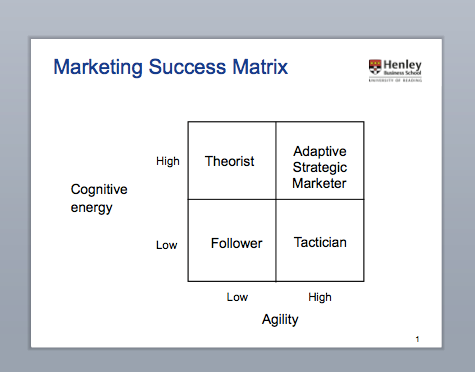
Clearly, for companies to survive and thrive in the digital age, they need fluid marketing tactics driven by a solid marketing strategy. To illustrate this point, we’ve developed a Marketing Success Matrix:

  • The x-axis represents Agility – the need for speed and action as well as the ability to quickly adapt to changing market dynamics.
  • The y-axis represents Cognitive Ability – the need for strategic thinking and long-range planning as well as the ability to analyse market forces.

Marketing Success Matrix

When we apply the matrix to marketing, most companies fall into one of four quadrants:

  • Tacticians are highly agile, but lack critical planning skills – which means they may be too consumed with the day-to-day to see where the market is going.
  • Followers have low agility combined with low cognitive energy – they may be able to follow the market for a while but they certainly won’t be able to shape where it’s headed.
  • Theorists expend high cognitive energy but have low agility – and that may prevent them from getting to market on time or outpacing the competition.
  • Adaptive Strategic Marketers exhibit high levels of agility and cognitive energy – giving them the one-two punch they need to be effective in the short and long term.

How can we become Adaptive Strategic Marketers?

While there’s no one-size-fits-all solution, there are steps that marketers can take to reach the ultimate quadrant:

 1. Think, but do it a bit more quickly.

Remember when a new executive came on board and he or she had a grace period of ninety days to get up to speed? Those days are gone.  Thinking is valuable, but it must happen in compressed timeframes.  In fact, in her book, “The Code for New Leaders,” Henry Rose Lee says that leaders must hit the ground running in days, not months or even weeks.

2. Implement a more agile planning process

Thinking should happen more quickly but it should also be done more frequently. In many companies, “strategic planning” is done once per year – and while they measure quarterly results, they may never revise the strategy until it’s time to plan for the following year.  We must implement less laborious strategic planning processes so they can be done more frequently.  Think quarterly instead of annually.

3. Assign ownership for marketing strategy

In many organisations, the CMO or Marketing Director “owns” the marketing strategy. And that makes sense.  However, the CMO or Director needs a right-hand man or woman who owns the strategy process. This “strategy sidekick” understands marketing analytics as well as market research and can advise the CMO on the marketing strategy.  He or she also discusses the marketing strategy with the people who have a strategy and planning function in other lines of business – including finance, sales, and operations.  Most important, he or she is able to facilitate this cross-functional strategic group to ensure that all line-of-business strategies tree up to a master business strategy for the organisation.

4. Inform your strategy with the right data

Although we’re awash with data, we often don’t have the key data we need to formulate sound marketing strategies. We’re not talking about the data that can be captured through a digital footprint, but the wisdom that comes from tried-and-true qualitative and quantitative research.  If you want to know what your customers’ goals are and whether they’re being met – why don’t you ask them?  Or take a page from Apple’s book.  Although Steve Jobs famously shunned market research, Apple actually spends a ton of time watching how people use their devices and gains deep customer insight by simply observing them.

5. Incorporate more strategic metrics

Be sure to measure what matters. For example, here at Cisco marketing, we have traditionally focused on individual metrics at different stages of the funnel. Now we’ve joined up measures of Reach, Response and Revenue in what we call “Connected Performance”, so that we’re measuring customer engagement from the initial impression all the way through to a sale.

Savvy marketers are also looking at new metrics like LOI (Learning on Investment) to measure their ability to adapt on the fly. They’re doing A/B testing constantly, adjusting campaigns accordingly, and codifying the lessons learned into their strategies.

But perhaps the ultimate strategic measure is Customer Perceived Value (CPV) – a measure of what customers get back from the time, effort, and money that they expend with a company. Measuring CPV looks not at the value a company gets from a customer but rather the value a customer gets from a company.  Marketers who measure CPV have access to incredibly powerful insight that can inform their marketing strategies and give them a competitive boost.

So what’s the bottom line?

When marketers think and move too fast, mistakes, missed opportunities, and mis-selling occur.

Paradoxically, sound marketing strategies help companies become more responsive and agile. By keeping everyone “singing from the same hymn sheet,” marketing teams are able to reduce duplication of effort, increase time to market, and respond to customer insight.

So the next time your sales team asks you to run an event or execute a tactic, ask them this: What are you trying to achieve – and how does that align to the marketing strategy? That will give them something to think about.


Authors

Dr. Christine Bailey

Marketing Director

EMEAR