Avatar

Since we launched the Cisco Digital Ceiling framework earlier this year, we have made a lot of progress in the market. We also got a lot of great feedback from the TechWise documentary ‘Let there be networked light’. With several of our wave 1 partners, we installed network powered lighting capabilities in campus and education environments. Tony Shakib’s Blog of April 2016 talks about that in particular.

Screen Shot 2016-06-12 at 13.52.58
Picture Source: Realcomm

Looking forward we are very excited about the upcoming Real Estate and Intelligent Building Conference RealComm/IBCon taking place in San Jose, CA from June 21st to June 24th. At this conference we will announce our wave 2 ecosystem partners, a number of new customer wins and we will have lots of opportunities to interact with customers and partners. These are the sessions where Cisco will speak in:

June 21

  1. I will speak in the Commercial real estate COO, CFO and CAO session from 1:30pm – 5:30pm at the San Jose Convention Center, Lower Level.
  2. Cisco’s Bill MacGowan (Dir, BD Sales) will speak at the 5th Annual Intelligent Buildings Boot Camp from 1:30pm to 6:00pm at the San Jose Convention Center, Lower level.

June 22

  1. I will be part of a panel around IoT for Buildings 3.0 – The next chapter begins at 11:30AM in Lower Level LL21F.
  2. Cisco’s Todd Frederes will be part of a panel in the session Creating a Holistic Smart Building Plan – Strategy vs. Tactical Projects at 1.45pm in Lower Level LL21F.
  3. At 2.50pm I will do a live 5 minute interview around Cisco’s Digital Ceiling at the Conference Live Desk in the main hall.

June 23

  1. Cisco’s Bill MacGowan will be part of a panel around Networked Smart Lighting – The Chasm Has Been Jumped at 10.45 am in Lower Level.

We are all looking very much forward to an exciting RealComm/IBCon conference this year and hope to see you there. If you’d like to learn more about moving to a Digital Ceiling, check out http://www.cisco/go/digitalceiling or contact us at digitalceiling@cisco.com


Authors

John Baekelmans

Chief Technology Officer

Internet of Everything (IoE) Solutions group

Avatar

Motivating Sales Teams:  5 Ways to Keep Your Sales Team Motivated

Working in a sales role can be extremely gratifying when things are going well. But let’s face it, when you throw in a few customer issues, missed deals or product availability problems in the mix, things can go south quickly. Keeping morale up during these challenging times is critical. Sales is an emotional game and your perspective and attitude impact your success and overall happiness. And a good sales manager is a key catalyst to ensuring peek productivity and subsequent job satisfaction.

So what are some ways managers are impacting team performance? Take a look at these five ways to keep your sales teams motivated, engaged, and consistently closing deals.

  1. Set reasonable yet challenging goals. Communicate them early and often. Nothing is more frustrating than a moving target. Sales teams eventually stop trying if they can’t see the goal line. Those that meet the expected target and then have it increased unexpectedly will be sorely frustrated and will stop trying. While those who meet goals that are set too low will sit idle instead of drumming up new business. So set challenging yet obtainable targets to get the best performance out of your sales team. Make sure goals are clearly communicated and performance against those goals is transparent and readily available.


  1. Keep your Promises. A promise, whether direct or implied, is still a promise. I once heard of a sales manager who promised a $15K US bonus to the top producing sales person of the quarter. When the quarter was complete and it was time to announce the winner, the sales manager instead nonchalantly commented that profits weren’t as expected so they wouldn’t be able to pay the promised bonus. The winner was crushed, the team was bruised but worse, the manager lost all credibility and future promises would never again have the intended impact. If you make a promise, honor it. Period.


  1. Respect Personal Time. The work day doesn’t always end at 5 pm so any sales professional who plans to live by that schedule might want to consider a career change. Customer issues come-up, orders get cancelled or any number of things can go wrong (or right) after hours. When you repeatedly call your sales team after hours you send the message that their time isn’t valuable. Over time that message translates into a stressed out, overworked, burned out employee who often delivers fewer sales less often then ultimately leaves your team. Unless that’s the outcome you’re hoping for, make your after hour calls, texts, emails, and IMs infrequent.


  1. Make your feedback specific. All of it: If your employee is performing well, tell them exactly what they are doing well and what the impact is. Conversely, convey the same information about areas of improvement. For instance, don’t just notice that an employee isn’t on the phone with customers as often as they should but notice the quality of the conversations. Are they asking the right questions? Are they asking for the close? Are they exploring other opportunities to expand the deal? Conversely, make sure you are giving accolades when you see the RIGHT proactive activities being performed on a regular basis, not just when the deal is closed. This takes an investment of time, patience and tolerance. It’s certainly a lot less expensive to work with an existing employee than it is to replace them. According to SHRM, the real cost of losing an average employee is about six to nine months’ salary. And for higher performers it can cost as much as two times the annual salary!


  1. Make sure ALL players are on the same page: The old saying “it takes a village” is certainly true now more than ever. But it’s surprising how often different members of the team don’t communicate with other members openly. It’s vitally important that the engineers are talking to the account managers who are talking to the customers IT managers, who are talking to the customer business managers and so on. It’s amazing the synergy that’s created when all involved in the deal feel included, valued and understand the role of everyone on the team. The momentum this team energy creates is motivating and keeps things moving.


Let’s face it. Sales managers have a challenging job in front of them in today’s fast moving, competitive environment. If you don’t keep your team happy, challenged, and motivated, you risk losing them to your competition which is an expensive endeavor. One fun way for Partner Plus Partners to motivate their employees is to get them excited about Winner’s Circle – a luxury incentive trip designed to reward the top partner sales people from around the globe. Learn more about these exciting upcoming trips in Miami, Honolulu and Seychelles by visiting Winner’s Circle.

How do you keep YOUR sales teams motivated?


Authors

Karin Surber

Sr. Global Business Development Manager

Global Partner Strategy and Planning

Avatar

Our goal in working with Apple was to create a no-compromise business calling experience on iOS. And with today’s announcements at WWDC, we have taken a huge step forward in delivering that capability to end users and IT departments.

So let’s get real, what did we announce? Well, we announced that Cisco Spark app will leverage new iOS 10 features and APIs to deliver seamless voice and video calling.

As an end user, what will you get? You will now be able to make Cisco Spark calls in the same way as cellular calls, including iOS 10 contacts, recents, and favorites. You will be able to receive an incoming Cisco Spark call on the lock screen, and with a single swipe answer the call. You’ll get call waiting, so if you’re on a Cisco Spark call and receive a cellular call, or vice versa, you can pick which one is the most important. Mobile accessories, like Bluetooth devices, will be integrated with Cisco Spark as well. You can even ask Siri to use Cisco Spark to place a call, truly simplifying the outbound calling experience.

Now, what is the IT department going to get out of this? Well, using MDM your IT department will be able to setup your iPhone or iPad, so calls to anyone within your corporate directory are automatically made using Cisco Spark. By routing mobile calls through the corporate PBX calling costs are reduced and compliance is improved.

We are pleased to announce these powerful new capabilities as part of our partnership with Apple. General availability of these new features is targeted for fall as part of an updated version of Cisco Spark for iOS 10. In the meantime download Cisco Spark from the App Store today and start using our existing calling, messaging and meetings for free.

Contact your Cisco and Apple account team to see how seamless collaboration on iPhone and iPad can improve your business.


Authors

Jonathan Rosenberg

Cisco Fellow and Vice President

CTO for Cisco's Collaboration Business

Avatar

I came to Cisco to create incredible technology experiences for millions of enterprise workers. That’s why I’m so thrilled to be the executive sponsor of our partnership with Apple; together, our two companies are capable of “incredible” on a pretty massive scale.

Since our announcement in August, engineers, user experience and design teams from Cisco and Apple have been working side by side and testing together to make sure you have a truly delightful experience with your iPhone and iPad on your company’s Cisco assets.  And today, as Apple introduces iOS 10, we’ve reached a major milestone.

When we announced the Apple partnership last August, we promised to change the way people work by:
– optimizing networks to deliver improved performance for iPhone and iPad.
– creating an even better experience for Cisco voice communication on the iPhone.
– reinventing teamwork and meetings with Cisco collaboration tools.

Here’s how we’ve done that by integrating into new capabilities and APIs that Apple has built into iOS 10:

– We’ve optimized how iPhone and iPad communicate with a Cisco wireless network. When you’re at work and on the go, your iPhone or iPad will simply “know” what’s the best available wireless access point for you—and will select it by default. This makes performance of all your apps, especially real-time apps like voice and video, much more reliable, particularly when you are on the move.

We’ve created a “fast lane” for business critical apps. No longer will you have to ask your coworker to lay off the cat videos while you’re on a Cisco WebEx or Spark Call on your iOS device; your IT department can now effortlessly prioritize the apps most critical to your business, helping you get the job done from your mobile device.

– We’re making Cisco Spark on iPhone a seamless experience. Cisco Spark is our platform for the future of work, and now it is completely optimized for your iPhone and iPad.  With Cisco Spark app installed on iOS 10 you’ll be able to tap a contact in your address book and instantly make a VoIP call without having to launch a third-party app. The integration doesn’t stop there, you’ll also enjoy other native iOS calling features with Cisco Spark—calls will now ring on the lock screen, just like a regular call, users will have access to mute and call waiting.  Even more conveniently you can now ask Siri to use Cisco Spark to call contacts in your People app.

We’re so excited to get these features into your hands.  You can find out more about the network enhancements and the collaboration improvements at www.cisco.com/go/apple.

I look forward to your feedback. Let me know @rowantrollope.

Authors

Rowan Trollope

Senior Vice President and General Manager

IoT and Collaboration Technology Group

Avatar

Jack-Zach-1

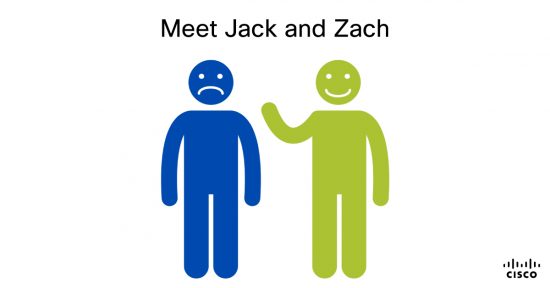
Meet Jack and Zach. You may have seen them around in a variety of situations where Zach is happy and Jack is not. Why is that? Because Jack relies on aging, non-compliant infrastructure and service, that’s why! And while it might be funny to follow along with Jack and Zach’s exploits, here at Cisco we know that security is no laughing matter. We created Jack and Zach to get your attention about two major security concerns in the public sector: aging network infrastructure and non-FedRAMP-compliant cloud-based collaboration tools.

Aging Network Infrastructure

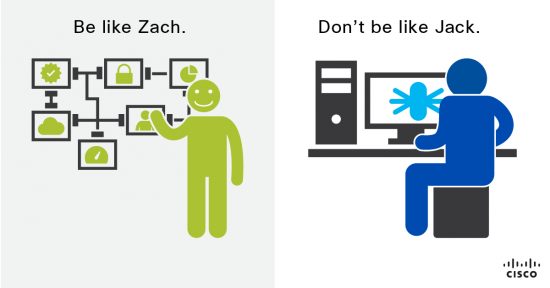
By using aging, end-of-life network infrastructure at your agency, you’re not only being inefficient – you’re also being very risky. Outdated infrastructure actually increases your security risk, putting your agency’s critical data in danger. By replacing old IT and network infrastructure with more modern secure technology, you’ll reduce your security risks and improve efficiency, productivity and service delivery.

Jack-Zach-2

Zach refreshed his network to keep it secure. Jack continued to use his out-of-date network infrastructure and got hacked.

Non-Compliant Clouds

While cloud solutions allow for faster processing and a more agile and efficient platform, government agencies need to ensure that their cloud-based tools are secure to protect citizen data. FedRAMP is a government-wide program that provides a standardized approach to security assessment, authorization, and continuous monitoring for cloud products and services. Cisco offers a variety of FedRAMP-compliant cloud-based solutions for agencies to use, including our popular WebEx collaboration environment. WebEx allows agencies to reduce travel time and costs and increase meeting engagement and efficiency, all while remaining secure and FedRAMP compliant.

Jack-Zach-5

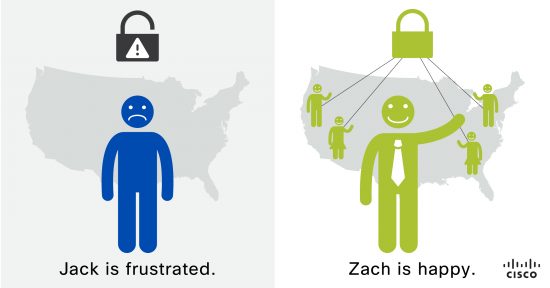
Zach is happy because he uses WebEx, which is a FedRAMP-compliant cloud collaboration tool. Jack doesn’t.

Don’t Risk IT

So now when you see Jack and Zach, you know that they represent the potential for serious security risks. Don’t risk your agency’s IT – make sure your network infrastructure is up-to-date and your cloud collaboration tools are FedRAMP-compliant. You can learn more about why you need a network refresh here. And check out our information on Cisco’s compliant cloud solutions here.

Authors

Kathy Ditto

Senior Director

U.S. Public Sector Marketing

Avatar

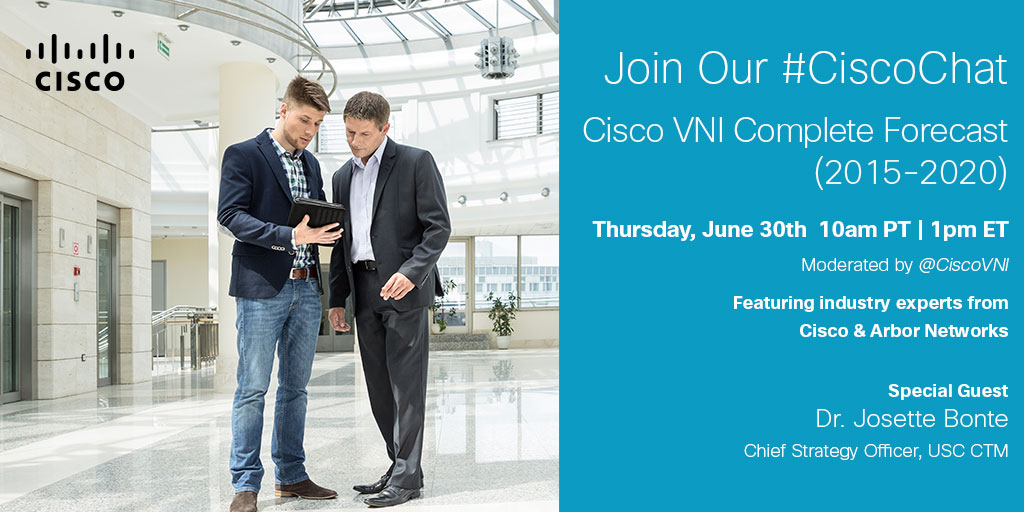
On June 7th of this year, Cisco’s Visual Networking Index released its annual Global Traffic and Service Adoption forecasts, for the years 2015-2020. The reports predict fixed and mobile IP traffic growth, as well as application trends for the next few years. Some of the topics covered in the report include how fast IP traffic is growing on a global scale and which regions are growing the fastest, as well as how various devices, from smartphones to tablets to the Internet of Things, impact that growth. But the question is, how do these forecasts impact you? That’s the topic of our next #CiscoChat, on Thursday, June 30th at 10am PT.

CIS_218_CiscoChat_VNI_Twitter_060716 (1)

There, we’ll joined by several key members of Cisco’s SP Thought Leadership Team, including Director Thomas Barnett (@tlb707), Senior Analyst Arielle Sumits (@ariellesumits), Senior Analyst Shruti Jain (@shjain), Senior Analyst and Service Marketing Provider Usha Andra (@AtUandra), and Research Analyst Taru Khurana (@TaruKhurana). They’ll answer your questions and address issues such as how broadband speeds are improving to meet consumer demands and the role of Wi-Fi in extending the reach of SP services and offloading cellular bandwidth demand.

To participate in the chat:

  • Make sure you’re logged into your Twitter account.
  • Search for the #CiscoChat hashtag and click on the Live tab.
  • The chat will be moderated by the Cisco VNI Forecast channel (@CiscoVNI) on Twitter. Be sure to follow the account to participate. They will begin welcoming guests at 10am PT (1pm ET) and posting questions for discussion.
  • For @ replies to specific participants in the discussion, please use a “.” at the beginning of the tweet, so that your question or comment will appear in your public twitter feed.
  • If you need multiple tweets to answer a question, please preface each tweet with “1A, 2A,” etc. in order to make it easier for others to follow along with the conversation.
  • Be sure to use the #CiscoChat hashtag at the end of each tweet, so that others can find your contributions to the discussion.

Don’t forget to bring your own questions to the discussion as well! See you there!

Authors

Thomas Barnett, Jr.

Director, SP Thought Leadership

Worldwide Service Provider Marketing Group

Avatar

Hello! My name is Teresa Devine, and I am a business transformation advisor here at Cisco. I help large enterprises in retail and hospitality define and execute digital transformation strategies. A key area of interest of mine is security: As a former Fortune 500 CIO and acting CISO, I understand the demands and complexities that retailers face, and certainly security is at the top of the priority list.

Companies today face big challenges in securing their networks to prevent malicious malware, hackers, and the threat of the kind of data breaches that make major and costly headlines. Yet despite these real threats to brand reputation, the fact is that employees are actually one of the greatest security risks to your organization, whether by accident, through ignorance, or due to active malice.

To protect against these internal threats, you need to foster a culture of security that supports long-term prevention and decreases business risk. This includes establishing a strong information security governance and awareness program. I’d like to discuss four simple but effective ways to help grow a security culture and mindset.

1. Take a Top-Down Approach

First, take a top-down approach and champion the information security awareness program at the executive security committee level. Part of an effective information security program and strategy should include such a committee to steer and govern security policies, procedures, and security-related decisions for the company.  Gaining sponsorship and support from this committee is key to the success of the awareness program. Culture is driven from the top, and when executive leadership openly supports and promotes a culture of security, the adoption rate will increase dramatically.

2. Train New Hires on Security

Second, be sure that every employee is exposed to your security measures right from the start by incorporating security awareness training into the on-boarding process. It is common to have a large population of employees who are not aware that storing sensitive PI (personal identification) data such as credit card numbers or social security numbers can cause a risk to the company. Including information security training videos and compliance testing into on-boarding is a great way to educate new employees about sensitive data procedures and other important policies to protect the company and integrate a security-focused mindset. Employees want to do the right thing and will welcome the opportunity to become part of the solution.

For existing employees, host lunch-and-learn sessions and require a compliance training. For free training videos, awareness posters, and other resources, visit the website of the SANS Institute, a non-profit security organization.

3. Keep Security Top of Mind

Create an information security newsletter, posters, and other internal materials to educate and promote awareness. Partnering with the marketing team is a great opportunity to develop great-looking information security collateral and also helps strengthen cross-departmental teams.  Adding security awareness topics, tips, and insights into existing company newsletters is another effective way to increase awareness and leverage existing methods at a low cost.

4. Engage and Reward Employees

Engage with your employees to help foster a security-minded culture. Perform social engineering tests and reward those who pass the test or report real security threats. Social engineering, in the context of information security, refers to the psychological manipulation of people into performing actions or divulging confidential information. A common method that hackers use to manipulate employees is to disguise themselves as the company IT support desk and request login credentials from the employee in order to enter company systems and retrieve private and valuable data.

Other methods include phishing emails. In one incident, for example, fake emails were sent to HR departments supposedly from company leaders, requesting copies of all employee W-2 forms. Unfortunately, many HR departments complied! Other emails may purport to come from a reputable sender in order to bait employees into clicking on links embedded in email messages. The executed link then automatically downloads viruses or other malicious attack.

Conclusion

These four steps are a great way to get started with creating a more secure company culture.

Cybersecurity is shifting quickly as a growth advantage, and retailers who have already adopted this are seeing the benefits. Security is critical to a solid digital strategy, ensuring agility in meeting accelerated digital market demands and to support rapid innovation during this time of digital disruption.

You’ll be hearing from me again on this and other topics – I look forward to speaking with you and receiving your comments. In the meantime, for more information on social engineering, please go here. And, for more great ideas and resources on how Cisco helps to foster a culture of security, please go here.

Authors

Teresa Devine

Business Transformation Advisor

Retail & Hospitality

Avatar

Register here for the event with Cisco CEO Chuck Robbins on June 15th.

In many ways, the state of analytics and the data center today can be best equated with the field of astronomy. As a science, astronomy has made great strides over the last several millennia giving us unprecedented knowledge and insights into the universe that are truly awe-inspiring.

However, even with breakthrough innovations such as the Hubble Telescope or the even more ambitious FAST radio telescope, astronomers can still only study tiny slivers of the universe at any given time and only from great distances that boggle the mind. Further, what they’re looking at is essentially a view of history – objects not as they are now but as they were at the time when they released the light millions to billions of years ago.

An image from the Hubble Deep Field, which provides a narrow glimpse into of the known universe as it existed billions of years ago. [SOURCE: Wikipedia]

But what if analytics could add in a layer similar to space exploration where we were able to record and learn from events in real-time? And at the exact locations where they were happening? Use the ability to capture events in “the now,” complementing what we can glean from historical events?

Imagine these possibilities. What if, through comprehensive and spontaneous visibility, you could:

  • Visibly search across billions of flow telemetry records using a forensics search engine?
  • Continuously monitor application behavior and establish a baseline for normal behavior?
  • Quickly identify any deviation to seek out anomalies, and plan for disasters?

In many ways, it would be like having a Data Center time machine – an ability to explore the past, to better understand the present, and help shape the future.

Please register to join Chuck Robbins, CEO, as he unveils this exciting new technology from Cisco – the next-generation in Data Center innovations. The live-streaming event happens Wednesday, June 15th at 3:30pm ET / 12:30pm PT.

Authors

DD Dasgupta

Vice President

Product Management

Avatar

Guest Blogger: David Soper, Technical Marketing Engineer

The new integration of UCS Manager with Puppet delivers rapid bare metal provisioning all Cisco UCS systems in just a few steps.

UCS_Manager-Puppet


Infrastructure as Code Meets Configuration Automation

Cisco UCS systems were designed from their beginning over seven ago to provide best in class software-defined infrastructure.  Every system is managed by UCS Manager, and there are programmatic interfaces to all components. UCS truly is “infrastructure as code”.   Treating infrastructure as code has many of benefits, including faster configuration workflows and faster application life cycles overall.

One of the leading tools for DevOps configuration management is Puppet Enterprise.  Since 2005, Puppet has become one of the industry’s most important, de facto standards for IT automation and management.  Puppet Enterprise’s extensible plug-in architecture and powerful declarative language provides a flexible, easy to use platform that seamlessly integrates the unique capabilities of Cisco’s UCS and Nexus solutions.  (Oh, and by the way, you can run a fully functional Puppet Enterprise on up to 10 nodes for free!)

To complete the trifecta with Cisco UCS and Puppet Enterprise for programmatic end-to-end infrastructure as code, the Puppet Razor module is used for bare metal provisioning.  Razor’s open source heritage makes it highly customizable and superior to the more cumbersome menu driven approaches of typical Preboot eXecution Environment (PXE) based systems.

See The Solution in Action

Seeing is believing, so I developed this demo video to show you how the end-to-end infrastructure definition, provisioning, and workload configuration management work seamlessly together.  There’s also a whitepaper on the solution which further explains how combining Cisco UCS with Puppet Enterprise and Razor allows for fast and flexible definition and management of a complete infrastructure as code solution.

How The Solution Works

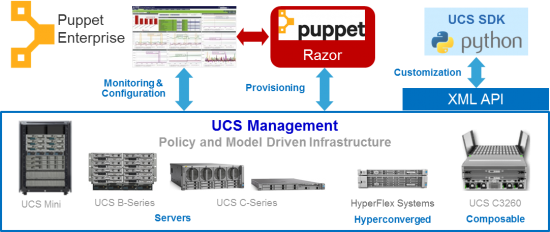
The UCS management framework is policy and model driven. It supports the entire UCS portfolio: UCS blade and rack servers, the UCS Mini, HyperFlex hyperconverged infrastructure and the C3260 composable infrastructure. It features an open API that serves as a unified control plane for all the physical and logical components in each UCS system.

The API facilitates a rich set of integrations that enable extensions beyond the physical infrastructure.  In addition to the new integration with Puppet Enterprise, UCS supports a broad ecosystem of tools and integrations to help automate routine processes.  There’s also a Python SDK  for customization. This allows IT organizations to dramatically reduce the time and costs associated with provisioning, administration, and deployment.  UCS management helps extend investments in existing tools and processes, so each organization can implement DevOps methodologies in a manner that minimizes disruptions and additional costs.

Puppet-UCS_Management_OV

Here are a few highlights of the solution:

Day zero configuration and server role assignment with UCS Service Profiles

  • An integral part of UCS programmability is the Service Profiles which provide identity for the infrastructure.  The infrastructure elements are stateless, and the network, storage. and server profiles create the identity for each of these elements through UCS Manager.  UCS’s combination of a model driven architecture plus Service Profiles enables safe, fast automation.
  • For additional customization, there is the Cisco UCS Python SDK on GitHub with a comprehensive set of Python SDK sample code to help you automate infrastructure as code with Cisco UCS.

Day one rapid provisioning with Razor

  • Razor provides a rich set of programmatic interfaces for provisioning including fine grained control of the target OS (Red Hat, Windows, etc.) and target workload (the server’s “role”).  UCS Service Profiles allow for upfront, flexible definition of the intended server role which is passed automatically to Razor.
  • Razor seamlessly integrates with Puppet Enterprise and provisioned nodes are immediately brought under management.

Day 2 and beyond management and monitoring with Puppet Enterprise

  • Puppet Enterprise can install and manage all aspects of a target workload with information passed up from UCS Service Profiles.  This allows for upfront definition of a target OS and workload which is automatically provisioned and brought into the desired state by Puppet Enterprise.
  • Puppet Enterprise’s rich set of modules allows for a wide range of managed workloads across all major OS, virtual machine, and containerized environments.

For additional information:


Authors

Ken Spear

Sr. Marketing Manager, Automation

UCS Solution Marketing