Avatar

Using CMX (Connected Mobile Experience) to track devices

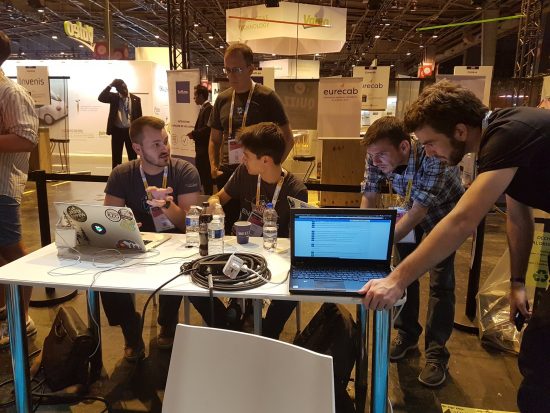
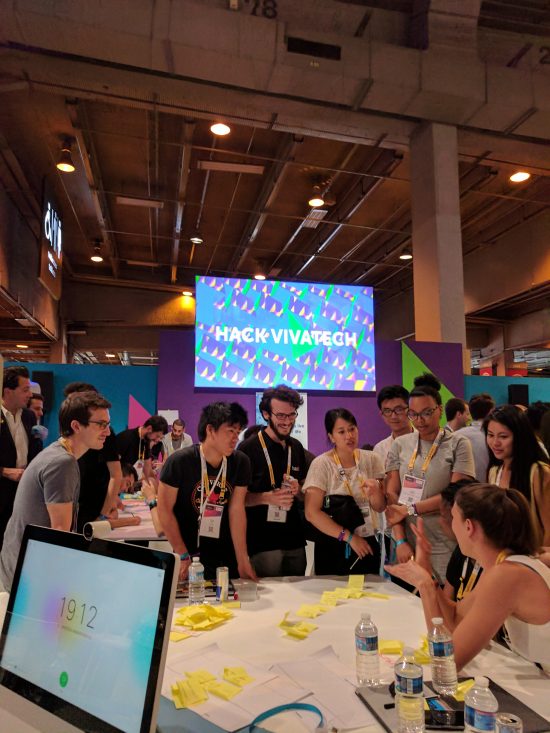
We had an amazing hackathon at VivaTech in Paris France last month. 10 person teams were assembled with the purpose of using Cisco Technologies to improve the conference experience! Cisco mentors and staff were on site and provided access to multiple technologies for the hackers to use.

The first Cisco technology offered to the hackers was Connected Mobile Experience or CMX. If you’re unfamiliar, CMX is used for indoor location tracking and can do some really neat things! Access points are set up in such a way that they’re able to triangulate a devices location by calculating the distance to the nearest 3 (or 4) access points! In order to provide real data to the hackers, the Cisco team installed over 250 CMX access points, covering the entire VivaTech conference! This CMX installation allowed us to track devices that have either Wi-Fi or Bluetooth radio that is turned on, not even necessarily connected to the network. This technology can be used to visualize traffic flows, figure out which booths are visited most, or even which booths are visited for the longest period (dwell times)! Check out more about how developers are using CMX in applications for manufacturing, healthcare, retail, hospitality, education, and government. CMX is also being used to make buildings smarter while simultaneously saving money.
The Spark video SDK shines

In addition to the CMX, Cisco was also providing access and support to the Spark collaboration tools! In particular, the Spark video SDK and everyone’s favorite… Spark BOTS! The Spark video SDK can be used to imbed high quality audio-video calling and messaging into any web or native application. Spark is an extremely powerful tool and the video SDK can be used to imbed that functionality where you need it most! Last but not least, we encouraged the hackers to take advantage of Bots and their ability to automate routine tasks and inject contextual content into groups, meetings and conversations. Bots and Bot frameworks, have become very robust and with the help of companies like recast.ai, you can do things like enhance your bot with natural language processing!

Learn more about Cisco Spark
See what integrations others have made with Spark
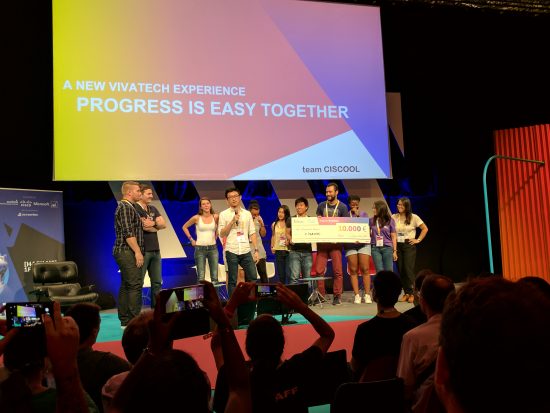
Team Ciscool’s “Smart Path” app takes home first prize

The attendees produced amazing projects during the 24-hour hackathon, but only one team would be allowed to take home the grand prize of 10,000 euros. Team Ciscool did this by using Spark and CMX to gamify the conference!

They created an application called Smart Path. The application starts by using a Cisco Spark chatbot and recast.ai to create interest profiles of conference attendees and booths or stands at VivaTech. Smart Path then matches attendees with the most relevant content to their interests at the conference!

Team Ciscool used the location data provided by the CMX installation and visualized by MapWise to then direct conference attendees to the booths or start-ups that they’re most likely interested in. Attendees that visit relevant booths will gain points in the app that allow them to win fast track passes to other popular conferences and events. Vendors and start-up exhibitors benefit by getting relevant traffic driven to their booths and reducing the chances of getting lost in the sheer size of the event. What a cool idea!

This amazing solution was conceived and developed in less than 24 hours! and stands as a great example of just what developers can do with Cisco SDKs and APIs.

If you’d like to learn more about what you can do with Cisco technologies, here’s a few options for things you can do:

Learn more about the CMX API

Become a Cisco DevNet member

Find one of our DevNet learning events near you

We’d love to hear what you think. Ask a question or leave a comment below.
And stay connected with Cisco DevNet on social!

Twitter @CiscoDevNet | Facebook | LinkedIn

Visit the new Developer Video Channel

Authors

Avatar

As my colleagues and I engage in our analysis for the Cisco Visual Networking Index, we are always on the look out for new or emerging technologies that have the potential to change network demands or user behaviors. Networks are truly organic infrastructures and many variables can have an impact on our forecast. This time around, our brainstorming sessions included a technology that is very much top of mind for many digital disrupters – Blockchain.  Blockchain technology has been applied to a variety of digital transactions and it is proving to be a transformational tool for content contracts and subscriptions with enhanced security and privacy features.

According to the World Economic Forum, 10% of global gross domestic product (GDP) will be stored on blockchain platforms by 2027. A significant amount of industry buzz has also been devoted to this relatively new digital fabric (see Blockchain: The Invisible Technology That’s Changing the World).. So, I thought it might be useful to learn more about blockchain technology and why it could be a big deal.

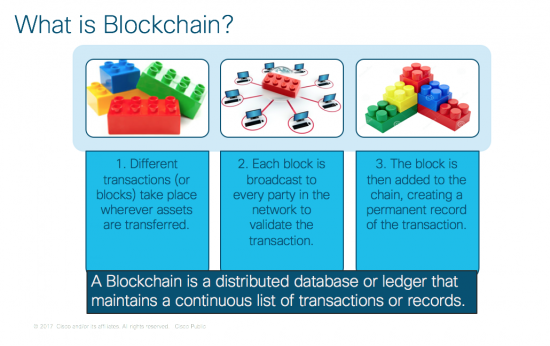
What is Blockchain?

The informal definition of blockchain is that it is a distributed ledger that maintains a constant, continuous list of records. In my mind, blockchain resembles a Lego block tower. Each transaction is like a Lego block and each block/transaction is transmitted to every party in the network.  Each transaction is validated and then added to a chain, which creates a structure (like a Lego tower). The chain of transactions is then stored on multiple computers/servers, which ultimately represents a permanent irrevocable record. And that concludes the Legoanalogy. Unlike actual Lego blocks, which can be pulled apart and applied to new or different structures, blockchain records are fixed and steadfast.

How and Where is Blockchain Transforming Transactions?

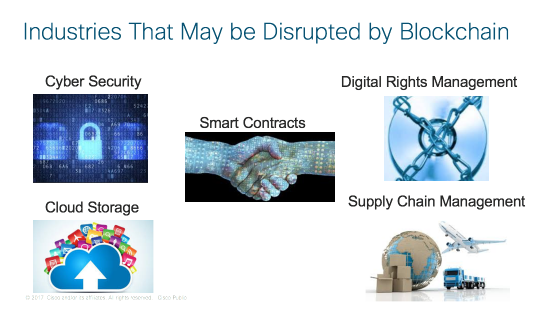
Blockchain technology has the ability to disrupt multiple technologies — cybersecurity, digital rights management, and supply chain management, just to name a few. The ability of the technology to track a transaction and maintain an immutable record will undeniably disrupt the way business is conducted today. It removes the mediator and brings the two parties involved in a transaction together with no issue of mistrust as the technology takes care of the transaction recording once the commitment criteria have been met by both parties. Transaction validation occurs once the handoff is completed on both ends (also called “Smart Contracts” or as I prefer to call it, “Programmable Contracts”).

In terms of cybersecurity, specifically DDOS attacks, there’s a major need for innovation and improvement. Cisco’s Visual Networking Index predicts that the average DDoS attack sizes are steadily increasing in number of occurrences and size. Breaches approaching 1.2 Gpbs are large enough to take most organizations completely offline and can represent up to 18% of a country’s total Internet traffic while they are active.  Blockchain can help prevent DDoS attacks since the transactions/chains are saved on multiple computers or servers making it would difficult to take the entire chain down with a targeted attack on a single location.

Privacy can also be improved with blockchain. There are a few public blockchains that can be viewed by everyone in a system. However, there is a more stringent privacy option that can be used for sensitive data or files, like electronic health records (where only you, your health care professional, and insurance providers can access your relevant information, which is safe from the public view).

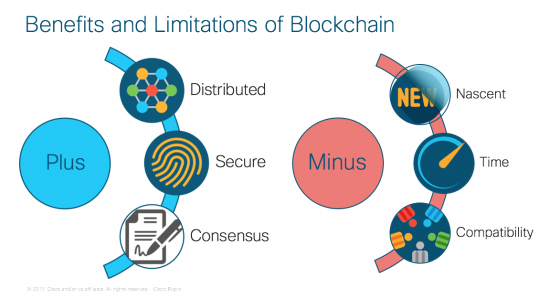
So, blockchain is a distributed system with no central authority, wherein two parties are able to exchange assets or information without any oversight or third-party intermediation. This process can reduce or even eliminate risk making the blockchain data secure, complete, consistent, timely, accurate, and widely available to those with proper authorization. The decentralized nature of blockchain makes it particularly resilient against malicious attacks. Any changes to public blockchains are transparently viewable by all parties and transactions cannot be altered or deleted. (Source: Deloitte)

But blockchain is still a very new technology and it does present quite a few challenges that need to be overcome before it can go mainstream. Because of its nascent state it is still unregulated so government regulations will also have an impact on the uptake and popularization of blockchain.

Also as transactions within a particular blockchain grow: think supply chain management with vaccines being transported from multiple countries to developing countries globally it might take longer and longer to verify transaction times. In 2016, it took an average of 43 minutes to verify a single bitcoin transaction record. By comparison, standard ATM transactions are processed almost instantaneously and reflect immediately on a financial ledger. Even interbank money transfers can be completed in seconds. As a blockchain grows, verification times might become longer, meaning more computing resources might be required to process even the smallest transaction. Small blockchains wouldn’t suffer the same problems, but this is a significant limitation of the technology in its current state.

Also, blockchain applications offer solutions that require significant changes to, or in some cases complete replacement of existing systems. In order to make the transition to blockchain technology companies must plan for this transition with care to ensure compatibility with its existing systems to maximize savings in their transaction costs but with a high capital investment upfront.  Also, blockchain will require substantial buy in as it represents a completely different way of doing business with a shift to a decentralized network.

Would love to hear your thoughts on blockchain. Also stay tuned for my next blog on the impact of blockchain technology to Service Providers and to consumers.

Authors

Taru Khurana

Marketing Manager, Product/Systems

Avatar

Someone recently asked me about the origin of the Data Virtualization category name. From my unique perspective as the software marketer who drove the term and category’s successful adoption, I enjoyed the chance to share the Data Virtualization category story with them.  And in this blog, I thought I might also share it with you.

So, like every good story, I’ll begin at the beginning.

It All Started with Enterprise Information Integration

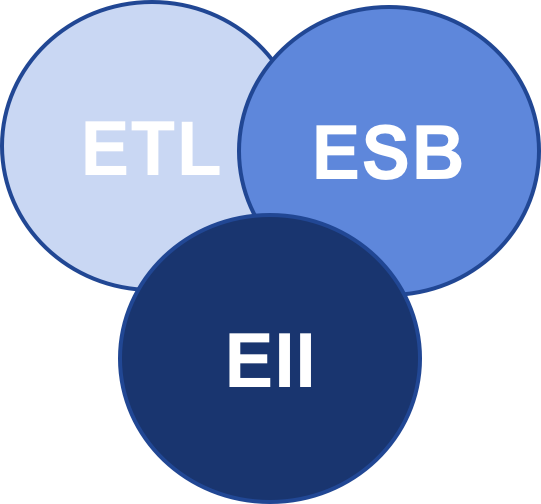
In the early 2000s the data management term Enterprise Information Integration (EII) came to the fore.  EII was driven by advancements in high-performance query optimization that made data federation at enterprise scale possible for the first time. Wikipedia’s entry on EII claims the vendor Metamatrix, was the source of the term. And organizations such as TDWI and Gartner identified EII as an essential complement to Extract, Transform, and Load (ETL) and Enterprise Service Bus (ESB), often depicted by three intersecting circles as follows:

In 2005, JP Morgenthal published EII’s first book, “Enterprise Information Integration: A Pragmatic Approach. In that same year, SIGMOD also published a groundbreaking EII compendium white paper authored by Alon Y. Halevy; et al., entitled “Enterprise information integration: successes, challenges and controversies.”

Always on the lookout for new enterprise software opportunities, nearly 30 venture-backed software firms were quick to move into the EII market.  Perhaps you remember Avaki, Ipedo, Journee Software, Metamatrix, XAware and more.

Data Services Arises as EII Plus

Service Oriented Architecture (SOA) was also a hot market at that time.  Although the goal of SOA is to enable business processes (rather than business intelligence and analytics), business processes also required data on demand.  Examples might include SOA Data Services to look up prices, customer discounts, ship-to-addresses and more within a SOA-enabled order management process.

Gartner’s October 2005 “Management Update: Data Services: The Intersection of Data Integration and SOA,” by Ted Friedman and Jess Thomson was amongst the first pieces of analyst research to address data from the SOA point of view.  Gartner’s definition of Data Services expanded the role of EII beyond BI to also include support for business processes.  Technically it also expanded EII beyond SQL into more SOA type approaches that leveraged then-emerging technologies such as SOAP and XML.

I joined Composite Software, one of the venture-backed EII firms, as Chief Marketing Officer in 2006.  Because Composite’s CEO, Jim Green, had led the definition of CORBA and was a founder of Active Software, a leading SOA provider, Jim saw the same trends that Gartner saw.  And thus, Jim and I positioned Composite away from the other EII vendors, instead focusing on the SOA Data Services segment of the market.

Forrester Plants the Data Virtualization Seed

Forrester had a different take on Data Services than Gartner, publishing landmark research in January 2006 entitled “Information Fabric: Enterprise Data Virtualization.”  In this work, Forrester analysts Noel Yuhanna and Mike Gilpin were the first amongst the analyst community to introduce the term “Data Virtualization.”  This work expanded upon the earlier SQL and BI-only focus of EII, as well as the services concepts of SOA Data Services.  It introduced the concept of an Information Fabric architecture that aspired to be the logical place to go for all enterprise information.

Wachovia Implements Data Virtualization

At Composite, a number of our customers began to implement the concepts espoused by Gartner and Forrester.  Technologists at Wachovia’s investment banking group were an example of these pioneers.  Led by Tony Bishop, they called their new implementation Data Virtualization, and it supported the entire bank’s customer and investment activity information needs.

Composite Evangelizes Data Virtualization Category Name

By the summer of 2007, the Composite field had seen great success promoting the Data Services concept.  However, too many of the prospects wanted to implement more transactional SOA capabilities first, before expanding to meet the BI requirements that Composite could fulfill.  This good news / bad news result drove Composite’s management team to meet in early 2007 in Half Moon Bay California to discuss our “category problem”.

After two days of hashing out various options and messaging, we decided to take the Data Virtualization leap, concurrent with the launch of Composite Information Server 4.5 in June 2007.

Slow and Steady Wins the Race

The CIS 4.5 announcement press release was just the first step in a ten-year category build with many milestones on this journey.   Below are just a few highlights:

And today the beat goes on, especially on the analyst front as I noted in my recent blog, It’s Summertime, So Analysts Turn Up the Heat on Data Virtualization.”

How Will the Data Virtualization Category Story End?

For those of you looking for a fast read, I don’t see the Data Virtualization category story ending anytime soon.  Market penetration, as estimated by several analyst firms, is still less than 20%.   And when you also consider Gartner’s recent Strategic Planning Assumption that predicts 40% lower data integration costs at organizations that use Data Virtualization, you can see a long future ahead.

So, it’s not too late to write your own Data Virtualization story.

Cheers to your journey!


Authors

Bob Eve

No Longer with Cisco

Avatar

People today use their mobile devices anytime, any place, and anywhere and According to the Global mobile Suppliers Association (GSA) today there are still more than 800 mobile operators investing in LTE. There are also close to 600 additional LTE networks that have been commercially launched and another 60 are still being built out. Growth in LTE is being driven by all types of intelligent devices such as smartphones, tablets, PCs, and IoT Devices are some of the big growth drivers. Adoption of Voice-over-LTE (VoLTE) and Voice-over-Wi-Fi (VoWi-Fi) is also extremely high and growing. This growth has caused a tremendous amount of new signaling traffic that needs to also be addressed with a new signaling architecture.

Recently analyst firmMarket Research Future announced that the Diameter Signaling Market globally is growing rapidly and expected to reach a USD $5B and growing at a CAGR of 47% by 2022. Diameter is a protocol that enables signaling between Internet Protocol network elements. It can be thought of as the language that servers and software use to communicate within the core of 3GPP Mobile 3G and 4G/LTE Networks. In IP networks, Diameter signaling performs the role that SS7 signaling performed in legacy networks. Today, as mobile IP networks are handling more data traffic per user than their predecessor 3G networks, Diameter signaling traffic is set to far exceed the signaling traffic in 3G networks. As central signaling routing nodes, Diameter Routing Agents (DRA) have been defined and deployed to facilitate Diameter signaling communications among a network of Diameter peers, eliminating point to point signaling connections, and the high maintenance costs these entail.

Cisco’s Diameter Routing Agent

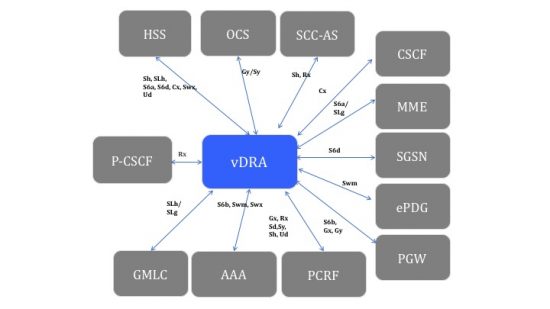
The Cisco virtualized Diameter Routing Agent (vDRA) is a Cloud-Native software network component that provides intelligent routing of Diameter messages to Diameter endpoints.  The Cisco vDRA operates as a Diameter proxy and load balancer, and is built on the same proven Cisco Policy Suite (CPS) virtualized software used in the Cisco Policy Control Rules Function (vPCRF), the Mobility Orchestration Gateway (vMOG), and our Access Selection (vANDSF) applications, extensively deployed on both VMware and OpenStack hypervisors in Tier 1 carrier networks today. The Cisco vDRA supports 3GPP Diameter interfaces such as Gx, Rx, Sd, Sy, Sh, S6b, S6d, SLg, S6a, Slh, Cx, Swm, Slh, Slg, and interconnects PCRF, AAA, GMLC, ePDG, CSCF, HSS, OCS, SCC-AS, P‑CSCF, MME, SGSN, and PGW among other Diameter peer types.
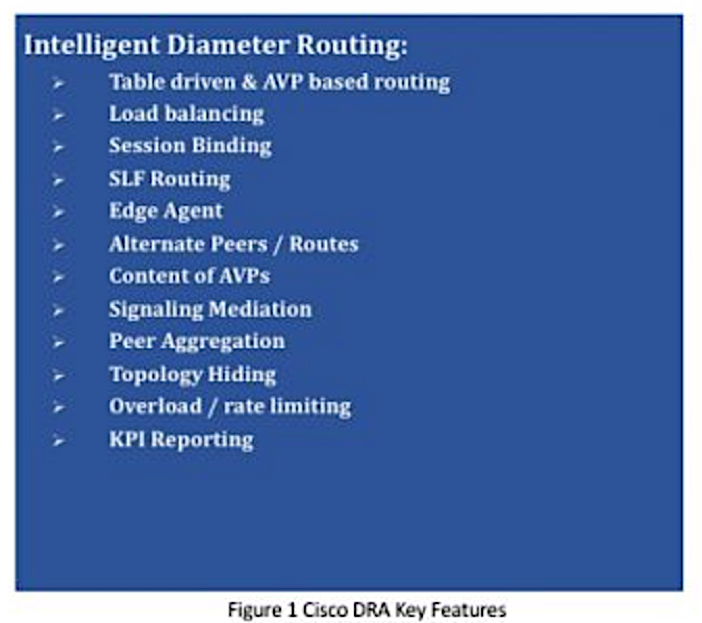


The Cisco vDRA solution is highly sophisticated yet very intuitive and flexible. Our extensive Diameter routing capabilities include Destination-Host Routing, Service-Key Routing, and Table-Driven Routing, along with support for Binding-based routing and Subscriber Lookup Function (SLF) routing, with database lookups based on IP-CAN session and a range of subscriber identifiers (IMSI, MSISDN, APN, IPv4/6). 

Cloud Native software design

The Cisco vDRA application is delivered to customers in a Cloud Native Docker Container and Microservices-based framework that presents them with a range of operational benefits, including:

  • Simplification: Simpler and faster API-orchestrated system installation, software management and In-Service Software Upgrades
  • Dynamic Service Discovery allowing for dynamic scale up and scale down of CPS vDRA processing nodes within a Cloud Native architecture.
  • A programmable Stats, Counters and Alarms framework based on Cloud compatible best in class monitoring software.  This monitoring tool provides metrics gathering, and interfaces to Grafana for powerful easy-to-use visualization of any metric, and complex alerting rules.
  • Conf-D Integration – Cisco’s Conf-D provides Netconf/Restconf YANG interfaces to the operational commands and configuration of the Cisco vDRA system.  This replaces custom scripts and config files that are otherwise required, and enables integrated single sign-on of multiple user interfaces and Docker services with the Conf-D NACM / AAA model.

Along with these Cisco vDRA platform benefits, the integrated Binding and SLF databases are all based on cost-effective, highly scalable and Cloud-ready NoSQL databases. Our system design and SLF database architecture allows for accepting provisioning requests on any API provisioning end point in our VNF solution in order to provision the SLF. There is no obligation or constraint for the carrier provisioning system to utilize a single API provisioning IP address endpoint in the CPS vDRA solution. Internal DB data replication for any such provisioning requests is handled internally within the Cisco vDRA architecture.

Customer Momentum

We are pleased to say that this new Cloud Native vDRA solution offering has not gone unnoticed in the industry. Cisco has had the pleasure of recently being awarded contracts with two large North American customers looking to modernize their legacy DRA solutions, and accelerate their move to Cloud Native. Cisco is also working very actively with a number of other leading carriers on pre-commercial vDRA trials.

For Service Providers looking to experience the next generation vDRA please contact us at mobilecloud@cisco.com and watch this space for more information.

Authors

Jim O'Leary

Sr. Manager Mobile Solutions Marketing

Avatar

Cloud and software-defined technologies continue to reshape traditional data centers.  Companies turning to cloud to deliver consistent services and processes have found that they can deliver elastic, safe and flexible services at the speed and expectations of their customers.  They have also discovered that cloud is extending the life of their on premise environments.

Is cloud in your toolbox?  If not, how do you choose from the surplus of solutions on the market today?  Did you ever wish for guidance from industry peers?

Since 1986, the Software & Information Industry Association has recognized the best of software and digital content with their annual CODiE award.  The CODiE is the only peer-reviewed program that showcases technology products across business and educational markets.  The results for 2017 were just announced.  Cisco repeated for the second straight year by winning:

Best Cloud Infrastructure as a Service:  Cisco ONE Enterprise Cloud Suite

Continue reading “Cisco ONE Enterprise Cloud Suite Wins Again!”

Authors

Joann Starke

No Longer with Cisco

Avatar

The Electronic Health Record (EHR) has been in the news a lot lately –for some good reasons, and some not-so-good ones. But one thing is clear: The healthcare industry has come to rely on this technology, and we’re not going back.

While the financial rewards offered by the HITECH (Health Information Technology for Economic and Clinical Health) Act may have been the catalyst for near-universal adoption of EHRs (by hospitals at least), providers—and patients—are now realizing the benefits. Studies show that well-functioning EHRs can help increase productivity, ease the exchange of information, and even aid in improving clinical outcomes. And although it’s no secret that some clinicians are frustrated with certain aspects of the EHR, very few want to stop using it altogether. (To the contrary, 75% of providers say they think it improves the quality of care.)

No doubt, EHR technology will grow and change over the next few years—and providers with have to evolve along with it. But with a solid EHR strategy and the right processes in place, every facility can benefit from the advances that digital systems bring to healthcare. Want to learn ways to make the EHR work for you and your organization? We’ve got six of them. Check out the SlideShare below to learn more.

https://www.slideshare.net/Cisco/6-ways-to-make-the-ehr-work-for-your-healthcare-organization


Authors

Amy Young

Marketing Manager

Healthcare

Avatar

If customer retention is what keeps you awake at night, then you’ll want to hear what Sanjiv Patel has to say. As director of data science for Cisco, Sanjiv plays a leadership role in our company- and partner-wide digital transformation. Kelly Crothers, director of strategy, planning and thought leadership, recently sat down with Sanjiv to discuss how partners can use data science to improve customer health and success.

Kelly: First off, how does data science impact the customer journey at Cisco?

Sanjiv: As Cisco began building its customer success practice a few years ago, it became clear that we also needed to build a strong data science foundation for the initiative. Through data science, we can gain a deeper understanding of the customer’s journey and engage in more effective conversations throughout the customer lifecycle. In the past year, our data science efforts have accelerated and my role has been centered on expanding our machine learning and predictive and prescriptive analytics capabilities to deliver a more powerful digital experience to our customers. It’s been gratifying to see the impact. For example, data-driven digital touchpoints led to a 21% increase in subscription renewals in one year, fueling increased customer retention.

Kelly: Can you tell us about the data science models you’re using and how they add value to the customer journey?

Sanjiv: Our data science models look at our customers from a who, what, when, where and why perspective. The “who” models focus on reaching the right customer contacts. The “what” models focus on the messages we present to them to address their specific needs. We have a recommendation engine–similar to Amazon’s–that predicts what each customer is likely to purchase across Cisco’s entire portfolio in the next three months. We can use that information in different ways to execute a touchpoint at the appropriate time in the customer lifecycle. The “when” models allow us to target specific customers at specific times, based on their interaction history with us. The goal is to get the timing right – to engage with them when they’re most likely to see our messages and extract value from them. The “where” models determine which digital channels best suit each customer: we’ve scored each customer based on their preferences, such as email, web and social. Lastly, the “why” models address specific problems, such as predicting that the customer is facing setbacks with a product, or that they are not likely to renew with us. These models prompt us to take corrective action.

Kelly: I’ve heard you mention Cisco’s “digital brain.” Tell us more about that.

Sanjiv: When you combine the “who, what, when, where and why” models and aggregate the incoming data in one central place, the result is what I call Cisco’s “digital brain.” That brain maps out our engagements with each customer based on their journey with us. Taking our “brainpower” a step further, we use machine learning to help our team identify all the ways they can make the journey for the customer more personalized. The idea is to eliminate mass messaging and even segmented messaging. We want to treat each customer engagement as a “market of one.”

https://www.youtube.com/watch?v=QsdvOvXKK-Y

Kelly: How can partners get started with data science?

Sanjiv: It’s easy to get intimidated by all the different metrics. My best advice is to start simple: this video interview offers a few of my ideas for how and where to begin. To solve the issue of how to reach your best or biggest customers using digital touchpoints, gathering the data you need is typically very easy. That information is front and center in your business. The challenge becomes more complex with your broader base of customers, especially when you consider the multitude of lifecycle touchpoints required to nurture success across each product or service the customer is using. That’s where our partner-focused offerings like Lifecycle Advantage come in. They are essentially hardwired to our “who, what, where, when and why” models, and provide partners with the ability to deliver timely, scalable and automated touchpoints—along with an immersive, personalized digital experience—to the customer.

Kelly: What is one message you’d like to leave with our partners when it comes to data science?

Sanjiv: Don’t wait. When it comes to serving your customers, it’s a race against time to deliver value. Through data insights, you can gain a deeper understanding of the customer’s journey in real time, which means you’re not only able to serve them better, but you can also establish a more profitable and rewarding future for your business.

How can partners get started with data science? Watch the video now.

Authors

Kelly Crothers

Director, Marketing

Global Customer Success

Avatar

Today, Cisco completed the acquisition of Viptela, which further accelerates our Network Intuitive vision we launched in June.

Viptela provides a world-class, cloud-first SD-WAN solution with advanced routing, segmentation, and security capabilities for interconnecting complex enterprise networks. Its cloud-based network management, orchestration and overlay technologies make it easy to deploy and manage next-generation WAN architectures.

There are massive transformations in enterprise networking as new waves of Software Defined Networking (SDN) move into the LAN and WAN. Customers are turning to SD-WAN solutions to simplify their branch office and WAN deployments, and lower costs and risks with simple automation and orchestration. In fact, IDC estimates that worldwide SD-WAN infrastructure and services revenues will see a compound annual growth rate (CAGR) of 69.6% and reach $8.05 billion in 2021.

The Viptela team will be joining our enterprise networking engineering and sales teams to begin extending Cisco’s vision for intent-based networking across the WAN, campus, and branch. We are committed to continuing to accelerate the standalone roadmap for Viptela’s vEdge routers and overall SD-WAN solution. We will also be committing significant incremental engineering resources to bring unified next-generation SD-WAN solutions to market across our ISR and ASR routers as well as the newly announced DNA Center.

Cisco is committed to offering the broadest range of SD-WAN solutions to our customers. Selecting the right solution is based on understanding our customers’ needs and goals. With that in mind, we’ll provide our customers with the following options:

  • For customers and partners that require cloud-first SD-WAN solutions with advanced routing, complex topologies, or granular segmentation capabilities, Cisco’s SD-WAN solution based on Viptela will be the preferred solution.
  • For customers looking for unified threat management (UTM) solutions with SD-WAN functionality or are existing Cisco Meraki customers looking to expand to SD-WAN then Cisco Meraki is the recommended solution.
  • Cisco is investing in and supporting the IWAN solution. Customers who need to support advanced services such as voice, compute, WAN optimization, integrated threat control capabilities, switching, etc., integrated on a single device, or are leveraging an existing ISR, should select Cisco IWAN. As new unified offers are made available with Viptela’s technology incorporated in the ISR and ASRs, customers will be able to migrate to the new unified solution as desired.

Viptela accelerates Cisco’s overall Network Intuitive vision that was unveiled in June. With this new Digital Network Architecture approach, Cisco is changing the fundamental blueprint for networking with reimagined hardware and the most advanced software. The shift from hardware-centric to software-driven networking will enable customers to experience a quantum leap in agility, productivity and performance. The intuitive network is an intelligent, highly secure platform — powered by intent and informed by context and Viptela’s solution is perfectly aligned with that vision. We’re helping our customers be successful with their digital transformation and Cisco’s next-generation SD-WAN solutions will play a key role in making that vision a reality.

Authors

Scott Harrell

Senior Vice President and General Manager

Enterprise Networking Business

Avatar

It’s Not Easy Being Green

In the workplace, there is an endless list of things that keep our minds occupied. For me, it’s everything from project deadlines to what I’m going to eat for lunch today. And even though society is doing its best to lead us into “being green” at work, how to be a better environmentalist is not necessarily on the top of everyone’s mind.

At Cisco’s headquarter in San Jose, the Workplace Resources (WPR) team wants to change that! And we’re continuously rolling out initiatives on how we can make our campus (and the company in general) more “green”.

I began to notice this new focus back in April, when Cisco’s Green Team helped put on a vendor fair for Earth Day. At the fair, employees were introduced to new and current vendors that are working towards the ultimate goal of bettering our environment – starting by the services they use on their very own campus.

Cisco employees in San Jose now have access to Scoop which is a mobile-based carpooling service that helps employees get to work in the greenest way possible. Additional electric car charges are also being installed in parking lots across campus that will aid in increasing charging stations for our employees.

So now that we have opportunities to be green going to and from work, what about within the campus itself? I asked myself this question recently and on my journey to see how our Cisco campuses were becoming more green – I discovered quite a bit!

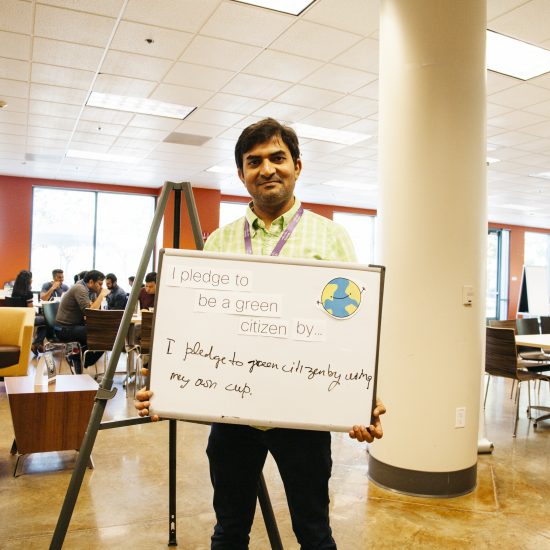
Within the breakrooms, WPR is reducing the amount of paper goods that are available at our disposable, and will (hopefully) be met with an increase in employee’s bringing reusable drinkware such as water bottles and coffee cups.

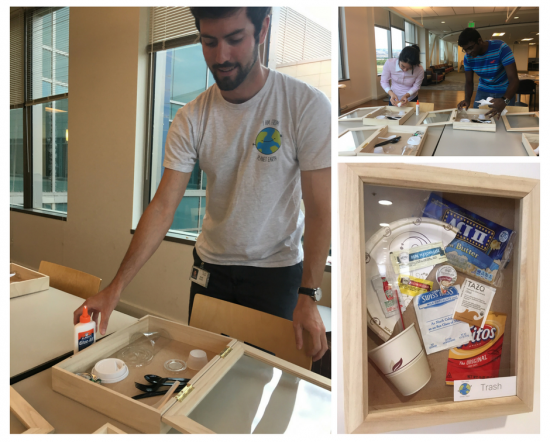
The Cisco campus is also making an effort at the locations that derive most of its waste – the cafes and coffee bars. Compostable items have always been available throughout the dining areas, but employees (myself included) don’t always know what trash bins to toss our leftovers into. Luckily, our Green Team came up with an awesome solution! The team recently created and installed some awesome signage to help café guests sort through their waste and get it into the proper receptacle.

A simple task, yes, but one that can always use a little reminding!

Being environmentally conscience can also mean helping others in need – which is exactly what Cisco’s newest partnership with waste management company Copia provides. Copia works with the cafes on campus to pick up all the edible waste food from a day’s service and drop off these delectable leftovers to local shelters. As of today, Copia has helped Cisco donate over 13,000 meals to local nonprofits! Food that would otherwise go into a landfill now helps support our community.

From transportation to waste management, Cisco has provided its employees with an array of options that make helping the environment easy. We can all be proud about working for a company who also cares about the city it lays its foundation on and is actively encouraging employees to be green in San Jose.

How is your campus helping the environment? We’d love to hear about it in the comments below!


Want to join a company that cares about the environment?  We’re hiring!


Authors

Amanda Filingeri

Marketing Manager, Dining @ Cisco

Services – Food & Beverage