Avatar

If you read my blog posts, you know there’s one thing that is very important to me: meetings. It’s how business moves forward. Meetings are where we get stuff done and where we solve problems. That’s why we are continuing to focus on building tools that enable meetings to be as seamless and simple as possible. At the end of the day, we want everyone to focus on the actual meeting content and not the tools.

Over the last 12+ months, we’ve made changes to improve your experience with WebEx.

  • First, we created a single, large, green button to start your meeting – no obtuse codes or strange URLs to copy and paste.
  • We optimized the meeting join time, down from 20+ seconds to < 5 seconds.
  • We created Personal Rooms, virtual meeting spaces that feel like your physical office.
  • And recently, we leveraged artificial intelligence to help users identify and mute background noise.

There have been more, but today I want to talk about what how we’re innovating in WebEx to stay in synch with emerging usage patterns.

What do I mean by emerging usage patterns? As the workforce shifts, your expectations of tools and technology have changed. The way people interact with tools has changed. One tap or click should get you what you want or where you are going. And in some cases, you should be able to just talk to your device.

Meetings are where we get stuff done and where we solve problems.

Take the “Facetime Generation,” for which the expectation is that a) technology just works with a single click, and b) audio and video are combined as a single component of any meeting. So, when you click to join a meeting and video doesn’t turn on, or you have to dial in separately for audio, it’s natural you’d be frustrated.

With these shifts, we started asking ourselves why we had joining video as a separate option in WebEx. Audio and video should automatically be part of every meeting experience.
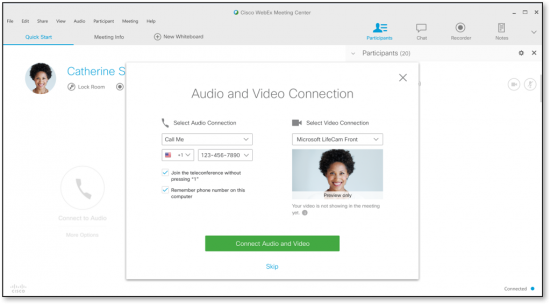
The new WebEx interface allows you to connect to audio and video with a single click.

And so, we changed it. We simplified the join process for WebEx meetings by tying the audio and video sequence together. With a new user interface, a single click does everything. Just like people expect: fewer clicks, no confusion.

How does it work? Just preset your audio and video preferences (whether dial in, call back, call back to a video endpoint, or connect your webcam), and click the big green button to connect to the meeting with audio and video. Do that once, and the WebEx client will remember your previous selections.

Our UI designers did a great job creating a control that maintains flexibility in how you prefer to join, while also introducing simplicity.

Evolving the Mobile Meeting Experience
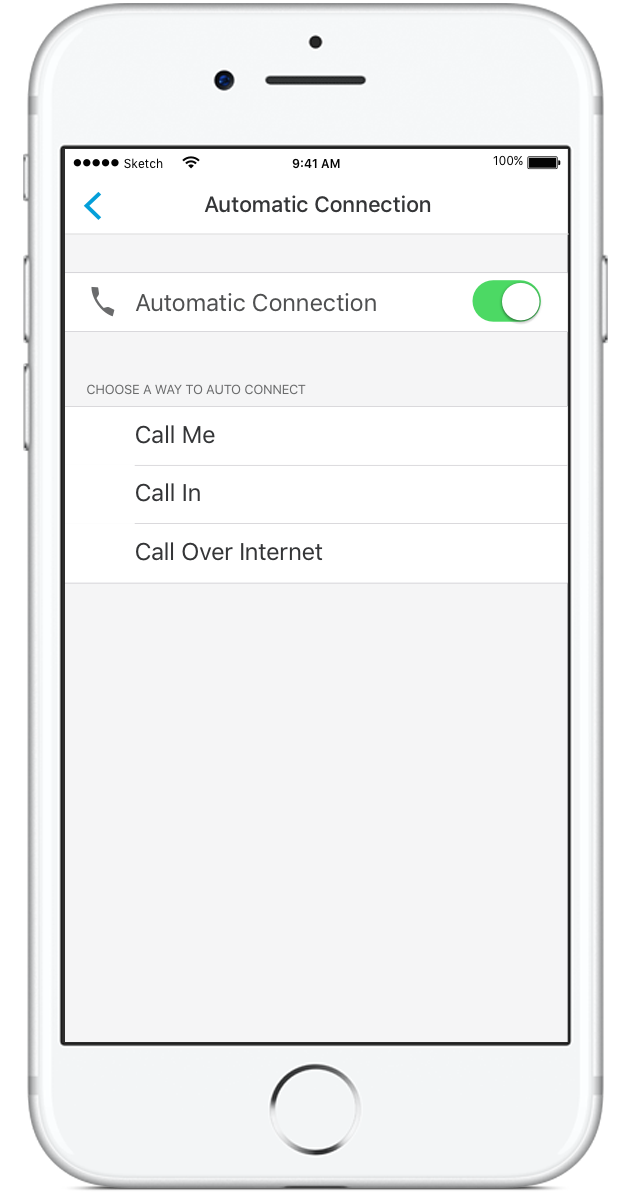
What if you’re working on the go? Mobile devices are where emerging usage patterns have become mainstream: We don’t dial or enter numbers, we simply tap. That’s why we’ve simplified the mobile meeting join experience, too. The app knows the call-in number for the meeting and it knows your phone number. With “Automatic Connection,” you can have the meeting call you, you can automatically call in, or you can automatically call over Internet. The best part of this feature? You don’t have to enter numbers for any of these options.

All these are seemingly simple, small changes that work in concert to improve the meeting experience.

Boosting the Browser

One other significant change we’ve made to make joining meetings easier than ever is to improve the WebEx web app so you can join meetings directly from a browser. Why did we do this? People aren’t always in a location or on a device where they can install software. Perhaps they’re on a computer that won’t allow plug-ins, software updates, or desktop image certifications. We want to make sure you can always have access to the latest and greatest meeting experience.
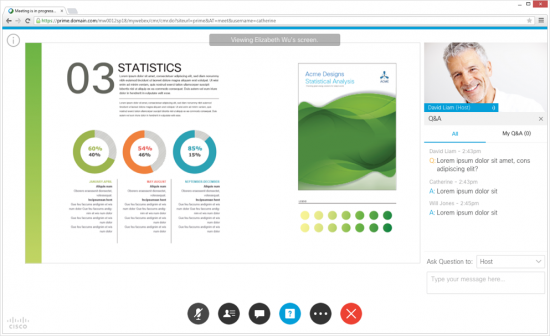
You can join meetings directly from a browser.

By leveraging WebRTC and Cisco’s OpenH264 binary module integrated into your browser, you get a great voice and video call, without plugins, complex and cumbersome browser downloads, or expensive transcoding gear in the cloud. Within seconds you’re in any WebEx meeting with almost the same experience – audio, video, and viewing of shared files. This is putting the web into web conferencing!

What’s Next?

We’re always striving to innovate with WebEx, creating better, simplified meeting experiences that allow you to focus on the core purpose of meetings: the exchange of ideas and collaboration.

What’s next for us at Cisco Collaboration? We’re continuing to create tools that accelerate the collaborative process. And we’re finding ways to leverage new technologies like artificial intelligence, machine learning, and virtual reality to make collaboration – and meetings – even better.

Stay tuned, because there is a lot more coming.

What do you think? Let me know below or on Twitter @jensmeggers.


Authors

Jens Meggers

No Longer with Cisco

Avatar

In FY17, which ended in July, we completed and met our latest greenhouse gas (GHG) Scope 1 and 2 reduction goal.

To recap, Cisco’s past Scope 1 and 2 reduction goals include:

  • June 2008: Five-year EPA Climate Leaders commitment to reduce all Scope 1 and 2 GHG emissions worldwide by 25% absolute by CY12 (CY07 baseline). Status: goal met in FY12.
  • February 2013: Five-year goal to reduce total Cisco Scope 1 and 2 GHG emissions worldwide by 40% absolute by FY17 (FY07 baseline). Status: more than $50 million invested; goal met in FY17.

We also committed in February 2013 to use electricity generated from renewable sources for at least 25% of our global electricity every year through FY17. We greatly exceeded this objective, reaching 71% in FY15 and 77% in FY16*.

To continue reducing our GHG emissions inline with recommendations of the Intergovernmental Panel on Climate Change, we have set our third Scope 1 and 2 GHG reduction goals:

  • Five-year goal to reduce total Cisco Scope 1 and 2 GHG emissions worldwide by 60% absolute by FY22 (FY07 baseline)
  • Use electricity generated from renewable sources for at least 85% of our global electricity by FY22.

Cisco will invest more than US$45 million over the five-year period in two areas—energy efficiency and renewable energy—to achieve these goals.

As part of these efforts, Cisco’s Operations group will implement over 300 energy efficiency and on-site renewable energy projects across Cisco’s real-estate portfolio and increase renewable energy procurement through utility green power programs, power purchase agreements, and renewable energy certificates. These goals are important because energy/GHG is the most material environment-related issue for Cisco and also help Cisco control its energy costs.

We continue to support the renewable energy industry, both to meet our GHG reduction goals and to respond to input from employees, investors, analysts, and advocacy groups.

With respect to employee attitudes toward sustainability in general and renewables in particular, Povaddo, a U.S.-based consultancy, recently released April 2017 survey results that examined employee attitudes towards corporate activism and employee engagement at companies with annual revenues of at least $1 billion.

As found in the study, 65% of employees would like to see their employer use its influence to take a public stand and/or be more vocal on renewable energy. Our internal assessment of employee attitudes track with this result.

While there are countries in which Cisco does business where electricity from renewables is not an economic option (why our goal isn’t 100%), our current level of purchases of electricity from renewable sources—greater than 75% increasing to 85%—address employee interest in this topic.

For more information on our other efforts to improve energy efficiency and reduce GHG emissions, including our Scope 3 supply chain carbon footprint, please see the Energy/GHG section of the environment chapter in our 2016 CSR Report.

*We will formally report our FY17 renewable energy purchases and GHG emissions metrics in our 2017 CSR Report to be published in November of this year.

Authors

Darrel Stickler

Sustainable Business Practices

Corporate Affairs

Avatar

I’m pleased to share some updates on our Cloud & Managed Services Program. First, we’re happy to say that in 2017 we’ve been listed in CRN’s Partner Program Guide for Network Connectivity and received CRN’s 5-star ranking. And we’ve kicked off a new chapter for the program—with more ways for providers who offer cloud and managed services to earn Market Development Funds. Here’s what’s new.

We made it in CRN’s 2017 Partner Program Guide

For the fourth year in a row, our Cloud & Managed Services Program made it in CRN’s Partner Program Guide for Network Connectivity. And as we shared earlier this year, it even got the coveted 5-star ranking.  CRN’s 2017 Network Connectivity Services Partner Program Guide gives you a detailed, unbiased look at the industry’s leading portfolios of telecom, cloud and connectivity offering.  It’s a great resource to help you choose a strong IT vendor who can help you navigate the convergence of IT and telecom.  We’re honored to be listed, and we think it speaks to how hard partners like you work to make the program a success.

We’re updating the program to help you do more

We’re focusing to help our service providers leverage software as a service and cloud managed offers. Which means your customers can get the solutions they need, right when they need them. They can roll them out anywhere. Subscribe to them. Or pay as they go.  With these changes, you can offer solutions much faster—and grow your recurring revenue business.

Deliver new Cisco Powered services

We’re also re-invigorating our Cisco Powered services to help you deliver more cloud and managed services—at the speed your customers need. With our hybrid delivery models, you have the flexibility to roll out your services wherever your customers want. Whether that’s to a public, private, or hybrid cloud. This helps you stay a step ahead of your competitors.

You can now offer these newly launched Cisco Powered services based on our published requirements to:

  • Get people talking and sharing with Cisco Powered Cisco Spark SP. It lets you offer compelling video and meeting experiences on any device.
  • Make networks work better with Cisco Powered Cloud Managed SD-WAN. As the newest member of our Cloud Managed DNA services, it lets your customers add new devices to their network in minutes, not months. And use their bandwidth better. All without sacrificing security or privacy.
  • Help your customers protect their business with our renamed Cisco Powered Cloud Managed Security You can offer your customers as-a-service options across our security portfolio. Including Cisco Umbrella and Cisco Advanced Malware Protection. And you now have the flexibility to use either virtual or physical appliances.

Earn Rewards In More Ways

It pays to partner with us to grow your cloud and managed business. Across the board, we’ve simplified our financial incentives to help you embrace this new era of software subscription and cloud orchestration.

New name. New focus. We’ve renamed our Cloud MDF to MDF for providers. Now both cloud and managed service providers can earn Market Development Funds.  Market your Cisco Powered services effectively by using MDF to build brand awareness and trust with new and existing customers. Generate demand, run marketing campaigns, engage with customers, and more.

Get MDF dollars sooner.  You can now get your MDF earlier in the year.  This gives you extra time to plan how you’re going to use your funds through the year. Start delivering you Cisco Powered Services to you customers and grow your earning power.

The Power of Cisco Powered

With the Cisco Powered brand next to yours, customers can see at a glance that you’re powered by the gold standard in security, performance, and agility. Which means they can be confident they’re choosing a provider they can trust.

This is only the beginning. We’re always looking for new ways to help you help your customers. Top of mind for us are other ways for this program to better serve our service providers.  In the meantime, we look forward to working together as we roll out this year’s updates.  A huge thank you to everyone who’s part of this program and has helped grow it into what it is today. We couldn’t do it without you.

Learn more:

Authors

Grace Lo

Director, Global Partner Programs

Global Partner Organization

Avatar

I’m a numbers guy. So, it really got my attention when I learned that businesses which make diversity and inclusion a priority do better than others. In fact, U.S. companies in the top quartile for gender diversity have 15 percent higher financial performance than the national industry median. And for ethnic diversity the difference is even more dramatic, with 35 percent better financial performance.

Of course, numbers aren’t the motivating factor, just the resultant. At Cisco, we value inclusion and diversity because it’s the right thing to do for our employees and customers. It’s a bonus that it’s also the right thing to do for our shareholders.

We have a wide-reaching view of diversity—embracing the full spectrum of backgrounds, genders, ethnicities, orientations, cultures, affiliations, abilities, work styles, and perspectives. Our customers are everywhere and represent everyone. It’s important that the company reflects this rich diversity so we can understand and deliver on the unique needs of our customers worldwide.


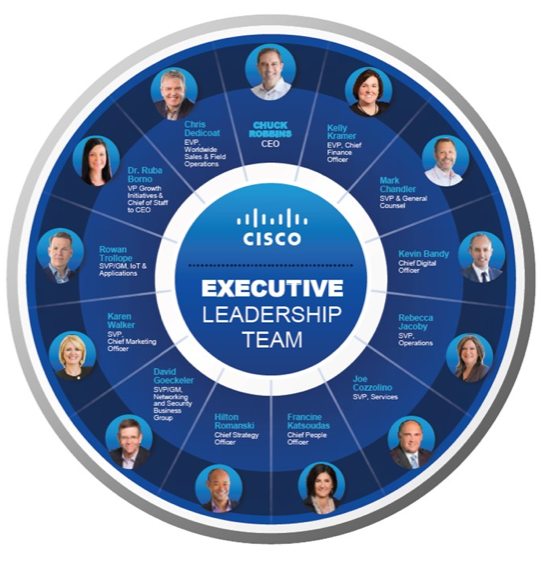
Cisco’s commitment to inclusion starts at the top. I’m proud to be part of one of the most diverse executive leadership teams in the technology industry. Our leadership is stronger when it is informed by different perspectives, experiences, and points of view. We have been very deliberate in driving a consistent approach to fairness and inclusion throughout our organization—monitoring pay parity, attracting a competitive share of diverse talent, and using data and analytics to accelerate our progress.



Building a truly diverse and inclusive company—and industry—starts with commitment, but can only go forward with action. Here are two examples:

1. Support initiatives that build diverse leadership

The Simmons Leadership Conference is top-of-mind for me right now, because this remarkable women’s leadership event is coming up in October in Geneva, Switzerland. I am proud to be an executive sponsor on behalf of Cisco. And I am even prouder that my VP and Chief of Staff, Jose van Dijk, is on the agenda. She will join prominent global leaders in government, business, and social change on the stage—inspiring 500 women who are leaders in their own organizations. I’m happy to say that, in addition to our financial support, Cisco will be sending significant representation of women leaders. I encourage you to attend or sponsor someone to attend this career-changing event.

2. Take the Multiplier Effect pledge

The Multiplier Effect pledge was launched in February at the 2017 Mobile World Congress, with Cisco’s CEO Chuck Robbins and more than 40 other tech leaders leading the way. The idea is to use the power of sponsorship to accelerate the pipeline of extraordinary diverse talent in tech. This pledge challenges leaders to go beyond lip service and make a personal commitment to be an advocate for someone who is different from them in race, culture, ability, gender, generation, ethnicity, or orientation. Leaders who sign the pledge commit to:

  • Sponsor a highly qualified diverse candidate for career advancement
  • Challenge peers to do the same
  • Stay accountable to their protégé and their peers

So, I’m challenging you! Join me in taking the multiplier effect pledge. Consider this:

  • 1 in 4 white men have a sponsor
  • Only 1 in 8 women have a sponsor
  • And only 1 in 20 minorities have a sponsor
  • Yet – research from the Center for Talent Innovation shows that having a sponsor increases your success rate by 23%

By actively promoting the career of just one diverse candidate, you will uncover hidden talent and multiply new perspectives and opportunities.

And—getting back to the numbers—your bottom line will be healthier for it.

Authors

Joe Cozzolino

Senior Vice President

Cisco Services

Avatar

The market for Low Power Wide Area (LPWA) networks, particularly NB-IoT and CAT-M1, is heating up. More and more Mobile Network Operators are engaged in trials or have already launched commercial services. Manufacturers are adding NB-IoT and CAT-M1 support to their sensors, modules, and devices. To date, Operators have taken a “horses for courses” approach by deploying a range of LPWA network standards for varying IoT application needs. However, many are predicting that the market momentum will swing from the first-to-market unlicensed LPWA standards (e.g., LoRa, Sigfox) to the emerging licensed LPWA standards (e.g., NB-IoT, CAT-M1), which are forecasted to capture over two-thirds of the LPWA market by 2020, according to ABI Research.

Some of the advantages cited for licensed LWPA technologies include: scalability, security, coverage, extended range in-building/underground, and easy deployment into existing cellular networks. For example, many operators have made their Radio Access Networks (RAN) NB-IoT-capable with a simple software update. The 3GPP specification for NB-IOT and CAT-M1 introduces two new network elements to an Operator’s mobile core network: CSGN and SCEF. The CSGN combines features of the LTE MME, SGW and PGW, while adding Cellular IoT (CIoT) optimizations such as: Control and Data Plane optimizations, Device triggering, Enhancements for battery savings, and more. Cisco Ultra IoT, introduced at MWC 2017, and now in trials with several Mobile Operators, provides these CSGN features and more. Cisco Ultra IoT is based on the NFV technology of Cisco Ultra Services Platform, which enables it to easily scale up and down virtualized resources based on application demands, as well as to support many scenarios from distributed, local points of presence to centralized, large-scale deployments.

Then there’s the SCEF, or the Services Capability Extension Function, which is an entirely new 3GPP network component. Within Cisco Ultra IoT, Cisco has delivered an enhanced SCEF that not only supports 3GPP standards but also offers a solution that allows Operators to grow their IoT business by bridging the gap between the network and IoT applications. The Cisco eSCEF is a horizontal framework residing between IoT devices and IoT applications that:

  • organizes device data, with data ingestion, storage and brokering capabilities
  • associates endpoints with apps, by normalizing devices, access types, and IoT transport protocols for IoT Applications via a unified API layer
  • implements multiple network service capabilities including identity management, application level authentication, and secure connection over any access, triggering, buffering, grouping, application event subscription and notification.

Linkages that exist between the Cisco eSCEF and Cisco CSGN elements of Cisco Ultra IoT make Cisco’s solution unique, enabling the Cisco eSCEF to have awareness of the end device’s state, location, and mobility events.

So, what does all this mean for the Operator? Cisco Ultra IoT not only hides network complexities from IoT applications, it exposes network capabilities to be used by IoT applications via an Open API. This creates new Operator monetization opportunities for new network services to devices and apps while providing flexibility in how those services are charged for. For example, Enterprises and their IoT app providers can:

  • Set own programmable policy control and enforcement for IoT devices and apps
  • Define data rate enforcement policies with various levels of granularity, for example, at a device, group, and enterprise level.
  • Establish new charging and accounting mechanisms to meet Enterprise business needs, for example, Operators could charge by network sessions or events rather than by data rate

With these horizontal capabilities supporting use case development across a variety of vertical IoT applications and devices, Cisco Ultra IoT opens new monetization opportunities for Operators in IoT markets such as Smart Cities, Transportation, Utilities, Intelligent Buildings, Agriculture, and more.

Find out more

Click here to learn more about Cisco Ultra IoT.

Authors

Brian Walsh

Senior Marketing Manager

Avatar

Overview

Free software often downloaded from large freeware distribution sites is a boon for the internet, providing users with functionality that otherwise they would not be able to use. Often users, happy that they are getting something free, fail to pay attention to the hints in the licence agreement that they are receiving additional software services bundled with the freeware they desire.
Graftor aka LoadMoney adware dropper is a potentially unwanted program often installed as part of freeware software installers. We wanted to investigate the effects this software has on a user’s system. According to the analysis performed in our sandbox, Graftor and the associated affiliate files it downloads perform the following functions:

  • Hijacks the user’s browser and injects advertising banners
  • Installs other potentially unwanted applications from partners like mail.ru
  • It does not ask the user, it just silently installs these programs
  • Random web page text is turned into links
  • Adds Desktop and Browser Quick Launch links
  • User’s homepage is changed
  • User’s search provider is changed
  • Partner adware is executed and it social engineers the user to install further software
  • Checks for installed AV software
  • Checks for sandbox environments
  • Anti-Analysis protection
  • Unnecessary API calls to overflow sandbox environments
  • Creates/Modifies system certificates
  • Functionality

<< Read More >>

Authors

Talos Group

Talos Security Intelligence & Research Group

Avatar

A couple weeks ago, we announced the availability of the RPHY Compact Shelf, complementing our Infinite Broadband solution launched in May 2017 at ANGA.COM. With the RPHY Compact Shelf extending support for Remote PHY to hub site deployments, the Infinite Broadband solution now includes everything you need to make Remote PHY a reality:

  • A CMTS core capability with the Cisco cBR8
  • Two types of Remote PHY Devices (RPDs), the GS7000 RPHY Node for Deep Fiber deployments and the RPHY Compact Shelf.

One of the main benefits of migrating to a Remote PHY deployment is the reduction in Total Cost of Ownership (TCO). However, deploying a massive number of RPDs and manually configuring and provisioning them would not afford you any operational savings.

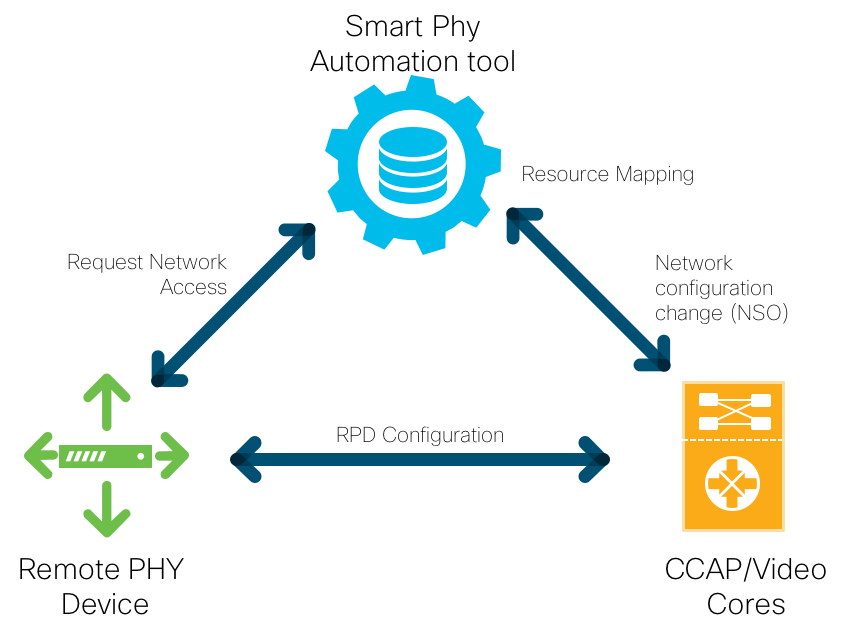
Here’s where automation comes into the picture, today Cisco is introducing Smart PHY, a vendor-agnostic Remote PHY automation tool that enables full automation of the provisioning, configuration and maintenance of the RPDs and RPHY cores.

How would it work? A typical Remote PHY deployment could include anywhere from two hundred-and-fifty RPHY RPDs up to five hundred RPHY RPDs, per CMTS core. If an MSO has one hundred cBR8s, that adds up to fifty thousand RPHY RPDs to configure. That’s a ton of work, hence the need for the Smart PHY automation tool.

Let me explain how the manual process and the automated process would compare:

The manual process (how most operators deploy network equipment today)

  1. Requires manual configuration of both RPD and CMTS/Video Cores
    • This is error prone at scale, the process makes it difficult to keep track of resources used, requires per RPD configuration and the field technician needs to know how to configure an RPD (special skill set)
  2. Manual provisioning requirements
    • DHCP server must know the CCAP/Video cores, which leads to inflexible load balancing. Also, in a line card high availability (LCHA) scenario the DHCP server needs to be configured with the protect card to come online during a LCHA event.
    • Validation and debugging needs to be done manually
    • Monitoring is based on Syslog messages

The automated process (how it would work with Cisco Smart PHY)

The automation process is applied to all RPDs simultaneously (if needed) and includes:

  1. Automated initial RPD installation and RPD provisioning with zero-touch of the Cisco CMTS or RPD. The field technician does not need any special skills.
  2. RPD inventory operations. For example, running inventory reports or searching for RPDs based on specific criteria.
  3. RPD health management.
  4. RPD software update automation and version management.

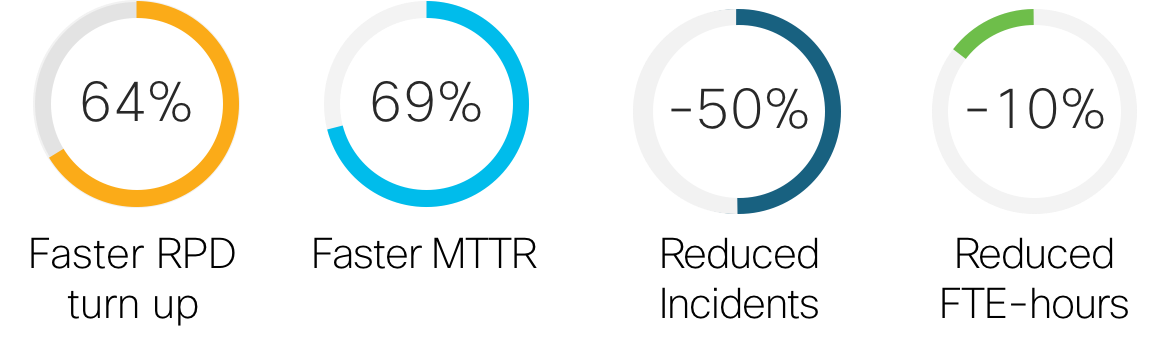
So, how do you quantify the value add of automation? We have a pretty good idea as to the processes and costs associated with a typical RPHY deployment, and that allows us to come with the following data points. Obviously, we have to make some assumptions in our ROI model, but the impact is real.

About Smart PHY

The Smart PHY application is based on model-driven network configuration protocol (NETCONF) and YANG technology, and it’s using a micro services architecture. Smart PHY uses Cisco’s Network Services Orchestrator (NSO) technology. Visit here to learn more about NSO.


To find out more about the Cisco Infinite Broadband solution and Smart PHY, visit our cable access solution page or download a copy of our Road to Cisco Infinite Broadband E-Book today.

Authors

Daniel Etman

Product Marketing Director

Cisco's Cable Access Business

Avatar

I’ve been sharing my life at Cisco from my own personal social media channels for many years. Posts such as international team offsites, pictures from events in Bangalore, and more.

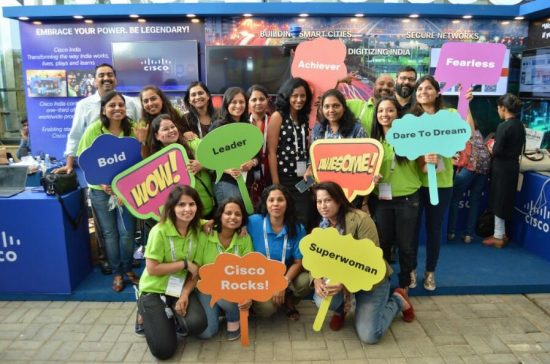
I just completed seven years at this amazing company. Around here, we call our anniversary a “Ciscoversary.” I also call it seven years of learning and using my passions.

When I joined Cisco, I didn’t really have a plan. The experts tell you to have a one-year plan, a five-year plan, etc. I just wanted a platform to learn, bring my skills and excitement to a role, use my “social butterfly” energy, get financial independence and grow as a person and as an employee.

It’s probably good that I didn’t have a set plan. Because in business, things change so quickly, that sometimes you have to take things one day at a time. For example, I’ve had five different roles within my organization [I work in the Human Resources (HR) function.] I’ve loved every. Single. One. It has made me what I am today.

Each role was a stepping stone to the next. In my current role, I work on the Talent Brand team for the Asia Pacific region. It’s one of the coolest roles I’ve had, and I have creative freedoms to innovate and see ideas come to life. Part of my job is to share with the world why Cisco is a great place to work using the great stories that come from employees (many of which you may have read on this blog!) and that’s one of the best parts – hearing all the stories!

But today, I’m going to put on my own employee “hat” and share with you the stepping stones that got me here, so you can see Cisco culture from my own employee experience.

Stepping stone 1: the PEOPLE. I can’t say enough about the people that work here. I’ve met many along the way, and can’t wait to meet more!

Stepping stone 2: the MENTORS. Everyone is always willing to help, no matter how busy or how full our calendars get.

Stepping stone 3: the LEADERS. My experience is that our leaders have our backs. Here to support us, allow us to fly or fail, and in each instance, help us learn and grow.

Stepping stone 4: my PEERS. When you surround yourself with great PEOPLE (see #1) you surround yourself with a network of peers to support you, help you reach your goals and form great teams.

Stepping stone 5: my FRIENDS. We talk a lot about the “Cisco Family” as employees, and it really is like that. It’s not a marketing term, it’s not even something Talent Brand asks us to say. It’s something we say on our own. And it’s because we are friends. We are a family. That doesn’t mean business decisions don’t come first, but we are there for each other in good times and bad.

Stepping stone 6: INITIATIVE. Cisco is a place where your ideas are heard and given a platform to fly. All you need to do is show initiative. I believe our career is in our hands first than on the company we work for. I still remember my growth started with the first email I sent after I completed 3 months to one of my leaders that I would want to get involved in projects outside of my regular duties. And there’s no looking back.

Stepping stone 7: INNOVATION & CREATIVITY. Last but not the least. At Cisco, we’re always looking for newer and creative ways of doing things. If you’re a curious person like me, Cisco is just the place for you 😊

Who knew a socially awkward girl in high school would one day work in social media! 😃 Well, what can I say — it feels like home here. ❤


Want to join a company that enables you to grow? We’re hiring!


Authors

Anjali Bhatia

Talent Adviser

Career Services