Have a question or comment? Tweet at @CiscoCSR and be sure to join us September 21, from 10-11am PT, for a #CiscoChat with PPP thought-leaders Laura Quintana, Vice President, Corporate Affairs at Cisco; Laurence Carter, Senior Director of Public Private Partnerships at the World Bank; Sasha Kapadia, Director, International Development at Mastercard; Keith Davis, President & CEO of the Camden Dream Center; and Jen Boynton, Editor in Chief at Triple Pundit.
How does a company or organization develop and sustain successful public-private partnerships to achieve large-scale impact?
Determine when, and how long, to engage: Successful public-private partnership programs are strategic multi-year, multi-phased engagements, not single transactions. It’s important to provide flexibility in the level and length of engagement. But, to have large-scale impact, a core set of partners should be committed for the long-term.
While Cisco Networking Academy was well established in Africa in the early 2000s, we determined further investments were necessary to help improve standards of living through the transformative power of information and communications technology (ICT). In 2007, Cisco made a US$10 million, four-year Clinton Global Initiative (CGI) commitment to support ICT-driven development strategies in five countries in sub-Saharan Africa: Ethiopia, Kenya, Rwanda, South Africa, and Uganda.
This strategic commitment to connect underserved populations was closely aligned with CGI’s focus on poverty alleviation, education, and global health, and was realized primarily through the establishment of locally managed and self-sustaining Community Knowledge Centers (CKCs). While each CKC is designed to be adaptive to specific community needs, all CKCs are technology hubs in rural communities that provide access to the Internet, education, and training classes.
For Nyangwete, a tiny village on the shores of Lake Victoria in Kenya, a CKC started in 2009 has created an opportunity for villagers to overcome enormous challenges. The remote fishing village was isolated by location and lack of power before the CKC opened and extreme poverty forced more than 12,000 children into the care of the state because parents could not provide for them.
Judith Yucabeth Otieno, pictured above, was a former primary school teacher who now sells sorghum, maize, millet, and fish at the daily afternoon market outside the CKC. A basic IT skills class opened a new world of information to her.
Learning about business in other countries has inspired her to improve her fishing techniques and enabled her to fix her boat. Judith also stays connected to family, visiting the CKC regularly to email and video with her children and grandchildren who have moved away from the village.
Entrepreneurs, many of whom took IT classes at the CKC, have opened small businesses around the thriving CKC, and the standard of living in the village has increased dramatically. As villagers prosper, more parents are able to care for their own children. The number of children who depend on the state has dropped from 12,000 to 6000, creating a brighter future for all of Nyangwete.
The CKC model is now a scalable model for sustainable, community-led development and has advanced the concept of connected communities as a long-term, IT-based poverty alleviation strategy. Cisco, together with local governments and several NGOs, established a holistic and collaborative strategy that leveraged every partner’s strengths to improve access to digital knowledge, skills, and opportunities for economic participation.
For example, Cisco provided its expertise and knowledge, funding, technology, training, marketing assistance, community portals, and curriculum to help establish and support successful CKCs.
One Global Economy, a nonprofit, developed the Beehive, an online portal of global best practices and localized information for CKC staff, and held community workshops to inform site content. Appleseeds Academy, another nonprofit partner, developed the support structure for the CKCs and provided on- and off-site support for CKC staff.
After six years of significant impact, Cisco successfully transferred the ownership of this program to local government and NGO partners in 2013. At that point, through public-private partnerships we had supported 114 centers, 24 of which were started from the ground-up by Cisco. To date, our local government and NGO partners continue to use the CKC model and have expanded CKCs into additional NGOs in South Africa and Ghana.
Blog #1Blog #3
Has your organization had success in determining when and how long to engage in public-private partnerships? Leave us a comment below, tweet at @CiscoCSR, and stay tuned for next week’s post on how to execute successful PPPs.
Today, Talos is publishing a glimpse into the most prevalent threats we’ve observed between August 25 and September 1. As with previous round-ups, this post isn’t meant to be an in-depth analysis. Instead, this post will summarize the threats we’ve observed by highlighting key behavior characteristics, indicators of compromise, and how our customers are automatically protected from these threats.
As a reminder, the information provided for the following threats in this post is non-exhaustive and current as of date of publication. Detection and coverage for the following threats is subject to updates pending additional threat or vulnerability analysis. For the most current information, please refer to your FireSIGHT Management Center, Snort.org, or ClamAV.net.
Well we have made it to September. Now, most kids are back in school. Pre-Season Football is taking stage while baseball is heading towards the playoffs. We are watching tennis as we look forward to the first weekend at Flushing Meadows for the 2017 US Open. There have been plenty of upsets, but Rafa and Roger are still alive. With #1 Plishkova is out, will #9 in the world Venus Williams make a push for her third US Open? This would go along with her seven Grand Slams, an amazing feat.
Let’s go Vee! Lil Sis is about to have her first baby…(updated at 12:30pm – Serena had a little girl today!)
Well, with September comes another update. We have a few things to update all of you so I will keep this short and sweet.
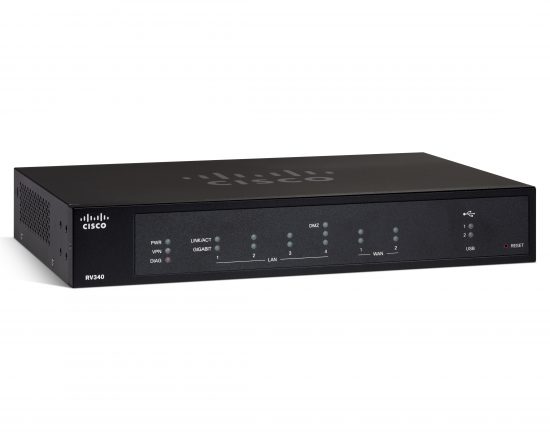
The new RV340 Tolly Report was released this week. This free report is available for download now. We are pleased with the results so please go take a look. The RV340, RV345, RV345P and RV340W are all shipping now.
Cisco FindIT 1.1 is now available. Monitor and Manage your Cisco Small Business Network – Download it free today!
Our new Cisco Small Business Support Community is now online. The new platform offers a new look and feel and should make content easier to find and consume.
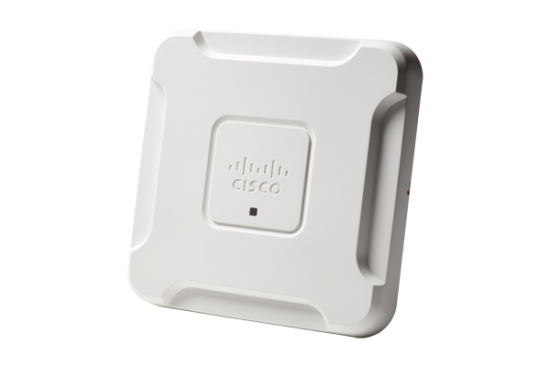
The new MGig Wave 2 WAP581 is now shipping. Make sure to contact your local Cisco Partner for details. This high performance Access Point is something that will elevate wireless performance for every small- and medium-sized business.
The new WAP125 is now shipping and available. This new desktop model brings solid wireless performance at an affordable price.
We will have some exciting news with our Switching Portfolio coming next month so please stay tuned.
Good luck to Serena (and Aunty Venus)!
Have a great weekend all.
Marc and the rest of the Cisco Small Business Team
A few weeks ago, 55,000 of my closest media, entertainment, and technology colleagues and I traveled to Amsterdam to attend IBC. IBC is a very special show where the worlds of technology and media collide. As the industry continues to evolve at warp speed, IBC this year proved to be an exceptional vehicle to bring some of the greatest minds in the industry together for discussion and sharing of innovation.
This year’s conference will have a strong focus on the role of technology in business transformation. As consumer demand grows for higher quality, more personalized video experiences, so too does the pressure on our networks to keep up. Configuration and operations can become complex, scalability with quality are often difficult to balance, and speed and security seem diametrically opposed. When it comes to quickly, securely, and efficiently moving video bits across the network, the future of video is the network. We call it ‘video-aware networking,’ and it will shift the future of video networks.
With Video Aware Networking, Cisco combines the synergies between the network and the video applications to deliver a better experience for the consumer. Video Aware Networking opens up the communication lines between the network and the applications. The network is made contextually aware of the applications and services it is running, and the applications will advertise to the network what it requires so that the network can supply it. It is a programmatic way operate networks and services, based on their needs, through APIs.
Achieving Video Aware Networking involves collecting information from the network and the application in real time, and translating it into specific, automated actions. It enables automated operations by correlating network telemetry information, improves quality of experience by solving video quality issues on the fly, provides dynamic content protection with real-time handling of security threats, and enables better subscriber monetization with user behavior information.
Here’s Cisco’s approach to Video Aware Networking, including Segment Routing and Smart Rate Control, which we showcased at IBC.
Segment Routing, with its capacity for centralized and distributed intelligence and enhanced packet forwarding behavior, helps to solve the scale and complexity challenges that come with digitization and traffic growth. With video driving the lion’s share of IP traffic, it is only logical to extend Segment Routing (also called source-based routing) for video services, and automate routing of video traffic from source to destination, enabling better scale and better utilization of the installed network infrastructure. It’s an improvement over traditional link-based routing, where at each “hop” along a data journey, the next best step is established. Segment Routing creates “awareness” so that the network can adapt how it behaves, according to contextual information from the video applications that it transports.
Smart Rate Control, a video encoding approach, is another key piece to the Video Aware Network. Smart Rate Control enables video rate shaping for bandwidth capacity optimization. It changes the way video applications behave, by acknowledging expected video quality targets and network bandwidth and matching the bit-rate needed, without wasting precious bandwidth.
These are some powerful things we have been doing in the data center to virtualize and automate broadcast production, all done in software containers, and we will demonstrate how our data center infrastructure is transforming live video production.
It is no secret that the industry is transforming. Cisco is diving deep to help our customers navigate change by ushering in the next era of the network with technologies that constantly learn, adapt, and protect. The future of video is the network and I look forward to sharing more about this innovation.
I can’t believe it has been a year since I wrote the blog series (part-I, part-II, part-III and part-IV – last one with help from Vincent Esposito) to share some ideas about how to bring theory to practice when it comes to ACI and Micro Segmentation.
In the last 12 months we have added quite a lot of new functionality to ACI and in this post I begin another small series to share the latest about APIC related to Micro Segmentation. Now we are getting to the point where the architectural advantages of ACI and APIC will begin to show and shine compared to alternatives.
To begin with, the APIC declarative approach to network and policy allows it to interact with different data plane implementations. APIC does not need to have low-level information of the data plane specifics, since each data plane will be programmed in its own particular way via a local OpFlex agent. This approach has advantages scaling, but in addition, it allows us to adapt to changing environments and potentially work with third party data plane elements. As an example, APIC can program L2, L3 and stateful security policies to Open vSwitch instances. We use that approach as part of our OpenStack KVM integration as well as on the APIC CNI-plugin integration with Kubernetes.
A consequence of this architectural advantage of APIC is that it does not depend 100% on the virtual switch. In other vendor SDN implementations, you have to install (and license) the vendor’s virtual switch and in absence of it, you get nothing. Not the case with APIC.
For instance, in the case of the VMware native VDS we can’t program policies on it, but we can program it using open northbound APIs with simple features in order steer all traffic to the ACI leaf, where we can apply policies. In a way, we program the VDS to act like a FEX: all traffic goes to the leaf where we can do more intelligent things. So sometimes we apply policy on an ACI leaf, sometimes we apply policy on a virtual switch, and sometimes we will do it in other data planes.
The other architectural advantage is that our model expresses policy intent, and policy is not just restricted to security. For example, QoS settings can be part of policy. I will elaborate this a bit more in upcoming parts of this series.
Now … what is new with APIC as it comes to Micro Segmentation?
With ACI 2.3 and now 3.0 we have added a lot of new features in multiple domains. From resource quota management for users and tenants to QinQ, VEPA, enhancements in CoPP and various routing protocols, Multi-Site and more. It is always good to check the Release Notes for details.
Specific to Micro Segmentation I will focus on five things on this post:
Support for additional VM-attributes: vSphere Tags and Custom Properties
Logical Operators for VM-attribute combinations
EPG Contract Inheritance
DNS-based uEPGs
IntraEPG Contracts
It is very important to remark that Micro Segmentation does not necessarily mandate the use of Micro EPGs. Regular EPGs allow you to segment subnets into smaller chunks, as small as you want. However regular EPGs select endpoints based on path and encapsulation, whereas Micro EPGs (uEPGs) allow for more dynamic endpoint classification.
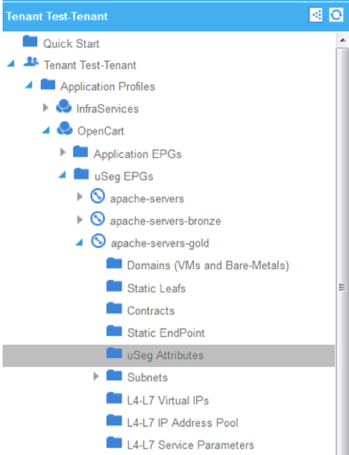
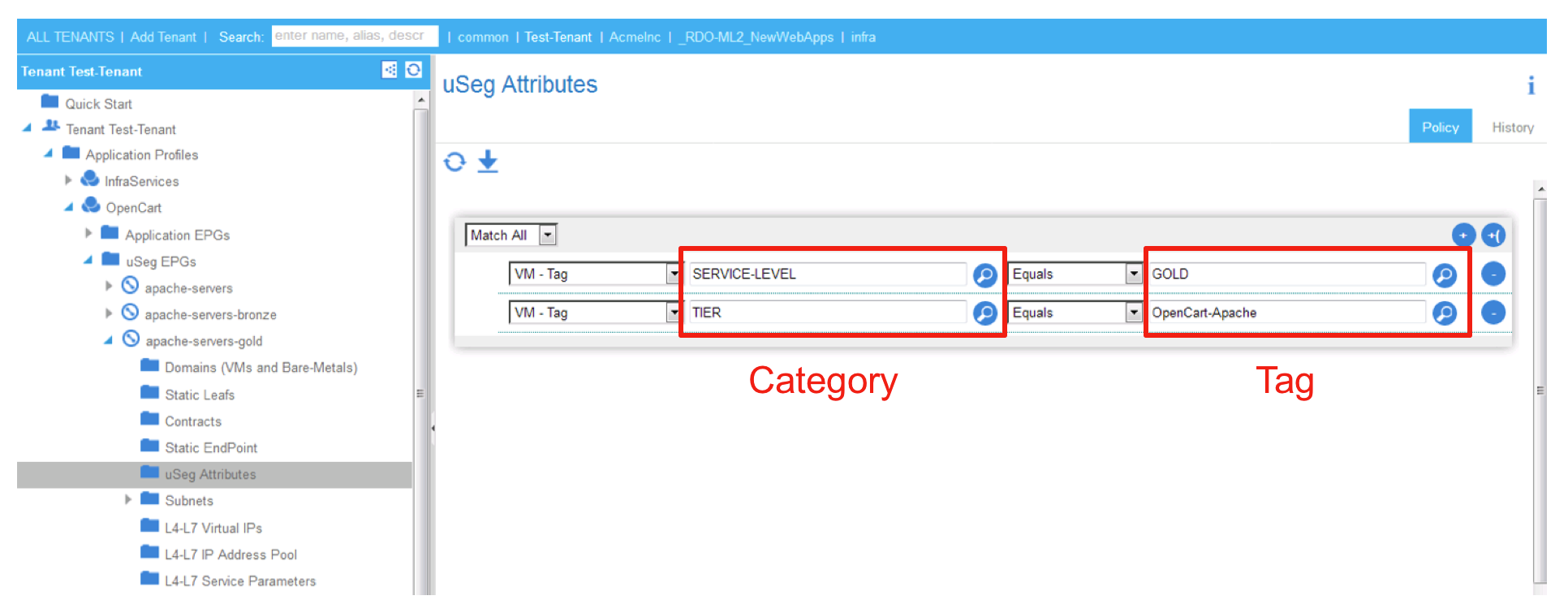
It is also important to highlight a change on the APIC GUI for ACI Micro EPG configurations. Prior to APIC 2.3, the attributes where specified on the main policy screen of the uEPG configuration. Starting with APIC 2.3 we have added a specific section for such configuration. Notice below, for a uEPG called ‘apache-servers-gold’, there is a new folder called ‘uSeg Attributes’ where you will now specify the classification.
ACI 3.0 also introduces significant changes to the APIC GUI. In the screen shots below I am using ACI 2.3 for features that were added on that release, and the new GUI for features added with 3.0.
Support for vSphere Tags and Microsoft Custom Properties to classify endpoints in uEPGs
Matching on the VM name, Guest OS, or Data Center is no doubt useful, but many customers prefer to use pure metadata to classify their Virtual Machines. The challenge with VM metadata is that it is not standard.
[Note: When you think about that, one thing that strikes me is that customers have never pushed for standards related to x86 virtualisation management. Nobody imagines that you could vMotion between different hypervisors – although … why not? – but it’s not even that, it’s that even VM meta data is not standard! Nobody complains that there’s no coherence or consistency for meta-data between virtualisation platforms. Food for thought!]
In vSphere customers have traditionally used Custom Attributes to add meta-data to virtual machines. This is useful for instance to record who’s the VM owner, what application team is responsible for it, or when was the last time a snapshot was taken. Custom Attributes also work great to classify VMs into uEPGs. But Custom Attributes are in the process of being deprecated in favour of vSphere Tags.
Tags were introduced with vSphere 5.1. A tag is a label that you can apply to objects in the vSphere inventory. In our particular case, we are interested in tags assigned to Virtual Machines. Similar to Custom Attributes, Tags allow you to identify that VM belongs to a particular environment (i.e. PCI, HIPPA …) or organisations (HR, Finance, …), etc. And now, since ACI 2.3, you can use those tags to identify the VMs, and classify them on the right uEPG and therefore apply the relevant policy.
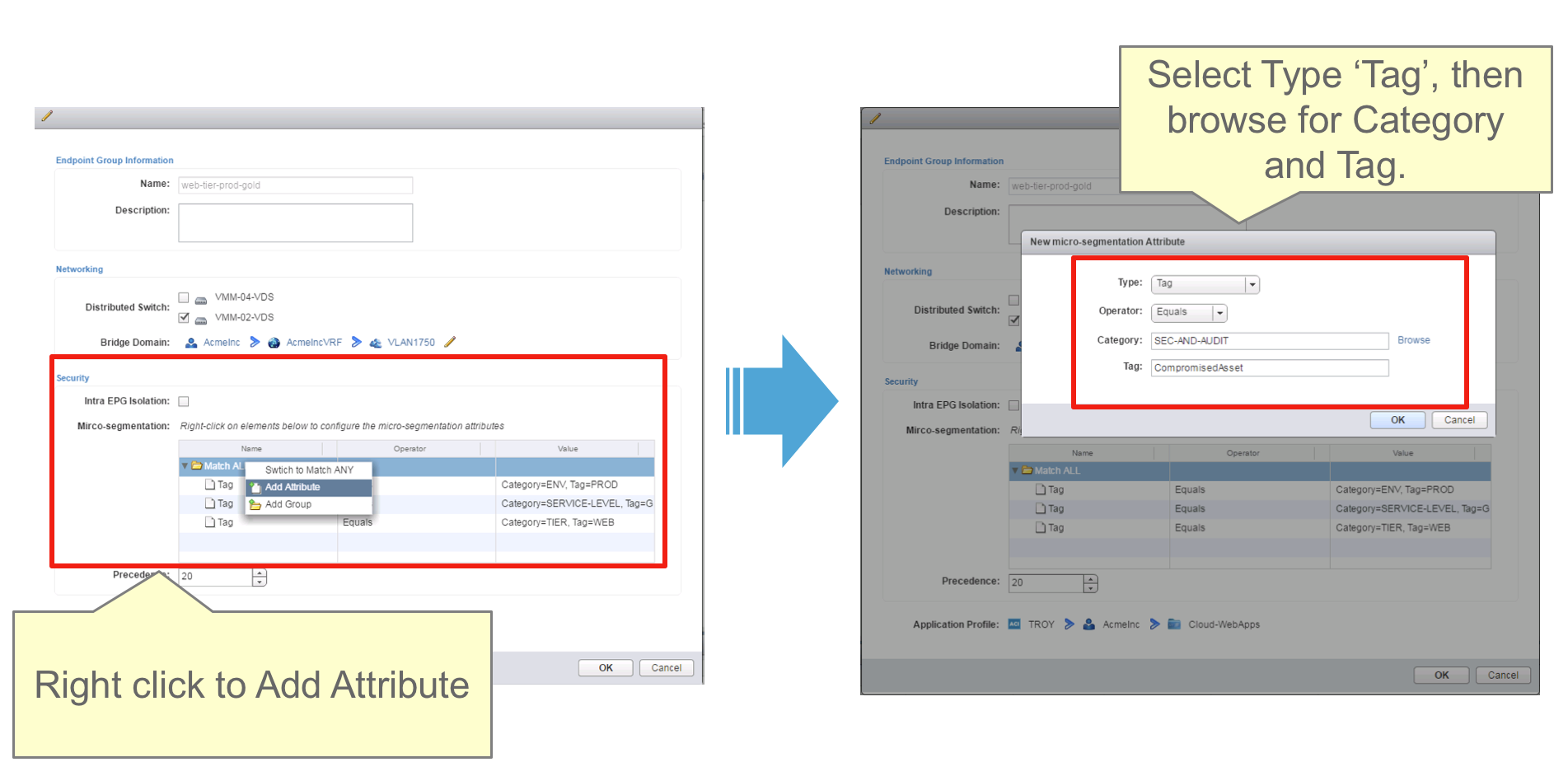
As with other attributes, you can use Tags within uEPG configurations and configure this from the GUI, NX-OS APIC CLI, vCenter Plugin or direct REST calls. Below you can see an example of the APIC GUI and another of the vCenter Plugin:
Hyper-V readers may be looking for a similar feature. Despair not! … in Hyper-V there is something similar called “Custom Properties”. They are similar to vSphere Custom Attributes, and they allow you to add arbitrary meta-data to a VM.
With ACI 3.0 we are adding Custom Properties to the list of attributes supported for uEPGs. Small clarification: with 3.0 the feature is in beta support only. Full support will come in the following release. Microsoft Custom Properties are mapped in APIC as “Custom Attributes” in search for consistency.
[Note: as a side note, we also added IntraEPG isolation for Hyper-V with ACI 3.0]
Support for Logical Operators when using VM attributes to classify endpoints in uEPGs
Prior to ACI 2.3, you could combine multiple VM-attributes to select which Virtual Machines belong to a uEPG, but only one attribute would eventually determine the classification and we had a pre-defined attribute precedence for this. This does not allow for a lot of flexibility.
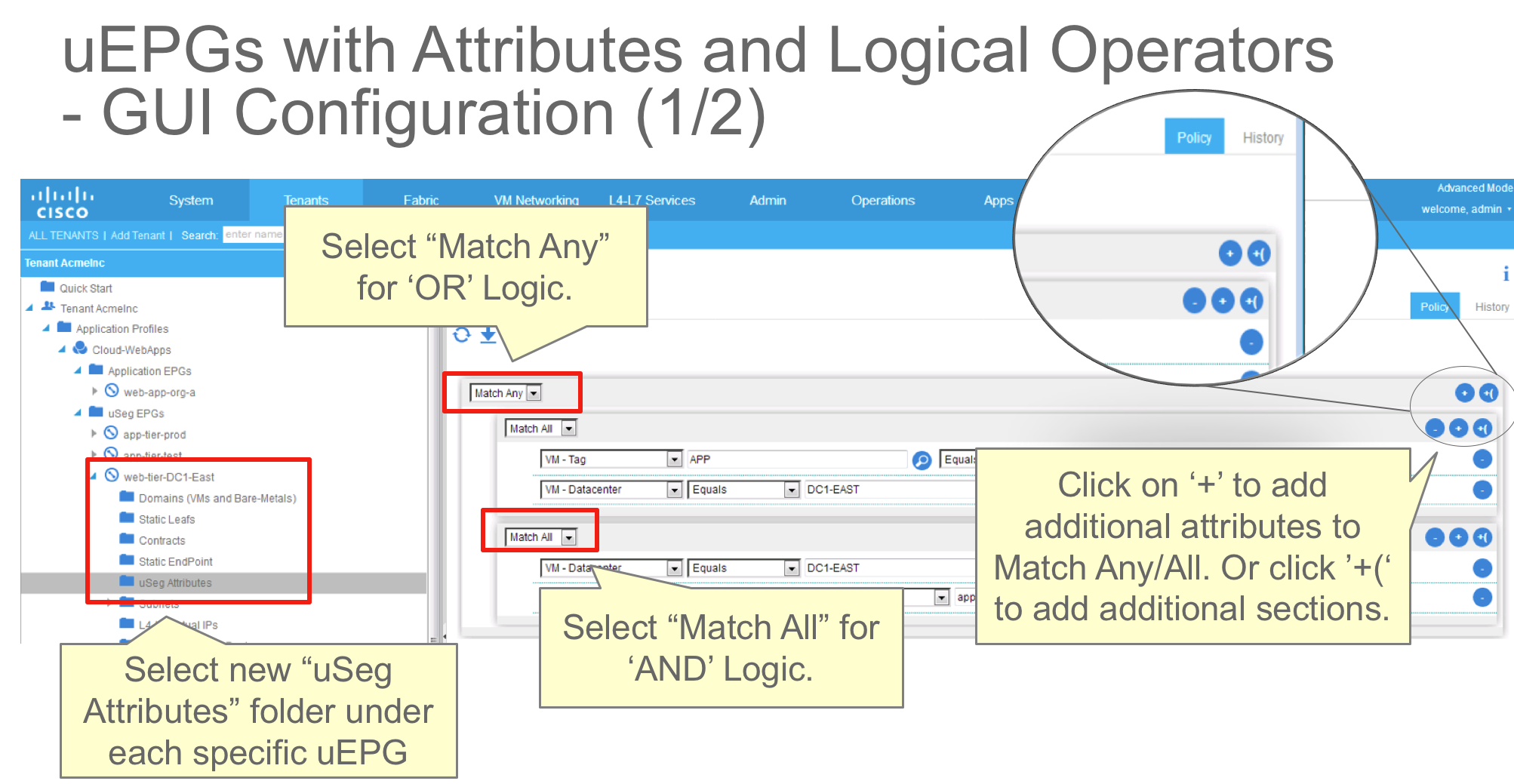
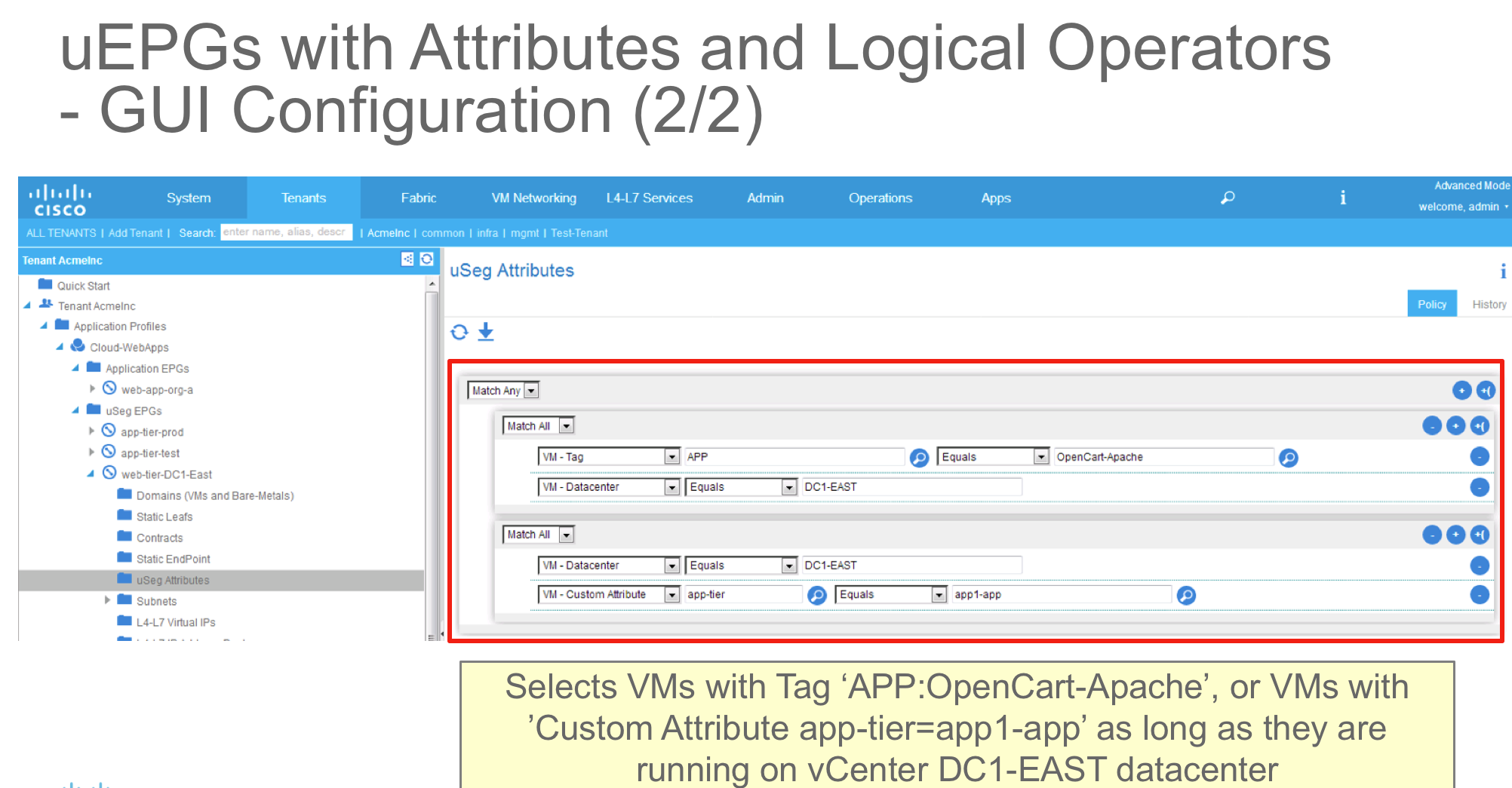
With the new functionality the idea is very simple: you can now define multiple blocks of statements of attributes, and you can express whether you want to match on all attributes (logical AND) or any attribute (logical OR).
uEPGs can be configured in this way from the APIC GUI, the NX-OS APIC CLI, the vCenter Plugin or direct REST calls of course. The APIC GUI configuration highlights is outlined on the graphics below:
Of course you can get to a situation where you have two uEPGs configured with different Logic and a VM that matches the criteria for both of them. The tie breaker for that situation is a new uEPG attribute: the uEPG Precedence. Below you see an XML snippet where we have a uEPG with precedence of 25. The default is zero.
The precedence can also be set of course on the GUI, the vCenter Plugin or the NX-OS CLI. I am adding GUI screenshots and XML samples just to illustrate options.
Use of Logical Operators with APIC 2.3 is supported only with vSphere VMM domains, whether using AVS or VDS. With APIC 3.0 we are adding support for Logical Operations with Microsoft Hyper-V.
EPG Contract Inheritance
In ACI if you use policy enforcement between EPGs you control policy using relations to contracts. One interest in using uEPGs is that you can have a base EPG where you define endpoint encapsulation (i.e. the base VLAN for attaching bare metals, or the dvPortGroup or Network on a vSphere or Hyper-V environment). The endpoints on the base EPG will have certain access privileges. This may be limited to shared services, tooling and provisioning services, or can be application specific.
Then you may want to further refine your segmentation and define that specific endpoints require specific policy. You do that by configuring uEPGs. the uEPG will have relation to a set of contracts specific to what you want to represent as “specific policy” but often times, you want it to also have the same policy that you had already configured for the base EPG.
Another example is where you have “many of the same”. So you have an EPG that has access to a set of resources and then you will configure a lot of other EPGs that should be isolated amongst them but have access to the same set of resources.
Prior to ACI 2.3, in all those cases you had to specifically configure all contracts for each new EPG or uEPG. This is not by mistake, this is because we built the ACI policy model thinking of com-posable policies where by you pick for each object (EPG) the relations that you need and only those that you need, which is very safe and works great in fully automated environments.
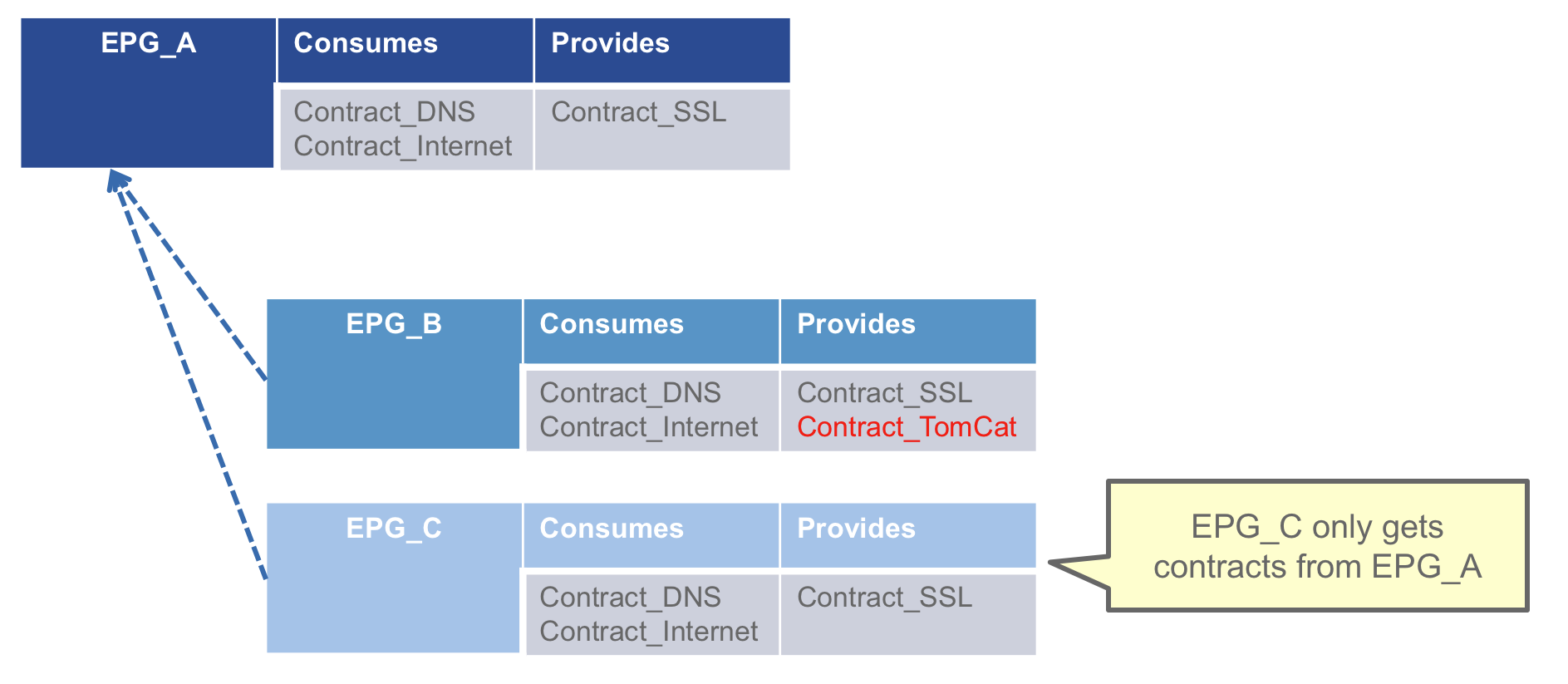
Now with ACI 2.3 we added a feature that enables one EPG or uEPG to inherit policy from another. So you can configure a new uEPG and set its “master” to be the base EPG, from my example on the paragraphs above. In this manner, you only have to configure the new stuff you want for the uEPG, but all the policies you had selected for the base are automatically inherited.
The graphic below shows the concept. EPG_B and EPB_C both inherit from EPG_A (their master EPG). Each of them can then have specific contract relations, for instance EPG_B provides ‘Contract_TomCat’.
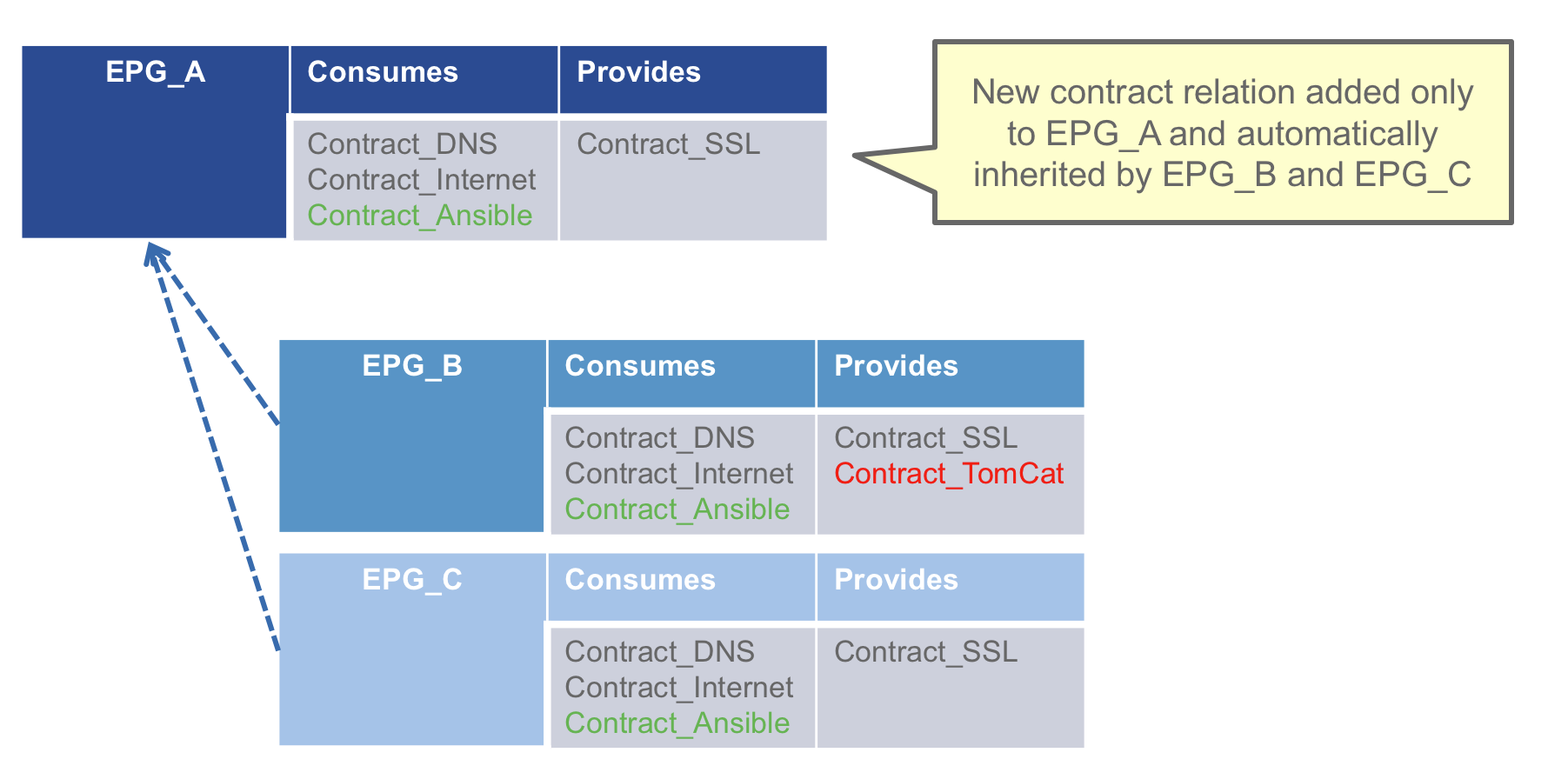
This model does simplify a lot of configurations, specially for those doing operations manually. For instance if you want to now add a new contract to all EPGs, you only add it to EPG_A:
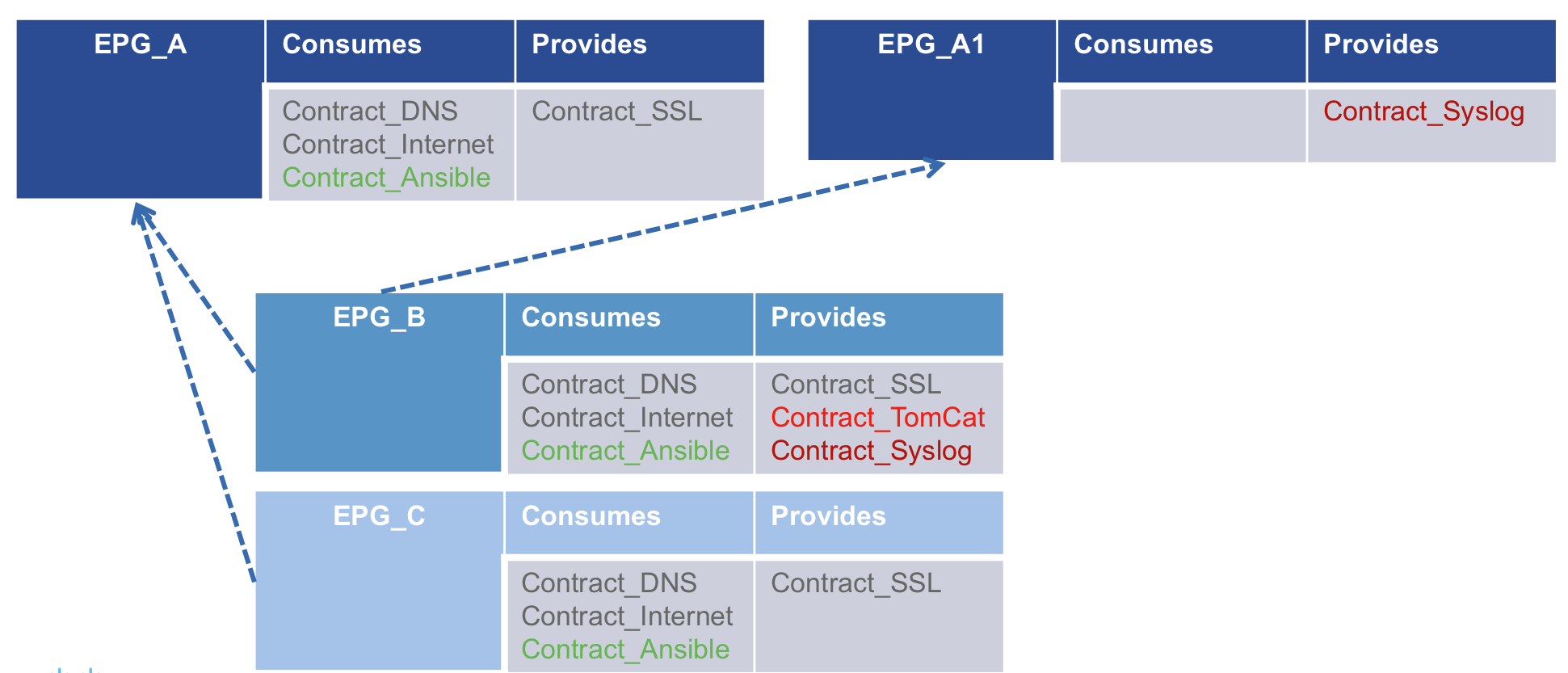
And you can inherit from more than one Master. For instance below, EPG_B now inherits also from EPG_A1 and as such provides ‘Contract_Syslog’:
DNS-based Micro EPGs
This feature has been introduced in preview or beta mode in both ACI 2.3 and 3.0. This means it is not yet TAC supported. The goal is to classify endpoints onto a uEPG based on a FQDN and/or a domain name.
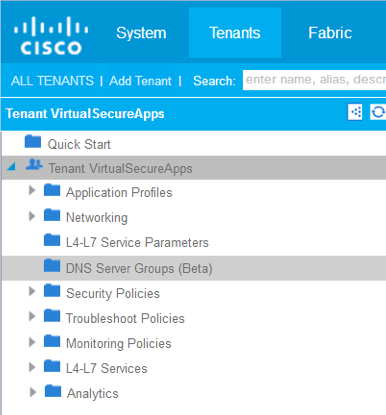
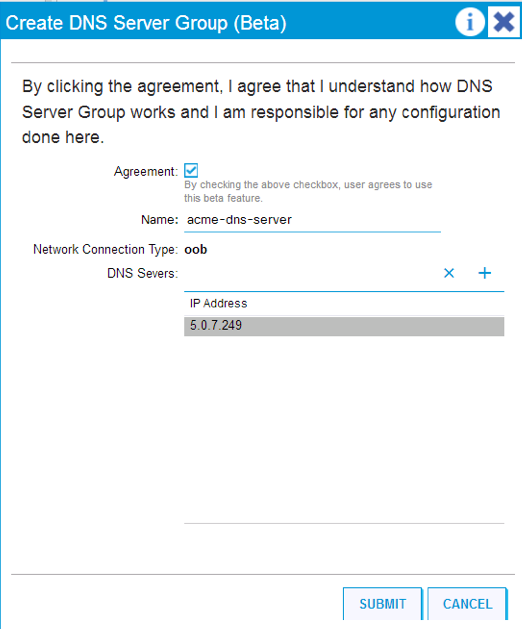
The configuration requires two steps, both done at the tenant level. First you specify a DNS Server Group. Here is where you define the DNS server that we will use for a particular tenant for DNS-based uEPGs. When you add a new DNS Server Group you will get a screenshot that says the feature is in beta, and upon acknowledgement, you can specify the addresses of the DNS servers.
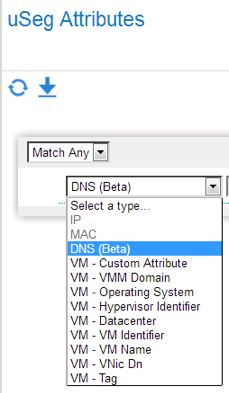
Once this is done, you can configure DNS attributes as the classification criteria for your uEPGs:
This is a feature you have to use carefully. You can add a full domain name, for instance mydomain.net, or a FQDN like app1.mydomain.net. APIC will query the DNS server to find the IP address(es) for the domain you specify. This could be one address, or many. Those IP addresses must be known to the fabric on a base EPG, and if they are, then APIC will configure the fabric to classify those endpoints on the right uEPG.
A use can be to have a farm of Virtual Machines on a default EPG with default policy configured. When you define a new application URL you create a uEPG correspondingly: for example app1-web.mydomain.net, with the specific contracts for that app. Then as your app is registered on your DNS server, the VMs that deliver that application will be placed on the uEPG. That approach can also be useful to expose services from CloudFoundry or OpenShift.
IntraEPG Contracts
Before ACI 3.0, an EPG could have two types of relations to contracts: provider (RsProv) or consumer (RsCons). Internal to the EPG you had two options: the default that allows all endpoints in an EPG to communicate without restriction, or the IntraEPG Isolation setting that would block all communication.
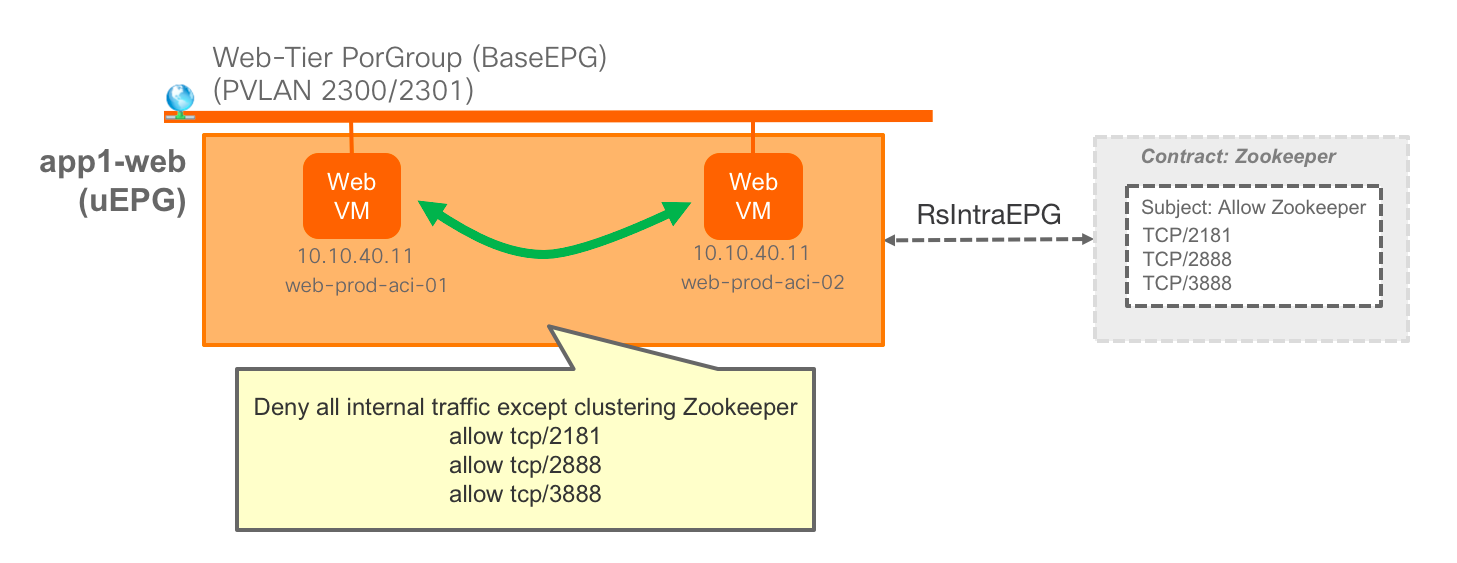
With ACI 3.0 we are introducing a new type of relation: IntraEPG (RsIntraEPG). This will allow you to apply filters that restrict communication between endpoints on the same EPG. This works for EPGs and Micro EPGs as well. As of ACI 3.0 this feature is supported with vSphere VDS VMM domains and with Bare Metal (PhysDoms). Support for other VMM domains will be added in the future.
One common use case is when you have applications that require a heart-beat. For instance, imagine you run a distributed web application that uses Zookeeper to implement distributed services. The endpoints for this application will be all on the same EPG, and you will use whatever contract you require towards other EPGs to expose your application.
But the endpoints in the EPG need to communicate for Zookeeper to work, so you can not use Isolated EPGs. Now you can define a contract with the filters required for Zookeeper and associate to the EPG (or uEPG). So you have a full white-list model approach.
What is next?
In the next few posts I will drive through some basic demos that make use of these features combined together, and illustrate some potential use cases. We will also see that all those features can extend to more than one DC and more than one vCenter by using Multi-POD, which is an added benefit.
It is also very important to remember that Micro Segmentation is but one more tool to help with DC Security. Cisco has a very broad portfolio to provide for a comprehensive security strategy that can leverage ACI Micro Segmentation. Cisco ACI looks at network security as a whole – beyond just segmentation and L2-L4 distributed policy. And offers several key network security features. It can work with a broad security ecosystem and will soon also add encryption capabilities.
One million devices are added to the Internet every hour, meaning the volume of data exchanged increases exponentially by the second. As customers determine how to employ modern, intelligent networking systems to support their strategy and goals, a priority is to harness and derive value from this vast amount of business critical data. But, while big data and associated technologies present tremendous opportunities, along with that comes risk. We hear from customers over and over that security is top of mind and if it’s important to customers, then it’s important to Cisco.
Effective, secure data management is central to how companies manage businesses today. Hackers know this too and are doing everything they can to steal it, hold it for ransom, destroy it, or sell it on the dark web. Cisco’s 2017 Midyear Cybersecurity Report highlights the escalating threats consumers and businesses alike face today. With this in mind, managing and protecting data as a critical asset has never been more urgent.
At Cisco, we take the protection of our customers’ data very seriously – it’s part of our DNA. Adversaries are working hard to create data incidents, so we’re working harder to build secure, intelligent networks to enable positive customer outcomes.
I asked Judy Barron, Director of our Cisco Services Data Protection team, to share how we’re integrating data protection into the culture at Cisco and steps we’re taking to mitigate risk and help avoid human error.
Data protection is something that is often taken for granted. Customers simply—and logically—expect that vendors do what it takes to protect data. However, sometimes that blind trust can be misplaced, depending on how secure a vendor’s site, network and storage solutions are, and how prepared they are to address emerging threats or remediate when issues do occur. In our case, Cisco has people who focus solely on Cisco Data Protection to ensure the right processes and technologies are in place. If you don’t hear much about us, it means we’re doing our job.
Aligned with the Cisco Data Protection program, our dedicated Services Data Protection program ensures that our people, processes, systems, and products all demonstrate industry leadership when it comes to protecting data. Data protection is key to proactively reducing risk. Malicious attacks like WannaCry are increasing in frequency and complexity, and business email compromises (BECs) represent new, lucrative threat vectors. We have to protect against these and countless others. But, securely managing your data is about more than just protecting against a potential data breach.
In Services, we alleviate your worries about regulations compliance, data encryption, secure access, and handling and storage so you can focus on what it takes to achieve your business outcomes. Here are just a few ways we do that:
We adhere to our own rigorous Data Protection Policy, detailed Code of Business Conduct (COBC), and thorough incident management process to protect your data.
We reinforce a data-centric mindset to ensure your data is managed securely, beginning with the initial concept of an offering, application, or product.
We strive to ensure all of our applications and offerings are built, maintained, and governed with security and privacy in mind.
We’re obsessed with protecting data because we want to deliver what our customers tell us are the most important data requirements to support business continuity, fulfill emerging needs, and enable predictive and pre-emptive capabilities to accelerate their business outcomes. We strive to instill customer confidence in the way we protect data and drive security, and aim to provide a seamless experience, enabling our customers to focus on driving their businesses with peace of mind. Cisco Data Protection has your back and your data covered!
The Future of Work is a huge topic. How will we attract and retain the worker of the future? How can we leverage the latest technology to augment the worker of the future? What will the workplaces of the future be like? It’s the subject of conferences, white papers, speculation, pontificating, and hand-wringing. Yet with all the talk, most of us have a hard time picturing the future in a way that brings the all high-flying ideas down to earth. We’re not wired to imagine what the world might be like in ten or twenty years time… maybe such a long term view wasn’t helpful for us back when we were cavemen…
That’s why we’ve chosen to literally paint a picture of what the future will be like.
In my work in Cisco’s Hyperinnovation Living Labs (CHILL), I’ve found science fiction prototypes to be a useful tool. In this case, it’s a story based on extensive research of trends, technologies, economics, and cultural change. These prototypes make it easier to visualize the future in a concrete way so that we can more easily identify areas that are ripe for innovation. Who will be the workers of the future, and how will their needs and expectations change? What will be the role of robotics, AI, and virtual reality? What risks will we need to navigate?
That is what this comic book blog series is about. It’s a way to imagine the future so we can then create the future we want.
My team are currently designing a cohort of corporations who will come together to design the future of work—a Future of Work Living Lab – where we will design and jointly invest in innovation we feel will create this Future. But first… let’s meet Gail our Superhero and come to understand some of the challenges that face us in the Future of Work.
I hope you’ll stay tuned and join the conversation.
Have you heard the term, “Design Thinking?” Cisco and other forward thinking companies are investing in tools and teams to create Design Thinking frameworks, and spread Design Thinking methods further and faster across their companies. Design Thinking is not just for designers. It’s an approach to problem-solving and innovation that can be employed by any business or function to achieve extraordinary results.
At its core, Design Thinking is about empathy. It encourages looking first at people (users) of the solution to the problem you are trying to solve, instead of jumping into solving the problem right away. It tells us to take a human-centric point of view, which is often overlooked by conventional problem-solving practices.
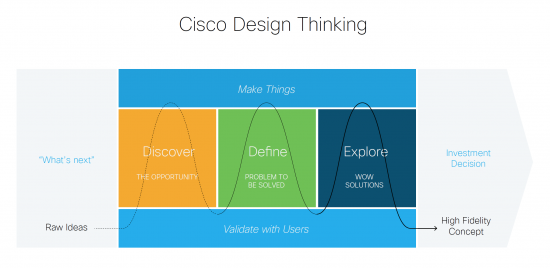
Design Thinking also changes our view of the design process. It promotes a build-to-test, iterative approach to the whole design process. Design thinkers acknowledge and preserve ambiguity. They use prototypes as their communication media.
Design Thinking puts user concerns first to achieve strong project results
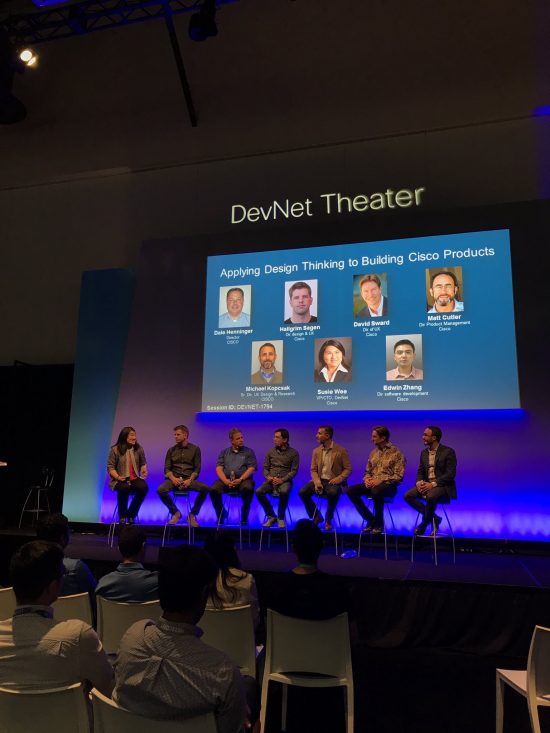
During the recent Cisco Live, we had the opportunity to discuss both the philosophy of Cisco Design Thinking and the practice of design taking place within multiple Cisco groups. Our panelists included Susie Wee, David Sward, Hallgrim Sagen, Michael Kopcsak, Dale Henninger, Matt Cutler, and myself. Please take a moment to watch a video of our Cisco Live “Design Thinking” panel discussion. I think you’ll like it.
Watch the video of the Design Thinking panel discussion at Cisco Live
Do software application developers and network infrastructure developer need Design Thinking? Yes, of course. Developers are making many decisions every single day, and not every development team has designer support. Leveraging a Design Thinking approach can help development teams build applications with a better user experience. For example, when designing an API for a product, they can look at who are the people who are going to use it? What is their background, skill level, need? Is the end user is going to use this API together with other Cisco API? If so, offering a consistent resource structure would be really helpful. If it’s more for an internal team use, perhaps a message queue would be a good alternative to mitigate any “fire and forget” issue with the API.
During last week’s Cisco GSX conference, Chris Lunsford and I conducted workshop sessions on how to design solutions that customers want to buy. We showed Cisco system engineers and account managers how applying design thinking to a specific customer scenario can solve customer problems faster and generate better results.
At DevNet, we recently launched the Opportunity Project in partnership with the U.S. Department of Commerce. Like so many initiatives designed to address social challenges, it’s a project that benefits greatly from Design Thinking, as it’s a project that will impact people and their lives. Using Design Thinking to build deep empathy with end users and related parties will bubble up high-impact solutions that cross traditional sector boundaries. I’d like to invite you to check out the Opportunity Project yourself. It’s a great way to participate in creating solutions that help families, local leaders, and businesses access information about the resources they need to succeed.
The Design Thinking workshop attracts a standing room only audience at GSX.
We’d love to hear what you think. Ask a question or leave a comment below.
And stay connected with Cisco DevNet on social!
As we wrap up the summer vacation season and settle back into work and school, I can’t help but reflect back on my personal summer vacation and share a few observations. My family and I had the chance to travel and while we were on the road, away from home, I shared with my wife that, in this bold new world, we could watch the Red Sox wherever we were. However, every night around 7 pm, we’d tune into the game and we’d wait. Sometimes the video wouldn’t start. Other times it would pause … buffering. And sometimes the video resolution would become so low that you couldn’t tell what was happening. Consumers, including myself, have come to expect a pretty high standard for video experiences. It begs the question, what if we could make IP video experience better than the broadcast experience?
Consumer Demand:
It should come as no surprise to anyone with a video subscription and a connected device that video is shifting to IP and mobile. According to Cisco’s Virtual Networking Index, 82% of IP traffic will be driven by video by 2020. Consider this – those same bright minds also believe that IP Video Traffic will surpass Broadcast by 2022.
Here’s a big secret; video providers who can take advantage of IP protocols to capture this market transition and meet the growing demand are going to win in the next generation of video. Why? Because the present generation of technologies are designed to operate on a lowest common denominator basis. Operators who recognize the importance of starting with the highest quality experience will be better positioned to address consumer demand, scale appropriately, better control operational costs, and deliver a great IP video experience to customers.
I’ll let you in on another secret; Cisco has a plan and a set of services to do just that.
IP Video Better than Broadcast:
For us, making IP better than broadcast means delivering consistent, great looking video on any device, on any type of network. It is about the quality of experience; buffering and low quality video have no place in our vision. It means that consumers can access their Live, VOD, and Recorded content on the go, with a seamless experience across all screens. And for the Service Provider, it means ensuring that their subscribers consistently have a positive experience with the Service Provider’s brand. For our friends in advertising, it means delivering targeted ads to the consumers who are most likely to buy their products.
Managing Scale, Cost and Quality
Cisco is committed to helping our customers capture the transition to the next phase of IP video. Making IP video better than broadcast requires a scalable, future-proof infrastructure, complete with micro-services, and all of the bells and whistles to enable ease of operation and service velocity. It means keeping costs down by leveraging an IP converged video core, pushing decisions to the edge, simplifying the network, and ultimately reducing operational costs. It is also important to take into account the current assets and investments that Service Providers have made. With our rich history in networking, and ability to closely collaborate with our customers and understand their needs, Cisco is uniquely positioned to help migrate Service Providers from traditional broadcast to a hybrid IP or all IP infrastructure.
How do we do it? Through a more intuitive, smarter network.
Converged IP Video Core Architecture: By pushing decisions to the edge of the network, Service Providers are able to improve feature velocity, reduce operational costs, and deliver more personalized experiences to the consumer.
Intelligent Edge: Format decisions for the subscriber device can be made at the edge of the network, freeing up bandwidth.
Cloud Recording: The cloud takes on an even bigger role with cloud recording, developed with cloud-native micro-services to increase feature velocity, improve scale, and reduce operational costs. But wait, there’s more. The cloud brings greater operational intelligence, analytics, and enhanced automation into the mix.
Smart Streaming: Cisco offers a toolkit of technologies that improve the streaming experience such as low latency, SVQ generation, chunked packaging, and fast channel change on top of point products, both at the edge and the core of the network, to optimize and balance the quality of experience with the bandwidth available.
The Next Generation of Video
The transition towards IP and ultimately making the IP video experience better than broadcast is a journey that we’re all invested in. Like other generational transformations in the industry, the companies who proactively plan will win. The challenge is great, but we are invested and eager to help our customers on this journey. This is the path to IP video that is better than broadcast, and we are well on our way. Play on.
Fabio Souza contributed to this blog. For more details about Cisco’s Infinite Video Platform, click here.















 Design Thinking puts user concerns first to achieve strong project results
 Watch the video of the Design Thinking panel discussion at Cisco Live