How do you build a developer program that is focused on what developers truly want? It’s a question we ask ourselves here at Cisco DevNet every day. So last week DevNet Senior Director Rick Tywoniak attended SlashData’s annual Future Developer Summit, with the goal of continuing our search for answers and ideas on how we can continuously improve how we serve the Cisco developer community.
Four years ago, when DevNet was just getting started, the vision was to engage both application developers and networking professionals, as part of a broad and well supported community to utilize Cisco networking platform APIs. We knew from the start that education and training would be critical components to building the community. So we focused our efforts on building learning labs, sandboxes, support forums, quality documentation, and usable sample code – tools that would allow developers to get hands-on with the APIs. We felt this would be the best way to help developers optimize their applications to take full advantage of enterprise networks, and introduce networkers to coding principles so that they could take advantage of Cisco APIs to automate network functions and management.
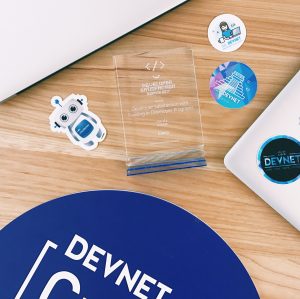
A big task. So you can imagine the thrill when it was announced at the SlashData Future Developer Summit that Cisco DevNet had received the customer satisfaction award in the category “Satisfaction with Training in Developer Programs.” This from a survey that is based on the independent and unbiased opinions of over 40,000 developers from around the world, combined with SlashData’s own research!
In presenting the award, SlashData CEO and Founder Andreas Constantinou said, “Going beyond tutorials to provide full training courses is difficult to scale and very few companies do it well (even at all). We commend Cisco for leadership in an area where most competitors have negative satisfaction scores.”
As networks become programmable and applications become the central vehicle transforming literally all aspects of our work and lives, Cisco will continue to deliver quality education, training, and support for our rapidly growing developer community. We look for ways to make it easily accessible to developers through learning events and shows, and through training partners such as Cisco Networking Academy and Learning at Cisco.
I thank our DevNet community for your feedback and support on our journey, and the SlashData team for this recognition.
We’d love to hear what you think. Ask a question or leave a comment below.
And stay connected with Cisco DevNet on social!
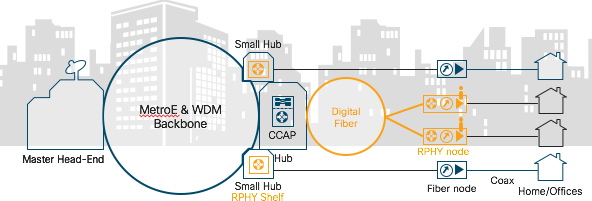
We are releasing a new product for our Cisco Infinite Broadband solution set, the GS7000 iNode, a No-Touch SmartNode. Based on the industry-leading GS7000 Optical Node, the new SmartNode delivers an innovative approach that enables unprecedented operational savings for multiple service operators (MSOs) through automation. The SmartNode has been designed with two goals in mind: one, reducing operating expenses and two, increasing the availability in the Access Network—benefits only now capable with this, industry’s first fully automated, optical node.
So what does the SmartNode really offer you?
The Smart PHY Automation application for the Infinite Broadband solution enabled us to automate the deployment and provisioning of the Remote Phy Device (RPD), but that still left the Optical Node in the “dark”. The Smartnode extends that capability to the Cable Access Network beyond the RPD, but it does more than automation only. With the SmartNode, we begin tapping into the data-intelligence of the thousands of devices in the network, making the devices and the network, as a whole, more self-aware and capable of self-healing. While this is all great marketing speak, let me walk you through a typical life cycle of a Node to better understand the significance of the iNode.
It all starts with the install; legacy nodes require a field technician for installation and configuration—a manual and error-prone process. With the Smartnode, there is no manual configuration necessary, the process can be automated or completed remotely. This means quicker deployments, faster recovery times, and fewer errors.
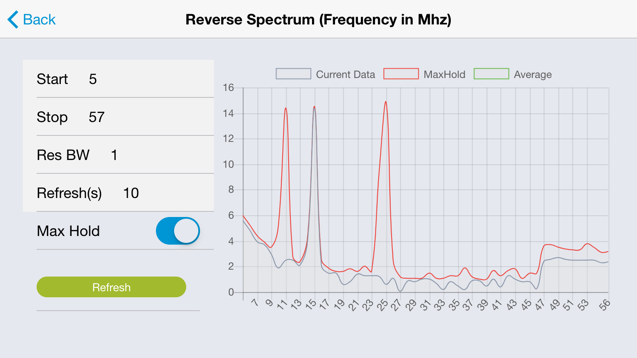
Once installed the Smartnode provides an unprecedented insight into the behavior of your access network—providing accurate, remote full spectrum analyzer functionality on every port and MER measurement and eliminates the need for costly and complex network probes.
The intelligence derived from the SmartNode coupled with its remote monitoring and management capabilities offers providers the agility to respond to network issues that are impacting subscribers on a per-leg basis. No truck roll needed. The SmartNode also offers savings on overall power consumption with the ability to remotely manage spectrum usage, turning off inactive legs when they are not needed.
The SmartNode fundamentally changes the way we test and troubleshoot our access networks. A simple, mobile app replaces the overhead expense of needing to have testing cables, pads, EQs, and spectrum analyzers on hand. Remote management capabilities reduce the impact of user error and over time, the intelligence that can be derived from the Smartnode analytics will provide even more insightful and actionable data for existing proactive network maintenance systems.
The Smartnode is an extension of Cisco’s Smart PHY capability for the Infinite Broadband solution.
And all of that, at almost the same price of a dumb legacy Node! Come see us in Denver, Colorado, October 17-20, at the SCTE Cable Expo, booth #987 for a demonstration.
Just last week, Chuck Robbins met with Jason Anders from the Wall Street Journal to discuss the future of smart cities. As observed by both gentlemen during their discussion, one does not simply turn a key and find themselves in a smart city. However, we are now at a place in our digital evolution that we can help solve for even the most complex challenges that exist in cities and communities.
Opening up the conversation with what a fully realized smart city might look like, it is clear that every smart city starts with its network. Intent-based, secure networking will be the foundation for successful smart city development and innovation. Smarter means everything being connected will improve and help manage the whole urban experience for each resident, visitor, local business, and public servant.
While Chuck may have been referred to as the ‘connectivity guy’ a few times, the very real problems we face in the physical world were not forgotten. We’re now in position to combat the mounting effects of urbanization, like overcrowded roadways, polluted air, and inefficient public services. However, as complex new problems crop up and the same persistent challenges evolve, smart city technologies have transitioned from nice to have applications to essential solutions that cities will need to survive, compete, and thrive.
As cities and communities embrace change, much of the value in this digital transformation will hinge on data. As our recent announcement of Cisco Kinetic for Cities outlined, getting the right data to the right applications at the right time while executing policies to enforce data ownership, privacy, security and even data sovereignty laws are all critical requirements for any smart city. The ability to capture and move data from its sources to adapt disparate pieces of information will help pave the way for more insightful city management, better citizen services, and opportunities for money-saving and revenue-generating operations.
Chuck hit home with the fundamental importance of network security, stating that Cisco blocks 20 billion cyber threats each day for its customers. With a target list of connected things that is getting infinitely longer, security must be a part of each building block of a smart city’s digital infrastructure. The risk is high, especially as threats and actors continue to adapt. It will be a balancing act for city leaders. While implementing innovative technologies that benefit citizens, fuel economic development, and ensure environmental sustainability, cities must also integrate security designed to work together to detect and stop threats.
For nearly a decade, Cisco and its partners have been committed to transforming cities and communities around the world. Exciting times lie ahead. Cisco is more committed than ever to securely connect everything to create smarter cities and communities for people to truly thrive.
Some people spend most of their time working in collaboration tools. They message, attend meetings, and share documents — living in applications designed to help them connect faster, better.
Others work almost entirely in specialized applications. Healthcare staff, financial services teams, sales organizations: People in these roles use tools tied to specific business processes.
For these workers, collaboration tools are a secondary destination. First priority is the vertical or functional application. Collaboration apps must work within those environments to support utmost productivity and effectiveness.
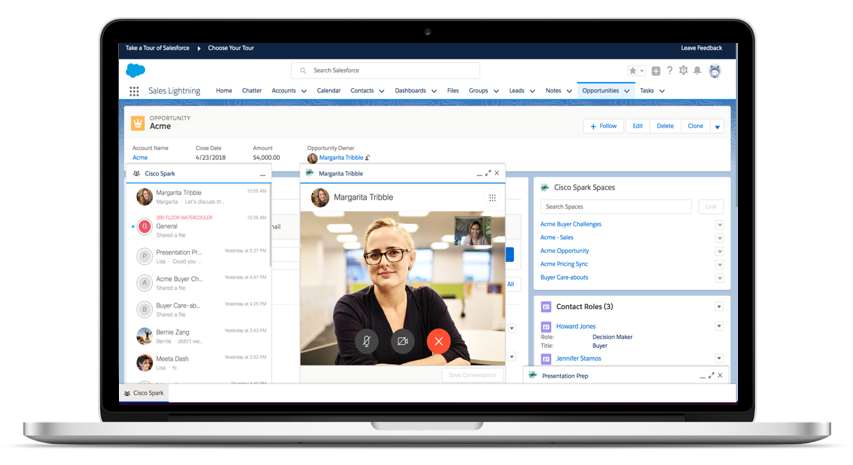
Today, the newly available Cisco Spark for Salesforce experience does just that. This solution puts essential collaboration tools in the hands of users directly within Salesforce. It’s turnkey and intuitive, allowing you to gain user value from day one.
If you’re in Salesforce, then you now have a free and ready-to-use solution that provides:
High-quality video calling
Group messaging with advanced features including file sharing, read receipts, and message deletion
Visibility of user status
And other tools designed to improve your effectiveness
These capabilities integrate smartly into the Salesforce interface. Simply hover over another user’s name to send a message or start a video call. Link group messages right inside relevant Salesforce records to keep things streamlined. Have multiple ongoing discussions to multitask as you move between different records.
Take a look:
https://www.youtube.com/watch?v=JQlsnKx4Lz8
Here’s what it means in practical terms:
For groups: Align teamwork with important Salesforce activities.
Anyone associated with a Salesforce record can link a new or existing Cisco Spark group messaging space to the record, generating a place for team members to ask questions, share files, and save helpful snippets of exchanged messages. This lets you streamline work by creating a topical discussion with all the right people – including external stakeholders – directly within an associated Salesforce record.
For individuals: Improve how you research a new customer opportunity.
There’s no need to send an email or compare schedules to find time to connect with someone to get important information about a new customer opportunity. You can explore associated Cisco Spark spaces to review previous conversations and shared files. Or you can initiate a message or video call with an account owner to get questions answered quickly.
For everyone: Get more done in a single place.
Cisco Spark for Salesforce gives you the power to interact with anyone else who uses Cisco Spark – and all that takes is an email address. Using Cisco Spark to interact with non-Salesforce users means you can get more work done with all your colleagues and stakeholders from a single place.
The benefits to Salesforce administrators are just as numerous. Enable it in a few clicks, it deploys “instantly.” Users just need to authenticate with the Cisco Spark service. They can leave downloads and plug-ins at home. And the video calling works right in Mozilla Firefox and Google Chrome browsers.
Get started today by simply turning on the Cisco Spark experience in your Salesforce Lightning Sales or Service clouds via the Salesforce administrator page.
And I want to know how it’s going! Please ping me via @JSGoecke on Twitter to tell me how you’re using it. We’re already working with Salesforce on our next release, so your feedback can help us make it better.
A very common goal for software designers and security administrators is to get to a Secure Zero-Trust model in an Application-Centric world.
They absolutely need to avoid malicious or accidental outages, data leaks and performance degradation. However this can be very difficult to achieve sometimes, due to the complexity of distributed architectures and the coexistence of many different software applications in the modern shared IT environment.
Two very important steps in the right direction can be Visibility and Automation. In this blog, we will see how the combination of two Cisco software solutions can contribute towards achieving this goal.
This is the description of a lab activity, that we implemented to show the advantage from the integration of Cisco Tetration Analytics (providing network analytics) with Cisco CloudCenter (application deployment and cloud brokerage), creating a really powerful solution that combines deep insight into the application architecture and into the network flows.
Telemetry from the Data Center
Cisco Tetration Analytics captures telemetry from every packet and every flow, delivers pervasive real-time and historical visibility across your data center, providing a deep understanding of application dependencies and interactions. You can learn more here: http://cs.co/9003BvtPB.
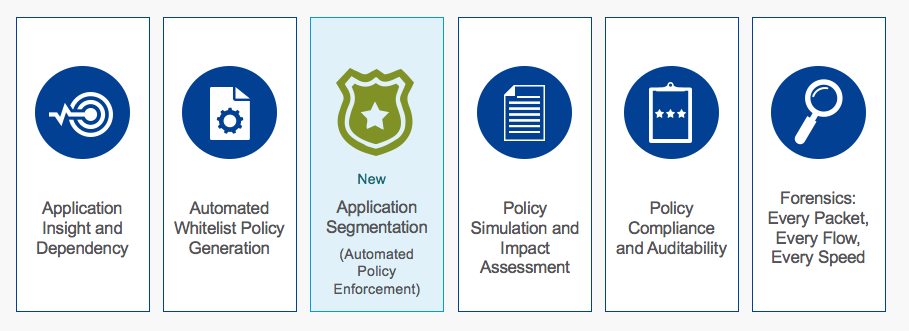
Main use cases for Tetration are:
Pervasive Visibility
Security
Forensics/Troubleshooting, Single Source of Truth
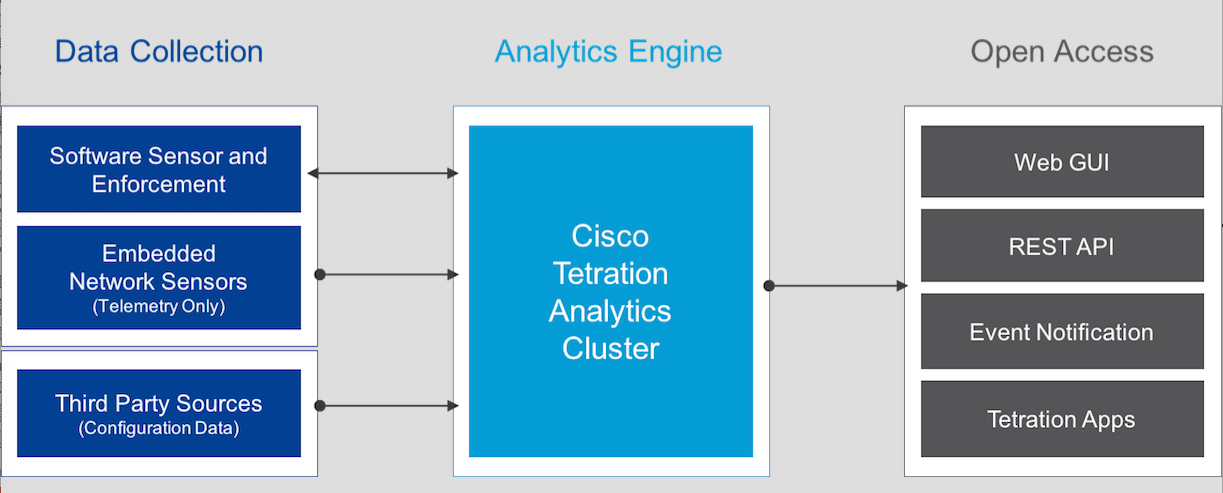
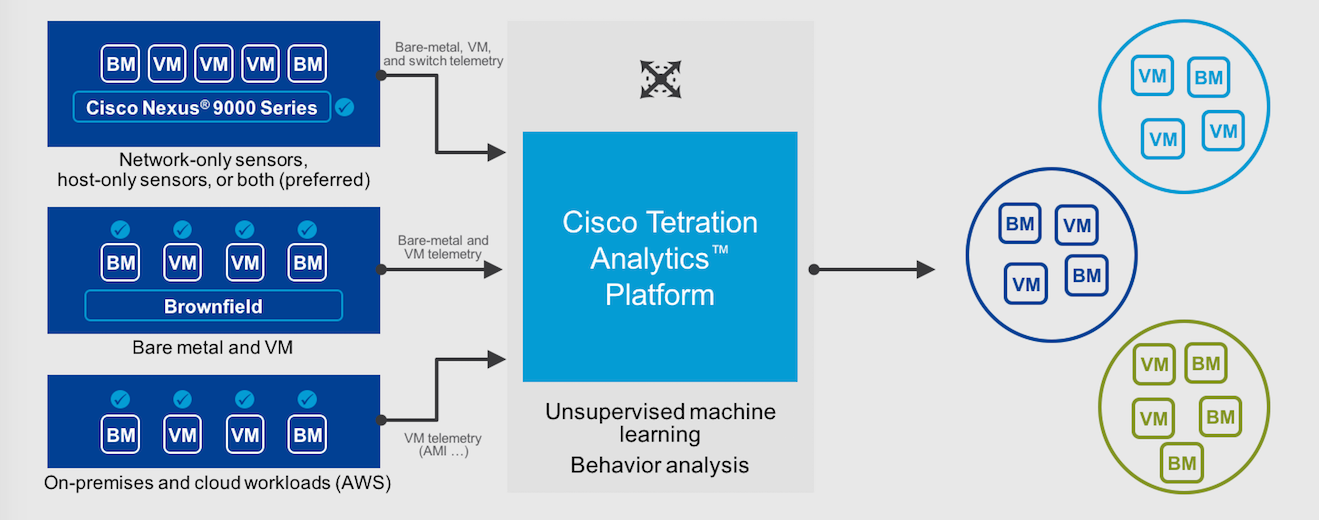
The architecture of Tetration Analytics is made of a big data analytics cluster and two types of sensors: hardware and software based. Sensors can be either in the switches (hw) or in the servers (sw).
Data is collected, stored and processed through a high performance customized Hadoop cluster, which represents the very inner core of the architecture. The software sensors will collect the metadata information from each packet’s header as they leave or enter the hosts. In addition, they will also collect process information, such as the user ID associated with the process and OS characteristics.
Tetration can be deployed today in the Data Center or in the cloud (AWS). The choice of the best placement depends on whether you have more deployments on cloud or on premises.
Thanks to the knowledge obtained from the data, you can create zero-trust policies based on white lists and enforce them across every physical and virtual environment. By observing the communication among all the endpoints, you can define exactly who is allowed to contact who (white list, where everything else is denied by default). This applies to both Virtual Machines and Physical Servers (bare metal), including your applications running in the public cloud.
As an example, one of your database servers will be only accessed by the application servers running the business logic for that specific application, by the monitoring and backup tools and no one else. These policies can be enforced by Tetration itself or exported to generate policies in an existing environment (e.g. Cisco ACI).
Another benefit of the network telemetry is that you have visibility on any packet, any flow at any time (you can keep up to 2 years of historical data, depending on your Tetration deployment and DC architecture) among two or more application tiers. You can detect performance degradation, ie increasing latency between two application tiers and see the overall status of any complex application.
How to onboard applications in Tetration Analytics
When you start collecting information from the network and the servers into the analytics cluster, you need to give it a context. Every flow needs to be associated to applications, tenants, etc. so that you can give it business significance.
This can be done through the user interface or through the API of the Tetration cluster, matching metadata that come associated with the packet flow. Based on this context, reports and drill down inspection will give you an insight on every breath that the system does.
Automation makes Deployment of Software Applications secure and compliant
The lifecycle of Software Applications generally impacts different organizations in the IT, spreading responsibility and making it hard to ensure quality (including security) and end-to-end visibility.
This is where Cisco Cloud Center comes in. It is a solution for two main use cases:
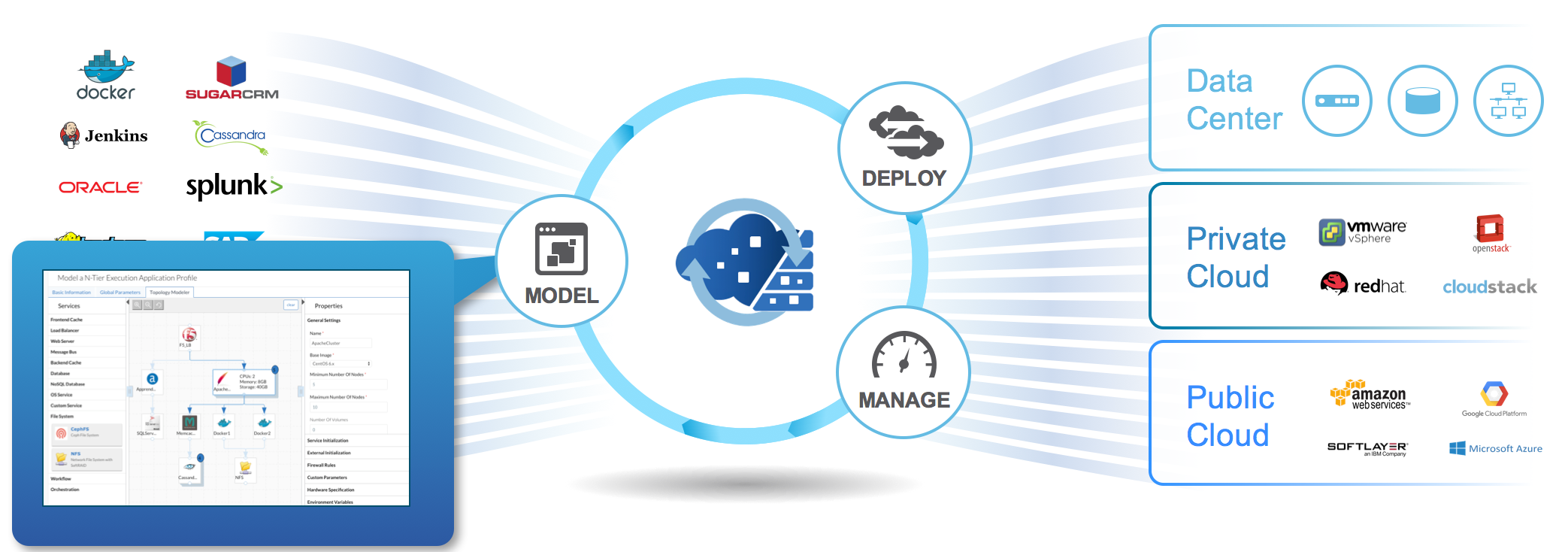
modeling the automated deployment of a software stack (creating a template or blueprint for deployments)
brokering cloud services for your applications (different resource pools offered from a single self-service catalog). You can consume IaaS and PaaS services from any private and public cloud, with a portable automation that frees you from lock-in to a specific cloud provider.
Integration of Automated Deployment and Network Analytics
It is important to note that both platforms are very open and come with a significant support for integration API. The joint usage means benefitting from the visibility and the automation capabilities of each product:
CloudCenter
Application architecture awareness (the blueprint for the deployment is created by the software architect)
Operating System visibility (version, patches, modules and monitoring)
Automation of all configuration actions, both local (in the server) and external (in the cloud environment)
Tetration Analytics
Application Dependency Mapping, driven by the observation of all communication flows
Awareness of Network nodes behavior, including defined policies and deviations from the baseline
Not just sampling, but storing and processing anytime metadata for any single packet in the Data Center
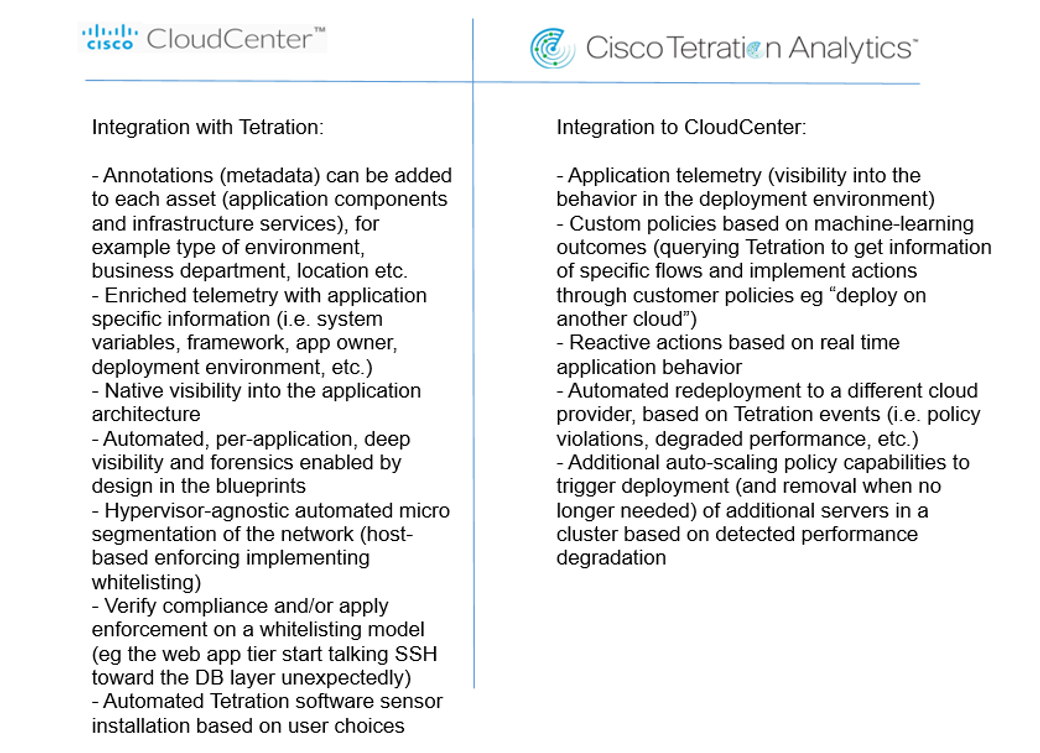
The table below shows how each engine provides additional value to the other one:
Leveraging the integration between the two solutions allows a feedback loop between applications design and operations, providing compliance, continuous improvement and delivery of quality services to the business.
Consequently, all the following Tetration Analytics use cases are made easier if all the setup is automated by CloudCenter, with the advantage of being cloud agnostic:
Of course one of the most tangible results claimed by this end-to-end visibility and policy enforcement is security.
More detail on the integration between CloudCenter and Tetration Analytics will be described in the next post, where we will demonstrate how easy it is to automate the deployment of software sensors along with the application, as well as preparing the analytics cluster to welcome the telemetry data.
Credits
This post is co-authored with a colleague of mine, Riccardo Tortorici.
He is the real geek and he created the excellent lab for the integration that we describe here, I just took notes from his work.
Millions invested in the latest security technologies? Check.
Your team trained on information security best practices? Check.
Passed a third-party review of your security architecture? Check.
So, how the hell were hundreds of your servers’ hard drives just destroyed by malware within minutes?! That’s exactly what your CEO, your Board and your investors all want to know. Now. (You have some time before the press start calling.)
I’m sure this is how a number of Chief Information Security Officers (CISOs) felt when their companies were impacted by the Nyetya/NotPetya malware attack in June. (The Nyetya attack only took 3.5 hours from beginning to end.) And I’d wager a similar sense of dread was felt when a backdoor was discovered in a certain version of the popular CCleaner utility. Luckily, there have been no known attacks results from the CCleaner compromise as of the time of this writing.
Despite the different outcomes, both attacks are examples of an effective and insidious type of attack known as a supply chain attack.
The Supply Chain Attack
Supply chain attacks focus on exploiting trust. A threat actor will compromise one or more components of a trusted development or delivery process. Such an attack could manifest itself through counterfeit chips, say, used in production of a computer or networking hardware. Or, the attack could introduce compromised code in a trusted software application as was done in both the Nyetya and CCleaner attacks. A number of scenarios and methods could be possible, but the net of it is, these attacks use trusted channels to infiltrate their targets.
Who Conducts These Attacks and Why?
I need to be clear about something from the outset: Attribution is hard. There are many ways that attackers can cover their tracks and misdirect investigators. That being said, there are characteristics that can indicate different types of threat actors such as nation-states or organized crime, for example. Certain threat actors may even re-use unique styles of code. Regardless, attribution is very difficult, nuanced work, and a margin of error must always be considered.
Consider that supply chain attacks are sophisticated. The stereotypical kid in the basement isn’t going to pull this off. Supply chain attacks require ample time for target reconnaissance to identify that weak link and then to infiltrate the target’s environment. They require skilled coders to develop an attack that mimics the target’s processes and to remain undetected. With those steps complete, the attacker can then focus on the exploitation of the ultimate, intended target. This entire process requires significant funding, skill, and patience. What kind of threat actor do you think can meet all of these requirements?
As for motives, they vary, but we can put political and economic motivators at the top of the list. Nyetya had the characteristics of making a political, if not psychological, statement, while the motivation for the CCleaner exploit could be interpreted as having been driven by economic factors. Determining the motives of an attacker is even harder than determining attribution. But just the fact that the former attack was so “loud” and the second so “quiet,” indicates that the attackers were after very different outcomes.
What You Can Do
Trust, but verify.
You have to realize that it’s the bad guys’ job to come up with ways to carry out their mission such that you’ll never see them coming. Exploiting trust is very powerful. Whether you are the end customer or have a place in a supply chain, ask your vendors/partners how they secure their supply chains. Ask them about their development practices and their internal security controls. How do they roll out patches and updates to their internal systems, and how often? How do they segment and secure their development, QA, and production environments? How do they vet their partners and vendors?
And be sure to ask all of these questions of your own organization, or you could find that it’s your organization that is the weakest link in the supply chain.
Can Cisco Help Me?
Of course!
Our Cisco Security Services team can provide a wide range of services from architectural review, design, and deployment, to security operations management, incident response, and more to ensure that your organization has the technology, training, and processes in place.
Supply chain attacks are an effective method for advanced adversaries, true, but you don’t have to face them on your own. Get in touch and let’s talk about how Cisco can help.
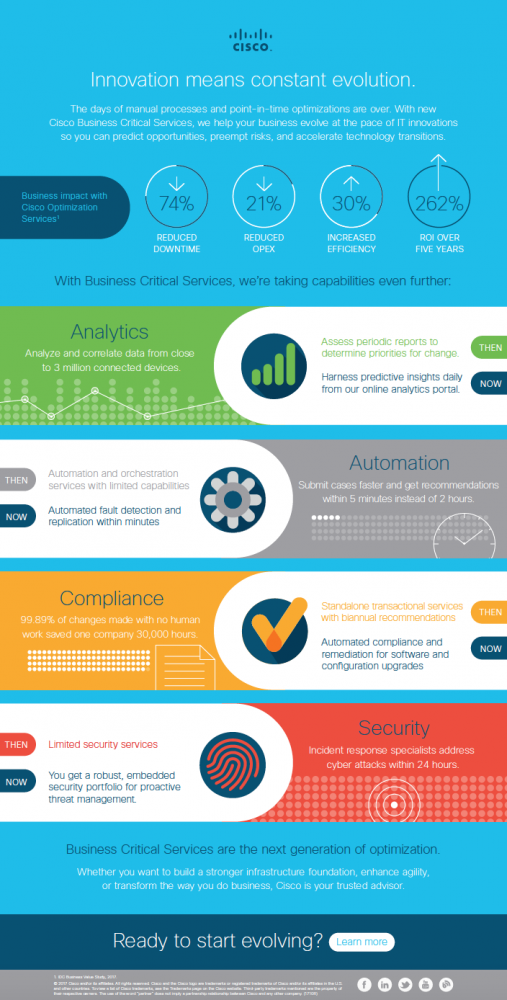
What if you could simultaneously reduce your network downtime by 74 percent and increase IT efficiency by 30 percent? What would you do with your newfound time? Maybe you would divert recovered costs toward revenue-generating activities. Perhaps you would redirect resources to take meaningful steps on a transformation project. Whatever you choose, you would have greater flexibility and freedom to pursue new growth opportunities.
There is no perfect formula for success, but we’re getting close with the launch of Cisco Business Critical Services. I am proud to share Cisco Services’ debut of our portfolio of next-generation optimization services that apply analytics, automation, and technology expertise to help our customers predict opportunities, preempt risks, and navigate technology transitions.
The Right Services for Now
Earlier this year, I had the opportunity to host a talk with top industry CIOs who expressed some universal challenges. They are pressed for technical talent in key roles. The pace of change has accelerated the demand for IT resources, not only to keep the
lights on but to secure their infrastructure, take on transformational initiatives, and leverage IT as a growth enabler.
The proof is more than anecdotal. According to the IDC Worldwide Digital leader survey, 69 percent of IT leaders shared that they lacked the right people, knowledge, and technology to transform. Seventy percent of IT networking teams believe programming and scripting skills are must. But, only 15 percent of the IT networking talent has these skills today.
How can technology leaders reconcile the dynamic? They can remove human error from the system and extract more value from their Cisco products and solutions. They can optimize their networks and enable IT to play offense. Business Critical Services integrates the right services for what organizations need now. They can choose from a combination of services including our new capabilities:
Analytics – Our advanced analytics engine enables IT teams to make informed decisions with trending data, anomaly detection, and near real-time reporting via a robust portal.
Automation – Automated fault management, detection, collection, reporting, and notification take complexity and guesswork out of the network.
Compliance – Automation boosts compliance with automated software upgrades and large-scale configuration changes. Companies reduce risk and gain confidence with PCI, HIPAA, SOX, ISO and other compliance audits.
Security – Today’s network is as strong as its defense. Business Critical Services bakes in best-in-class threat management including Incident Response, threat hunting, and vulnerability assessments.
There is more good news. Business Critical Services was built for customers across industries and to meet them anywhere they are in their transformation journeys. We have learned from tens of thousands of engagements that organizations need flexibility to tap into expertise when they need it and new ways to optimize their infrastructure to make the most of their investments. With our launch of Business Critical Services, we’re giving customers opportunities for both. It’s a fresh formula for success in today’s hyper-competitive market. A secure, efficient, and agile technology environment is closer than you think.
Read Cisco Service’s Senior Vice President Joe Cozzolino’s Business Critical Services Launch announcement.
As more and more cable service providers forge MVNO partnerships with mobile carriers, or build their own MNO-styled networks, the time has come to start solving mobile backhaul problems — and especially the backhaul latencies required by LTE networks — by expanding the DOCSIS specification yet again, to handle mobile backhaul on current 4G/LTE and forthcoming 5G networks.
Here’s the backstory. If it had a title, that title would be “Worlds Coming Together,” and specifically the worlds of wired and wireless network providers. Cable operators have successfully addressed the video, voice, data, home security and business services markets. Their search for the next big market has now brought them to mobile services.
Mobile carriers, faced with massive increases in consumer consumption, are working to “densify” their current macrocell topologies, which cover a radius of up to 10 miles, by moving into small cell deployments. Small cell radios will cover a substantially and deliberately smaller radius, typically of 100-200 meters, of up to 500 meters.
Meanwhile, consumers often pay their cable and mobile provider $200 or more each per month, in large part for sustained wired and wireless connectivity to the Internet. If cable operators start providing mobile services to their customers, they have the opportunity to increase their ARPU.
Clearly, though, a new network needs to be built — a small cell network. What does it take to build it? Three things, really: First, a place to mount the small cells. (People call this “urban furniture,” to mean a telephone pole, lamppost, building, node, or residence.) Second, those small cells will need power. Third, they’ll need a way to backhaul bandwidth — a connection, traditionally fiber. Or, DOCSIS!
The cable HFC (Hybrid Fiber Coax) plant is the only place that has all three necessities — placement, power and backhaul — because they really do have the densest wired network in the world. The HFC plant is already the RF front end for video and DOCSIS. Could the HFC plant now become the new RF front end for mobile?
(It’s worth noting that cable providers are already long-time partners to mobile carriers for macrocell backhaul services. Deepening those relationships to keep up with the pace of demand is an extension of “business as usual.”)
Which brings us to DOCSIS. Cable providers are already on a path to break up their current, 500-home serving areas into 10 or so smaller serving areas. This involves taking fiber deeper into neighborhoods, with “node+0” configurations, already in play.
But taking fiber to the lamppost is just as unrealistic as it sounds, and few cable or mobile operators plan to take fiber directly to homes. It’s just too expensive, in actual and “soft” costs (like the angst that comes with digging up yards.)
Put another way: When small cells are deployed deep into the mobile network, DOCSIS will already be there. Fiber may not be.
That’s why CableLabs searched for concepts on a more efficient way for DOCSIS to provide mobile backhaul — for 4G/LTE networks to start, and 5G installations as they start to emerge in meaningful ways. They looked for partners who could help develop and validate these concepts through experiments and a proof-of-concept implementation. Cisco had the capability and willingness to partner on this preliminary work.
From a technological perspective, it’s also notable that both cable and mobile use similar technology principles. Both are actively “densifying” their networks. Both routinely tackle the challenges associated with point-to-multipoint communications, which involves a lot of work to schedule upstream transmissions and both use OFDM related PHYs. .
The mobile industry’s migration from macrocell to small cell is analogous to how cable’s HFC (Hybrid Fiber Coax) topologies are migrating from N+5 to N+0 (fiber deep) — where “5” and “0” represent the number of amplifiers in any one path along the coaxial portion of the plant.
At SCTE Cable-Tec Expo CableLabs’ Distinguished Technologist, Dr. Jennifer Andreoli-Fang and I are presenting our co-authored paper that describes how DOCSIS backhaul latencies can be reduced for LTE backhaul by using “pipelining” and a new message called the “bandwidth report,” or BWR.” The principles proposed within it will extend to 5G.
We’ll also be demonstrating the mobile backhaul for DOCSIS concept in our booth. In essence, the intent is to create an API-based method for LTE to “pipeline” its upstream request messages to a DOCSIS CMTS in advance, so as to “work ahead” of known timing.
This matters because the minimum LTE “request-grant” time is much longer than those of DOCSIS — upwards of 15 or more milliseconds compared to 5 milliseconds with DOCSIS. What we’ll demonstrate is the low latency technique where an LTE system will make a bandwidth requests from a DOCSIS system for a specific time in the future, before the arrival of the actual traffic at the CM. This will allow the CMTS to make QoS and granting decisions earlier than it normally would.
Bottom line: When LTE and DOCSIS work together, a low latency backhaul mechanism is created for Gigabit-per-second mobile traffic. It’s a win-win that’s worth checking out! Come by and see the proof of concept we developed with CableLabs for yourself — we’re in booth 987.
Craig Tranter is a former educator, and now serves as a technology presenter for Cisco. This blog is the fourth in his series on advancements and opportunities in education. All views are his own.
Let’s talk about a campus of the future. Imagine a digitally connected campus where students can access content from any device, and the campus reacts to their presence, giving them personalized, real-time updates.
Here’s an example. Take a typical student, let’s call her Sarah.
Sarah goes to a university where third-party suppliers have worked closely with Cisco to create a digitally connected campus. Here’s a typical day for Sarah if she does choose to physically go to campus.
Sarah heads to campus and arrives in the smart car park, where she’s already booked her parking space via an app on her phone.
The lighting reacts to her presence, saving money through energy efficiency and making Sarah feel safe as she moves around the campus.
As the university supports a culture of BYOD (Bring Your Own Device), Sarah takes her personal device(s) and automatically connects to the university Wi-Fi using Cisco ISE (Identity Services Engine) to authenticate her as a user and give her secure access to all the content that she needs.
She heads to the library where she uses her ID card to get in to the secure building.
Sarah sees interactive digital displays and uses the touch screen to find a quiet area in the library where she can work in peace. Through the power of Cisco CMX (Connected Mobile Experience) Sarah is able to follow the indoor wayfinding to her quiet study space.
Sarah can look up book locations through RFID tagging, and, if she still needs help, she can request assistance using the university’s ‘Assist Me’ app to get personalized assistance to find that elusive book. Because even in this digital world, books do still exist! (For now at least!)
Having completed her task in the library, she heads through the campus and with CMX and EMSP (Enterprise Mobility Services Platform) she gets real-time, personalized notifications on nearby events that she has indicated she may be interested in.
Sarah can also pre-book her study sessions in specific rooms, which is then displayed with digital signage to show that the room is occupied.
She talks to her friends in the room and to the mentor who is attending via video, so that everyone is able to collaborate wherever they are.
At every step through Sarah’s day, she is securely connected to all the content that she needs and is able to interact with the environment around her. She can easily access different systems and the campus itself reacts to her presence.
Perhaps tomorrow it’s raining, so she decides that she can just as easily work from home and connect virtually.
Wherever Sarah is, she receives an enhanced digital experience that improves her learning.
Watch out for the next post about collaboration tools and apps.



 A big task. So you can imagine the thrill when it was announced at the SlashData Future Developer Summit that Cisco DevNet had received the customer satisfaction award in the category “Satisfaction with Training in Developer Programs.” This from a survey that is based on the independent and unbiased opinions of over 40,000 developers from around the world, combined with SlashData’s own research!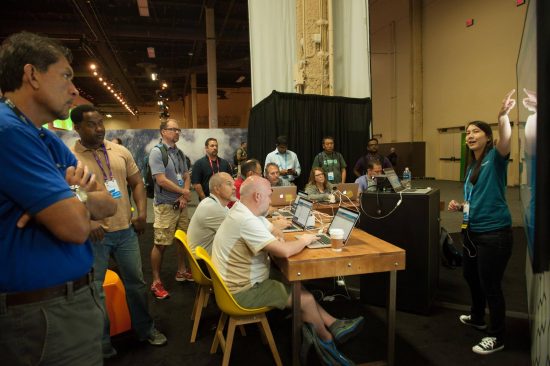














 Sarah heads to campus and arrives in the smart car park, where she’s already booked her parking space via an app on her phone.
 The lighting reacts to her presence, saving money through energy efficiency and making Sarah feel safe as she moves around the campus.
 As the university supports a culture of
  She heads to the library where she uses her ID card to get in to the secure building.
 Sarah sees interactive digital displays and uses the touch screen to find a quiet area in the library where she can work in peace. Through the power of
  Sarah can look up book locations through RFID tagging, and, if she still needs help, she can request assistance using the university’s ‘Assist Me’ app to get personalized assistance to find that elusive book. Because even in this digital world, books do still exist! (For now at least!)
 Having completed her task in the library, she heads through the campus and with CMX and EMSP (
 Sarah can also pre-book her study sessions in specific rooms, which is then displayed with digital signage to show that the room is occupied.
 She talks to her friends in the room and to the mentor who is attending via video, so that everyone is able to collaborate wherever they are.