Avatar

It is with great admiration and fondness that I write this blog about my colleague John Chapman’s induction into the 2017 class of Cable Pioneers, during the SCTE Cable-Tec Expo, in Denver this week.

The Cable Pioneers is an organization that honors long-serving and accomplished executives in the industry. It began in 1966, with a group of 21 entrepreneurs, and has grown since then to over 700 men and women. (Click here to see a Multichannel News compilation of 50 Facts about the Cable Pioneers.)

I’d venture a guess that anybody who works on the IP-side of cable, and particularly those familiar with DOCSIS (Data Over Cable Service Interface Specification), knows John Chapman, or at least knows of his foundational and ongoing work to advance the depth and breadth of broadband communications.

We took the liberty of checking in with some industry luminaries about John’s role in the cable and broadband universe. Here’s what Tony Werner, cable pioneer and President of Comcast Technology and Product, has to say: “John has a unique knack for innovating in the precise directions the industry needs — years before those needs arise. He’s done it over and over again, even before the beginnings of DOCSIS. Plus, he’s not only a ‘dream it up’ guy — he’s also a ‘get it operationalized’ guy, which is always harder than it looks.”

Mark Bell, Vice President of Industry affairs for NCTA – The Internet & Television Association, notes that “John’s longstanding commitment and numerous contributions to the NCTA Technical Papers is immeasurable. Serving countless terms on the selection committee as our DOCSIS ‘spirit guide,’ John’s unique vision into the trajectory of cable’s broadband platform — as one of its creators — often led to vigorous debate, selection and publication of several technical papers on the topic.”

“As one of the most distinguished and frequently published authors from the series,” Bell continues, “John himself, along with distinguished co-authors, has contributed more than a few peer-acclaimed written works to the industry’s archival body of technical literature — including one that ‘weighed in’ at 182 pages. Bonus: He’s also one of the nicest brilliant minds in the business.”

John was nominated by Rouzbeh Yassini, CEO of YAS Capital Partners an acknowledged “father of the cable modem,” and Nick Hamilton-Piercy, former CTO of Rogers, in Canada. They note several major accomplishments, attributable to John:

  • He founded the CMTS business at Cisco in 1996
  • He’s a prolific author, with more than 100 patents issued and pending, related to DOCSIS
  • He’s contributed meaningfully to the DOCSIS spec since its first iteration (DOCSIS 1.0) through to DOCSIS 3.1, Full Duplex DOCSIS, and now, at this year’s Expo, mobile backhaul for DOCSIS

Beyond that, he’s a 7th Dan in Tae Kwon Do, a 5th Dan Black Belt in Hapkido, and a blue belt in Brazilian Ju-Jitsu. He’s taught martial arts to adults and children for over 30 years. Which speaks volumes about his intensity, fortitude, and respectfulness.

John will be inducted into the Cable Pioneers at a dinner event on Tuesday, October 18, at the Brown Palace Hotel. Our deepest congratulations, John! You are an industrial treasure, and we are lucky to have you on our team at Cisco.

Authors

Sean Welch

Vice President and General Manager

Service Provider - Cable

Avatar

Next week Cisco will be exhibiting at the 2017 GE Minds + Machines conference in San Francisco (October 25 and 26). Cisco is a platinum sponsor, and if you’ve never attended this conference, it’s one of the premier Industrial IoT (IIoT) events. Topics of discussion will include:

  • IIoT architecture
  • IIoT data management and analytics
  • Industrial control and edge computing
  • Asset performance

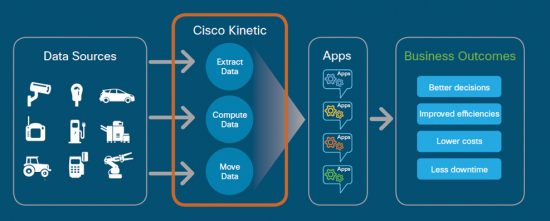
In addition to those topics, the event will also cover industrial verticals such as manufacturing, smart cities, transportation, and utilities, among others. Cisco will be located in booth 17 at the event and will be presenting our Cisco Kinetic IoT data fabric solution. During the week, we’ll discuss how Kinetic is reducing the complexity of connecting, securing, and managing devices. We’ll also show how to unlock data and move it in a secure, programmatic way to the right applications at the right time.

The presentation will showcase the integration of the gateway management module for connectivity, and Kinetic Edge and Fog on the processing side. Additionally, we’ll discuss proof of concept integrations of Kinetic with GE’s Predix solution.

On October 25, Cisco’s Todd Gurela will talk about leveraging the power of Cisco to securely extract, compute, and move data in an IIoT environment. Todd’s session will be at 12 p.m. in the Tech Hall. We look forward to seeing you there.

To learn more about Cisco’s Kinetic solution, please visit the Kinetic webpage.

I also invite you to explore the following manufacturing topics:


Authors

Eric Ehlers

No Longer at Cisco

Avatar

Let’s say you are totally on board for private cloud. You (well, really your developers) love the public cloud, but you know you could save a whole lot of money if you moved that big data workload over to the private side. Or maybe you need to keep your data on-premises in order to meet industry regulations. Whatever the reason, you get the private cloud value proposition, and it makes sense for your company. Plus, you understand the technology, you have a vision for how you’ll use public and private cloud together, and your team is the type that will rally around the cultural changes required to make such a move.

So it looks like you—or your company to be more specific—are in an ideal position to take the plunge.

But there’s this one teensy, weensy, actually-kind-of-giant thing holding you back: You’ve got thousands—literally thousands—of legacy apps that have to be dealt with. There’s no way you have the time or the money to rewrite them all to work in the cloud, and you definitely need most of them for your company to move forward.

So you’re stuck. You want a private cloud, you know you should have a private cloud, but you do not have a private cloud.

In this episode of Cloud Unfiltered, Sinclair Schuller talks about the challenges that enterprises face as they wrestle with a desire to become more agile yet protect and preserve the legacy applications their businesses were built on. Specifically, he touches on:

  • How Apprenda helps companies move legacy apps to a cloud native environment
  • Why they’ve embraced Kubernetes
  • Why he encourages companies to start with a “small bite” when it comes to cultural change
  • Why multi-year transitions are not necessarily a bad thing
  • Why both the developer and IT point-of-view on multi-cloud environments are both 100% accurate (even though they’re radically different)
  • The soon-to-be open source project he’s geeking out on in his spare time

See the video podcast on our YouTube page, or listen to the audio version on iTunes. And if you like what you hear, we invite you to subscribe to our channel so you don’t miss any of the other exciting podcasts we have scheduled over the next several months.


Authors

Ali Amagasu

Marketing Communications Manager

Avatar

Frankfurt, Germany in October transforms into a city of festivals, catering to all tastes and ages. Just two weeks ago Oktoberfest got over and last week we saw the city play host to the famous book fair. This October, Frankfurt gives techies in Europe an extra delight with a hi-tech event, Tufinnovate EMEA 2017, Oct 17-19.

Cisco is the main Gold sponsor this year at Tufinovate Frankfurt, and is showcasing both its market-leading technology innovations ACI and Tetration Analytics.  Attendees can see prima-facie, how the combined power of Cisco and Tufin can help address customer challenges in application connectivity analysis, security orchestration and continuous compliance areas. Cisco Networking and Analytics expert Juan Lage from the Insieme Business Unit, is leading a technical track titled “Cisco ACI & Tetration integrations with Tufin” on October 19, 9.30 AM to set the technology tracks in high gear. Juan comes with a stellar background in networking and has authored several papers and patents at cisco, and many of the attendees probably know him already through Cisco Live EMEA events at Berlin, London in recent years. I strongly recommend you to attend Juan’s session to get a 360 degree view of Cisco’s cutting-edge innovations in DC networking and analytics. In addition to speaking sessions, Juan and another Cisco expert Matthias Weesendorf will be demonstrating live demos at the Cisco booth through the duration of the event. So, do not miss this great opportunity to engage in peer-to-peer information sharing with Juan and learn the most about Cisco-Tufin joint solutions.

Besides Juan’s breakout sessions, you can gain a broad overview of Tufin’s vision and strategy from the keynote sessions hosted by Tufin co-founders Ruvi Kitov and Reuven Harrison and as well from guest speaker Samy Kamkar who made waves with his creation MySpace worm, industry’s fastest spreading virus of all time. Samy’s work has been cited by the NSA, triggered hearings on Capitol Hill, and has been the basis for security advancements across virtually all web browsers, smartphones, and other technologies. See Agenda for details.

In closing, I want to draw your attention to the leading joint solutions featuring Cisco ACI & Tetration Analytics with Tufin.  For Cisco ACI – Tufin solution refer to the solution brief link. For Tetration Analytics – Tufin solution refer to the solution brief link. To get you on a fast-ramp, here is an excerpt of the Tufin Cisco ACI and Tetration value-props. Tufin’s Unified security policy model with Tetration enables you to achieve continuous compliance, policy consistency across your data centers, enabling zero-trust operations. The integration of Tufin Orchestration Suite with Cisco ACI enables you to  adhere to security standards and automate the security policy configuration across Cisco ACI fabric.

Enjoy your time at Tufinnovate 2017, Frankfurt. We look forward to seeing you there.

Related Links:

www.cisco.com/go/dcecosystem

www.tufin.com

Authors

Ravi Balakrishnan

Senior Product Marketing Manager

Datacenter Solutions

Avatar

Commercial drones are moving from a novelty item to an indispensable business tool, with PwC pegging the potential opportunity size at $127B in its report, “Clarity from Above”. However, there is a key element that is needed before drones can be successful in enterprise applications: they must be integrated into regular workflow systems, instead of existing in their own silos.

It’s like saying “let’s talk” instead of “let’s talk over a telephone” in the world of voice communication.

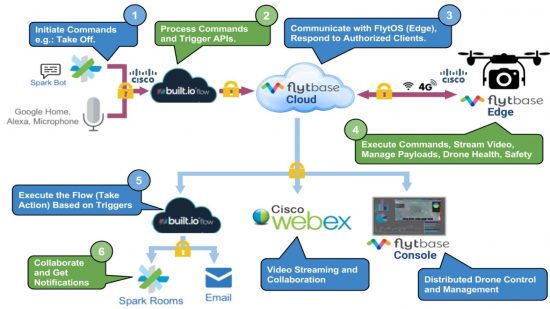
An example of this is showcased below. A few months ago, Cisco’s Enterprise Routing and Mobility team partnered with FlytBase and AeroTestra to showcase end-to-end enterprise workflows involving fleets of drones. Cisco’s Spark, WebEx and Drone ASAP products were integrated with Built.io’s Digital Transformation Platform to create this unique solution.

As shown in the diagram above, users can send text messages through Cisco Spark or voice messages through Amazon Alexa or Google Home to initiate and execute various drone commands. These commands are then securely delivered to the drones via Spark Bots over Cisco’s wireless and FlytBase’s cloud infrastructure. The drones perform these operations while offering complete visibility and control over Cisco Spark, Cisco WebEx and FlytBase’s consoles.

 https://youtu.be/f4Z4Yc3SES8

More recently, at the Drone World Expo conference in San Jose, I conducted a session on “The Future of Commercial Drone Ecosystem” that outlined the vision and criteria for successfully integrating drones into enterprise workflows.

I can sum up my vision for the successful integration of drone technology in a single quote: “Success is when you can peacefully forget about the technology.” How many years do you think it will take for drones to become an integral part of our lives in a similar way?


Credits: Shivaji Diwane, Jon Schimpke, Sundara Paal Rani Thirumalaiappan, Keith D’souza, Nitin Gupta, Sean Headrick


Authors

Biren Gandhi

Head of Drone Business & Distinguished Strategist

Corporate Strategy Office

Avatar

Do you know what the greatest Olympian of all time and Stealthwatch have in common? Both work harder and smarter for unbeatable performance.

I recently heard from the one-and-only, Michael Phelps. He said that very early on, he and his coach set very high goals. And he knew that to achieve them, he had to train differently than his competitors. So Phelps decided to practice all 7 days a week. He called it making a “deposit” and “cashed” them when he achieved the goals he set for himself. While Phelps and his team trained harder and analyzed every aspect of his technique by gathering all data points, they also selectively chose which ones to work on for constant refinement and improvement. I mean, have you seen those underwater turns!!

Similarly, Stealthwatch works hard by collecting and analyzing a robust spectrum of enterprise telemetry from all levels of the networking stack. It provides end-to-end visibility across the entire digital business by leveraging your existing network infrastructure. And you don’t need to deploy agents across your routers, switches, firewalls, endpoints and other network devices to get rich security analytics. Stealthwatch scales with your business across endpoints, data centers, branches and cloud.

But what’s also important is how Stealthwatch uses all that data, the collected telemetry, to generate smart insights and detect advanced threats. Using the power of multi-layer machine learning, Stealthwatch creates a baseline of normal web and network activity for a host, and applies context-aware analysis to automatically detect anomalous behaviors. This is important because in spite of perimeter-based defenses and security products, odds are that your organization will be breached. And when (not if) that happens, there are three key questions:

  1. Do you know if your network has already been breached?
  2. Can you easily determine the cause of the breach?
  3. Can you contain the potential impact and effects of the breach?

It is important to remember that a breach not only refers to malware and other advanced persistent threats (APTs) but also insider threats, such as data exfiltration and data hoarding. There have been too many instances lately when a large organization with a complex network discovered much later that an attack had occurred. As mentioned above, Stealthwatch helps answer the first question as it provides end-to-end visibility by collecting enterprise telemetry from every part of the network, and creates an effective model for all the hosts.

Once a breach is discovered, Stealthwatch answers the second question because it has visibility into every host’s activity and the ability to go back in time to analyze the network audit trail it collects and stores over long periods. Now, you can conduct a thorough retrospective investigation and accelerate incident response from months to hours!

And when you gain visibility into the entire network, you can optimize your security policies and and create logical segmentation based on effective behavioral modeling. For example, Stealthwatch can validate that your printer shouldn’t have access to the source code repository or the payroll system. Stealthwatch can also easily quarantine the infected host and enforce policies using the network. In this way, Stealthwatch solves the third question by providing simplified network segmentation. 

That’s why Cisco Stealthwatch is the industry-leading visibility and security analytics solution. It works harder and smarter to provide advanced threat detection, accelerated threat response and simplified network segmentation. And it does this across your entire digital business using the most advanced machine learning and behavioral modeling.

 Visit www.cisco.com/go/stealthwatch to learn more or www.cisco.com/go/stealthwatch-free-assessment to see what risks exist on your network.

Authors

TK Keanini

No Longer at Cisco

Avatar

Believe it or not, there are some interesting books about IT governance and controls. Before you doze off, let me oversimplify. IT Governance is all about having a system that determines who gets to make decisions. IT Controls provide a framework to make sure things are done a certain way.

This is important! Who gets to decide if and when a server gets patched? Who verifies it was actually patched? Who decides how much budget is available for cloud spend? How is spending controlled? Who gets to decide which firewall rules and port settings are applied? Who decides who can do what at different stages of the application development and release process? Who gets to decide if an application with customer or patient data can be deployed in the cloud?

Today there are more cloud options — including both application architectures and deployment environments – than ever before. That means there are more choices than ever before. But at the same time, more cloud options have changed IT consumers’ expectations. They expect to get what they want when they want it.

Policies that lay out who can do what, where, when and for how long are critical for balancing agile operations with risk mitigation practically. Applying these policies can’t introduce too much friction into the IT consumption process, or else people will actively work around the control system.

So, how do you help users make good decisions while ensuring things are done the right way every time? In a word: automation.

Automation with Guardrails

It’s generally recognized that in the current agile, digitally transformed, multicloud DevOps environment, you should automate everything. Automation saves time and money. It makes things move faster.

But it also makes things consistent, repeatable, and predictable. Automation helps solve for the decision/control/policy problem. With automation, policies can be codified and simplified so they are consumable by both humans and the computers executing the automation.

There are many different tactical options for automating the deployment and configuration of workloads in multicloud environments, including scripts, workflow orchestrators, JSON blueprints, configuration management tools (both declarative and imperative), and other cloud vendor offered tools.

Most of these options don’t provide governance guardrails on the automation that works consistently across multiple environments. As a result, applying a single set of governance and control policies across multiple environments that have different automation tools and processes can be hard. And implementing automation without guardrails leaves IT open to significant risk.

Multicloud Governance with CloudCenter

Here’s where a multicloud management tool like Cisco CloudCenter is different. It abstracts Infrastructure as a Service (IaaS) APIs that are different in each environment and uses a unique and patented architecture to allow a single deployable blueprint to be used in a user’s choice of target environments. Under the hood, a simple object model defines relationships between users, deployment environments, and deployable blueprints (called Application Profiles).

As a result, a single set of policies can implement governance and controls across users, applications, and multiple target deployment environments. That gives CloudCenter a governance wrapper around everything. That makes both IT and IT consumers’ jobs easier.

The simple “Who, What, Where, When, How” model can be used to understand how the CloudCenter policy model can apply consistently across multiple virtual data centers and private and public cloud environments.

Who?

Can access and execute automation? (e.g. deploy a workload to user’s choice of environment). Who determines what standard services are included in each blueprint? Who updates, quality controls, version controls, and releases each automation artifact for broad use?

Who has project authority at different stages of development and release cycle?

What?

What can be deployed? For Dev? Test? Production? What port settings? What configuration? What scaling policies?

Where?

Can customer, credit card or patient data be deployed in the cloud? Which cloud? At what stages of the application lifecycle? Can workloads be migrated? To the cloud? Or split between on premises and public cloud?

When?

Are all self-service deployments pre approved? Or only if there is budget? When do workloads get suspended to cut costs? Or Deleted?

How much?

Are self-service pre approved deployments unlimted? Can users choose any instance size they want? Is autoscaling unlimited? Are bugets unlimited? (rhetorical question). Unlimited in cloud, but limited on prem to a specific resource pool? Or limited to project budget? Department budget? Or user specific budget?

How long?

Are deployments forever? What triggers workload deletion? Suspension?

With multicloud governance, there are many choices. And there are a wide range of controls required to mitigate risk. And you may have a long list of policies.

The good news, is with CloudCenter you can make it easy for self-service multicloud users to make good choices and do the right thing every time.

Watch Now –  30-minute demo webcast where I’ll walk through the CloudCenter features that implement a who, what, where, when, how model for multicloud governance and control in a IT consumer friendly way.


Authors

Kurt Milne

Marketing Manager, US

CloudCenter Marketing

Avatar

As countries digitize to expand economic growth, promote a secure environment for investment, job creation and global competitiveness, cyber attackers are also seeing the monetary and political opportunity to exploit digital expansion and its data to their advantage. The dynamic threat landscape is not a challenge to be solved by one organization, one product, or even one solution. This is why collaboration between the public and private sector is more critical than ever in the digital era.

An effective cybersecurity partnership is one that goes beyond traditional intelligence sharing agreements and brings a deeper engagement across areas like sharing lessons learned and best practices, collaboration on architecting, building and deploying secure solutions, and bolstering education and training to help protect businesses and citizens alike. According to industry analysts there will be a global shortage of 2 million cybersecurity professionals by 2019. Private and public entities need to co-invest in research and education that will help educate, train, and build the skills needed globally to fill this vast talent shortage.

The urgency created by the disruption of digitization, is matched by that of the threat landscape, talent shortage, and the complexity that exists across public and private environments. It requires a multi-faceted approach with new ways to work together.

It takes a combination of people, process, technology, and policy in order to form an effective strategy to mitigate risk and ensure resiliency.

People

From government officials, to businesses and citizens, it is important to take a broad stroke to training programs. For example, Cisco works with organizations around the world to set up cyber ranges to support local government and public sector customers to build the skills and experience necessary for their IT staff to combat modern and evolving cyber threats. It provides a synthetic war-gaming environment that allows staff to play the role of both attacker and defender in order to learn and defend against the latest methods of exploitations. To supplement that, we’re working to educate cyber professionals globally through the Cisco Network Academy program and through investments in research and education. We also participate in events and activities that reach a wide range of audiences, such as National Cyber Security Awareness Month.

Process

Cyber resilience increases our collective ability to manage risk, identify new potential risks, and our ability to react quickly to take appropriate actions. It’s about more than having a plan when something goes wrong. Every organization needs that.

What we can learn collectively is how to improve our ability to make data-driven decisions quickly in times of crisis and incidents. At Cisco, we’ve signed multiple agreements with world governments to establish a threat intelligence sharing framework wherein personnel from both Cisco and the government will work cooperatively together to address cyber security threats and incidents. Through the process we will help identify and shape emerging security market trends, share best practices, and learn new approaches to enhance cyber security.

Technology

Building security and privacy controls into solutions is the baseline for achieving cyber resilience, aiding in the creation of secure critical infrastructure and enabling a trusted digital nation. With trends like IoT and digitization taking hold in every organization, technology must be built, bought, and operated with security, trust, privacy and data protection in mind.

Our approach at Cisco is to strive to build capabilities that:

  • are built for tomorrow’s threats
  • can showcase evidence of trust
  • and are designed with security and privacy innovations from the start

By taking this methodology, we’ve found that both the public and private sectors are able to adopt new technology faster, due to the high standard and transparency of the solutions. Companies and countries alike will continue to be enabled by technology, and that means we’ll need to continue to embed security and privacy in everything.

Policy

Similar to building the latest innovations into solutions to keep up with threats, we need to make sure regulations keep up so we strike the right balance between security and privacy while also enabling innovative new technologies to grow. High-profile breaches at well-known and respected government institutions and companies are becoming almost commonplace.

Beyond the theft of customer information, cybercriminals are creating legal issues, inciting fraud, and making off with intellectual property. These types of attacks are highly damaging to both business and society. Hence the need to bring security, privacy, and data protection into the boardroom and government leadership as an ongoing agenda item and open dialogue to discuss industry standards and regulations that protect everyone.

How do you think the public and private sector can work better together? Join the conversation. I’ll be covering this topic at the NATO NIAS conference this week.

Authors

Anthony Grieco

SVP & Chief Security & Trust Officer

Security and Trust Organization

Avatar

The life of the typical CIO has become amazingly complicated. No longer are they just expected to manage costs and keep the network running, the CIOs I talk to also have to help grow the business. That’s because their networks are generating massive amounts of data and it holds the key to business insights, better decision making, and new revenue streams—assuming there are resources available to make sense of the data.

And that could be a problem. Because at the same time as demands on IT are increasing, CIOs are challenged by a large and growing technical skills gap. Without the skills they need in their organizations, CIOs will not only miss the growth opportunities, but could put existing systems and business continuity at risk.

Enter Cisco’s suite of predictive services, announced today as two new Cisco Services portfolios: Business Critical Services, and High-value Services.  With these new offerings, Cisco harnesses the power and intelligence of AI and machine learning to help CIOs address their most pressing challenges.

https://www.youtube.com/watch?v=wfrOxkF-Dis&list=PLFT-9JpKjRTDtRPjwm1sIvtG-oDBSCFKy&index=2

We’ve Reached the Tipping Point on Talent

Our customers tell us they are missing the critical technical skills that they need to grow and stay competitive in the 21st century—IT, network architecture, security, and automation.  A lack of digital skills is the single greatest challenge to successfully implementing digital transformation. In fact, 69 percent of respondents to an IDC Worldwide Digital Leader Survey said their organization lacks the right people, knowledge, and technology to transform.

Some of the most valuable skills are the hardest to find. According to a report last year, 41 percent of CIOs expect to face a skills shortage in data science, business intelligence, and analytics, and more than a third see upcoming shortages in security and risk management.  It now takes an average of 96 days to fill a job that requires expertise in cloud security, more than double the IT industry average.

It’s clear that companies will need to rethink their approach to this growing skills gap. Increasingly, leading organizations are partnering with third-party service organizations—such as Cisco Services—to fill in their missing capabilities while making the most of the talent they do have.

Moving from Defense to Offense

Forced into a defensive position by increased complexity and a growing number of threats, it’s no wonder that 70 percent of the typical IT budget is spent on maintenance, and only 30 percent on innovation, according to IDC. Now, with our new service offerings, companies can take a more proactive strategy. By collaborating with Cisco Services they not only fill in their missing skills, they can take a predictive view, leverage automation, and accelerate innovation. These strategies don’t replace the IT team (we’ll always need more people with the right skills). Rather, they allow IT to spend more time on strategy, innovation, and working with lines-of-business to support business priorities. And by combining our trusted experts with predictive insights from AI, we can help customers take their operations to the next level. These new services help our customers achieve the business outcomes they desire, and provide even more value through our partners for their customers. Both of these offerings are available today. 
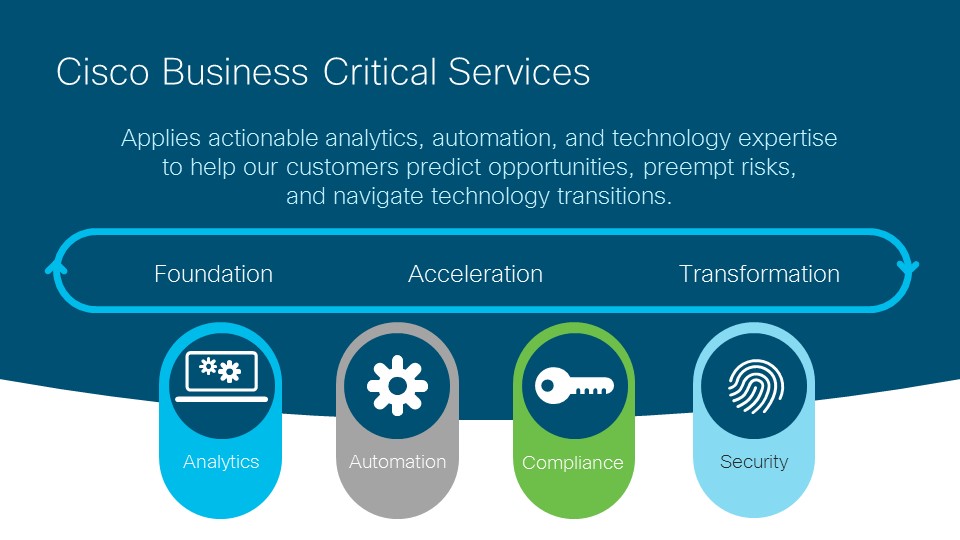
Our new portfolio of subscription services, Cisco Business Critical Services, goes beyond traditional optimization services to deliver new analytics, automation, compliance, and security capabilities. These new services will help organizations reduce complexity and risk, protect their businesses with built-in security, and make more informed decisions through infrastructure analytics. They’ll also help generate revenue. On average, Cisco’s optimization customers have generated an additional $54 million per year by cutting downtime.

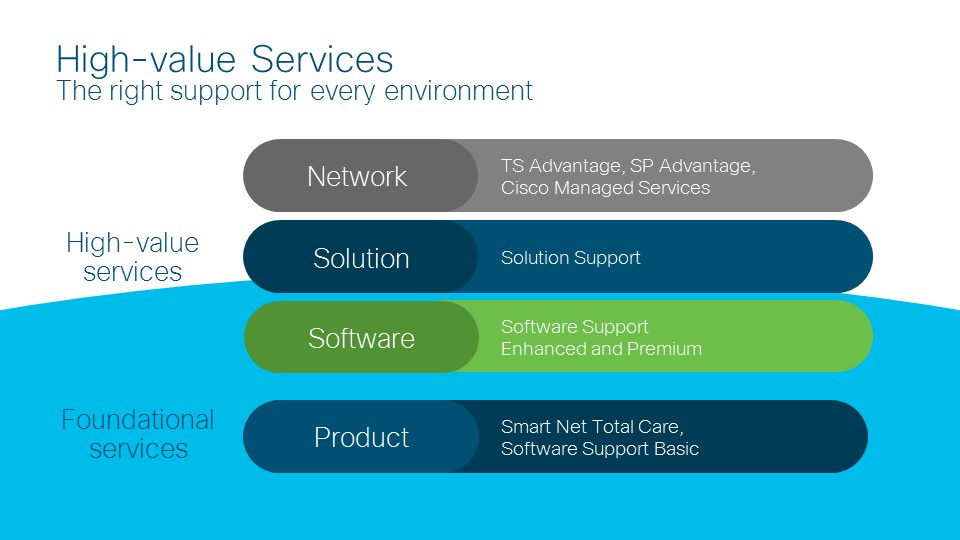
We’ve also rolled out Cisco High-value Services a new portfolio taking technical services beyond basic hardware support to deliver proactive and prescriptive service options for software, solutions, network, and the entire infrastructure. This next generation of technical services steps up to the new demands of IT to deliver to customers the most value from their Cisco investments.

We’ve digitized our intellectual capital and created automated systems that can scan and detect potential problems in customer networks.

We’ve digitized our intellectual capital and created automated systems that can scan and detect potential problems in customer networks. These scans detect at least one problem 86 percent of the time, and uncover a network-impacting problem nearly half the time. Recently, automated scanning across a large media company’s 29 sites uncovered a problem and kept the company from having to send trucks out to replace equipment at subscribers’ homes—a savings of $250,000.

I’m proud to lead the teams that have worked incessantly over many months to create this next generation of Cisco Services. As change accelerates, we’ll continue to deliver industry-leading services to our customers, and work with them to accelerate digital transformation.


Authors

Joe Cozzolino

Senior Vice President

Cisco Services