This is a quick wrap-up as we wish Brian, our fine Wireless Product Manager good luck this weekend as he plays in his hometown city golf tournament.
Brian about to his drive off the first hole at a course in Costa Mesa, CA. This was taken a few months ago during one of our Team Outings. As usual, he made the rest of us look bad.
We have been fortunate to have multiple calls over the last two weeks with our regional teams including Brazilian Marketing Team and the Sales Engineering Teams that cover all of North, Central and South America, as well as the Caribbean. Up next is the Brazilian Sales Team. We always enjoy these engagements as we get the opportunity to tell our story about our products, but more importantly, we get the opportunity to learn about what these teams face on a daily basis.
I just had the opportunity to see drafts of some of our new videos. These videos were created at the direction of Paul Yanzick, who is managing (not only this one) effort to bring about new product videos, how-to’s, and other types of videos. There are a multitude of uses for them, which makes them invaluable especially when you cannot simply touch every person you would like to. Believe me, I try…
Next week, some of the team travels to Taipei and Shanghai to meet with some of our partners and engineering team members.
Brad, Marty, Skip, Cady and James: safe travels.
Brian, hit’em straight – Good luck!
Marc and the rest of the Cisco Small Business Team
Digital technology is changing teaching and learning, and affecting the way entire campuses operate. As a Cisco Education Advisor, I meet with education institutions that are exploring and embracing innovation that is fueled, in part, by digitization and supported by a shift in culture in today’s college and university environments.
The education institutions I work with are thinking about how technologies can have an impact on the learning environment. I would have you consider that educators and students are being “trained” by consumer applications that enable engagement in collaborative technologies through multiple social media channels, across a wide range of personal devices. Because these collaborative tools are changing the way educators and students interact in their personal lives, they’re influencing a user’s habits; significantly, they’re relied upon much more frequently than any enterprise-level application.
In addition to changing the way educators and students teach, learn, and engage, the ubiquitous nature of collaboration tools in our personal lives is influencing the design of new learning spaces, particularly as we build new buildings or renovate existing spaces. What does today’s classroom look like given the potential of learning models such as blended, flipped, or hybrid? Are classrooms becoming “smarter,” where teachers are able to use technology to reach students beyond the classroom walls before, during, and after class?
For educators, new teaching models and access to data from applications allow insights and an exciting opportunity for their own innovation in teaching and research. Education institutions now have the ability to use technology efficiently to help educators meet students where they are and provide data analysis that moves educators to act. In the case of an absent student, an educator might have some information—insight from the LMS that an assignment is missing, for example—but lack the complete analysis, which shows that the student hasn’t been on campus for days or weeks, and points to a much greater issue that can impact institutional funding. With the complete analysis, this data point can trigger a notification to faculty or a student advisor/mentor to begin a dialogue with the student: “Is the subject matter a challenge, or has there been an illness or emergency? What can be done to help?” Colleges and universities need to maintain and increase student enrollment, but it is just as important to retain students and see them through to program completion or graduation.
Of course, a campus is more than just classrooms. A culture of innovation can touch everything from security to parking. For instance, new security technologies are helping protect both people and information, and smart transportation solutions make it easier and more efficient for everyone to move across campus. Lack of Wi-Fi usage in a classroom can initiate steps to turn down heating and cooling systems or turn off lighting in the space, which, if done consistently, can lower operational costs. As more and more devices and applications ride on the network, we must not only manage the data that is generated but also analyze the data to improve efficiency.
Education is never stagnant, and with technology, change and innovation is swifter than ever before. New technologies like augmented and virtual reality are an exciting example. We’re seeing great promise with AR/VR simulations where programs use the technologies to train—and in some cases, re-train—the workforce of tomorrow. How will these tools along with collaborative technologies and data-driven applications change the culture of higher education? What will learning spaces look like, and what will the role of educators be as these platforms and tools are developed and implemented? As we research and answer these questions, I expect we’ll discover that the impact of technologies in education is greater and more far-reaching than anything we have seen thus far.
Meet us at EDUCAUSE to share your thoughts on the reality and promise of technology in education!
Ransomware has been all over the news since 2015. You’d think we would all know how to deal with it and the fad would be dying by now. Well, that’s what I would think. It turns out that ransomware generates a lot of cash for criminals, an estimated $1 billion in 2016. It also has a low cost structure (so, very profitable) and the victim directly sends the perpetrator money.
What is ransomware?
In short, ransomware is malware that prevents you from accessing data on your PC. This either by encrypting as much of your personal data on your PC as it can find or by locking your screen. Then it issues a demand for ransom to you – give the bad guys money and they will let you access your data. Most commonly, ransomware infects your PC when you click a link in an infected e-mail. For more details, let’s go to the experts. The Cisco 2016 Midyear Cybersecurity Report and a detailed study from Talos give a good analysis of ransomware and trends and directions we can expect from crimeware operators pushing ransomware. For a nice infographic summary of the problem, check here. Cyber security specialists should read it, although I suggest everyone have a look at the executive summary at the least.
A Ponemon survey of companies who were affected by malware includes cautionary facts for those who might be thinking they will just pay the ransom and go on. Most of the companies who paid, paid over $1,000 per PC to recover their data. But only 55% of the companies that paid the ransom received the decryption keys to get their data back. The cheapest ways out of a ransomware attack are: try hard to avoid the social engineering tricks (don’t let it happen) and keep backups of data you value. Please don’t pay the ransom.
How does it spread?
Speaking broadly, the most common method of spreading ransomware is by social engineering. Social engineering works by tricking you into infecting your own computer by falling for a trick the malware author tries to play on. This is usually by e-mail, but it could be a malicious ad on a web page or a malicious web page. The trick is usually some enticement to click on an attachment or a link to a document, picture or video. Microsoft Office files, PDFs and multimedia files can all be the carriers for the ransomware program. Once you click, the ransomware finds your files on the computer and encrypts them. Then it demands a ransom if you want them back.
For more details, start with a nice, concise video looking at the anatomy of a ransomware attack. Talos will carry on from there with a detailed study of ransomware, how it spreads and provides links for what you can do about it. This discussion is best suited to an audience with some technical skills – admins, software engineers and other IT folk.
How do I know I have been infected?
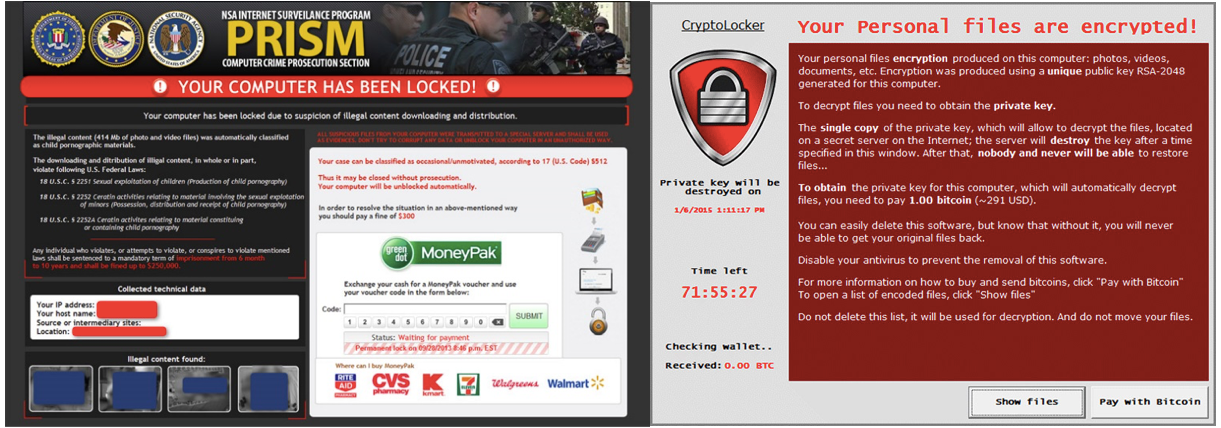
That’s easy, your screen will be taken over by something that looks like these screen images captured by Hyphenet.
When you look through the images on the Hyphenet page or do a Google images search on ransomware screenshots, you will see a lot that claim to represent action taken by a government agency. This is social engineering in an effort to create fear of government reprisal for failure to cooperate.
Best practices to NOT get infected by ransomware
Here are a couple of a great resources for businesses – This one if you are just starting a project to defend against ransomware and a useful 10 point checklist of defensive actions that will help.
What about for those of us at home? Some of the best advice for us as private individuals is as follows:
Don’t click links or open attachments in an e-mail, unless you know who sent it. Even then, consider contacting the person to see if they really did send it.
Be suspicious of directives to “click this patch” for Adobe, Flash and some other common tools – there is a high chance this is malware. If you want an Adobe patch, go to the adobe site and get it yourself.
Be alert for news that there are new methods of infection. For example, malvertising may become a popular method of infection.
What can I do if I am affected?
Sometimes, no matter what you do, stuff happens and now you are wondering what a bitcoin is and how are you going to buy one so you can pay off the ransomware and have your files back.
If you really are at this point, you have three choices:
Pay the ransom. Hey, there’s a 45% chance you’ll actually get your data back! Just kidding, please, do not fund criminals by giving them your money. All of us loose when any of us do that.
Lose your data. Hey, there’s a 55% chance you won’t get it back even if you pay!
Remember I said above that even if you pay the ransom and get your system back, it may now be full of badness that will make your life miserable. The only way to avoid that is to wipe it out with a full reset to a factory image. Really, you have to do this, whether you pay the ransom or not. If you pay the ransom and get your files back, copy them to a USB drive before you reset Windows. One more piece of bad news – it is possible that your data is now contaminated with malware also. This is another reason not to pay. If you pay and actually get your files back, you could find yourself immediately held for ransom again because copies of the ransomware were left like landmines in your data. It is much better to make a backup before you get infected.
Let’s talk about backups. Maybe your employer backs up your data. Mine does. Even so, I have rolling backups of my data on USB drives that are only used for backups. I also have backups of personal data kept on my home PCs. USB drives can be bought for less than $100 from most retail outlets that offer laptops or desktops. My backup drives live in a drawer. I pull one out once a week, attach it, copy all my personal data onto that drive, then put it away. Each drive has at least three full backups.
If ransomware strikes and you have a backup, restore your system, restore your data from a backup and move on. And next time, remember not to click the link in that e-mail!
For more information on ransomware and how best to stay protected, visit cisco.com/go/ransomware.
October is Cyber Security Awareness Month, and Cisco is a Champion Sponsor of this annual campaign to help people recognize the importance of cybersecurity. For the latest resources and events, visit cisco.com/go/cybersecuritymonth.
October is National Cyber Security Awareness Month in the U.S., and the Cyber Security Month In Europe. Cisco is proud to be a Champion Sponsor. Throughout the month, the cyber security community comes together to highlight the simple steps that can be taken to stay safe online, and why cyber security matters to everyone. I thought this would be the perfect opportunity to connect with you.
Technology has evolved to be part of our everyday lives. The ability to stay connected to everyone and everything is our reality more than ever. We estimate that there will be approximately 50 billion connected things by 2020. But what are the security implications? Concerns around ransomware, protecting IoT devices, and talent shortage are top of mind for our customers.
That’s where you come in, armed with the Cisco Security Architecture.
As a Cisco partner, you can provide our customers the solutions and services they need to be successful in this new digital environment. Vendor sprawl leads to security blind spots, inefficacies, and wasted personnel time. According to the 2017 ESG Research Report, The Shifting Cybersecurity Landscape, 62% of organizations surveyed said they are actively looking to reduce the number of security vendors. With the Cisco Security architecture you can offer a portfolio of best in breed products that work better together and lead with threat intelligence powered by our Cisco Talos team; providing your customers with a more effective security postiure and solutions that can scale with their growing needs
Companies also need solutions that are simple to manage, can integrate with other products to leverage existing investments, and provide automation to reduce time to detection. In the end, this saves your customers precious time and money. Our portfolio-based approach is simple, open and automated; and delivers unmatched threat prevention, detection, and remediation. It also saves precious time and money in that the Cisco Security Architectural approach has been shown to reduce TCO by 30%.
There is a massive opportunity for you in building out a security practice and being that trusted advisor for your customers. You can offer your services and augment with Cisco Services to address the ongoing needs of our customers from threat analytics to incident response. Cisco can help you own the opportunity with your customers. Check out our latest training offerings, services, and profitability/ incentive information by visiting our Selling Security site.
Stay Engaged
As we head into the next chapter of this digital age, we need to be cognizant of our customers’ top concerns. With National Cyber Security Awareness Month in mind, it is a great time to connect with your customers and have an honest conversation about the challenges and opportunities they face, and how we can help them move forward with confidence and success. Stay engaged with us throughout the month by visiting our National Cyber Security Awareness Month Hub.
If you are attending Cisco’s 2017 Partner Summit physically in Dallas or plan on registering to tune in virtually, don’t miss our Security Impact Session, to get the latest update on Cisco Security and hear what we are doing to drive your growth, your profitability, and customer success.
The new age of innovation is providing a level of convenience and technological advancements that were once unfathomable. But with every breakthrough comes challenges, and more precisely these days, security challenges. We, in the security industry, are constantly faced with new threats emerging from vectors that didn’t even exist yesterday.
Enterprise Security vs. Consumer Convenience
The consumerization of IT has made it impossible to ignore the demand for convenience in the products consumers use. The lines between work and play are blurring, which is changing not only business risk profiles but also the way employees want to work.
In a recent study, for example, Cisco Cloudlock saw close to 50 percent of customers/professionals who had the popular Pokémon GO gaming app, connect the app to their professional identity, automatically giving it access to all their corporate data.
While businesses are constantly thinking of security (“are my assets protected? Am I doing what’s needed to ensure the integrity of my data and our corporate resiliency?”), consumers don’t fully grasp the impact that the lack of security could have on them. This lack of consumer cyber awareness is a result of the security complexity we face today. This complexity is a struggle even for businesses and entire security and IT departments. For an average user, the challenge is magnified tenfold.
As employees gravitate toward consumer-oriented and architected apps, businesses will need advanced technologies, such as Artificial Intelligence (AI), to help build smarter security systems that can differentiate between business and personal context, as well to help pinpoint malicious activities.
The future is all at once exciting and scary. Cisco is seeking ways to help our customers deal with the challenges in a manner that allows them to capitalize on new opportunities without risking everything they have already built. Key to this will be new technologies, like Machine Learning and AI that not only promise to make protection faster, but smarter – a necessary and critical security trait, given the industry’s widening talent shortage, which continually exacerbates enterprise challenges.
Marching to the AI Drum Beat
This week I joined my peers across the security industry at Nasdaq MarketSite in New York to attend the National Cyber Security Alliance’s flagship Cybersecurity Summit. There, we discussed how breakthrough technologies will enable the new day of secure innovation and change the way consumers interact and businesses operate. As an industry, it’s our shared responsibility to prepare for tomorrow’s threats and identify how technologies such as AI and Machine Learning can better our online security, safety and privacy strategies.
There are many things that AI and Machine Learning can help us do, such as become more efficient and simplify cybersecurity by automating it through intelligence to speed resolution when minutes or seconds count. But jumping straight into AI will be getting ahead of ourselves. The first step is to simplify our approach to security. At Cisco, we’ve been building a simple, open and automated security architecture for our customers that can adapt and rapidly respond to the demands of digital transformation, consumerization of IT and the evolving business landscape.
We see the cloud as a central component to simplifying security, which is precisely what Cisco Umbrella’s objective is. Cloud can help close the security effectiveness gap by breaking down silos and offering smarter automation. Cloud is a critical component to the AI and Machine Learning arenas – providing a data repository and the compute power to make security intelligent and self-sufficient, so that in the future solutions can detect and respond to risks without requiring users’ decision-making.
Enabling a Better User Experience
A seamless, integrated, and automated security platform that is supported by Artificial Intelligence and Machine Learning can have a huge impact on the way we protect consumers — by enabling their “cyber conscience.” It doesn’t require a user to manually activate security layers, and it breaks down and transcends silos. It also leverages and contextualizes the user’s current activity, to activate all the necessary security components that will ensure the user has a smooth ride online. These technologies can help us consolidate and learn from users’ activities. They also can increase productivity by promoting certain applications that foster a more engaging and productive user experience, with security embedded throughout the entire cycle.
As our industry faces a talent crisis, automation, Machine Learning and AI will be critical in ensuring protection, but it also cannot be the only focus. Besides, these technologies still require the human element to ensure they are operating appropriately, enacting operations that make sense and improving processes and communication. AI and Machine Learning are only as good as how we set them up to work. That’s why Cisco provides ongoing learning opportunities for employees to keep up with the demands of the industry and launched the Cisco $10M Global Cybersecurity Scholarship Program. Already in its second year, Cisco’s scholarship program offers free training, mentoring, and testing designed to help individuals earn CCNA Cyber Ops certification and hone the skills needed for the job role of security operations center analyst.
The bottom line is that there is no silver bullet. We are facing a new frontier of innovation and can only seize the opportunity if security capabilities are built to support new ventures. We need more trained professionals, as well as smarter tools that make cybersecurity more effective – for both businesses and their consumers. AI and Machine Learning currently promise our best chance of outpacing adversaries, but only if these solutions are backed by integrated architectures that leverage the new compute capabilities of the cloud. It will be fascinating to see where they take us. We’ve only just scratched the surface.
October is Cyber Security Awareness Month, and Cisco is a Champion Sponsor of this annual campaign to help people recognize the importance of cybersecurity. For the latest resources and events, visit cisco.com/go/cybersecuritymonth.
In the previous post we described the benefit of using Application Automation in conjunction with Network Analytics in the Data Centre, a Public Cloud or both. We described two solutions from Cisco that offer great value individually, and we also explained how they can multiply their power when used together in an integrated way.
This post describes a lab activity that we implemented to demonstrate the integration of Cisco Tetration (network analytics) with Cisco CloudCenter (application deployment and cloud brokerage), creating a solution that combines deep insight into the application architecture and into the network flows.
The Application Profile managed by CloudCenter is the blueprint that defines the automated deployment of a software application in the cloud (public and private). We add information in the Application Profile to automate the configuration of the Tetration Analytics components during the deployment of the application.
Deploy a new (or update an existing) Application Profile with Tetration support enabled
Intent of the lab:
To modify an existing Application Profile or model a new one so that Tetration is automatically configured to collect telemetry, leveraging also the automated installation of sensors.
Execution:
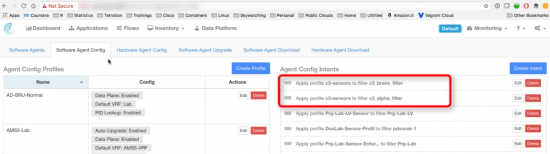
A Tetration Injector service is added to the application tiers to create a scope, define dedicated sensor profiles and intents, and automatically generate an application workspace to render the Application Dependency Mapping for each deployed application.
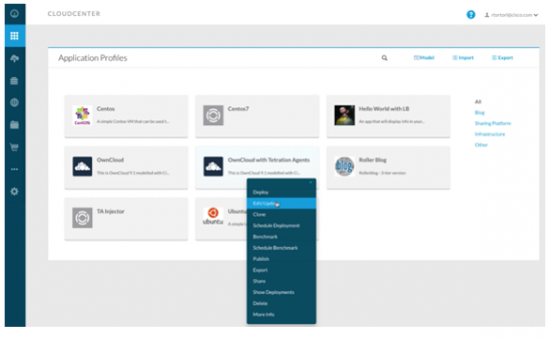
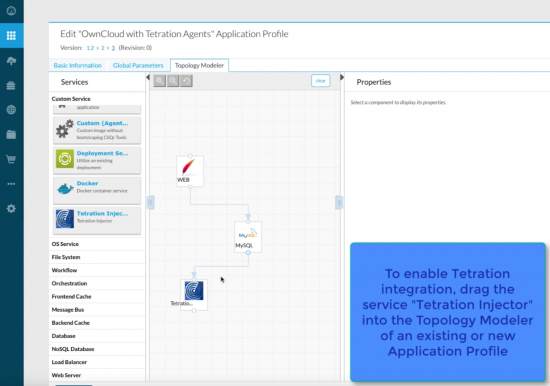
Step 1 – Edit an existing Application Profile
Step 2 – Drag the Tetration Injector service into the Topology Modeler
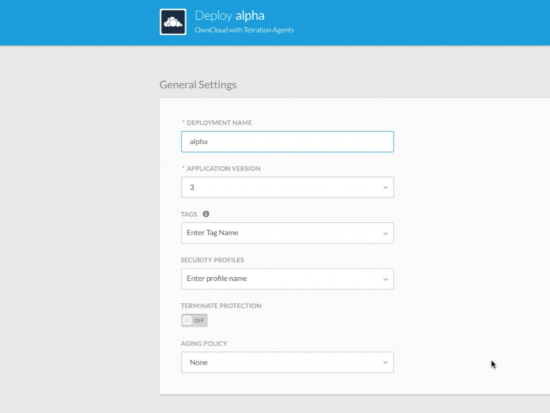
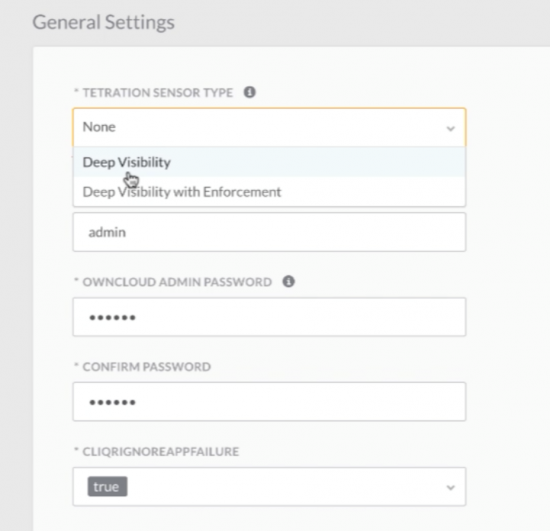
Step 3 – Automate the deployment of the app: select a Tetration sensor type to be added
Tetration sensors can be of two types: Deep Visibility and Deep Visibility with Policy Enforcement. The Tetration Injector service allows you to select the type you want to deploy for this application. The deployment name will be reflected in the Tetration scope and application name.
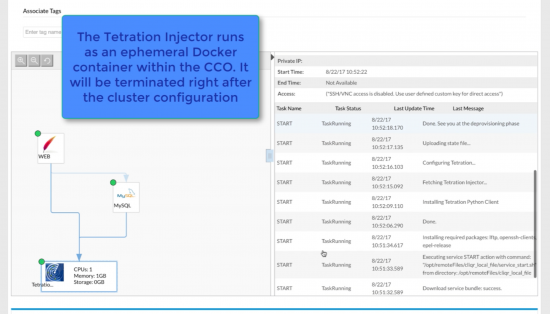
In addition to deploying the sensors, the Tetration injector configures the target Tetration cluster and logs all configuration actions leveraging the CloudCenter centralized logging capabilities.
The activity is executed by the CCO (CloudCenter Orchestrator):
Step 4 – New resources created on the Tetration cluster
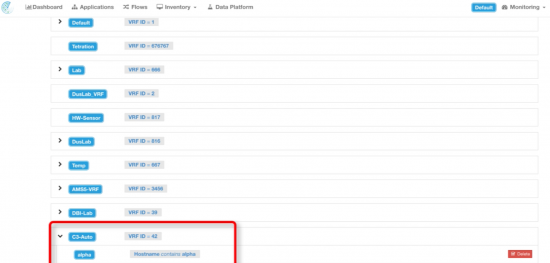
After the user has deployed the application from the CloudCenter self-service catalog, you can go to the Tetration user interface and verify that everything has been created to identify the packet flow that will come from the new application:
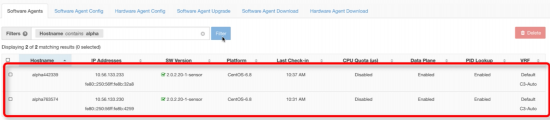
In addition, the software sensors (also called Agents) are recognized by the Tetration cluster:
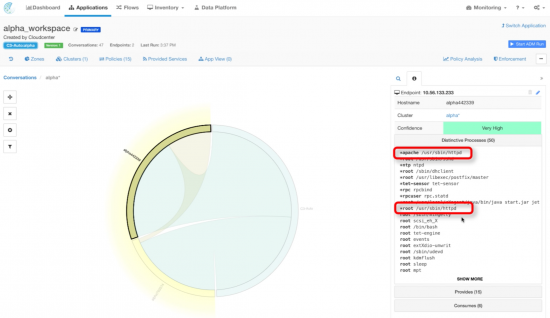
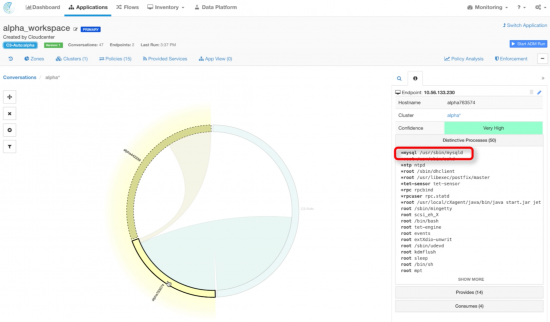
An application workspace has been created automatically for the deployed application, through the Tetration API: it shows the communication among all the endpoints and the processes in the operating system that generate and receive the network flows.
The following interactive maps are generated as soon as the network packets, captured by the sensors when the application is used, are processed in the Tetration cluster.
The Cisco Tetration Analytics machine learning algorithms grouped the applications based on distinctive processes and flows.
The figure below shows how the distinctive process view looks like for the web tier:
The distinctive process view for the database tier:
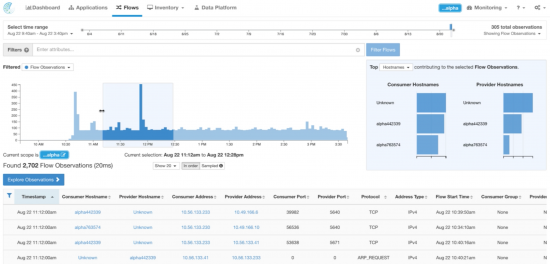
Flow search on the deployed application:
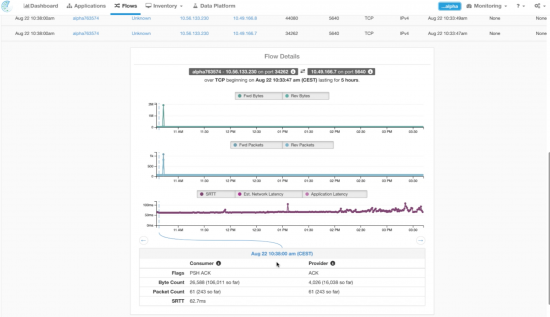
Detail of a specific flow from the Web tier to the DB tier:
Terminate the application: De-provisioning
When you de-provision the software application as part of the lifecycle managed by CloudCenter (with one click), the following cleanup actions will be managed by the orchestrator automatically:
Turn off and delete VMs in the cloud, including the software sensors
Delete the application information in Tetration
Clear all configuration items and scopes
Conclusion
The combined use of automation (deploying both the applications and the sensors and configuring the context in the analytics platform) as well as the telemetry data that are processed by Tetration help in building a security model based on zero-trust policies.
The following use cases enable a powerful solution thanks to the integrated deployment:
Get communication visibility across different application components
Implement consistent network segmentation
Migrate applications across data center infrastructure
Unify systems after mergers and acquisitions
Move applications to cloud-based services
Automation limits the manual tasks of configuring, collecting data, analyzing and investigating. It makes security more pervasive, predictive and even improves your reaction capability if a problem is detected.
Both platforms are constantly evolving and the RESTful API approach enables extreme customization in order to accommodate your business needs and implement features as they get released.
The upcoming Cisco Tetration Analytics release – 2.1.1 – will bring new data ingestion modes like ERSPAN, Netflow and neighborhood graphs to validate and assure policy intent on software sensors.
You can learn more from the sources linked in this post, but feel free to add your comments here or contact us to get a direct support if you want to evaluate how this solution applies to your business and technical requirements.
Credits
This post is co-authored with a colleague of mine, Riccardo Tortorici.
He is the real geek and he created the excellent lab for the integration that we describe here, I just took notes from his work.
The greater Houston area, our employees, and everyone affected by Hurricane Harvey remain a focus for Rockwell Automation and for Cisco. Our primary goal is to support our employees, our customers, and to get customer facilities back up and operational as quickly as possible.
In this spirit, Automation Fair, PSUG and other related events will continue as planned in Houston the week of November 13th. We want this event to be one of the many signs to the community and the region that Houston will have a robust recovery and we will be there to help!
Automation Fair is the premier North American event for discrete and process manufacturers. Visit over 150 exhibitors and learn from more than 110 industry forums, hands-on labs, technical sessions (also free), and earn Professional Development Hours. It’s also a great opportunity to network with industry experts and peers. As always, this event is a can’t-miss conference for all of you who are in plant management, controls, operations, or IT for industrial companies. The best part, it’s free!
Reflective of our robust relationship with Rockwell Automation, Cisco will again have a strong presence (Booth #1133) at this event including multiple speaker presentations.
Visit our booth to learn why Cisco is your critical network infrastructure partner, from the enterprise all the way to the plant floor with our partner solutions from Rockwell Automation. Don’t trust your industrial Ethernet automation network to anyone but the best. On the factory floor, the Rockwell Stratix line of managed switches give you the validated, scalable, and secure network designs to ensure industrial automation and control systems perform as required. Here is a summary of the solutions we will be highlighting in the Cisco booth:
Converged Plantwide Ethernet: A strong core network enables solutions like Factory Wireless and Cisco Collaboration for Industry. You will also see how Edge compute allows you to perform unique functions, like protocol translation directly on your Cisco Industrial Routers and Industrial Ethernet switches with IoX capability. We will also be showing the new FactoryTalk Network Manager to help troubleshoot and manage your plant floor network.
Factory Security: Manufacturing is the number one targeted Industry for cyberattacks and security breaches. Learn how IoT Threat Defense can protect from the enterprise to the shop floor can lower your costs, improve safety & reduce downtime.
Cisco Collaboration for Industry: Learn how remote expert solutions allow you to oversee more plants, in more places, with a smaller team of experts. See how Virtual Expertise On-Demand with Telepresence, Spark, Webex, and other Cisco and partner solutions can lower costs while improving efficiency and uptime.
Oil and Gas: See how unique solutions from Cisco can help get more value from your existing assets, and how Cisco Kinetic extracts, computes, and moves data to solve Industrial IoT challenges.
We’ve got a couple of new solutions for you to see, too. Come visit us and see our new 807 Industrial Integrated Services Router. This small footprint cellular router has powerful capabilities and a very low power draw, allowing you to put 3G/4G LTE where it’s needed. It’s perfect for field device enablement in RTU’s, for example.
Also at our booth, we’ll be demonstrating some new features for our popular 829 Industrial Integrated Services Router. We’ve expanded the cellular capability of this unit to include dual SIM “active-active” radios. What does this mean? It means you can enable the router to connect to two separate cellular carrier services. Why is this important? As we all know, cellular carriers can change hill to hill as you drive. Service vehicles can span widely disparate geographies, with random coverage offerings from cellular networks. With dual SIM “active-active” radios, an instrumented vehicle can traverse two different carrier coverage areas and still maintain connectivity. It’s all about reliability and efficiency, and Cisco offers that and so much more.
Follow us on Twitter at @CiscoMFG to see the live activity at the show even if you’re unable to make it to Houston. If you haven’t registered yet, you can do so here.
Other show highlights include:
Free technical sessions, including the following by Cisco:
T34 – Digital Manufacturing Solutions in Practice
T83 – Identity and Mobility in Converged Plantwide Ethernet (CPwE) Architectures
T21 – Deliver the Plant of the Future Today
Rockwell’s Connected Enterprise Industries Pavilion, Booth #1221 demonstrates a highly connected, knowledge-enabled industrial enterprise where devices and processes are optimized to enhance productivity, safety and security, sustainability, and economic performance. Visit the booth to see how the Cisco/Rockwell partnership makes this possible.
You can also see Cisco products featured in Rockwell’s premier show area, the Integrated Architecture Booth #2113, on the Networks Wall display.
Talos is disclosing a single off-by-one read/write vulnerability found in the TIFF image decoder functionality of PDFium as used in Google Chrome up to and including version 60.0.3112.101. Google Chrome is the most widely used web browser today and a specially crafted PDF could trigger the vulnerability resulting in memory corruption, possible information leak, and potential code execution. This issue has been fixed in Google Chrome version 62.0.3202.62.
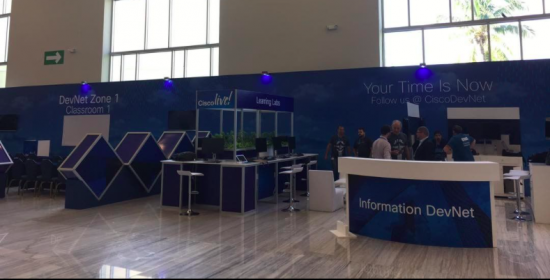
After months of effort and careful preparation, the DevNet team is ready for Cisco Live Latin America in Cancun! This year the event will take place between November 6 and 9. Cisco Live is a massive event with thousands of attendees. It’s the place where Cisco customers, partners, vendors and employees gather every year for a marathon of knowledge transfer, training sessions and fun activities. In only 4 days, hundreds of training sessions, technical seminars and activities will be unleashed on the event attendees. If you have not attended a Cisco Live event so far I would definitely recommend it as you will get the chance to learn, make connections and see what will be the next products and technologies from Cisco.
Waiting for you in the DevNet Zone
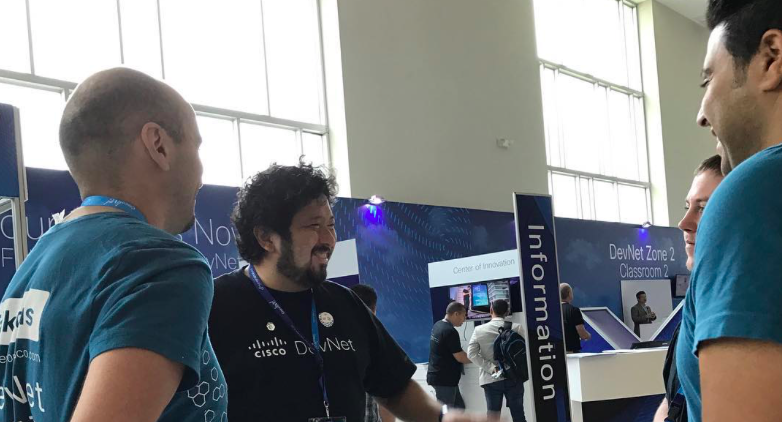
For the DevNet team this will be the third year in a row that we are taking part in Cisco Live Latin America. We are pleased and honored to have been invited again to bring the DevNet Zone to the Cisco Live attendees in Cancun. If you are not familiar with DevNet I suggest you register for a free account at developer.cisco.com and have a look around.
Between the learning labs, the sandbox resources, the free sample code and libraries on github.com, the multiple communities of interest, the support forums and DevNet Creations where you can get inspired by what other community members have built so far, I’m convinced you can find something that appeals to you. If you just want to see what’s new from Cisco, or you want to improve your skills or you need to solve a pressing problem at work, developer.cisco.com is the place to start. Or if you prefer you can join us in the DevNet Zone in Cancun and get a sample of all these and more. We will bring our learning labs, classroom sessions, hands-on workshops, demo booths and the amazing DevNet team that will be on-site to welcome everybody and answer any questions you might have.
New Resources
For our Cisco Live veterans and attendees that are familiar with the DevNet Zone don’t worry we have surprises for you, too. A new set of learning labs around networking and network programmability, coding, collaboration, data center and wireless technologies will be available for you. You can get a start on this right now and access the learning labs at learninglabs.cisco.com and bring your questions and suggestions when you meet us at the event.
We will also have for you 30 classroom and workshop sessions covering everything from introduction to coding and REST APIs to building your first Cisco Spark bot to network programmability with NETCONF/RESTCONF/YANG and running Python code on IOS-XE devices. The great thing about our workshops is that they are hands-on. We offer Apple Macbook laptops with development environments already setup and an instructor walks the attendees through a scenario to accomplish a task by the end of the workshop. The main goal of the workshops is to introduce the attendees to a specific use case of the technology and have them directly interacting with it. This combines nicely with the classroom sessions which are more on the theoretical side. The workshop seating is limited so if you haven’t done it yet, please sign up for the ones you want to attend at the following link: www.ciscolive.com/latam/learn/sessions/session-catalog
If you are not familiar with the DevNet Sandbox, if you have any questions about it or you want to see a demo session we will have a booth for it. Having just recently won the prestigious Cisco Pioneer award, the Sandbox gives DevNet users free access to testing and development environments. If you want to interact hands-on with the brand new Cisco Catalyst 9k switches, or with Cisco ACI, APIC-EM, UC Manager 11.5 and many more environments for free, the DevNet sandbox is there for you. You can access it at the following link: developer.cisco.com/site/devnet/sandbox/ or come by the demo booth in the DevNet Zone.
Continuing Education
If you want to make the most of the Cisco Live event I suggest preparation before you even get to the venue in Cancun. Based on your interests I would start looking at what Cisco Live, and specifically the DevNet Zone, has to offer. If you are interested in SDN and emerging networking technologies I would definitely sign up for the workshops around NETCONF/RESTCONF/YANG and the classroom sessions around APIC-EM and running Python applications on IOS-XE. If you are new to programming and want to know what an API and REST is, how to build your first Python application then you should attend the introduction to git workshop and the coding 101, 102 and 103 classroom sessions. If you are interested in data center technologies I suggest you sign up for the UCS Python SDK workshops and the classroom sessions around UCS PowerTools, Cisco ACI and Kubernetes on UCS. There will also be presentations around Meraki, cloud technologies, Cisco Spark and bots.
If you cannot attend in person there will be a live stream of the event on www.ciscolive.com as usual. But if you will be joining us in person in Cancun, don’t be shy and stop by the DevNet Zone. We do speak Spanish, too!
We’d love to hear what you think. Ask a question or leave a comment below.
And stay connected with Cisco DevNet on social!














 The greater Houston area, our employees, and everyone affected by Hurricane Harvey remain a focus for Rockwell Automation and for Cisco. Our primary goal is to support our employees, our customers, and to get customer facilities back up and operational as quickly as possible.