Office workers of the mid-20th century would not recognize how we work today. They banged out documents in triplicate using manual typewriters and carbon paper. They had to wait for a live operator to connect their phone calls manually. Their hours were fixed and non-negotiable. How could they have imagined word processors, printers, and powerful hand-held computers delivering live video as a part of their daily lives?
Where we work has evolved in some unexpected directions as well, reflecting the transformation of who we are in the workplace. It began with factory workers moving off the factory floor to the “knowledge floor,” as knowledge work and services grew out of the first industrial age. We designed cubicle farms, with office workers lined up almost like production lines. Then, as collaboration became more important, we moved to open office environments with the aim of becoming better communicators. And now, we are entering the era of the borderless office, a flexible work space not constrained by geography or organizational structure. Virtual teams work together seamlessly all over the world, brought together by video and conferencing technology that is so ubiquitous we don’t even think about it. We have become a more diverse and inclusive workforce, and our workplace is reflects that, enabling greater collaboration and creativity. My own team stretches from the Bay Area to Dubai to Singapore, working together across the globe without a hitch.
As we continue to imagine the future, we see a blending of face-to-face and remote work, flowing together seamlessly. We see technology releasing the physical limitations of disabled workers, opening up a vast pool of talent and providing new opportunities for workers and employers alike. We see communications becoming more immersive and more mobile. And we see a fluid blending of human and artificial capabilities that enables the best of both, elevating every worker into a knowledge worker. Indeed, our workplace both reflects who we are, and enables who we will become.
What’s the next stage in workplace evolution?
This is just one of the questions we will be considering in our next Living Lab on the Future of Work. Share your thoughts on Twitter or in the comments below if you’d like to find out how you might join a cohort of elite companies for two days of rapid innovation to co-create the Future of Work.
Meanwhile, let’s follow our future worker Gail as she continues to struggle with a personal crisis of conscience…
74% of IT executives expect IT services to predict potential IT issues and take action to avoid them. Our two new Cisco Services portfolios, Business Critical Services and High-value Services usher a new era of predictive services:
At a US bank, we used ML to predict an outage 32 hours before it would have occurred.
At a service provider, we automated 99.9% of software changes – raising CSAT and lowering outages.
Cisco has been investing for 30 years to make this new era of services a reality. In the last 2-3 years, we doubled down on analytics and ML. The journey has not been easy and there is still a lot more to do. We have learned a ton in the process. As I reflect on our journey, three lessons stand out.
I love movies. So you will find the lessons expressed in Hollywood metaphors.
#1. The Iron Man Lesson
Be explicit about where you want to be on Man-Machine continuum.
Some believe machines will replace humans, and others believe machines will merely supplement humans. After thoughtful debate, we’ve concluded that for our services business it’s not a binary choice, but rather a conscious decision on where we want to be on the Man-Machine continuum. Our people, who are expert advisors, simplifiers, implementers and optimizers, are trusted partners of our customers. We believe that the human connection and human judgement will always remain essential.
Consider “Iron Man” – a 2008 American superhero film based on the Marvel Comics character. The story is about Tony Stark, an engineer who builds a powered exoskeleton. While Tony Stark and the exoskeleton are both great, the combination of the two makes Iron Man the awesome super-hero my six-year old son loves!
So, we took a lesson from Iron Man. In the example of the bank, ML generates the good/bad patterns, and a Cisco Services expert reviews them and makes edits. Cisco software recommends steps to auto-remediate problems, and our human experts vet them before making changes.
#2. The Moneyball Lesson
Take a data-backed approach to scouting and nurturing ML initiatives.
There is a lot of hype around ML. Instead of starting with real problems that need to be solved and then using ML as a tool, it sometimes feels like people use it as a hammer and then look for nails. So, how do you find solutions that use ML to deliver true differentiated value to customers?
I like to think of this problem through the lens of the movie “Moneyball” – a 2011 American film based on Michael Lewis’s 2003 nonfiction book. While most baseball scouts rely on qualitative metrics and hunches to select “stars,” in this movie Billy Beane (the general manager of the Oakland Athletics team) uses data to find and nurture overlooked talent, enabling him to assemble an unexpected winning team.
At Cisco Services, innovation happens at all levels, and some of our best innovation happens at the grassroots level. A small group of engineers started digitizing Cisco’s intellectual capital and created a solution that led to an exponential reduction in time to resolution of cases. They called the solution, “Big Data Broker (or BDB) BORG.”
Today, BDB BORG can process customer files against 17,000+ modules/scripts. In these scans, we detect at least one problem 86% of the time, and 46% of the time BORG detects a high-severity issue that should be resolved right away. BDB BORG, with its humble beginnings, won Cisco’s Pioneer Award – the highest accolade for innovation within Cisco.
#3 The Minority Report Lesson
Be relentless about building “the” data-analytics platform.
Cisco did not start its Predictive Services efforts greenfield. There were ongoing data/analytics efforts in various parts of our business, and we decided to pull our various data sets together into one platform.
This reminds me of “Minority Report” – a 2002 American science fiction film directed by Steven Spielberg, loosely based on the 1956 short story by Philip K. Dick. In the movie, “PreCrime,” a specialized police department, apprehends criminals before they commit their crimes, based on data provided by three psychics. While each of the psychics have powers, it is the combination of the three that leads to the best results.
Cisco realized that it must tap the combined power of its data sets. We have installed 50M+ networks over the last 20 years, and we conduct 6M+ customer support interactions every year. We have billions of pieces of digitized knowledge. With the help of our Distinguished Engineer community and a central analytics group, we put together a proposal for a single platform. At a service provider, this analytics platform powered by multiple data sources led to a 30% reduction in time-to-resolution.
I am proud to have been part of the many teams that have worked tirelessly over many months to bring this next generation of Cisco Services to life. We will continue to learn, lead and innovate, because we are committed to helping our customers accelerate their digital transformations.
In today’s world, things evolve daily. The cars we drive, the music we listen to, the way we shop, and the way we provide services to our customers.
As with most things, the driving force behind evolving industries and trends are manpower. Why are there new cars every year? Because someone thought of a better/safer way to get you from point A to point B. It’s the same with services. Our Cisco engineers thought of a better way to maximize the availability, performance and security of mission-critical networks.
Evolving services doesn’t happen by itself. It takes innovative thinking and great listening skills to ensure we do everything we can to create an effortless, efficient experience for our customers. With the right people, processes and technology, year after year, we continue to evolve Cisco Services to meet and exceed our customer’s and the industry’s needs.
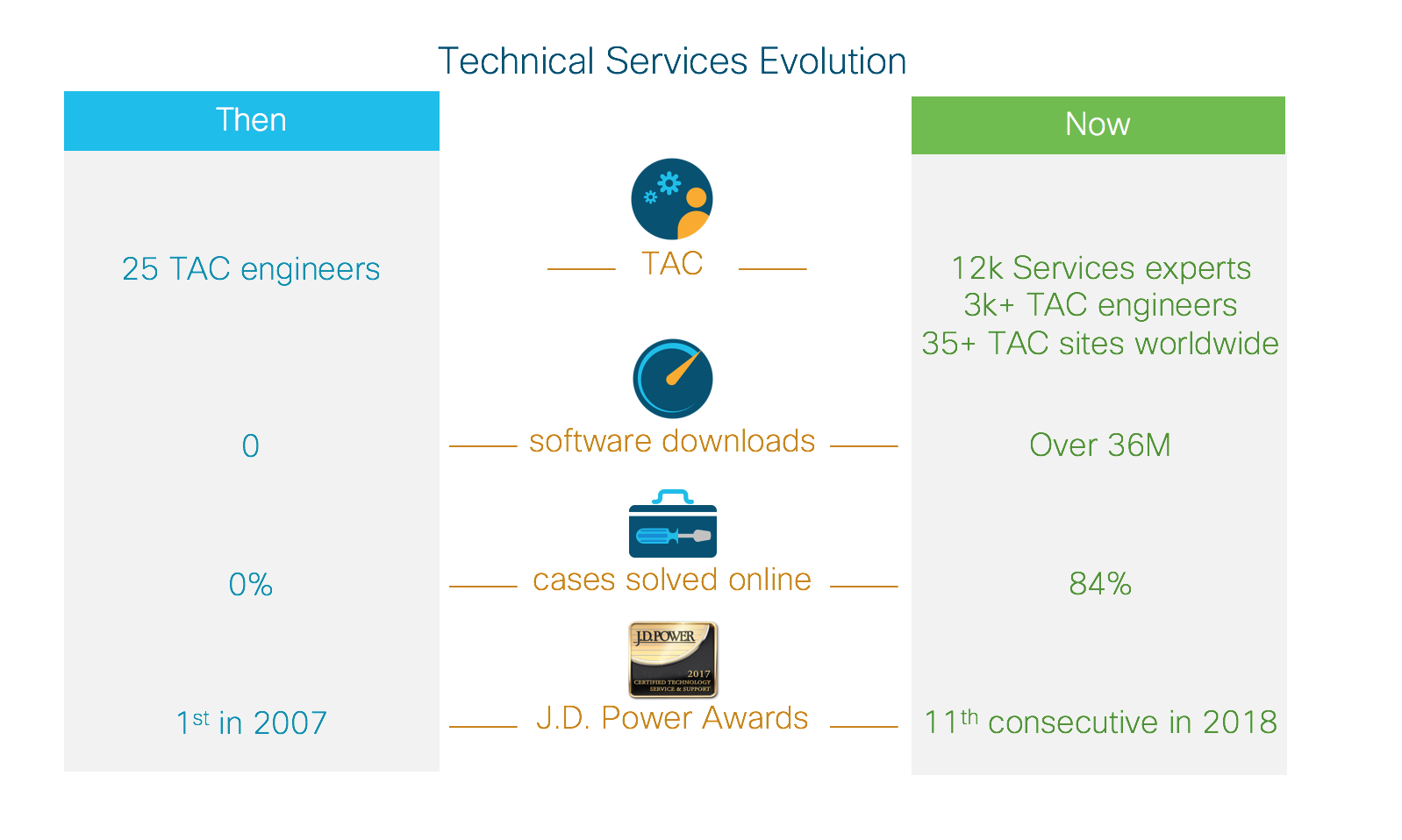
Let’s take a quick look at how our technical services has evolved since we launched it 25+ years ago.
Just as car manufacturers continue to improve their models every year, Cisco Services continues to innovate. In the old days, technical support meant shipping you a new “box” of equipment when your old one broke. Traditional product support is no longer enough. Today, it’s about supporting complete, multi-vendor solutions and achieving desired customer outcomes.
The Next Evolution of Technical Services
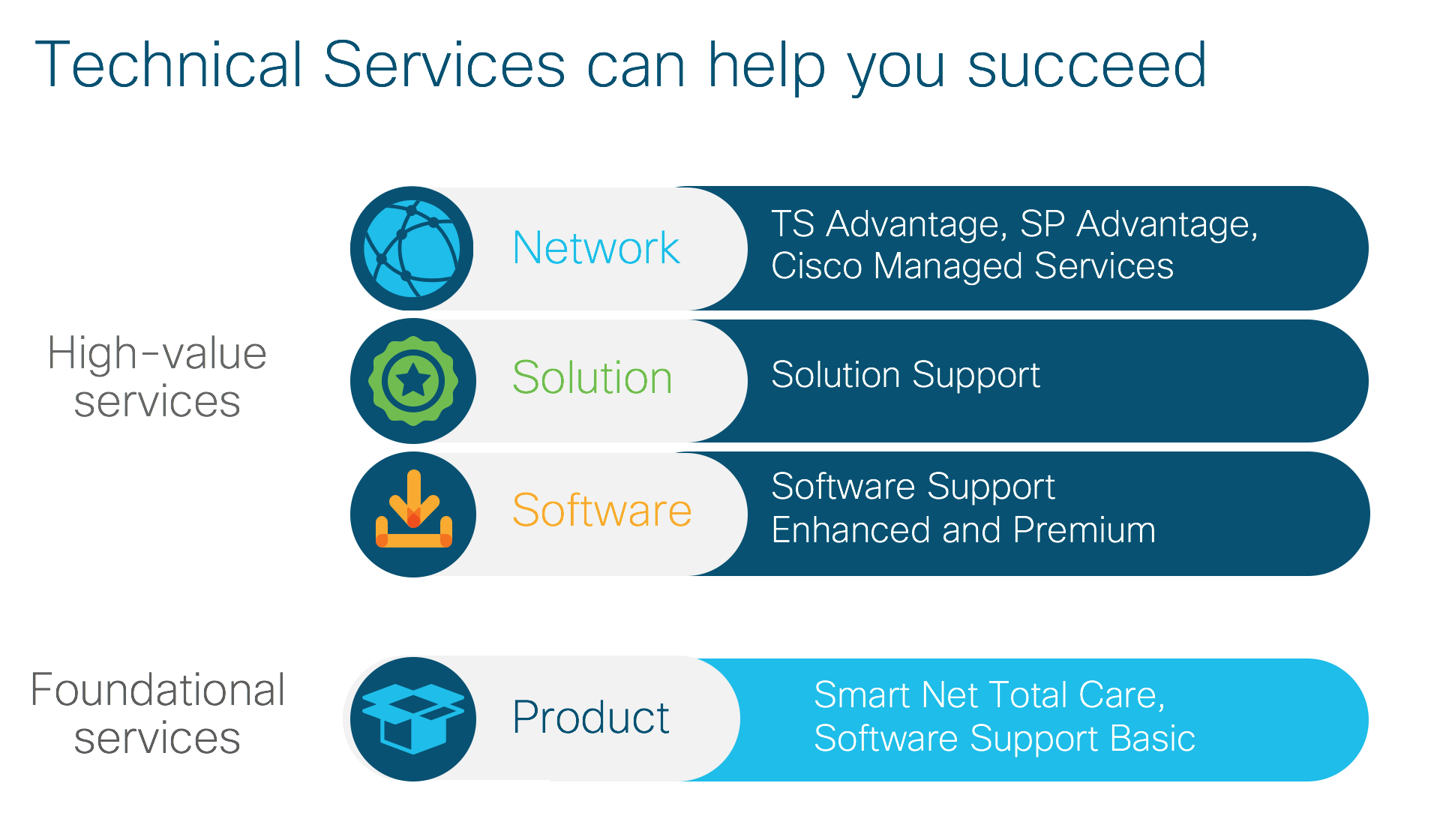
Cisco’s Predictive Services launch marks a significant step in our services business with our next generation technical services, called high-value services. Cisco high-value services builds on our industry-leading product support to deliver more proactive and prescriptive service options at the software, solution, and network level.
High-value services feature our Software Support portfolio with new enhanced and premium service options. We’ve moved beyond standard support contracts to new subscription and consumption models of our software, for simplicity and flexibility as our customers’ infrastructures change.
We’re not only focused on reducing IT inefficiencies and minimizing business disruption, but we also want to help customers bridge the gap with the expertise and resources required to transform their business. According to IDC’s 2017 Global Digital Transformational (DX) Leader Survey, 69% respondents say they lacked the right people, knowledge, and technology to transform, with 94% looking to third-party suppliers or new hires. Organizations want higher level services that use analytics to assess infrastructure performance, anticipate and remediate issues quickly (sometimes before they occur), and optimize technology utilization.
That’s where we come in. To help organizations better utilize advanced software, solutions, and the network, Cisco high-value services provides designated technology experts as well as measurable KPIs, technology adoption and onboarding capabilities, and third-party solution support. We help customers:
Enhance operations by combining advanced analytics, best practices, and personalized guidance for improved efficiency and availability
Maximize uptime by accelerating issue resolution with proactive and prescriptive support to assure business continuity
Unlock IT value by leveraging Cisco experts to ease resource constraints and accelerate technology adoption and utilization
Our portfolio of high-value services have already helped customers increase software technology adoption by 27%, resolve solution issues 43% faster, and reduce outages by 70% and incidents by 75%.
But don’t just take our word for it. Take a test drive of our new high-value services and see how we can help you realize more value out of your IT investments like many of our customers today.
Read Cisco Service’s Senior Vice President Joe Cozzolino’s High-Value Services Launch announcement.
I love all aspects of traveling. (Well, maybe not the jet lag). So it’s ironic that I work for a marketing team that promotes the very collaboration technology that can help reduce business travel. How did I end up here?!
Traveling is a passion of mine, but personal travel is not the same as business travel. While personal travel is meant to be leisurely, business travel is no vacation. But the way we conduct business travel is changing and it’s time to adapt.
With great power comes great responsibility. With great technology comes great opportunity.
They say that with great power comes great responsibility. Similarly, with great technology comes great opportunity to use that technology for the better.
In this case, “technology” refers to collaboration solutions. And you’d better believe that Cisco and businesses around the globe are using these solutions for all kinds of “better.”
More specifically, organizations are using WebEx and Cisco Spark collaboration solutions to tackle inefficiencies in business travel and change the way we meet –for the better.
What’s wrong with traveling for business?
Basically, business travel can be unproductive, inefficient and often unnecessary. Let’s look at some statistics based on Cisco research:
Approximately 25% of corporate travel is non-optimal.
According to The New York Times, one round-trip flight from New York to Europe or to San Francisco creates a warming effect equivalent to 2 or 3 tons of carbon dioxide per person.
In 2014, companies spent an average of 10% or more of their total annual budget on expenses related to business travel.
Business travel mishaps amount to $1,475 in missed work and out-of-pocket expenses, plus an average of 2.3 work days lost.
“But I need to speak with my customers face-to-face!” I can hear the objections already. But before dismissing the idea of technology over travel, let’s dive deeper the benefits of collaboration technology and online meetings and see if I can’t change your mind.
What collaboration solutions take away from business travel
“Taking away” from your business isn’t always a bad thing. In fact, if you take away the right things, you increase productivity and add value. That is exactly what Cisco WebEx and Spark do – take away detrimental aspects of business meetings and add productivity and efficiency.
For example, collaboration solutions take away:
Corporate costs on travel expenses such as transportation and hotels
Greenhouse gas emissions
Lost productivity due to employee time spent in transit
Employee safety concerns
Distance barriers and time restrictions
What collaboration solutions add to business travel
Now that we’ve removed the ugly aspects of business travel, let’s consider the ways you can add value to your business by optimizing meetings.
Our collaboration solutions can help increase:
Geographic flexibility, allowing your employees work from anywhere
Time back that an employee might have spent traveling
Convenient recording capabilities to review meetings or trainings – and make them available on demand
Ability to include diverse parties in global meetings
Streamlined communications with workspaces to share documents or chat
Are you convinced yet?
Collaboration technology is advantageous to the environment, companies, and employees alike. But not any collaboration technology will do… You want the best of the best. As the industry leader in web and video conferencing, Cisco focuses on quality and efficiency. Anything is possible! Whether you’re in Beijing or the local Starbucks down the street, you can reap the benefits of business travel without the hassle and especially the jet lag.
Written by Alon Bernstein, Distinguished Engineer, Cable Access Business Unit
Web-scale giants, like Amazon, Google and Facebook, design their infrastructure, applications and deployments to be cloud native because this is the ideal environment for supporting their core applications, including search, e-commerce, and storage. But can a system designed to handle Christmas shopping support a CMTS? Yes, absolutely. Cloud native’s benefits are so compelling that it makes sense to enhance them with what’s needed to support a CMTS, namely data forwarding and the networking control plane. Let’s look at the gaps that exist now in the cloud native architecture, how they could be addressed to support a CMTS, and how the cloud native system relates to the existing network virtualization framework, namely ETSI-NFV.
Cloud Native vs. Virtual Machine
First, a quick refresh on what cloud native is, and why it’s becoming the standard for the software industry. The Cloud Native Computing Foundation defines the nature of cloud native as “containers, dynamic management, and micro-service oriented.” For many, it’s the container component that causes confusion and generates the debate between containers vs. virtual machines (VM). Let’s clear that up that debate. In reality, the VM vs. containers debate boils down to the packaging option. Cloud native advocates micro-services, so it makes sense to have lightweight packaging (i.e. containers). By contrast, the main benefits of a VM is the hardware virtualization. VM enables a “lift-and-shift,” by taking existing code base and emulating the server to look like the original platform hardware. Because cloud native requires such a massive re-write of the software to remove all hardware dependencies, according to 12-factor app roles, and using a VM to virtualize the hardware adds overhead, VM in a cloud native environment slows performance and adds no benefits.
Some might ask, is the software re-write worth it? Well, it’s all about velocity, availability and scale. And these features are all enabled by the inherent design of the cloud native architecture: it’s a modular and highly distributed system. Because of this modularity/distribution, the system is not sensitive to faults. This reduces the risk when deploying a new software version or new configuration because even if a new deployment happens to cause a fault the service is not interrupted. Now you have a virtuous cycle: because updates are less risky they can be made more frequently which means the delta between updates is smaller. Instead of a doing a massive update every six months, we can do tiny, incremental updates daily, eventually supporting a continuous integration/continuous delivery (CI/CD) approach that increases feature velocity. All these benefits are not achieved when packaging software monolithic in a VM.
The distributed nature of cloud native system also results in a higher system availability. Because the system is distributed, there is no single-points-of-failure by design. In fact, the cloud native design rules are so effective in providing high availability that you can build a system with a 99.999% availability from components that are 99.9% available, resulting in cost savings without compromising service.
Adding Support for Packet Forwarding
What’s missing from existing cloud native systems? At the moment, they don’t handle packet forwarding. The cloud native systems are oriented around transaction handling and a common design is to use a load-balancer in front of several stateless containers. Here’s a simple example: let’s say we have a micro-service (in a container) that adds two numbers X+Y. As customers request more additions we spin more containers and load share the demand across them. As a side note, you can see how this design pattern helps availability – if one container fails the load balancer simply diverts the traffic to a container that is running.
Unfortunately, the load balancer design does not work for data forwarding because the load balancer itself is a performance a bottleneck. This is not an issue when load balancing transactions, because transaction processing takes longer than an HTTP request (well, maybe not for our X+Y example, but serving a web page definitely takes more time then re-directing HTTP). The way to maintain the cloud native approach for packet forwarding is to directly stitch traffic flows to a path based on the scaling/availability demands of the system at any given point in time instead of using load balancing
Another issue is that many networking protocols are not HTTP based, so even when managing control plane transaction, where load balancing across containers is in place, a system like Kubernetes can’t load balance “out of the box”. Fortunately, in the Kubernetes environment, its fairly easy to write customer load balancers that can be based on any protocols.
Cloud Native and the ETSI-NFV model
Another question many ask is how cloud native fits the ETSI-NFV model, which is very much a lift-and-shift architecture with the networking functions encapsulated in a VM running in an OpenStack environment. To gain traction, the ETSI-NFV has started a work item in the area of using cloud native however, it will take time for it to achieve greater acceptance.
One simple way to have cloud native fit into the ETSI-NFV framework is to state that the NFVI (network function virtualization infrastructure) is cloud-native based and all the management functions on top of it are ETSI-NFV. This is a bit of an over-simplification, as NFVs are frequently re-designed and the changes in the infrastructure tend to percolate upwards. As a simple example, with cloud native we don’t use the active/standby model (because cloud native is all about dynamic scaling and is more of an active/active model) and so the whole management of availability is different. Still, as a mental model one can think of cloud native as a form of NFVI, and it’s very likely that as we go up the manageability stack, e.g. the definition of services, fewer and fewer of the cloud native specifics will impact the higher management layers.
In summary, creating a cloud native system or environment is more than just throwing an existing function on a general purpose server. And it’s certainly more than re-packaging a software monolith in a VM. Cloud Native is about re-thinking scaling, availability, software upgrade, deployment (DevOps) and organization structure. It is all a tall order but it’s in line with how complex software systems are built, delivered and deployed in the 21st century.
Come see us in Denver, Colorado, October 17-20, at the SCTE Cable Expo, booth #987 for a live Cloud Native CMTS demonstration.
Endpoint. Cloud. IoT Devices. Email. Network. All of it needs to be secure, but where do you start? Once you have visibility out to your endpoints, the perimeter shifts: when you think you know all the devices connecting to your network, you discover new SaaS-based applications in use. You train your team on information security practices, but hygiene is impossible to mandate and track.
It’s critical for security to flex to meet the daily needs of your organization, while maintaining an acceptable risk profile for the business. That’s why we introduced Cisco Business Critical Services. We combined our unrivaled engineering expertise with integrated analytics and automation to help our customers build a secure foundation for innovation, preempt risks, and navigate technology transitions.
To simplify the security journey for our clients, our Business Critical Services for Security are aligned under three themes: Foundation, Acceleration, and Transformation:
Foundation: Have a plan What happens if a breach occurs? Who do you notify first? What do you communicate? Who are you legally obligated to tell? These days, having an incident response plan is imperative to basic security.Knowing what to do when disaster strikes can mean the difference between surviving a cyber attack, or suffering massive losses in brand equity, customer loyalty, and potentially legal fines. Incident response plans, retainers, and readiness assessments can help you prepare to respond in the event of a breach.
Acceleration: Know your vulnerabilities While you are preparing for an incident, take the time to understand where your security vulnerabilities are. This doesn’t mean executing a simple vulnerability scan.Instead, take a deep look at your network architecture for the shadows and crevices where threat actors can hide. Understand who has access to what on your network, where your partners and vendors are entering and exiting your network, as well as what homegrown applications may leave you vulnerable.
Transformation: Build a secure foundation for innovation Security doesn’t end at the firewall. Nor does it end at the cloud. It must be pervasive within your network and personnel to effectively safeguard against threat actors.Network segmentation, data privacy policies, and clear security metrics are all building blocks of a holistic security strategy program. With a secure foundation in place, your organization will be able to innovate with the confidence to take innovative risks without placing the organization in peril.
Valley Proteins doesn’t like to waste anything. They’re world leaders in recycling, keeping millions of gallons of cooking oils and food by-products out of landfills every year. They use what other people throw away to make valuable biodiesels and animal feed, among other things. But to do their job right, they rely on quick processes and efficient collection to avoid ruining raw materials.
That means real-time tracking of inventory and vehicle location is crucial. But with one of the country’s largest fleets of trucks, it’s a serious challenge. Add 40 processing and transfer facilities to the mix, along with a steady stream of acquisitions, and Valley Proteins’ data storage capacity was getting overloaded.
Cisco and Pure Storage have collaborated to deliver a powerful converged infrastructure, FlashStack, which uses best-of-class storage, systems management, server, and network components in a single solution. The system slotted seamlessly into existing Cisco UCS servers and VMware software. And migration took just one in-house engineer less than three days to complete.
Pure Storage says…
For Valley Proteins, it was a simple and easy solution. Now, storage maintenance and optimization doesn’t drain IT talent, time, and money. Instead, FlashStack makes things run smoothly, and making it easy to fold in newly purchased companies while delivering better performance and less stress for the financial team.
Now Valley Proteins gets to focus on finding value in what other people see as waste instead of wasting time and money on creaky IT.
Cisco’s ability to successfully acquire and integrate innovative companies is an industry gold standard. Today, this acquisition engine has achieved a major milestone with the announcement of Cisco’s 200th acquisition. Acquisitions help extend market leadership in our key domains, as well as position us to enter into new, growth markets. Acquisitions drive value and benefit for all of our stakeholders—shareholders, customers, partners and employees– because they give us a powerful, strategic tool to execute our company strategy.
Acquisition Impact
Acquisitions are one of our five pillars to drive strategic growth through innovation for the company: build, buy, partner, invest, co-develop. Acquisitions have a significant impact on Cisco’s current success. Our acquisitions drive growth for Cisco by accelerating key aspects of our business model evolution, including recurring revenue. Acquisitions have also helped position Cisco as a market leader in key domains such as Security, where Cisco is the #1 vendor with the broadest portfolio of products and services. Acquisitions such as Sourcefire, OpenDNS, and Neohapsis have helped to establish and extend our market position in this important market.
Other recent acquisitions have helped us learn and evolve Cisco’s business model while helping to scale and enhance the value proposition of our Core business. Teams like Meraki have enabled us both to learn from a new market approach and to scale our business differently. The Meraki business model taught us valuable lessons around extending the value of cloud management to our customers as they deploy infrastructure in their environments, enabling continuous customer value. At the time of acquisition, Meraki generated less than $100 million in annual bookings. Fewer than five years later, it now generates well over $1 billion. It also helped influence exciting new market offers like Cisco DNA Center and the 9300 in our recent launch of the Network Intuitive. Meraki is an excellent example of something that worked very well both in the marketplace and here at Cisco, allowing us to extend that learning into other parts of the company.
Our Acquisition Approach
Cisco believes the next billion dollar idea can come from anywhere, which is why we maintain awareness of market disruptions by cultivating great ideas internally and looking externally at companies that can fulfill our vision. Yet how do we decide when to acquire a company? It all starts with our strategy. As Rob Salvagno, vice president of Cisco Corporate Development and Cisco Investments states, “We start every conversation with what the strategy for the business is. Acquisitions become a primary route when they have an ability to provide a capability, acceleration potential or earlier market entry compared to partnering or developing in-house. Focusing on strategy first is what allows us to move at such speed once we do zone in on a specific acquisition target.”
Our approach to acquisitions is unique because we have a dedicated team, with an ability to invest and acquire, focused around Cisco’s key priorities and geographies. Investments allow our teams to track emerging technologies, companies and business models which may shape future markets we care about over the next 3, 5 or 10 years. As a result, investments provide us with deep market learning that help inform the overall strategy for the business and our future thoughts around M&A. The focus on priority areas and insight from investments are what places us in a great position to determine both ways to accelerate existing businesses such as networking, data center and security as well as identifying new areas to enter for Cisco such as application intelligence and AI. In fact, over the past 12 months we have made acquisitions in all these categories including Viptela (networking), Springpath (datacenter), Cloudlock (security), AppDynamics (application intelligence) and Mindmeld (AI).
A Talent Refresh Engine
Acquisitions allow us to constantly refresh and complement the innovation that’s already occurring inside the company. The talented people who join Cisco through acquisitions are an important part of our DNA, accounting for 20 percent of the whole company and 20 percent of the leadership – meaning one in 5 Cisco employees today are from an acquisition. What’s more, about 80 percent of acquired team members continue to be part of the Cisco team three years after joining.
And once talent finds its way to Cisco, it doesn’t stop innovating. Take the work we’ve done in the security space. Since entering the space through acquisition, we have continued to innovate through further acquisitions and internal development. Our acquisitions of Sourcefire and later OpenDNS reestablished our market leadership in security such that we’re now the No. 1 cloud security vendor in the world.
The leadership teams of these companies are core to internally developing the next generation of security technologies that are leading the market. Today, OpenDNS founder David Ulevitch is the leader of Cisco’s security business. David along with Sourcefire founder Martin Roesch are great examples of the innovation that was brought to Cisco through their startups and of continued innovation with their teams as they’ve stayed at Cisco. Overall, 87 percent of key employees of an acquired company—usually the founders and critical leaders—continue with Cisco after two years of joining the company. And about 20 percent of Cisco’s director and above leadership team came from acquisitions.
Reaching 200
When I joined Cisco 17 years ago, our acquisitions model was already a finely tuned machine. In fact, acquisitions have been a key approach and part of Cisco’s DNA since our very first one in 1993. After nearly 10 years in the routing market, the acquisition of Crescendo opened the door for us to the switching market – an area Cisco has led ever since. Today—as we hit the 200th acquisition milestone—we recognize the importance of strengthening our position in current domains, and also constantly evolving our business model to capitalize on entering new ones in the future.
The number 200 is symbolic in more ways than one. It represents our willingness to engage, time and time again, with the broader market, with the broader set of innovators, entrepreneurs, leaders and talent outside the company in order to bring the best possible capabilities into Cisco. It also represents a market-leading approach to openness and a lack of technology religion that puts the customers and partners first. This enables us to always adapt to changing market conditions and bring the best to our customers and their everyday business needs.