Avatar

Are you an IT professional trying to address next generation healthcare application requirements across your complex environments and applications? Let me share why Cisco’s policy driven infrastructure, Cisco Application Centric Infrastructure (ACI), has been selected and deployed by many healthcare institutions around the globe.

In this blog, we will focus on how Cisco ACI is used in production for Electronic Health Records (EHR) systems at large to small healthcare organizations.  From discussions with our healthcare customers, some of the key concerns I’ve heard are security, reliability, performance, compliance with regulatory requirements, agility  and, most importantly, simple and easy to manage operations.  One of the market leading EHR systems is from Epic so we will consider how ACI addresses some of these concerns for Epic systems.

  1. Does your platform give you the flexibility to deploy Epic on whichever infrastructure is right for your business? Whether that is a multi-hypervisor-based system, bare-metal, or any option available in the Epic target platform guide?
  2. Does your platform give you the resiliency necessary? Do you need high availability across active-active data centers?
  3. Does your platform properly secure the Electronic Patient Healthcare Information (ePHI)? Do you have the isolation and layers of security protections that will be required to achieve deployments for next generation applications?  Do these implementations start at the client device accessing the EHR system?

The Epic EHR system supports electronic medical and health record data for patients, as well as end to end management of workflows supporting patient care including scheduling, billing, prescription management, record management, clinical unified communications, and more.   Epic is a complex application suite, made up of many discrete software components and services.  Figure-1 provides a high-level overview of the Epic application suite, mapped into an ACI Application Profile.
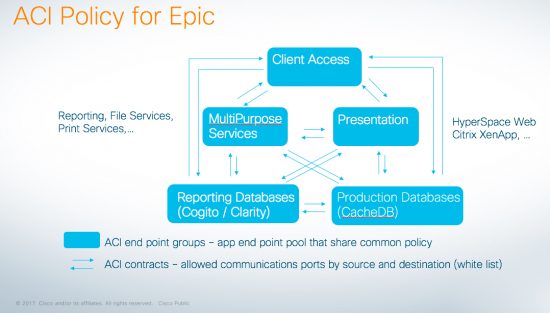
Figure 1 ACI Application Profile for Epic

  • Client access is a grouping of the Thin Client, Willow Client, Thick Client, and Business Continuity Access (BCA) PCs.  
  • Presentation contains the BCA relay, CitrixXenApp and Epic HyperSpace for virtual desktops (VDI), MyChart, and other presentation layer functions and services. 
  • Database contains the Clarity RDBMS, BusinessObjects, and related functions. 
  • CacheDB contains the production InterSystems Caché database, failover, reporting and disaster recovery (DR) shadow systems.  
  • MultiPurposeServices contains WebBlob servers, FileServices, Network Printers, WinPrintServers, Digital Signing, Kuiper, SQL, SystemPulse for monitoring, and more.

Working together with healthcare customers, Epic deployments on Cisco ACI have included InterSystems Caché databases and Epic Hyperspace on bare metal servers or virtualized on leading vendors’ hypervisors.  Cisco ACI provides a means for consistent segmentation and policy-based automation of the bare metal Unix servers and virtual guests on VMware, Microsoft, or Citrix hypervisors.   This simplifies operations for the healthcare IT organization providing a single pane of glass for configuration and troubleshooting across multiple hypervisors and bare-metal server endpoints.

To achieve Epic Honor Roll Good Maintenance Grant Program requirements, the Epic systems must be deployed on a high availability infrastructure to quickly recover from any downtime during a regional disaster. With this in mind, Epic systems are designed and deployed across multiple fault domains to achieve high availability.  ACI simplifies the management of active- active data centers by reducing the complexity of the networking requirements for data center interconnect and by providing centralized, consistent, and flexible automation and control of application and security policies across multiple data centers. An  ACI multi-pod deployment provides a common operating framework across separate failure domains in different data centers.  The ACI Application Network Profile allows Epic services and server groups to be implemented in separate failure domains, and yet used as a single pool that can be independently operated in the event of a failure.

Figure-2 provides a logical view of the common operational control ACI can provide to simplify management of separate fault domains.
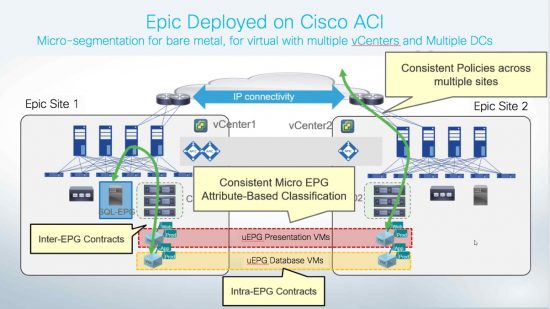
Figure 2 Cisco ACI provides common operational control across multiple pods or data center sites for Epic application resiliency.

In a 2017 research report by the Ponemon Institute, on the cost of a data breach, they talk about the average cost of a data breach at $3.6M and the firms they studied are having larger breaches.  So in addition to protecting PHCI, healthcare companies have to concern themselves with ransomware and other threats.  Security experts talk about using a layered defense and reducing the attack surface.

Here are a few examples.

  1. Security needs to start at the client device. Using Security Group Tags (SGT), we can tag the security group policy associatedwith the client device’s network communications and use ACI or Tetration to do the enforcement in the data center.
  2. If we consider the Epic Hyperspace presentation layer, we can talk about using secure VDI for desktop virtualization so that each virtual workstation is completely isolated from any other client workstation by micro-segmenting the Epic Hyperspace on Citrix XenApp or VMware horizon VDI VMs using Cisco ACI. (See Figure 3)
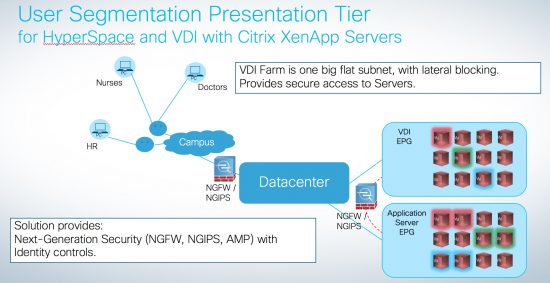
Figure 3 Epic Presentation Tier with Cisco ACI secure VDI use case

  1. In another example, in the Multipurpose Services tier, Web Blob servers communicate to discrete application servers which have full rein to talk to each other. With micro-segmentation, they can be isolated to further reduce the attack surface.

In recent discussions with Epic customers requiring additional layered data center security policies and looking for ways to further reduce the application attack surfaces, we have presented another option, Cisco Tetration, for their Epic EMR deployments.  I will cover this and more in a future blog.

  1. Tetration records all network traffic between data center physical and virtualized guests, and provides extremely precise “customized white list” application profiles used to secure the Epic EMR system and all other healthcare applications in customer data centers today (regardless of which networking infrastructure is implemented today).
  2. Tetration also provides real time change notification as healthcare applications evolve; the application profiles are automatically updated to provide visibility and policy enforcement for the Epic system and all the other applications sharing the data center infrastructure.

Contact your Cisco account team to learn more about Cisco ACI, Tetration, and our deployments in healthcare.

I want to thank Shawn Carrigan, Jody Davis, Jon Ebmeier, Cesar Obediente, and Diane Smith  for their contributions to this blog.

For more information:

www.cisco.com/go/aci

Applications: The Reason We Have Infrastructure

Micro Segmentation and Cisco ACI – From Theory to Practice

Micro Segmentation and Cisco ACI – From Theory to Practice Part II

Micro Segmentation and Cisco ACI – From Theory to Practice Part III

Micro Segmentation and Cisco ACI – From Theory to Practice Part IV

Cisco ACI Multi-Site Architecture White Paper

www.cisco.com/go/tetration

www.cisco.com/go/acicasestudies

Authors

Harry Petty

Director

Data Center and Cloud Marketing

Avatar

I got into blockchain from when I hit the Ethereum Developer Conference, DevCon1, out of sheer inquisitiveness, in London a couple of years ago.

Here’s a typical 3-min overview of blockchain, for those super new to the technology.

Two years doesn’t seem like a long time, but in Blockchain terms, that’s a decent stretch. Since then, I’ve written whitepapers, visited government accelerators, and have been lucky enough to take part in industry guidance boards regarding blockchain technology and its uses. Still, this tech is moving so fast that if I take a week out, I feel like I’ve missed another development.

One thing that struck me early on with blockchain, is that you can apply it to so many use cases that it’s tempting to do just that. But if you pause and think a little a bit about your use case, more often than not, there’s decent tech out there that will serve you just as well if not better.

Blockchain has some fantastic properties and I love its disruptive powers, but it’s the use cases that really exploit those powers that shine and are much fewer in number. These days when someone comes and asks me about how great a use case they have for a blockchain, my answer has started to be somewhat predictable… “So, you wanna use a blockchain, huh?”

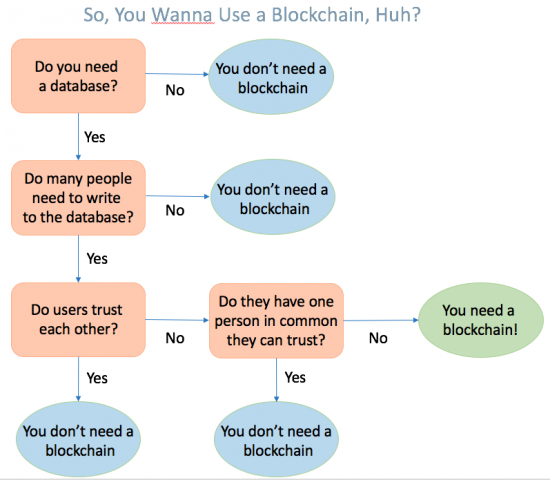
On that note, in the rest of this blog post, I’m going to try and discuss what makes a good basis for using a blockchain. And to do that I’m going to totally rip off an excellent flow diagram put together by University College London, I’ve re-created here:

First off, if you don’t need a database, you probably don’t need a blockchain (Database being a place to store a bunch of data). If you don’t need a place to store a bunch of data, you won’t need a blockchain. Blockchains are essentially a distributed database of record. Like a giant audit book or ledger (thus, blockchain tech also gets referred to as Distributed Ledgers).

If you do need a database, then next think about if you or your application are the only actor that is going to be writing to it. If you are the only actor, then again, you probably don’t need to use a blockchain. You’ll be better off with a standard database on the whole. And there are plenty of those out there to choose from. This is where the bulk of applications fall, I would suggest.

Now, if you have a bunch of folks or applications that will need to directly write to your database to provide the best solution to your use case, things are getting a little more interesting.

But, if you trust them all, then guess what, you don’t need a blockchain. You could use one, sure,  but you don’t need to as you’re not using the best properties of a blockchain and what makes it unique. It’s just a technology choice on your part to use a blockchain, and one that could add needless complexity to your solution. Think carefully about that one. Many an enterprise application behind a firewall sits in this bucket.

Next, is there a third party that everyone else trusts that can act as a regulator of the database of record? If so, then you might not want a blockchain. I think this decision is an interesting trade-off between the complexity of building solutions on blockchains (at least, at the moment) and still having a technical solution that works for your use case. Setting up a regulator or finding one for the purpose of trust might be hard and the agreements around this at a business level, complex. Personally, I’d explore blockchain tech at this point in the flow and make a decision on if the tech solution warrants the business model of not having a trusted third party (if there is an option to have one). I think the very much touted supply chain use case hits this bucket. Probably controversial, that. I’ll keep it in the blog just for that reason.

If no-one can trust anyone (What IS the world coming to? ) and you need a database with a bunch of folks writing to it constantly, then a blockchain could be the solution for you! Woo! Great examples here are IoT registration, M2M communication and transaction solutions etc. At that point, you’ve got quite a number and variety to choose from, public or private or community, open source or proprietary, language considerations…I feel another blog post coming on in the future.

But, hopefully that little run through will help the new blockchain practitioner understand if a blockchain is appropriate for the use cases they are thinking of, or at least instigate more thought on how to really exploit the unique properties of blockchain technology.

Here at Cisco, we’re helping the community understand use cases and applications of blockchain through our work on the Linux HyperLedger and Trusted IoT Alliance. We are also getting to meet and discuss solutions with the awesome folks who work in this area as a community!

Also, check out the DevNet Hyperledger Sandbox if you want to get hands-on with blockchain technology in the near future.


We’d love to hear what you think. Ask a question or leave a comment below.
And stay connected with Cisco DevNet on social!

Twitter @CiscoDevNet | Facebook | LinkedIn

Visit the new Developer Video Channel

Authors

Tom Davies

Manager, DevNet Sandbox

Developer Experience

Avatar

The sporting achievements of top athletes often appear effortless, with each goal on target, photo finish or unstoppable ace seeming like a celebration of their natural talent. Yet in reality, these individual triumphs are the culmination of not only an intensive training regime, but detailed data analysis, painstakingly reviewed and interpreted by coaches whose role it is to translate that talent into success.

Every aspect of a professional athlete’s performance is tracked and analysed in great detail today, with nothing left to chance. KPIs such as training intensity and volume, sleep quality and duration, nutrition, hydration and stress levels are routinely monitored in real-time. Data is benchmarked from their own sport and beyond, providing a rich data pool to mine, and dashboards highlight key areas of focus.

For most of us, the results would be overwhelming, but to elite coaches, they form the basis of an ever-deeper insight to the critical factors of an athlete’s success, and early warnings of anything that might have a negative impact on their performance, as well as indicating where an adjustment might yield greater rewards.

Not just data

At Cisco, we see that, as our customers digitise more and more, periodic reporting is not enough. They need a constant stream of data to track how their transformation strategies are performing. However, as we frequently hear when advising customers on how to optimize their networks, it is difficult enough to keep track of the huge volumes of data generated by their business systems, let alone glean useful insight from it. Data collection without insight has no value.

This is exactly why Cisco has launched a new analytics engine and analytics platform as part of our new Business Critical Services portfolio. It provides our customers with an online portal giving a near real-time view of the health of your network, by scanning relevant data such as device configurations, software and hardware platform information and syslogs, detecting anomalies and even predicting future issues. And it displays it all in a ‘good morning’ dashboard format that shows you at a glance what you need to know, just like your smartwatch or fitness tracker (check out our video demo):

https://www.youtube.com/watch?v=6GRNxpH0C54&feature=youtu.be?ccid=cc000424&dtid=oblgzzz000659

But importantly, by combining your data with that of nearly 3 million connected devices, it also makes pre-emptive and predictive recommendations (not unlike a fitness tracker urging you to meet your daily step target), effectively allowing you to learn from others’ experiences. Adding another layer of value, Cisco Services engineers then use their experience to create actionable insights tailored to your business. This goes beyond ensuring business continuity, although that is of course essential, enabling an ongoing process of optimization, iterating improvements rather than just fixing problems after the fact.

Clear insight

Using the sports analogy, if your network was Roger Federer suffering a run of bad luck with his forehand (unlikely at his peak, I know), then Cisco’s analytics engine would have highlighted the downward trend and flagged the anomaly before he’d crashed out the world tour leader board.

The team of Cisco engineers (the masseuse, the nutritionist, the sport psychologist) would have been straight in there, constantly tweaking diet, body, mind to ensure performance levels were maintained, informed by similar patterns exhibited by his peers past and present.

Guided by their experience, they would have prioritized a list of recommendations to get him back on track, or to prepare for an upcoming tournament. These might include adjusting his grip, increasing the proportion of protein in his diet or additional upper body strength training. Enough to put him in the best possible position for his next Grand Slam victory — business as usual in his case.

Keeping pace

Now analytics aren’t new, either to sport or to business. But the pace of digital change we are experiencing right now means that they are needed now more than ever before by our customers. In a recent Gartner CEO Survey, 57% of respondents said that building up technology and digital capabilities is critical to helping their company grow. Yet the well-documented digital skills gap makes that impossible to achieve in isolation, and so there is a real need for services like Business Critical Services that give targeted insights and ease the burden on stretched IT teams — instead of simply more and more tools that maxed-out IT teams have no time to use.

As the EMEAR service delivery lead for our Enterprise and Public Sector customers, I am excited about how the analytics capabilities of Cisco Business Critical Services, combined with the wealth of experience of our engineers, will help our customers lower costs and accelerate innovation as they transform for even greater success.


Authors

Amelie de Marsily

Senior Director

Cisco EMEAR Delivery Services

Avatar

Today’s network needs to make decisions faster, combat more security threats and manage an unprecedented scale of connected devices. All types of companies continue to move towards digitalization opening up new opportunities in every industry.

This helps retailers looking at an omni-channel experience with the ability to engage with customers online and in-store while providing location awareness. It provide doctors the ability to monitor patients remotely and using analytics to predict issues faster. Even in education, where technology levels the playing field for student access to learning resources and allowing for more personalized education while connecting disparate campuses.

For any organization to successfully transition to a digital world, they must invest in their network. It’s the network that connects all things digital, and is the cornerstone where digital success is realized and lost – it is your first line of defense, your pathway for productivity and collaboration, and will enable the Internet of Things and a multi-cloud world.

As Cisco delivers on intent-based networking, we provide our customers a network that grows more intuitive every day because it’s informed by context and powered by intent.  The foundation for this is strength of Cisco Digital Network Architecture (DNA) and the best of breed products for both wired and wireless. According to Gartner, Cisco continues to be named a leader in the Gartner Magic Quadrant for the Wired and Wireless LAN Access Infrastructure Report.


Through exclusive features such as the SD-Access Fabric which provides a revolutionary approach to provide one consistent policy across the entirety of your network at unprecedented scale—no matter if it’s wired and wireless, or the Catalyst 9000 Series Switches that is purpose built for intent based networking, Cisco is at the forefront of transforming the network.  Similarly, Cisco and Apple partnership enable the network to optimize the experience for iOS and macOS  users  through features like FastLane and rich client insights.

With innovations that continue to push Cisco to the front of the industry, Cisco has continually seen its leadership recognized.

  • Flexible Radio Assignment is one feature that automatically adjusts your wireless network to meet higher capacity needs
  • Mobility Express is a controller-less wireless network deployment that combines ease of deployment with affordability.
  • Cisco’s Connected Mobile Experiences (CMX) with Hyperlocation and Cisco Beacon Point deliver near-real-time analytics and engagements through precise location accuracy of less than three meters. Cisco Beacon Point uses easy-to-deploy-and-manage virtual BLE beacons for superior wayfinding and proximity marketing.

Cisco’s strengths lie in both the size of our portfolio and Cisco DNA, as well as the robustness of Cisco Software-Defined Access (SDA). SDA works with other network services such as Cisco Identity Services Engine (ISE) and Cisco Stealthwatch for IoT segmentation and encrypted traffic analytics and end-user security concerns. Likewise, with the expansion of the switching product line, Cisco believes that the high performance capabilities of the Cisco Catalyst 9000 Series this was reflected as a strength in the report.

Boosted by a strong wired and wireless product portfolio and software that will make sure that your business is trending in the right direction, it’s no wonder that Cisco continues to be an industry leader.

Read the Gartner Magic Quadrant report here.


This graphic was published by Gartner, Inc. as part of a larger research document and should be evaluated in the context of the entire document. The Gartner document is available upon request from Cisco. Gartner does not endorse any vendor, product or service depicted in its research publications, and does not advise technology users to select only those vendors with the highest ratings or other designation. Gartner research publications consist of the opinions of Gartner’s research organization and should not be construed as statements of fact. Gartner disclaims all warranties, expressed or implied, with respect to this research, including any warranties of merchantability or fitness for a particular purpose.

Gartner Magic Quadrant for the Wired and Wireless LAN Access Infrastructure, Tim Zimmerman, Christian Canales, Bill Menezes, 17 October 2017.


Authors

Prashanth Shenoy

Vice President of Marketing

Enterprise Networking and Mobility

Avatar

Hey, you networkers out there. (Yes, it’s a little weird – I’m talking to networkers in a blog post at a site where a lot of Developers hang out.) Remember the short struggle when you first learned about Cisco devices? What cable to use to connect to the console? What drivers to add to make the USB console cable work? What apps you needed (terminal emulator, telnet/SSH app) to connect to your lab devices, and what configuration settings you needed? With proper guidance, and a short bit of practice, you got through it, and those details became second nature – but we all had to get through it.

For network programmability, the same progression happens, but with some complications. You need more software tools in comparison, and many will require upgrades over time. The inner workings of the software tools require more thought, first to avoid some simple mistakes, but also to open a whole world of interesting and useful features.

At the same time, we often install desktop tools and quickly move on to the next topic. For instance, when you first learned about Python, did you stop and think about Python and PIP as installed on your computer, where PIP installs code so that Python knows where to look for it, where the Python executables are, whether there was a concept of a virtual environment even exists? Most of us don’t – we just install the tool and move on.

This blog post introduces a new DevNet Learning Module gives us a chance to reverse that trend. Instead, this new Learning Module has this as its overarching goal:

Help you build the same level of comfort with the programming software tools on your desktop OS as you have built from tools to access the Cisco CLI.

The Basics:
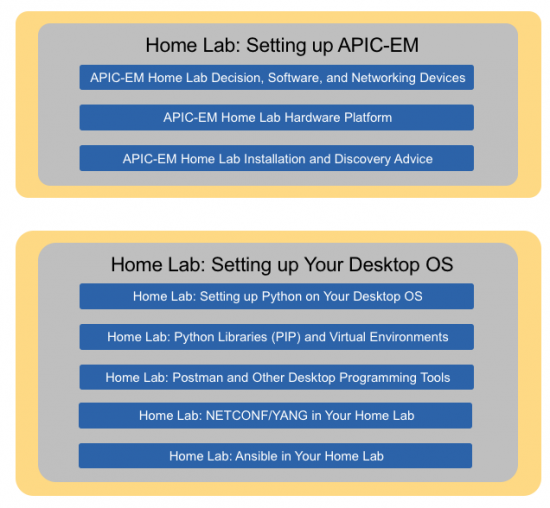
The labs in this module follow the usual DevNet Learning Lab format: read about something, do some scripted exercise steps, and make something work. Almost all the steps in these labs happen on your desktop OS, but with details so the labs can be applied on Windows, Linux, and Mac OS X operation systems.

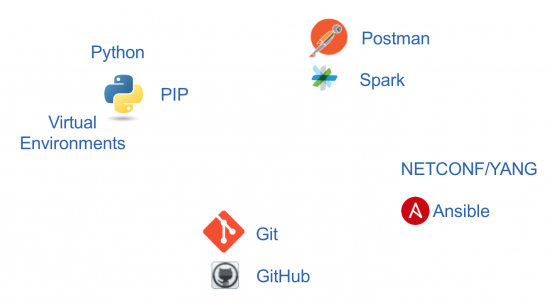
The labs touch on a variety of topics, and beyond the labs about Python and PIP, you can pick and choose which tools you care to investigate or ignore as you work through the labs. The following figure shows most of the primary topics, with a few other sprinkled throughout the labs.

If you do work through all five labs in order without skipping tools, you should finish with a better understanding of each tool, and have installed a good beginning toolset, as follows:

  • Python 2.7 and 3.6 installed, with the confidence to know when you are using one or the other.
  • One virtual environment installed, with the knowledge of how to create more.
  • PIP installed and working, with the confidence to know how to use PIP with multiple Python versions and with virtual environments.
  • Experience with how to use the Postman API client to create API calls, group into Collections, and share those Collections with others.
  • An understanding of the basics of Python editors, Integrated Development Environments (IDEs), Git/GitHub, and Spark, with some suggested further reading and exercises.
  • The software installed on your computer to begin NETCONF/YANG and Ansible experiments, managing devices either in a DevNet Sandbox or in your own home lab.

The Details:
For the backstory… a while back, the folks at DevNet asked if I would write some Learning Labs, all centered around a theme of what to do with your home lab to make it ready for you to learn about network programmability. Networkers have built their home labs to learn about networking since it was affordable to build a lab with used gear, probably somewhere around the mid 1990’s. So we decided on one module about adding APIC-EM to your home lab, and then this next module about the tools you would put on your home PC’s OS to make you productive with network programmability in your home lab.

As an example of what these labs provide, consider some of the issues discussed in the first two labs in the module about Desktop OS tools. Imagine you take your Windows laptop, with no Python installed by Microsoft, and install Python 3.6. Now you have one specific version/release of Python. When you run the python command, you know it must be using that one release you installed. When you install Python libraries with PIP, you know they install for use with that once instance of Python. And even if you see mention of virtual environments in DevNet, you ignore them, because they do not seem useful on your computer. Nice, simple, and no confusion. However…

Now realize that different labs, books, courses, and libraries will use some examples that require Python 2.7, with others that require 3.6, and possibly different releases of Python version 3. Those differences then require you to install both Python 2.7 and 3.6 (and maybe other releases). Just adding two instances of Python on one computer causes issues with which commands to use, how PIP works, and is one of the first (of many) reasons to think about using virtual environments.

The first two labs in this module discuss Python, PIP, and virtual environments, all within the context of running both Python 2.7 and 3.6.

As another example, the last two labs in the Dekstop OS module take a similar approach to two different topics: NETCONF/YANG and Ansible. These labs approach the topic from the perspective of getting your desktop OS ready to do lab experiments with NETCONF/YANG and Ansible, rather than being about NETCONF/YANG and Ansible as ends to themselves. Each lab lets you prove that you are ready to start doing lab experiments by first testing with an always-on DevNet Sandbox, and then showing how to test with a router in your home lab.

Where from Here:
What next? Find yourself a little time, sit in front of whatever computer you will use in lab for doing network programmability, and work through the labs. Simple enough.

Check out the “Home Lab: APIC-EM and Network Automation” learning track for an overview of the labs contained in each module, and find your starting point on your journey into network programmability.

I’d also love to hear from you, here in the blog, and/or on Twitter (@WendellOdom). What do you think of the idea for this module? What other topics would you be interested in seeing in this Home Lab series? What else can we do to help you become productive on your journey? I’d love to hear your thoughts!


We’d love to hear what you think. Ask a question or leave a comment below.
And stay connected with Cisco DevNet on social!

Twitter @CiscoDevNet | Facebook | LinkedIn

Visit the new Developer Video Channel

Authors

Wendell Odom

Founder, Certskills

Avatar

Nearly 30 years ago, I attended the first of what would be hundreds of information security conferences throughout my career. I was astonished to be one of only a handful of females in a sea of men – our career goals were the same, but I had a steep climb compared to my male counterparts. I entered an exclusive club.

Fast forward to today, the cybersecurity industry has exploded into a multi-billion dollar market, but exclusivity is still present. Nearly half of the global workforce is female, yet women hold only 11 percent of IT and cybersecurity positions. To effectively stand up against attackers we must build a workforce that takes exclusivity out of cybersecurity, embraces diversity and educates the next generation of cybersecurity leaders.

This week’s theme for National Cybersecurity Awareness Month is, “The Internet Wants You: Consider a Career in Cybersecurity.” The growing cybersecurity workforce shortage poses a dire threat to our economy and security. Given the low numbers of women in cybersecurity positions, the solution is to broaden the pool of available talent and build inspiring work places for all people.

To do our part in developing a diverse talent pipeline, I co-founded the Cisco Women in Cybersecurity Community, which focuses on developing the next generation of female cybersecurity leaders within Cisco. The goal of the initiative is to build a dynamic talent pool of women by focusing on four strategic pillars:

  • Education – Provide opportunities and resources to ensure community members are expanding their knowledge and skills in cybersecurity
  • Outreach – Develop a pipeline of women in cybersecurity at the K-12 and collegiate level and expand our community industry-wide
  • Leadership – Prepare members for career advancement and leadership roles by providing mentorship and professional development training to increase their sphere of influence in the industry
  • Community – Provide opportunities for members to gather regularly for the purpose of knowledge sharing and networking.

In the initiative’s first year, we’ve grown the community to more than 200 members who actively seek out certifications, advanced positions and mentorship opportunities. Today, the Women in Cybersecurity Community continues to grow offering women access to career development opportunities and a network of inspiring, like-minded men and women to exchange ideas and prosper in the field.

The Women in Cybersecurity Community is just one of 14 Business Initiated Networks at Cisco with the goal of actively empowering and building the next generation of cybersecurity and IT professionals. The networks are grassroots, regional employee communities with a specific interest and focus, which can be local to one business function, group, site and/or region. Networks are actively engaged through various events and initiatives that promote and support specific goals.

Cisco’s support of diversity and inclusion initiatives has played an instrumental role in building an empowering workforce. Our employees’ diverse backgrounds assist in our ability to fight against the most sophisticated attack methods and offer crucial analysis and solutions for a rapidly evolving threat landscape.

The talent is there. It’s up to leading businesses to eliminate the barriers and implement practices to recruit, train and retain a strong workforce.

Michele Guel joins other leading cybersecurity women in a webinar to discuss how they broke into and excelled in the industry. To learn how they have overcome challenges and achieved professional success, please sign up for our webinar, Finding a Career in Cybersecurity: Panel on Job Success.

October is Cyber Security Awareness Month, and Cisco is a Champion Sponsor of this annual campaign to help people recognize the importance of cybersecurity. For the latest resources and events, visit cisco.com/go/cybersecuritymonth.

Authors

Michele D. Guel

Distinguished Engineer & Data Security and Privacy Strategist

Office of the CTO, Security Business Group

Avatar

Cisco is committed to delivering the next generation of collaboration experiences to all workers across every room, desk, pocket and application. These experiences include meetings, as well as messaging, calling capabilities and contact center touchpoints. As our customers continue to transition to the cloud, they are demanding deployment flexibility across all of these experiences. This requires collaboration solutions across all workloads on premises and in the cloud.

That’s why today we announced a definitive agreement to acquire BroadSoft.

We chose BroadSoft as it provides a portfolio of cloud collaboration platforms and business applications, which strengthen our cloud investments and ability to deliver collaboration solutions to our global telecom provider customers. Following the close of the acquisition, Cisco and BroadSoft will provide a comprehensive SaaS portfolio of cloud based unified communications, collaboration, and contact center software solutions and services for customers of all sizes.

Collaboration is the first step to business digitization and BroadSoft has partnerships with over 450 telecom carriers in 80 countries – including 25 of the top 30 globally – to 19+ million BroadSoft business subscribers. BroadSoft’s portfolio is complementary to our existing on premises and enterprise-centric Hosted Collaboration Solutions (HCS), as well as Cisco’s overall cloud investment strategy.

Together, we are committed to redefining the future of work and collaboration to help businesses perform in ways never before imagined, with the flexibility to deploy them on-premises or in the cloud and to better meet the calling and contact center needs of our SMB and mid-market customers.

We also recently announced that Cisco reached its 200th acquisition. With the acquisition of BroadSoft, we’re continuing our strategy of strengthening our position in the collaboration market, while continuing to evolve  our business model for the future.

We are excited and look forward to welcoming the BroadSoft team to our Unified Communications Technology Group led by Tom Puorro vice president and general manager in the Applications Group. We expect the acquisition to be completed in Cisco’s first quarter of calendar year 2018.

***

Forward-Looking Statements

This blog contains forward-looking statements that are subject to risks, uncertainties and other factors that could cause actual results to differ materially from those referred to in the forward-looking statements. All statements other than statements of historical fact are statements that could be deemed forward-looking statements.  For example, statements regarding integration plans and the expected benefits to Cisco, BroadSoft, and their respective customers from completing the acquisition are forward-looking statements.  Risks, uncertainties and assumptions include those described in the joint press release announcing our proposed acquisition of BroadSoft and in Cisco’s SEC reports (including but not limited to its most recent report on Form 10-K filed with the SEC on September 7, 2017).  These documents are available free of charge at the SEC’s website at www.sec.gov or by going to Cisco’s Investor Relations website at http://investor.cisco.com.  If any of these risks or uncertainties materializes or any of these assumptions proves incorrect, Cisco’s results could differ materially from its expectations in these statements. Cisco undertakes no obligation to revise or update any forward-looking statement for any reason.

Additional Information and Where to Find It

In connection with the proposed acquisition and required stockholder approval, BroadSoft will file with the Securities and Exchange Commission a preliminary proxy statement and a definitive proxy statement. The proxy statement will be mailed to the stockholders of BroadSoft.  BroadSoft’s stockholders are urged to read the proxy statement (including all amendments and supplements) and other relevant materials when they become available because they will contain important information.  Investors may obtain free copies of these documents (when they are available) and other documents filed with the SEC at its website at http://www.sec.gov.  In addition, investors may obtain free copies of the documents filed with the SEC by BroadSoft by going to BroadSoft’s Investor Relations page on its corporate website at http://investors.broadsoft.com or by contacting BroadSoft Investor Relations at (561) 404-2130.

BroadSoft and its officers and directors and other members of management and employees may be deemed to be participants in the solicitation of proxies from BroadSoft’s stockholders with respect to the acquisition.  Information about BroadSoft’s executive officers and directors is set forth in the proxy statement for the BroadSoft 2017 Annual Meeting of Stockholders, which was filed with the SEC on March 17, 2017. Investors may obtain more detailed information regarding the direct and indirect interests of BroadSoft and its respective executive officers and directors in the acquisition by reading the preliminary and definitive proxy statements regarding the transaction, which will be filed with the SEC.

In addition, Cisco and its officers and directors may be deemed to have participated in the solicitation of proxies from BroadSoft’s stockholders in favor of the approval of the transaction.  Information concerning Cisco’s directors and executive officers is set forth in Cisco’s proxy statement for its 2016 Annual Meeting of Shareholders, which was filed with the SEC on October 24, 2016, annual report on Form 10-K filed with the SEC on September 7, 2017, Form 8-K filed with the SEC on September 18, 2017, and Form 8-K filed with the SEC on March 13, 2017. These documents are available free of charge at the SEC’s website at www.sec.gov or by going to Cisco’s Investor Relations website at http://investor.cisco.com.


Authors

Rob Salvagno

Vice President

Corporate Development and Cisco Investments

Avatar

Traditional load-balancers have operated at multi-Gbps speeds. Our recent inventions allow us to scale the load-balancing speed to multi-Tbps.

Today’s data centers have 1000s of web, application and database servers. Each server is already capable of serving multi-Gbps traffic. Hence there is a need for load-balancers to scale much higher than the legacy multi-Gbps speeds.

As the inventor of these load-balancing technologies, I have been asked by several media representatives for an interview. Please see the video above.

Load-balancing is estimated to have a $2 billion TAM (Total Addressable Market).

Here are more details of this disruptive load-balancing solution (ITD).


Authors

Samar Sharma

Intelligent Traffic Director for Nexus 9k/7k/6k/5k

Avatar

This post was authored by Warren MercerPaul Rascagneres and Vitor Ventura

INTRODUCTION

Cisco Talos discovered a new malicious campaign from the well known actor Group 74 (aka Tsar Team, Sofacy, APT28, Fancy Bear…). Ironically the decoy document is a flyer concerning the Cyber Conflict U.S. conference organized by the NATO Cooperative Cyber Defence Centre of Excellence on 7-8 November 2017 at Washington, D.C. Due to the nature of this document, we assume that this campaign targets people with an interest in cyber security. Unlike previous campaigns from this actor, the flyer does not contain an Office exploit or a 0-day, it simply contains a malicious Visual Basic for Applications (VBA) macro.

The VBA drops and executes a new variant of Seduploader. This reconnaissance malware has been used by Group 74 for years and it is composed of 2 files: a dropper and a payload. The dropper and the payload are quite similar to the previous versions but the author modified some public information such as MUTEX name, obfuscation keys… We assume that these modifications were performed to avoid detection based on public IOCs.

The article describes the malicious document and the Seduploader reconnaissance malware, especially the difference with the previous versions.

Read_More>>

Authors

Talos Group

Talos Security Intelligence & Research Group