Virus Bulletin conference is a well regarded intimate technical conference focused on malware research. It provides a good balance between listening to technical talks and spending time exchanging experiences with colleagues from different companies; all working on the same task of making our computing environments more secure.
This past October, Talos participated at the Virus Bulletin conference in Madrid with a talk presented by Warren Mercer and me, Paul Rascagneres. This talk covered the latest techniques used in the reconnaissance phase of attacks by APT actors. During the presentation, we demonstrated how the reconnaissance phase is executed as a part of the infection process in order to protect valuable zero-day exploits, malware frameworks, and other tools.
SD-WAN has blown past all of our 2017 expectations. It has become one of the hottest trends in networking, and forecasts are increasing every quarter with IDC predicting the size of the SD-WAN market to be $8.05B by 2021.
My colleagues keep asking me, “Where do we go from here?” Will the forecasts continue to increase? Is there enough demand in the market for over 40 SD-WAN vendors to survive? Is there really a need for routers in today’s increasingly virtual network? And the question I get asked the most: Who is going to be acquired next?
Digital transformation continues to be the driver behind network refresh. Increasing bandwidth, cloud IaaS and SaaS applications along with WAN complexity and security are largely the same as in previous years, but these disruptions have evolved and are becoming increasingly important issues IT needs to solve across their networks and not just the WAN.
Digital Disruption. More devices, creating more data is challenging IT. How can IT manage more devices coming online when they lack business and IT insights into what is happening on the network.
Complexity. Branches contain multiple devices, this means IT has to make changes to each device separately and in most cases manually resulting in IT being slow and prone to errors.
Security. The number of security attacks continues at a relentless pace and attacks are becoming more sophisticated and coming from both inside and outside of networks and IT is having a hard time keeping up with an unconstrained attack surface.
Technology innovation is going to determine what’s next for SD-WAN in 2018. While I don’t have a crystal ball, here’s what I predict for SD-WAN in 2018:
More consolidation in the marketplace: The acquisitions of both Viptela and VeloCloud indicate that there continues to be significant customer demand but also that SD-WAN has reached maturity. Expect to see more consolidation as both technology vendors and service providers look to expand their portfolios and offerings with SD-WAN.
Managed services providers dive into virtualization: MSP’s are looking to transform their infrastructure going beyond offering connectivity to more value added services. Expect to see MSP’s to deploy large scale networks with virtualized CPE solutions using flexible software licensing for greater agility and investment protection.
SD-WAN will evolve beyond pure SD-WAN: Enterprises like the simplicity of SD-WAN but want to consolidate all their branch devices. Look for SD-WAN vendors to start adding more comprehensive security and WAN optimization functionality along with support for virtualization into a single platform.
Artificial intelligence: SD-WAN will provide connectivity to your end-points, but what is the most optimum path for traffic to be routed over your WAN? Intent-based networking will make it easier to manage and operate your WAN and it will also use AI and machine learning to become smarter ensuring you WAN stays healthy under all traffic conditions.
Security designed to work together: Effective security needs end-to-end visibility, not just across the WAN. To ensure that the branch and WAN is protected from increasingly complex threats, expect to see SD-WAN platforms include more embedded security that uses advanced threat detection techniques.Direct internet access and cloud access require security to protect data passing over the internet but machine learning will be required to see all threats, even those in encrypted traffic.
The SD-WAN market is going to look very different this time next year. Tell me your predictions, or if you think I’ve missed the mark on any of mine. Comment below or reach out to me on Twitter @ghodgaonkar.
I have a love-hate relationship with this time of year. I sincerely appreciate the opportunity I have to reconnect and celebrate with the people I care about most, but I often resent the hectic pace required to achieve those moments of peace and joy. Though in the end, the memories make all the effort worthwhile.
In general, this same scenario can apply to our lives at work. We strive all year to meet the goals set for us—or that we establish for ourselves—and at year-end, it can be very rewarding to look back on what we’ve accomplished. On the Cisco Education Blog, for example, we try to share news, thoughts, and ideas that will motivate and inspire readers to begin their own transformation in teaching and learning.
In that spirit, I thought it would be interesting to look back at the five most-read blog posts of 2017. Are they familiar? Feel free to take a second look. Or, if you missed them the first time, now’s your chance to see why they resonated with other readers.
1. Create New Learning Experiences with Cisco Spark. Today’s learning environments offer much more than just pencils and blackboards and rows and rows of desks. With Cisco Spark and Cisco Spark Board for Education, schools, colleges, and universities are personalizing the learning experience, helping students, educators and researchers work together across boundaries.
2. How Our Students Will Overcome Machines. It’s estimated that 65 percent of children entering school today will work in job types that don’t even exist yet. And, somewhat ironically, it’s not technical skills that will best equip them to thrive, but those skills considered to be the most human.
3. How Curtin University Is Building a Campus of the Future. Five years ago, Curtin University had no collaborative classrooms. Now it has 76—all video-enabled with cameras that can transmit in and out. The university also recently opened its first 180-seat classroom that’s completely video conference-enabled. This is all part of the university’s strategy for learning for tomorrow.
4. Essential Skills for an Entirely New Era in Networking. Software-defined automation (SDA) is poised to play an important role in the careers of today’s IT professionals, as well as for IT professionals of the future. Next-level network automation will free users to take on new challenges, achieve their business goals, and stand out in the digital world. In fact, networking professionals will be even more in demand as millions of apps and billions of users connect with each other in the IoT.
5. Video in the Classroom? The possibilities are endless. Located on the Hudson River, Troy, N.Y., is home to some very imaginative educators and students. They’re using video to open a “window to the world” and seeing amazing results.
And, because I’m a fan of even numbers, here’s a bonus: my favorite blog from 2017.
6. Why Cisco? A Commitment to Education—and to Making a Difference. I live in New Hampshire, the state with the lowest poverty rate in the nation, yet in my small city alone, hundreds of children are food insecure, meaning they don’t always know when they will eat their next meal. I am fortunate in so many ways. My children will never be hungry, and I have time to volunteer for End 68 Hours of Hunger, which helps me ensure that the few children I can touch aren’t hungry either. I also work for Cisco, a company that supports my efforts with paid time to volunteer through the Time2Give program. For me, this is one important answer to the question, Why Cisco?
If you’re wondering what Cisco’s Multicloud Portfolio is and what it has to do with our recent Google announcement, you’re not alone.
At least I suspect you’re not.
I mean, as transparent as we try to be with our many announcements about new products and solutions, sometimes we’re just…not. And other times we are, but on that particular day you may not have had time to read past the headline or the first paragraph or wherever you were when you decided “Yeah, reading about this new tech initiative is fun, but I think I’ll watch that video of the kitten and the owl playing together again. It’s so uplifting.”
So I thought it might be helpful to take another shot at explaining the Cisco Multicloud Portfolio. This time with the help of Lax Sakalkale, Cisco’s Director of Product management for Multicloud Solutions. He’s about as involved in our Multicloud Portfolio as anyone can be, and we had him in our clutches for 40 minutes, so Vallard and I asked him everything we could think of. A few of those items include:
What is the Cisco Multicloud Portfolio?
Who is it for?
What does it have to do with the big Cisco/Google announcement of a few weeks ago?
Do interested parties have to buy all of it, or can they pick and choose the bits they want?
How does it make life better for the people running IT organizations?
Where does the Portfolio go from here? Will it evolve?
If you were watching the kitten+owl video that day, you win. Here’s your chance to catch up and know everything your colleagues know—and more—without having to lift a finger. Just plug in your headphones and enjoy. You can watch the video version of this podcast on our YouTube page, or listen to the audio version on iTunes. And if you like it, please take a hot minute to rate it, review it, and subscribe to the channel. That way you won’t miss any of the other exciting episodes we have scheduled over the next several months. And we’ll have a better idea of which content you really enjoy. Thank you so much!
Every year, teams get together in December to celebrate the close of another calendar year, to wind down and just have some good old fashioned team fun. There are white elephant gift exchanges, team dinners, and – a Cisconian favorite – ugly holiday sweater contests.
This year will be no different. Actually, it might get a little more, shall we say, interesting? Employees never seem to back down from a challenge, and the ugly sweater competition from last year was pretty tight!
The employees in Raleigh, North Carolina are one such example.
“For the last few years, my team has had an ugly sweater contest which takes place during our group’s last All Hands Meeting of the year.” Says Ileana Le.
“Everyone is invited to wear their sweaters to the meeting whether they are in the local office or from any of our locations (or remote!). At the end, we reserve time for every person to showcase their sweater via Webex or Telepresence and share any interesting or funny details about it. After everyone has had ample time display their masterpiece, we vote through the Chat window (can be sent only to the host or public for everyone to see).
Due to stiff competition from 2015’s Ugly Sweater contest, the rules were modified last year. We had two categories—Best Stock Sweater: The most naturally ugly (unaltered and unmodified) Christmas sweater you can find –featuring sweaters made by a manufacturer or grandmother with sincere intentions. We also added Best Modified Sweater: The most creative use of materials – any sweater you or someone else has created for ugly/creative purposes.
One winner from each category won a $50 Amazon Gift Card. Woohoo! I won this year’s Best Modified Sweater, which featured some familiar Cisco faces (which I printed and ironed-on).”
Wow, now THAT’S dedication! (And we’re sure that CEO Chuck Robbins will be ordering one of these for his very own. That’s his face on there!)
Want to tap into the spirit of working at Cisco? Bring your unique style and apply for open roles here.
The Talent Acquisition (TA) team in Bedfont Lakes is no less competitive. There seems to have been tough competition, but all in good fun.
A few weeks before last-year’s break, the annual holiday dress up competition for EMEAR (Europe, Middle East and Africa Region) and Engineering TA took place. The year before, even being dressed in a full snowman suit didn’t win the prize, so the challenge was ON! Some even wrapped themselves in festive paper, but after the independent judging took place, (The VP of HR in EMEAR and her executive assistant) took points off for “trying too hard” (HA!) and announced Kathryn Zaki, a TA Recruiting Manager, the winner. Afterwards, everyone went on a pub crawl around London still dressed in their outfits, which was the best part, so says the team.
Cisco employees from Cloudlock got in on the action as a newly-acquired Cisco company in 2016.
“Inspired by ‘The Internets,’ CloudLock held its first annual Ugly Sweater Contest last year.” Says Russ Miller, Head of Product Marketing.
This led a normally fun-loving group to devolve into a group of fierce individual competitors. This year and in future years, we look forward to rallying our team spirit to challenge other groups inside of Cisco. No quarter will be expected or given.”
The competition in San Jose’s headquarters is also pretty fierce, with an edge of fun. Bryan Porcher is known for his holiday spirit! His “tree” costume is more than a sweater, and always puts people in the holiday spirit!
“I have always enjoyed “dressing” and have found it to be an authentic form of expression. No matter the occasion it’s a fun challenge to thoughtfully arrange something that’s unique but still proper for a situation,” Bryan says.
“Aside from self-expression, ‘dressing up’ does much more. For one, it’s a tremendous ice breaker. It can bring people together in ways that are atypical and can often times lead to conversations that would not be had otherwise. I set the bar high for everyone so the pressure is always on to deliver the goods myself.”
Bryan says he gets the best reactions:
“Folks are blown away by the tree costume and it’s a hoot watching them dissect the ensemble piece by piece. You never know what feature will be the most sticky (e.g. faux-bois pants, pine tree scent, personalized ornament, blinking lights or bright red shoes) but the interactions are always charged. The thing that made last December so great at Cisco was that I took the feedback of colleagues from the year before and wove in some unexpected upgrades. It inspires people to go bigger and badder for whatever the competition holds the next year. Any time strangers flock around for selfies in the lobby of building 10 to capture the moment, something is striking a chord by tapping into the holiday spirit here at Cisco.”
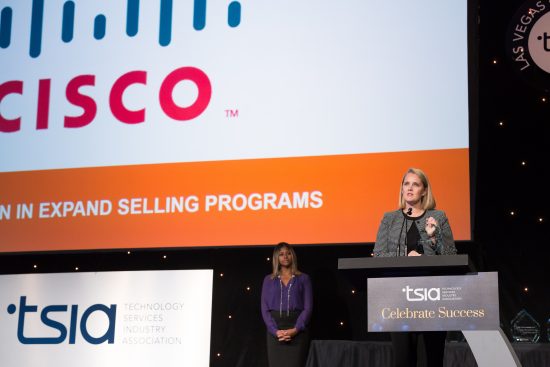
We are thrilled to announce the receipt of our 31st STAR Award for Innovation in Expand Selling Programs. The STAR Awards offer companies the opportunity to showcase their commitment to outstanding innovation, leadership, and excellence. The awards span across eight service disciplines including: support services, customer success, education services, field services, managed services, professional services, service revenue generation, and expand selling.
When asked specifically about Cisco’s recognition, here’s what TSIA had to say:
“Cisco Systems took the prize in 2017 by driving innovation in expand selling throughout their enterprise. As their customers have struggled to evolve to digital networks and adopt the right solutions for their business outcomes, Cisco has aligned their product management and marketing to help make these choices easier for customers. They have empowered their service delivery teams to take ownership of the customer problem beyond just the simple fix… to drive home the change in culture. The end results included a 389% increase in services sold on DNA solutions and a 95% increase in software support services revenue. Congratulations Cisco!”
Our 31st STAR Award means that we will continue to offer new and innovative services that meet the needs of our customers’ businesses and help them stay ahead of the pace of change.
In addition to our STAR award, we received our 11th J.D. Power plaque in-hand. The J.D. Power Certified Technology Service and Support (CTSS) certification recognizes service quality and customer satisfaction in the services space.
To achieve this significant recognition, Cisco Services underwent a demanding evaluation process, which included a 6-week audit of our support policies and procedures, involving multiple global and partner locations. See all of the great details in my recent blog here.
So, what does this mean for our customers? Validation that the services we offer across the IT lifecycle will continue to help their businesses extract the most value from their IT investments.
We are humbled to be recognized and awarded for our services programs. Thank you to our amazing talent within Services for their continued excellence and to our customers for allowing Cisco to be a continued part of their digital transformations.
Disclaimer: J.D. Power 2017 Certified Technology Service & Support ProgramSM, developed in conjunction with TSIA. For more information, visit www.jdpower.com or www.tsia.com.
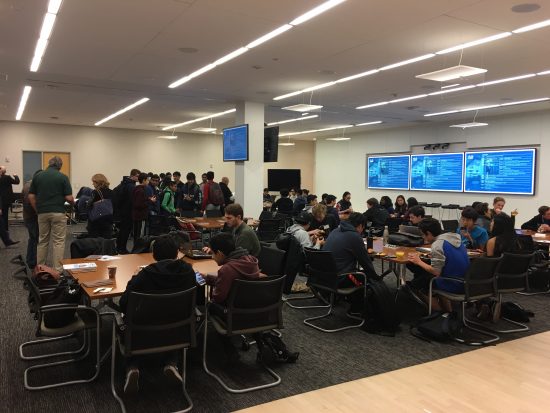
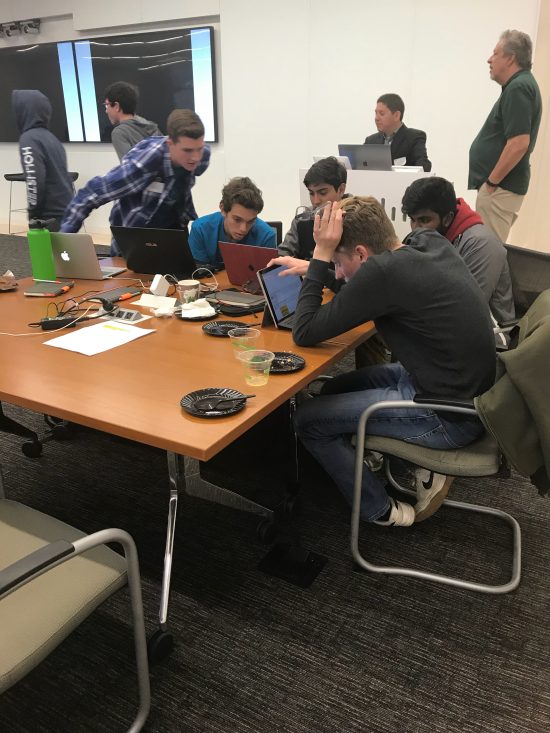
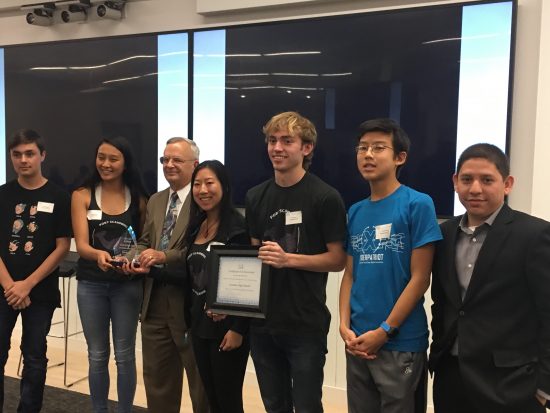
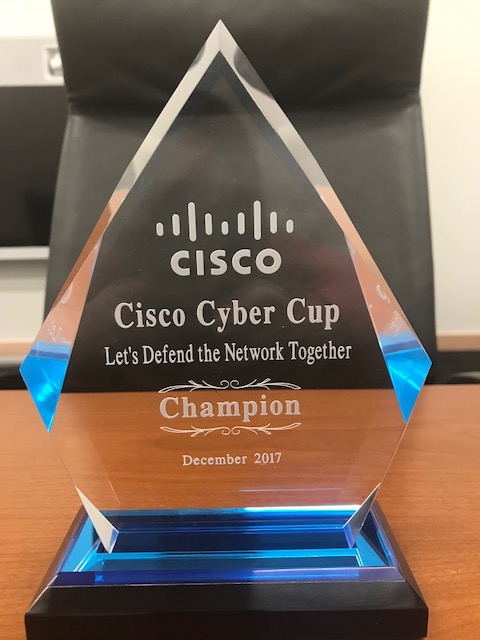
Cisco hosted the Southern California Cybercup Challenge in December in Cisco’s Customer Experience Center, and I was lucky to welcome a group of college and high school kids from across the state of California for the competition. Cisco hosts more than 2,500 customers a year in the John T. Chambers Customer Experience Center in our San Jose headquarters, but rarely are they so “young in career.”
A Cyber Cup Challenge is a competition between teams against cybersecurity challenges. We read and hear about stolen data almost daily – but it’s always from the point of view the people affected by the hack. These kids were trying to see a hack from the point of view of the hacker: How did they get in? What did they do? How can we stop it?
The hands-on technical challenge and experience was all about learning, with a spirit of competition. What fascinated me were the kids themselves. The room of 100 or so was clearly full of both girls and boys, and the crowd was equally diverse. I’m used to my little Macbook and iPhone, but these kids brought laptop PCs that were big and had all kinds of gadgets hanging off them. One kid’s laptop must have had such a fast processor that it had a visible heat sink attached to the rear of the laptop.
The smartest and brightest from California were in the room. It was clear these kids were technologically ready for the challenge and not intimidated. I couldn’t help but believe the world was in good hands with these kids ready to take on the challenge of cyber-security.
But then I asked them, “what is the #1 security concern for companies today?” Most knew the name of some popular ransomware hacks or companies who’ve had data stolen – the artifacts of failed cyber-security strategies. What I realized was important to tell these young students was that cyber-security was more than a technological challenge – not matter how fast or cool those PCs in the room were.
Most cyber-hacks are result of process or people breaking down, not technology. The vast majority of the CIOs who visit Cisco tell us that “insider threats” are what worries them most about cyber-security. Insiders are people who either are actively aware or inadvertently aware of their participation in a hack.
When the competition started, I could hear a few conversations talking about people and their behaviors before the kids jumped in. Someone had to win the competition – congrats to the winning teams – but I hope the experience at Cisco expanded the world view of these students to see cyber security as a people, process and technology challenge.
The world needs these students to succeed – both for themselves and for our own cyber-security peace of mind.
The Technologies They Used
The students who participated in the Cyber Cup Challenge used the Circadence Project Aires platform, which gamifies security configuration on Windows and Linux environments.
These technologies were chosen to create awareness among middle and high school kids in regards to cyberthreats that can exploit the everyday devices that they use.
Students also learned to use Cisco Spark technologies to collaborate with their peers as well as with Coaches and mentors. They accessed the challenge content through online access – yet another hole in a company’s security.
With the growing number of connected devices available to youngsters at an early age, there is a real concern about hackers exploiting the identities of kids. This emphasizes the need to create cyber best practices awareness to help protect the users. Secondly, the number of career opportunities in cyber security are growing exponentially. Participation in challenges like the Cyber Cup Security Challenge hosted by Cisco, helps create pathways for students to choose a career in Security related technologies.
As part of Cisco’s hosting, the students were given demonstrations on Cisco’s Umbrella, StealthWatch, and Firepower solutions. We also had presenters from the Cisco DevNet team talk with the students to educate them on how they can leverage the DevNet portal to further their knowledge in software programming and learning about APIs.
Find out more about the SoCal Cybercup Challenge.
The following are dCloud demos for the technologies used in the challenge.
What’s the hardest part about meeting someone new or going to another country or just interacting with something you are unfamiliar with? Typically, it’s how to start the interaction, how do you connect, stay connected, and reconnect. Sometimes the relationship or the place just doesn’t work out and then you have to leave or disconnect.
I think you probably already know that I’m not going to be talking about personal relationships or travel, but interacting with Cisco UCS Management interfaces via UCS PowerTool. In my previous blog I wrote about getting started using UCS PowerTool for automation, this blog is all about Connecting and Disconnecting. Could there really be that much information about connecting and disconnecting? You bet, let’s get started.
Hold up, if you’re not familiar with the basics of UCS PowerTool you can start with the UCS PowerTool User’s guides or try out the DevNet resources.
Connecting to the three available UCS Management interfaces is pretty straight forward, use the appropriate “Connect” Cmdlet and provide one or more IP addresses or DNS names for the UCS Management interface(s) that you would like to connect to.
Connect-Ucs -Name <ucsm-ip or dns-name, ucsm-ip or dns-name, ...>
Connect-UcsCentral -Name <ucsc-ip or dns-name, ucsc-ip or dns-name, ...>
Connect-Imc -Name <cimc-ip or dns-name, cimc-ip or dns-name, ...>
Disconnecting is even easier, just use the appropriate “Disconnect” Cmdlet and all the existing connections will be dis-connected.
When connecting to UCS Manager, UCS Central or a CIMC (Cisco Integrated Management Controller), by default only a single connection to a single interface is supported and is referred to as the “Default” connection. A variable will be created in the UCS PowerTool session to hold the connection information, these variables respectively are named,
As 2017 comes to a close, we look back at one of the most interesting inflection points in the business landscape. Competition is increasing as growth remains tepid. Geo-political tensions swelled as certainty decreased. In many ways, 2017 was an unprecedented year.
It was also an exciting year for Cisco Capital as we celebrated our 20th anniversary. Throughout the year, we’ve reminisced over the changes we’ve seen in the last two decades: the dot-com boom and bust, the introduction of the Dodd-Frank Wall Street Reform, the rise of usage-based financing and more. It’s been an incredible journey as we’ve looked back at how our team at Cisco Capital has positively impacted the world.
For 20 years, we’ve been part of everyday lives. Consider the following examples:
When Usain Bolt, the fastest man in the world won three gold metals at the 2012 Olympic Games in London, Cisco Capital helped deliver the most technologically connected Olympic and ParaOlympic Games to date.
Through a partnership, Cisco Capital has helped to digitize India by enabling a broader network of schools, hospitals and businesses. As a result, there is better access to healthcare, education and an improved quality of life.
And when the country of Uruguay set a goal to provide every student access to a computer, Cisco Capital enabled the delivery of almost half a million of laptops to students and teachers in the primary education system. Our work changed the quality of education in Uruguay – resulting in increased self-esteem in students, improved motivation of students and teachers, and active participation by parents.
So what’s next?
In the next month, you will undoubtedly see forecasts and projected business trends for 2018. As captive financing organizations like Cisco Capital remain increasingly important for business and economic growth, we must remain tuned in to not only how we can adapt to trends, but also how we can help our customers and partners adapt to business transformation and keep pace with the rapid pace of change.
Major market transitions over the last two decades have driven change at every level. However, our commitment to customers and partners remains steadfast – and it will in the years to come.
We are driven to help customers and partners transform and grow their businesses through the acquisition of Cisco-led solutions. But acquiring solutions isn’t enough. We want to make a positive impact and enable our customers to pay for the tools they need in a seamless, flexible and affordable manner.
2018 and Beyond
As we prepare for 2018, organizations, regardless of size, should consider how flexible payment solutions can help them gain a strategic advantage in a rapidly changing environment.
More than ever, customers are shifting their buying behaviors towards pay-per-use models, cloud-based models, and/or bundled solutions that include a combination of hardware, software, and services. Meanwhile, the competitive business landscape is driving aggressive payment terms, pricing and risk appetites. We are continuing to innovate to address these needs.
Next year will bring unique challenges and victories. I’m hopeful it will also be a year when business leaders continue to leverage innovative, flexible payment options to navigate in an ever-changing digital world.
There will be new opportunities for predictive analytics, artificial intelligence, robotics, machine learning and more. We are eager to help our customers and partners capture a competitive advantage while driving operational efficiencies, enhancing decision making and enabling an efficient technology acquisition strategy. As we wrap up our 20th anniversary, we look forward to working together with our customers and partners to transform the world for decades to come.
For more Cisco Capital news, follow us on LinkedIn. Be sure to join the conversation, #CiscoCapital.















 To achieve this significant recognition, Cisco Services underwent a demanding evaluation process, which included a 6-week audit of our support policies and procedures, involving multiple global and partner locations. See all of the great details in my recent blog