Avatar

Cisco LaunchPad’s startup cohort #2 graduated with resounding success. All eight startups received an enthusiastic response from investors, partners, and the Cisco Community. Currently, Cisco LaunchPad has 16 startup alums, of which seven are actively engaged with Cisco on technology and Go-to-Market collaboration. Through Cisco LaunchPad, we are building engagement with highly relevant startup communities and their networks.

It is now time to welcome Cisco LaunchPad’s cohort #3 startups. For this cohort, we focused on key technologies such as IoT, Security and Mobility and fine-tuned the selection process to better assess startup potential and program fit: more intense, front-loaded, and Agile. Fifteen shortlisted startups attended a three-day immersive bootcamp session at Cisco, covering the following themes:

  • Product Market Fit
  • Brand, Revenue Model, Pricing, Distribution Strategy
  • Tactics to validate/iterate fast

After joint learnings and a week of applying those learnings in the real world, the startups returned for detailed pitches and deep dives with Cisco teams. From there, we selected eight startups with strong growth potential and alignment with Cisco technology and/or GTM. These exciting startups are leveraging cutting-edge technologies such as edge compute, ML/AI, sensor fusion, and Homomorphic Encryption to deliver innovative IoT and Security solutions.

Please join me in welcoming Cisco LaunchPad Cohort 3:

Asquared IoT: Machine learning and edge compute enabled monitoring of production quality and Overall Equipment Effectiveness (OEE) in manufacturing factory floors.

Atoll Solutions: End-to-end solution for asset tracking, tracing and even usage.
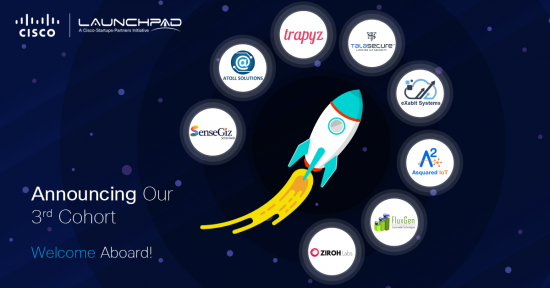
eXabit Systems: Cloud-based IoT Agri-Tech platform with a focus on Smart Sensing & Monitoring, Smart Control Systems and Smart Crop Analytics.

FluxGen Engineering Technologies: IoT-based water management solution that can help in saving water expenditure by up to 15%.

SenseGiz: Enterprise and Industrial IoT products for sensor-based condition monitoring, security and real-time asset/people tracking applications using a combination of connected hardware, cloud, analytics and apps.

Talasecure: Lifetime security for IoT devices through a comprehensive, easy-to-use and affordable solution that helps device manufacturers to reduce time to market of secure devices.

Trapyz: Software platform from Planetworx that provides brands with location intelligence to map offline consumer journeys across multiple venues in the real world thus helping derive purchase intent, buying propensity and campaign attribution.

Ziroh Labs:  Creating software-defined security stack with privacy-preserving, performant cryptographic algorithms.

Please stay connected with us on this initiative. Join us on Facebook and Twitter, @CiscoLaunchPad. Do visit our website to find out more about Cisco LaunchPad, opportunities to refer potential startups or to apply to this program.


Authors

Ravi Chandrasekaran

Senior Vice President, Engineering

Catalyst Engineering Group

Avatar

One week away from Christmas – let the countdown begin! Don’t get me wrong, I love this time of the year, but it doesn’t stop me from thinking about how many talented marketing professionals don’t want to lose traction with their key stakeholders.

In my last blog post, I talked about how the engagement economy embodies a fundamental shift in relationships between buyers and sellers, and is something that extends across entire organizations to include customers, prospects, employees, and partners. Bottom line, today’s marketer must engage with all stakeholders in a business — and even further, connect with them as human beings. More than ever, the only way to win the heart and mind of your customer is to consistently deliver authentic and personalized experiences.

How will we deliver these personalized experiences? Santa’s best kept secret, digital marketing.

Looking ahead to 2018, I’d love to hear from you on your marketing predictions and resolutions for 2018. In the meantime, here are several of my own:

Prediction #1: #NoFilter Content

Authenticity was key in 2017 — and it’s here to stay. Audiences today know that behind every story, photo and video are hours of work, strategy and craft to perfect it. The reality is manipulated to create the perfect illusion, but we need to stop and understand that true identity matters now more than ever. Creating an engaging identity requires companies to humanize their brands, which means telling stories that show growth. At the same time, these stories need to be transparent by including speed bumps along the road to success.

Resolution:

Hold back from airbrushing real-life stories around your company’s digital transformation journey. Digital brands need to be human to engage effectively with people. This will show that companies understand – and lead to gaining trust.

Prediction #2: The Reel Gets Real

What’s a good way to deliver authenticity? Digital marketing has become a battlefield between omnichannel content campaigns, with company’s trying to penetrate the awareness of customers from all touchpoints. We saw the rise of video, particularly live streaming, in 2017 and I would argue that no other content form connects with viewers as quickly and efficiently as video can. Video is a great way to get an important message across, and is more effective in locking the eyes of targets to secure their attention. Look out for more changes as social media giants like Facebook and Instagram work to push out new features and functions in video marketing.

Resolution: 

Implement video when it makes sense. The content is rich and the relevance of footage can last a long time. And I’m not referring to just filmed video – experiment with live streaming too!

Prediction #3: Insight Over Instinct – What’s Old Doesn’t Mean It’s Out

IoT is pushing everything to the edge. In today’s current phase of digital transformation, it’s up to us to leverage the convenience of automation and rapid communication of actionable insights. These insights are powered by IoT and cloud-based technologies, and combined with our human judgment to determine the right approach to customers, audiences, and geo-targeting, we have a winning formula.

The adoption of chatbots are growing and allowing companies to act like a 24/7 convenience shop for information. Technologies like AI will continue to grow, but brands are still experimenting to understand how to best incorporate AI into their business models in a way that will deliver the most business value. Regardless, it won’t be long before it becomes a mainstream marketing platform.

Resolution:

New trends and technologies are hard to resist, but we all have business models and are in different stages of digital transformation. Look into the resources you already have, and think about what can be streamlined and automated – as well as what can’t be replaced by bots just yet.

Prediction #4: The Rise of the CMOs

Today’s customer, and the customer of the future, will be more identity-centric. They’re searching for brands that cater to their identities as they look for ways to build their own personal brands. This is a great opportunity for CMOs and marketing leaders as we expect the demand for more thought leadership around topics that will benefit customers in developing their own identities.

Resolution:

Rethink our marketing and selling campaigns, and celebrate and leverage internal knowledge around strategies. This will cater to the growing appetite for self-marketing intel. Put forward a couple influencers from your marketing team and help them create platforms through their social media channels to start.

And that’s a wrap for my predictions going in to 2018. Happy holidays. Comments are welcome!


Avatar

Cisco’s U.K. Innovation Center, IDEALondon, had a lot to celebrate earlier this month, with holiday festivities, a celebration of its fourth birthday, and the launch of a new report on the United Kingdom’s “scale-up” ecosystem.

Scale-ups are companies that have grown beyond the initial startup stage, with more than $1 million in investment. IDEALondon has been active in helping these companies make the connections they need to grow, with more than 400 customer engagements in the last four years. Something about the formula is working because, according to the new report, the U.K. is outstripping the rest of Europe when it comes to producing scale-up companies.

You can read the whole story here.

Authors

Katherine Hannah

Head of Customer Engagement and Partnerships, Cisco Innovation UK and Ireland

Corporate Strategic Innovation Group

Avatar

Cryptography is very important in today’s world. Improper or maliciously altered crypto implementations have been a concern for the industry in recent years. To alleviate the risk, Cisco has been working with the industry, the National Institute of Standards and Technology (NIST) and other international organizations on finding ways to validate crypto implementations and speed up crypto certifications like FIPS or Common Criteria. The output of these efforts is the Automated Cryptographic Validation Protocol (ACVP).

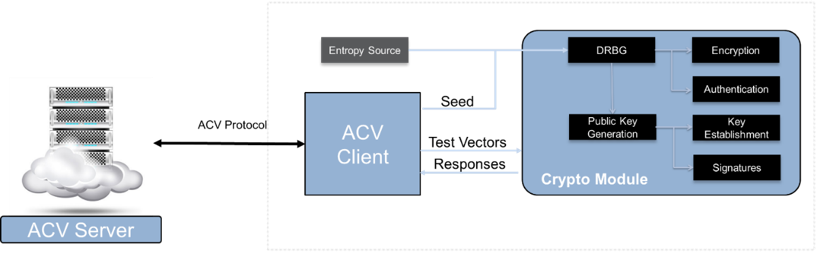
ACVP enables crypto implementations to interact with a server that provides crypto test vectors which the crypto implementation encrypts and sends back. The server can then check for correctness which would mean that the algorithms are implemented correctly. ACVP can be used for validations of the cryptographic modules. Cisco has open-sourced an ACVP client that implementers can use to validate and certify their algorithm implementations against NIST’s or 3rd party servers.

ACVP Architecture

On the other hand, constrained environments cannot always use all the commonly accepted crypto algorithms available because of their constrained nature. A battery operated sensor, for example, cannot use 3072-bit RSA because it would deplete its battery faster and because of the processing load. NIST’s Lightweight Crypto Program is working on defining lightweight crypto algorithms suitable for these constrained endpoints. Some of the lightweight algorithms are documented in their Report on Lightweight Cryptography. Additionally, a recent paper from NIST’s 2016 LWC Workshop describes a methodology of using use Joules/byte as a metric for evaluating the algorithms’ energy efficiency.

What if we introduced ACVP in Lightweight Crypto for constrained environments? Could ACVP be used to validate lightweight crypto implementations and provide energy efficiency metrics for these modules that are important for constrained environments? These were some questions we were interested in answering and proposed to North Carolina State University (NCSU)’s Computer Science (CSC) Senior Design Center as a Senior Design Project.

The NCSU CSC students who jumped into this new project were Jack Thornton, Jake Inkrote, Sam Rappl and Ian McKinnon. The project was driven by Barry Fussel and Panos Kampanakis from Cisco and overseen by NCSU CSC Senior Design Center Director, Ms. Margaret Heil, and technical advisors, Dr. Lina Battestilli and Mr. Michael DeHaan.

Sam, Jake, Jack and Ian working though their code with Barry and Panos.

The outcomes of this effort were:

We hope this work will be used and extended to expand the use cases of ACVP.

Sam, Jake, Ian and Jack on the Posters and Pies project demo day at NCSU

We would like to thank the NCSU CSC Department students, Ian, Jack, Jake and Sam, for the good work and collaboration. Also thank you to the Director of the NCSU CSC Senior Design Center, Margaret Heil, and CSC Senior Design technical advisors, Professor Lina Battestilli and Mr. Michael DeHaan. We hope it has been a good experience for them as it was a fun experience for us. The collaboration will continue…

Authors

Panos Kampanakis

Product Manager

Security & Trust Organization

Avatar

Whether it is misconfigured cloud assets, phishing, or malware, protecting your public cloud workloads from threats is a challenge with expensive consequences. If you have tried to extend your on-premises threat detection solutions in the public cloud, you probably know that they can be hard to manage, limited in scope, and ultimately ineffective.

The good news is no one can help you secure your public cloud workloads like Cisco.

Cisco Stealthwatch Cloud provides actionable intelligence, low-noise threat detection, and pervasive visibility in your public cloud infrastructure. As a software as a service, Stealthwatch Cloud is also easy to deploy – it can take as little as 10 minutes in AWS environments – easy to manage, and flexible in pricing.

Interested? Try Stealthwatch Cloud today with a free, 60-day trial.

So what makes Stealthwatch Cloud better than everything else? It comes down to three major things:

Security that makes sense in the cloud

You adopted public cloud infrastructure for very specific business benefits. It allows you to be responsive to the business, boost the availability of your services, and – most of all – lower your operational costs by providing exactly the computational resources you need when you need them. Unfortunately, a lot of cloud security products undermine these benefits by being difficult to manage and producing too many false alerts.

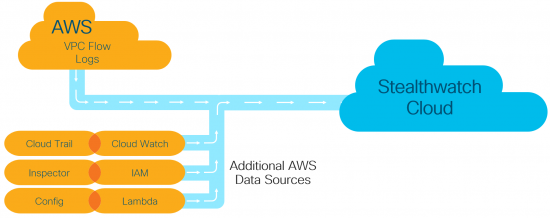
Stealthwatch Cloud was built to protect the public cloud while retaining the benefits that you went to the cloud for in the first place. In environments that support it, such as Amazon Web Services (AWS), Stealthwatch Cloud consumes VPC flow logs. This provides end-to-end visibility of the cloud infrastructure, including every transaction that takes place, and automatically scales as that infrastructure grows and changes. This allows Stealthwatch Cloud to easily monitor your cloud environment with minimal management.

Alerts that don’t waste your time

The cloud provides machine scale: an environment that is automated and dynamic to address your needs without heavy human oversight. In short, it allows you to do more without a lot of dedicated people. Numerous false alerts throw a giant wrench in that system by requiring extensive analyst investigation.

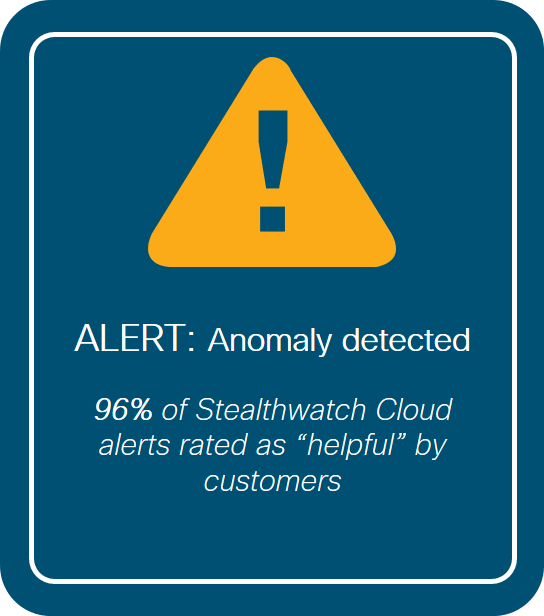
Stealthwatch Cloud aims – more than anything – to only draw your attention to actual problems, and when we do, to give you all of the information you need to address it. Today, our customers rate 96 percent of our alerts as “helpful.” This low-noise, high fidelity approach to alerts ensures you don’t waste time responding to false positives.


Intelligent behavior modeling

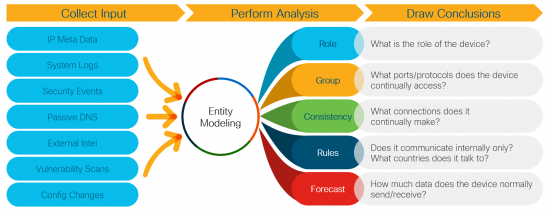
Stealthwatch Cloud employs an advanced form of modeling – termed “entity modeling” – to improve our alerts. For every entity operating on the network or in the cloud environment, Stealthwatch Cloud monitors its behavior to draw conclusions, such as the entity’s role, how it normally communicates, and if it is communicating in an unusual manner.

Entity modeling helps Stealthwatch Cloud identify a variety of bad activities, such as potential data exfiltration or geographically unusual remote access. For example, let’s consider an AWS S3 bucket that has only ever communicated with other internal assets in your AWS environment. One day it communicates with an external host. This could be for a variety reasons, both legitimate and not, but it is significant enough to warrant investigation. Stealthwatch Cloud would detect this activity in near real time and alert you to it.

Try Stealthwatch Cloud today!

If you think Stealthwatch Cloud might be a good fit for your organizations, sign up for a free, 60-day trial today.


Authors

Andrew Akers

Product Marketing Manager

Security Product Marketing

Avatar

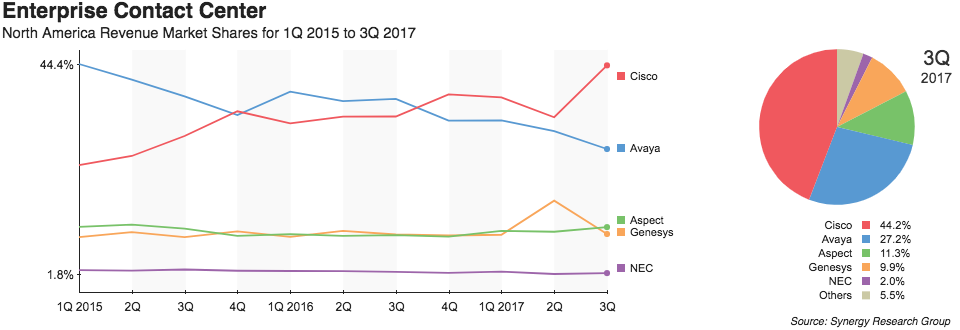
2017 has been a terrific year for Cisco’s contact center business. We’ve held number-one market share in North America for four straight quarters. And as Synergy reports, we had nearly 20 points higher share than our nearest competitor in the most recent quarter.Synergy: Q3 2017 Contact Center Market Share

But we never rest. We’re always looking to the future. Here are six things we foresee for the customer care industry in 2018.

1. Informal customer care will increase. 

Many businesses need to provide care, but not necessarily from a formal contact center. This includes small and midsize companies, but also teams within larger organizations. And the care can be for internal or external “customers.” For example, a marketing team might support sales on seasonal promotions. Or product developers could answer non time-critical questions from consumers. Persistent messaging is foundational to this type of care, whether to a customer or fellow employee.

Cisco introduced Cisco Spark Care to help businesses provide less-formal care. Built on Cisco Spark, it provides integrated administration and enterprise-class security.

2. The machines will rise. (But don’t be afraid.)

If you’ve been paying attention, the increased emphasis on artificial intelligence (AI) shouldn’t surprise you. AI can drive automated care via chatbots and the like. The interactions can be surprisingly natural. So much so that you’ve probably already chatted with a bot without realizing it.Bots are like IVRs, however. Employ them when they add value to the customer, not just to cut operational costs. It’s important to properly scope your bots. “Smarter” bots require more training and must typically address a narrower range of topics. Also, bots must seamlessly escalate to live support. This is one reason why Cisco predicts call volumes won’t drop much in the emerging age of bots.

Cisco Spark’s Care Assistant leverages AI and human experts. If the AI recognizes a question, it provides an answer. If it doesn’t, it escalates the query to people. Cisco also acquired MindMeld to power the next generation of automated conversations.

3. Context is everything. 

We hear this from politicians all the time: “You quoted me out of context!” This is because context really is everything. Without context, you don’t know the whole story. Fantastic customer support requires that we know who the customers are and why they’ve contacted us. Customers interact with businesses over time and across different channels. The customer views this as a single, connected journey and you as a single entity. But the business typically sees these interactions as isolated, disconnected events. Is it any wonder consumers are frustrated?

Cisco’s cloud-based Context Service allows you to keep track of previous customer interactions to provide faster, better-focused care. Best of all, it’s built into our Contact Center Enterprise and Express products.

4. It’s cloudy out there. 

Contact centers are moving to the cloud, especially at the low end of the market. But on-premises contact centers won’t disappear anytime soon. In fact, many new customers still prefer on-premises deployment. What does that mean for you? When evaluating vendors, consider one that lets you choose your deployment model. (Like Cisco.)

Cisco offers contact center solutions for on-premises, cloud, and hybrid deployments. You’ll also want a solution with open APIs and rock-solid security to leverage best-of-breed capabilities and even multicloud possibilities (think Google, AWS, Azure, etc.).

5. The new table stakes: Implement on time and on budget. 

We all want the newest shiny feature, but not if it’s going to disrupt the customer experience – or the bottom line. What good is a long list of promised features and a lowball price estimate if the vendor can’t deliver in reasonable time and without endless add-on costs? How confident are you that web services from a provider with no care heritage can be the backbone of your contact center?

More and more businesses leaders have expressed delight that their Cisco contact center was deployed on-time and on-budget. Our channel partners feel the same way.

6. Many more identities will be stolen. 

We’ve heard the horror stories. And it may have happened to you. I spent hours last weekend reactivating a credit card account after someone stole my personal data. How secure is your contact center? Is it built on solid security like Cisco’s? The scary truth is that nothing is 100% secure (except perhaps a bone guarded by my dog), but you want the odds in your favor. Consider world-class Cisco security.

I hope 2017 has been good to you and your business. I can’t wait to see what 2018 holds in store for us and the contact center industry!

Learn more about how Cisco contact center products can help your business – and your customers.

Authors

Jeff Campbell

No Longer with Cisco

Avatar

Hybrid cloud will be the way many companies, across industries, future-proof business and innovate faster than ever before. I recently shared my thoughts with Information Week about the evolution of customers’ hybrid cloud expectations and the new requirements that are impacting how customers think about their cloud strategy.  They want more choice, consistency, control, and compliance – anywhere. In a hybrid IT world, applications live everywhere, and it will take more than just connecting clouds to be successful.

Our recently announced partnership with Google Cloud is a great example of a major step forward in enabling our customers to address these requirements. If you look at most hybrid cloud solutions today, they look a lot like two clouds with VPN tethered between them. What we are building and what is different is a more integrated system and experience for developers, IT, operations, and security staff. We are enabling customers to extend their management frameworks and tools across on-prem and cloud, and treat those environments as a single system with the right policy or security controls, but without artificial barriers or differences between the environments to make it difficult to build applications that take advantage of these abilities in both of those environments. The Cisco and Google Cloud hybrid cloud offering opens the door for developers to combine emerging Google Cloud services with Cisco on-premises networking, hyper-converged, and security offerings. Together we are working on a complete solution to develop, run, secure and monitor workloads that enable customers to optimize their existing investments, plan their cloud migration at their own pace and avoid lock-in.

More to come. Our goal is to help our customers build cloud strategies based on their unique business needs and cloud providers they work with today. We’re complementing offers from major cloud providers and helping our customers navigate this new world, to bridge across a multicloud environment with critical areas like networking, security, analytics, and management.

If you had a chance to catch my commentary in Information Week, please share your thoughts.


For more information:


Authors

Kip Compton

No longer with Cisco

Avatar

The cloud has always been in a key pillar of digital transformation—and it is fast becoming one of the enablers of tomorrow’s mobile world.

According to the Cisco Global Cloud Index (GCI) 2015-2020, cloud traffic will represent 92 percent  of total data center traffic globally by 2020.

mobile networkIt shouldn’t come as a surprise that an increasing number of applications and workloads are moving to the cloud. Due to the ability of cloud infrastructure to scale quickly and efficiently, cloud operators are delivering a growing variety of services to businesses and consumers alike.
In Asia Pacific, cloud adoption is already in overdrive and will continue to gain traction. The region is set to outpace the rest of world with a 31.6 percent CAGR in cloud data center workloads from 2015 to 2020. Key market forces and trends driving today’s cloud momentum include:

The world has gone mobile

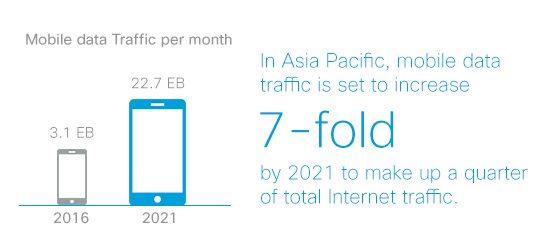
Mobile trafficSmartphones have quickly become the main “communications hub” for many people across the Asia Pacific region, especially in countries such as India. Consumers and business users are increasingly using their mobile devices to access cloud-enabled applications such as collaboration, social networking and video streaming. Mobile data traffic in Asia-Pacific is set to increase 7-fold from 2016 to 2021 to make up a quarter of total Internet traffic. Of that traffic, 92 percent will be from cloud services, up from 85 percent in 2016*. This shift means that mobile users’ quality of experience will be increasingly dependent on the mobile network’s ability to deliver cloud services with high bandwidth and low latency.
Consumer workloads are growing fast, driven by video applications

Video and social networking will dominate consumer workloads. Globally, video streaming alone will account for 34 percent of total consumer workloads by 2020. In the region, video is already the majority of fixed and mobile traffic and will continue to grow by 9-fold between 2016 and 2021[1]. As the transition to 5G networks takes shape, video will be one of the primary beneficiaries with faster speed and improved quality for end-users. 5G networks will also further enable new applications such as augmented and virtual reality.

Rise of machines and IoT connections

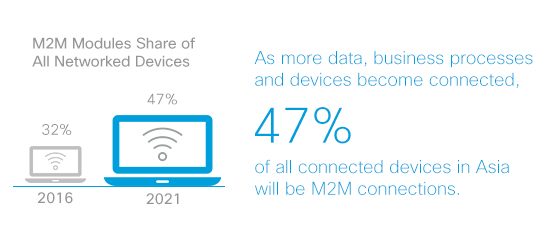
Cloud services are also accelerated by the unprecedented amount of data traffic being generated by not only people, but also machines and IoT connected devices. As more data, business processes and devices become connected, 47 percent of all connected devices in Asia Pacific will be M2M connections1. For service providers, the ability to create M2M connections can generate significant new business opportunities in the B2B and enterprise market segment. Service providers will need to leverage hybrid cloud enviroments to build these IoT platforms to allow for service agility and capability exposure to enterprises.



Powering transformation through cloud innovation

Just as Asia Pacific is gearing up for cloud transformation, service providers need to ensure their mobile networks are cloud ready, and equipped with the agility to cope with the sheer volume and complexity of cloud-enabled workloads. Network Function Virtualization (NFV) is another significant game-changer in redefining network architecture and service delivery, empowering service providers to unlock greater efficiency, capacity and reduced costs.

Along with the increased significance of the cloud, the explosion of mobile-ready devices and IoT connections also mean service providers need to ensure faster, more reliable mobile services – a promise that future 5G networks can deliver upon, by taking the benefits of NFV and network slicing concepts.

Cloud

Are your networks ready for 5G?

To handle the increased amount of network traffic generated, service providers need to look at streamlining their infrastructures to ensure they can deliver IP-based services profitably. Some of the technologies that service providers should consider include:

  • Leaf-spine architectures to flatten the tired architecture of data centers to better support the increasing number of mobile connections
  • Software-defined networks (SDN) which separate the control and forwarding of data center traffic to streamline mobile data flow and address any bandwidth bottlenecks
  • Network function virtualization (NFV) which virtualizes a variety of network elements to bring in more network programmability and automation that facilitate new service innovations

Combined, they will give service providers the flexibility and agility to adapt to evolving user demands, as well as server, networking and IT needs. They also facilitate faster time-to-market of new services to accommodate upcoming trends such as the proliferation of IoT.

Cisco GCI estimates that by 2020, over 40 percent of all within-data-center traffic will be transported via SDN/NFV networks. Service providers looking to remain competitive will need to create service differentiation through these technology tools and approaches.

With our full suite of solutions and network innovation, Cisco is well positioned to help service providers in Asia Pacific prepare their networks infrastructure for 5G.

The possibilities of 5G are endless, and we look forward to helping you discover more greater opportunities.
Download our Service Provider Strategy whitepaper or contact us today to find out how we can help you lay the groundwork for mobile success.


*Source:  Cisco VNI Forecast Highlights Tool

Authors

Andrew Mackay

Head of Mobile Solutions

Asia-Pacific Region

Avatar

As networks grow, so does the complexity that comes with adding new applications and on-boarding new devices—including IoT—all while delivering a more secure network. Add to that challenge the drive to transform the network to deliver new innovative services and applications while providing the best experience for your customers.

Read on, because Cisco has the solution.

Built on the principles of Cisco’s Digital Network Architecture (DNA), Software Defined-Access (SD-Access) provides automated end-to-end segmentation to separate user, device and application traffic without redesigning the network. SD-Access automates user access policy so organizations can make sure the right policies are established for any user or device with any application across the network. This is accomplished with a single network fabric across LAN and WLAN. Pairing the two creates a consistent user experience anywhere without compromising on security.

Now available for customers, SD-Access takes the complexity and the stress out of your growing network. Don’t just take our word for it. The engineers at Network Test Inc., an independent testing lab, has put SD-Access through a series of tests in their recent report. Take a look and see how Cisco SD-Access rates in providing a simpler yet more powerful approach to enterprise networking.

After you’re done reading how well we did, take a look at the new Cisco DNA ROI Calculator. The Cisco DNA ROI Calculator allows users to review and modify eight different use cases in order to get a better understanding of the operational ROI associated with SD-Access and Cisco DNA. This tool provides an excellent starting point to understand the dramatic operational saving enabled by the automation and assurance provided by Cisco DNA Center and SD-Access.

With the growth of Wireless devices including IoT along with the importance of keeping a network secure, Cisco knows that being a Network Administrator can be a stressful job. We have created this video to see if you can live without the stress.

Go ahead and check out the video, read the report and crunch the numbers and you will see the benefits of Cisco’s SD-Access. If you want more information, please visit www.cisco.com/go/sda.


Authors

Bill Rubino

Product Marketing Manager

Enterprise Networking and Cloud Marketing