Avatar

Today’s network was devised decades ago. Over the years, it has been stretched to meet the ever-growing needs of enterprises – tinkered, tweaked and extended. It is time for a major reset. To take on this major shift in networking, we at Cisco introduced the Network Intuitive earlier this year. This was a culmination of a series of innovations that the enterprise networking engineering team has had in the works for a while. We brought together the level of vision and execution necessary to empower a network to automatically configure, understand and maintain itself based on the desired needs of business. This launch concludes the first leg of a phenomenal engineering journey, paving the way for our next set of networking innovations.

You may think revolutionizing the industry would be enough, but besides our big announcement around actualizing intent-based networking built on the Cisco Digital Network Architecture (DNA), the year was chockfull of other highlights. When I look back at the year, I feel like I just got off one of those action-packed, 3D rides at an amusement park. The year was a non-stop engineering extravaganza, one where Cisco showed that we are unafraid to disrupt ourselves. Here are my top seven for 2017.

  1. The New Generation of Catalyst Switches
    The Catalyst switch family has had an illustrious past. It continues to provide a trusted foundation for many organizations’ campus networks. So, this year, when we introduced the next generation Catalyst 9000 family of switches in June, we knew it had big boots to fill. And, what a punch it delivers– secure, completely programmable, cloud-ready, and tailored for the mobile, IoT-scaled world. We’re so excited about the rave reviews its already receiving.
  2. Accelerating SD-WAN Solutions
    In August, we were thrilled to welcome Viptela into the Cisco family, to provide a compelling software-defined wide area network (SD-WAN) solution that simplifies management, increases agility and reduces costs of interconnecting dispersed enterprise networks. Its network management, orchestration and overlay technologies make it easy to deploy and manage SD-WAN. This cloud-first approach also aligns with Cisco’s Digital Network Architecture (DNA) transition to software-driven, automated networks that are more flexible, responsive and dynamic.
  3. Growth in Wireless LAN
    2017 was also the year our flagship wireless product portfolio saw lots of advancement including new capabilities like: Flexible Radio Assignment that automatically adjusts your wireless network to meet higher capacity needs and Mobility Express, a controller-less wireless network deployment that combines ease of deployment with affordability. Cisco’s Connected Mobile Experiences (CMX) with Hyperlocation and Cisco Beacon Point deliver near-real-time analytics and engagements through precise location accuracy of less than three meters.
  4.  Cutting-edge Intelligence via Software-Defined Access
    SD-Access provides automated end-to-end segmentation to separate user, device and application traffic without redesigning the network. By decoupling network functions from hardware, SD-Access helps ensure policy consistency, enables faster launches of new business services and significantly improves issue resolution times while being open and extensible and reducing operational expenses. Furthermore, with dynamically segmented networks, at scale, networks are more secure since the edge can sense and enforce.
  5. Encrypted Traffic Analytics meshes networking and security closer together
    Gartner predicts 80% of web traffic in 2019 will be encrypted. This raises a serious question of how IT teams can detect malware hiding in encrypted traffic, without sacrificing privacy and decrypting it. Encrypted Traffic Analytics (ETA) uses enhanced network visibility and passive monitoring to detect encrypted malware traffic on enterprise networks. We are literally “solving the unsolvable” with this solution.
  6.  Networking Magic with Cisco DNA-C
    Cisco DNA Center is the command center of the network, where all the magic happens, is Cisco DNA-C revolutionizes how networks are operated. It allows IT to centrally manage and automate their network with a centralized dashboard for design, provisioning, policy and even assurance. Elegantly simple yet with powerful, granular control over data, Cisco DNA-C provides control, security and analytics. Cisco DNA-C is our most exciting platform ever! Stay tuned for our next set of innovations coming in 2018.
  7. Software Subscription Model
    Besides the many engineering innovations we were able to launch this year, the other major highlight was our transition to a software subscription model. We have always been a software company but we are changing how infrastructure software is bought and deployed in the new era of networking. This reinforces our commitment to enable customers to flexibly, easily and quickly access ongoing innovation through a simple subscription-based model.

I’m incredibly proud of these seven innovations. If this year is a sign of things to come, I cannot be more excited and confident in our continued innovation in 2018. I guarantee you’ll see us continue to lead the industry forward. I hope you’ll continue to watch our journey and lend your support. Here’s to a great 2018!

 

Authors

Ravi Chandrasekaran

Senior Vice President, Engineering

Catalyst Engineering Group

Avatar

Traditional features such as SNMP, CLI, and Syslog, used for collecting operational statistics from a network, have several restrictions due to the growth of the objects like IoT devices and cloud based applications.

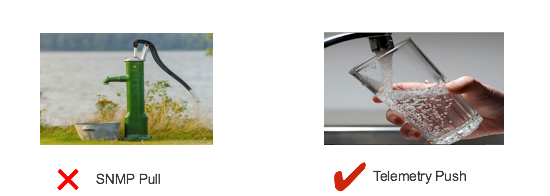
SNMP uses the pull model when retrieving data from a switch. This model cannot scale for today’s high-density platforms, and offers very limited extensibility. The pull model is based on a client sending a request to the switch, then the switch responds to that request. On average, network operators using SNMP poll data every five to thirty minutes. But with today’s speeds and scale that’s not enough to capture important network events. SNMP also uses push model while sending a trap similar to Model-Driven Telemetry on-change notification which is described later in this blog.


These traditional models also impose limits like scale and efficiency. We are using the same tools (SNMP and CLI) to get operational data of our routers and switches that we are using from years. These two also put barriers for truly automating and gathering data from network devices.

The Main use cases for network monitoring and troubleshooting didn’t change much but what’s new is that hardware capabilities and performance has changed tremendously. Many third party applications have been developed to collect data from network devices for data storing, analyzing, indexing, searching, and visualizing. And all these tools are open sourced.

Why Model-Driven Telemetry?

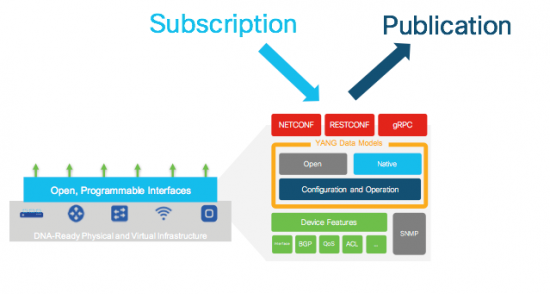
Model-Driven Telemetry is a new approach for network monitoring in which data is streamed from network devices continuously using a push model and provides near real-time access to operational statistics. You can precisely define what data you want to subscribe to using standard YANG models (YANG is a data modeling language used to model configuration and state data manipulated by the NETCONF protocol) with no CLI required. It allows network devices to continuously stream real time configuration and operating state information to subscribers. Structured data is published at a defined cadence, or on-change, based upon the subscription criteria and data type.

You also can use third party applications to collect the data which can be used for monitoring and troubleshooting. Telemetry subscriptions and their updates are transmitted over a NETCONF session. A NETCONF session is established by starting an SSH session to the device on port 830.

How to create Subscription

In order to stream data from the device the application must set up a subscription to a data set in a YANG model. A subscription is a contract between a subscription service and a subscriber that specifies the type of data to be pushed. Subscription allows clients to subscribe to data models and device pushed the data to the collector for the subscribed model.

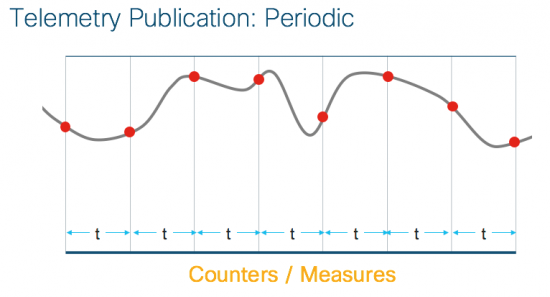
There are two types of subscriptions: periodic and on-change. With periodic subscription, data is streamed out to the destination at the configured interval. It continuously sends data for the lifetime of that subscription. With on-change, data is published only when a change in the data occurs such as when an interface or OSPF neighbor goes down.
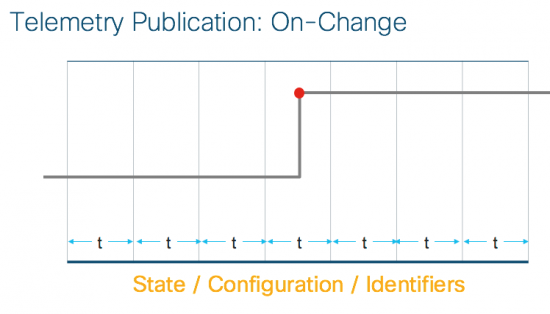

Subscriptions are created over existing NETCONF sessions and are created using XML RPCs (RPC is a Remote Procedure Call protocol which uses XML to encode its calls). The establish-subscription RPC is sent from a client or collector to the network device. The following is a sample output from the show telemetry ietf subscription all detail command, which shows the details of a subscription.

switch#show telemetry ietf subscription all detail
Telemetry subscription detail:

Subscription ID: 2147483678
Type: Dynamic
State: Valid
Stream: yang-push
Encoding: encode-xml
Filter:
   Filter type: xpath
   XPath: /cpu-usage/cpu-utilization/five-seconds
Update policy:
   Update Trigger: periodic
   Period: 1000
Notes:

There are different third party applications to collect the data from switch. Below is an example for the data collected in ELK stack and represented in Kibana. ELK stack is an open source application for real time data analytics for structured and unstructured data. KIBANA is an open source data plugin and provides visualization capabilities. Below is the graph for CPU utilization for every five seconds represented in Kibana.

You can delete a subscription in two ways. One is by sending a delete-subscription RPC with the subscription ID or a subscription is also deleted when the NETCONF session is torn down or disconnected.

Now you can also stream on WLC

Until now you have learned about streaming telemetry on switches, but now you can also stream real time data from a Wireless LAN Controller as well. On the WLC, streaming of data will be implemented using pre-configured webhooks. A Webhook is a web application that POSTS a message to a URL when certain things happen, it delivers data to other applications with near real time information. This webhook is a new feature that comes in WLC and enabled with few cli commands.


On the WLC you will subscribe to a tables such as AP’s, client, mapserver using either CLI or the GUI. Once a subscription is enabled on the WLC, it starts streaming data to the telemetry consumer.

Data is published in the form of snapshots at interval of 5 minutes or 30 seconds. Each snapshot can be either ‘Bulk’ or ‘Differential’ type. As the name suggests, ‘Bulk’ is the whole dataset and ‘Differential’ is a patch on top of last bulk. You can also enable network webhook on-change publication that means when a change occurs then only a notification will be sent. Similar to switching you can use different third party applications to view the collected data.

Try it

Modernize your network monitoring using Streaming Telemetry and if you need some help getting started with, refer Cisco.com, DevNet, IOS-XE pages, Learning labs and Sandboxes for more details.


We’d love to hear what you think. Ask a question or leave a comment below.
And stay connected with Cisco DevNet on social!

Twitter @CiscoDevNet | Facebook | LinkedIn

Visit the new Developer Video Channel

Authors

Krishna Chaitanya Kotha

Technical Marketing Engineer

Technical Marketing Engineering

Avatar

At work, we accomplish tasks through the people we work with. We collaborate. Communication is the key to collaborating with co-workers, customers, and stakeholders. At Cisco, we strive to make communication simple as possible. We offer ways to have meaningful, face-to-face interactions with everyone you work with, no matter the location.

Cisco Meeting Server is our video-conferencing solution for on-premises deployment. On-premises infrastructure supports the greatest percentage of workloads, reaching 43% for enterprises.

Cisco Meeting Server makes running digital meetings efficient, simple, and secure. Help your users to communicate seamlessly with video, voice, and content sharing.

We’ve simplified joining, running, and participating in meetings. Now available, Release 2.3 of Cisco Meeting Server makes this solution a better collaboration platform than ever before. Cisco Meeting Server is the on-premises meetings solution within the Cisco Spark Flex Plan, which enables user-based subscription purchasing. We also support perpetual user licensing, so that you can choose whatever way to purchase Cisco Meeting Server that is best for you

Here are five top reasons to upgrade or migrate to Release 2.3:

Cisco Meeting Server offers the industry’s highest capacity for meetings. You can connect from one to eight servers in a single cluster per call to connect all the people you need. For large deployments, you can connect 24 servers. Our competition says they can link as many servers as you want, but this causes less efficient deployments, poor user experience, and more expensive server requirements. Cisco Meeting Server supports 12,000 concurrent HD video calls to deliver clear audio and visual for all attendees. Enable your company to collaborate as often as needed with cluster-wide licensing.

People can join a Cisco Meeting Server meeting at any time, from any location, via the updated Cisco Meeting appActiveControl technology in the app gives you more control of your meeting. The app upgrade allows you to change the layout to see what you want in a group meeting. From your mobile device, you can add or remove participants and control recording or streaming. You can mute others, too. The app even pairs with Cisco video endpoints through intelligent proximity giving you call control and the ability to share content wirelessly. Anyone can join your meetings easily on mobile devices or with Google Chrome through WebRTC. Gone are the days of waiting for plug-ins and downloads before getting to work.

Cisco Meeting Server works with all supported Cisco video endpoints including the new Cisco Room Kit and Cisco Room Kit Plus. These devices have new features that can count meeting attendees for usage metrics and resource allocation. Cisco Room Kits track the active speaker and automatically frame the image of that person. Using artificial intelligence, Cisco Room Kits can switch between and frame speakers more quickly as meetings progress.

You can stream to an unrestricted number of teammates through Cisco Meeting Server. You can even stream to all of your customers on Facebook or YouTube. You can record meetings to edit and share later through Vbrick. Cisco Meeting Server records the raw meeting content and pushes it to Vbrick, which uses your directory and permissions to manage and distribute your content. This helps make sure you can get your crucial information to everyone.

Cisco Meeting Server plays well with others. It’s fully interoperable with any standards-based video endpoint as well as with Lync or Skype for Business. Anyone with a standards-based system connecting to Cisco Meeting Server will enjoy our easy-to-use front-end experience. With our dual-home solution, people using Skype for Business or Office 365 can connect while maintaining the user experience they are familiar with. Everyone connects with audio, video, and content sharing while enjoying the familiar experience of their existing system to simplify connection across video systems.

I work for Cisco from Raleigh, North Carolina, and I collaborate daily with my team leader in England and other teammates across the world. I’m experiencing how simple collaborating across continents can be with online meetings and video.

Cisco offers one of the top on-premises video solutions in the industry. Gartner recently named Cisco a leader in its Magic Quadrant for Meeting Solutions based on our “ability to execute” and “completeness of vision.” Download the report to learn more.

To ensure your organization has smooth meeting experiences, upgrade to Cisco Meeting Server 2.3. Enable your company to use our latest technology to make work simpler. As the new release makes meetings more scalable, accessible, and user-friendly, now is the time to upgrade.

Learn more about the latest edition of Cisco Meeting Server. Find out how Cisco Services can help simplify the upgrade process.

Authors

Suzanne Phillips

Education Business Development Manager

Global Industry Solutions Group

Avatar

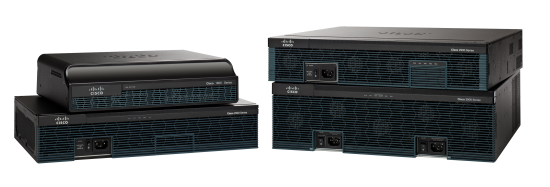
Over the past 9 years, the Integrated Services Router (ISR) G2 router portfolio has helped tens of thousands of Enterprise and Service Provider customers build, secure, grow, and transform their businesses. It has been the most successful router product line in the history of branch networking.

Introduced in 2009, ISR G2 has been the anchor product of Cisco’s enterprise networking business.  However, there comes a time when the leader has to pass the baton to the next generation, and for the ISR G2, this time is now.  The Cisco 2900 and 3900 ISR G2 Series is End of Sale this month (December 2017).
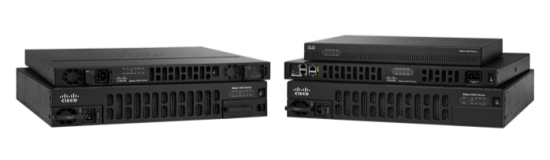
Why now? In June 2017 we launched a New Era of Networking, taking an Intent-based networking approach across the Cisco portfolio. Built on Cisco DNA, we believe that Intent-based Networking is the future of networking and it will help our Enterprise and Service Provider customers successfully navigate the digital disruption we are seeing across all industries.

Using Cisco’s Digital Network Architecture (DNA) as our vision and strategy my team and I used the years of experience and insights we  have developed building Enterprise-grade multi-service branch platforms when designing the next generation of Integrated Services Routers – the ISR 4000 series. The ISR 4000 Series has already been deployed by over 25,000 unique customers with more than 725,000 units shipped since launch. What makes the ISR 4000 so special? It is a single platform that is designed for:

  1. Intent-based Networking

Enterprise grade software: ISR 4000 runs Cisco IOS XE software which lays the foundation for the Intent-based networking across Cisco’s enterprise networking portfolio. Built for enterprise routing, security, unified communications, IoT, and the cloud, the ISR 4000s form the foundation for Cisco’s Software-Defined WAN as well as Cisco Software-Defined Access.

Automation and assurance: The ISR 4000 can be managed by DNA Center, which is a centralized network monitoring dashboard for managing your end-to-end network including the campus, branch and WAN. Cisco DNA Center simplifies network management so IT can move more quickly, using automation to lower costs, assurance and analytics to improve network performance, and security to reduce risk.

  1. Best in-class performance and security

Multi-service architecture: Cisco IOS XE version 16 is an open and flexible operating system with containers for 3rd party app hosting. Standards-based programmable interfaces automate network operations and give you deep visibility into user, application, and device behaviors.

Embedded security: Application aware firewall and intrusion detection secures business critical applications. Newer features like Encrypted Secure Communications using Next-Generation Encryption (NGE) or Suite B Cryptography for secure voice communications.

  1. Investment protection

Flexible consumption: Cisco ONE software licensing provides the investment protection with services-enabled software license portability. Customers who have Cisco ONE for ISR G2s have an easy path to move to the ISR 4000’s by just swapping out the platform and bypassing the software licenses payments. Cisco ONE also offers investment protection to existing customers looking to move to SD-WAN with Viptela.

Network functions virtualization: Integrated server blades going up to 12 cores and 32 TB storage combined with best in class network hypervisor NFVIS for running VNF’s provide enterprise grade routing with the flexibility of deploying new network services on demand.

As the Cisco ISR G2 2900 and 3900 Series pass the leadership baton to the Cisco ISR 4000, my team and I are working hard to ensure that our loyal customers can make the seamless transition to Intent-based networking for the branch and WAN. For a full list of benefits when migrating to Cisco 4000 Series Integrated Services Routers read more here.


I would love to hear how the ISR G2 and ISR 4000 Series are helping you achieve your business objectives. Let’s continue the conversation:  @jayeshchokshi or https://www.linkedin.com/in/jay-chokshi-a995344.


Authors

Jay Chokshi

Director Product Management

Enterprise Networking

Avatar

As we head into the last few days of 2017, I look back on the year with gratitude and pride. I want to thank our employees, partners and customers for being part of the Cisco Services journey during the year. Together, we explored some exciting new territory in technology services. We have some amazing results to be proud of, highlighting an acceleration in Cisco innovation:

  • A new era of predictive services In October we launched two new service portfolios that harnesses the power and intelligence of AI and machine learning to help CIOs address their most pressing challenges.
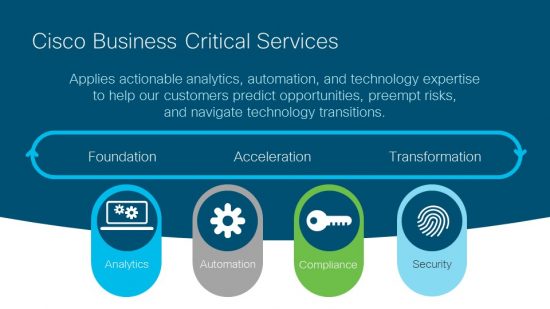
    • Business-Critical Services helps customers reduce complexity with automation, delivers critical insights on infrastructure and applications, and offers subscription security services to manage threats proactively.

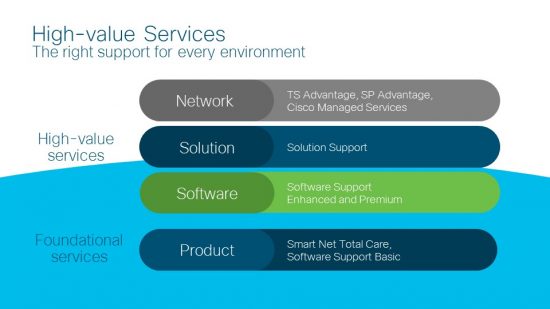
    • High-value services goes beyond traditional technical support to offer premium network, solution, and software support. We can now deliver centralized support across Cisco ecosystems, resolving issues 43 percent faster than with product support alone.

  • The Multicloud portfolio – As customers move into the multicloud world, they need a multivendor architectural approach to help them manage how they connect, consume, and protect cloud services in a consistent way, no matter where the services reside. We have rolled out an extensive Advisory services capability to help customers understand how to build and execute their cloud strategy. Cisco’s partnership with Google announced in October takes a big step toward helping customers access and run cloud-based applications that span on-premises resources to public cloud environments. With these new capabilities, cloud is finally delivering on its promise of flexibility, simplicity, and speed.

  • Building startups from scratch
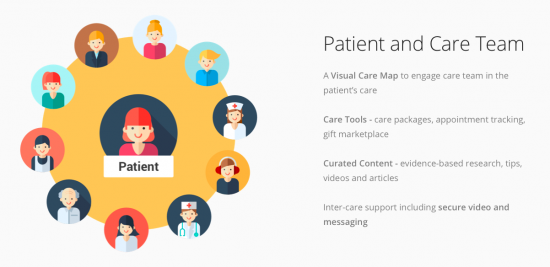
    Innovation at Cisco doesn’t only lead to new products and services. Sometimes it leads to a brand new startup. Cisco Hyperinnovation Living Labs (CHILL), led by Services Senior Director Kate O’Keeffe, has always been known for delivering a compelling innovation experience, resulting in some interesting joint projects with customers. But this year, one CHILL outcome has grown into a full-fledged startup. MyWays is a healthcare startup conceived last year at a CHILL lab focused on improving the experience of cancer patients. It provides a mobile app that makes it easy to marshal and integrate care and support throughout the cancer treatment journey, “igniting humanity’s capacity to care for each other.” Look for more startups to grow out of CHILL in the coming year.


All of this is possible because of the diverse and talented group of people I work with every day.


Their commitment to our customers’ success has led to Cisco winning the J.D. Power award for “Outstanding Customer Service Experience” for the 11th consecutive year. They are also committed to making the world a better place by contributing their time, talent, and financial support to people in need. During this season of giving, I invite you to join us in this spirit by supporting a cause that is important to you.

Whether you’re a customer, colleague, or employee, I’m glad you’ve been a part of our year, and I wish you a happy holiday season, and I look forward to continuing our journey together in 2018.


Authors

Joe Cozzolino

Senior Vice President

Cisco Services

Avatar

What captured the attention of healthcare professionals this year? Well, if our blog is any indication, quite a lot! As 2017 comes to an end, we take a look back at the top five most-read stories on our healthcare blog and what they tell us about the priorities and interests of our audience (Spoiler alert: cyber security is the runaway hit.)

We’ll start with number five and work our way up.

“Digital Transformation” is more than just a buzzword.

It’s inescapable: Healthcare is going digital, and leaders are looking for ways to extract maximum value from the shift. In March of this year, IDC released a Vendor Spotlight outlining the challenges and opportunities ahead for healthcare, including how the Cisco portfolio can help. Our fifth most-read blog post summarizes the report and includes links to an infographic as well as the full spotlight. Read the blog here. 

Cybersecurity concerns rise to the top as healthcare lags in maturity.

Our 2017 Annual Cybersecurity Report held some disconcerting news for healthcare, revealing that less than a one-third of healthcare organizations have high security preparedness, or “maturity.” At the same time, cyber attacks are rising and becoming more sophisticated, so the time to act is now. The fourth most-read post explores news from the annual report and offers a link to an infographic outlining solutions to ten of the most common healthcare security challenges. Read the blog here.

High-profile cyber attack rattles healthcare professionals worldwide.

On May 12, 2017, the now-famous WannaCry ransomware attack seriously disrupted patient care across the National Health Service in the UK (as well as other businesses across the globe). As files were locked and computers rendered inoperable, thousands of non-emergency appointments were canceled and ambulances  were forced to divert to other facilities. The attack was a wake-up call to many in the industry, forcing organizations to take a closer look at software patches and other, more sophisticated defenses. Our third most-read blog, posted on the day of the attack, broke the news to our audience and offered a link to a timely white paper on cyber security strategies for healthcare. Read the blog here.

The EHR is now an essential part of healthcare operations—and infrastructure must keep up.

The announcement of a partnership between Cisco and Pure Storage generated the second most-read healthcare post of the year. Our solution, called FlashStack, combines Cisco UCS with industry-leading flash storage in one powerful package. This is especially good news for for customers of Epic, the leading electronic health record (EHR) software vendor in the U.S., because FlashStack is Epic-compliant.  Now, all of the data coming in through your EHR can be stored in a more modern way that allows you to drive always-on, high performance for Epic (even under heavy use), and deploy a cloud-like infrastructure for flexible growth. Read the blog here.

Groundbreaking FDA action lends urgency to the threat of medical device hacking. 
Our number one most-read post in 2017 has to do with the topic on everyone’s minds, cyber security. In late August, the FDA announced the first-ever recall of a medical device—a pacemaker—due to security concerns. This action was the culmination of an investigation by the FDA in February that highlighted a number of areas of non-compliance. The news generated significant buzz, partially because it is the first time that the FDA has acted to protect patient health in this way. And while there have been no reports of patient harm to date, connected devices continue to pose a threat to both patients and facilities—a fact underscored by the FDA’s announcement. Read the blog here.

Bonus post! A look back at everyone’s favorite portability and accountability act.

Just for fun, here’s my favorite post of the year—well, at least it was my favorite to write.  It combines HIPAA, cyber security, and…Prince? Check it out!

So there you have it—2017 in a nutshell. If you missed them the first time (or even if you didn’t), we hope you’ll go back and give these healthcare blogs another look. As we move on to 2018, we look forward to a year that promises even more opportunity and innovation in digital healthcare. Thank you for letting us be a part of the journey.

Authors

Amy Young

Marketing Manager

Healthcare

Avatar

Guest blog by:
Paul Bibby
Solutions Engineer
ResponseTap


Enabling conversations that get to the point of sale faster

Imagine if you could connect a caller’s online website journey to their phone call.
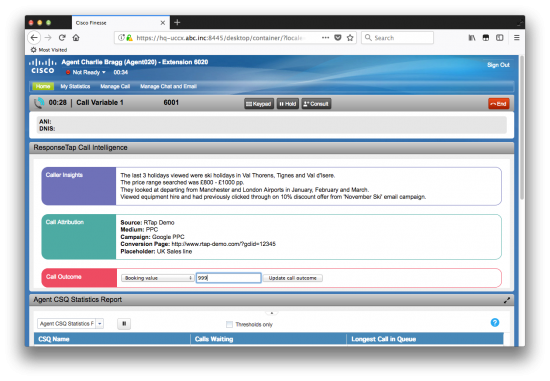
As soon as a contact center agent answers the call, they’re presented with valuable insights from the caller’s online journey, enabling a more relevant conversation that gets to the point of sale quicker and improves the customer experience. Well, that’s exactly what the ResponseTap platform enables and thanks to Cisco Finesse we have now expanded our reach.

Who are ResponseTap?

ResponseTap is the leading Call Intelligence platform. Traditionally we’ve been used by marketing teams wanting to plug the gap in their analytics and discover which campaigns drive phone calls, and their associated revenue. This is done by each visitor on the website getting a tracking number that’s not displayed to any other visitor on the website at that time. Therefore when they call the number, we can link the online journey to the phone call and show marketers where to spend their budget. But we always believed that the online journey we captured could be of just as much value for the contact center, and conversely, the data captured from the contact center, such as a sale value, could then be of benefit within our platform.

A faster, hands-on way to explore technologies and prototype solutions

When asking our customers what technologies they had in their call center, Cisco Finesse was repeatedly mentioned, so it made sense for me to find out exactly what it was and see if we could add Finesse to our portfolio. My role as Solutions Engineer involves exploring problems, researching technology and prototyping ideas. I want to be able to do this as fast and as cheaply as possible without going down too many dead ends. The Cisco website has always had a good range of collateral available about Finesse and it’s ecosystem. But no mater how many documents I read or videos I watch, I always feel the need to get my hands on a product to fully understand it; the Cisco UCCX Sandbox environment made this a possibility and within a couple of hours I was making and answering phone calls within Finesse, and all at no cost.

Digging deeper led to that “Eureka!” moment

The next step was to look at how Finesse could either accept or pull our data. If Finesse could make an API request to ResponseTap with the caller’s number, we could return all of the online behavior for that call. A stumbling point with other web-based contact center solutions has been the inability to call our API due to the browser’s same-origin security policy. Thankfully in Finesse, you can call an external REST API and there is even a sample gadget showing how to do this.

This was the eureka moment when I realized being able to display the caller’s online activity to agents would be possible, and it felt great! I just needed to understand the example code and how to develop within the Finesse Framework. I expected this to be a fairly steep learning curve, but after spending a couple of hours following the step-by-step instructions in the Learning Sample Gadget guide, I realized it was straightforward. Over the following days I modified the External REST API Sample Gadget code to make a request to the ResponseTap API and present our data, and added in a request to another endpoint that allows call outcomes to be selected and sent back to ResponseTap. The only thing that wasn’t obvious from testing within the sandbox was how external phone numbers were formatted. So I posted a message on the Cisco DevNet Finesse Communities forum and got an answer the same day.

By now we were really excited. We showed a demo to a couple of our customers in the travel sector, one of which asked to trial it with their agents. Having never deployed to a live environment before, and not being a CISCO expert, I was a little nervous, but installing the gadget to production was exactly the same as with the sandbox. We simply uploaded the files to the 3rdpartygadget folder and added the gadget to an agent’s screen by editing one line in the Finesse Layout xml file.



The feedback from agents was great; they loved being able to see the exact holiday the customer was enquiring about, price ranges they’d searched within and package upgrades they had researched online. Inevitably there were some changes asked for regarding the information displayed and the layout, but these were easy to make and test within the Sandbox.

Looking to the future

To summarize, our first steps developing for Cisco Finesse have been pain free. Voice is key for high commodity purchases and Cisco Finesse has helped us to help agents improve their conversations. Our next step is to look at how we can route calls based on the online journey; for example if they’ve looked at holidays to Italy, put them through to agents who’ve been to Italy, or if they have a high propensity to purchase, put them at the top of a queue. We’re excited to see how Cisco can help us accomplish these goals.


We’d love to hear what you think. Ask a question or leave a comment below.
And stay connected with Cisco DevNet on social!

Twitter @CiscoDevNet | Facebook | LinkedIn

Visit the new Developer Video Channel

Authors

Denise Kwan

Software Engineer & Developer Advocate

Cisco DevNet

Avatar

Today, Talos is disclosing a pair of vulnerabilities in the VNC implementation used in VMWare’s products that could result in code execution. VMWare implements VNC for its remote management, remote access, and automation purposes in VMWare products including Workstation, Player, and ESXi which share a common VMW VNC code base. The vulnerabilities manifest themselves in a way that would allow an attacker to initiate of VNC session causing the vulnerabilities to be triggered. Talos has coordinated with VMWare to ensure the issue was disclosed responsibly and patched by the vendor. Additionally, Talos has developed Snort signatures that can detect attempts to exploit these vulnerabilities.

Read More >>

Authors

Talos Group

Talos Security Intelligence & Research Group

Avatar

While not quite as old as the school, which was founded in 1218, Spain’s Universidad de Salamanca’s wireless infrastructure was in desperate need of a refresh.

Like most universities, the Universidad de Salamanca relies on its network to connect their 28,000 students. Whether it’s relaxing in their dorm rooms, learning in the classrooms or using social media to promote the school’s myriad special events, a fast and reliable network is an absolute necessary.

The school’s IT Communications Manager Ramón Bellido de Vega agrees.

“Our wireless system was ten-years-old,” he said. “As a result, we could not provide enough coverage in some areas.”

A need for faster speed and a larger coverage area lead Universidad de Salamanca to investigate Cisco for its new wireless network. The school liked the solution that Cisco offered. For a campus that spans 80 buildings over four cities, the Universidad de Salamanca needed wireless devices that provide cutting-edge technology but are easy to deploy. That lead Cisco to suggest the Cisco Aironet 1800 and 2800 Series Access Points (AP) along with the Cisco 8500 Series Wireless Controllers, a variety of Cisco switches and Cisco Prime infrastructure to easily manage the entire network.

Supporting the newest 802.11ac Wave 2 standards, both access points provide higher performance, faster speeds and an increased bandwidth over the school’s previous network. The Aironet 2800 Series Access Points also makes use of the Flexible Radio Assignment (FRA) feature. FRA detects when a large number of devices are connected to a network and adds capacity by automatically switching the AP’s dual radios from 2.4/5 GHz to 5/5GHz. You can imagine how this would be a huge boon in an academic setting.

The Aironet 2800 Access Point also provides High Density Experience (HDX) which alleviates network strain when large volumes of client devices attempt to connect to the APs.

Agudo Cuesta, Security and Network consultant for the Universidad de Salamanca said, “With HDX, we can utilize Dynamic Bandwidth Selection to use all the spectrum available in the 5GHz band without fear of interference.”

After the upgrade—the school almost doubled their access point total going from 700 to 1,300—the Universidad de Salamanca has reported success. Not only are students, staff and visitors afforded the faster, more secure connections, but the IT staff has had an opportunity to work on more pressing projects. The reason? There was a decrease in requests to troubleshoot the network.

To read the entire case study, click here.

Authors

Byron Magrane

Product Manager, Marketing