Numbered lists are always arbitrary. The Top 5 Gliding Mammals, the 9 Best Jellybean Sculptures, the Top 10 Numbers Under 11 (#4 Will Shock You!). And unless you’re ranking measurable data like book sales or batting averages, they’re subjective.
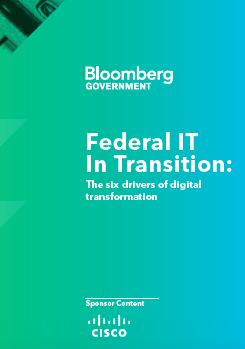
But they can also be really useful. Bloomberg has just published a fantastic little eBook called “Federal IT in Transition: The Six Drivers of Digital Transformation.” It’s available, free, here. (Full disclosure: Cisco sponsored the project, so that Bloomberg could turn its considerable journalistic and analytical prowess on the Federal IT world.)
Bloomberg sees six interconnected arenas that all play major roles in the evolution of information technology:
Security and Safety
Application and IT Modernization
Big Data Analytics
Customer Experience
Sustainability and Real Property
Next Generation Workforce
Each topic is covered in a brief chapter, ending with several “strategic takeaways” that Federal IT managers can apply in their own departments to smooth and speed their own work and sidestep some potential pitfalls.
Why six? These are the six areas are touched by virtually everything involved in Federal IT. There certainly are other important considerations, but Bloomberg shows how these form the core of an effective transformation strategy. For IT managers struggling to keep pace with changing technologies and strategies, these six drivers make all the difference.
I don’t want to say too much because you really need to just read this eBook for yourself. Go grab a copy and prepare to be enlightened.
I’ve been talking to partners a lot lately about “the roads to recurring revenue” that can take us all closer to a future of cloud, subscription services, and relevance in a new market where software is king. It’s always exciting to hear from the partners who are cruising these roads and transforming their businesses. They are seeing some interesting payoffs and having a lot of fun along the way.
On-Ramp: Application Development
Jeremy Hudgeons is a lead solution architect for collaboration at GDT, one of the largest Cisco VARs in the country for more than 20 years. Hudgeons says the transition isn’t happening fast enough for him. He’s a huge Cisco Spark proponent and his self-described “impatience” is helping drive a lot of innovation at GDT and their enterprise customer businesses.
Four years ago, GDT started building a software development practice when its owner steered the company towards solution integration. Today the GDT development team is focused on taking Cisco’s diverse portfolio, including collaboration, IoT, and big data analytics and building total solutions.
They are designing integrations for customers in healthcare, education, financial services, and oil and gas industries. While they focus on total solution development, their approach to app dev starts with the small things that make life more convenient. Incident management, which combines Cisco Spark, WebEx, Tropo, and ServiceNow software, is what they call “low hanging fruit” because every industry can use this automation to speed troubleshooting. They’ve built internal apps like “lunch bot” (suggests restaurant ideas), “room bot” (identifies open meeting rooms), and “file security bot” (allows moderators to control sensitive content in Cisco Spark spaces) to help with their own day-to-day decision making. “If we see a use for it, others will too,” says Brett Kugler, a software architect for DevOps Innovations at GDT.
On-Ramp: Talent Transformation
The biggest payoff from building this software practice so far, the team agrees, is talent transformation. GDT is using the movement to software as a way to vitalize the business with new energy and fresh perspective. The company is not only hiring more “hybrid” engineers (who have hardware and programming expertise), adoption consultants, and people who are experienced talking to line of business, but they are reskilling their existing engineers to code and to communicate with developers. “Yes, we want that traditional CCIE, but we need people who can share a common nomenclature with our developers and be an intermediary too,” Hudgeons explains.
It’s a Journey
The software team admits the transition to a new business model isn’t an easy one – and they are still figuring out how to monetize this business. The best place to start, they believe, is getting the engineering team to make the transition. Then you’ve got to look at everything else – the licensing, accounting, sales teams and your go-to-market. They also say it’s smart to bring in partners to fill in gaps of expertise so you can ramp up more quickly.
By developing this new practice, GDT is not only embedding itself into its customers’ business, but strengthening its ties with Cisco. “Application development has given us a whole new network of relationships,” explains Kugler. More and more Cisco product sales specialists bring GDT into customer accounts to talk about workflow integrations using the Cisco Spark platform. GDT was one of four partners Cisco asked to develop an application for the APIC app store we unveiled last year.
“I haven’t seen a Cisco person walk into this building and not walk out just ‘awestruck’ because we are doing everything we say we’re doing,” says Kugler.
Congratulations to GDT and all our partners out there who are making changes to accelerate their path to recurring revenue and a future of relevance and greater profitability.
Learn more about how Cisco can help you expand your practice:
Using cloud-based software, it’s simple to launch and refine agile video services
The world of online video is changing fast. People watch an increasing amount of content over the internet. And the success of over the top services like Netflix means that they also expect to be able to access it cheaply and conveniently, whether they’re inside or outside the home.
This is a hugely exciting development for service providers. But it’s also a big challenge. And not just because of the increasing scale and complexity of people’s demands. In addition to this, no one is sure exactly which services will be the big revenue generators in future. So businesses will need to continually innovate and iterate until they find out what works best.
These two problems together create a real headache for service providers. Their current video infrastructures, which provide content across separate broadcast, on demand, and over the top platforms, are inefficient and inflexible. They make it difficult to scale up operations and create the personalised, flexible services that customers want.
An integrated, comprehensive solution
We created the Cisco Infinite Video Platform to give service providers a solution to these problems, and make the most of the business opportunities offered by online video. The platform enables rapid service creation and deployment by simplifying and unifying the process. It gives providers the agility to launch and refine new services at the pace the market is developing.
The flexibility of the Infinite Video Platform comes from its cloud-based software as a service (SaaS) model, which takes the complexity out of creating new services. Providers can focus on designing what their customers want, and let us take care of the technical side. The flexibility of the platform means they can reduce time to market from months to minutes. Once services are launched, the platform’s comprehensive capabilities, together with its powerful analytics, enable them to make continuous improvements. And as new consumer devices emerge, we are able to keep pace with the rapid rate of change.
It’s a much more efficient way of working. In fact, we find that companies typically experience a 15% fall in the monthly video expense per subscriber after switching to the Infinite Video Platform.
Developing the services of the future
With the platform offering these advantages, it’s little wonder that telecoms companies are seizing the opportunity to move to the front of the pack.
One business we are working with is the French service provider, SFR. Last year we helped the company create a new infrastructure for the launch of its new video service, Zive. It can be viewed from a variety of devices, offers a broad category mix of thousands of high definition shows, and is one of the only services on the market to provide ultra high definition 4K content.
Max Blumberg, the chief technology officer of Altice Group, which owns SFR, said: “Our business runs lean in operation and agile in delivery. Everything’s kept secure. And it’s much easier and cost-effective to customise solutions.”
Always at the cutting edge
The Infinite Video Platform puts service providers at the cutting edge of video technology. And we want to make sure that it will always stay that way. We’re always updating the platform with new features. So when you invest in the technology, you can be confident not only that you have the latest tools at your disposal – but that you always will do.
Find out how you can cut operational costs while creating the services of the future.
Digitization is opening up new opportunities for business expansion. Cloud and IP are enabling service providers to deliver new services and impactful experiences with greater agility, less cost and flexibility. Interconnected devices are offering exciting new means to respond rapidly and deliver a truly exceptional experience anywhere at any time that you and your customers can benefit from. Although these new trends introduce new opportunities to service providers, it also presents new vulnerabilities and risks from hackers and cyber attacks.
New Trends Bring New Risks
Hackers are sophisticated, financially motivated and are increasingly launching new attacks that are hard to see and stop. The estimated industry time it takes companies to discover these attacks is between 100 and 200 days. The attacks are damaging for service providers resulting in business impact, service disruption and revenue loss.
The reality is, the occurrence of breaches is not slowing down any time soon. Just recently, a post-production media company has taken a direct hit which has negatively affected major cloud and IP based companies such as Netflix. In the mobility space, the T-Mobile breach resulted in massive theft of customer information. Customers take notice of which environments are safe and can offer impactful experiences.
It’s time to rethink security and how you can leverage it as a key business enabler to drive forward with your business outcomes.
Cisco Security Solution Launches and Offers at MWC and IBC
As you transform your network, security must be deployed strategically across the network, cloud and endpoint.
Cisco Security Architecture
Cisco’s Security architecture integrates best-of-breed technologies that work in concert, giving you the visibility and control you need for robust security holistically – across the endpoint, network and cloud. Backed by Talos, the largest threat telemetry network and research team in the world, you can be sure you have the latest in threat intelligence. Our unique solution extends visibility into the network, successfully decreasing the time to detect to as low as six hours (remember, the industry average time to detect a security breach had occurred is 100 to 200 days).
Cisco at CommunicAsia 2017
Cisco is participating at CommunicAsia 2017 where we will be showcasing how Cisco’s simple, open and automated security solutions enable Service Providers to deliver effective security that helps to protect their business, protect their customers, and monetize new opportunities. Register now if you are at Singapore!!
Fifty countries, 4.5 billion people, and a multitude of cultures and economies.
Asia Pacific is indeed as varied as it is vast. And that variation includes the way people watch TV.
But if there is one thread that binds everyone in this region, it has to be the explosive growth of Mobility.
According to Cisco VNI estimates, mobile data traffic in Asia Pacific will grow nine-fold between 2015 and 2020, a CAGR of 54%.
What will drive this explosive growth of Mobile data traffic? Video, video, and more video! In fact, by 2020, as much as 81% of mobile traffic in Asia Pacific will come from Video.
Not surprisingly, this is consistent with a consumer behavior trend that will ultimately see 70% of all millennials consuming TV Online. It’s hardly surprising then, that as the youngest market in the world—Asia Pacific will latch on to TV over IP and Mobile, fundamentally changing PayTV market dynamics in the region.
This begs the obvious question…What challenges & opportunities does this bring?
In most Asia Pacific markets, premium content is still distributed over broadcast networks. As a result, content providers are rushing to deliver content directly to consumers via OTT. The last few years alone have seen services like Hotstar, Sony Liv, Hooq. Netflix & Amazon Prime launch and flourish into a real force. People with access to IP, mostly via mobile, are not ready to accept a bundle of 200 channels—many of which they never watch—as the only viable option for TV entertainment.
With few notable exceptions, People no longer watch channels. They watch shows & events. As a result, content acquisition costs are rising, while legacy networks are becoming difficult and costly to maintain.
The result? Operating margins go into a continuous downward spiral.
Does this mean it’s the end of road for premium video? Is it no longer the cash-cow for service providers that it once was?
Having witnessed the leapfrog that this continent pulled off to embrace mobile revolution via 3G & 4G, I wouldn’t give up at all.
In fact, I would suggest to the contrary. That this region can in fact show the world that IP Video can actually be delivered at the scale and robustness that this populous market demands.
But don’t take my word for it. Look at the facts on the ground.
It’s not about just surviving. It’s about winning in style & scale!
So what could be the winning formula for tomorrow? Here are a few pointers.
Focus on delivering quality at scale
Broadcast delivery (satellite & cable) offers quality & reliability, while IP delivery offers flexibility, interactivity & multi-device reach. To bring premium video to IP, you need to achieve, or even surpass, the quality and reliability achieved over broadcast. It requires making intelligent decisions and optimizations across the entire delivery chain; from encoders at video processing levels, to the network and finally, in the client, where an appropriate request for content streams can lower costs and improve video quality.
Focus on unique service experience
Not every service provider can own content. Syndication & partnership is the way to go. Having a Netflix, Amazon Prime, Hulu, or a local language OTT service optimized on your network is a win-win for everyone. Adding to it sticky services like Cloud DVR, not only encourages consumers to build their personalized library, it also ensures that they will stream assets again and again, like long tail content using your video optimized IP network. There are sceptics who question whether or not Cloud DVR is relevant for the Asia Pacific market.
But as a region, Asia Pacific never really reached the critical mass with physical DVR, due to high device cost and subsidization. With IP coming in, there is an opportunity to leap-frog into multi-screen Cloud DVR. Today’s consumer is familiar with the concept of personalized cloud storage. If the pricing and the experience are right, consumers wouldn’t need much persuasion in order to replicate this model for the Pay TV world.
Focus on security
Whether it’s a mass-scale cyber-attack like the recent WannaCry, a targeted attack like the Sony hack, or the millions of illegal streams that bleed owners’ content rights during every major sporting events, its abundantly clear that unless content & service security is watertight, the illegal hackers will always win. Your network is as vulnerable as your weakest link. And with content going over IP, it’s time for Pay TV operators to look beyond Smartcards and integrate cyber-security, Digital Rights Management and Streaming Piracy Prevention into one fail-proof system. All investment in video quality and ARPU-enhancing features & services will come to nothing, unless revenue is protected.
Reduce investment in infrastructure & operations
After content, the biggest driver of costs (and drag on margins) has been client hardware, followed closely by costly and often underutilized investments in video back-end. With born-in-cloud virtualized head-end on one side, and democratization of client middleware through platforms like Android TV, and native CE devices, now is the best time to leave the headend and the client to ecosystem partners and put the focus back on network & service.
How can Cisco Help?
Our video technologies now touch well over 350 million devices, across 80+ deployments, in collaboration with 20+ technology partners to bring together the world’s most advanced TV platform, the Infinite Video Platform. With our pedigree of encoding, networking, securing, analyzing, and delivering rich and compelling video, we are enabling an IP-led transformation of the video industry by bringing in specific technologies & innovations such as:
Anend-to-end cloud-based As-a-Service platform that can reduce per-subscriber monthly expenditure of video delivery by 15%
Innovations to dramatically improve video quality on IP networks using advanced streaming technology as part of Cisco’s Virtualized Video Processing portfolio
Innovations in cloud DVR technology that can reduce cloud storage costs up to 50%
A robust eco-system driven offering on Android clients through Google TV to reduce your client cost, and accelerate innovation
Multi-DRM, Cyber Security & and Streaming Piracy prevention to help you protect your revenue as part of Cisco security for video portfolio
An Agile & DevOps based Cloud platform that enables you to launch/test/revoke end-user features in minutes.
At the beginning of May, we hosted a hackathon. We invited more than 100 geeks from around the world to develop innovative features on our platform, based on real problem-statements & use-case challenges thrown at them by our customer community. They came up with 22 brand new ideas, and implemented them, all within 24 Hours.
Yes, we are innovating on our platform by the day, being bold enough to skate to where the puck is going.
Sounds too good to be true? Take a look at the Infinite Video Platform, and see how we can turn your opportunities into reality.
Next week we kick off the fourth IoT World Forum in London (IoTWF), Europe’s fast-growing technology capital.
IoTWF is my favorite event. The opportunities that IoT creates, the sheer creativity and innovation that it opens up, and most of all, the great people committed to it, not only inspire me but also make me feel part of a special team that is going to change the world in a good way.
Almost every aspect of business, and many elements in our lives, can evolve and improve with IoT. Take, for example, the venue for this year’s IoTWF — the historic Tobacco Dock. It represents the spirit of digital transformation and is an excellent example of how technology is changing our world and invigorating business. Built in 1811, with the sole purpose of storing tobacco, today the Tobacco Dock is a modern meeting place, supported by one of the capital’s most technologically advanced IT infrastructures. Tobacco growing itself has transformed with the rest of the agriculture industry. Looking at how IoT transformed agriculture today seems like science fiction compared to how it was when I was a child. The use of data generated by sensors throughout growing and processing has substantially improved product quality, time to market, and environmental impact.
One of the best things about my role at Cisco is hosting the IoTWF. Each year I meet incredibly dedicated and passionate people from around the world who are galvanizing this industry and truly changing their companies, cities, and possibly the world with their ideas. We share our challenges and best practices, and we dare to imagine together. It is a community where you feel passionate (and not at all ridiculous) about discussing random innovations like connected toilets, as we did at the first forum in Barcelona. I can’t wait to see what we learn in London, but I’m even more excited about what we will unleash when we go back to our working environments!
We’ve hosted some truly amazing speakers in the past, and I’m particularly excited about this year’s agenda. We will look at IoT from every perspective: the opportunities, the challenges, the innovative solutions, and the people involved across industries.
Cisco CEO Chuck Robbins will kick things off by sharing his insights on the IoT industry, the incredible opportunities behind it, and how Cisco, its partners, and customers are navigating in today’s highly dynamic environment. Chuck is one of the biggest supporters of the IoT vision and its promise to change the world.
We will hear from industry and thought leaders, futurists, and IoT innovators in the public and private sectors, as well as the technical experts who are taking IoT to the next level.
We’ll learn about smart cities, smart manufacturing, smart transportation, the transforming workforce, the IoT value exchange, and the power of the network effect.
We also will be sharing IoT success stories that are sure to inspire new innovations. My favorite story is about Caterpillar. The Caterpillar team, who visited IoTWF in Barcelona, was so inspired by the Rio Tinto case study that they were on stage at the next IoTWF in Chicago to tell their new IoT story that developed as a result of their participation in the forum – possibly inspiring other companies. And best of all, the IoT community will come together to continue clearing the path ahead for everyone.
Since 2013, this event has set the tone for industry in how we think about the IoT in business – and in our lives. I remind myself each year that the forum is not just an event, it’s a journey. We first planted the seeds of community in Barcelona with a small group of innovators, connecting a new industry to change the world. The following year in Chicago, our community grew as we talked about the IoT projects, innovations and the many possibilities being realized. In Dubai, we focused on the need to awaken, activate, and accelerate to scale the possibilities.
Next week in London, our focus is to bring it all together — building the necessary ecosystems that will reduce the barriers and empower the possibilities!
If you are not able to join us in London this year, you can follow the conversation on Twitter with #CiscoIoTWF and #IoTWF. You will also be able to view keynote presentations and speaker videos following the event at IoTWF.com.
We are always connected. By 2020, the number of devices connected to networks will outnumber the world population by three times (Cisco VNI). Mobile and other wireless devices will make up nearly 70% of Internet traffic.
Today’s increasingly digital landscape has drastically changed many businesses, fueled by technological innovation and the exponential growth of the Internet. One of the most significantly impacted is the hospitality industry. In fact, hospitality and travel ranked seventh on the Global Center for Digital Business Transformation’s list of industries that will experience the most digital disruption by 2020. In this rapidly changing environment, hotels need to continuously adopt new technologies to meet and exceed guest expectations.
One of these forward-looking companies is IHG, a world-class hospitality provider.
The IHG and Cisco solution
Shawn Olmstead, Hotel Manager at Intercontinental Hotels Group’s (IHG) Intercontinental Barclay in New York City, considers technology to be one of the biggest challenges facing the hospitality industry today. “Secure, reliable internet access is no longer a guest expectation, but a demand,” he says.
Partnering with Cisco Connected Hotel and Hospitality solutions, IHG has reinvented itself to provide a series of sophisticated and secure mobile guest services. This allows them to create a personalized experience for each guest that differentiates them from competitors. Based on Cisco Meraki and the Enterprise Mobility Services Platform (EMSP), IHG has built a new guest Wi-Fi platform called IHG Connect.
This portal has improved their ability to monitor and control their networks to support a consistent guest experience across more than 5,000 properties worldwide. In addition, new data collection and analysis abilities allow IHG to offer a connected experience uniquely tailored for their guests.
Outstanding business outcomes
Since implementing their new solution, IHG’s guest satisfaction scores have skyrocketed. Once its top dis-satisfier, Wi-Fi connectivity now gets rave reviews from guests. IHG also streamlined the login process while increasing the number of Wi-Fi users, which offers new opportunities for advertising services and products available on the property. The new platform overall increased guest loyalty program membership and reduced IHG’s operating costs by millions.
Cisco’s hospitality solutions are providing companies like IHG with an easy way to digitally transform their businesses. With a superior guest experience that builds loyalty and lays the groundwork for future technological initiatives, IHG is leading the hospitality industry towards a more connected future.
As we approach the final week before DevNet Create, I wanted to share with you details on how to make the most of your time. I recently posted about the agenda and the engaging lineup of keynotes and presentations. In addition to these speakers, we have also woven hands-on learning opportunities throughout the entire two days. You won’t just be hearing from others at this event, you will be an active participant and have the opportunity to dig into hands-on workshops, mini-hacks, and connect with others (for example in our BoF sessions).
Here are a few examples of how you can learn, code, inspire, & connect while at DevNet Create!
Learn Learning labs are a core part of DevNet, and we have several new Labs in store to provide you with the fundamentals or supplement your knowledge of Cisco APIs across a variety of tracks. Pull up a chair and take “Build your own Hotspot” and learn how to create a WiFi network with Cisco Meraki and a splash page with NodeJS.. And, while you learn, perhaps Colin Lowenberg, head of their developer community will join you!
Code Want to get up to speed quickly on how performance management can change the value of your applications? Bring your laptop and pull up a chair to join an AppDynamics mini-hack. Each mini-hack includes a scenario to solve and a set of requirements and tips. You’ll get experience using different APIs to solve the scenario at hand. And of course, prizes will be awarded on-site.
Inspire
Join Drew Zachary and Radhika Bhatt and the team from The Opportunity Project in a hands-on workshop where you will get to code against Census Open Data sets to create solutions to the nation’s pressing social issues and fully understand the value of “being counted” as they prepare for the decennial census in 2020.
Connect
Are you evaluating your security model and rethinking your approach as you consider IoT? Join Bhavana Srinivas from PubNub to discuss a new security model that will enable ubiquitous, secure, bi-directional communication protocol for the Internet of Things.
These are just a few examples, we can’t wait! Join via live stream (we’ll broadcast live during the event!) and dive into more topics relevant for IoT & application developers at DevNet Create! We’d love for you to contribute virtually, tweet to us @DevNetCreate (please include the #DEVNETcreate tag), and follow us on Storify.
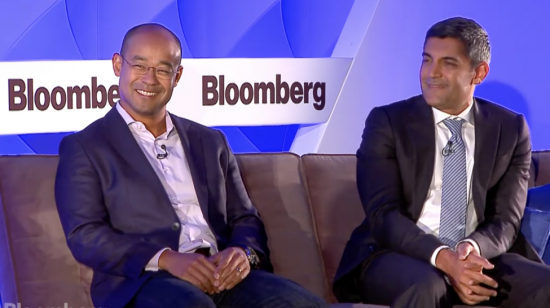
For CEOs and CFOs pursuing growth, market understanding and actionable insights, the Bloomberg BreakAway Annual Summit has been a key event to attend. I had the pleasure of participating in a energetic panel discussion on digital transformation culture at this year’s event in New York. Moderated by Bloomberg’s Brad Stone, author of The Everything Store and The Upstarts (two great books about disruption in the digital age), the panelists and I shared our experiences and challenges to remain competitive in an evolving tech landscape. Personally, it was a time for me to reflect on Cisco’s roots as an industry disrupter, and the way Cisco enhances its capability by engaging new markets through strategic acquisitions, start-up investments and constant encouragement of internal innovators. Here is a replay of the Bloomberg discussion.
That same week, I also had the opportunity to attend the 20thMilken Institute Global Summit. Cisco is a sponsor of the Milken Institute which is dedicated to the goal of solving the world’s most stubborn challenges. It was great to join technologists, government leaders and corporate disruptors for a focused keynote conversation on Unleashing Innovation in the context of large, established companies. It was a lively discussion where we touched on various topics around the innovation efforts within each of our companies – a key takeaway was that approaches to fielding and driving disruption can vary radically from company to company. No easy answers—but that’s what keeps things interesting and exciting.
I’d like to thank Bloomberg Breakaway and the Milken Institute for sparking important conversations and for engaging innovators across private and public sectors as we collectively embrace the new challenges of an historic time in tech and innovation.



 Bloomberg sees six interconnected arenas that all play major roles in the evolution of information technology: