Avatar

Working smarter while we work together. That’s what we’re all about. In fact, it’s this exact idea that forms the foundation of the Cisco Spark Depot, the hub for all Cisco Spark integrations and bots. (See my previous post.)

If you haven’t had a chance to check out the Cisco Spark Depot in the past few weeks, take a few minutes to see all the new additions to the Cisco Spark family.

All these integrations and bots certainly help power up the Cisco Spark platform. But we also understand the importance of simplicity. We want to make it as smooth as possible for our strategic partners and dedicated developer community to access the powerful collaboration features of Cisco Spark.

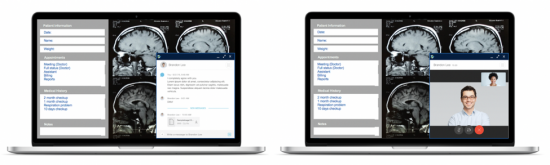
So that’s what we did. At DevNet Create, we have announced new Cisco Spark SDKs (for iOS and JavaScript) and Cisco Spark widgets for messaging and calling simplify integrating Cisco Spark functionality into all sorts of business applications.

But while the SDKs and widgets both offer new possibilities for third-party integrations, it’s important to note that they serve distinct functions. The SDKs offer an impressive amount of user interface flexibility, while the widgets are the simplest, fastest way to get something up and running.

The widgets extend the Cisco Spark user experience with features like 1:1 messaging and 1:1 voice/video calls. They can also connect to Cisco Spark spaces. With the widgets, we’ll instantly push new Cisco Spark features or enhancements to you. The SDKs also support 1:1 voice/video calls, but their big benefit is a completely customizable UI for creating truly integrated experiences.
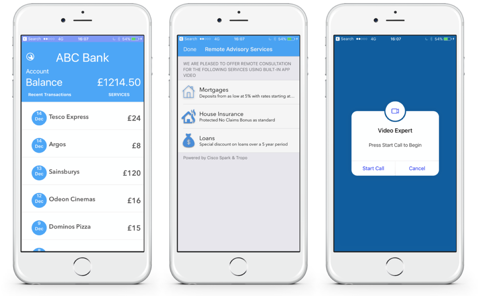
Say a developer working on a banking app wants to use Cisco Spark’s secure communication capabilities to allow users to message or talk directly with the support team. Until now, the developer had to send app users outside of the banking application to complete the connection. Thanks to recent changes, they can now keep customers within the application. Simple, smooth, convenient.

And that’s just one example. The functionality enabled by these SDKs and widgets could support applications within healthcare, sales and marketing, task management, retail, and even remote tech support or mobile service-worker use cases.

Both the SDKs and the widgets leverage WebRTC, which means your users never need to download any browser plug-ins. And all the code for these projects is completely open-source, so anyone can contribute and keep up-to-date with recent releases.

Find more, including Getting Started guides for each of the widgets and SDKs, on the Cisco Spark SDKs and Widgets page.

Think about all the ways you can unlock smarter ways to work together with our new Cisco Spark widgets and SDKs. We are planning even more features so be sure to follow @CiscoSparkDev on Twitter to keep up with our news.
Authors

Jason Goecke

Vice President & General Manager

Cognitive Collaboration & Cisco Spark Platform

Avatar

32 hours non-stop. Pushing boundaries. Thinking creatively and innovating in ways never thought possible.

That sums up the recent 4th Annual Enterprise Networking Group (ENG) Hackathon.

It sounds like it’s all around solving business challenges to transform Cisco and technology (which it is) but it’s also about teamwork and having FUN together – it’s a blast to see Cisco folks at work. If a positive side effect is increase in revenue, that’s a bonus, but that’s not what motivates us.

At Cisco, everyone from the top down is a strong believer that the strength of our company comes from its people. That’s why our team thinks, either disrupt, or you get disrupted! Thus, the Hackathon idea was born.

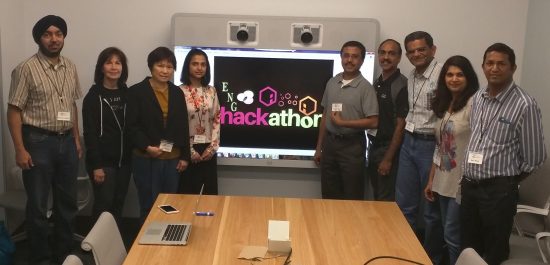
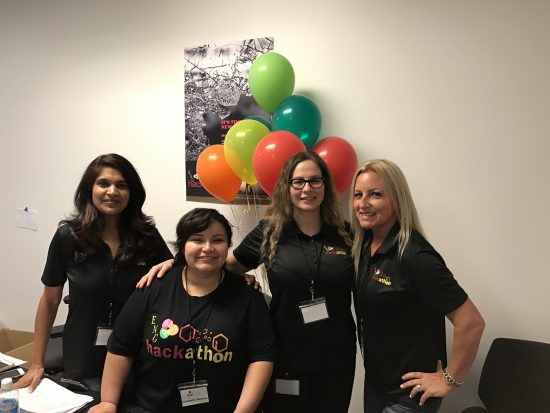
Hackathon organizers

For the non-engineers among the readers, a hackathon is a sprint-like event where we tackle complex problems and emerge after a fun, but tiring, specific time frame with innovative ideas and ways to better change the world.

It’s special because it’s an event by engineers, for engineers. Different perspectives are not only welcomed, they’re encouraged! I love organizing these hackathons. When you see 350+ engineers work straight for 30 hours, 55+ out of box and innovative ideas being worked on, collaboration at its peak, and the excitement of business leaders as they experience working demos at the end of hackathon – anyone would get inspired to do more! This is what motivates me to keep organizing hackathons.

Hackathon fun

You don’t have to be an engineer to get inspired by a hackathon. Here are three things I’ve learned, both in past events and in this year’s event.

1. Collaboration is key Events like this provide a great platform to socialize and make new friends/connections which can be cherished lifelong. When you come together in a setting like this, you can exercise and sharpen their collaboration skills at an unimaginable pace.

2. Diverse perspectives get the best results – When you bring your unique self and set of skills to the table with other people who are also unique with different skillsets, you’ll blow your mind with all of the creative and out of the box ideas you’ll have. If you surround yourself with people who think the same as you, you might not consider all the possibilities.

3. No problem is too big for a creative solution (and it’s okay to fail and get up!) Engineers at hackathons like this get real experience in transformation as they provide real life experiences where one can fail fast while continuously improving and learning. If you’re not thinking freely/creatively/constructively/wildly then you’re not doing yourself justice. The best ideas come from the most out of the box thoughts.

Maybe you’ll be inspired to have a marketing hackathon, or an HR hackathon, or a sales hackathon (Cisco employees have done them!)

What can you hack on today that will change the world?


Want to hack on your career path? Check out open opportunities on the Cisco Careers website!


Authors

Jimit Maheta

Director Software Development

CSG PD Switching Access - US

Avatar

Pete Sawyer is a systems engineer at Cisco. He’s a military veteran, having served seven years in the United States Army. He’s also a global problem solver, using decades of military and IT experience to make a difference in his local community.

Through his volunteer work with the Fisher House Foundation, Pete is ensuring veterans’ families stay connected while their loved ones receive necessary medical treatment.

“I’ve always been involved with the military and appreciate what veterans do for us, the sacrifices they make,” he said. “It’s good to have the ability to give back to them. I saw this opportunity and knew I wanted to get involved.”

The Fisher House Foundation is a nonprofit organization that seeks to improve the lives of military families. Since its inception in 1990, it has served more than 307,000 families, most notably through the building of Fisher Houses. These 72 homes offer families free lodging near military and Veterans Affairs (VA) medical centers.

Each Fisher House has up to 21 suites and provides all the comforts of home: a kitchen, laundry facilities, a warm dining room, and an inviting living room. For those traveling and staying in an unfamiliar location, these simple amenities can ease the stress of the unfortunate situation. But in today’s digital world, where connectivity is a vital part of our lives, an Internet connection can make all the difference.

Brian Gawne, the Fisher House Foundation’s VP for Community Relations, discovered five years ago just how valuable a reliable Wi-Fi network can be. “Our first priority is taking care of families, and the people who run the homes are experienced in things like social care and lodging,” he said. “They’re not IT experts, and we soon realized we needed a network on steroids to support all of our families.”

By chance, a representative from Cisco’s Veteran’s Program emailed Brian in 2012 with a simple question: “How can we help?”

“Before we started installing equipment, house managers often took a trip to Best Buy, bought routers and repeaters, and set up the networks on their own,” Pete said.  These configurations are often spotty and outdated, leaving family members in the dark in homes that are built to the highest military standards. “Our homes are built so well that sometimes, even cell phones can’t get an indoor signal,” Brian remarked.

Shortly after receiving the email, Brian spoke with the representative and filled out a technology grant application. Local employee volunteers in San Antonio, Texas were soon on-site at the newly-built home, installing a network with the capability to meet every resident’s needs. Since then, employee volunteers like Pete have donated and installed equipment at dozens of Fisher Homes.

With support from Cisco’s Veterans Enablement and Troop Support Employee Resources Organization (VETS ERO); Charles Washington, Baron Rawlins, Andre Winkfield, and volunteers from the Army Enterprise Region Systems Engineering team; Pete has developed a standard equipment bundle and install process, which can be implemented at any Fisher Home not outfitted by the Department of Defense (DOD) or VA.

When Brian reaches out to Pete with plans for a new build, initiating the installation is as simple as opening a request with one of Cisco’s Meraki equipment distributors and delivering the gear.

“We provide the solution to the homes and offer installation services for free,” Pete said. “I volunteer to do that, and once I’ve finished the installation, I give the house manager some over-the-shoulder training and knowledge transfer before leaving it for them.”

Pete’s most recent installations include homes in Ft. Bragg, Las Vegas, Tuscon, Portland, and Joint Base Lewis-McChord, where networks connect more than 750 distinct users. And it’s in homes like these where Brian says reliable Internet connections are making a huge difference for families.

“There’s something so powerful about being able to communicate to other family members and keeping folks up to date,” he says. “Even something like Facebook access gives them peace of mind and escapism while they’ve got the angst of one in a hospital.”

To date, Pete says none of the equipment has failed, ensuring families in Cisco-supported homes are always connected. With more than 12 homes planned for construction or opening in the next two years, there’s an even greater opportunity for Cisco employees and volunteers to get involved and become global problem solvers for veterans and their families.

“With Cisco’s support, we’ve received equipment, free installations, and the valuable time of employees on-site,” Brian said.

Employees can contribute to Fisher House through Cisco’s Community Connection portal. If you’d like to donate to the Fisher House or learn more, please visit the foundation’s website today.

Authors

Michael Veysey

No Longer at Cisco

Avatar

Our business is changing. Our customers’ needs are evolving. Companies are more global than ever. The phrase ‘think global, act local’ has never been more relevant. We’ve listened closely and understand that we need to make it easier for our partners to do business with us at a global scale.  Today I am excited to announce Global Gold, our highest partner certification tier.

Global Gold certification allows us to broaden our reach — together. We’ve bridged the pieces of our existing Gold certification with today’s global business needs to provide a simpler, scalable, and profitable global experience for our partners. Global Gold partners can now showcase their ability to deliver and support solutions as a Cisco Gold certified partner from any of their worldwide locations.

We’re also ramping up the benefits. Global Gold partners receive Gold benefits consistently across all of their locations. Additionally, the expertise of Global Gold partners will be branded in the Cisco Partner Locator. A unique icon appears next to the listing for each of a Global Gold partner’s registered locations.

Global Gold is designed for our highly-specialized partners who can provide a Gold level experience to their customers globally.  That’s a tall order, which is reflected in the requirements. However, we are giving partners a choice in how they meet the requirements.  Take the knowledge and expertise requirements as an example. A partner can choose to achieve a certain set of our Channel Partner Program certifications in each region, or they can show their expertise in the form of equivalent competencies using a centers of excellence model.  (See the full requirements here.) This flexibility provides a partner the ability to scale their Cisco resources and teams in the way that works best for their business.

Global Gold increases the value exchange with our resellers by helping them expand their customer bases. Their sales and technical teams can now reach across borders and support their global customers more effectively than ever before. And while this new certification is important to our global business strategy, we absolutely remain fully committed to the partners who do the equally important work of caring for customers in their local and regional markets.

Don’t just take Cisco’s word for it, here’s what Dimension Data and BT have to say about Global Gold:

“Dimension Data is thrilled to be one of the first Global Gold certified partners. As our customer base has rapidly become more and more global, we’ve shared our new business needs with Cisco. They listened.

The new Global Gold certification tier will allow us to do business with Cisco and our customers at a large scale, with much simpler processes and more benefits. We can now more effectively deliver world-class solutions and services regardless of our office locations or those of our customers. This reinforces our commitment to our on-going relationship with Cisco.”

— Christine Wolff, SVP Group Cisco Alliance, Dimension Data

“This is an important certification and reflects BT’s commitment and capability to deliver globally with Cisco in a world that is increasingly adopting software defined cloud services.”

— Neil Sutton, VP Global Strategic Alliances, BT

Global Gold certification is one step of many in our ongoing evolution. It is a proof point of our promise to simplify and embrace consistent business processes. We will continue to refresh our partner value exchange to reflect new capabilities in key areas for future growth such as software lifecycle management, customer success, and business outcomes.  Partners who focus on developing these broader opportunities increase the value of their Cisco practice and enhance their customer experience. Stay tuned for more exciting news in the coming months as we continue our drive toward simplification, alignment, and increasing value exchange.

Is Global Gold certification a fit for you?  Learn more about it on the Global Gold web page. And please, let us know what you think. Your feedback is the cornerstone for our best-in-class Channel Partner Program.

Authors

Marc Surplus

Vice President, Partner Strategy & Programs

Global Partner Sales

Avatar

I recently wrote a previous blog about Starbucks Digital Transformation to highlight that, it is really happening and that there are actual business results out of their strategy. It is not only a marketing campaign nor a crazy idea but a vision and a strategy to drive business outcomes. As part of Digital Transformation, Cloud, permeates everything we do and powers digital transformation. Its impact on customer experiences, business processes and models, and workforce innovations, is undeniable.

To continue the conversation, with Starbucks as an example, I found some interesting readings and here are some conclusions:

Customer experience; Starbucks driver for Digital Transformation

This is just a personal conclusion but, from a business outcome perspective, I believe it’s fair to say that this is the main driver that Starbucks wants to achieve. According to their CTO, Gerri Martin-Flickinger, their focus is to provide customers with a “consistent global user experience” regardless of what store they visit. Its not only a geo related experience but also a currency experience and beyond; it’s getting to know you better and understand when you drink coffee, from what store, at what time during the day, what you order and more. It goes beyond than the barista knows your name and, probably, remembers what coffee you ordered last time.

“With about 90 million transactions a week we know a lot about what people are buying, where they’re buying, how they’re buying,” said Martin-Flickinger. “And if we combine this information with other data, like weather, promotions, inventory, insights into local events, we can actually deliver better personalized service to other customers.”

From a cloud (not too technical) perspective

Starbucks is planning to migrate everything to the cloud. The status according to an article dated on Dec. 2016:

  • Currently they have 22 different mobile apps around the world so the plan is to unify everything into one single app.
  • To build that consistent global user experience, Starbucks plans to connect its device applications through a cloud-based commerce system that will give it the “elasticity and stability” not available in Starbucks data centers
  • The rewards program requires connecting the in-store point-of-sale system with the back office accounting system
  • The mobile order-and-pay system was then layered on top of that and now, personalization is being layered on top of that – all in that same back-end system

The solution then is to re-architecture it through the cloud to connect all locations, whether corporate-owned or licensed. A huge amount of data will need to be stored and analyze the data coming from the store such as store location, hours of operation, products, price and others; and marry that information with the customer’s personal data. For me, this is the perfect scenario where we see a Hybrid IT world.

From a recent IDC study, we have seen that there are five levels of cloud maturity and that the companies with a cloud-optimized strategy, only 3%, excel in business outcomes, as Starbucks has. When adopting cloud, companies need to make sure that they have a clear strategy to lower what IDC call, the cloud gap. This gap comes in different forms depending on the IT infrastructure, the company culture, processes, etc. Some of the technological issues that I believe, Starbucks is addressing concerning the cloud gap, are the following:

  • Application management and performance. How to ensure a consistent management, compliance, and user experience from one environment to another?
  • Security. Cloud…infrastructure…customer’s personal data…always on… This one has a lot to mention. No company would like to see their name on the news as the last attacked/hacked company.
  • New network needs. Embracing cloud will bring some new traffic patterns to their network and no one wants to be disappointed with the network performance.
  • DevOps environments. Embracing a DevOps model with continuous development and integration requires profound organizational and cultural change.

There might be others, for sure, but I believe that these four are a good start. In fact, some articles position Starbucks as a technology company rather than a retailer or coffee shop. When you go to their website and check the job offerings, look what I found in the “Technology Careers” section :

  • Sr. network engineer: will focus on the Retail Network space encompassing multiple datacenters and thousands of stores internationally. Experience with Cisco Systems switches and routers. Able to implement network performance improvements based on understanding of network trends and patterns.
  • Sr. devops engineer-security. Ability to establish cross-functional, collaborative relationships with business and technology partners. Enables team members to understand “why” security controls are important to mitigate enterprise risks

The list goes longer but I’m pretty sure this reinforces my point on how they are addressing some of the challenges listed above.

Why Cisco?

I would suggest that first, you need to define the business outcome that you want to achieve on your digital transformation journey and cloud as one of the enablers. Then think on your current environments and the complexity of your IT infrastructure. Marry both and list the vendors and providers who can help you. The most trustworthy ones and start from there. It does not matter if you want to migrate everything to the cloud as Starbucks is doing, you’ll need some help in management, security, analytics and network as you can probably foresee or saw if you already have some cloud environments. We can:

  • Enable application lifecycle management with one integrated platform for your traditional and cloud applications
  • Secure users, data, and applications everywhere
  • Use both infrastructure and application insights to improve your security and customer experience
  • Ensure scale, agility, and secure user-to-cloud access across your environments
  • Offer your choice of technology, professional services, and cloud partners to help you meet your specific business needs

Cloud is not a product or a single solution. It is a consumption model that address a strategic business or IT need. We can help.

  1. If you want to assess your company in your cloud maturity (using IDC best practices), go here.
  2. Click here to see how we can help in your cloud strategies.


Authors

Sergio Licea

Marketing Manager

Cloud Solutions, Americas

Avatar

Protect Vital Services in Advanced Medical Care, Automated Manufacturing, and Power Generation and Delivery

From time to time, I find it’s helpful to pause and take stock of why I do what I do.

Recently, I found myself talking with a CEO of a medical startup. Their goal was to improve the care of cancer patients through customized drug therapies. Their approach uses a patient’s genomic information, real-time health data, and current prescriptions to formulate a personalized medication regimen. That regimen helps give the appropriate combinations and dosage of the proper medications specifically for that individual to avoid negative side effects. The more he spoke, the more fascinated I became, and it hit me.

This is the why!

Cybersecurity is not going to improve patient care. It is not going to cure cancer. What it will do is help researchers continue their important work.  Imagine the impact of a ransomware attack against this company. What if the research data were manipulated to show false positives or negatives? What if the devices administering the medications were exploited by a malicious actor? And this is just one use case among many exemplifying the promise of the Internet of Things (IoT). That promise is being made real in healthcare, manufacturing, and utilities, to name a few. Yet, we’re just getting started with the IoT, and there is so much more to come.

We at Cisco are fully committed to the IoT, and we believe the IoT must be secured for its promise to be realized. Securing the IoT is easier said than done, though. The first complication is that most IoT devices can’t protect themselves. To be fair, there are a number of reasons why they can’t, but from a cybersecurity perspective, those reasons don’t matter. A vulnerability is a vulnerability is a vulnerability. And these vulnerabilities create ample opportunities for an attacker to exploit those devices and gain access to your network.

The second complicating factor is scale. We estimate that there will be 50 billion connected devices by 2020. That’s enough to give any security administrator heartburn.

Look. Enterprises are exposed now. And our customers are asking us how Cisco can protect them… now.

We are proud to announce Cisco IoT Threat Defense. Cisco IoT Threat Defense, first, securely segments IoT devices based on policy that provides an adaptable, extensible means of protecting vital services at IoT scale. Think connected medical care, power generation and delivery, automated manufacturing, and more. Segmentation puts those IoT devices out of reach of attackers, and if they are compromised, prevents these devices from being used as pivot points for attackers to move through the network.

Network segmentation is not new. Virtual Local Area Networks (VLANs) have been in use for decades. But with the expected explosion of connected things, the sheer scale of the IoT makes creating enough VLANs impractical, if not impossible.

Cisco has designed, deployed, and secured networks for over 25 years. We continue to build the equipment, invent the technologies, and develop the standards that help make the Internet possible.

We have invented an extensible, automated, policy-based technology to solve the problem of secure segmentation at scale for the IoT. It is supported across a wide range of Cisco equipment – ruggedized or non-ruggedized, in the data center or branch office.

Cisco IoT Threat Defense is built as a cybersecurity architecture, featuring a strong cast of integrated products, starting with Identity Services Engine (ISE) and TrustSec, which facilitate extensible, scalable segmentation using group- and device-based access policy throughout the network. These are layered with Stealthwatch, Umbrella and Next-Generation Firewall, as well as Cognitive Threat Analytics, AnyConnect VPN, and Advanced Malware Protection. Cisco Security Services puts real people into the solution to help organizations make decisions about protecting their environments, from medical facilities treating patients, to manufacturing plant operations, to power companies powering the electric grid.

Let’s be clear about something important. The last thing operators of critical networks want to hear about is automated cybersecurity. It may be fine for most IT networks, but certainly not for industrial control networks, and we know this. You can automate as much or as little as you want. It’s your network, and you control it. We help you do it more easily and securely.

Attacks do succeed, and people do make mistakes. We constantly analyze network traffic not just throughout your network, but also traffic entering and exiting your organization. We use our integrated portfolio to detect anomalies, block threats, identify compromised hosts, and help prevent user error.

Despite the technological advances that the IoT represents, the human factor is the most important. People develop these technologies to help people, to secure IoT environments. Our people are highly skilled experts with decades of experience, who can help businesses design, assess, secure, operate, and respond to incidents in all manner of networks. Incident readiness and response services allow organizations to respond to attacks and reduce damage, exposure, and network downtime.

So, who better to help meet the challenge of the IoT head on?

For more on Cisco IoT Threat Defense, check out our announcement and the Cisco IoT Threat Defense at-a-glance.

Authors

Marc Blackmer

Product Manager, Engineering

IoT Product Mgmt Networking

Avatar

When the WannaCry attack was launched a little over a week ago, it was one of the first large scale attacks leveraging the data that was leaked by the Shadow Brokers. At the time the real concern was how quickly we would begin to see other threats leverage the same vulnerabilities. Over the past couple of weeks, Talos has observed other malware variants that are using the ETERNALBLUE and DOUBLEPULSAR exploits from the Shadow Brokers release as part of their campaigns. Among them were Adylkuzz, Uiwix, and EternalRocks.

Adylkuzz is a piece of malware that uses ETERNALBLUE and DOUBLEPULSAR to install cryptocurrency mining software on the infected system. This attack actually pre-dates the WannaCry attack and has continued to deliver the cryptocurrency miner.

Uiwix uses a similar technique to install ransomware on the infected system. When the files are encrypted, the file names include “UIWIX” as part of the file extension. The key difference with this malware is that, unlike WannaCry, the Ransomware doesn’t “worm itself.” It only installs itself on the system.

Read more »

Authors

Talos Group

Talos Security Intelligence & Research Group

Avatar

The new enterprise rock stars

“Our rock stars aren’t like your rock stars.” an Intel ad from 2009 concluded. Fast forward to today and in these times of change the choice for businesses (and IT) is to disrupt or get disrupted. The impact across teams within any organization in any industry has been and will be profound: 40% of market leaders are to be rocked by digital disruption (see the Digital Vortex report for more details). We recently published an article on Unleashing IT asking Cisco and Intel Executives, Roland Acra and Iddo Kadim, to weigh in and share their thoughts and insights on who are the new rock stars:

  • The new enterprise rock stars
    • With the rise of application development, infrastructure teams must find new ways to support and enable their software counterparts.

Technology that makes an impact

We also asked to hear from our customers, practitioners and analysts on the business impact of our ASAP Data Center Architecture solutions for their businesses, customers and communities. ASAP stands for analyze, simplify, automate and protect – four key design principles for a modern hybrid IT. Read their stories here:

Cisco Live Las Vegas takes center stage June 25-29

To learn more about our latest innovations and how customers are using our solutions join us for the Data Center Innovation showcase talks with Cisco Data Center Executives.

 Stay connected and engaged

For more updates as we get closer to Cisco Live follow us here on our blog or on Twitter @ciscolive for all things Cisco Live and @ciscoDC for all things Data Center. And unleash your inner rock star by subscribing to Unleashing IT and engaging with us on #unleashingIT.


Additional resources:

www.unleashingit.com

www.ciscolive.com/us/

www.cisco.com/go/asap

CNN Article: How humble USB turned engineer into tech ‘rock star’

Authors

Klaus Schwegler

No Longer with Cisco

Avatar

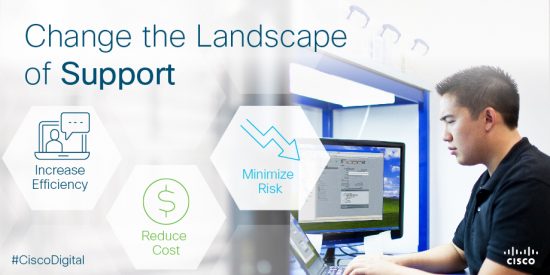
Customers are now demanding much more from support services, and that is leading to a change in the support landscape. Customers want unified interactions using voice, video and email that helps to increase efficiency. They are looking for near time issue resolution to reduce costs, and they want to proactively detect and mitigate issues to minimize risk.

Cisco is transforming its support services to provide better customer satisfaction by making it connected, collaborative, and cognitive.

Connected Support:  Cisco connects to customer networks securely and continuously using network monitoring tools. This enables us to monitor customer’s network and reduces the time spent digging up information. Networks can be continuously evaluated for potential security and support issues, alerting customers to problems before even they are aware of them.

Collaborative Support: Within a case, a Cisco Spark™ room can be opened that allows the technical support agent to bring in the appropriate subject matter experts to help solve problems. If necessary, technicians can also initiate a real-time video call and work with sales, engineering, or anyone else to address the customer’s needs. All this helps to bring together insightful data to create more collaborative customer experiences.

Cognitive Support: The Cisco® Technical Assistance Center (TAC) has started digitizing the knowledge base of engineering and product support cases into diagnostic signatures. Currently, Cisco has around 16,000 diagnostic signatures, and this number is growing. Now, when a customer uploads case information, such as serial number and log files, our innovative capabilities immediately bounce it against the diagnostic signatures. Best practices, error messages, configuration settings, and more are analyzed automatically. By the time a TAC engineer opens the case, resolution recommendations are already part of the case file. With the solutions for known issues automated, the engineer can spend more time proactively resolving unknown issues.

All this is helping to improve customer satisfaction and drastically reduce the mean time to resolution (MTTR) for known issues. Proactive and even predictive support is being enabled with securely connected customer networks. Cisco has accomplished much on its support transformation journey, and is continuing to build new capabilities every day. We’re ready to apply the lessons we have learned to help you transform your support. Learn more at www.cisco.com/go/digital.

Authors

Aditya Mohta

Sr. Manager, Solutions Marketing - Full-Stack Observability

Strategy, Incubation and Applications Group