Avatar

You’re convinced hosting your mission-critical applications on AWS public cloud is the right choice for your business. You need to host hundreds of web app, database, Oracle, SAP and Microsoft servers. How do you host these applications across many VPCs without having to create a networking nightmare?  Will a single VPC be able to scale to your demands? How about 2 VPCs? 10 VPCs? 200 VPCs? Or 500 VPCs? When you need to scale above 10 VPCs networking between regions and physical locations becomes a challenge. Managing VPN endpoints per VPC and creating a mesh network to communicate between all sites becomes complex and unmanageable. That’s why Amazon AWS came up with the “Transit VPC” Solution in order to solve the complexity of networking between VPC-to-VPC and VPC-to-physical locations. Using the most deployed  AWS network appliance, Cisco CSR1000v, the “Transit VPC” delivers a highly available network solution that centralizes security, firewall and routing functions within a single point that is scalable and easy to manage. AWS uses the CSR1000v because it is the only network appliance on AWS that delivers the necessary features to make “Transit VPC” work.

Cisco CSR1000v on AWS: http://www.cisco.com/c/en/us/td/docs/routers/csr1000/software/aws/csraws/awsinstall.html

What is the “Transit VPC”?

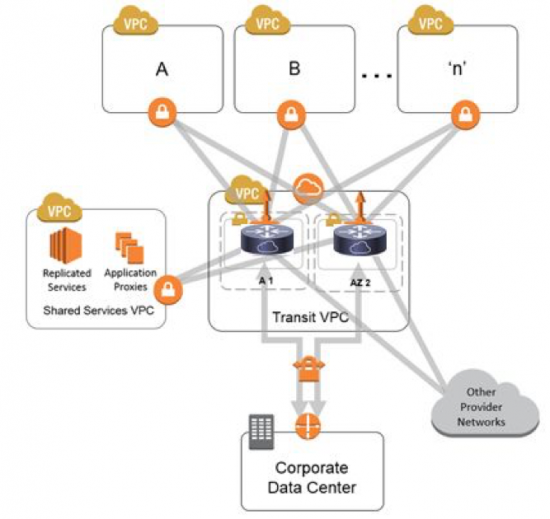
Think of it as a central or DMZ VPC where the admin spins up two CSR1000vs in high availability mode. The Transit VPC resources, CSR1000v machines and networking configurations are automatically created using a click to launch button that leverages AWS CloudFormation, S3 bucket and Lambda function. The automation script configures secure tunnels northbound from where spoke VPCs running your applications connect to the CSR1000v. The CSR1000v connects to physical locations via Direct Connect and overlay encrypted tunnels, or over the internet using IPSec tunnels.

Picture1Highlights:

  • AWS Transit VPC marketplace listing based on Cisco CSR1000v allows you to ‘click and launch”.
  • CloudFormation will automatically create the resources needed in the Transit VPC and launch the creation of the CSR1000v.
  • AWS Lambda function automatically pushes the high availability and tunnel configs down to the CSR
  • Spoke VPCs are automatically launched and configured from the Transit VPC GUI console.

The Transit VPC solution with the CSR1000v becomes the secure access point to any of your mission-critical workloads running in AWS. Only the admin and the users that the admin entitles for access are able to reach the applications. All the complexities of figuring out which technology and how to use them are simplified and users can securely connect. Headaches gone.

For more information on the AWS-Cisco based Transit VPC Solution see:

https://docs.aws.amazon.com/solutions/latest/cisco-based-transit-vpc/overview.html

Post Written By: Tony Banuelos, Product Manager for the CSR 1000v

Authors

Matthew Packer

Product Manager, Engineering

Platform Routing

Avatar

Pandora! In the motion picture Avatar, Pandora is a beautiful fictional place and a paradise for nature lovers. The 3D version of the film left a deep impression in my mind, as I am sure it did with many other moviegoers who might share my dream of experiencing a vacation in Pandora. Well, that may soon be possible with virtual reality (VR) and augmented reality (AR).

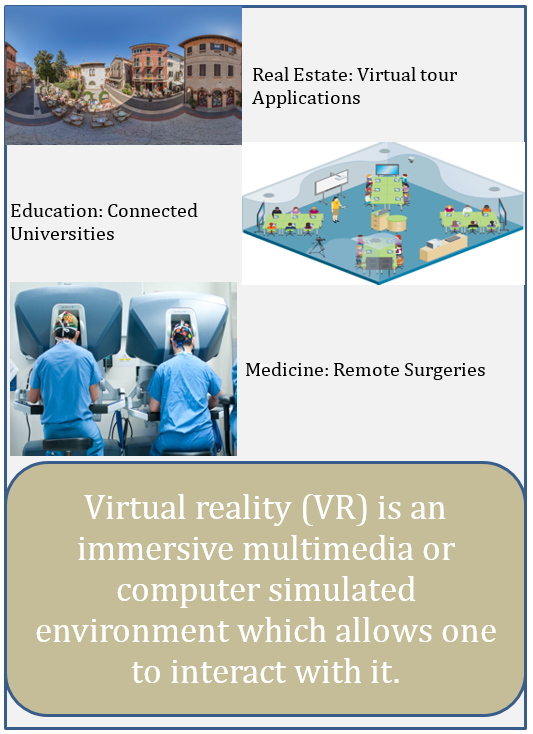
What is VR?

ar vr 2

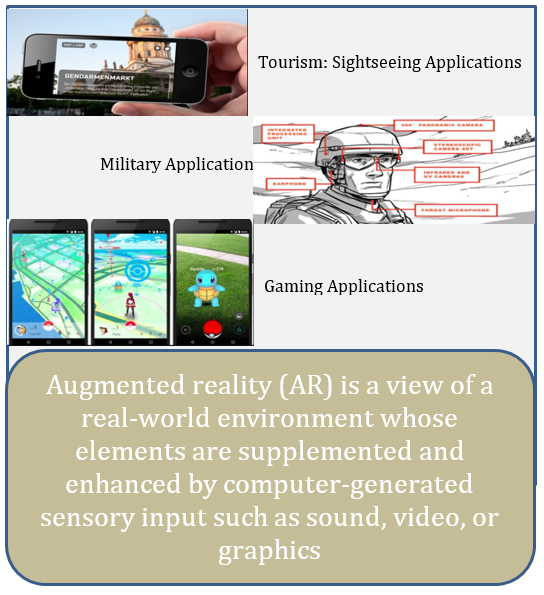
What is AR?

ar vr 3

And where did all this begin? We have always been intrigued with compelling visual experiences – big screen movies, 3D graphics, and higher definition TVs. – All of these media display techniques have something in common – filling up our entire field of vision with an image that makes us feel present at that place within it. Surround sound was designed to provide a 360° audio experience to immerse viewers deeper within the virtual space.

Where do we go from here? We live in an Information age, where our public and private environments are full of content and data that is processed, transmitted and posted in ways that allow us to access and interact with it. This pervasive preponderance of consumable content is what drives VR and AR – somewhat similar to the experiences depicted in the movie Total Recall, where experience and virtual reality are simulated and you can have real memories of it.  VR engages all our senses and gaming seems to be where this technology has had its initial major impact.

But not just gaming and entertainment, each and every industry can perhaps be transformed if touched by virtual reality- think education and even your office- by staying in the comfort of your home and with a very high bandwidth connection, you can interact with and talk to your colleagues and fellow students.

The applications are endless and many have not even been thought of as yet.

In fact, today’s VR is very similar to early concepts developed in the 70’s and 80’s. So, why is there so much telecom industry and media buzz around VR implementations in 2016? Well, many innovative enablers have contributed to the new view and promise of VR that we are experiencing today:

  1. VR content: there was not much content available for people to view – with the advancement in digital photography and media technologies there are many players who are dedicating all their efforts in generating VR content. For example, Magic Leap (a U.S. start-up) that superimposes digital content on real situations and Matterport (an immersive media technology company) that focuses on digitizing all 3D spaces that exist. VR content is still in its nascent stages and content generation will be faster in some industries compared to others. Gaming appears to be the initial “sweet spot” for VR content development.
  2. Evolution of networks and edge computing – VR requires large data transfers and processing at relatively higher speeds to respond to user interaction with VR content. Edge and cloud computing solutions have evolved quite a bit in the last few years (and public and private IP networks have evolved dramatically within the last decade as well).
  3. Evolution of consumer devices: VR headsets were only meant for the rich and the scientist and not ready for commercial prime time. Acquisition of Oculus by Facebook and now Google’s project Tango and cardboard headsets is changing all that. Cisco’s Visual Networking Index predicts that by 2020, 601 million devices and connections will be wearables (which includes VR headsets) and this will have 44% CAGR throughout the forecast period from 2015-2020 so we are seeing considerable growth happening in this segment.

Evolution of a new platform ecosystem:

For any new platform to succeed it needs to have not just the right technical model but also the right ecosystem and business model. There needs to be enough economical interest for different ecosystem players to jump in and make significant investments to develop the ecosystem.

The tipping point:

No commentary on VR or AR can go without the mention of Pokemon Go. With an $11 billion bump in valuation in just 11 days for Nintendo, there’s a tangible economic incentive for many VR and AR ecosystem players to grab a piece of the profit potential.

It takes an initial investment to develop one side of the ecosystem that automatically creates network effects and develops the other side of the ecosystem. It is a chicken and egg situation or the dilemma of the first penguin that jumps in the water to be followed by all other penguins – someone needs to take the first leap.

Big tech giants such as Facebook and Google whose business revolves around consumer engagement have decided to take that first leap to take VR to the consumer community – the VR ecosystem is just now starting to shape up. With Facebook, Google and now Samsung and Sony developing anywhere from free to very cheap VR headsets each of which will drive vast adoption of VR amongst consumers and in turn will encourage more organizations to develop VR content and for ISVs (independent software vendors) to develop applications for VR.

Impact on Service Providers:

All these fascinating innovations will place new demands on the network in terms of its quality and performance. Bandwidth and latency requirements will become increasingly imperative for a high quality VR and AR experience and Service Providers need to take a note of this new demand. Virtual Reality traffic has the highest growth traffic category that the Cisco VNI team tracks and it has quadrupled in 2015, from 4.2 Petabytes per month in 2014, to 17.9 Petabytes per month in 2015. Globally, Virtual Reality traffic will increase 61-fold between 2015 and 2020, a compound annual growth rate of 127 percent.

This is a tremendous opportunity for service providers to jump in at and provide their distribution and GTM (Go to market) muscle to further drive the adoption of VR. VR ecosystems are just being formed now and unlike the Cloud wave Service providers can catch some of these early developments and gain significantly by owning or helping develop some of the VR ecosystems that will ultimately drive their network connectivity offerings.

What we are seeing now is just the beginnings of this ecosystem being formed. Platform wars are yet to come so stay tuned! While the big giants fight the platform wars – the ultimate beneficiary is going to be the consumer.

Whether the evolution of VR and AR ultimately lead us to real-life manifestations of The Matrix or Avatar is yet to be determined. What appears certain is that VR and AR adoption are primed for growth and early platform sponsors are most likely to shape their future and reap near-term economic benefits.

Authors

Taru Khurana

Marketing Manager, Product/Systems

Avatar

This is the first in a series of blogs about advanced malware

Behavioral Indicators Morph Over Time

A large part of Threat Grid’s efficacy in determining the nature of a submitted file is through the use of over 675 indicators to identify malware. The initial indicators created for AMP Threat Grid sought to identify strictly the behavioral elements of a submission. Over the years however, these indicators morphed beyond identifying simple behaviors, to include static forensic attributes, and finally to include the positive identification of malicious families and variants. The latter achievement leads directly to an increase in the contextual data provided to customers, and also making a significant difference when addressing a specific threat.

In an effort to combat the growing threat of ransomware while providing this context-rich analysis, AMP Threat Grid has positively identified over 39 different ransomware families and 15 variants to-date. With the ever-increasing amount of ransomware being seen on a weekly basis however, merely creating indicators or signatures in a purely reactive state is not enough. AMP Threat Grid has therefore created several indicators that generically identify malicious behaviors related to ransomware. This helps our customers detect a potential new ransomware variant even if we don’t yet have a name for it.

One of the oldest behavioral indicators identifies the deletion of shadow copies. The deletion of shadow copies was first implemented in Cryptowall after a write up identified the fact that recovery could be made without paying the ransom. As a result, many authors moved to include this [behavior] through a variety of means to gain the use of Windows native utilities and Windows scripting host. When the results for this indicator were reviewed for efficacy, we discovered that 100% of the samples exhibiting the behaviors cause by this indicator were malicious. Having reviewed the data, we concluded the threat of this behavior warranted an increase in threat score. Threat scores provide a quantitative measure on a scale of 1 to 100 of how confident we are of a sample’s maliciousness based on the behaviors it exhibits when executed in Threat Grid.

Ransomware Indicators

Generic Ransomware Notes Detected

Several recent additions have contributed to an increase in detections of ransomware variants in AMP Threat Grid. These include a behavioral indicator titled “Generic Ransomware Notes Detected,” which detects the presence of ransomware notes identified by common characteristics of the instructions left by ransomware.

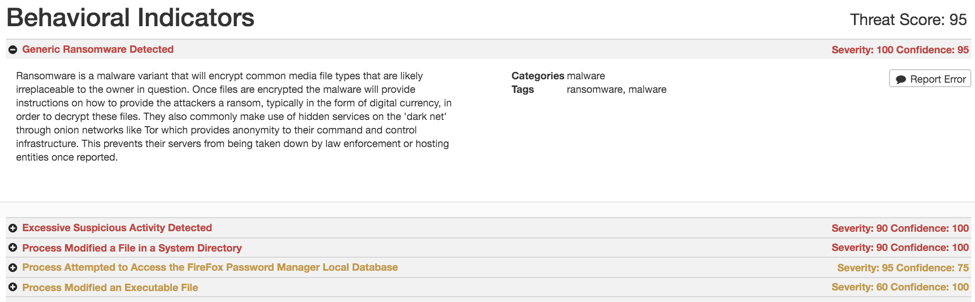
Generic Ransomware Detected

These Generic indicators work separately or in tandem to convict emerging ransomware threats. This multifaceted approach provides greater detection than one of these functioning on its own. These Generic Ransomware indicators allow us to convict ransomware first, then focus on identifying the specific ransomware family.

tg-1

Generic Ransomware Backup Deletion

Since ransomware began deleting system backup files as discussed above we created an indicator to detect this behavior. We see below this indicator works well with our other generic indicators to confirm overlapping behaviors and identify other samples.

tg-2

Overlapping Triggers

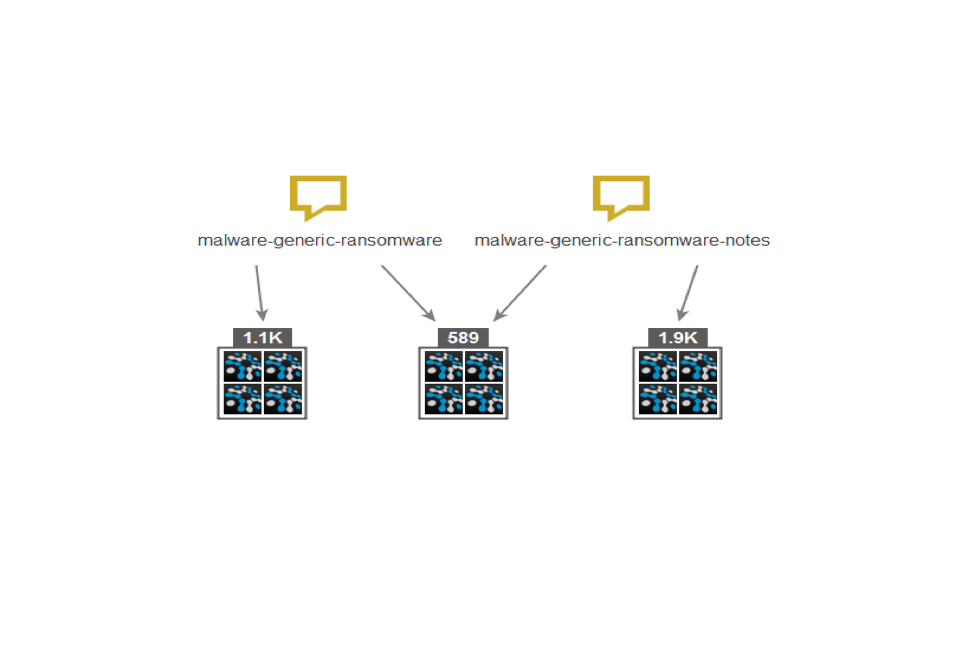
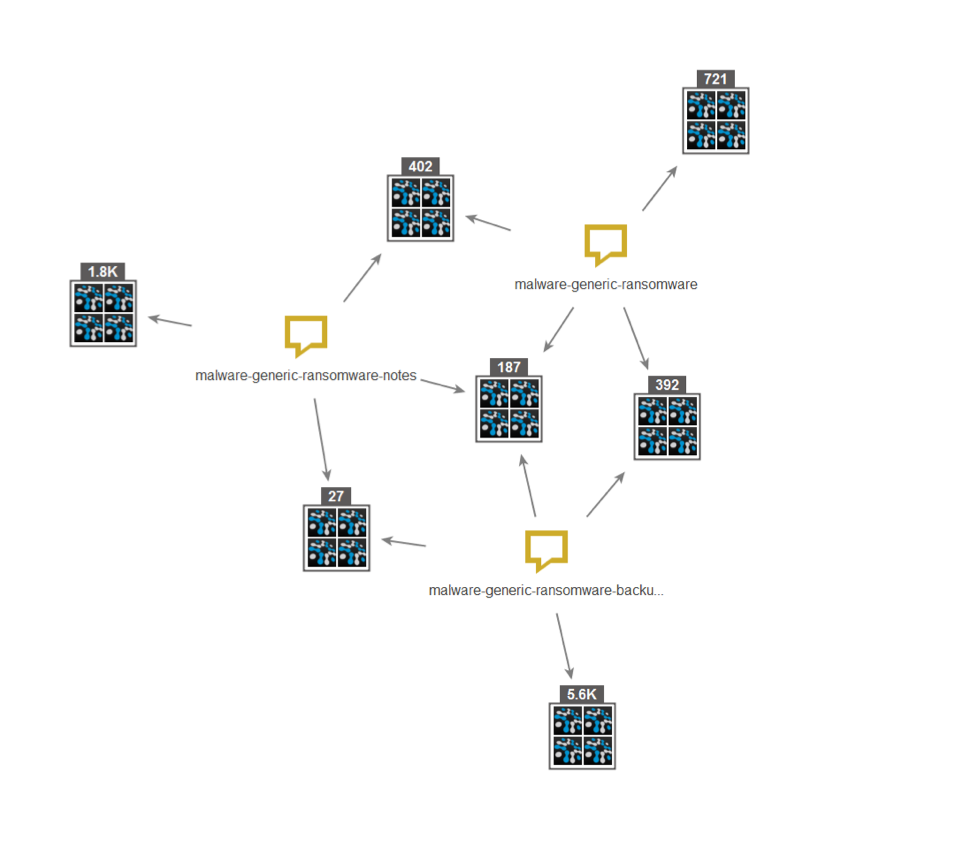
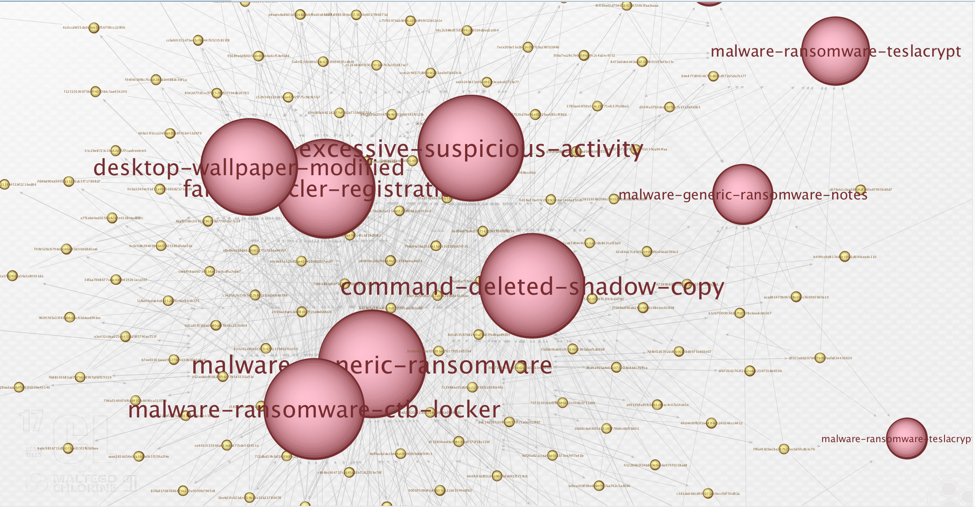
By taking any of these indicators in isolation and graphing search results in Malformity Labs Maltego using the AMP Threat Grid API transform pack, we begin to see there is some overlap in triggers. In this case we search for a single indicator: “generic ransomware”.  We pivot on the sample IDs, then pivot again on the indicators for each sample. The results start to show overlap with each other but not every instance triggers on the same sets.

tg-3
Visualizing behavioral Indicators in Malformity Lab’s Maltego

The overlap allows us to group indicators together and to create indicators we’ve labeled as compound. That is, several actions combined indicate malice with a higher degree of confidence. Absent the overlap, the results also allow us to identify new families of ransomware as well as new behaviors from existing variants.

tg-4

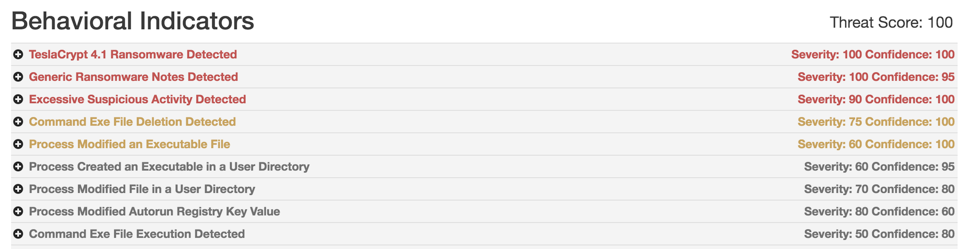
Excessive Suspicious Activity Detected

Another recently added behavioral indicator is “Excessive Suspicious Activity Detected. With this Behavioral Indicator, AMP Threat Grid is observing several traits over a set of files. If we observe these behaviors / traits, then there is a high level of confidence the sample is malicious and returns a higher threat score. In this way, AMP Threat Grid is able to identify new ransomware families, and shifts in existing variants.

The Excessive Suspicious Activity indicator was added in early February of 2016, and at the time of this writing we’ve seen a total of 1,830,488 triggers in the field. To highlight the benefit of these generic indicators we turn to an article written by Lawrence Abrams, published on bleeping computer, April 20th [1] highlighting the discovery of TeslaCrypt 4.1b.

After reading the article and searching the AMP Threat Grid Elastic Search instance for key indicators, it was discovered that because of the excessive suspicious activity indicator, the first instance of TeslaCrypt 4.1b was observed in the AMP Threat Grid environment on March 30th, 2016. That first instance, as well as subsequent observations of the new TeslaCrypt variant, were all given a malicious rating throughout the AMP portfolio a full 3 weeks prior to the public observation of the new variant.

tg-5

JavaScript Ransomware Downloaders

Finally, towards the end of March 2016 we started to see ransomware downloaders in the form of JavaScript files. Initially many sandboxes and even endpoint products did not support the analysis of this type of file, after all it’s rather difficult to identify and even Magic’s filetype identification shows it as Text more often than not. To address this delivery mechanism, AMP Threat Grid has added support for JavaScript file submissions. These files will execute in the sandbox environment just as other submission types.

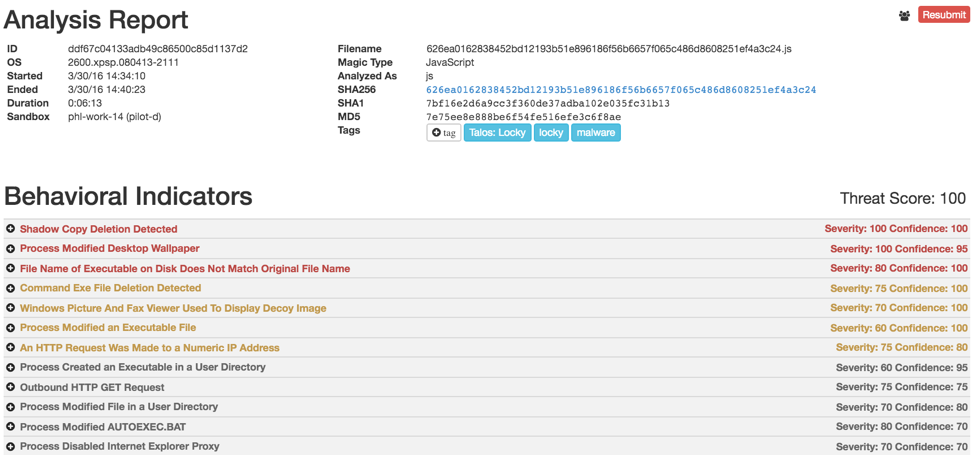
Locky was one of the first families identified as using this technique. Finding one of the downloaders on Virus Total, we submitted it to AMP Threat Grid and once analysis is complete we get a full picture of everything the downloader – and subsequently the downloaded binaries – are doing.

tg-6

As existing ransomware variants continue to morph and new families are introduced on nearly a weekly basis it becomes increasingly difficult to keep up with the task of identifying and writing specific signatures for each one. To that end, the indicators covered in this post have contributed heavily towards early detection of ransomware families and variant shifts as we see them. In the month of June alone, the indicators outlined in this post identified and proactively blocked over 1.1 million ransomware samples, protecting customers from having their data encrypted and disrupting business operations.

Check back here for a technical deep dive on the CryptXXX ransomware threat to learn how AMP Threat Grid can help protect your organization from malware. The next article will dive into CryptXXX to demonstrate how AMP Threat Grid engineers reverse malware to create targeted behavioral indicators we use in conjunction with our generic indicators to detect the ever evolving threats.

In the month of June alone, the indicators outlined in this post identified and proactively blocked over 1.1 million ransomware samples, protecting customers from having their data encrypted and disrupting business operations.

Cisco AMP Threat Grid is a malware analysis and threat intelligence platform, which is available as a cloud-based subscription service as well as on-premises appliances for those customers with stringent data privacy requirements. AMP Threat Grid is integrated with other Cisco products and third party solutions.

AMP Threat Grid performs static and dynamic malware analysis of unknown samples, which is combined with integrated threat intelligence into one unified solution. It provides the timely, in-depth information you need to protect your network from all types of malware threats. Threat Grid combines real-time behavioral analysis with up-to-the-minute threat intelligence feeds and existing security technologies, offering protection from both known and unknown malware attacks.

Sign Up for a Trial Account

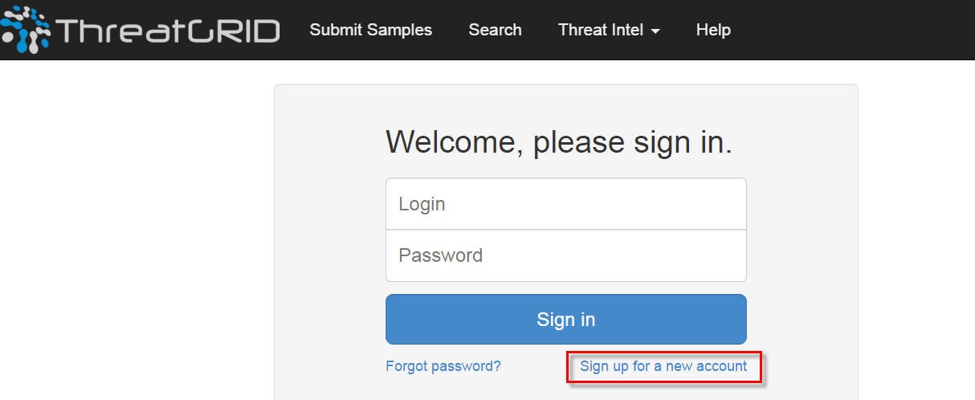
If you would like a personalized AMP Threat Grid demonstration and trial account, you can go to https://panacea.threatgrid.com and click on Sign up for a new account.

tg-7

[1] http://www.bleepingcomputer.com/news/security/teslacrypt-4-1b-released-with-few-modifications/]

Be sure to watch our webinar, The modern way of hunting – How three CTOs tackle incident response, hosted by SC Magazine featuring Dean De Beer, CTO at ThreatGRID, Dan Hubbard, CTO at OpenDNS, and TK Keanini, CTO at Lancope as they discuss what it takes to accelerate investigations, decrease incident response times, and uncover potential attacks before they are launched.

Authors

Eric Hulse

Sr Reverse Engineer

Advanced Threat Solutions – AMP Threat Grid

Avatar

When we think of collaboration, we often picture a corporate setting or consider the remote worker connecting from home. In the early days, that was probably accurate. Yet, with video and productivity apps becoming far more common, the only barriers we have now are the limitations of our own imagination.

What about the novelist and publisher who want to exchange ideas and house all versions in one place? Or the graphic designer who wants real-time reviews and feedback? Or the musical group that needs to collaborate from a distance?

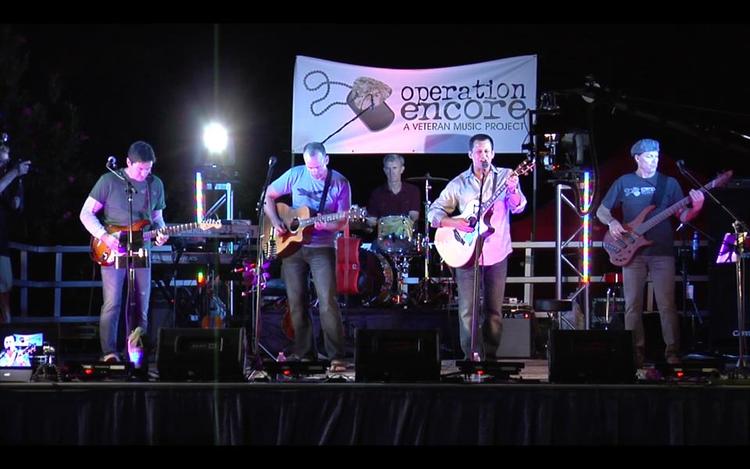
I’d like to introduce you to Operation Encore – a group of musical artists I’ve come to know well.

In 2013, my husband Keith, a U-2 pilot stationed at Beale Air Force Base in California, learned of an opportunity he found both humbling and exhilarating. He was invited to be part of a new musical project offering former and active duty military members a venue for sharing their stories.

Operation Encore’s founders, Eric Brine, Rob “Trip” Raymond, and Chris “Snooze” Kurek, sought out songwriters from across the military and veteran communities to record original music for a compilation CD. The group spans the various military branches and includes a variety of career fields from pilots to medics to paratroopers, and even the spouses that support them.

Operation encore - Stage
Operation Encore’s mission is to help raise awareness of veteran issues, encourage collaboration among veteran artists, and produce music inspired by service.

In watching Keith’s engagement with the group, I saw that they relied on email for sharing song ideas and audio files, and then had to wait on replies. It was a tedious and inefficient process, made even more challenging by the geographic separation. Many of the artists were still Active Duty and thus stationed all over the world.

“While working on our first CD,” said Trip “I remember holding my iPhone in front of my computer screen so Snooze could see the mixing software on my laptop via FaceTime. It wasn’t very tech savvy, but was the only way we could think of to work on the final song arrangements together.”

We learned last year, in 2015, that Operation Encore had plans to begin work on a second CD. Keith is not involved this time around, but we continue to support the group’s efforts because we feel so strongly about their mission.

Having focused on #Collaboration over the past few years, I’ve watched the technology evolve. So it occurred to me that I might be able to help solve their communication challenges. Enter Cisco Spark.

I introduced the group’s founders to Spark via one brief demo and then had them download the free app from iTunes. That was all it took. We met again to check their progress and they informed me that they had already created several virtual Spark rooms because the app was so “user friendly.”

Now they can share and store files, communicate real-time through group messaging, and start meetings all from one location, or Spark “room”.  They can create separate rooms for different projects, such as small work groups by song, larger groups for general messaging, or even just one-on-one. Plus the meetings feature will allow them to screen share – a big step up from using FaceTime to send video of Trip’s desktop.

“Posting CD artwork, for example, so that  everyone can comment in one place is going to be a big time saver. This will greatly improve how we can work together.” -Erik Brine

Preparing for the launch of their second CD, the Operation Encore team is now finalizing their songs and planning for the release party in Phoenix this November. I plan to monitor their progress and collect ideas for improving the user experience – something Cisco is always looking to do.

That said, this is only the first installment on Operation Encore and their Spark experience. Stay tuned for updates as they work toward the November CD launch!

Learn how Cisco Spark can help your organization, and follow Operation Encore on Facebook

I’d like to close each post by introducing one of these amazing artists, starting with the extremely talented Stephen Covell.

Stephen Covell
Stephen Covell enlisted in the Army in 2006. Having served two tours in Operation Iraqi Freedom as a combat medic in the 82nd Division, he uses music as an outlet for processing the effects of war. Stephen’s vivid and meaningful lyrics transport listeners to a different time and place. Check out Stephen’s song from the first Operation Encore album, Sand Hills to Sandals, about a soldier returning home.


Authors

Erin Broecker

No Longer with Cisco

Avatar

Previously on the blog, we’ve discussed why cybersecurity is such an important topic in the education space, including the different types of attacks schools, colleges and universities might face, such as ransomware. But cybersecurity can be daunting – where do you begin? That’s easy – call in the experts.

Here at Cisco, we have scores of experienced security professionals who have dedicated their entire careers to helping institutions like yours navigate the increasingly complex and dynamic cybersecurity landscape. You can learn from these experts in our two upcoming webinars that focus on ransomware in education.

K12

If you’re in the K-12 education space, be sure to register for our K-12 webinar this Wednesday, August 10th. Joey Muniz, Cisco Security Architect, and I will discuss:

  • IT security challenges common in K–12 schools environments
  • The latest threats seen by Cisco security experts
  • Ransomware such as SamSam, Locky/Zepto, and CryptoWall 4.0
  • Best practices to secure your network and IT systems

HigherEd

And for higher education leaders, sign up now for our webinar on Thursday, August 11th. Security experts Nick Biasini and Steve Caimi will discuss topics such as:

  • How today’s ransomware works and the preventative steps you can take
  • Strategies you can implement to reduce time to detection
  • Ways you can mitigate malware even after it invades
  • Which best practices to follow to secure your network and IT systems

Both webinars will also feature a live Q&A at the end so you can ask the experts your pressing cybersecurity questions. Don’t miss the chance to learn how to better protect your school – register now for our cybersecurity webinars for K-12 and higher education!

Authors

Matthew Gibbs

Solutions Architect

U.S. Public Sector Sales

Avatar

The fourth song on the iconic album, Sgt. Pepper’s Lonely Hearts Club Band, is Getting Better with Sir Paul McCartney the lead on the memorable refrain:

“I’ve got to admit it’s getting better
A little better all the time
I have to admit it’s getting better
It’s getting better since you’ve been mine
Getting so much better all the time.”

Take a listen…

As I was reviewing all the cool new features in Cisco Data Virtualization 7.0.4 release this week, “Getting so much better all the time” popped into my head, adding a musical dimension to the joy I felt.

A Little Better All the Time

With every new release comes features and enhancements that help us stay in tune with our customers and the market.

One particular feature I find especially useful is the addition of custom properties to the Business Directory. It supports the self-service trend sweeping business and IT today by letting users add their own business metadata to the formal IT metadata automatically. This allows users to more easily personalize data sets and then search for them using business-friendly terminology.

To allow Cisco Data Virtualization users to take advantage of the ever-expanding data infrastructure universe, eight new data sources were added and four updated.

  • New base adapters include Apache Drill, Netezza 7.2, OData Version 4, and Redshift
  • On the data / NoSQL front, now available are Cassandra, Couchbase, and HBase, with Amazon DynamoDB, Google BigQuery and MongoDB updated
  • A new adapter for SharePoint Excel Services and an updated adapter for Google Adwords round out the release.

For developers and administrators there is a long list (too many to include here) of additions and improvements to the development studio, runtime engine and management tools that will increase productivity and improve service levels.

Also, this latest release marks the first localized for the Chinese and Japanese markets where customer demand for data virtualization solutions is accelerating.

Authors

Bob Eve

No Longer with Cisco

Avatar

Quantum-resistant crypto

Recently there has been great media attention on Quantum Computers (QC) and their potential impact on current cryptography standards. We blogged about it in 2015.   All of this attention has drawn out critical efforts from many in academia and industry to solve problems with today’s cryptography that would break in a post quantum computer world.  However, much of that work has lacked focus on an area which is fundamental- cryptographic signatures.

Why are quantum-resistant signatures important

A quantum computer could break essentially all of the public key cryptography standards in use today: ECC, RSA, DSA and DH. Thus, if practical QCs became a reality, they would pose a threat to PKI-based signatures. For example, someone with a QC at some time in the future could perform a man-in-the-middle attack for a captured TLS negotiation, meaning the encryption within TLS protecting the confidentiality of the data would be broken. Signatures are often used to ensure software is legitimate and from a known entity.  In another scenario, if a signature used to validate software integrity is embedded in a piece of software or ‘burned into a piece of hardware’, a QC could, at some time in the future, forge a signature and manage to load an arbitrary otherwise malicious image. For those reasons, at Cisco, among other things, we have been investigating quantum-secure signatures.

HBS schemes

HBS (hash-based signatures) tree

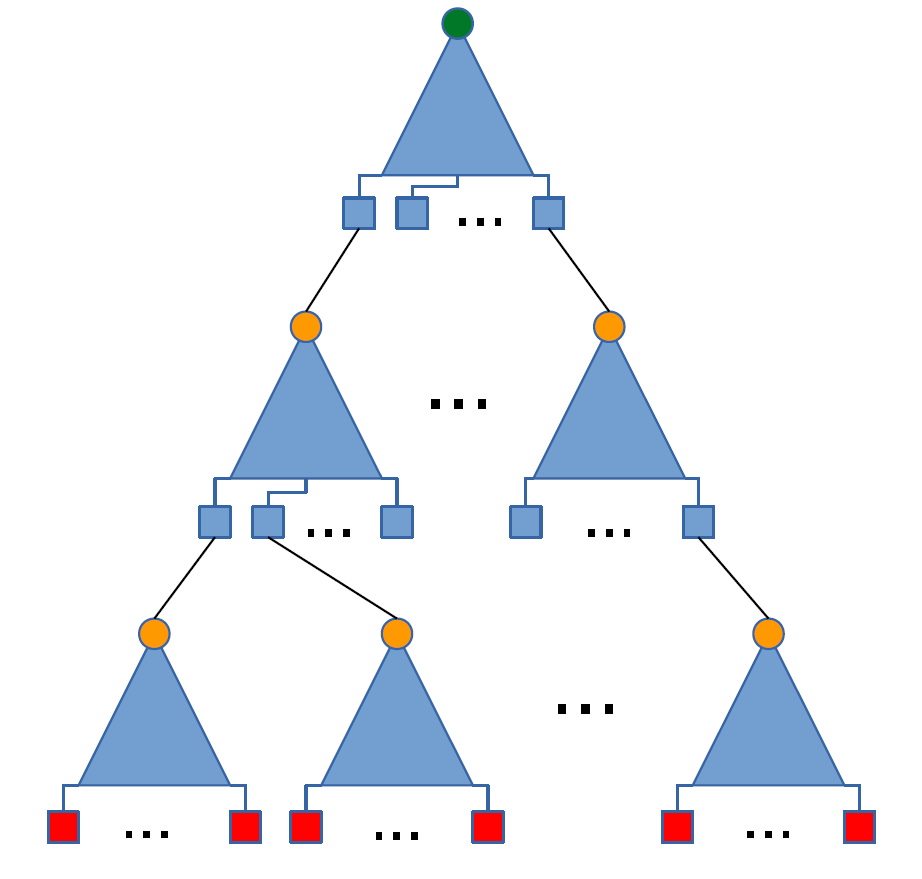
A well-understood quantum-secure signature technique is Hash-Based Signatures (HBS). Hash-Based signatures are tree structures that have signatures of messages as their leaves and the root and the path to the root of the tree becomes the public key for the messages signed in the tree. Due to their well-understood and analyzed primitives, HBS schemes are widely accepted as good candidates for quantum-secure signatures. XMSS is one such scheme that has been going through iterations for standardization in IETF’s CFRG WorkGroup (WG). Similarly, LMS is another HBS scheme by Cisco’s David McGrew driven in IETF. Both of these schemes are stateful, which means that a private key should only be used once to sign a message and a reused private key compromises the security of all the signatures in the tree. On the other hand, purely stateless schemes like SPHINCS eliminate the state management challenges, but have significantly high signature sizes.

As we’ve seen in a number of other encryption schemes, while the requirement of avoiding key reuse in a stateful signature schemes seems simple, it conflicts with a baseline goal of ensuring crypto is as easy as possible to implement and needs to be addressed. There are techniques that can be applied to protect against such concerns.  Cisco has been working with a set of world class researchers to mature these schemes and offer them for broader consideration via our paper here.  In this paper, we analyze state management in hash-based signature schemes, and categorize the security issues that can occur and ultimately we consider a hybrid stateless/stateful approach. Compared to a completely stateless scheme, the hybrid approach realizes the essential benefits, with smaller signatures and faster signing. We believe that by leveraging these techniques, stateful schemes can be practical in more environments since the complexity and very high signature size of stateless schemes are often limiting factors for their deployment.

Future

A properly deployed and implemented HBS schemes has multiple applications in a post-quantum world. Some use cases include

  • Firmware or software image signing
  • Certificate authentication (TLS, IKEv2 and more). Standardization of the HBS scheme in the widely used in the industry Cryptographic Message Syntax (CMS) would be required as the LMS in CMS draft attempts to do for LMS.
  • Software package signing
  • File signing

We believe both stateful and stateless schemes are useful for certain use cases. Tradeoffs between signature size, performance and implementation concerns will be important when deciding which scheme is used where. For example, a stateless 41KB SPHINCS signature can be impractical for a certificate in certain environments, whereas in modern networks it might not be an issue. Similarly, state management can be challenging for certain memory technologies, which can deem them impractical in some cases.

We expect that some HBS schemes will be standardized which will make the eligible to be used in crypto protocol and for certain use cases. We are working to ensure HBS schemes will be considered in many standards efforts going on around the world.

At Cisco, we will keep focusing on signatures that stand up to the existence of quantum computers and we believe HBS is the right place to focus. Our goal is to work with the industry and promote standardization of commonly accepted schemes and adoption in crypto standards like CMS. Our vision and thoughts will be presented in the 4th ETSI/IQC Workshop on Quantum-Safe Cryptography in September. For more information on our view of engineering postquantum security and recent developments, stay tuned for an upcoming blog.


Authors

Panos Kampanakis

Product Manager

Security & Trust Organization

Avatar

Spend less time making more money. Sound good? Keep reading.

This week we’re talking about:

  • Making money just got easier
  • How to reach more of the right customers: a use case
  • Making the mobile experience easy, instant, and collaborative


Making money just got easier.

Helping you be more profitable is something we’re always thinking about. We had this in mind when we redesigned VIP. Say goodbye to complexity while you get rewarded for selling architectures and new business. Say “woohoo!” when you discover how much easier it is to enroll, participate, and track VIP from beginning to end..

Find out what’s new and what’s better with VIP 28. And remember to enroll so you can make more money when you sell.


How to reach more of the right customers with less time and money. A use case.

ShoreGroup reveals how they increased their sales qualified leads by 50% in just one month. They didn’t spend more money. They didn’t spend more time. Instead they…

Watch the video to find out.


Make the mobile experience easy, instant, and collaborative

Our customers want to collaborate quickly in the office and on the road. Wherever they are, whoever they’re connecting with, they expect instant access to an experience that mimics being face-to-face. And you can deliver it to them. Our new solution with Apple is coming this fall and you can start generating demand today with this all-in-one marketing campaign, customized for the Americas, EMEAR, and Greater China.

(Note: this campaign is available through Partner Marketing Central which your marketing team has access to use. Assuming you’re a Cisco partner. If you’re not a partner, now’s a good time to join our ecosystem.)


Since we’re talking about collaboration…

Find out what’s new and what’s to come. Gary Wolfson, Director, breaks down all the news and announcements related to collaboration in this blog.


What’s next?

 >> Fast Forward: Find out why CNN is talking about Connected Conservation. And come back to get more tips on renewals, managing the lifecycle, security, software, and…you guessed it…digital transformation.


The partner weekly rewind and fast forward is designed to give you a snapshot of what you missed and what’s to come. Tell us what you think and what you want to hear about in the comments. And come back next week for more!


Authors

Jill Shaul

No Longer With Cisco

Avatar

We are quickly moving into an era of accelerated digitization. Where technology connects everything –people, processes, data, and things. These connections will create a sustainable impact for every aspect of society.

It’s predicted there will be over 50 billion connected things by 2020. In order for countries to embrace the opportunities this digital transformation can bring, they need people with the right technology skills.

By embracing digitization, Latin America can become a leader in the next generation of jobs, social inclusiveness, research, and education.

The digital era is now. But is Latin America ready?

A new study from market intelligence firm International Data Corporation (IDC), supported by Cisco, shows that when it comes to the skills needed for digitization, many countries are not.

IDC recently repeated their 2007 and 2012 studies of the IT industry skills gap in Latin America. They used a rigorous proprietary research model which includes data from many sources, including interviews with 760 employers in 10 Latin American countries. IDC tracked essential as well as emerging networking skills in a variety of industries to present an accurate picture of Latin America’s IT employment situation.

The news was fairly good – the gap is shrinking slightly – but the numbers still remain daunting. By 2019, Latin America will lack 449,152 IT professionals. This is bad news for a future where billions of things will be connected in less than 5 years.

The Skills that Drive Digitization

So what are the missing skills that drive digitization? The study focused on three types of skills:

  • Essential networking technology skills
  • Emerging networking technology skills
  • Non-technical skills

The largest gap (55% of total Full Time Employees skills gap in 2015, growing to 64% in 2019) was in emerging networking technology skills: video, cloud, mobility, datacenter & virtualization, big data, cybersecurity, IoT, and software development. Essential networking skills, representing 45% of the skills gap in 2015 and 36% in 2019, are basic router and switching skills, network security, wireless networking and VoIP and unified communications. The IDC study also showed that networking professionals need non-technical skills to succeed as well. Proficiency in English, team work, problem solving, creativity and innovation, and communication skills are all important.

So what’s the risk of not filling this gap? The International Labour Organization tells us that 21 million individuals in Latin American countries will be unemployed by the end of this year. Delaying digitization risks stifling social and economic development throughout Latin America. Without skilled employees, technological progress does not translate into productivity or growth. According to the World Economic Forum’s 2016 Global Information Technology Report, which measures the capacity of countries to leverage information and communication technologies (ICTs) for increased competitiveness and well-being, Latin America is struggling in the areas of networked readiness and the impact of ICTS on government efficiency and basic services. The region continues to move up in ranking, but more work needs to be done.

Filling the Gap – Not as Simple as it Sounds

What’s the solution? On the surface, it seems simple: train more people with the right IT skills. But it’s more complicated than that. There are not enough teachers with the right training. Internet access (which could provide the training remotely) is limited in the region. And, most fundamentally, there is a lack of students who are interested in learning these tech skills.

It’s going to take everyone working together — schools, corporations, government agencies and local communities — to solve these problems and fill the skills gap from the bottom up. This effort has recently gained momentum though, with the announcement of two collaborations.

The first collaboration’s goal is to connect all classrooms to the Internet and transform the quality of digital education in Latin America. Comprised of a diverse group of organizations (CAF, the Development Bank of Latin America, the Economic Commission for Latin America (CEPAL), and Cisco), one of their primary objectives is to gain support from national lawmakers to prioritize internet access. Mario Castillo, New Technologies and Innovation Chief, CEPAL, reiterates the importance of this effort: “IT adoption is crucial for social and economic development. To reach it, policies that promote access to internet and use in high impact areas such as education are required.” He’s right. According to the Inter-American Development Bank (IDB), countries that increase their broadband penetration by 10% enjoy, on average, a 3.19% increase in GDP, a 2.61% increase in productivity, and 67,016 new jobs.

The Organization of American States (OAS) is leading another regional effort, which is dedicated to ending poverty in the region through the use of information and communication technologies. This initiative, which is part of the 2030 ICT Alliance for the Americas, looks to expand connectivity in Latin America and provide training for active participation in the digital economy. Together with the OAS, information and communications technologies companies, universities, and the Economic Commission for Latin America and the Caribbean (ECLAC) have committed to join and support efforts to connect the next 1.5 billion people and every public school in the region to the internet. They will also promote digital training, improve the quality of education, and develop talents for the new digital economy, preparing students for entry-level ICT jobs.

Cisco is also contributing to this effort through Cisco’s Networking Academy. The Cisco Networking Academy partners with learning institutions, community centers and governments to offer technical training and professional skills development training. The curriculum, which adapts and changes with technology trends, is currently focused on networking, security, and Internet of Things (IoT) technologies. One million of the six million people who have taken courses since 1997 are in Latin America.

Generating Interest in IT Careers

It’s encouraging to see organizations working together to bring internet access and technical training to Latin Americans. But Latin America needs a lot more people to get interested in and enroll in these programs if it is going to fill that skills gap.

Cybersecurity is one of those emerging networking technologies that is becoming more and more critical. An understanding of cybersecurity – knowing how to keep information and operational technology secure — is one of the most sought-after skills in the digital world right now. Amanda Cumberland, Head of Strategic Research for Corporate Affairs at Cisco, explains: “Cybersecurity strategies are an integral part of digitization and are critical to its success. The latest IDC study found that 86% of companies in Latin America have a cybersecurity strategy. Security is central to digitization.” But a predicted global shortage of two million cybersecurity professionals by 2019 limits the ability to adopt technology, accelerate economic growth, improve productivity, and create new jobs. We need to get more people interested cybersecurity. But how?

One solution is to reach out to new audiences, and offer them incentives. Cisco is investing $10 million in a two-year Global Cybersecurity Scholarship program to grow interest in cybersecurity careers. The program is looking for participants in some unconventional places: community centers in Costa Rica and Mexico, and other diversity organizations. To recruit scholarship recipients from a relatively untapped audience, Cisco is partnering with events like “International Girls in ICT Day,” which empowers and encourages girls and young women to consider careers in the information and communication technologies.

According to the IDC study, women comprise one of the most promising new markets for networking skills training. Currently women represent only 13.3% of networking employees in Latin American companies. And 15.7% of Latin American companies have no women on their networking teams. However, 31% of Computer Science and Engineering majors in the region are women, and 23% of Cisco’s Networking Academy students are female. The future looks bright for female networking programmers.

It looks bright for Latin America as well, as digitization continues to transform Latin American countries, cities, businesses, education, and job markets. The way forward is clear, and we are all working to prepare for a digital future. Together, we can close the gap.

Authors

Jordi Botifoll

No Longer with Cisco