Many colleges and universities are being faced with declining budgets and rising expectations. Increasing operational efficiency while driving innovation is crucial for higher education institutions.
To summarize the current state of higher education and to provide insight on how institutions can be innovative and cost-effective, global industry analyst firm Ovum created this simple outline.
Check out the infographic, and then learn more about Cisco’s digital learning and digital campus portfolio offerings for higher education.
Lee Memorial Hospital Systems (LMHS) located in North Fort Myers, Florida has taken that truism and has adapted it over their network of four acute care hospitals. With a goal of expanding stroke care services, LMHS needed to make sure that the hospitals and the physicians were all intelligently connected. This meant that if a patient was brought into one facility, he or she could be “seen” by an expert in another—without wasting time going from one place to another.
Cisco proposed a solution that included building a wireless infrastructure made up of products like the Cisco Industrial Wireless 3700 Access Point and Cisco Catalyst 3700, 3800 and 4500 Series Switches. Cisco deployed communication products that allowed patients and physicians to use the cutting-edge infrastructure and connect as if they were in the same room.
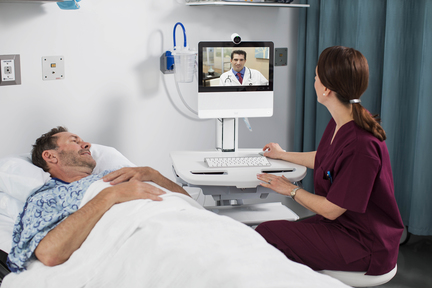
LMHS doctors are now able to quickly access patients’ medical records and imaging systems from remote locations. This allows the patient to be diagnosed much faster than the previous way. LMHS staff also uses a mobile telestroke cart to allow medical care to come directly to the patient. The information that the cart takes is sent directly to the physician and the rest of the hospital staff, which is a real time saver.
On-call doctors don’t even need to be near their office or hospital to treat a patient. If a need arises and a specialist is at home, that physician can be sent the patient’s data where he or she can assess the patient and provide care instructions.
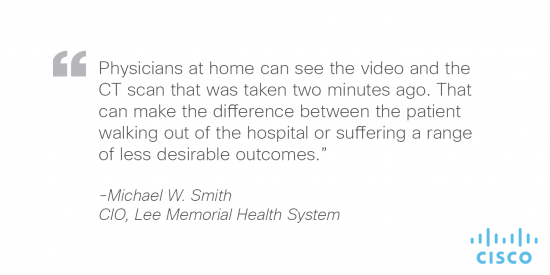
“Physicians at home can see the video and the CT scan that was taken two minutes ago,” said Michael W. Smith, Chief Information Office at Lee Memorial Health System. “Sometimes that can make the difference between the patient walking out of the hospital or suffering a range of less desirable outcomes.”
Cisco Live 2016 was an exciting opportunity for a handful of young men and women. As part of the Cisco Networking Academy Dream Team, 10 students worked side-by-side with Cisco engineers in Las Vegas, setting up and maintaining a massive network for more than 28,000 attendees.
Together, they wired over 45 miles of cable and provided wireless coverage to 2.8 million square feet of convention space through 650 access points and 500 switches. It was a week that saw the Dream Team apply their skills in real-life situations, connect with industry professionals, and build relationships that will last a lifetime.
For many of the students, Cisco Live opened their eyes to the IT industry; to fulfilling careers made possible through NetAcad curriculum and courses. It inspired them to continue their education and pursue one of thousands of jobs created by the digitization of our economy. Here, in their own words, are the answers to the question asked at the beginning of this blog:
“After Cisco Live, I know I want to continue on the path I have started to have a meaningful career with my Cisco certifications. Not only do I feel confident in having upgraded my skills, but I will be able to use these skills one day to help others that would like to do the same. I would like to inspire them to never stop learning and growing. That there is always something that you will love doing and somewhere you will love being, you just have to find it and go for it.” — Candice Darrohn
“After Cisco Live, I know I want to… to continue to pursue an IT Networking career. I was inspired by speeches, executive chats and IT trends. My next step is complete my degree in IT Network Administration.” — Olivia Averhart
“After Cisco Live, I know I want to obtain my CCIE as well as my CCDE and secure a job working for Cisco as a Network Engineer. I want to be able to design and implement networks for special events and help develop emerging technologies.” — Kyle Ramsey
“After Cisco Live, I know I want to become a CCIE Security, Certified Penetration Testing Consultant (CPTC), and become the CIO of Cisco.” — Arodi Grullon Fernandez
“After Cisco Live I know I want to get a job with Cisco or with a Cisco partner company and also get my certifications up to the CCIE level in Routing and Switching and Security and even beyond.” — Stephane Zi
“After Cisco Live, I know I want to become CCIE certified and pursue my dream of becoming a network architect.” — Andrew Mueller
Many of the students share the same goals and aspirations; some want to change the world, some want to work for Cisco, and some even want to run their own companies. Growing up, they may have dreamed of becoming firefighters, astronauts, or police officers, but after Cisco Live, they’ve discovered new networking dreams.
Submitted by Kelsey Kusterer Ziser, the Editor of Upskill U at Light Reading
Open source software plays a key role in developing an efficient and agile virtualized network architecture at a reduced cost. Interest from operators in building their own open source services is on the rise, but this shift means service providers must re-think traditional standards processes and software development cycles.
Beginning August 10, Light Reading and Cisco are launching an Open Source series at Upskill U, a free online university delivering must-have education on themes relating to the overall business transformation taking place in the communications industry. In this four-part learning module, speakers from OpenDaylight, Telstra, Heavy Reading and LinkedIn will address the challenges and opportunities service providers face as they seek to successfully implement open source software as the network moves more toward virtualization. This series starts with the fundamentals of open source, and subsequent courses will cover how open source supports NFV, shapes data center operations and cloud services and influences the white box transformation.
Secure your seat at Upskill U for these exciting lectures in the Open Source series:
Telcos & Open Source 101 (Wednesday, Aug. 10, 1:00 p.m. ET): Phil Robb, Senior Technical Director, OpenDaylight, examines how service providers can make the shift from the traditional standards processes, how the open source process is tackling a new role of competing at the higher levels of the software stack and provides understanding in open source licensing and managing R&D processes.
The Role of Open Source in NFV (Friday, Aug. 12, 1:00 p.m. ET): Jim Fagan, Director, Cloud Practice, Telstra, addresses the impact open source is having on NFV platforms and what it means for vendors and operators.
Using Open Source for Data Centers and Cloud Services (Wednesday, Aug. 17, 1:00 p.m. ET): Roz Roseboro, Senior Analyst, Heavy Reading, examines the use of open source for cloud services in the telecom space, what issues still need to be resolved and whether standards bodies are perhaps the better way forward for CSPs.
Open Source for White Box Networks (Thursday, Aug. 18, 1:00 p.m. ET): Saikrishna Kotha, Global Infrastructure Architect, LinkedIn, explains the importance of open source software to the white box transformation and how virtualization and evolving standards will impact that transformation overall.
During each 45-minute course at Upskill U, listeners have the opportunity to discuss course material with industry peers and ask expert presenters key questions. All courses are archived, so listeners can revisit lessons anytime. Don’t get left in the dark during this sea change – register today for the upcoming Open Source series at http://www.lightreading.com/upskillu. I’ll see you on the chat boards!
IT departments regularly ask us questions about their security posture, their security concerns, and specifically, the makeup of their Threat Management (TM) organizations. Generally speaking, Threat Management includes anything in the Intel-Detection-Response arena, generally encompassing Security Operations Centers, Intelligence Organizations, and Incident Response Teams. When it comes to the makeup of their TM organizations, companies vary, and there is no one-size-fits-all model. In fact, ask any number of organizations what defines a SOC or IRT, or where an Intel team fits within their organization, and you’re bound to get countless answers that sound similar, but ultimately differ. What doesn’t often vary, however, is the answer to the follow-on question about how large the team is: “We have a guy/gal.”
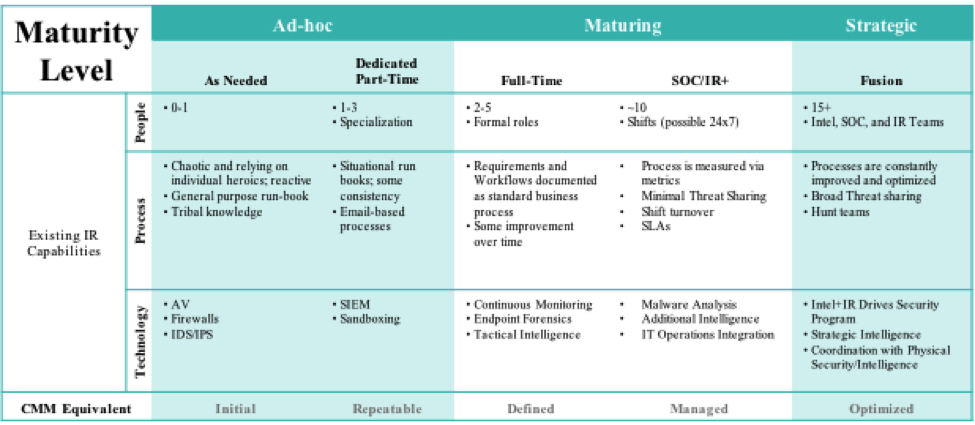
Based on these conversations and our experience, including when I was originally “the guy” responding to incidents at a large, well-respected enterprise – it’s quite obvious that there are Haves & Have Nots in the Threat Management space. Since we weren’t aware of a maturity model for TM teams, we decided to draft one.
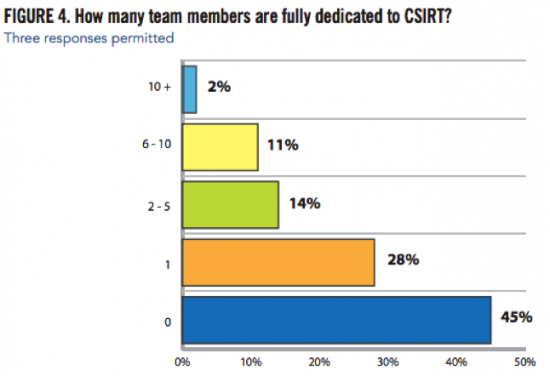
To be clear, much of this is anecdotal and not yet based upon a scientific sampling. But we’ve shopped this around a bit with some of the smartest folks we know and have gotten lots of head nodding. Some agreement can be found in Lancope’s sponsored Ponemon report which, when you consider the data, supports the notion of a TM continuum.
To dive a little deeper into the three main categories:
Ad-Hoc
In our experience, this accounts for the majority of organizations. These companies have generally not invested in TM and typically deal with issues on a case-by-case basis. They have basic tools such as AV, FW’s, and even IDS/IPS and SIEM; but their implementation supports basic use cases, like addressing common malware and supporting compliance efforts.
Maturing
We’d estimate 25% of organizations fall into this category in which they are in the early stages of building out a TM function. In this stage, firms are standardizing processes, harvesting intelligence, building relationships outside of their company, and becoming more specialized and responsive – perhaps even starting a Security Operations Center. Commitment can yield significant results at this stage, but fairly quickly firms will encounter bandwidth issues and need further investment in human capital to get any further.
Strategic
We’ll call these the One-Percent. Very few firms consider Threat Management a strategic function of the organization, let alone leverage it to drive their security program. But these organizations do. They recognize the power of intelligence, proactive hunting, and incident dissection, and also partner with business units, keep tabs with government intel organizations, lobby The Hill, and more. This doesn’t happen overnight. Rather, they progressively leverage the fruits of these activities over time to gain the personnel, bandwidth, muscle, and budget to achieve this a reality.
This is just a first crack at a maturity model for TM. We’re sure it could be a lot better. But so far, the categories and their components resonate with our experience and what we see in the market generally. We suspect that this will be a hotly contested topic, with countless differing opinions – your feedback and continued conversation is welcome.
This post was co-authored with Ted Julian from Resilient Systems. Feel free to reach out to us on twitter @SeanAMason & @eajulian to provide us your thoughts.
Alert to all startups, entrepreneurs and developers with digital breakthroughs to disrupt the world!
Cisco’s innovation bullet train is about to leave the station. Last call to hop on board this high-speed express line is less than three weeks away — Aug. 31!
Don’t miss the train destined for new frontiers of opportunity! Enter here before Aug. 31.
Called the Innovation Grand Challenge 2016, #CIGC16, this will be the third consecutive year that we are calling on innovators around the world to compete for a portion of $250K in cash prizes, game-changing development support, mentoring and more. Once we select winners in November (see timetable below), we will help them accelerate technologies and solutions on our digital platform that transform countries, companies, and cities.
All passengers (entrants) on board this train though will reap valuable experience that goes far beyond the potential for rewards and recognition. Tom Caldwell, co-founder and EVP of Products at CyberFlow Analytics, and one of last year’s winners, recently told me, “I encourage all startups to enter the competition and go through the experience. Focus on the customer’s problem and highlight the use cases for how you deliver true value in a disruptive manner.”
If you’ve been paying attention to the news, you might have realized that the U.S. National Conventions happened last month. As the Official Network Provider for both the Republican and Democratic National Conventions, Cisco helped transform Cleveland and Philadelphia into mini smart, connected cities to help the conventions go off without a hitch. It wasn’t easy – conventions involve lots of people, set-up time, and, of course, balloons. Here are the RNC & DNC by the numbers:
RNC:
32 days – How long they had to set up Quicken Loans Arena for the RNC, since the Cleveland Cavaliers had just been playing there for the NBA finals.
50,000 – The approximate number of people who traveled to Cleveland for the RNC, including about 15,000 journalists, 2,472 delegates and 2,302 alternate delegates.
125,000 – The number of balloons dropped on the last night
DNC:
58 days – How long they had to set up Wells Fargo Center for the DNC.
50,000 – The approximate number of people who traveled to Philadelphia for the DNC, including about 20,000 journalists, 4,760 Democratic delegates and 347 alternate delegates.
100,000 – The number of balloons dropped on the last night, including extra-large 36-inch ones
So what exactly did Cisco supply to help connect the conventions?
300 access points across Cleveland and Philadelphia
80 video security cameras
Around 2,000 desk and video-enabled phones
12 TelePresence units
400 switches and routers
2 UCS servers for RNC Teleprompters to store and retrieve speeches during Convention
What did that network help power?
28.5 terabytes – The amount of data used over the four days of the RNC in downtown Cleveland – that’s the equivalent of streaming video for 3,560 days straight!
50.4 terabytes – The amount of data used over the four convention days at the Wells Fargo Arena in Philadelphia. Most of this was from social media applications, followed by video viewing and Web browsing.
Cisco also provided extensive network security utilizing ASA5585s with FirePower modules, FireSight, Identity Services Engine (ISE), and StealthWatch. In addition, Network Management was provided by PRIME Infrastructure 3.0 for wired and wireless devices, with Video Surveillance Manager (VSM) for viewing real-time or recorded video footage.
To learn more about Cisco’s role in powering these #ConnectedConventions, check out this great recap video:
On average, there are 795,000 stroke cases in America every year, and 130,000 of those cases are fatal. Accelerated identification, diagnosis, and treatment by the right experts are key components in winning the war against strokes.
With four acute care hospitals and two specialty hospitals known for their treatment of stroke patients, throughout five counties, Lee Memorial’s team of dedicated healthcare specialists serve one million patients every year through acute care, emergency care, rehabilitative and diagnostic services, health and wellness education, community outreach, and advocacy programs.
With a world-class neurology team already in place, Lee Memorial needed to connect the right physicians to geographically dispersed patients in need of care.
Their solution? Use Cisco technology to provide a connected patient experience with mobile, high quality, remote video consultations while connecting physicians with reliable, high-speed, mobile access to the hospital’s EMR CT system and PACS.
To learn more about how Lee Memorial improved patient care and physician accessibility, read more in the full case study here.
Cisco was front and center at Microsoft’s worldwide partner conference in Toronto recently. We had prime real estate at the entrance to the exhibit hall, engaging the 16,000 people in attendance to share how Cisco is helping Microsoft partners deliver value.
Not only did we win two awards and rocked out to Gwen Stefani, but we had a blast, and our partners did too! What really stood out for us was how incredibly exciting it was to engage with many non-traditional partners – from Solution Integrators to ISVs. They were so interested in wanting to talk to us about how Cisco can help them deliver better customer outcomes.
Partner-to-Partner with Cisco and Microsoft SQL Server 2016
While April 2016 marked the end of support for SQL Server 2005,the end of support for SQL Server 2008 is not far behind. This means that thousands of enterprise customers are planning mission-critical application migrations now. This represents an opportunity for you.
With Cisco you can help your customers transform their operations by delivering an environment optimized for SQL Server 2016. Learn how you can differentiate your go-to-market offerings with Cisco, Microsoft and combine with your value-added services. Simply register for this informative webinar and learn how you can grow your market share. Topics covered include:
What’s new in SQL Server 2016
Benchmark test results of the combined solution
Performance, economic, and manageability benefits
Customer case study with SQL Server environment on Cisco UCS and SanDisk flash storage
And the Winner Is ……
The Microsoft Canada red carpet awards event was held at famed Roy Thompson Hall. The Microsoft IMPACT awards recognize how the Microsoft partner ecosystem is making a difference by helping customers transform and innovate. Hundreds were in attendance and Cisco was delighted to be recognized – along with partners TELUS and NetApp – by Microsoft Canada for our hybrid cloud offerings built on Microsoft software. The new TELUS Hybrid cloud features Cisco CCA for Microsoft and NetApp for storage, as well as a fully leveraged Microsoft Azure hyper-scale option. Way to go team!
Recognition by Partners, for Partners
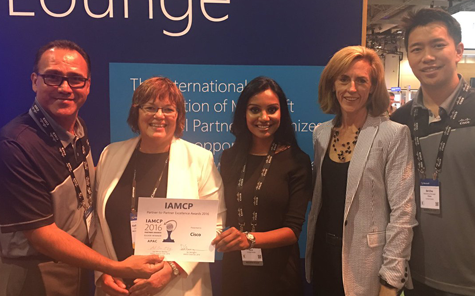
Probably one of our most satisfying wins came on Tuesday at WPC when the International Association of Microsoft Channel Partners (IAMCP) selected Cisco and NetApp together for our work with Microsoft partners in Asia. Together Cisco and NetApp have been helping partners, not only in Asia, but all around the world, to modernize their infrastructure to deliver advanced managed services for customers.
IAMCP is the leading independent global organization for business networking in the Microsoft partner ecosystem with 80+ chapters in more than 40 countries. Cisco has been working with IAMCP members to deliver Cisco validated solutions specifically designed for the Microsoft platform.
Are You Working with Cisco?
Cisco has a wide range of programs specifically designed to help Microsoft partners add value and compete to win. We operate a broad ecosystem so that partners can choose how they want to deliver solutions – as a Cisco reseller or in partnership with a traditional reseller. Our ISV community is growing and we are going-to-market with applications certified for Cisco – from the Internet of Things to Cloud to Vertical/Industry solutions, learn how Cisco can help you grow your partner-to-partner business today.








 mitted by Kelsey Kusterer Ziser, the Editor of Upskill U at Light Reading