Avatar

In July of this year, business, government and higher education leaders met at Flinders University to discuss ‘innovation at work’ at the Tonsley Precinct in Adelaide, Australia. The discussions during the Business/Higher Education Roundtable centered on better understanding the impact of technology and digital disruption with a focus on how universities and industry respond and better align to the challenges and opportunities.

The conversation started by identifying digital disruption currently taking place, and investigating how the Tonsley Precinct transformed from an outdated automobile manufacturing site into a thriving innovation environment transitioning to the new economy. The Tonsley precinct is a a great example of how start-ups, academia and industry can innovate together to create economic and societal benefits.

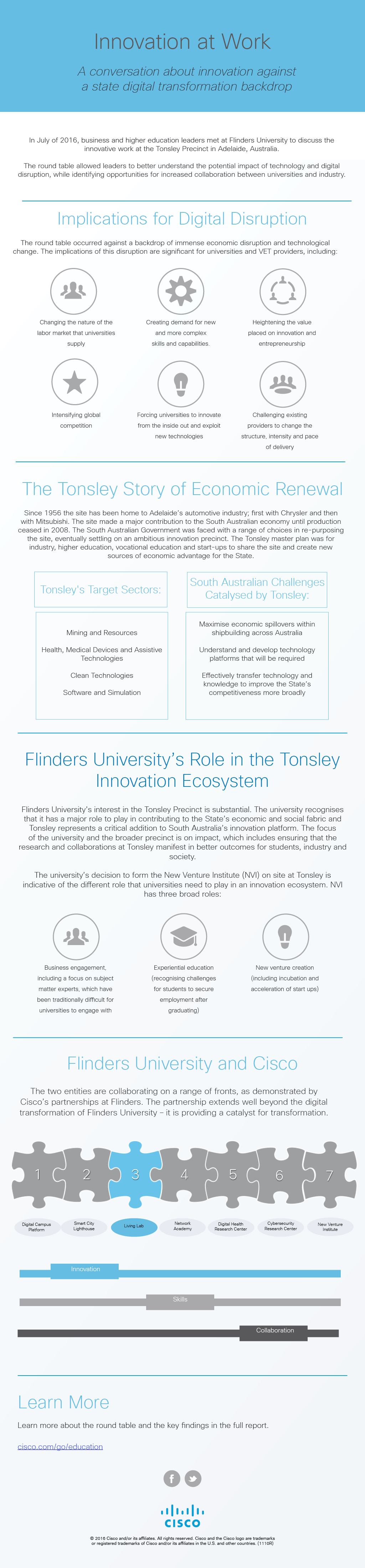
Check out this infographic to learn more about Tonsley and the partnership with Flinders University and Cisco, showcasing collaboration between university and industry in Australian innovation.

Innovation at Work-V2

Authors

Reg Johnson

General Manager, Education

Cisco Australia and New Zealand

Avatar

Introducing Cisco Hosted Collaboration Solution for Government

Security has never been more important. This is especially true for our U.S. federal, state and local government customers. Their employees and their constituents have become more mobile and more virtual. They expect communications beyond just voice. And many US government customers have a cloud-first technology mandate. They need to improve efficiencies, offer better services and to ease resource constraints. To meet this need, we are building solutions that are cloud based and secure. In fact, they are so secure that we built them to the U.S Federal Risk and Authorization Management Program (FedRAMP) requirements.

Last spring, Cisco WebEx, our industry leading conferencing service, achieved FedRAMP certification. And now, we are introducing Cisco Hosted Collaboration Solution for Government (HCS for Government). Cisco HCS for Government offers industry-leading Cisco collaboration and is in process for FedRAMP authorization.

Cisco HCS for Government is based on our proven Cisco HCS offering. But it is hosted in the Cisco Collaboration Cloud and managed by Cisco. So it delivers our industry-leading collaboration features. Cisco HCS for Government includes voice and video communications, mobility (yes, it supports Jabber), messaging, presence and more. When combined with WebEx, our government customers have a complete solution.

The security makes this offering even better. Cisco HCS for Government’s FedRAMP certification is expected later this year, but offers that level of security today. It offers:

  • Dedicated deployments for U.S. government customers and contractors only
  • End-to-end FIPS 140-2 compliant encryption
  • Constant monitoring
  • Application-based policy enforcement and management
  • An architecture based on FedRAMP security requirements


So if you are a U.S. federal, state and local government customers, take a look. Cisco has a complete solution for your security and collaboration needs. Lean more

Authors

Patty Medberry

Senior Manager, Product Marketing

Cisco IoT

Avatar

At the end of 4th grade, 10-year-old Peyton Walton learned that her family was moving 600 miles away. She also learned that she was diagnosed with cancer.

As Peyton began her cancer treatment, doctors stressed the importance of Peyton continuing to attend school in order to minimize isolation and destruction. However, as her treatments became more intense, and it became apparent that attending school daily wouldn’t be a reality, Peyton and her mother Lynn struggled with the limited options given by their healthcare provider.

According to Lynn, “It was important for me to connect her [Peyton] to children and people that knew her before cancer, because then she was just Peyton.”

After tackling many roadblocks with her healthcare providers, local legislation, and school district, Peyton and Lynn were connected with Cisco, and were given video collaboration units to help Peyton learn virtually, from her home or from the hospital. The collaboration technology that helped her stay connected academically also helped her remain engaged and feel included in her social network.

Screen Shot 2016-07-25 at 11.35.19 AM
Peyton attending class with video

“When we got the equipment, I saw how well it worked and how clear it was,” said Peyton’s teacher, Mrs. Krumm. “She’s sitting in the room almost with you…it was very exciting.”

Throughout her treatment, Peyton was able to connect to her classroom at Woodland Elementary. According to Lynn, giving Peyton the opportunity to be included in the classroom was imperative to her health improvement and well-being. Peyton’s doctors took notice too.

According to Lynn, “Peyton’s doctors want to see this as part of the treatment. They could physically see the effects that this had on her.”

Today, Peyton is cancer-free and her story opens up a world of possibilities for pediatric patients facing not only severe illnesses but also interruption of their education. This new model of care could truly transform the way healthcare is delivered and most importantly improve the patient’s overall experience and well-being.

Her story is also inspiration for the countless ways we can leverage technology to drive inclusion and collaboration for people in other similar situations.

To help bridge the gap between the current standard of care and access to schooling, Cisco hosted Peyton, Lynn, and leaders in education and healthcare for a roundtable discussion during Cisco Live US. The primary premise of the roundtable was setting a stage for an aspirational call to action for capturing the potential of technology to enhance the possibilities for pediatric patients facing illness.

Bridging Patient Care with Virtual Classroom
From left to right: Shari Slate, Colleen Krumm (Peyton’s Teacher), Lynn Schaeber (Peyton’s Mother), Peyton Walton, Rowan Trollope, Francine Katsoudas, Stephen Krause

During the event, participants explored the ideal future scenario in which we can regularly connect patients with an interactive educational experience and eliminate the isolation through enriched and immersive collaboration technology.

The day began with inspirational talks from SVP and Chief People Officer, Francine Katsoudas, SVP and General Manager of Cisco’s Internet of Things (IoT) and Applications, Rowan Trollope, and of course, Peyton and her mother Lynn.

Bridging Patient Care with Virtual Classroom-10
Colleen Krumm, Lynn Schaeber, Peyton Walton and Shari Slate discussing Peyton’s story

The theme of those presentations centered around the need for collaboration and innovation, as well as policy and precedent to allow all patients to receive a similar opportunity for education.

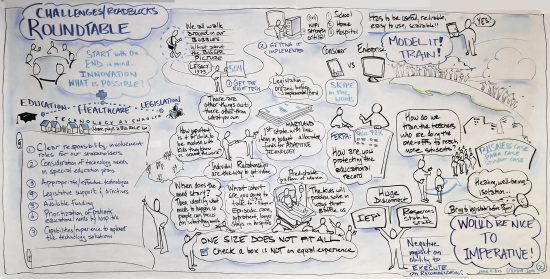
Following the key speeches, the floor was opened up to the attendees to discuss how to achieve this future scenario in which all patients are connected. Conversations were insightful and action-focused, as you can see by this illustration of the roundtable discussion.

Challenges, Roadbloack Rountable 2
Illustration of the roundtable discussion

If there is one thing that we can take away from Peyton’s inspiring story, is that technology has endless possibilities to improve access to healthcare and education for everyone.

While we still have a long way to go in providing equal access to education and connectivity for all patients, it’s clear that with Cisco collaboration technology and inspiring leaders, like those in attendance, we’re certainly headed in the right direction.

Authors

Tapan Mehta

No Longer with Cisco

Avatar

We live in the age of digitization. Digital tablets are replacing books, we get our news from RSS feeds instead of newspapers, “records” are being released as MP3s, and cars will soon be driving themselves.

Yet at the same time, many people do not have enough food to eat, reliable medical care, or an adequate education.

In fact, studies show that over 250 million children of fourth- and fifth-grade age are not able to write, read, or do basic math.

In Latin America, the education gap is very prevalent. The majority of children in Latin America are not receiving a high-quality, relevant education. According to the Worldfund, approximately 22.2 million children and adolescents in Latin America are not in school or at risk of dropping out of school each year. As a result, too many Latin American youth entering the labor force lack the skills necessary to find dignified work and participate in an increasingly competitive, information-rich and globalized economy.

The most important competitive asset Latin America has is its youth. Using technology to digitize education across this region will lead to further innovation, social inclusion, job creation and national competitiveness.

According to industry analysts, there are already 150,000 information and technology (ICT) jobs that are unfilled because there are no qualified workers to fill them. At the same time, jobs that require unskilled, manual labor are quickly being replaced by automation.

In order to succeed, Latin Americans need to learn new job skills, competences such as critical thinking and they need to learn English. But there aren’t enough qualified English teachers in Latin America, let alone teachers who can pass on the technical skills that are most needed in this new digital economy.

The Solution: Digitizing Education

The Internet.

In the recent report, School Connectivity for the 21st Century, it states that the Internet provides a unique opportunity to solve classroom challenges and improve education. The digitization of education has the power to give students the skills they need to generate a more prepared workforce, create jobs, and ultimately make Latin American companies more competitive in a global marketplace. But Latin America lacks the connectivity infrastructure of other regions. According to the 2015 Global Information Technology Report, in a measure of 143 countries based on the use and impact of information and communication technologies, the highest ranking Latin American country is Chile, at position 38.

Ricardo Santos, Cisco’s Latin America Digital Education Leader, sees how digitized education can make a huge difference for his region: “Without the technical infrastructure, you are limited to the knowledge you have in your own city, your own neighborhood. Digital connectivity allows you to search for new information, new solutions to solve problems. Latin American students can access the best teachers and databases in the world. No borders. No limits.”

Imagine:

  • A classroom in a rural town in Uruguay where teachers from across the world appear on video screens to teach perfect English.
  • A former gang member in Mexico who learns computer networking skills and starts his own lucrative consulting company.
  • A woman in Costa Rica who can finally feed her family because the market for her tiny craft business has been vastly expanded through a website.

It’s all happening. And Internet access is making it possible.

Changing the Way Latin American Students Learn

Cisco recently announced a partnership with the Latin American Development Bank CAF and the United Nations Economic Commission for Latin America and the Caribbean (CEPAL), with the goal of improving the quality of education in Latin America by connecting all classrooms to the Internet.

Plan Ceibal is making good progress in this area. Before they started a program to digitize education in Uruguay, 43% of primary schools in the country did not have a computer. If they did, it was much more likely to appear in a wealthy, private school. Low-income public schools averaged one PC per 78 students. Through Plan Ceibal, Uruguay became one of the first countries in the world to provide a laptop to every primary school student. But a laptop is not very useful without Internet connectivity.

Plan Ceibal’s program also brings expert English teachers into the classroom via video. Now almost 80,000 students in Uruguay are learning English through this video conferencing system. There are similar initiatives happening all across Latin America.

The Teacher’s College from the Secretary of Education in Sao Paulo, Brazil is another great example of how digitization has transformed the process of training teachers. Through connectivity, video and collaboration on a network infrastructure, over 270,000 public school teachers were trained – contributing to significant improvements in the overall quality of education across this state.

The Right Skills for Tomorrow’s Jobs

But someone needs to build and maintain this new network. Through the Cisco Networking Academy, more than 5.5 million students have participated in ICT courses and become a force for change in the global economy. The Academy has also given 1 million students from over 30 countries in Latin America the skills they need to fill jobs that are in demand. Academy students are not only learning how to build, operate, manage, and troubleshoot networks, they are learning about hot topics such as cybersecurity and the Internet of Things (IoT). Some are also learning how to market and charge for their services, so that when they graduate, they can jump right into the workforce, and be successful.

The Academy’s curriculum, free to universities, colleges, and high schools, has continued to evolve over the past 19 years, as research organizations like the Gartner Group help to identify the most needed and saleable skills, as well as what the workforce of tomorrow will look like.

It’s working.

95% of students who have completed the Academy’s CCNA, CCNP, or higher-level courses, have obtained a job or gone on to higher education. 78% have obtained a job opportunity, and 54% got a new job as a result of the skills acquired through the program.

What Does Success Look Like?

Ask Daniel, of Mexico City, who began using drugs when he was 14 and dropped out of school. He learned about the Cisco Networking Academy through a drug rehabilitation center for youth, where 300 patients and their relatives completed the program between 2008 and 2015. With his new skills, Daniel was able to open a computer repair workshop, and he returned to school to study math and engineering.

Or Luis, who was expelled from school after getting involved with a gang. He was working a minimum-wage job at a local park when he found out about a local program that combines Cisco Networking Academy coursework with entrepreneurship training. The partnership between Cisco, the United States Agency for International Development (USAID), World Learning, and the Mexican Secretariat of Public Education supports at-risk youth as it increases the number of skilled workers in Northern Mexico. After he graduated from the program, Luis started his own networking support company. He grew his business and hired other students from the same program. He and his employees are making significantly more than minimum wage. And they’re staying out of trouble.

Boys like Luis and Daniel are the face of Latin America’s future. As Internet connectivity and digitized education become more prevalent, the future will get brighter and brighter not just for the youth, but for all of the people in this great region.


First published by the World Economic Forum on Latin America in Medellin, Colombia: https://www.weforum.org/agenda/2016/06/how-can-digitization-help-young-people-in-Latin-America

Authors

Jordi Botifoll

No Longer with Cisco

Avatar

By Ted Rose, Operational Security, Service Provider Video Software and Solutions, Ciscoheadshot

Our security team already blogged about the complex realities of securing digital video content back in April, when attendees of the National Association of Broadcasters gathered in Las Vegas for their annual meet-up. Then (and now), they were grappling with how to keep their valued video assets secure, particularly as they move deeper and deeper into the Internet Protocol world.

And while conditional access and DRM continue to be a solid piracy deterrent — we still own the longest “un-hacked” track record in the market, nigh on 14 years, with our VideoGuard Everywhere line — it’s still not enough. It’s not enough because the face of piracy does one thing really, really well: It changes. The more reasons that exist to protect something, the more reasons exist to pirate it.

Consider: the Motion Picture Association of America estimated global losses to the movie industry at $18.2 billion — and that was in 2005. CreativeFuture, citing a 2013 study by NetNames, states that illegal streaming makes up nearly a quarter (24%) of global Internet traffic. A new category of theft, OTT video credential sharing, cost the industry $500 million in 2015, according to Parks Associates.

Think about content theft as it relates to your life. How many people do you know that pirate digital content online, possibly without even noticing or thinking it’s wrong?

HAJ45722

In part, it’s the pervasiveness and ubiquity of broadband connectivity that’s fueling the latest piracy movement. Pirates these days are often enormous online video operations, some actually charging consumers for their illegal services. It’s the classic double-edged sword: Broadband and IP connectivity enables content and service providers to deliver video to more and more consuming devices, which also makes it easier for pirates to illegally gain from those same services.

At Cisco, we continue to work hard to uncover and combat new forms of piracy, and particularly those enabled by the Internet. After all, we’ve been providing security solutions for the pay-TV industry for decades, using both advanced technology and security intelligence to deliver our global customers an unparalleled level of protection. It’s a natural progression of what’s been in our DNA since the very beginning of subscription video.

Which is why this blog will serve as the kickoff in a series about the status of digital streaming piracy. You’ll get details from our video security experts on topics ranging from the shift from “card sharing” to “content sharing,” to an inside look at streaming piracy operations. Also: The ineffectiveness of take-down notices as a viable deterrent, and methods for stopping streaming piracy, in real time.

This all matters if we want to make a dent on those billions of dollars lost to video piracy, around the globe, since the beginning of pay TV — but especially now, as broadband ubiquity makes it easier and easier for the world’s digital malcontents to covertly make their way into assets they didn’t create, and don’t own.

  • Read Part Two of our Security for Video blog series here
  • Read Part Three of the series here

Save

Save

Authors

Michal Brenner

Marketing Manager

Service Provider Video Marketing

Avatar

The annual NBA Draft is all about finding the latest and greatest basketball talent; players who will someday become the face of franchises around the league. It’s where their lifelong dreams of playing in the NBA become a reality, where years of hard work and dedication culminate in a once-in-a-lifetime opportunity.

The same could be said for a handful of Cisco Networking Academy students who worked the event, assisting professional engineers to bring the action to life. The hands-on experience helped prepare them to succeed in today’s digital economy.

Last May, six students and one instructor traveled to Brooklyn, New York for the NBA Draft Combine, where they helped connect three venues to a massive network. They used their technical skills to run cables, troubleshoot Internet outages, and provide customer support to those on the ground. Their work helped bring the NBA Combine to viewers at home and allowed them to apply the NetAcad curriculum in a real-world situation.

https://www.youtube.com/watch?v=zCO-PJwOqps

And in June, two more students worked the NBA Draft itself, operating behind the scenes as college players took the stage one-by-one to hear their names called. Nearly 3 million people tuned in to watch the NBA Draft on its first night, with many more tweeting their thoughts, highlighting the importance of a reliable Internet connection. NetAcad students were there to troubleshoot, ensuring media, fans, and teams never lost connection.

Like the NBA Draft for the players, the NetAcad Dream Team is a life-changing experience for students in North America. It gives them an opportunity to apply their skills under pressure, work side-by-side with industry professionals, and showcase their talent for potential employers. The NBA’s partnership with NetAcad is opening doors for students to gain real-world skills and thrive in future IT careers.

Learn more about the Cisco Networking Academy and see how you can join the program by visiting our website today!

Authors

Austin Belisle

No Longer with Cisco

Avatar

The Internet of Things (IoT) is on course to transform businesses and create new revenue opportunities — is your organization ready to exploit it?

It’s a recurring topic of interest that crops up frequently during my conversations with business leaders in the service provider industry. As networked devices become more pervasive, operators worldwide not only need to update their infrastructure to accommodate bandwidth-intensive content and applications. Increasingly, they need to explore how to make a successful (and profitable) transition to new IoT-enabled business models and boost ARPU.

Consider our findings in the latest Cisco Visual Networking Index (VNI) report, where it was forecast that M2M modules in Asia Pacific will increase at 19% CAGR over the next five years to reach 5.2 billion connections by 2020.

For carriers and service providers, the growing M2M adoption across business verticals such as retail, healthcare and manufacturing means that new models of billing may be required to effectively monetize IoT services. To tap on the growing revenue opportunity, service providers also need to consider how best to roll out IoT services to support a wide range of applications. Data storage, at the edge or in the cloud, and advanced analytics capabilities will be essential to fully realizing the potential of the IoT for consumers, governments and businesses.

Here, we take a closer look at two key IoT/M2M vertical developments that are opening up many new possibilities for forward-looking service providers:

The Dawn of Smart Cities

Asia Pacific is home to some of the world’s fastest growing urban cities. The likes of Singapore, Tokyo, Guangzhou and Adelaide are well on their way to smart city transformation, leveraging digital innovation to addressing urban challenges such as traffic congestion, pollution and waste management.

picture

Or consider the smart city developments that are taking shape in Songdo, South Korea, recognized today as one of the most eco-friendly and technologically advanced cities in the world.

A constant influx of information allows for the city’s infrastructure improvements; for instance, sensors in Songdo monitor temperature, energy use and traffic flow to achieve a lower energy footprint. One of the city’s future-oriented highlights is a living lab dubbed the IoT Cube, where businesses and startups can pilot their developing solutions on the street. Cisco infrastructure was included in the IoT Cube, including Wi-Fi, fog computing, and security solutions.

Indeed, evolving network technologies have a significant role to play in how these future smart cities in Asia operate.

From public infrastructure (automated street lightings, enhanced energy distribution) to smart video surveillance for improved public safety, the latest IoT systems are designed to unlock actionable insights from a wide range of connected devices and data-collecting sensors.

From a service provider perspective, the first step is to build up the network capabilities and technology expertise needed to foster smart city development. The increased use of M2M applications such as telemedicine and smart car navigation systems requires greater bandwidth, lower latency and network resources that are easier to manage. Security is another key issue. A layer of enhanced security and intelligence is required for communications networks to adapt to the proliferation of connected devices.

As smart city initiatives take shape, service providers need to work together with different stakeholders across the IoT/M2M ecosystem.

We see a great potential for service providers to move up the IoT platform stack to unlock new sources of value and achieve revenue uplift. Yet, many operators in this region are more focused on their core business of providing robust connectivity. To bridge the IoT gap, operators have to create new sources of expertise beyond their existing network capabilities – and gear up for a brave new world of connected cars, smart factories and M2M applications.

Putting Industry 4.0 in action

The IoT is at the forefront of the fast transforming manufacturing sector, through the combination of smart sensor and network technologies. With a large (and growing) manufacturing base, the Asia Pacific region is expected to see a high adoption of industrial IoT (IIoT) technologies — as manufacturing hubs such as China and India embrace new Industry 4.0 initiatives to become the “digital factory” of tomorrow.

M2M applications are crucial for manufacturers to gain better data insights as well as improve processes and outcomes through industrial automation. Here, service providers have a vital role to play in extending reliable connectivity across diverse factory environments, and collaborating with end customers to expand their IoT deployments.

Cisco’s approach is to help service providers deliver integrated IoT solutions and build up new horizontal capabilities to continue driving the Industry 4.0 momentum. In the manufacturing sector, we see many of the key technology considerations being made around edge devices and networks.

picture 2

For industrial M2M applications such as remote monitoring, manufacturers will require a combination of different levels of connectivity, along with the capability to carry out computing both at the edge and in the cloud. As such, service providers need to be adept at integrating a mix of capabilities to provide a scalable managed services platform — while ensuring security across the network, cloud and applications.

Manufacturers can also leverage edge analytics capabilities to uncover faster, more actionable insights. Cisco has developed a data and analytics software that enables organizations to aggregate and analyze data closer to where it is generated, including at the edges of the network. This approach allows manufacturers to better manage their IoT data traffic and make more effective decisions for better business outcomes.

Whether it’s connecting machines for industrial applications or building intelligent networks to make smart cities a reality, I am confident Cisco is well placed to help you develop a strategic approach to keep pace with a new era of connectivity.

You can find more insights into the opportunities and challenges faced by service providers across the region in our VNI Asia Pacific and Japan EBook.

Authors

Chris Heckscher

Vice President

Global Service Provider

Avatar

From the U.S. to the U.K. (and everywhere in between), Cisco is enabling schools and universities to #LearnWithoutLimits through the use of digital technology.

As schools are put under constant pressure to compete for new students, raise academic performance, build safe and secure learning environments, and increase operational efficiencies, digital technology is at the forefront of the conversation.

The definition of ‘digital technology’ is the name given to new and innovative Internet-based technologies (such as video and collaboration, mobility, data analytics and embedded sensor devices) that hold the potential to transform schools and shape people’s lives with a very rich set of infrastructure, applications, and services.

Watch this short video to see how we are partnering with schools and universities worldwide to ‘digitize’ their campuses:

https://www.youtube.com/watch?v=fFUSiNDHx_I&index=10&list=PLE9603246C9094F72

Digital technology has been embedded into everything that Brunel University does to run their university and drive business. It’s an integral part of the campus as a whole, ranging from network infrastructure, to how they manage their buildings, and even how they communicate.

Simon Furber, Network Manager at BU, believes having digital technology that allows educators to educate and researches to research has become a part of everyday life at Brunel University.

John Krull, CTO of Oakland Unified School District (OUSD), is also dedicated to the transformation of education through Cisco technology. By seamlessly complimenting their traditional Cisco switches and routers with 3,500+ Cisco Meraki wireless access points, they have been able to support thousands of devices a day across the school district, regardless of bandwidth usage.

This combination of infrastructure has OUSD positioned to take the next step towards absolute cloud networking in the future.

Comparatively, the University of Guelph is not only increasing student performance but doing so by creating a safe and secure learning environment. Dave Whittle, Associate Director of Computing and Communication Services, has doubled down on security by launching their Security Operation Center with investments in Next Generation Firewall, Information Protection Services, and advanced malware protection.

University of Guelph has made the commitment to identify threats to students and faculty before they even become a concern.

The wave of global digital transformation in the education industry is happening. Cisco and our vast ecosystem of partners can help you plan, build, and execute the implementation of a digital campus in your school or university.

Contact your Cisco account manager for specific solutions that are the right fit for your campus, and remember to follow our Twitter and Facebook accounts to stay in the know of the ever-changing global education landscape.

Authors

John-Paul Overton

Global Ecosystem Partner Manager

Corporate Marketing

Avatar

Visibility has always been a core component of building effective security policy. Starting with the discovery phase of understanding the behavior of the users and assets on a network through the effective monitoring of the policy once the policy is implemented. Through the collection and analysis of NetFlow data from the network infrastructure Cisco Stealthwatch has always proven invaluable in the development of effective segmentation policies. Through the integration with the Cisco Identity Services Engine (ISE) and the export TrustSec Security Group Tags (SGTs) values in NetFlow Cisco Stealthwatch is also able to effectively model and monitor TrustSec group policy.

In a recent blog post, Kevin Regan discussed the policy plane integration between Cisco TrustSec and Cisco Application Centric Infrastructure (ACI) enabled with Cisco ISE version 2.1. This new enhancement in ISE 2.1 ensured consistent security policy by sharing contextual and policy group information between a TrustSec and ACI domain. With ISE 2.1 it is now possible that an SGT defined in ISE for a TrustSec-enabled network could be translated to an Endpoint Group (EPG) defined in the ACI Controller (APIC-DC) inside an ACI-enabled data center and vice versa.

By creating a set of enterprise wide groups the policy plane integration between Cisco TrustSec and Cisco ACI also extends to Cisco Stealthwatch, allowing Stealthwatch visibility into the unified TrustSec-ACI policy. Much like Stealthwatch was able to model and monitor TrustSec group policy, Stealthwatch can now model and monitor the unified group policy.

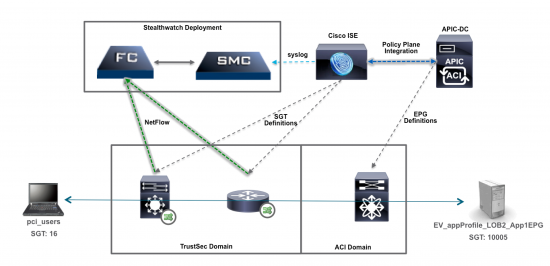
In the example below a Security Group “pci_users” was defined in ISE and a Endpoint Group “EV_appProfile_LOB2_App1EPG” was defined in APIC-DC and pushed to the network infrastructure in their respective domains. Thorough the policy plane integration ISE is able to push the EPG definition into the TrustSec domain as well. When a network traffic flow between a host in the “pci_users” Security Group and a host in the “EV_appProfile_LOB2_App1EPG” occurs the network devices in the TrustSec domain will export the EPG in the SGT NetFlow fields and Stealthwatch is able to monitor the communication between SGT “pci_users” and EPG “EV_appProfile_LOB2_App1EPG “ just as if the EPG was a Security Group.

Unified_Monitoring_Diagram

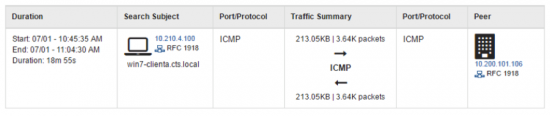
The figures below are two screenshots in Stealthwatch showing a flow between the “pci_users” Security Group and the “EV_appProfile_LOB2_App1EPG” Endpoint Group.

Stealthwatch_bi_flow

Stealthwatch_bi_flow_details

This first phase of integration between Stealthwatch, TrustSec and ACI can effectively allow organizations to model, monitor and validate their segmentation policies across the organization reducing risk, more easily meeting compliance goals and reducing the effort required managing complex and disparate security polices.

Authors

Matthew Robertson

Distinguished Engineer

Security Business Group