In today’s world of digital disruption, the customer experience is king and end-users are becoming sovereign decision makers who select their own portfolios of collaboration and content sharing SaaS tools. This pattern is driving tremendous innovation in the market and exponential growth for dozens of major new collaboration applications in use by knowledge workers globally. However, it has also led to a fragmented user experience where users must context shift between many tools which not only lack integration with existing enterprise collaboration assets, they cannot leverage the full potential of carrier networks for providing advanced network or mobility features.
We believe it is time to de-fragment the user experience and drive a new approach for SaaS and collaboration applications — an approach that deeply integrates service providers in the delivery in order to leverage technology and networks together and meet increasingly high customer expectations.
A great example of this approach is the announcement that Cisco and Verizon Enterprise Solutions made last week regarding Cisco Spark, a next generation collaboration solution. We’re teaming up to offer advanced collaboration services through the cloud to enterprise and government agencies around the globe. This is exciting news on several fronts: Continue reading “Cisco, Verizon Teaming to Offer Expanded Collaboration”
And it looks like the Foundation has used that input to assemble a Summit schedule jam-packed with relevant and interesting presentations about OpenStack. There will be a lot of NFV material this time around, a lot of SDN, and yes–we’ll all still be talking about containers.
If you’d like to hear from Cisco speakers at the event, you’ve got a number of compelling options across a variety of subjects, including:
But hey—we know you’re not going to the OpenStack Summit to hear from Cisco. We’re not either, frankly. We’re going there to eat tacos and barbecue and listen to live music (Google “Austin”).
Did I say that? That’s not what I meant. I meant that we’re really going there to connect with the brilliant people working on the project (while eating tacos), to hear about how customers are using it (over tacos), to learn about its latest capabilities (more tacos), to pick up best practices for different use cases (with a pulled pork sandwich in hand), and to get a look at the roadmap for the next six months (an endeavor best undertaken in the presence of a live band). We plan to learn from our own colleagues as well as from our competitors. And we hope to contribute in equal measure.
So thanks for taking a moment to note where we’ll be and what we’ll be talking about. We look forward to seeing you (at the taco truck)!
The United States increasingly relies on the Internet to support our economic, health, and social services. However, the more we utilize network connections, the more cognizant we must be of potential cyberattacks from enemies seeking to access information and to destabilize our country. We’ve seen the results – everything from people’s personal emails to shopping habits can be stolen and laid out for the world to see. But there’s one arena where cybersecurity is perhaps more vital than any other: national defense.
The increasing connections modern networks provide offer unparalleled new opportunities for the Department of Defense to carry out its missions, but it simultaneously makes DoD networks more vulnerable by widening the attack surface for threat actors. Both citizens and nation states are using increasingly sophisticated cyberattacks to infiltrate DoD systems and agencies. For the military, cybersecurity is not only about protecting sensitive intelligence, it’s about protecting troops while they’re on the physical battlefield. And beyond just protecting its own networks, the DoD is charged with helping protect the broader homeland against cyberattacks.
To address the emerging and evolving threat of cyberattacks, the DoD released its second overarching cybersecurity strategy in 2015, designed to help the department develop cyber forces and strengthen its cyber defense and cyber deterrence posture. It focuses on building cyber capabilities and forces to support the DoD’s three primary cyber missions:
Defend DoD networks, systems, and information
Defend the U.S. homeland and U.S. national interests again cyberattacks of significant consequence
Provide cyber support to military operational and contingency plans
To support this effort, DoD plans to create 133 cyber mission force teams by the year 2018. It also plans to build strong bridges to the private sector and research institutions. As Navy Adm. Michael S. Rogers, commander of the U.S. Cyber Command and NSA Director, said: “The challenges [in cyberspace] are so broad…it is going to take a true partnership between the private sector, the government and academia to address [them].”
Here at Cisco, we’re working hard to provide cybersecurity solutions that align to DoD’s strategy and offer both reactive and proactive defensive cyber capabilities. Products that help address network segmentation, insider threats, and mobility can help defend both DoD networks and the U.S. homeland, as well as better enable warfighters to carry out military operations. Over the coming weeks, we’ll discuss some use cases and specific products that are helping the DoD implement its cyber strategy and strengthen the United States’ cyber defense posture.
We’ve all heard that saying, “What is under that hood?” That question refers to “the kick-ass” capability not obvious at first glance. Starting today that question will have a new meaning.
A few weeks ago Cisco launched the first NFV solution for the Enterprise – a key component of the new Cisco Digital Network Architecture. Enterprises can now virtualize network services and applications at the branch similar to how servers have been virtualized in the data center and the cloud. Enterprise NFV introduces the best aspects of NFV and SDN, such as programmability, elasticity and automation to the network edge. It will significantly reduce cost and increase speed of service deployments.
A closer look at the engine under the hood of Cisco Enterprise NFV.
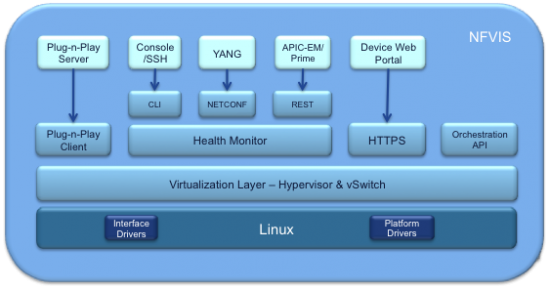
That “kick-ass” I referred to above is the Cisco Enterprise NFV Infrastructure Software (#NFVIS). NFVIS is the software platform that implements full life cycle management from the central orchestrator and controller (APIC-EM and ESA) for virtualized services. NFVIS enables the connectivity between virtual services and external interfaces as well as supporting the underlying hardware. You can think of NFVIS as a software virtual platform that has the following key capabilities:
Platform management supports not only network and platform resources such as CPU/Memory/Storage, but also to enable higher network performance functions such as SR-IOV (for those that are not familiar with Intel’s SR-IOV, here is a good primer);
A virtualization layer that implements a Linux KVM hypervisor and virtual switch. This layer abstracts the service functions implemented by each VNF from the underlying hardware. NFVIS allows VNFs to be managed independently and to be provisioned dynamically.
Programmable API interface for REST and NETCONF used to control all aspects of the virtual services life cycle management.
Health monitoring system watches over the critical processes of the system that can also be accessed via the NFVIS API.
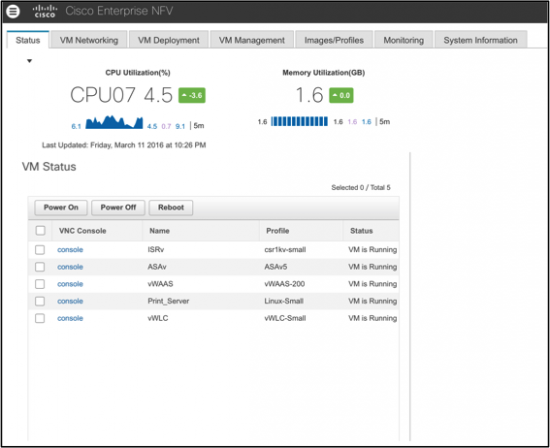
Local web portal that allows the system to be managed, to create virtual networks, assign physical interfaces, and deploy, add and remove VNF services. For all of the dashboards and tables displayed, the web portal uses the exact REST API set that is available to end users to call as well. Below is just a sneak preview of the NFVIS device portal.
When a new network service needs to be deployed, NFVIS is the software doing the heavy lifting to make the process smooth and seamless to the end user. Here is a breakout of the earlier diagram that shows more details on NFVIS.
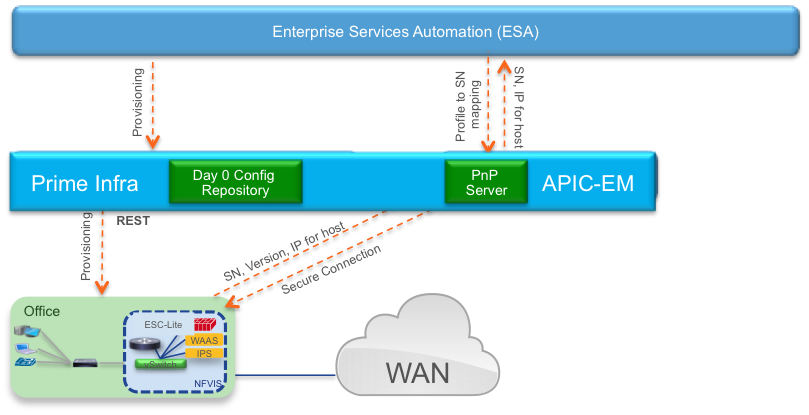
One more item illustrated above is Plug-n-Play. This allows NFVIS to receive and execute the profiles created in the ESA orchestrator to automate the deployment. The following diagram illustrates the flow.
In our first release of Enterprise NFV, NFVIS will be supported on the following platforms:
Cisco UCS 220-M4
Cisco UCS-E 140S on ISR-4331
Cisco UCS-E 140S and UCS-E 160D/180D on ISR-4351 and 4451
Wrapping it up
In addition to all of the great advantages described so far with NFVIS and the Enterprise NFV solution, here are just a few more highlights:
Engineers and administrators of Enterprise NFV with NFVIS do not have to be experts in virtualization since the system takes care of those details “under the hood”.
Cisco Enterprise NFV is not just a hypervisor. It is an end-to-end solution that delivers all of the needed automation, management and services components.
NFVIS is built and packaged to deliver the best performance with minimal resources to maximize the number of supported VNFs.
Deploy virtual network and application services without having to purchase licenses and learn separate virtualization software.
When compared to systems like Openstack, the implementation of NFVIS in the Enterprise NFV solution provides a much more efficient and lightweight means of deploying virtual machines.
Enterprise NFV also can manage existing Cisco hardware devices, making NFVIS a friendly addition to our management suite.
Supports multiple methods for chaining VNF services with more to come.
Each of the hardware platforms referenced above supports the Cisco Integrated Management Controller (CIMC) for complete out of band management of the platform.
In a technical whitepaper located here Enterprise NFV Whitepaper, my friend and colleague Matthias Falkner and I provide some guidance for when you would use each type of platform. Also, I’ll be giving two new deep technical sessions on Enterprise NFV; one technical breakout and one hands-on session at Cisco Live Las Vegas July 10th to July 14th this summer.
When combining these hardware options with NFVIS, the result is a pretty powerful NFV platform. You can get more information on Enterprise NFV via these resources:
Mar 22, 2016 @10am PT, @1pm CT webinar: Exploring the Advantages of Enterprise Network Functions Virtualization. Register.
Cisco is proud to be a sponsor of this year’s Open Networking Summit being held this week in Santa Clara. The focus of this year’s conference is, “A New Era of Open Source Networking” and we think it’s quite fitting given the amount of investment the community has made this year in some amazing Open Source projects and programs.
We’ll be at the event showcasing a number of cool technologies and also speaking about a number of projects, inclusive of; SDN, NFV, OpenDaylight, Fd.io and more. Dave Ward, CTO and Chief Architect of Cisco, will also be presenting at ONS. Dave will dive into reactive networking and SDN/NFV as the entropy of the reaction.
We’ll have several of our engineers, leaders and executives in attendance that focus on Open Source, SDN & NFV. Feel free to find us on Twitter @CiscoOpenSource or reach out directly at the event – we’d love to chat and get your feedback.
Below is a list of sessions, speakers and demos we’ll have running in the booth area, so please stop by.
Booth Demos:
• OpenDaylight Applications
• Open BMP (Open BGP Monitoring Protocol)
• Introduction to Virtual Packet Processing and Containerized Networking
• Containerized VNF Deployment & Orchestration
Tuesday 3/15 Sessions:
• Fd.io is the Future (3:30pm PST Room 209/210)
• Alternatives to Improve OpenStack to Address NFV (4:10pm Grand Ballroom B)
• OpenDaylight Architecture Overview (5:00pm Grand Ballroom D)
Wednesday 3/16 Sessions:
• Reactive Networking with Dave Ward (12:00pm Mission City Ballroom)
• Introduction to Fd.io (4:10pm Grand Ballroom B)
• Fd.io Meetup (5:00pm Napa)
Thursday 3/17 Sessions:
• What is NFV and What Does it Deliver (2:50pm Room 209/210)
• Model-Driven APIs for Network Programmability (3:40pm, Room TBD)
Factory workers often learn about issues with their production machinery too late – after the line shuts down. For example, a robot used in Automotive Body in White production may suddenly break down or start yielding poor-quality welds. This can be disastrous for final assembly, halting output while workers troubleshoot the issue. Unplanned downtime in a factory can cost automakers $15,000 – 50,000 per minute, according to Nielsen.
Now we can prevent unplanned downtime using real-time condition monitoring and diagnostics.
CableFAX just gave us the good word that our own Conrad Clemson is officially a Most Innovative Person in Multiscreen.
If you don’t know Conrad, here’s the top line: He runs our Service Provide Video Software and Solutions group, as Senior VP and General Manager.
Conrad leads a global team focused on delivering Cisco’s industry-leading cloud-based video offerings. He’s the guy who leads the product development team that landed our V2P line as “Best New Cloud Solutions Product,” in the CableFAX Digital & Technology Awards.
A typical day in the life of Conrad has him collaborating with engineers and product managers across the globe to direct the strategy and development of our video software portfolio — which spans content protection, headend, client software, streaming, and encoding. It’s his job to help our service provider customers leverage the cloud to succeed over the long term as they manage the rapid changes in their customers’ viewing behaviors – where the demand is programing on any screen, anywhere.
Conrad was a part of the team that led our agile and CI/CD (Continuous Integration and Continuous Delivery) transition. He currently leads our Infinite Solutions line of cloud-based video solutions, which we unveiled at IBC last year.
Just one month after becoming a part of the Cisco Family, I overheard some co-workers discussing the need to update their LinkedIn profile portraits. As an avid photographer, I quickly stepped in and offered to volunteer some time to make this happen. It was a great way to bond with my co-workers, and it was also a fun way to incorporate one of my hobbies into the work day!
So you want to share why you #LoveWhereYouWork? For a lot of folks at Cisco, it’s because of the people they work with. Here’s how to take colleague photos that truly shine:
1. Ask Permission – Not everyone is comfortable having their photo taken and/or shared online. It’s best to ask before you start snapping. 2. Capture an emotion or story – Leave the viewer intrigued and wanting to know more about your experience! Capturing a team activity or outing off campus is a perfect idea. Really, anything that captures the atmosphere of the moment helps to enhance the story you’re trying to tell. For example, if your team is volunteering, taking a photo in action may be more intriguing to the viewer than a posed group picture (although those are still great moments to capture too!) 3. Make sure your image pops! This means it’s well lit, in focus, and has good color or contrast. You want to get your exposure just right—not too dark and not too light, and you want everyone’s faces to be seen.
Most phone cameras will expose your photo based on where you touch the screen to focus. If the image on your screen looks too dark, tap on the dark section to focus and your camera will adjust and brighten up.
Typically, photos taken outside work great, but be careful of harsh sunlight during the middle of the day because it creates harsh shadows. If you’re taking a photo in the office, us the windows to your advantage. Placing a subject in front of a window will create a back-light effect and your subjects will be too dark. Adjust so your colleagues are standing in good light.
Filters are your friend when used tastefully. They can boost your dull picture into a bright and colorful photo.
4. Share, share, share. I really enjoy sharing the Cisco brand throughout my photos partly because I love the Cisco brand so much, and partly because I like to provide some context for viewers who may not work at or know a whole lot about Cisco. People really enjoy learning more where you work and what the life is like there “behind the scenes” so to speak. Also, you never know who will stumble across your photos! Many of Cisco’s ELT are quite active throughout social media and really enjoy engaging with their followers and – you guessed it! – Cisco employees. So, who knows – maybe Chuck Robbins will see your next great image! 5. Hashtags! I typically use a few hashtags, but never more than 2-3 if at all possible. Too many can start to distract from your main post. If I want colleagues at Cisco to view my photo, I typically choose from #LoveWhereYouWork, #WeAreCisco, and #Cisco and I might even make up a few… #ChangingTheWorld, #MyJobRocks #RTP to broaden the scope of my post. You also have the freedom to tag various Cisco pages in your posts. @WeAreCisco is a great one to tag on Twitter and Instagram to share your employee stories with our Talent Brand team.
As an avid picture-taker and proud employee of Cisco, I love sharing my work experiences on social media. For me, this is an example of how I integrate my work and personal life. It’s important to note that not all content works for every social media platform. You still want to make sure your LinkedIn head-shot is standard and professional, but Instagram and Twitter allow more creative freedom, so have fun with it!
Want to share your #LoveWhereYouWork story with us on Social Media? Don’t forget to tag us! @WeAreCisco #WeAreCisco
I have just returned from a very interesting and jammed-packed week at Mobile World Congress 2016 in Barcelona. For the first time ever, over 100,000 people and 2,200 plus vendors attended this year’s premier technology festival. Much has changed in the industry over the last year since I reported my observations of MWC 2015. However, what is most remarkable is how the boundaries of mobility continue to expand and morph – everything now seems to be mobile? As such, the show offers a fascinating glimpse into the future of technology and the major social and business shifts that we can expect in the next few years.
The big take-away for me was that the show seems to have returned somewhat to its roots. While there were still lots of new smartphones, wearables and cars scattered around the show floor, they seemed to be more wallpaper, or in the background. Much of the buzz and marketing was around new network technologies and the core business of the mobile industry. The new things were 5G networks, low powered networks, and the new Internet of Things solutions that are going to ride over these new networks.
The following are my personal observations and extrapolations from the show, based on my conversations with operators, customer meetings, analysts, and colleagues, as well as from simply walking the show floor.





 The United States increasingly relies on the Internet to support our economic, health, and social services. However, the more we utilize network connections, the more cognizant we must be of potential cyberattacks from enemies seeking to access information and to destabilize our country. We’ve seen the results – everything from people’s personal emails to shopping habits can be stolen and laid out for the world to see. But there’s one arena where cybersecurity is perhaps more vital than any other: national defense.






 CableFAX just gave us the good word that our own Conrad Clemson is officially a Most Innovative Person in Multiscreen.