Avatar

Now more than ever, universities must establish digital strategies that bring technology to the forefront of their institutions.

To stay competitive, attract and retain students and faculty, and deliver the best possible experiences, it’s essential for higher education institutions to fully digitize their campuses.

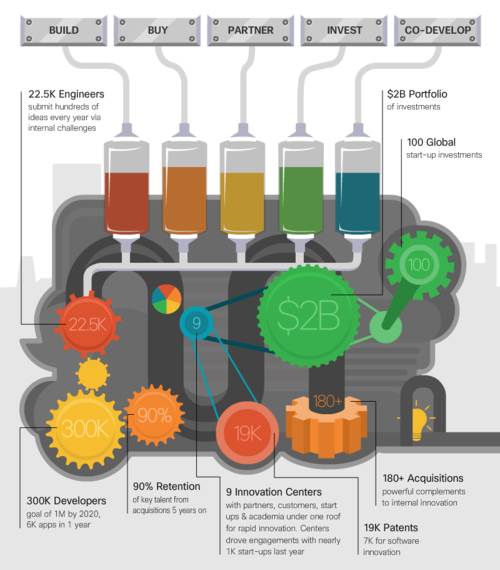
Check out this infographic to see how Cisco is leading the digital transformation of higher education and read our new whitepaper to learn more.

Continue reading “The Digitization of Higher Education”

Authors

Alexia Crossman

Senior Cross-Portfolio Messaging Manager

Cisco Marketing

Avatar

The fourth industrial revolution is here. Soon connections will be limitless as we evolve at an exponential pace. The World Economic Forum showcased this revolution and the technological transformation to digital transformation. Cisco believes digitization will be the most exciting phase of the Internet yet. By 2020, it’s predicted there will be 50 billion connected things, bringing massive change to business and societies, including a focus on new skill sets for future jobs.

The International Labor Organization estimates that 197 million individuals globally are unemployed, a trend that is expected to increase by 3 million over the next two years, of which 73 million are youth. On the other hand, employers worldwide cite a lack of applicants as the main reason they have difficulty filling positions. A Manpower study backs up this claim, with 42% percent of U.S. employers reporting talent shortages as a barrier to filling jobs. Given the large unemployment rate around the world, training people for digital transformation is critical to filling jobs and skills gaps.

Building on a previous report, a new Gartner study supported by Cisco Corporate Affairs lists the key skills required across a variety of digitization jobs. In this new study, Gartner found entry-level opportunities globally across all job families, with the most growth in device management and network management. Here are Gartner’s estimated 2014–2020 growth rates for entry-level digitization jobs across five employment families:

  • Device management – 32.6%
  • Network management – 28.9%
  • Applications development – 25.8%
  • Digital security and privacy – 22.3%
  • Business analytics – 20.7%

In 2020, Gartner estimates that of the additional 1.5 million IT service and applications jobs worldwide, 300,000 are entry-level. These jobs will be in addition and complementary to core IT services and applications jobs.

To access these new opportunities, people will need the right skills. As job roles become more complex, successful applicants will need a mix of technical and soft skills, such as creativity. In this latest research, Gartner found the most common core skills needed across the variety of digitization entry-level jobs are analytics, applications, network management, security and privacy, communication, critical thinking, and teamwork/collaboration. In addition, understanding the business context is becoming more and more critical to success.

No matter the job, a basic understanding of digitization will be important as all jobs will require some element of technology skills. Many jobs are becoming technology jobs, and many businesses are becoming IT businesses. To reap the potential rewards of digital transformation, the world will need millions of people to fill information and communications technology jobs in every country, and in almost every field. But no one organization can solve unemployment; it requires partnerships across many industries, including government, education, corporations, and nonprofits.

To make a significant and lasting impact, Cisco works with nonprofits, NGOs, and community-based organizations around the world, investing in corporate social responsibility programs in areas where we can add the most value. Our Cisco Networking Academy program partners with more than 9500 institutions that teach ICT skills to students each year in 170 countries, providing greater economic opportunities for students and building a pipeline of innovators for the future workforce.

Digital transformation will create a revolution in how we work. However, we need to collaborate with educational institutions, incubators, innovation centers and businesses to develop the right skills development for these new digital jobs.  By bringing together this diverse set of stakeholders, we can address part of the problem via a comprehensive and collaborative skills-to-job approach. Ultimately, if we can harness the power of digitization and align education, curriculum, and learning to the technology job market, we can use it to prepare people for employment success and fuel economic growth.

To request a summary of either Gartner study, click here.

Watch this blog and follow Cisco CSR on Twitter as we continue to discuss ways to multiply impact and bring positive change in the world.

Authors

Tae Yoo

No Longer with Cisco

Avatar

In my last blog, I touched on some of cool innovation happening at Cisco. Today, I want to focus on one in particular: CHILL (Cisco Hyper-Innovation Living Labs). CHILL is helping Cisco re-define how ideas come to fruition. CHILL takes a vertical and creates an environment where a handful of Cisco’s biggest (non-competing) customers come together, collaborate and build prototypes to drive rapid results – Not in a matter of years but within months, days, or mere hours. Now that’s cool (no pun intended) innovation.

Cisco's New Innovation Engine
Cisco’s New Innovation Engine

Recently, CHILL brought together giants of industry to transform supply chain and logistics. They included Airbus, Caterpillar, DHL and Cisco’s very own Supply Chain as well. Over two days these customers were teamed together in a living lab environment to ideate and develop solutions. The solutions were then prototyped and tested with end-users live in the room to validate each solution. They went through 12 cycles of iterations and truly drove disruptive outcomes.

https://vimeo.com/154844561

Last year CHILL also brought together four of retail’s biggest brand titans – Costco, Nike, Lowe’s, and Visa. With a willingness to focus on customer needs, learn quickly, and build on ideas, sleeves were rolled up and co-innovation blossomed over 48 hours. These companies worked together under the single ambition of how to remove queues from the retail experience. Ideas ensued and — with the power of Cisco engineering, proto-typing, and technology resources to support them — moved the needle toward real tangible solutions that could be taken to market.

Moving real solutions from concept to action in today’s world takes hyper-innovation. CHILL’s formula is quickly working across the globe, in verticals like healthcare, financial services, and transport to ignite innovation that is valuable for Cisco and our customers. Customers involved in these CHILL experiences tap in to Cisco’s $6 billion in R&D resources and $2.2 billion in venture capital portfolio. The solutions that are developed provide opportunities to drive growth for Cisco and our customers through joint ventures, seeding new businesses, joint projects, and partnered go to market.

Pretty cool, right? How do you see hyper-innovation changing your industry?

Authors

Kip Compton

No longer with Cisco

Avatar

2015 was a big year for Cisco as we made tremendous progress on our journey to provide a simpler and richer customer experience across all of our offerings. As Chuck said on our recent earnings call, “Our portfolio is more strategic than ever to companies and countries that are digitizing everything.” Customers worldwide rely on Cisco as a strategic provider of IT services and solutions across their business, but they’re also looking for us to go beyond delivering technology, to helping them with their digital transformation as they seek to achieve specific business outcomes.

With the introduction a year ago of Cisco ONE Software, we dramatically changed the way we deliver innovation across our infrastructure offerings making it easier for customers to procure, deploy and manage their data center, networks and critical applications. We built Cisco ONE Software on our four key principles: Customer Experience First; Everything Cloud Ready; Simple and Open; and Consumption Flexibility.

Cisco ONE Software offers customers the choice to buy and consume software in a way that meets their budget and investment strategy while providing simplified solutions to their most relevant, frequently-used scenarios. With Cisco ONE Software, we’re sharply focused on outcomes, like rolling out Intelligent WAN, Connected Mobile Experience, and Hybrid Private Cloud. And with Cisco ONE Softwarewe are delivering cloud and subscription based offerings, starting with Enterprise Cloud Suite. (For more, check out Cisco ONE Software – One year old!)

We’re looking at many opportunities to move point products and components into easier-to-consume and manage customer models. Last December, Cisco completely changed the game in collaboration with the announcement of a major evolution in Cisco Spark, with a brand-new offer to deliver the universal forms of collaboration— messaging, meeting, and calling — in a simple consumption model, all native and from the cloud. With Cisco Spark we’ve made it easier to get phones and other devices connected to these services—all with a rich customer-experience making collaboration simple and easy anywhere, anytime and on any device. Spark is modeled on a very intuitive and simple good, better and best user-subscription model.  Spark, like Cisco ONE Software, brings simplicity, value and innovation in one consistent model across the data center and network.

Now, with the recent launch of Digital Network Architecture (DNA), we’re bringing rich capabilities like virtualization, automation, analytics, and cloud, through the Cisco ONE Software framework, which gives our customers a simpler, more valuable way to take advantage of these technologies in an integrated approach. DNA helps enterprises operate at digital speed, and supports the business outcomes customers are after – accelerated innovation, reduced costs, simplicity, and lower risk. DNA is key to getting the network ready as companies go digital, and Cisco ONE Software provides the investment protection that allows customers to begin their network transformation journey today and add new innovations through software updates.

Throughout 2016, you’ll see us continue to refine our software-led model, putting the customer at the center of the experience, with a focus on flexibility in how they consume and manage software. With this model, customers can rely on Cisco to help them transform their businesses, while ensuring they get easy access to continuing innovation.

Watch us further solidify our position as the only vendor that can provide end-to-end solutions to help customers digitize their businesses.

Thank you,
John

Authors

John Brigden

Senior Vice President

Offer Monetization Office

Avatar

Last week, in Part 1, I blogged about the bizarre association of queues at my local ski centre and unreliable access to cloud payment services. Being located in an area of poor internet provision, the resulting unreliable and slow access to cloud services means that credit card payments process slowly. Very slowly. Consequently, on busy days, there can be queues of 30+ minutes just to get a ticket to the ski slopes.

The real life examples I quote in Part 1 lead me to believe that what we are seeing in the Highlands of Scotland are the first negative regional impacts of digitization. The “bigger picture” to this is what we in Cisco call “country digitization”, which is discussed by Cisco Chairman John Chambers in the video below.  John predicts that successful adoption of country digitization … “… will determine which countries really grow and prosper in the future, and …” [ominously] “… which ones fall behind”.

In this Part 2, I’ll discuss some ideas on how the Internet of Things (IoT) and new business model opportunities could help service providers justify investment in rural broadband. Such investment is necessary to build the platform for digital business in rural areas, and ensure that such areas do not “fall behind”.

Continue reading “Part 2: The Ski Centre Queues and the Service Provider Internet of Things Opportunity”

Authors

Stephen Speirs

No Longer at Cisco

Avatar

This post is authored by Andrea Allievi and Holger Unterbrink

Executive Summary

Ransomware is malicious software that is designed to hold users’ files (such as photos, documents, and music) for ransom by encrypting their contents and demanding the user pay a fee to decrypt their files. Typically, users are exposed to ransomware via email phishing campaigns and exploit kits. TeslaCrypt is one well-known ransomware variant, infecting many victims worldwide. It is in the top 5 of ransomware we see most often in our analysis systems. The core functionality of TeslaCrypt 3 remains the same as it continues to encrypt users’ files and then presents a message demanding the user to pay a ransom.

While the Information Security community has responded to the ransomware threat by disrupting distribution mechanisms and developing better detection methods, adversaries realize they must also continue to adapt and evolve their capabilities. Unfortunately, this has lead adversaries to iterating and improving upon previous releases of TelsaCrypt, leading to the release of TelsaCrypt 3. In response to this latest TeslaCrypt variant which is compromising users, Talos reversed engineered TeslaCrypt 3 to better understand its functionality, how it works, and what’s changed since the last release.

The former variant had a weakness in its way to store the encryption key, which enabled researchers to provide a tool for decryption of the files encrypted by TeslaCrypt [1]. Unfortunately, so far we are not aware of any tool which can do the same for this variant of TeslaCrypt.

This analysis gives an overview about the encryption algorithm used by TeslaCrypt 3.0.1. which is the latest as of the writing of this article. To improve readability, we will refer to this as TeslaCrypt 3 for the remainder of the blog. We will explain the cryptographic details in a way that they can be understood using high school mathematics. Nevertheless, expect a tough cryptographic journey.

 Read More>>

Authors

Talos Group

Talos Security Intelligence & Research Group

Avatar

Cloud has become a strategic component to business strategy for a wide range of businesses because it can deliver a comprehensive set of workloads as automated services.   Additionally, it allows organizations to reach new customers, stay ahead of the competition and transform the way they deliver resources to line of business and application teams.

But which cloud model is best for your organization?   Which delivers the most cost-effective solution or organizational flexibility?    There clearly are advantages and trade offs for each approach, but to begin the process you simply need to answer a single question “do I want to build or buy my cloud?”

cloudA private cloud that is operated by IT and located on premise is the best way to preserve maximum flexibility and choice.   With this solution, your business owns the assets, installs, operates, manages and maintains both the environment and your data and well as sets your security strategy.

Let’s say you want to own the infrastructure and keep your data on premise, but you are not keen on installing, managing and maintaining the cloud environment.  With a managed private cloud, you get to focus on running your business applications while someone else watches over the care, maintenance and updating of the environment.

Continue reading “It All Begins with a Single Step”

Authors

Joann Starke

No Longer with Cisco

Avatar

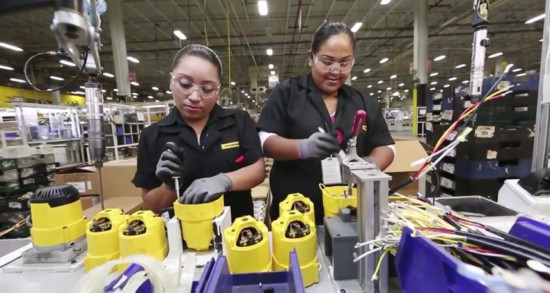
Digitization is rapidly transforming the manufacturing industry. Manufacturers are now tracking supplies and resources, viewing work flow status, measuring production yield, and predicting downtime through extensive data collection and analytics in real time.

Companies that digitize their operation will leave behind those relying on legacy systems. In fact, nearly 4 of the top 10 incumbents in the Manufacturing industry are considered vulnerable to digital disruption within the next three years.

training-blog3

Unfortunately, despite the advantages brought forth by digitization, less than 20 percent of U.S. manufacturers have implemented a connected enterprise, according to Rockwell Automation. Continue reading “Digitization@Work: The Manufacturing Plant”

Authors

Tejas R Vashi

Senior Director, Product Strategy & Marketing

Learning@Cisco, Cisco Services

Avatar

Craig Huitema and Soni Jiandani blogged  about Cisco’s latest ASIC innovations for the Nexus 9K platforms and IDC did a write up and video. In this blog, I’ll expand on one component of the innovations, intelligent buffering. First let’s look at how switching ASICs maybe designed today. Most switching ASICs are built with on-chip buffer memory and/or off-chip buffer memory.  The on-chip buffer size tends to differ from one ASIC type to another, and obviously, the buffer size tends to be limited by the die size and cost. Thus some designs leverage off-chip buffer to complement on-chip buffer but this may not be the most efficient way of designing and architecting an ASIC/switch.

This will lead us to another critical point: how can the switch ASIC handle TCP congestion control as well as the buffering impact to long-lived TCP and incast/microburst packets (a sudden spike in the amount of data going into the buffer due to lots of sources sending data to a particular output simultaneously. Some examples of that IP based storage as the object maybe spread across multiple nodes or search queries where a single request may go out on hundreds or thousands of nodes. In both scenarios the TCP congestion control doesn’t apply because it happens so quickly).

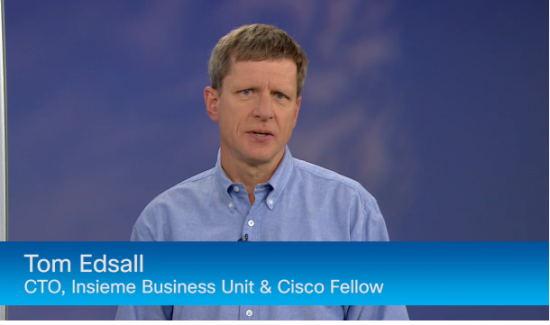
In this video, Tom Edsall summarizes this phenomenon and the challenges behind it.TomEdsallBufferVideo1

Now, what have we done in our latest switch ASIC innovations to tackle these challenges? First of all, the latest ASIC innovations are based on 16nm fabrication technology – Industry’s first for switch ASICs compared to 28nm offerings from merchant vendors. This allowed us to bring more capabilities and scale while keeping cost under control and lowering power consumption.

The other innovations are around addressing network congestion challenges. How to support different types of traffic that will traverse the fabric like distributed IP-based storage, microburst, big data, etc. without performance impact?

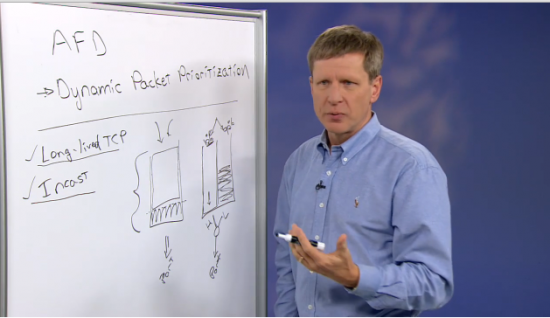
Tom Edsall illustrates here two things to alleviate this challenge and the importance of intelligent buffering:

TomEdsallBufferVideo2

  1. Dynamic Packet Prioritization (DPP) – prioritizes small flows over large flows in transmit scheduling so that mice flows will be guaranteed for transmission without suffering packet losses due to buffer exhaustion or additional latency due to excessive queueing.
  2. Approximate Fair Drop (AFD) – introduces flow size awareness and fairness to the early drop congestion avoidance mechanism. Unlike WRED which treats all traffic flows equally within a given class, AFD is capable of differentiating large flows vs small flows (using elephant trap) in a class, and submit large (elephant) flows to the early-drop buffer threshold while leaving enough buffer headroom for small (mice) flows.

MiercomSpeedingApps

In addition, this Miercom test report (Cisco Systems Speeding Applications in Data Center Networks) puts the traditional simple buffer implementation and our new algorithm-based intelligent buffer architecture into the test with real-world traffic workloads, and proves that our intelligent buffer management based on DPP and AFD provides a better solution than just simply increasing the buffer size.


MiercomBigData

Another test report by Miercom around Big Data (Cisco Network Switch Impact on “Big Data” Hadoop-Cluster Data Processing) that compares the hadoop-cluster performance  with switches of differing characteristics.


What’s in it for customers? For one they have a two year advantage to build a differentiated infrastructure that allows them to advance their business goals and outcome! They’ll have best in class infrastructure that can support various application and traffic types. App developers and DevOps teams can deliver the app performance at cloud scale providing ultimate user experience – an infrastructure for the long run.


Authors

Rami Rammaha

Sr. Marketing Manager

IDS