Avatar

Yesterday, Mike Cohen’s post Networking Containers: Policy Finally Comes of Age appeared on the Open Networking User Group blog site.  He talks about the tremendous interest among application developers to use Linux containers to develop, deploy, and operate applications.  Containers and microservices simplify complex application development into smaller, less risky software components with the benefits of portability and speed.

Like cloud and big data, containers and microservices will transform the traffic in your data center infrastructure.  As applications are disaggregated into many component services, each service now becomes an endpoint to be accessed and shared across the network.

Moving to a container-based microservices architecture will increase the number of addressable endpoints in the data center by an order of magnitude or more.  (See “The Impact of Containers and Microservices” below)

Cisco anticipated these forwarding scale and associated bandwidth requirements by releasing a new generation of Nexus 9000 switches based upon what we call Cloud Scale ASIC technology that delivers up to 12X the IPv6 routes, increased end host scale, increased end point density, and much greater network segmentation.

Finally, the blog makes the connection that tools like Docker Compose and  Kubernetes already use aspects of application policy and therefore it would be quite simple to use policy to automate the networks for these containers.

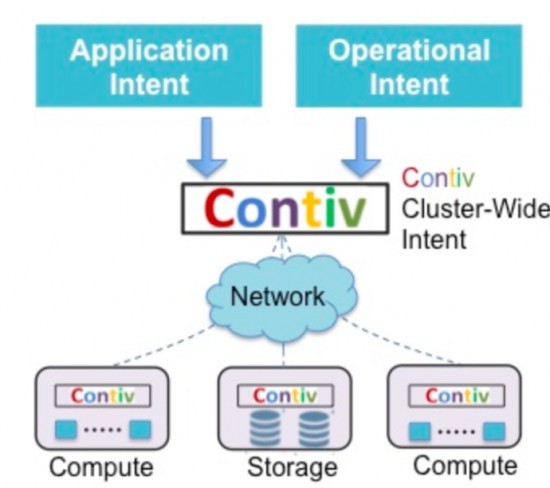
Container PolicyThe open source Project Contiv compliments application intent to enable operational intent to specify infrastructure and policies for network, storage and compute.

At Cisco, we’ve been talking about using Group Based Policy for awhile.

And Cisco ACI  supports Group Based Policy  and the same high level Application Policy Model works with all of these workload types – Bare-metal, VMware ESX, Microsoft Hyper-V, KVM, Xen, containers, and L4-L7 services.


To learn more about Cisco innovations in networking come join us at ONUG Spring May 9-11, at:

ONUG Academy

Monday May 9th 9:00AM-12:00PM

Hands On Container Networking with Contiv

Wednesday May 11th

Townhall Meeting and After Party 4:00PM-9:00PM

NETWORKING IS FAST BECOMING THE BOTTLENECK FOR STORAGE AND COMPUTE, HOW DO WE FIX IT?


For More Information

Networking Containers: Policy Finally Comes of Age

Group-Based Policy: Using Intent to Manage Infrastructure

Integrate Cisco ACI with Docker Containers White Paper

Cisco ACI Policy Model spans Physical, Virtual and Container based environments

Cisco Application Policy Infrastructure Controller Driver for OpenStack Group-Based Policy

Group-Based Policy

See “The Impact of Containers and Microservices” in “Why Network Silicon Innovation Is Critical to Next-Generation Datacenters” by Brad Casemore, Feb 2016


Authors

Harry Petty

Director

Data Center and Cloud Marketing

Avatar

E-Rate season is winding down, but it’s not over just yet! We want to take some time to remind our K-12 readers about the education-specific resources Meraki has to offer.

Have an hour to spare?

We offer a variety of live and recorded webinars hosted by Product Specialists focused specifically on K-12 environments and deployments. We were recently joined by Scott D. Miller, Director of Technology at Wayne Highlands School District, who shared his story on managing Meraki APs, switches, security appliances, and MDM. This webinar even features Scott adding a Meraki AP to their network on air!

MerakiWebinarCover

Last minute E-Rate questions?

Check out our handy customer FAQ to answer your most pressing E-Rate questions. From the basics of the E-Rate program to how Meraki and E-Rate interplay, this will cover it all!

Who doesn’t love a deal?

E-Rate eligible schools and libraries can take advantage of the Meraki K-12 promo*, which offers a steep discount on 5 year licenses associated with new hardware purchases. Reach out to your Meraki rep to learn more about the promotion.

Interested in learning more about K-12 for Meraki in general?

Our K-12 solution guide and customer stories are great places to start! The solution guide provides you with a quick overview of what Meraki can offer K-12 environments, while our customer stories give insight on how current customers are using Meraki and why it’s their solution of choice.

Good luck finishing off the FY16 E-Rate season. Remember, summer break is just a few months away!

Authors

Tania Spezza

Marketing Campaigns Manager, SLED & E-Rate

Cisco Meraki

Avatar

Today in OpenStack, if you’re thinking about networking, you’re almost certainly thinking about Neutron.  Neutron provides you with networks to attach your VMs to, and you can attach one virtual machine to many networks via individual ports – letting you isolate your internal application traffic from the world.  You can use many IP addresses in your application even when the cloud only has a limited number of IP addresses in our IPv4-starved world.  What’s wrong with that?

Well, if you’re a normal cloud application designer, that works very well.  If, however, you’re working in the world of NFV, it’s rather limiting.

Look at your home network.  In your home, all your devices talk to each other over a network – or, if you’re really adventurous, two or three networks – using IP.  That works fine – for your house.  However, internet service providers and telcos frequently want to do much more than this.

One example is MPLS.  In the world of service providers, you sometimes want to make a kind of circuit from one place in the network to another one.  You might do it so that you can reserve bandwidth between the two points for a specific purpose, for instance.  MPLS can let you do this.  But MPLS is not an IP based protocol.  It works differently and has different properties.

NFV designers would like access to tools like MPLS to make their network applications work better.  And this matters a lot – in the world of high performance virtual networking functions, or VNFs, it’s possible to run VMs so that they completely fill a 10G interface, a pipe ten or more times bigger than the ones you’re likely to have in your home.  Unlike the applications you’ll usually find in a public or enterprise cloud, they do a little bit of work to every single packet that passes through them, and the application as a whole – a collection of lots of VMs – can even be processing all the internet traffic of a country-wide mobile phone network.  They want to be able to use the right tool for the job.

To date, we’ve added a few of these functions – like MPLS networking – to Neutron.  But the problem is they don’t fit there very well – we can make them work, but because we’re still talking in terms of Neutron’s networks and subnets – as if the network is one big flat network like you find at home – the model in the API doesn’t really fit the model of the underlying network, and there are some things you can’t easily describe.  Additionally, 90% of OpenStack clouds don’t get any benefit from these new APIs, so we have to find a very careful way to add them.   We have to keep backward compatibility, so the APIs that already exist have to work in just the same way.  We add these features as extensions, but we still sometimes need to change core networking code, so we have to be very careful not to introduce bugs.

What if we could make a completely new API, completely specific to these special networking tasks, without touching Neutron at all?  That’s something I’ve been working on in conjunction with friends from other companies like AT&T, Ericsson, Nokia, Juniper and Huawei.

In the physical world, gluons hold particles together.  In an OpenStack cloud, Gluon lives between Nova and the cloud’s networking services and holds them together.  Nova can talk to Neutron in just the same way it does today – but it can also talk to other sorts of network provider, ones that are specialised to other tasks.  Networking APIs provide ports, and Nova attaches to any of those ports just as it does to Neutron ports today.  It doesn’t care where they came from, and Gluon helps to hide all that away.  I still get all the things I like from Neutron – but I can add different – and completely independent – networking types to my cloud as I need them.  And – equally importantly – if I don’t need them, I can leave them out, and there’s not an ounce of code on my system that’s affected.

We’re trying to go further still.  If we want to invent one new API, how many more might we want?  How do we experiment?  So we’re trying to make it possible for someone to quickly write a model file describing an API for a new networking type – we call these new APIs protons – and rapidly turn that into a reality, using something we call a particle generator.  (We might have taken the analogy a little too far, sorry…)

What if I want to use lots of different networking types?

Today, if I want to use different networking concepts using Neutron extensions, I have to find myself a Neutron plugin that does all of the things that I might want to do.  That’s not so easy – there’s a basic implementation for some of these APIs in OVS, but if I want lots of these APIs (and, of course, really fast networking), I might be limited to just one commercial network controller from one vendor, or even find there’s nothing out there that does it all.

With Gluon, I can use my many APIs, and, because the APIs are completely independent, each of those APIs can be backed up by a different SDN controller.  I can use Neutron with a plugin I like for my normal networking; I can find a controller that does MPLS; I can add a third one for service chaining – and I can use one VM connected to all of these different types of networks, so I get my customer traffic in over MPLS, run it through a service chain, and administer and control my VM using conventional Neutron networks.

And, conversely, if it satisfies all my needs, I can run Neutron by itself just the same way I do today – I don’t have to worry about any of the other services at all, and no matter what new developments come along none of the code I deploy needs to change.

We’re trying to expand the world of cloud networking.  We hope you’ll join us on the journey.  And we’re trying to make sure we don’t drag you along for the ride.

For more information about Cisco at OpenStack Summit, visit cisco.com/go/openstacksummit. If you are at the event, come by the Cisco Booth C11 to talk to the NFV team.

Authors

Ian Wells

Principal Engineer

Openstack Systems Engineering

Avatar

The comic strips of our childhood fascinate us. A once prosperous city falls under the shroud of crime. Enemies of various origins and shapes attack it from all sides. The horizons darken and all seems to be lost. Then magically, the superheroes arrive. Armed with x-ray vision, mighty punches, or ability to freeze the enemies in their tracks, they vanquish the invaders and the skies clear up again.

IT as superheroes

In the world of business, IT has been playing the role of superheroes. Every day the challenges are unique. Systems for day-to-day operations suddenly fail. Cyber attackers attempt to siphon confidential information. Business demands new technology to stay ahead of the competition. How can the superheroes facing stagnant budgets, staffing challenges, and aging infrastructure meet these needs?

Weapons for the superheroes

In the past, IT superheroes’ weapons have been traditional. They included on-premise data centers, associated networks, and monolithic software systems. IT teams themselves had to sharpen the weapons and hone the skills to use them.

With cloud, the landscape has changed. The weapons have proliferated and can be used by anyone without oversight, security, and compliance. The underground economy of shadow IT has taken roots.

Hybrid IT model promises to bring all IT domains out of the shadows into unified management. Business-critical processes and applications stay on-premise. On-demand applications get sourced from the cloud; now with the right policy, security, and measurements. Sounds great, but easier said than done. Hence, new weapons are needed.

Platforms as trusted weapons

In my opinion, platforms can be those weapons. I use the term ‘platform’ in a rather broad sense to encompass automated hardware, software, or composite systems that support applications and services for digital business.

Take a note of what the platforms have done to the world of smartphones. Just a decade ago, the phone ran on a single platform – its own operating system running on a chip-set inside the phone. Modern smartphones like the iPhone opened up the option to run apps on device and cloud-based platforms. As a result, innovative apps like voice recognition ran on the hybrid system and allowed the phone to interpret our queries, gather answers, and respond in real time.

Similarly, platforms enable IT to focus on innovation. Available platforms ranging from integrated infrastructure stacks to software stacks automate specific foundational functions for IT. The functions include application development management, data management, and service delivery. Once such  functions are in place, IT can focus on building or procuring innovative applications that run on the platforms. In essence, the platforms become IT’s secret weapons.

Immortal IT superheroes

Superheroes need to be immortal. They need to reincarnate themselves as challenges evolve. IT superheroes can derive their immortality from platforms that keep pace with industry trends. For example, as IT is asked to support Internet of Things (IoT), platforms that allow distributed intelligence and low-power management of sensors would take center-stage. As real-time data analytics become as important as Big Data analytics, platforms would emphasize network-awareness.

How the platform will evolve remains to be seen. Traditionally, IaaS, PaaS, and SaaS have been the labels used to categorize cloud platforms and applications. But such demarcations may change over time. Recently, Cisco’s CTO Zorawar Biri Singh, articulated a platform-based vision encompassing data center, cloud, networking, and analytics. If we look to smartphone ecosystems as a model, in the future some IT platforms may end up being tightly integrated like Apple platforms. Others may be loosely coupled with complementary platforms, the way Google Android platform is; and be driven via partnerships, industry standards, or consortia. In addition, the platforms will need to adapt with new technology breakthroughs related to interconnected robots and virtual reality that are on the horizon. The immortal IT superheroes would be ready to harness the new powers.

Bottom line

IT would maintain the cape of superheroes defending business worlds from competitive disadvantage, security threats, and industry obsolescence. The new weapons of defense will be automated platforms that enable digital business. With platform-based strategies, IT can reinvent and innovate towards bright horizons.

Credits:
Images – Comic vector designed by Freepik

Authors

Krishna Parab

Product Marketing Lead - Cloud

Avatar

There is something special about round tables. It gets people to open up, collaborate, and talk to everyone that sits at the table. Be it at home, in political discourse or in business, round tables help to solve problems, and foster the open exchange of ideas and thoughts.  It eliminates side or siloed conversations at the other end of the table. This is especially important when you put top experts together on a topical, and sometimes, a controversial subject.

It was with this spirit in mind that we accepted the Robert Frances Group (RFG) offer to join “The Rounds”, a new series of industry experts from users and vendors collaborating with RFG in the development of Open Cloud frameworks. Cisco has embraced open conversations, the sharing of ideas and participation in industry bodies and forums for a long time. As such, “The Rounds” was a perfect fit – so when RFG invited to join in, we gladly accepted.

Get a glimpse on what “The Rounds” is all about in this 90 second video.The Rounds Promo

“The Rounds” will address all aspects of the Cloud, be they private, public or hybrid. The subject matter experts will address considerations for Policies and Orchestration, required to automate the Data Center. These subject matter experts will also examine the various approaches and solutions available, all with a view to best practices, guiding principles and taking into consideration the lessons learned from experience.

Over the coming weeks, moderated by the Robert Frances Group, you will hear from Cisco, Red Hat, IBM and other Cloud Architects in a series of short videos. The videos will be posted on the RFG Exchange webpage.

We think you will gain some surprising, valuable insights about how important it is to connect people, processes, and business technology around how you deploy applications and use policy driven automation to configure and control the infrastructure it runs on.

I encourage you to bookmark the webpage and keep up to date with “The Rounds”.

Authors

Klaus Schwegler

No Longer with Cisco

Avatar

Through the use of digital technologies and innovation, Cisco enables cities to become Smart+Connected Communities that help to improve its citizens’ quality of life. One particular urban locale that is helping to set a great example of this is right here in the United States. Kansas City, Missouri has created a Living Lab to promote citizen engagement and act on ways to implement digital transformation that will improve the city’s “Livability Index”.

https://www.youtube.com/watch?v=lgIfC5l0DzI

At 319 square miles in size, Kansas City’s transformation will be far reaching. Central to the change is the city’s 93,000 street lights, which are being used as pillars to weave together a high bandwidth, low latency wireless sensor network that can move large amounts of data, while also providing Wi-Fi access to both citizens and public servants.

One way the City plans to turn these connections into solutions is through use of the Cisco Enterprise Mobility Services Platform (EMSP). This software platform helps unite infrastructure, mobile applications and cloud services to allow citizens to take ownership of decisions anywhere within their city to report issues, protect or revitalize their community.

Further, using context-aware data and location-based services, EMSP stimulates opportunities for local businesses to promote personalized offers to citizens in the immediate vicinity of their place of business. For example, on a sweltering summer’s day in Missouri, a refreshment vendor might promote a special offer on iced lemonade or frozen treats as prospective customers walk by their location. EMSP can also create more engaging experiences for those attending a Kansas City Royals baseball game or a downtown event.

Smart city possibilities are virtually endless, which is why the Living Lab is encouraging new ideas by combining Cisco expertise with industry, citizen and government leadership to build solutions together. Plans are already underway for better parking and traffic control, automated energy management, improved public safety, proactive infrastructure maintenance, theft prevention, and public transit accident avoidance among other ideas.

Learn more about smart cities, their innovations and the use of EMSP as one platform for three different constituents that produce unlimited benefits in my blog: Talking Trash: What is Your City’s Digital Transformation IQ?

Authors

Mala Anand

No Longer with Cisco

Avatar

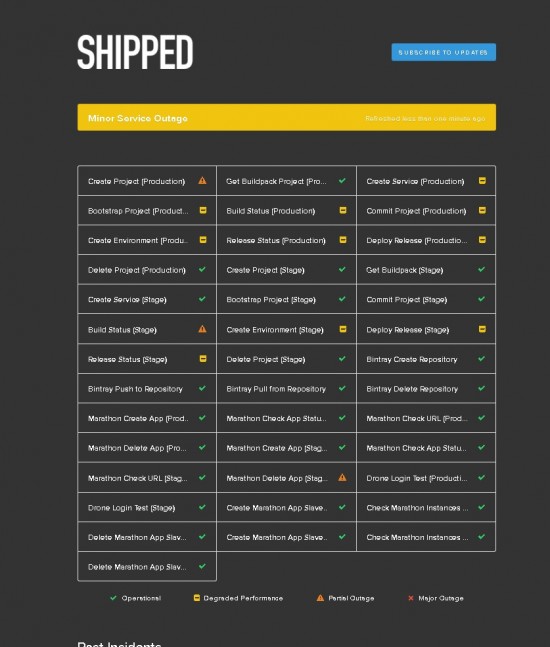
When developing applications in a microservices architecture, one of the first obstacles a developer faces is determining the state of the underlying orchestration and container services. The developer has no real insight into how the underlying services and orchestration system(s) are performing. As part of the developer experience we built for this new application development methodology, Shipped we started building the Shipped Synthetic Monitor service to simulate an end-to-end experience. The service was designed by capturing the steps of  a typical deployment scenario and then monitoring the services and orchestration system tasks. The reporting provides each step and task availability and assurances as shown in the figure below.

synthetic monitor

This is the overall status page which lists the overall status and then each task has an individual status.  We track the following states:

  • Operational
  • Degraded Performance
  • Partial Outage
  • Major Outage

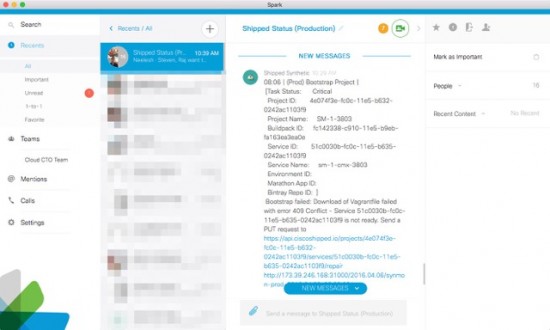
The Shipped Synthetic Monitor (aka Synmon) tests Shipped functionality, with optional reporting to a web-based dashboard, and with critical errors reporting to Spark (see image below). Synmon includes an end-to-end test of Shipped and the underlying Mantl platform components, creating a project and service, bootstrapping it, and deploying it to an environment. We are continuously improving the monitoring platform and have built out testing on other components of Shipped, including test on Bintray, creating a Docker repository, and more. In addition to the benefits we have received in enhanced visibility and trouble detection, this effort has really helped us with stability in both Shipped and Mantl.

shipped-spark

The choosing of the monitoring platform was difficult. We initially decided to go with Stashboard, an open source tool by Twilio. Although it worked, we ended up switching due to an OAuth 2.0 upgrade that Google GAE upgraded to, and as a result, there was no longer support for Stashboard. We wanted to be sure to switch to a system that would have full support, and chose StatuspageIO. It was fairly easy to replace Stashboard since Synmon was designed with  a micro service framework in mind. The switch has lowered cost, and created a more reliable status page, with support if needed.

In order to further enhance Synmon, we plan to integrate Performance Benchmarking, Perfkit soon as well, which will be the next step in fully understanding our users performance needs. Pefkit is an, “…open effort to define a canonical set of benchmarks to measure and compare cloud offerings. It’s designed to operate via vendor provided command line tools”, we look forward to integrating this platform and hope to help contribute to the goal of making a standardized benchmarking tool(Perkit Github).

With Synmon integration into Cisco Shipped, the result has been the identification of bugs, defects,  and improved visibility on the key components of Shipped were failing the most. As we add more test cases to Cisco Shipped we are continuing to gain critical insights on the stress points of Cisco Shipped. We are continuously adding test case to Synthetic Monitor resulting in continuously stabilizing and improving the visibility of the underlying processes and system calls.

3rd Party Tools

If your interested in learning more about the tools we are working with, please click on the links below.

I would like to thank Nick Hayward on my team for his hard work and dedication to improving the performance and reliability of Cisco Shipped, developer experience with microservices, and his co-authoring of this blog post.

For more information about Cisco at OpenStack Summit, visit cisco.com/go/openstacksummit. If you are at the event, come by the Cisco Booth C11 to talk to the Cisco Shipped and Mantl teams.

Authors

Kenneth Owens

Chief Technical Officer, Cloud Infrastructure Services

Avatar

About the Author: Scot recently joined Cisco and previously worked for Rockwell Automation for over 11 years as the Regional Marketing Leader for their Western US Architecture and Software business (Controllers, I/O, HMI, Networks, and Software).

It is well accepted that there is great potential in manufacturing with the Internet of Things – the challenge is realizing that potential and getting started on your journey. There is a huge amount of useful data trapped within plant floor equipment, which includes run-time, equipment condition, performance, and quality data. You need access to this data to make better business decisions in your plant.

If you can, you’ll be able to:

Authors

Scot Wlodarczak

No Longer with Cisco

Avatar

What do you think when you hear Hybrid IT?   Does your mind go to a 3rd kind of not quite private, not quite public cloud that your team needs to build?

Fear not.  Hybrid IT is not another type of cloud but rather a strategy for your organization to quickly and cost-effectively deploy technology across multiple platforms.  It is a service delivery strategy that places the right workload into the right environment based on business need.  That need could be speed of deployment, performance, cost, or security.  The essence of hybrid IT can be summarized in the following quote from EMC World last year:

“I want to be able to tell our business units, if you want to stand up services on the private cloud, go ahead.   We have the technologies and operating processes to do that.  And when it’s time to move appropriate workloads to a public cloud, we have the technologies and operational processes to do that too.”     Eric Craig, CTO, NBC Universal

Continue reading “Hybrid IT: It’s a Strategy Not Something You Build”

Authors

Joann Starke

No Longer with Cisco