Avatar

Digitization is impacting companies in every industry as business leaders implement digital technologies and processes to transform all aspects of their operating models. Yet, even with the growth and innovation that digitization will drive, many people fear it will eliminate jobs at a record pace.

In addition, by 2020, four in 10 industry incumbents will be displaced by disruptive competitors (according to the “Digital Vortex” research conducted by the Global Center for Digital Business Transformation, or DBT Center), further heightening the uncertainty around job security

At this important point in the evolution of business and technology, the question we should ask is: Will digitization eliminate jobs or redefine them?

The answer depends on how companies are digitized. If you look at technology simply as a way to reduce costs at the expense of your most important asset—people—job losses will mount. If, however, you approach digitization correctly by first reimagining work—understanding which new roles and skills will be needed in a digital world—the future of jobs is bright.

To help business leaders reimagine work, the DBT Center just released a new study, “Workforce Transformation in the Digital Vortex.” The research shows how empowering people with “digital accelerators” that combine business process change and technology creates the three capabilities of digital business agility—hyperawareness, informed decision-making, and fast execution.

Digital Business Agility Is Achieved with Six Digital Accelerators that Enable Hyperawareness, Informed Decision-Making, and Fast Execution
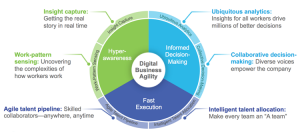
Digital Business Agility Is Achieved with Six Digital Accelerators that Enable Hyperawareness, Informed Decision-Making, and Fast Execution
Source: Global Center for Digital Business Transformation, 2016

These digital capabilities and accelerators can help organizations reimagine work and the jobs and skills workers will need as they digitize their businesses.

Hyperawareness with insight capture and work-pattern sensing

Developing hyperawareness requires people with strong communication and analytic skills—especially the ability to listen, formulate insights, and share information. Cultural change management will be required across all levels of the organization to share and act on these new insights.

Informed decision-making with ubiquitous analytics and collaborative decision-making

Informed decision-making requires workers who can embrace new technology, learn new skills, and provide honest feedback. Successful employees will also benefit from education and experience in Big Data, analytics, artificial intelligence, user experience, and system design.

Fast execution with agile talent pipeline and intelligent talent allocation

To help with fast execution, consider dedicating those with social media experience, analytics abilities, and good people skills to discover and recruit talent. Allocate budget to pay rewards for hiring top job candidates.

Digitization is not just about deploying technology to cut costs. The real goal is to drive business growth through innovation. That means reimagining work and empowering people in a digital context and creating a more efficient and fulfilling work experience along the way.

Authors

Kevin Bandy

No Longer with Cisco

Avatar

We’re excited to be at Hannover Messe this week and even more excited to announce that our network architecture now supports the PROFINET standard. This is a big step on our journey towards the Industrie 4.0 Initiative, and in helping our manufacturing customers achieve the business benefits of fully digitized manufacturing.

scene-1440x470-354501

Cisco’s manufacturing customers using the PROFINET standard will now be able to integrate Cisco Industrial Ethernet switches within their existing network. This will allow them to monitor and manage network operability with their Siemens© SIMATIC Step 7 and TIA portal while utilizing Cisco Industrial Ethernet switches. Or, they can use Cisco network management tools to manage more detailed network configurations from a single location.

Benefits include lowering automation integration costs and speeding up network deployments. By integrating manufacturing and business systems onto a single network, customers will also gain greater visibility of overall operations and how machines are performing.

PROFINET is used in Europe, Asia and North America, and accomplishes resiliency through the Media Redundancy Protocol (MRP). PROFINET integrates onto IP networks and is supported by many industrial automation vendors.

What Else?

We have made profound progress working with our customers to bring the best of Plant Operations and Information Technology together to implement IP networks on the plant floor using Cisco’s Connected Factory PROFINET as a best practices reference for our customers.

Profinet International certified support for PROFINET and MRP is included in a number of ruggedized Cisco products. PROFINET is supported on Cisco Industrial Ethernet (IE) 2000, 3000, 4000 and 5000 Series Switches. MRP functionality is included on Cisco Industrial Ethernet (IE) 2000 and 4000 Series Switches included in this release.

Support for the PROFINET standard will help our customers realize the full benefits of digitization and gain the confidence that comes with a secure, end-to-end factory with multiple layers of protection powered by Cisco technology.

More details are available in our Connected Factory PROFINET At-A-Glance.

To receive future Manufacturing blogs straight to your inbox:

subscribe


Authors

Brandon Lackey

Business Development Manager

Internet of Things Manufacturing Solutions

Avatar

In the era of digital transformation, the ability to rapidly access and analyze data from inside and outside your company’s walls is a competitive imperative.   Because much of the so-called “hot data” is already within SAP environments, it’s no surprise that many Cisco UCS customers are adopting SAP analytics, running in either a validated SAP appliance or a Tailored Data Center Integration (TDI) environment.

Cisco customers have industry-leading choices in both areas.  Our SAP appliances support scale up or scale out options and are simple to deploy, speed time to market, and reduce operational expenses.  We’re also the leading proponents of TDI landscapes for SAP HANA.  TDI allows SAP customers to leverage existing investments in compute, network, and storage infrastructure.  We support TDI with our renowned Cisco Validated Designs (CVDs), providing foolproof, pre-tested foundational designs that simplify deployments.

SAP HANA is a popular platform for transactional workloads and analytic analysis because its in-memory architecture addresses the performance demands of analytics applications.  But such demands require high-speed infrastructure to compliment the real-time capabilities of SAP HANA.  That’s why Cisco has launched UCS Integrated Infrastructure for SAP HANA, a new solution designed to optimize the performance of SAP HANA environments by taking advantage of our upgraded 40G 3rd generation Fabric Interconnect (UCS 6332) to eliminate network bottlenecks within the system – the first 40G FI certified by SAP.

  • For SAP HANA applications such as Business Warehouse, Cisco has created a new SAP-certified appliance with a cluster of C240 systems and the MapR Converged Data Platform.  MapR is a leader in big data solutions, and the appliance includes the NFS-attached persistent storage, as supported by SAP.  Some customers prefer the design of server-based storage because of the reduced expense and added flexibility – it delivers linear performance, cost scalability, and the servers themselves can be repurposed as needed, as MapR Hadoop servers running Spark and SAP HANA Vora for example.
  • Our 40G Fabric Interconnect also enhances our customers’ Enterprise Shared Storage TDI environments, allowing them to better integrate SAP HANA with big data feeds and analytics apps. It complements our TDI shared storage solutions with partners such as EMC and NetApp.

idcWhy are we fixated on “fast fabric?”  Think about the advantages it creates for SAP workloads:  You can load data faster into the HANA nodes at startup or recovery.  You can ingest data faster when pulling from the customer network.  And node-to-node communication is considerably faster resulting in quicker responses to queries.

In addition to our new UCS 6332 FI for blazing fast 40Gbps end-to-end speed, both architectures leverage our popular B460 scale-out servers, and as with other UCS solutions, customers benefit from UCS Manager and UCS Director for integrated management and scalable storage for better resource utilization and lower OpEx.
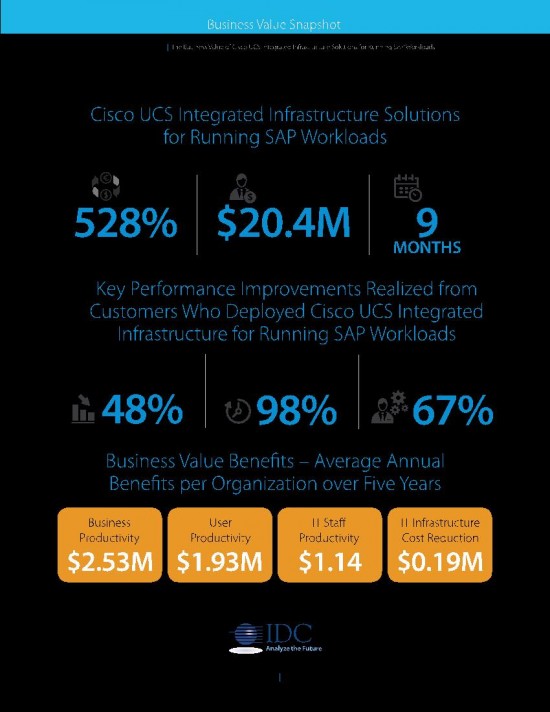
Now let’s revisit that competitive imperative I mentioned earlier; with our steady stream of co-innovations with SAP, it’s no surprise that a just-released IDC survey finds on average, SAP customers running Cisco UCS integrated infrastructure achieved a 528% ROI over five years, a 48% reduction in infrastructure costs, and a 67% reduction in needed staff time.  These companies now have more money and resources available for new projects to drive incremental revenue and differentiation in the market.

Sound like something worth exploring for your company?  Talk to Cisco about the industry’s most sophisticated integrated infrastructure solutions for SAP HANA.

Authors

Marcus Phipps

Director

Data Center Solutions Marketing

Avatar

You probably did a double-take when you read the title and asked yourself, “What is SOAM?” Let me start by telling you what it is not. It is not service integration and management (SIAM), which emerged more than a decade ago to address the highly complex contract and governance processes introduced by multisourcing. SIAM was a good starting point for service integration management, but things have evolved and today something more is needed.

Service Orchestration and Management (SOAM)

Companies expect their platform and services initiatives to deliver greater business and customer value in the form of higher-quality outcomes and enhanced user experience. This requires moving past static outsourcing models to embrace one that is scalable, configurable and delivers real-time orchestration. That model is service orchestration and management (SOAM).

SOAM, a new approach created by Cisco and our partner, Avasant, is a service orchestration strategy that encompasses the best of what service integration and management (SIAM) has to offer, but takes it a step further by making use of the many-to-many service provider relationships in the evolving multisourced ecosystem and more flexible contracting. Orchestration within SOAM does the following:

  • Provides automation to allow services to adapt to situations that impact customer value
  • Enables services to respond proactively to customer demand
  • Improves customer outcomes and experience

SOAM Readiness

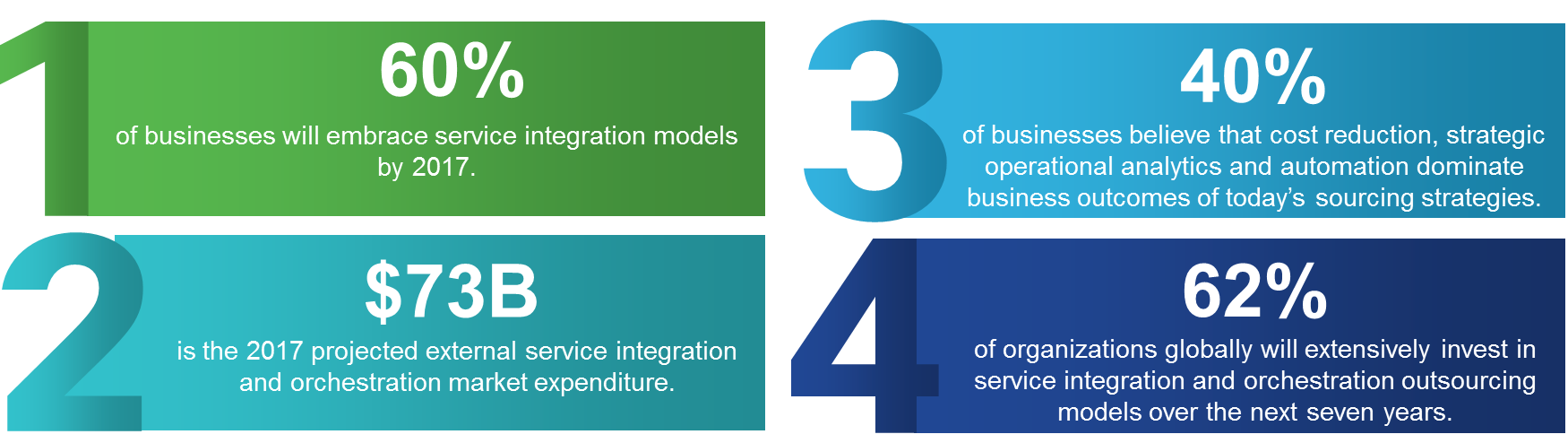
04April_JimsBlogIn 2014, Avasant conducted a scan of the market and discovered increased investments by companies in service orchestration as a way to tackle challenges not addressed by other integration models. Based on the above statistics, I believe now is the time for companies to get SOAM ready. So what does that look like?


Collectively, we’ve created a scale of readiness that assesses a company in six distinct categories:

Pricing is based on a percentage of the actual cost to produce the outcome and the experience offered to the customer.

Orchestration focuses on service provider relationships and the degree of planning and automation that allows for services to adapt based on the given situation.

Transformative Functions deals with agility in processes that improve a company’s ability to adapt to various customer demands.

Sourced/Retained Functions keys in on strategies that improve competitive advantage using high-performance supplier networks.

Sourcing Mix is the extent to which a company delegates services to managed service providers in a many-to-many relationship model.

Organizational Readiness is the evaluation of an organization’s ability to deliver services based on outcomes and experience.

The Cisco and Avasant Connection

Cisco ServiceGrid, our multisourced integration platform in the cloud, provides a scalable, highly secure, and fast way to integrate with your support ecosystem for end-to-end processes and faster collaboration on support issues. ServiceGrid is prime for the SOAM way of doing business. Avasant focuses on translating the power of technology into realizable business strategies and has a long history of thought-leadership in sourcing models. This is why we have partnered with them to develop this pioneering strategy and lead in this new approach.

Read our collaborative white paper, Adopting Service Orchestration to Realize Greater Value from Your Multisourced Ecosystem, to learn more about SOAM and becoming SOAM ready and then leave a comment to let me know your thoughts.

Authors

Jim McDonnell

Director, General Manager

ServiceGrid, CMCP, UCSF Alliance

Avatar

As the product manager for the flagship enterprise switching platform for campus core deployments: the Cisco Catalyst 6500 and 6800 product families, I frequently speak with key technology executives who drive business outcomes for customers across the world.

I was recently asked about the Total Cost of Ownership (TCO) model for the next-generation Cisco Catalyst 6800 Supervisor Engine 6T (Sup6T).

Before I answer the question, it’s important to note that a typical, fully configured 6800 system consists of the chassis, supervisor engine, line card(s), optics, software and the SmartNet license, power supplies and cables for the chassis along with some accessories.

Understanding that, let’s look at two TCO models for the next-generation Cisco Catalyst 6800 Supervisor Engine 6T so that that question can be answered properly:

1) The Cisco Catalyst 6800 Supervisor Engine 6T offers a 20% TCO advantage (approximately $20,000 list price) with respect to the current fully configured Cisco Catalyst 6800 Supervisor Engine 2T.

6807 config comparison

But what is driving the 20% savings? The answer to that lies in the feature-rich design of the Cisco Catalyst 6800 Supervisor Engine 6T. It comes with eight 10GE ports on the supervisor itself, which means that fewer line cards are needed to achieve the equivalent port density of the Cisco Catalyst 6800 Supervisor Engine 2T.

2) Second, the next-generation Cisco Catalyst 6800 Supervisor Engine 6T offers an attractive bundle C6807-XL-S6T-BUN priced at $38,000. This offers a whopping 42% savings (approximately $28K in USD list price) with respect to the a-la-carte Cisco Catalyst 6800 Supervisor Engine 6T configuration. The Cisco Catalyst 6800 Supervisor Engine 6T bundle price gets you a 6807-XL chassis, two power supplies, one Sup6T (with standard tables), one Fan Tray and one IP Services license, similar to what you would get with the existing Sup2T bundle.

sup6t comparison

A simple way to visualize this bundle is that the customer effectively pays the price for the IP Services license and a discounted Sup6T. The 6807-XL chassis, power supplies and accessories are then included for free in this bundle.
It’s not just the price saving. The Cisco Catalyst 6800 Supervisor Engine 6T offers advantages such as higher port density, 40GE readiness, faster processor, greater on-board memory, 440G/slot on the 6807-XL chassis and 3500+ advanced network services with Day 1 maturity of code.

Given its rich features and advanced capabilities, the next-generation Cisco Catalyst 6800 Supervisor Engine 6T is optimally positioned to provide tremendous ROI. This makes Cisco Catalyst 6800 Supervisor Engine 6T the optimal choice to address trends such as: the Internet of Things, mobility, flexible workspaces and Big Data in the next-generation campus.
For more information, click here.

Avatar

3800

You don’t have to check your local listings when it comes to discussing the new Cisco Aironet 2800 and 3800 Series Access Points (APs), TechWiseTV has you covered.

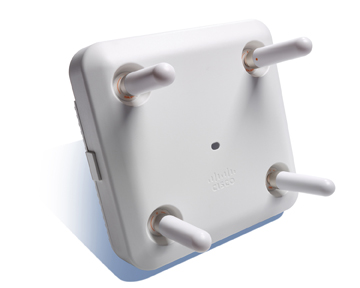
TechWiseTV host Robb Boyd interviews Cisco Aironet 3800 Series Access Point Product Manager Mark Denny as he discusses the ins and outs of the new APs. In addition to talking about the new products, Denny dives deep into the 802.11ac Wave 2 standards and explains how it is affecting the industry.

With an abundance of features and functionalities that take advantage of the 802.11ac Wave 2 standards, the new Cisco Aironet Access Points allow for a wireless network flexibility that is unseen in the industry. During his one-on-one with Boyd, Denny touches on offerings such as: Flexible Radio Assignment, Turbo performance, Hyperlocation antenna and much more.

“This is really about a shift that goes to 5GHz,” Denny said. “2.4 GHz still exists but it’s on the decline. [The access point’s] flexibility allows our customers to tailor the access point and their wireless network to their business needs. This is really the key.”

To view this episode, click here.

Authors

Bill Rubino

Product Marketing Manager

Enterprise Networking and Cloud Marketing

Avatar

The financial crisis of 2008 cast a negative shadow on the banking industry. And the series of banking scandals that followed resulted in the public’s loss of trust in banks.

“The disconnect between banks and customers has reached a critical point. As this “value gap” continues to widen, many customers feel that banks are becoming less relevant to their financial lives,” according to a research whitepaper, The Advice Advantage.

The loss of public trust is only one area of concern for banks worldwide. Other concerns include pressure to increase sales, improve cross-sell and up-sell opportunities, and increase productivity. Success requires that banks prove their value.

Filling the value gap isn’t instantaneous. The crucial first step is re-establishing trust. Collaboration solutions such as video, unified communications, and contact center provide customer connection points for personal, face-to-face interactions.

“Mobile banking won’t only be something for consumers in 2016,” says Byron Vielehr, president of the Depository Institution Services group for Fiserv. “Banks themselves may start to use mobile technology in their branches. Other branches are adding technology by installing self-service kiosks or video ATMs that provide the opportunity to chat with a remote teller.”

Get Closer to Customers
Collaboration technology allows you to instantly connect customers to banking experts anywhere, anytime — on the customer’s terms. Whether customers visit a branch office in person, or contact you from a home computer, tablet, or smartphone; you can provide a personalized high definition, interactive experience.

Italy’s ING Bank has experienced first-hand the power of collaboration. The bank worked to create innovative channels for customers and to optimize remote in-branch resources. By using video, ING raised sales and customer satisfaction by making more memorable customer experiences. “We now have the high-touch personal interaction needed to sell investment products,” says Mario Carrara, ING’s head of sales and product. “It’s more convenient for customers. That’s driving top line growth with a 15 percent sales increase.”

Regain Customer Trust and Attract New Customers
Customers want on-demand services to meet a variety of needs. Offer agent support beyond general banking. Make mortgage lending, wealth management, cash management, small business lending, and commercial loan services available.

Malaysia’s Bank Simpanan Nasional has more than 8 million customers and 400 branches. The bank used collaboration solutions to balance its services between urban and rural branches. Virtual teller machines offer branch-based self-service, allowing tellers from any location to remotely serve customers any time. As a result, customers now spend less time waiting and have a better banking experience.

“Partnering with companies like Cisco and using new channels like the Virtual Teller Machine offers a better banking experience,” says Pupsa Marina, senior vice president strategic communications. “It’s attracting Generation Y customers who use technology all the time in their daily lives.”

Position Your Bank as a Trusted Advisor
Earning customer trust and loyalty requires being genuine, insightful, and proactive. “Through technology, coupled with branch assets and financial expertise, banks have an opportunity to restore value and offer it to a much higher percentage of customers,” shares The Advice Advantage.

To start improving trust and relationships for your bank, look to improving collaboration. Incorporating collaboration solutions can get you started on a new, more fulfilling journey with your customers. At the end of the day, banking is all about relationships and the experience.

For more information on ways to improve banking operations, check out Cisco’s collaboration resources for financial services.

Authors

Sandra Acham

No Longer with Cisco

Avatar

Good news: the E-rate filing window has been extended! That means you have more time to apply for funding that can help your school district upgrade its IT infrastructure to better support digital learning.

The filing deadline for the FCC Form 471 has been extended to May 26, 2016. This extension also means that you have a little more time to file your Form 470 as well, which is due four weeks before the Form 471 on April 28. You can go to USAC’s website for more information on the filing process and what you need to do to apply for E-rate funding.

Additionally, USAC announced a second, separate extension specifically for libraries and consortia. Since libraries and consortia have to wait for schools to file their paperwork before submitting their own applications, their Form 471 filing window will now close on July 21, 2016. The effective Form 470 deadline for these applications will be June 23, 2016.

ErateDeadlineExtendedThe extensions come in response to many applicants’ requests for more time because of difficulties filing with USAC’s new online tool, the EPC system. But if you’ve already filed for E-rate this year, there is more good news in that USAC is optimistic that the window extensions won’t cause delays in application review or funding decisions. In fact, they plan to start reviewing next week!


Why should you apply for e-rate funding if you haven’t already? Check out this whitepaper on how E-rate funding can help spark a digital transformation in your school. Or visit Cisco.com’s E-rate page to learn more about the program and see how schools like yours have taken advantage of E-rate funding to expand opportunities for their students.

Authors

Renee Patton

No Longer at Cisco

Avatar

Not so long ago, the Internet and television were incompatible. Today, they’re practically interchangeable. Next month, May 16-18 the Internet and Television Expo (INTX) kicks off in Boston, MA where the worlds of media, entertainment and technology get linked together. Come and learn about the latest breakthroughs in video and cable and participate in interactive discussions. We’ve got our experts available to help you with the challenges of the future.

Our booth focuses on two key themes: (1) the virtualization of video services and (2) the evolution of cable access.

intx blog

Cisco Infinite solutions are cloud video entertainment offerings that can help you deliver live, linear, on-demand, and over-the-top TV services to multiple screens. It’s a three-part offering – ‘Infinite Home’, a build-your-own TV Everywhere solution, ‘Infinite Video’, a Software as a Service (SaaS) solution that can take a service provider from interested to up-and-running in 90 days, and ‘Infinite Broadcast’, a multiscreen video solution for one-way and hybrid satellite and cable service providers. Whatever access network uses to connect customers, within and out of the home, or whatever device the subscriber uses, one cloud can serve them all. With Cisco Infinite solutions, carriers can make more money, offer new services more quickly, and reduce operating costs.

In terms of cable access we’ll showcase the Cisco evolved CCAP solution, the Cisco CBR-8. This was announced last year at INTX with 2 major customers – Comcast and Altice. Since then many other customers have deployed cBR-8 including KBRO, SK Broadband, Midco, and more.

  • What does cBR-8 offer cable operators? Unlike other CCAP platforms, the Cisco cBR-8 was purpose built for DOCSIS 3.1 – no forklift upgrades needed to achieve Gigabit and multi-Gigabit services.
  • Convergence of video and DOCSIS 3.0 and 3.1 onto one high capacity all-IP platform while slashing space, power, and cost requirements.
  • A platform architected to meet future of cable access requirements: distributed CCAP, node-as-a-platform, SDN, virtual CCAP, and integration into multi-access networks

Come and listen to Cisco leaders and experts talk on the leading edge topics in video and cable:

Yvette Kanouff, SVP & GM, Service Provider Business, Cisco Systems
Alon Bernstein, Distinguished Engineer, Cisco Systems
11:00AM – 12:00PM Tuesday, May 17
Separate Is Better: The How and Why of Network Function Virtualization, Part 1

John Chapman, CTO, Cable Access BU & Cisco Fellow, Cisco Systems
1:00PM – 2:00PM Tuesday, May 17
Separate Is Better: The How and Why of Network Function Virtualization, Part 2
2:00PM – 3:15PM Monday, May 16
Architecting the Networked Future: Part 1

Maxwell Huang, Technical Leader, Cisco Systems
Michael He, Technical Leader, Cisco Systems
4:00PM – 5:15PM Monday, May 16
Architecting the Networked Future: Part 2

Sangeeta Ramakrishnan, Principal Engineer, Cisco Systems
8:00AM – 9:00AM Wednesday, May 18
The End of Guesswork: Big Data Analytics and Implications for Content Delivery

Pawel Sowinski, Software Architect, Cisco Systems
Amit Singh, Principal Engineer, Cisco Systems
8:00AM – 9:00AM Tuesday, May 17
Moving On Up: Remote PHY and What It Means for the Future of Networking

Come visit us on the INTX floor in booth #ES-1. We look forward to showing you the future of video delivery!

Authors