Avatar

My wife and I recently ordered some clothes online for our children. My youngest son was particularly excited about a Marvel Avengers t-shirt he’d picked out. Imagine his disappointment when the order failed to arrive!

After several days and several email exchanges with the online retailer’s customer-service team, it became clear that our items had been lost somewhere in the retailer’s warehouse.

In the end, our local department store came to the rescue. My son is now happily running around wearing his new t-shirt while trying to solve the perhaps biggest of all dilemmas: Team Iron Man or Team Captain America?

Fortunately, experiences like the one above are becoming less common, thanks to companies like Impinj. Impinj is a leading provider of RFID tagging solutions, working to help to transform businesses in retail, healthcare, manufacturing, and supply chain. Impinj says that its solutions help companies to accurately manage assets and inventory, and create engaging shopping experiences.

But what helps to keep Impinj’s business on track?  The answer, in part at least, is Cisco collaboration technology.

A 200-person organization based in Seattle, Impinj is growing quickly in the highly competitive Internet of Things sector. To stay ahead, Impinj needed a system that would let its employees communicate and collaborate quickly and reliably.

Impinj implemented a collaboration solution based on Cisco Business Edition 6000 and Cisco Collaboration Meeting Rooms (CMR). It allows employees to communicate and collaborate anywhere, using any device with voice, messaging and high-definition video. Benefits so far include:

  • $450 reduction in IT costs per new employee
  • Increased productivity due to 50% reduction in travel
  • Improvements in staff satisfaction
  • More effective meetings, contributing to faster decision making and product development cycles

“I love the new collaboration tools,” says Eric Brodersen, chief operating officer at Impinj. “Some of our best remote meetings ever happened today.”

Many other small and midsize businesses are also seeing real benefits using video conferencing to support their growth. A recent Techaisle study, “Video-Enabled Collaboration and Business Growth: The Winning Combination,” reports that 75% of high-growth businesses use video-enabled collaboration. That’s 1.3 times the use rate reported by low-growth businesses.

In the study, high-growth, innovative businesses experience were significantly more likely to report more of the following benefits from using video:

  • Faster decision-making
  • Improved employee productivity
  • More personal interactions
  • Seamless exchanges of ideas
  • Better teamwork

The report goes on to discuss the different use cases of video across corporate functions.  It also examines the essential attributes of a video solution that IT decision makers and lines of business users are looking for.

Download the Techaisle report to learn more.

Learn more about the report’s findings:
Join us on Twitter for a #CiscoChat on June 2, at 10:30 a.m. PST. We’ll be live with Techaisle CEO Anurag Agrawal for a special discussion about benefits of video for midsize businesses.


Read the full Impinj case study to learn more about collaboration is improving its business.

Authors

Andy Johnston

Solutions Marketing Manager

Avatar

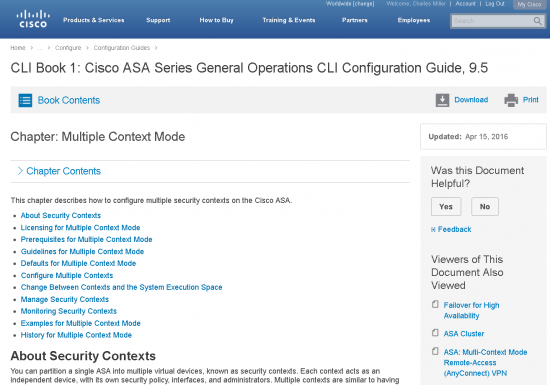
Did you know this is the first time that the Books and Chapters have  received an update in over 10 years?  Over 10,000 Books and 150,000 related chapters have been updated with a new, more flexible format.  The new design addresses the top pain points voiced by customers and this was further refined and validated with user research sessions. One in 10 users accesses these documents, representing over 8.8 Million visits a month to Cisco.com.

We included the same features found on the single HTML pages, including breadcrumb navigation, responsive content, downloadable versions, recommendations, and back-end instrumentation to allow future enhancements.

In addition, the new format for Books and Chapters includes:

  • Links to the Book and Chapter contents at the top.
  • The bar with the Book Contents ‘sticks’ to the top of the page so that the Download (for PDF, Mobi, and ePub) and Print options are always available.
  • And a floating ‘Top’ button will take you to the top of the document at any time.

Cisco_Product_Documentation
Example of new look for Cisco product documentation pages.


So What’s Next?

We are actively gathering and analyzing feedback from this first version to guide updates to the design.  And we are working on functionality that will let you search across the entire set of chapters for a text string without the need to download the entire book’s PDF.  The search box for desktop screen sizes is targeted for release early this summer.   A follow on release will enable the search on mobile devices.  And the mobile-friendly layout for localized content is targeted for completion by the end of 2016.

Have suggestions to make it better?  Let us know either by providing feedback directly from any document or by commenting on this article.

– By Joann Hartman, Christopher Bey, and Vipul Ashta


And if you are curious about the announcement that started it all: Cisco.com goes Mobile – One Page at a Time


Authors

Joann Hartman

Technical Lead, Services

Smart Web Technology Group, Tech Comms, and WEM IT

Avatar

We all know data and analytics are important. Once something used only by a handful of large, data-intensive organizations, it has now evolved to be a factor critical to success in every organization today.

  • But are you on top of your game when it comes to how data and analytics really work?
  • Do you know the key challenges and solutions from the point of data creation all the way through to business insight and impact?
  • And do you know best ways to accelerate a successful data and analytics strategy?

If you are seeking additional information to become smarter about data and analytics, I recommend a couple of different resources.

First, the new e-book, Big Data and Analytics for Dummies offers an overview of what’s needed to get started in data and analytics. It provides common use cases, explains key steps within the end-to-end data management process, and clarifies technology options so you can determine the optimal infrastructure needed to deliver the capacity, performance, and scalability you require. My main contribution is chapter three where I highlight steps you need to take to collect and prepare your data for analytics. This, of course is only one piece of a large puzzle.


Other Helpful Resources:

Authors

Bob Eve

No Longer with Cisco

Avatar

MPLS+SDN+NFV World Congress is already two months away. Time goes really fast! Once again, it was an awesome week with spot on content and great speakers – can’t wait attending the next one! As every year, Cisco had a booth with some nice demos and the ones related to Segment Routing clearly hit the mark! Demo staffers relentlessly showcased Segment Routing demos to enthusiastic customers.

2016 is clearly an inflexion point in Segment Routing adoption. Enterprise and Service Providers have tested and validated the technology and are ready to roll out the technology in live networks. Customers now fully understand the benefits of the technology – it’s all about bringing simplicity and scalability to the network. No RSVP, no midpoint state, no tunnel to configure!

mpls blog

Some noteworthy innovations were disclosed during the Segment Routing track:

On-Demand Next Hop and SR PCE (Path Computation Engine)

Provisioning multi-domain services (L2VPN & L3VPN) comes with complexity and scalability issues notably when routing information need to be redistributed across domains … With the On-Demand Next Hop (ODN) feature, no need to do any redistribution. ODN does trigger delegation of computation of an end-to-end LSP to a PCE controller, including constraints and policies. It then installs the replied multi-domain LSP for the duration of the service into the local FIB.

TI-LFA (Topology Independent Loop Free Alternate) node/SRLG (Shared Risks Link Groups) protection

TI LFA Fast ReRoute has been enhanced to not only protect from Link but also from Node or SRLG failure now! It increases significantly network availability.

Micro-loop avoidance

When a link or a node fails, traffic is being switched over to a backup LSP. Now, depending on the time it takes for each node to update their routing tables, loops can occur causing drops in traffic. Even if these loops are transient (as routing protocols end up converging), they could put some applications into severe troubles. Think of IoT applications such as remote surgery for a moment … If you were to be the patient going for such a surgery, I bet you would feel better off knowing the network is fully reliable!

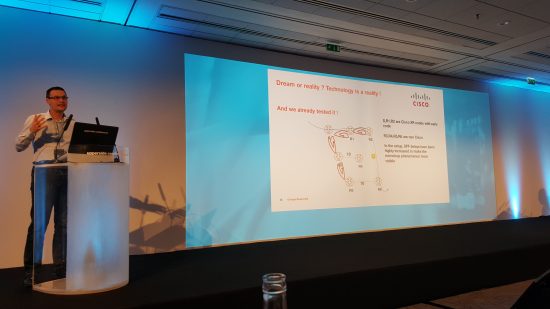
Stephane Litkowski, from Orange Group, did some in-depth testing of micro-loop avoidance code provided by Cisco and shared great insights during his presentation at MPLS World Congress.

See below what Stephane has to say about it:

“Customer expectations in term of quality of experience are growing with the criticality of their applications. As MPLS transport is the foundation of our services, we must make it the most efficient and robust, also because bad things can happen in a network and network must dynamically adapt without disrupting customer applications. In this area, micro-loops have always been a pain for networks by breaking fast-reroute or creating micro-congestions. Orange was interested in micro-loop prevention for many years by investigating, evaluating, implementing multiple solutions. But all those past solutions were only partial or too complex to be deployed in a live network. Now, thanks to the Segment Routing building blocks, we have the technology to easily build loop-free paths in the network in a simple way. We consider Segment Routing as an enabler to prevent micro-loops in IP/MPLS networks. We already evaluated Segment Routing micro-loop avoidance in our labs, showing impressive results: we will deploy it for sure!”

mpls 2

If you’ve missed this event and want to know more about these innovations, go and watch these videos:

And for those willing to do some hands-on, check out dCloud: https://dcloud.cisco.com/

Authors

Frederic Trate

Marketing Manager

Service Provider Business Architecture, France

Avatar

It may surprise you to know that Cisco security researchers have been fighting quietly, for more than a decade, on your behalf to defeat cyber criminals.

Cisco Talos, our security intelligence and response organization, is an elite group of security experts focused on protecting you and your organizations from threats. Their tireless pursuit of attackers has resulted in the takedown of several notorious adversaries. Late last year, Talos researchers disrupted a significant international revenue stream generated by the Angler Exploit Kit that was linked to several high-profile malvertising/ransomware campaigns, which targeted up to 90,000 victims a day and is estimated to have generated more than $34 million annually.

I’d like to share some insights from one of their most successful criminal takedowns.

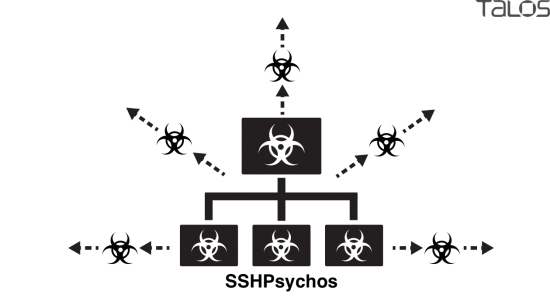
One year ago, Cisco and Internet service provider Level 3 Communications teamed up to takedown SSHPsychos. This sophisticated group of hackers had been building one of the largest distributed denial-of-service (DDoS) weapons in the world using Secure Shell (SSH), an encrypted terminal service that allows legitimate users to gain secure remote access to networks.

SSHPsychos“This was the most blatant daylight robbery we had ever seen,” said Craig Williams, senior technical leader from the Talos team.

Before their efforts were thwarted by Talos, these adversaries were responsible for producing a third of all SSH activity on the entire Internet. The actions of the Talos threat intelligence team severely degraded the group’s ability to hack servers and potentially disrupt business operations for thousands of organizations. Talos helped our customers save valuable time, money and resources by getting to the heart of the attack source.

The Good Fight chronicles the Talos team’s efforts that led to the discovery of SSHPsychos, and pulls back the curtain to show how our Talos researchers, together with Level 3 Communications, crippled this malicious group. SSHPsychos is just one example of the highly organized and well-funded groups that Talos defends against daily. I encourage you to read about this discovery and learn more about how these dedicated researchers work relentlessly to protect the Internet for us all.

Authors

Martin Roesch

Vice President and Chief Architect

Cisco Security Business Group

Avatar

Meraki has always focused on simplifying powerful technology so our users can focus on their own mission. Originally, cloud managed wireless allowed users to deploy large, sophisticated wireless networks and reach more people. The results speak for themselves. From our humble beginnings with our first wireless access point back in 2006, our global customer base has grown to over 120,000 worldwide.

Meraki users have guided our expansion from wireless to networking to infrastructure including security, routing, switching and mobile device management. Simplifying infrastructure has been incredibly compelling, allowing them to focus on educational initiatives, shopper experience, hotel guest services and operational efficiencies around the globe.

Once again, Meraki users have spoken passionately. They need enterprise communications to be simpler. We’re extremely excited about entering this market with our first cloud-managed voice platform. This completes our transition from Cloud-Managed Wireless through Cloud-Managed Networking to Cloud-Managed IT.Simplifying IT with Cloud Management

Meraki Formula

Why has Meraki’s model been so much simpler than anything else available? A cloud-based dashboard that provides IT managers with a “single-pane-of-glass” to manage Meraki devices across the enterprise. But the Meraki dashboard isn’t just an overlay. The true magic of the Meraki formula comes from a seamless blending of hardware, software and cloud technologies. We design Meraki devices from the ground up to work seamlessly with our cloud, providing users with a single simple dashboard to manage their entire site.

All of this technology is really just a means to an end, and that’s where simplicity comes in. Instead of sending someone to a branch office to configure a network or change a security setting, an IT manager can simply log in to the Meraki dashboard and make the changes remotely. Need to troubleshoot a network remotely? No problem. Need to set up a new branch office? Easy. Trouble with remote security posture? Piece of cake.

Introducing Cloud-Managed Communications

A rapidly growing number of IT teams depend on the Meraki Dashboard to manage their infrastructure. More and more of them have been asking if we could do the same thing to simplify their voice networks. Meraki users can be incredibly persuasive.

The result is the new phone, the Meraki MC. As you’d expect, it’s designed to deliver the same simplicity and ease-of-management Meraki customers have come to expect. Here are four things you need to know about the Meraki phone:Meraki Communications

  • Single-Pane-of-Glass: It’s managed from the same “single-pane-of-glass” dashboard as the rest of the Meraki portfolio, including wireless, security, switching and mobile device management.
  • Three Elements: The platform is built on a SIP-based architecture and the solution is comprised of the endpoint, cloud license and SIP service from designated service providers.
  • Availability: It’s available immediately in the United States, with other countries coming on board over time. (We’re in the process of partnering with service providers around the world to deliver the SIP capabilities that underpin the solution. Once that happens we’ll announce local availability.)
  • Integration: The Cisco Meraki team is working on integrating with Cisco Collaboration solutions like Cisco Spark to enable a complete mobile collaboration solution. Cisco Meraki is also working on integration with other leading IT tools and platforms.

Focus on Users

In this industry, it’s easy to focus on the newest technology, or aggressive competitors, analysts or the media. We believe that a maniacal focus on users is our true north. What do we hear?

  • Simplicity – less is better: Functionality no one can turn-on might as well not exist. Every IT dollar spent on complexity that can’t be leveraged is wasted.
  • Do more with less: IT groups have fewer resources and need to do more with less. Specifically, they need fewer systems that do more, less hardware on-site, and just enough complexity to get the job done.
  • Technology for the future: Technology teams are investing in cloud systems, modern collaboration and high performing connectivity to make their infrastructure simple. This simplicity frees them to focus on the digitization of their businesses, schools and organizations.

We think Meraki’s MC is by far the easiest to manage voice system on the market. We believe by providing users a voice system managed on the same platform as networking and security we’ve changed the game.

Expanding the Stack

This phone release is so special because these devices are managed exactly the same way and in the same Dashboard as the rest of the Meraki IT stack. This converges networking, security, enterprise mobility management and now voice onto one IT platform.Mobility Continues to Explode

With that in mind, we’re also adding new wireless access points and Ethernet switches to our product lines. Our two new indoor access points will be the highest-end, highest density APs we’ve ever built. They provide higher capacity, connect more devices and support more voice and video streams than ever before…So much, they won’t be able to reach their full potential on a single gigabit link, so we’re also releasing a new Multigigabit Ethernet switch and two new 10Gbps fiber switches.

Managing more with fewer systems will free IT groups to focus on what really matters to them instead of another cumbersome management platform. We know this is what users around the world have been asking for. I can’t wait to see what they do with it.

Meraki Communications: https://meraki.cisco.com/products/communications 

Meraki Switches: https://www.meraki.com/products/switches

Meraki Wireless Products: https://www.meraki.com/products/wireless

Authors

Todd Nightingale

No longer with Cisco

Avatar

Today’s bankers have no shortage of headaches.

Agile “fintech” challengers, tech-savvy customers, complex compliance demands, legacy-burdened IT environments — all conspire to keep them up at night.

But there is great news for retail banks — as Cisco has outlined in a new research study, “A Roadmap to Digital Value in Retail Banking.”

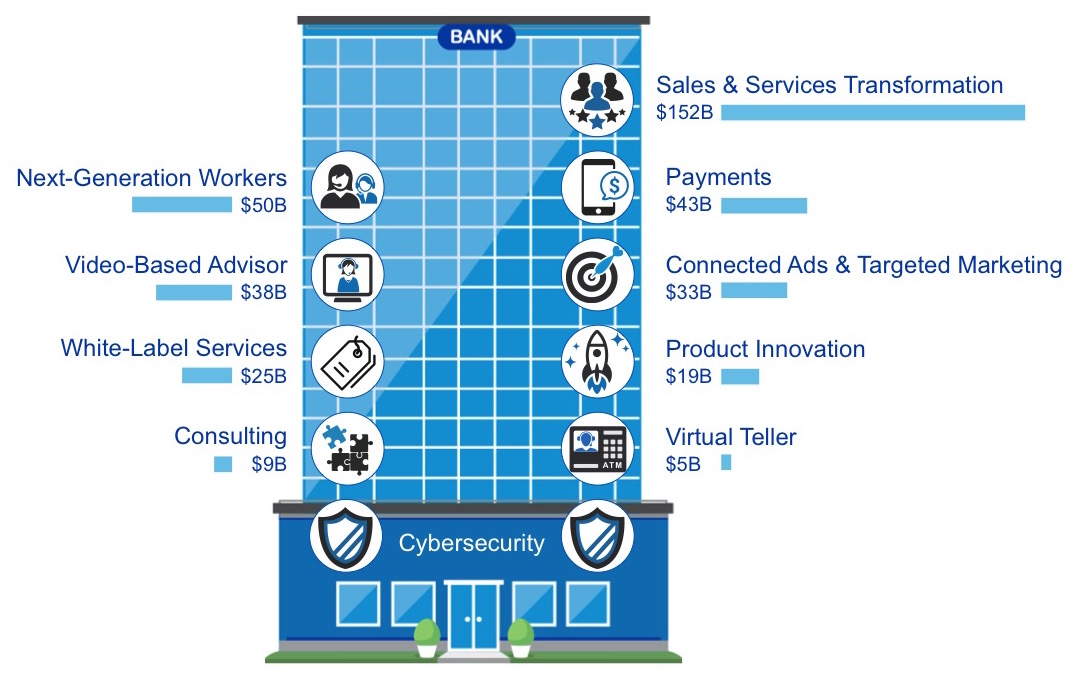
By adopting some key digital solutions (see Figure 1), retail banks can capture their share of an enormous opportunity: $405 billion in industrywide Digital Value at Stake from 2015-2017.

Banking Use Cases


Continue reading “The Road to Digital Value Just Got Smoother for Banks”

Authors

Leni Selvaggio

Global Senior Manager

Financial Services Industry

Avatar

This is a guest blog written by Sunil Gudurvalmiki, Product Manager, Insieme Business Unit.SunilGudurvalmiki


Data center operations teams are increasingly looking at tools to automate and simplify the manual tasks. In addition, they are driving towards using the same tools across compute, storage and network. Cisco announced the availability of Cisco Open NXOS to enable customers reach this goal by installing Open Source and custom developed DevOps tools on Nexus switches.

Two interesting challenges arise that require changes to adapt to new tools and software on the switch:

  1. Revert the switch back to a known working state if any recent changes made the device unusable or unauthorized changes were done.
  2. RMA scenario where a faulty switch is replaced with a new device and the new device needs to inherit the entire personality from the previous device.

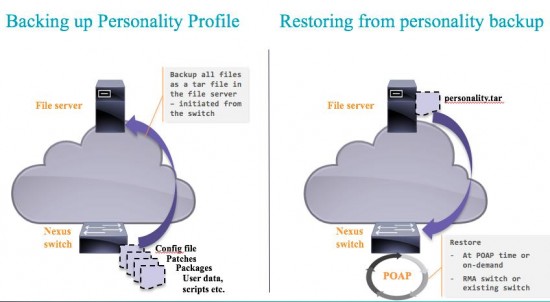
Today, we are happy to introduce a powerful new capability “POAP Personality Profile” as part of Open NXOS in Cisco NX-OS Release 7.0(3)I4(1) to address the above challenges. Using POAP Personality Profile capability, customers can snapshot the personality of the switch at a given time and restore to that snapshot when needed.


PersonalityProfile

The personality of the switch is customizable and it includes the following:

  1. Image version
  2. Running configuration
  3. Startup configuration
  4. Patches installed
  5. Packages installed
  6. Scripts
  7. User data

Multiple script directories and user data directories can be included in the personality at run time.

While taking a snap shot, the switch does not backup the binaries for packages and patches; instead, it just records the meta data to save space. While restoring the switch, repositories can be used to download the binaries and install the packages and patches.

Taking personality backups can be automated using the scheduler and the whole process can be automated using NX-API. This capability is integrated into the POAP workflow to make the RMA scenario completely zero touch.

We hope you’re as excited about this capability as we are. As always, please let us know what you’d like to see in future versions.

POAP Personality profile is supported on Cisco Nexus 9000 and Nexus 3000/3100/3200 series switches in 7.0(3)I4(1) release.


Key Resources

  • Release notes:

http://www.cisco.com/c/en/us/td/docs/switches/datacenter/nexus9000/sw/7-x/release/notes/70341_nxos_rn.html

  • Configuration guide:

http://www.cisco.com/c/en/us/td/docs/switches/datacenter/nexus9000/sw/7-x/fundamentals/configuration/guide/b_Cisco_Nexus_9000_Series_NX-OS_Fundamentals_Configuration_Guide_7x/b_Cisco_Nexus_9000_Series_NX-OS_Fundamentals_Configuration_Guide_7x_chapter_0100.html#id_23531

Authors

Rami Rammaha

Sr. Marketing Manager

IDS

Avatar

I’m in Vienna this week at the Pioneers Festival, which describes itself as “the epicenter of innovation.” Surrounded by 2,500 technology pioneers, including 500 of some of the world’s most promising early-stage startups, I definitely feel the seismic disruption all around me.

I can’t think of a better ground zero for Cisco to blast off our third annual Innovation Grand Challenge – in front of an inspired, AQ81814worldwide startup community at the stately Hofburg Imperial Palace. We love the energy and optimism of the Pioneers Festival!  In the past two years, we chose this venue to kick off and announce winners of Cisco’s Entrepreneurs in Residence program, and this year we’re holding the Challenge Up! IoT Accelerator program for startups here along with our partners, Intel and Deutsche Telekom.

Today, we’re also charging up the end-to-end, network of entrepreneurial talent with this year’s launch of the Innovation Grand Challenge. We’re calling on all innovators, entrepreneurs, developers, researchers and students to submit disruptive ideas for digital transformation in industry and government.

Continue reading “Cisco Challenges Digital Entrepreneurs Worldwide”

Authors

Alex Goryachev

Senior Director, Innovation Strategy & Programs

Corporate Strategic Innovation Group