Avatar

According to our latest economic analysis, there’s $405 billion in Digital Value at Stake in Retail banking from 2015 to 2017. In 2015, financial services institutions captured only 29% of the potential Value at Stake. There’s a lot on the table and disruptive new market entrants like FinTech startups want a piece of the pie.

The FinTech world is exciting, disruptive, complex and increasingly crowded. There is a wide spectrum of innovation and maturity in the FinTech market that can be baffling for banks and insurance companies.

https://youtu.be/QyEhLGjCQPY

What is different about FinTech startups vs. retail banks? The major difference is that they start with the customer and the problems they are facing and build their solution from a customer-in perspective. This has already influenced banking language developing ‘customer first’ or ‘customer in’ strategies.

Another difference is the general view being that new is better than legacy. Clearly FinTechs and new digital banks have the advantage of being built for the new digital world with a heavy focus on user experience, built-in cybersecurity and the ability to adapt at pace to changing consumer demands.

The key advantage of legacy in general is heritage – something that is often underestimated in the world of financial services. Legacy also has other advantages – established banks have experience of operating at scale and still have large and often very ‘sticky’ customer bases – something that not all FinTechs can boast of.

The real drag in legacy though–the old IT. The key question is–can legacy systems be saved or will they need to be replaced entirely. It is easy to say replace entirely and go digital but these are multi-billion dollar investments with high risk for the banks and the individuals who lead these programmes.

Many banks are covering both bases – maintaining and developing the legacy systems and adding middleware to connect to the new digital world (this is how most banks solved the banking app challenge) while running parallel projects to build new digital banks from scratch to run alongside their legacy banking operation. This again sounds sensible – it does however drive up costs as the banks need to run two types of banks to serve similar numbers of customers.

There are clearly no easy answers–that is why we’re working with banks and insurance companies through their digital transformation journey – whether it is connecting legacy to digital or building new digital eco-systems to develop new operating models that can future proof their businesses.

There’s never been a better time to do something amazing, even if that’s disrupting yourselves in order to compete and win. As Ray Davis, CEO of Umpqua put it, if you haven’t got plans, get there quick, very, very quick.

 

Authors

Simon Blissett

Head of FS Solutions & Innovation EMEAR

Financial Services Solutions & Innovation EMEAR

Avatar

Partners are focused on delivering the best customer and workforce experiences using technology, and more often than not, this digitization is enabled by software. Digital transformation creates an unbelievable opportunity for Cisco partners to move from selling boxes to selling software solutions to address customers’ evolving needs.

We are seeing partners mobilize to capture the software opportunity, and there are four main ways they can increase revenue with Cisco Software and build their software practices:

  • Sell software as a solution
  • Sell software with an understanding of customers consumption needs
  • Sell Lifecycle Advisory Services
  • Sell Advanced Software Integration and Development Services

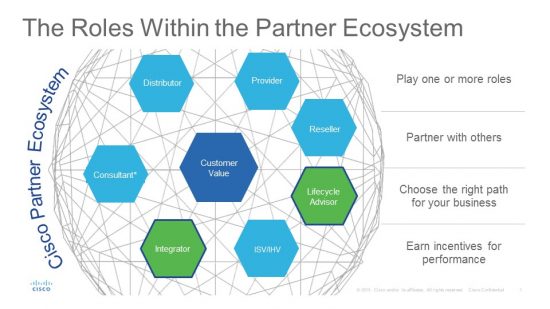
A roles-based framework within the Cisco Partner Ecosystem

In May, the Global Partner Program launched two new software business roles within our existing Partner Ecosystem:  Lifecycle Advisor and Integrator. These new roles consist of eligibility requirements as well as value exchanges and a performance-based reward structure to help partners grow and monetize their software business with Cisco. The initial versions of the roles are focused on delivering software, and are offered by invitation only to new and existing partners.

Lifecycle Advisors deliver services across the land, adopt, expand, and renew stages in the IT investment process and help customers get the full value of their investments in Cisco’s solutions.

Integrators are experts in software integration and development, programming, API management and DevOps which benefit customers through advanced integration and optimization of enterprise applications running on Cisco infrastructure.

Both roles provide additional opportunities for partners to drive profitability by creating their own high-value, high-margin services. The role design incorporates programmatic recognition and differentiation for partners, and uses a flexible approach so partners can build capabilities or partner across the Ecosystem. There is no requirement to invest or gain capabilities, but current and future partners will be encouraged to participate to differentiate themselves in the market.

Slide1


New Value Exchanges & Performance Based Incentives

Lifecycle Advisor

Rewards are offered for success at every step, including:

  • Adopt incentives for a Customer Success Plan that drives service adoption and successful results
  • Expand incentives for incremental bookings that result from adoption within an architecture
  • Renew incentives for on time renewals and loyalty of subscription customers (coming soon)

Integrator

Rewards are offered for success with:

  • Referral incentives for recommending Cisco software and driving incremental business with customers
  • Performance incentives when partners build solutions based on Cisco’s software platform for their customers

Partner Enablement

Cisco also provides enablement to equip and support our partners all along the journey.

We help Lifecycle Advisors to get to market quickly with:

  • Lifecycle Management Workshop for Executives helps partners align their software lifecycle services practice to their overall business objectives
  • Lifecycle Management Workshop for Practitioners helps practitioners develop best practices for each stage of the software lifecycle

We help Integrators to get to market quickly with:

  • Developer evangelists (where available) provide subject matter expertise and sales assistance on large opportunities
  • Dedicated hackathons for joint customer solutions
  • DevNet* offers tools and a testing sandbox environment for implementations
  • Not for resale licenses to test new software development ideas in your own labs
  • Developer briefings offer information about the latest offers and opportunities
  • Cisco Partner Ecosystem networking events to help partners collaborate with other partners

Now is a perfect time to explore the new roles and assess how this new way of doing business with Cisco.

Authors

Grace Lo

Director, Global Partner Programs

Global Partner Organization

Avatar

This is a guest blog by Tejas Vashi, Senior Director, Product Strategy & Marketing, Cisco ServicesTejas Vashi_final

Data rules the IT world right now – there is just so much of it.  Yet, there are often many missed opportunities when it comes to utilizing this data to extract insights and leveraging them to drive business outcomes

Organizations aren’t executing as well as they can, but the problem may not be what you might think.

In the whitepaper, “Big Data Doesn’t Make Decisions, Leaders Do,” Florian Zettelmeyer and Matthias Bolling propose the theory that Big Data is not so much a data science problem per se. Rather, it’s more of a leadership problem.

Organizations today want to extract insights to obtain value, but the thing is – as McKinsey & Company point out – most of the available IoT data currently isn’t used. Not only is there too much data coming from structured and unstructured sources, but also leveraging the data where it resides and preparing it for analytics is a huge challenge.

For example, on an oil rig that has 30,000 sensors, only one percent of the data points are typically examined. That’s because data is used today mostly to detect and control anomalies.  However, analyzing data — and using it to optimize operations and predicting issues before they happen — can provide great value and drive utilization, productivity, profitability and reliability outcomes.

Businesses must find ways to extract insights from all their data in order to succeed and drive better outcomes. One way to approach this change is to match organizational change with technology adoption.

It’s not enough to just capture and integrate this data though. Organizations must also get the data to the right place at the right time (and to the right people) so it can be analyzed. Accomplishing this includes automatic and consistent access to the data and a determination as to when it can best be utilized – whether it needs to be moved to the “center” (a data center or cloud) or analyzed where it is – at the “edge” of the network. Maximum value comes from employing a combination of this edge and the center – not one or the other.

So what does this mean for IT professionals?

2015-Big-Data-Survey_Current-Implementation-Challenges_Cover1Therein lies the rub. The data market is growing, but businesses are struggling to find people with the skills to design, install, operate and manage these intelligent networks as well as expertise to understand how to analyze and use the huge amounts of data being captured across the network. In fact, in a survey conducted by IDC and Computerworld, respondents said that their top business challenge was a lack of enough staff with appropriate analytics skills. And a recent Knowledgent survey revealed that the top business challenge regarding infrastructure is getting the appropriate hardware and software installed and operational, largely due to a lack of skills.

We now see the issues of organization and technology coming to the forefront. From an organizational point of view, businesses need to take steps to identify, address and resolve the issues pointed out by Zettelmeyer and Bolling, including:

  • Analytics should start with business problems.
  • Analytics needs translators.
  • Analytics requires data scientists of different flavors.
  • The analytics team should help get the job done.
  • All leaders need a working knowledge of data science.

IT pros who gain the skills needed to work with data will have a huge leg up as they look to get ahead. Fortunately, there are certifications and training available to help you prepare. At Cisco, we have created the following:

  • Integrated Infrastructure for Big Data: Providing beginning and advanced training for designing, installing and trouble-shooting data solutions using Cisco UCS Big Data infrastructure products.
  • Data Virtualization CIS: Basic and advanced training addresses solution architects, solution Integrators and administrators who are familiar with data warehouse, ETL and data management solutions and want to learn how to design, deploy and operate a virtual data warehouse.

I can’t emphasize it enough  – when it comes to digital transformation, data is the true competitive advantage. For an organization to stay competitive analytics must be a front-and-center focus – and you must empower your staff with the skills and technology needed to implement and maintain the needed data infrastructure, as well as understand how this data can be best leveraged.

Authors

Marcus Phipps

Director

Data Center Solutions Marketing

Avatar

On January 28, 2015, Cisco launched the Virtual Pediatric Network (VPN) at the Children’s Hospital of Orange County (CHOC) Children’s Hospital Hyundai Cancer Institute in Southern California.

The VPN, a Cisco Corporate Social Responsibility initiative, uses advanced Cisco technology to connect pediatric oncologists, genomic researchers, and bioinformatics experts, allowing them to collaborate closely in treating children with cancer.

“A conservative U.S. estimate translates to about 5 million children who could potentially benefit from applying genomic medicine to better manage care delivery,” said Dr. Spyro Mousses, the Executive Scientific Advisor at CHOC Children’s Hospital.

Continue reading “Cisco’s Virtual Pediatric Network Connects Doctors to Cancer Patients”

Authors

Jan Jensen

Program Manager

Corporate Affairs Marketing

Avatar

Customers are gaining market power and they want to interact with your organization using digital technologies.   As a result there is a plethora of automation solutions on the market.   Did you ever wish for guidance on these solutions from industry peers?

Since 1986, the Software & Information Industry Association (SIIA) has recognized software and digital content providers with CODiE awards.  The SIIA CODiE is the only peer-reviewed program that showcases technology products for business and education.  SIIA represents approximately 800 member companies worldwide that develop software and digital information content.

Recently, SIIA announced the winners of their CODiE awards and Cisco was a double winner!

Winner Best Cloud InfrastructureCODiE:   Cisco ONE Enterprise Cloud Suite

Winner Best Cloud Management Solution:    CliQr CloudCenter (now Cisco CloudCenter)

Cisco ONE Enterprise Cloud Suite is a hybrid cloud solution that allows organizations to land and expand their cloud journey.  This solution’s modular architecture allows companies’ to start with basic infrastructure automation and then move into more sophisticated use cases, such as IT and business-based service delivery.   Your business benefits because it gets to experience the ROI and benefits of automation faster. We have found that this modular approach reduces the fear and dread of automation within organizations resulting in faster adoption of automation across additional organizational areas such as application development.

CliQr CloudCenter (now Cisco CloudCenter) reduces the complexity and number of applications needed to capitalize on the benefits of a hybrid cloud strategy.   Let me explain further.

You want to deploy an application onto three platforms, say your data center and two public cloud environments.  With no common API for cloud, you have the privilege of writing, updating and maintaining three separate code streams of that same application.  Cisco CloudCenter eliminates all that costly duplication with an architecture that allows you to model the application once as a profile. That single profile can then be deployed into over 19 different data center, private or public cloud platforms.

Cisco’s hybrid cloud duo provides any organization with a simple way to get started and grow as your expertise of cloud services evolves.  These solutions provision and manage heterogeneous hardware, support any platform and virtually eliminate cloud lock in further increasing organizational speed and flexibility.  Best of all, both solutions contain built-in guardrails that are hidden from developers or line-of-business to silently protect your business compliance and security.

Watch these videos to learn more about Cisco ONE Enterprise Cloud Suite and Cisco CloudCenter.

Authors

Joann Starke

No Longer with Cisco

Avatar

GeekDay

The first thing you need to know about Austin is the motto: Keep Austin Weird! Technically, that should say it all. The second thing you need to know about Austin is that EVERY day is Geek day and we love that!

Being a geek, a gamer, or even a Star Wars nerd is something that Cisco embraces completely.  This has led us to be an honest, open, and more effective workplace. We are a family, we are a “nerdom,” and we are happier — not to mention more successful, because we own our geek!

On this “holiest” of days — when Episode IV: A New Hope was released in theaters on May 25, 1977  — we’re excited to celebrate Geek Day with you all through some of our favorite photos that we captured here in Austin on another one of our favorite “holidays” — May the 4th. 😉

“I love being a nerd at Cisco because I’m (mostly) accepted for any kind of nerdom I choose.  I’m admittedly a Star Wars-Light fan, but definitely an all-out Mighty Ducks fanatic too.  Quack, quack, quack!” – Jennie Kam

GeekDay1
Stephanie Mosher (Executive Assistant), Jennie Kam (Software Engineer), Prasanthi Somepalli (Software Development Engineer) and Sara Santoliquido (Account Manager).


GeekDay2
Jason Rogers, Software Engineer

Our “Force” event (along with many other fun events here at Cisco Austin) is so important! It gives people an outlet to express themselves and feel like a valuable member to the Cisco world. They help reinforce the balance between work and play, and who doesn’t need that! Cisco embracing the “Geek Life” allows thousands of people to feel confident with their “geekiness” and provides a fun inspiring work space. – Sara Santoliquido

GeekDay5
Sara Santoliquido, Account Manager


GeekDay4
Ramrao Deshpande, Software Engineer


GeekDay3
Prasanthi Somepalli (Software Development Engineer), Jason Chen (Director Software Development)


GeekDay7
James Kemp (Janitorial Services), Israel Mendoza (Janitorial Services)


GeekDay8
Karen Ragland, Program Manager


GeekDay9
Chandra Kothakonda, Technical Leader Engineering


SB-J1LKva-000870
Ravi Papisetti (Technical Leader Engineering), Anuj Singh (Software Engineer), and Lenin Lakshminarayanan (Technical Leader Engineering)


How are you celebrating #GeekDay?  Tell us in the comments below!

Want to join a team that believes in The Force? We’re hiring!

Authors

Stephanie Mosher

Executive Assistant

EAS – Enterprise Access Switching

Avatar

In Part One of this Cybersecurity for IoT Blog Series, I noted that we should assume that everything will someday be connected—even those “things” designed without any networking capability. However, we should also be deliberate when deciding what to attach and what to isolate. When a link is established, we should know not only that a connection has been created, but also why, what risks will result, and how those risks will be managed. If connections must be made with care—or in some cases not at all—then why should we assume “things that can be connected will be connected?” It might initially appear that my proposed first and second laws of IoT contradict one another.  I would argue against this conclusion.

Connections that enable functionality often also create complexity. This step should therefore be taken deliberately and with an eye towards weighing potential costs and benefits.  Attacks have successfully been waged against power distribution networks in Ukraine and national retail payment systems in the U.S. These and other cases may have been preventable if decisions about whether and how to enable network connectivity—whether to isolate or segment key functions from each other—were fully considered in light of the attendant risks.  As we noted in our White Paper on the IoT Threat Environment, “thinking in this way is important because a key activity in terms of both security best practices and compliance is to segment a network to separate systems with different trust levels and to implement a defense-in-depth strategy of layered security.”

We may very well decide that some things ought not to be tied to the Internet or to each other. But we should assume, given the rapid advancement and adoption of IoT, that they might very well be connected in the not-so-distant future.

Technology developed based on the faulty assumption of permanent separation will yield hidden vulnerabilities when it is almost inevitably connected.  If we instead recognize that some “things” currently in isolation may someday be networked, we are then offered an opportunity to create contingency plans for security and pathways for updates that otherwise would not have existed. Then we must threat model the mechanisms used to deliver security patches and updates to manage the risks that they introduce.

The future will be full of connections that we cannot yet imagine.  There are devices that will light up in new ways and fuel future innovations. We need to assume that anything networked can and will be internetworked. With that in mind, we may decide that some “things” might be better left isolated from the networks we create.  Both the decision to connect or to contain a device or system should be made with consciousness of the risks so that we are prepared for eventualities in which the Second Law of IoT has been broken.

For more information about Cisco’s Data Protection and Privacy Program, visit trust.cisco.com.

Authors

Eric Wenger

Senior Director, Technology Policy

Global Government Affairs

Avatar

Shortly after being named the leader of Cisco’s Global Partner Organization, I championed three strategic imperatives that are vital to our partners’ and Cisco’s continued success:

  1. Simplicity: removing complexity and making it easier for our partners to work with us
  2. Alignment: ensuring our sales and marketing teams’ go-to-market motions are in lock-step
  3. Evolving the Value Exchange: delivering a mutual exchange of value that reflects the new technology landscape

Given today’s radically changing market dynamics, I’m convinced these have never been more important. It seems like the entire business world has been turned on its head. Whether it’s how companies purchase, deploy, consume, or service technology, these seismic changes require us to adapt to new ways of doing business. Add to this the incredible opportunities digitization brings and your head starts to spin.

So, yes, anything Cisco can do to help our partners be successful is critically important.

We’re making solid progress with these strategic imperatives. Our most recent milestone was through our new Brand Campaign. With the theme “There’s Never Been a Better Time” (appropriate on so many levels!), we are using this campaign to break new ground. For the first time ever, our partners can use our brand campaign to spark new conversations with customers, drive sales, and differentiate themselves in the market.

https://www.youtube.com/watch?v=BRUuwRmT7UY&index=1&list=PLF390A3A7152E5BF4

We are now giving our partners access to our creative assets, which reflects a new way we’re exchanging value with them. Partners can leverage the investments we’ve made in our brand assets to develop their own campaigns. They’ll also be able to influence and shape future offers and campaigns by giving us feedback on which campaigns they want and when.

I can’t think of a better way for our joint sales and marketing teams to be more aligned on our messaging and marketing priorities than this brand campaign. It’s designed for partners to connect to specific campaign topics such as security, retail, manufacturing and finance. These topics are strategic focus areas for our partners, as well our company.

It’s also simple for partners to leverage these brand resources in Engage, our online suite of digital marketing services. With Engage, partners can launch their own digital marketing campaigns by accessing copy, creative assets, digital ads and social media content. New training courses help partners learn how to create a compelling value proposition and co-brand with us. Using Engage, partners will find everything they need to get started and keep the momentum going.

We’ll continue working to achieve the full benefits of these strategic imperatives around Simplicity, Alignment and Value Exchange. Cisco’s new brand campaign is just the latest example, but it reflects how important our partners are and demonstrates our continued investment in their growth and profitability.

Be sure to join the brand campaign conversation using #NeverBetter.

Partners, learn more about our new brand campaign and how you can leverage Cisco’s brand . Connect with your Cisco rep to tell us your story of how we have or can change the world together.

If you are not a partner with Cisco, learn how to get started today.

Questions or Comments? Feel free to connect with me on Twitter.

Authors

Wendy Bahr

No Longer with Cisco

Avatar

#CiscoChampion Radio is a podcast series by Cisco Champions as technologists. Today we’re discussing Meraki with Simon Tompson.

Cisco Champion 2016Get the Podcast

  • Listen to this episode
  • Download this episode (right-click on the episode’s download button)
  • View this episode in iTunes

Cisco Guest
Simon Tompson (@MerakiSimon), Cisco Meraki Product Marketing

Cisco Champion Hosts
Chris Brown (@chrisknowsit), Senior Network Operations Manager
Dan Croutch (@dcroutch), Product Support Analyst

Moderator
Lauren Friedman (@Lauren)

Continue reading “#CiscoChampion Radio, S3|Ep. 13: Meraki Malarkey”