The world’s leading conference and exhibition dedicated to critical communications, the 18thannual Critical Communications World (CCW) event is to be held May 31 – June 2, 2016 in RAI Amsterdam, Netherlands. Over 4000 professionals are expected representing 120+ countries to network and learn from more than 200 expert speakers and 175 exhibitors.
Our joint sales and marketing teams are more aligned than ever. This week we’re talking about what’s making that possible and:
The next step in delivering on *the* three strategic imperatives
Revenue, revenue, revenue with a side of digital transformation
We’re talking about you. Again.
Putting digital transformation into perspective for sales and marketing
We talk a lot about changing market dynamics, new consumption models, and how digital is changing everything. This week Wendy Bahr, SVP, Worldwide Partner Organization, puts it all into perspective.
In her blog, Wendy expands on how the team is delivering on three strategic imperatives (quick, name them!), how sales and marketing are more aligned than ever, and how our brand campaign sparks new conversations and drives sales.
Still wondering what those 3 imperatives are? Read Wendy’s blog.
Revenue: get more of it and make it reoccur
Do you want to create high value, high margin services? (If your answer is no skip the next section.)
One way to achieve this is by becoming a lifecycle advisor or integrator. Grace Lo, Director of Programs, Global Partner Organization, elaborates on the link between software, these new roles, and how it all connects to revenue in this blog.
Another way to achieve this is to know when you stand the best chance of getting the most revenue. Quick quiz: your opportunity to increase revenue happens (a) at the early phase of customer engagement (b) after customer adoption.
The answer – and how to use this information to create more revenue – is answered by Senior Director of Global Customer Success, Ed Daly. To find out more read his blog and register for his webinar coming up on May 31st.
And to answer the question on everyone’s mind, find out what happens when you cross a rhino with digital infrastructure, hybrid cloud, and security solutions:
The partner weekly rewind and fast forward is designed to give you a snapshot of what you missed and what’s to come. Tell us what you think and what you want to hear about in the comments. And come back next week for more!
On May 10, the world-class admin behind John Chambers’s success was honored with one of the top awards in her field: Debbie Gross received the Colleen Barrett Award for Administrative Excellence.
Clearly, Debbie is a force. This CNBC story gives us a peek into her life keeping John at the top of his game. People are rightly saying she’s a role model for next-generation administrators. But what people aren’t saying is that some next-gen admins are made not of flesh and blood like Debbie but of compute cycles.
For the record, I do not believe virtual assistants will ever fully replace human ones. Just like televised baseball will never fully replace seats behind home plate and video will never fully replace a deal-sealing handshake, there will always be excellent admins like Debbie Gross behind incredible minds like John Chambers. But massive change is coming to this profession—and others.
Change Gets Exponential Of course, the change started many years ago, and it started pretty slowly. Dictation, words per minute—such skills were the coin of the executive-assistant realm. The best admins found ways to use computers and services so they could scale.
Those types of changes are about to start happening at warp speed, thanks to advances in machine intelligence and natural language processing (NLP). Ray Kurzweil’s Law of Accelerating Returns is at play here; we’re done with linear change and change will happen exponentially very, very quickly from here on out.
Computers will be able to do more rote tasks faster and better than any human. By off-loading these tasks to a virtual teammate, just think of the possibilities for the Debbie Gross’ of the world. And while not every team will be able to have a real-life Debbie, just think of the possibilities if every team gets one or more of these virtual teammates.
What happens when we provide an amazing assistant to everyone in the world? What happens if an overburdened teacher in Chicago gets access to a virtual assistant at the push of a button on a smart phone? What would the amazing executive assistants of the world be freed to do if their most routine tasks were suddenly done by a computer instead?
We aren’t quite there yet, but we are really, really close. I am not talking might-happen-before-your-grandkids-have-grandkids type of timeframe. I am talking next-five-years fast. Incredulous? Then watch this mind-blowing video of Siri co-founder Dag Kittlaus at Disrupt NY last week.
In it, Kittlaus’s artificial intelligence “personal assistant platform” orders his mother’s favorite flowers for her birthday and tells him to pack a jacket for an evening stroll across the Golden Gate Bridge in a few days. Kittlaus talks to the virtual assistant the same way he’d talk to a “real” assistant—in complex, normal language—and the assistant actually writes its own code to get to an answer.
You read that right: The software writes itself to solve complex problems really, really fast.
The Next Frontier: Personality for the Virtual Assistants
The main challenge remaining is to give this new technology one thing Kittlaus’s assistant is missing that Debbie has in spades — that’s personality and the ability to build relationships. We like working with people who have opinions and quirks—people who are interesting.
We’ll want our virtual assistants to be interesting, too. We need to trust our new teammates and that means we need to want to develop relationships with them. This goes way beyond the Siri-type novelty of selecting whether the voice is male or female, or has an English or Australian accent. Smart people all over Silicon Valley—including here at Cisco—are solving for that right this very second.
Do you feel threatened — or excited — by the idea of virtual teammates? Let me know on Twitter @rowantrollope
This post was written by guest blogger Douglas Roberts, a Cisco Communications Manager, Country Digitization. Douglas is a U.S. Army Veteran.
I would love to say that Memorial Day plus planes equals scuba diving in Hawaii or visiting distant relatives in New Zealand. For me though, I think of C-17 cargo planes.
The worst part of deploying to Iraq or Afghanistan was the plane flight leaving the US, and the eventual return flight home. At some point during every flight to either Iraq or Afghanistan, I looked around the plane at all my buddies, my brothers and sisters that were deploying with me. And then, every single time, I came to the subsequent realization that some, if not many of them, would not be on the return flight with me.
I was tormented by not knowing who would be taking an earlier flight back home, straight to Dover, Delaware and then directly to Arlington National Cemetery; and who would still be sitting by my side after our time was up? Despite the joy of being on the return flight home after anywhere from six and 12 months, I actually prefer flying into a combat zone rather than leaving one, stripped of my previous ignorance.
https://www.youtube.com/watch?v=iCRsLuoMgOU
I share this not for anyone’s pity; I volunteered to enlist, volunteered for Airborne School, and volunteered for Special Forces. And I do not share this to shame or pass judgment on those who chose other paths and did not join the armed forces, or for those who take advantage of this long weekend and warm weather. In fact, I implore you to take your loved ones to the pool or beach, drink beer and have a barbecue.
The fact that most of us have the freedom and ability to do so honors our fallen as much as anything else you could do this weekend. However, I would ask that at some point over this long weekend, stop and remember this is not an arbitrary long weekend to increase travel and department store sales. Take five minutes to research a fallen service member from your local community. Donate 10 dollars to the USO or many of the other worthy organizations we at Cisco support.
Most importantly, take the utmost advantage of as many freedoms as you can; freedoms we have because of the sacrifice of so many, of so many nations, over so many decades. All gave some. Some gave all. De oppresso liber.
Visit the Cisco Corporate Social Responsibility website and learn more about our Veterans Program!
About Doug Roberts:
Doug graduated from the University of Colorado in Boulder with a bachelor’s of science in Anthropology. In 2005, he enlisted in the Army as a Psychological Operations Specialist. From May 2007-June 2008, he was deployed to Iraq during the Iraqi Surge. Upon return, Doug was selected for, attended, and graduated the US Army Special Forces Qualification Course. As a Special Forces Communications Sergeant, Doug deployed to Afghanistan from September 2011-2012 and again from November 2013-May 2014. Along the way, he was trained in and demonstrated proficiency in Arabic, French, and Russian. He officially left the Army and started working for Cisco June 2015. Monday is the first Memorial Day in ten years that Doug has spent as a civilian.
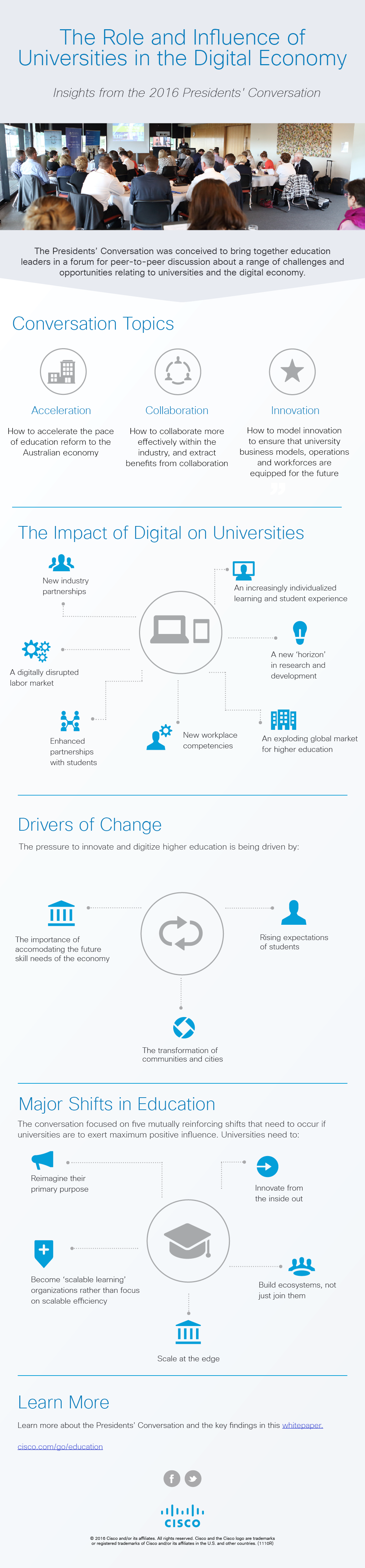
The Presidents’ Conversation was conceived to bring together like-minded vice-chancellors and presidents in a forum for peer-to-peer discussion about a range of challenges and opportunities relating to universities and the digital economy.
The concept of a global conversation of this type was suggested by Professor Mo Qayoumi, who hosted the inaugural conversation at San José State University in Silicon Valley in his (then) capacity as university president. That conversation was based on the theme ‘the role and relevance of universities in the digital economy,’ a title reflecting high levels of uncertainty whether universities had a sustainable future and would remain relevant.
At the conclusion of that prototype event, plans were developed to host a second conversation, this time hosted in Australia with a larger group of leaders from around the world.
The 2016 Presidents’ Conversation was held in Brisbane and was hosted by Professor Peter Høj, Vice-Chancellor at The University of Queensland, and co-chaired by Ken Boal, Vice-President of Cisco (Australia and New Zealand) and President of the Business/Higher Education Round Table (B/HERT).
Check out this infographic that outlines key insights from the event, and read the full report here.
Ochsner Health System is Louisiana’s largest non-profit, academic, healthcare system. In the past ten years, they’ve grown from one hospital to 28 owned and affiliated hospitals, 50 health centers, a fitness chain and more. They employ more than 17,000 employees and over 1,000 physicians in over 90 medical specialties and subspecialties and conduct more than 1,000 clinical research studies.
As the only full-service hospital to remain completely functional during and after Hurricane Katrina, Ochsner embarked on a bold acquisition strategy to restore and renovate the devastated region’s healthcare, intent on improving quality, cost-effectiveness and accessibility.
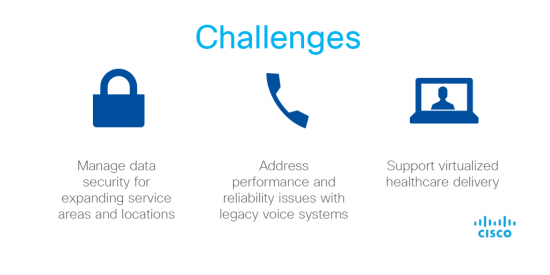
With such extraordinary growth came challenges with IT. Oschner needed a way to securely manage data while supporting collaboration and virtual healthcare delivery.
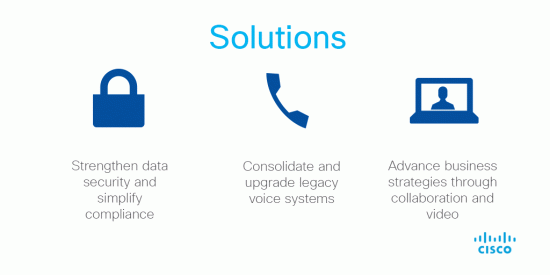
By using Cisco’s Trustsec network security technology to secure sensitive data, streamlining communications with VoIP and Unified Communications and delivering virtual care through wireless and video, Ochsner was able to expand the reach and impact of their nationally-ranked expertise.
To read more about Ochsner Health System and the Cisco solutions they have in place, please check out the full case study here.
I have worked in the communications industry for over 20 years and never before have I been so excited by the amount of change I am seeing. Change can be scary, but it also brings new opportunities.
One of the topics I hear about most is new business models enabled by digitization. It seems that every industry is being disrupted in some way — some more than others, and some faster. Every business I speak to is worried about:
Who will be the next new entrant to their market
How they will be disrupted
What market shift could catch them off guard
Everyone seems to be up on their toes, ears pricked. This is scary for those being disrupted, but good for those that disrupt — and for their customers.
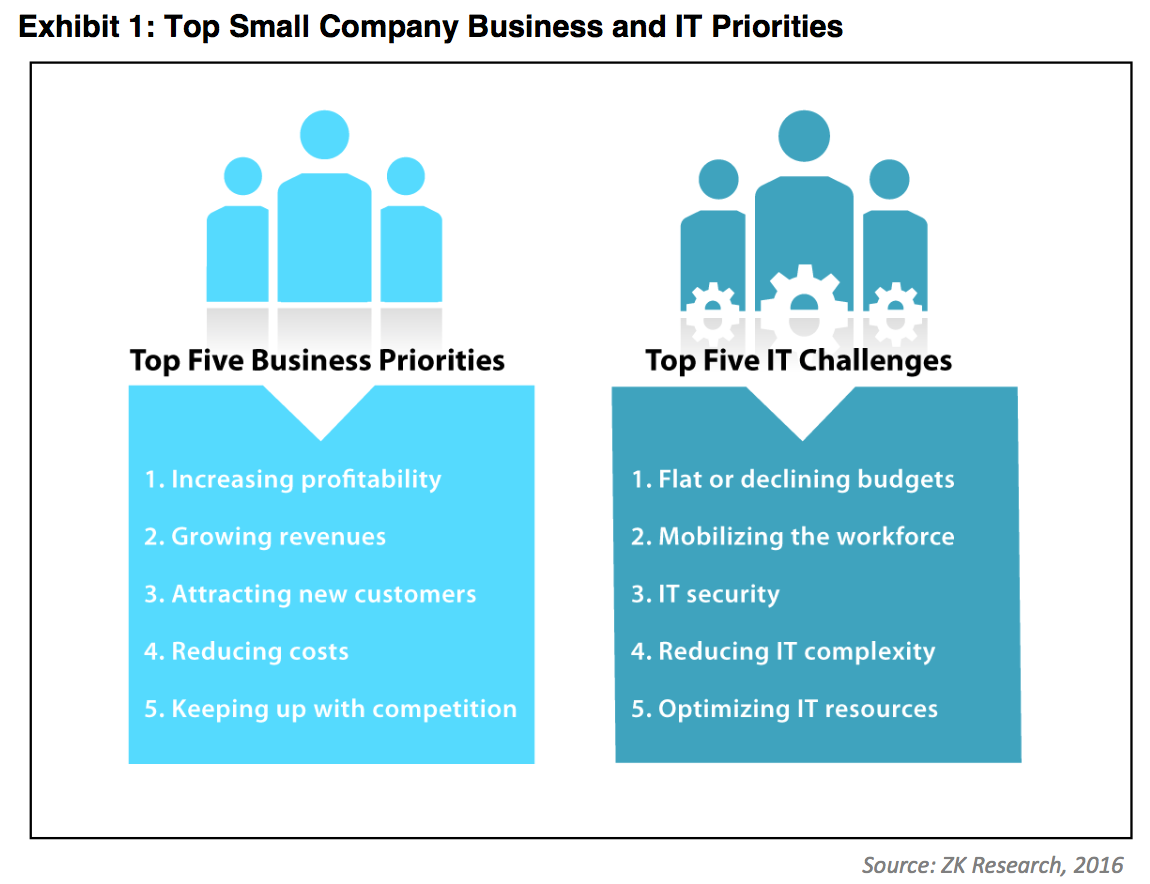
Recently I caught up with Zeus Kerravala, an industry analyst I admire. We talked about how the business landscape is evolving, how fast, and how our industry is helping organizations react or disrupt. We discussed the basic forces at play and Zeus agreed to research the top small-business challenges and how unified communications and collaboration solutions help with each.
Zeus conducted more than 50 one-on-one interviews with small-business owners and IT leaders to understand their top business and IT priorities. He has now published his findings and his paper is a very good read. In it Zeus points to some key findings around:
Top small-company business and IT priorities
The benefits of unified communications as a service
Recommendations around cloud-based services, using Cisco Spark services as a lead example
For me, the golden nugget of Zeus’s paper is where he makes a vital connection between what small business are trying to achieve and the IT services that are available to them. This is a key observation, and understanding it is one of the foundations of success for any business. Zeus points out that technology alone isn’t the key. Importantly, he digs into how businesses deploy these services, particularly small businesses with limited IT resources. He recommends that collaboration technologies are critical, but extends this to suggest that maximizing the benefits of theses services requires that organizations adopt them successfully.
We are experiencing massive disruption in our own industry, particularly around the cloud. Zeus’s summary centers on his view that UCaaS delivers all the benefits of UC without the associated complexity of deploying and maintaining the technology. UCaaS is aligned with a cloud and mobile-first world, and it ensures organizations are working with the latest features instead of having to wait for IT-scheduled upgrades. He concludes that UCaaS should be a top initiative for small business leaders. I agree.
Download Zeus’s paper here. Use the comments area below to share your thoughts around his paper and the art of balancing small-business initiatives and technology.
New technologies drive new capabilities, new information, and new ways of doing business. Forward-looking companies will demand more from the services and applications they use. This is the digital transformation. This will affect every industry and will impact every human being.
“We stand on the brink of a technological revolution that will fundamentally alter the way we live, work, and relate to one another.” This is what Professor Klaus Schwab, founder and executive chairman of the World Economic Forum, said at the start of 2016. He calls it the Fourth Industrial Revolution. And he believes that the change will be unlike anything we’ve experienced before.
The Internet of Things (IoT) plays a key role in this digital transformation. More people, devices, and things are being connected. By 2020, more than 50 billion devices will be networked. In North America alone, the average number of devices per internet user is expected to reach 13.6 in 2019 – up from 7.3 in 2014. We can save lives, protect endangered species, make cities smarter, make roads smarter, and be smarter in what we do. And all by connecting four elements: sensors, smart devices, autonomous machines and software.
Cloud-based data is the fuel of the future
All these new connections, applications and devices are generating a flood of data. Some is temporal, but much is not and has to live somewhere. Most will reside in the cloud. By 2019, 83 per cent of global data center traffic will come from cloud services and applications.
These cloud solutions are being adopted for many reasons. Initially, the focus was on reducing costs, meeting personnel needs, and improving the customer experience. Companies now expect cloud to impact broader, more strategic measures of the business’ success. In recent IDC research, 54 per cent of those surveyed expected cloud to have a major impact on their IT budget allocation. Further to that, 53 per cent expected cloud solutions to increase their revenues.
Increasing connections, evolving priorities
Digital transformation is having a major impact on business imperatives, and how your customers think about their cloud deployments. As more devices and connections generate more and more data, businesses have to contend with increasing complexity, new security issues, and regulatory concerns. They have to make these decisions fast. They face fierce pressure from competitors, from disruptors, and escalating demands from their own end customers.
More and more, businesses are drawing their attention and investment to what matters most – their core work and intellectual property value. Beyond that, they want partners who can help them to outsource IT services previously done in-house, and to create new business models. First, they must ensure strong business continuity and protect their data. In short, they must protect their future value.
Security that spans the attack continuum
Strong security is critical. Its importance has only grown as the IoT emerges. Organizations are becoming more aware of reputational risks and revenue losses associated with sensitive data breaches. They are also worried about the increasing sophistication of targeted attacks. They want partners such as service providers (SP) that can help protect them across the entire attack continuum.
Before an attack, they need security solutions that can control, enforce and harden the network perimeter, and provide vulnerability assessments. Next generation firewalls, virtual private networks, and unified threat management solutions can help keep intruders and malicious software out. During an attack, your customers need to detect, block, and defend themselves with solutions such as web and email security, and next generation intrusion prevention systems.
Even with strong security in place, advanced, persistent threats can penetrate defenses and lurk and spread for days or months without detection. Businesses need to scope, contain, and remediate sophisticated threats after an attack through advanced protection and sandboxing, as well as network behavior analysis.
Because your clients understand that security is critical, they see the value in getting that extra peace of mind. This can translate into higher value services you can provide leading to revenue increases.
Visibility and control
Being able to move fast, make decisions quickly, and provide great user experiences for their customers, is also important to organizations. To do this, they require granular end-to-end visibility into their network and applications. They also need a simple way to manage their IT environments and make informed decisions. Your customers need an autonomous system that can run smoothly and give them the control to quickly change and scale to support new business needs.
Customer self-service portals are a robust tool to give businesses the insight and control they need. According to a Cisco survey, 35 per cent of those questioned said that the ability to customize information to their business needs was the most attractive feature of a self-service portal to manage services. Customizing information was even more important among very large businesses with more than 10,000 employees.
Maintaining compliance
Regulatory compliance is top of mind for businesses. Whether they are deploying their digital transformation solutions on premises, buying them from an SP, or deploying a hybrid of both, organizations still need to comply with government and industry regulations. They need a solution that provides the flexibility, convenience, and cost savings of cloud without compromising compliance.
SPs also need to consider compliance when developing their solutions. When you are serving customers in different countries, you must consider data sovereignty. Digitized information is subject to the laws of the country it is located in. These laws can have substantial impact on your logical and physical cloud and storage architectures. If you have a network controlled by yourself or through a partner, you have an advantage in being able to locate data storage and repositories right where they need to be.
These are just a few of the changing expectations of your customers. They are going through a major change, as you must too to take advantage. This industrial revolution can sound scary wherever you are on the curve – the alternative, however, is far worse. We can help with transition and remove the fear.
It will be a fun ride!
Find out more
To keep pace with changing customer needs, you’ll need a network that can deliver the rich cloud services and scalable performance required. Cisco is the leader in network and cloud services, technologies, solutions, and security. Our solutions let you provide the management and flexibility customers need to quickly order and provision the services that work best for their business. And our robust security helps you protect yourself and protect your customers. I think that’s worth doing!
To learn more about how Cisco cloud solutions can help you support customers on their digital journey, visit www.cisco.com/go/spcloud.
End-to-end security tends to be very abstract and difficult for humans to visualize. The challenges of designing, building and maintaining networks with security across every business case and each part of your network is no simple task. It requires that you know why you are building the network from a business perspective, and then, how security controls will affect it.
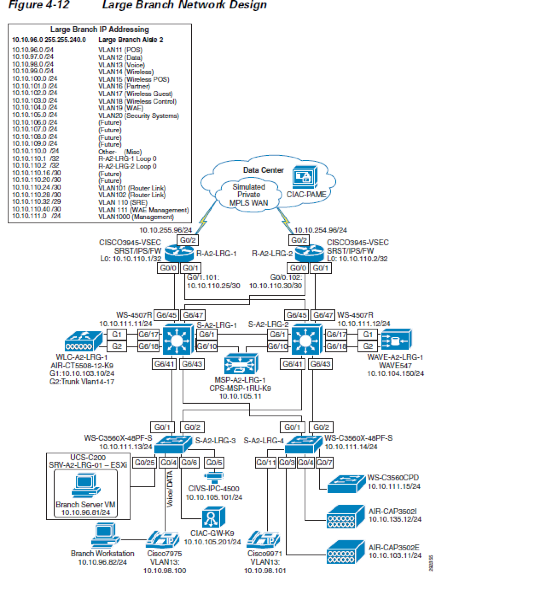
Today’s Problem
This diagram represents the challenge that we have in the industry. This is my own drawing that I used to represent a large store for the “PCI Design Guide.” I needed to represent a store architecture and depict how it was secure and compliant for credit cards. Although technically accurate, it is very hard to read. Where is the credit card flowing through out this store architecture? How do you know if a switch is being used as a firewall or if a firewall is being only used for intrusion detection? You can’t because the icons of today were not designed with security capabilities in mind.
The ease of children’s building blocks
SAFE uses a visual language; icons and graphics to simplify the complexity of security. There is a high, medium and low level view that can be used depending on the needs of the audience. When discussing the high level needs of the business, security is depicted in simple controls for the business use case. At a medium view, these simple controls are organized logically. At the lowest level, specific designs complete with Bills of Materials and configurations are used.
CAPABILITIES- High Level- Conceptual
SAFE uses the idea of “capabilities” to abstract the controls used in security. For example, if you wanted to purchase a firewall from Cisco, you might consider the Firepower NGFW, the ASA, the firewall IOS, a virtual ASA, or the Meraki product line. While the form factor might be different, at the end of the day, you are still buying a product that has the capability to Firewall. That concept or capability of a firewall is depicted using a descriptive icon that is reused across all three levels so that you see how they map directly.
FIREWALL
Cisco uses blue circles for each capability. We have developed a palette of security capabilities representing the spectrum of controls that you will need for the networks of today and the future. This is important because you can now resolve a classic security problem with notation.
What if the firewall product that you bought is not really being used for Firewalling at all? Perhaps you are using an ASA for the sole purpose for Intrusion Detection. Or, perhaps you purchased a Cat6k switch with the firewall module. That is a switch using a firewall capability and a firewall performing IDS? This is confusing so we developed the next level down to resolve it; Architectures.
ARCHITECTURES- Medium Level- Logical
Cisco uses green squares to represent the Architecture level. Building on the concepts presented at the capability layer, the architecture icons depict the problem use case that we presented above with ease:
Here we have a Firewall that is being used for Intrusion detection.
FIREWALL USED AS INTRUSION DETECTION
Here we have a switch that is being used as a Firewall.
SWITCH USED AS FIREWALL
Any of the blue security capabilities can now be paired with any green architecture symbol used in network and security architecture. By using this notation, you can depict any business use case throughout your company in a logical manner that ensures you have the appropriate level of security controls.
DESIGN- Low Level- Specific
Finally, the lowest layer of the SAFE model is the Design layer. This is where specific products are selected that follow the method from a conceptual capability, to a logical architecture to a specific design. SAFE uses purple hexagons to represent exact product choices, configurations and wiring diagrams.
5505 ASA FIREWALL
SAFE helps simplify security by providing a model that is used as a reference and a method that tailors this model to your specific environment. Finally, it uses a visual language to simplify the business flows.
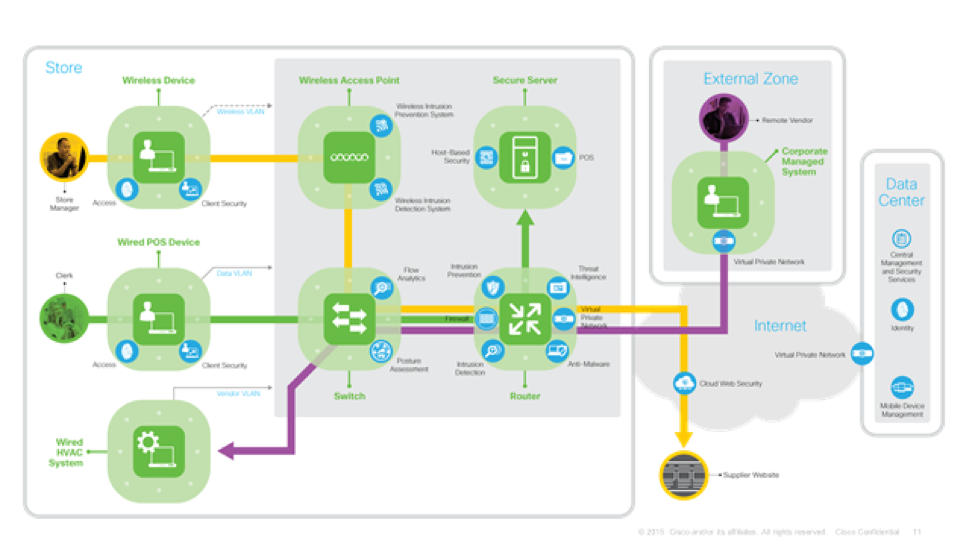
Compare this diagram with the one above. Can you see the clerk’s credit card transaction now?
Do you see the firewall (and all the security capabilities) located in the blue circles?
Much easier to understand.
Next in this series of SAFE discussions I will show how you use SAFE and these icons to document a Retail Store; Francisco’s Supermarket.


 annual Critical Communications World (CCW) event is to be held May 31 – June 2, 2016 in RAI Amsterdam, Netherlands. Over 4000 professionals are expected representing 120+ countries to network and learn from more than 200 expert speakers and 175 exhibitors.