Avatar

Just say NO to SLAs

Most of you who’ve either purchased or delivered cloud services have been asked for an SLA (Service Level Agreement). I’ve seen SLAs that can be measured on inches of paper.  Why so big?

Just consider getting 10 people in a room and trying to write down the definition of what it means for an application to be down:

  • Do you mean a partial outage?
  • What if only one iPad can access the application, is the application up?
  • What if it’s down for one minute in the middle of the night? Is it down?

Now let’s imagine adding our lawyer friends into the mix to write in English our definition of application outage, and then discuss the terms of a penalty payment. If you do this, you’ll quickly see the contract getting thicker and thicker.

SLAs are an anachronism. They come from the day of companies using Model 3 and outsourcing. This means handing over all of your computers and staff to another company, so they can take over your mess and do it for less.

Continue reading “Just Say No to SLAs”

Authors

Timothy Chou

Lecturer at Stanford University

Avatar

I recently wrote in my blog about a partner, WWT, that quickly developed a network replication solution across dual DC using the programming interface on the APIC.  Our own development team, just published a complete management rollback mechanism for the APIC using the ACI toolkit’s high level APIs and the APIC’s RESTful APIs.  It took them just a few short days to accomplish this.  This is a testament to the fantastic capability our customers and partners have for rapid feature development on this open programmable platform, the APIC and ACI fabric.

Cisco Insieme engineering team has introduced a new ACI toolkit feature to automate the snapshot and rollback of ACI fabric configuration. Why Snapshots and Rollback for Virtual Networks?  Virtualization introduced a powerful debugging and management capability when file based snapshots of state, data, and configuration of a virtual machine could be made at a specific point in time.  You could restore a previous state, restore lost data, and restart applications from a point in time using snapshots.  With network virtualization, you can store the state of the network, restore a previous configuration, and restart the network with its applications from a point in time.  There are tremendous applications for this capability for DevOps teams testing and debugging distributed applications to optimize performance at scale or to recover from some introduced error or failure.

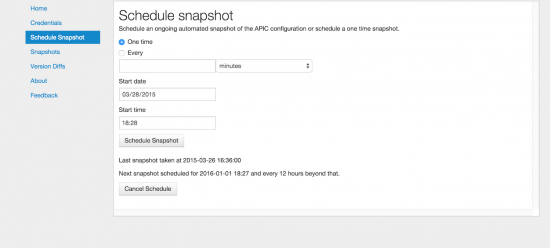
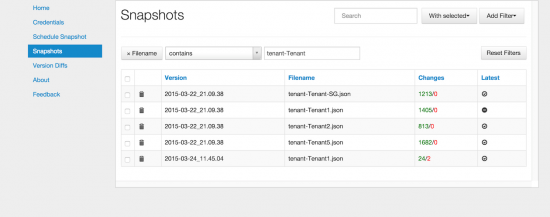
Snapshot Feature: The tool called “snapback” allows administrators to take live snapshots of a running ACI Fabric configuration either immediately or at some predetermined time in the future.  It allows the snapshots to be performed as a one-time occurrence or on an ongoing schedule.  All snapshots are stored in a version control system that allows full viewing of any version of the configuration and the differences between versions.  Policies can be specified in version control to meet compliance requirements.

snapback-schedule-snapshot-set

Rollback Feature: Rollback is allowed to any previous configuration version and can be done as a full configuration rollback or as granular as per tenant. This enables certain tenants to be rolled back to previous configs, while certain others get to keep their current configs. All config files are readable and open JSON formatted text files. The Open interfaces of ACI enables easy integration of this “snapback” tool with third-party systems to develop integrated operations-focused solutions as it can be imported as a library, run from the OS command shell, or run as a web application.

snapback-snapshots

The source code of the toolkit with examples in GitHub, is available for you now to access and start building your own customized solutions using the APIC and ACI.

Related Links

http://acitoolkit.readthedocs.org/en/latest/snapback.html

https://github.com/datacenter/acitoolkit/


Authors

Ravi Balakrishnan

Senior Product Marketing Manager

Datacenter Solutions

Avatar

Who doesn’t enjoy a vacation? And not just one day, but – four!

What if there were a cloud service that saved you so much time, you could actually send all of London’s working population on a 4-day vacation?

Well, that’s exactly what Cisco Active Advisor does – save you time and money so you can do just that! Read Pradeep’s post to find out how – Introducing Cisco Active Advisor – A Free Cisco Tool for Your Network.

But more on that later… Continue reading “Cisco Active Advisor – Network Maintenance and Improvement Made Easy”

Authors

Efrat Noy

Product Manager

Avatar

Inspire and connect women, celebrate achievements, encourage more women into technical and leadership roles, recruit men to be advocates for women, make a measurable difference. We can’t wait for the day when we don’t have to talk about it anymore. Until then we want to do more and say less. Because, gender equality: its not just good business, its good for business.

At Cisco, we are not sitting around and waiting. We are casting a wide net by looking at all disciplines. Bring your curiosity, desire, ambitions! Our culture is about bringing in the best talent, we conform to who you are instead of asking you to conform.

Think of the most significant inventions and business achievements of the last 15 years, and it becomes clear how much IT has shaped the world. Facebook, Google, the iPhone (and most other devices from Apple), 4G / emerging 5G mobile connectivity, all define possibilities in how we connect with others and interact today.

Over the next few years wearable technology, 3D printing, Artificial Intelligence and Augmented Reality will all make big strides. The Internet of Everything (where every device, thing, can communicate automatically, be it a smart-phone or a smart-fridge) will continue to grow, further binding our consumer existence to technology.

A career at Cisco could put you at the forefront of these important advances, changing people’s lives in dramatic ways.

Cisco technology has been pivotal to the development of our Internet. As we move to Cloud Computing, Internet of Things, Cyber-security, the sky is the limit of the possibilities for you as technologists.

Accept the challenge of joining the Internet of Women at Cisco to invent together and moreover, to truly change the way we live, work and play.

i-z4LM3tg-2530x1836-4.3.15


If you want to make a difference and have impact visit the Cisco team at the IEEE-WIE Conference. Hack with us on April 26: IEEE-Cisco Micro Hackathon. Meet with people outside of your regular work and collaborate with people you just met. Have fun developing ideas and your entry could win you a prize. Register at https://www.eventbrite.com/e/cisco-wise-ieee-wie-ieee-cybersecurity-micro-hackathon-tickets-16052593740

We are excited about the forthcoming IEEE Women in Engineering Conference to be held in San Jose, California, April 23-25

http://ieee-wie-ilc.org/


We look forward to welcoming you!

Liz Centoni and Monique Morrow, Co-Cisco Women In Science and Engineering (WISE) Exec Sponsors


Authors

Liz Centoni

Executive Vice President

Chief Customer Experience Officer

Avatar

I’ve been a huge fan of Cisco and NetApp’s FlexPod since 2011, when I had the pleasure of working with it for the first time.  We had just gotten two brand new UCS Chassis full of B-Series blades, and I was impressed with how quickly I had them up and running.   I wired up the UCS Chassis to a Nexus 5000 switch I had in the lab, as well as a NetApp FAS2020, it wasn’t pretty, and it wasn’t in the same rack, but it was still a FlexPod.  When I did some firmware updates a couple of weeks later, again, it was simple process.  I could have actually scheduled it to run later, which I thought was an extremely cool feature.  It took next to no time to have everything revved to current levels (the poor UCS sat in the lab neglected for a few months before I got my hands on it).

FlexPod has come a long way since then, so let’s take a look at some of the hottest Cisco Validated Designs out there today, and a little bit more about what makes a FlexPod a FlexPod Continue reading “FlexPod for the Future”

Authors

Melissa Palmer

Systems Engineer

Avatar

In the era of digitalization, mobile, social and the Internet of Everything, Data Center and Cloud infrastructure are more and more representing a strategic business asset for organizations of all kind.  Companies are looking into how to best design, scale and integrate the various components in order to leverage synergies and simplify management. Application uptime of 24×7 is now the norm and Fast IT is not just a marketing message but rather a desire for everyone.

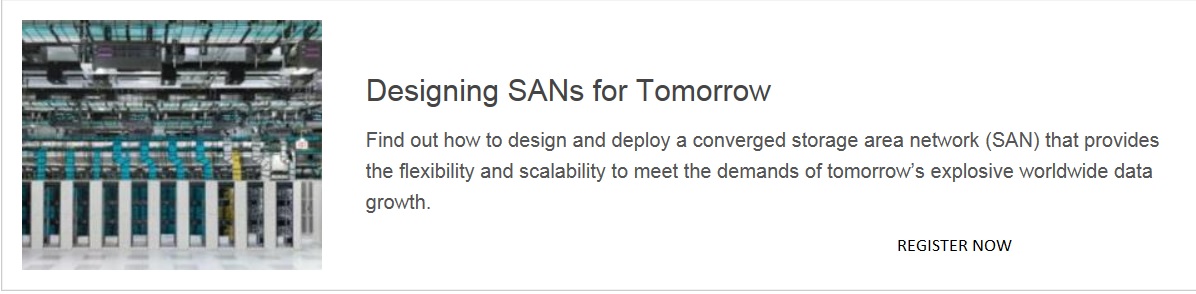
According to a IDC study, worldwide data will grow from 4.4 zettabytes today to a whopping 44 zettabytes by 2020.  How do you create a SAN that can efficiently handle a 10-fold increase in data in just 5 years without breaking your IT budget?

Learn best practices for designing a converged SAN that will meet your critical business needs tomorrow as well as today at this live, 60-minute webcast.       REGISTER NOW April 7, 2015,  8:00 AM PST


Like a tsunami, the proliferation of data threatens to overwhelm the capacity of the average storage area network (SAN). The latest Cisco  solutions can help you define and create a much more efficient network that reduces operating costs, simplifies management, and increases flexibility while scaling easily to meet your future requirements. Cisco’s latest offering benefits from the latest and greatest innovations in hardware, software, ASIC design and architectural approach, leading to improved performance, higher availability, unmatched scalability and simplified operations.

Subscribe to youtube Channel – http://www.youtube.com/ciscomds9000

Continue reading “Designing a SAN for the Next Decade”

Authors

Tony Antony

Marketing

Solutions

Avatar


CEWN Header

Anuja SinghGuest Blog and Interview by Anuja Singh

Welcome to our monthly Cisco Empowered Women’s Network (CEWN) segment about role models. We all make resolutions and set goals to improve ourselves– but somewhere along the way, life interrupts our plans, we find ourselves juggling different priorities and invariably things get dropped. In this segment, you’ll find inspiration from ordinary people who have achieved extraordinary results. Everyone featured in this series has faced challenges and opportunities that the rest of us can identify with; let’s draw inspiration from the choices they made and aspire to the outcomes they created.

Rima Alameddine

Rima leads the New York Enterprise Sales business for Cisco, which consists of large Fortune 500 companies in the NY Metro area. Rima brings a wealth of diverse experiences to the business having worked in Continue reading “Carpe diem – Seize the day! Inspiration from everyday heroes of CEWN”

Authors

Rehana Rehman

No Longer with Cisco

Avatar

CiscoChampion2015200PX#CiscoChampion Radio is a podcast series by Cisco Champions as technologists. Today we’ll be talking about the Cisco UCS E-Series with Cisco Technical Marketing Engineers Kishan Ramaswamy and Tony Banuelos.

Listen to the Podcast.

Learn about the Cisco Champions Program HERE.
See a list of all #CiscoChampion Radio podcasts HERE.

Cisco SMEs
Kishan Ramaswamy, Cisco Technical Marketing Engineer
Tony Banuelos, Technical Marketing Engineer

Cisco Champion Guest Hosts
Michael Aossey, @aossey, Solutions Architect
Chris Nickl, @ck_nic, Cloud Infrastructure Architect
Jonathan Davis, @subnetwork, Network Planning Analyst Continue reading “#CiscoChampion Radio S2|Ep 11. UCS E-Series and the Branch in a Box experience”

Authors

Rachel Bakker

Social Media Advocacy Manager

Digital and Social

Avatar
Handcuffs01_2003-06-02
Photo courtesy of Klaus with K, Creative commons.

Customers frequently ask how to avoid a “wild wild west” situation as they move from tightly-controlled traditional infrastructure to the self-service, highly abstracted model that Cisco OpenStack® Private Cloud provides.

They have concerns over quality assurance, security, costs, resource utilization, and more. There’s often a hesitation to take the handcuffs off their developer teams by giving them access to real cloud, even though they clearly realize that if they want to let those teams innovate faster and roll out new features faster, it’s necessary.

Here are five tips for maintaining control of your developers as you move to OpenStack, in no particular order:

#1 – Just don’t do it

If moving fast is your goal, meaning that you want your development teams to be able to create and roll out features faster than ever before, you may need to trade control for speed. That’s right. Don’t do it. There’s a real argument to be made that if your goal is to move fast, you need to get out of your developers way. To summarize a quote from Adrian Cockcroft (@adrianco) in a great talk he gave at Monktoberfest last fall: when big-company CIOs ask how he found such awesome developers at Netflix, his answer is that he hired those smart developers away from those same CIOs, got out of their way, and they built amazing things.

Continue reading “5 Ways to Manage Your Developers in OpenStack”

Authors