
Avatar

Cisco asks the industry to think aggressively and to accept risks when it comes to 5G planning.

I was fortunate to attend the NGMN 5G Industry Conference in Frankfurt Germany March 24-25th. And while Frankfurt in March is a bit chilly for this Florida-boy, the conference was interesting and certainly well worth an investment of time. It was great to get together with over 300 people and to listen to a free exchange of ideas and views from the network operators, technology vendors and academia. Everyone was there for the common purpose to figure out what will 5G really be.

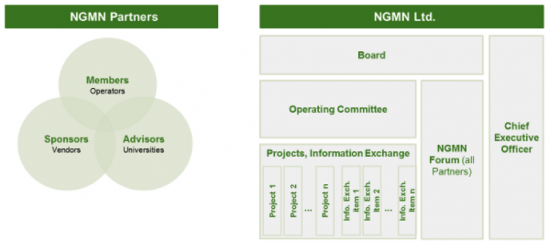
The NGMN is a network operator led organization that includes technology vendors and academia and takes an active role defining the requirements for next generation technology. They released their first of five white papers on 5G at this past MWC 2015.   This initial white paper focused on use cases that illustrate requirements needed in 5G.

NGMN

Why do we need 5G? Continue reading “Observations from the NGMN 5G Industry Conference”

Authors

Dan Kurschner

Marketing Manager, Product/Systems

Avatar

This post was authored by Earl Carter & Yves Younan.

Talos is constantly researching the ways in which threat actors take advantage of security weaknesses to exploit systems. Use-after-free vulnerabilities have become an important class of security problems due to the existence of mitigations that protect against other types of vulnerabilities, such as buffer overflows. Today, Talos is releasing FreeSentry, a mitigation for use-after-free vulnerabilities.

FreeSentry works as a plugin for LLVM with an associated runtime library that tracks pointers when they are set to objects and invalidates them when the memory associated with that object is freed. Our initial approach was published at the 2015 Network and Distributed System Security (NDSS) Symposium in February. The paper can be downloaded here. At CanSecWest 2015, Yves Younan of Talos presented an enhanced version of FreeSentry which included further developments, such as porting the original mitigation from C Intermediate Language (CIL) to LLVM. The CanSecWest slides are available here. Note that the LLVM performance numbers in the CanSecWest presentation were preliminary numbers, and have been updated for this post.

Continue reading “Research Spotlight: FreeSentry Mitigating use-after-free Vulnerabilities”

Authors

Talos Group

Talos Security Intelligence & Research Group

Avatar

When used wisely, consuming cloud as-a-service (aaS) can dramatically improve business outcomes. Primarily, cloud IT services can promote business agility, reduce expenses, and accelerate time-to-market. They also can provide access to highly trained professionals with focused technical expertise, solving a longstanding problem many IT leaders face with sourcing specialized talent.

Businesses today want speed and flexibility, and cloud IT as-a-service can help them achieve that because they don’t need to procure and deploy hardware and then build, test, and iterate software solutions. Although cloud offerings are attractive because they are readily available and can be deployed quickly, there are several factors to consider when deciding whether to build a solution in-house or outsource it to a cloud provider.

Continue reading “Harnessing the Power of As-a-Service Cloud Offerings”

Authors

Tal Saraf

Vice President, Product Management

Avatar
Photo courtesy of Breville, USA, Creative Commons license.

We talk to customers all the time that want to move to OpenStack, but the tools and processes they rely on just aren’t ready. Or the policies around their applications or data don’t support a true self-service cloud.

Not wanting to be stuck with VMware for the rest of their lives, we talk to them about what I call “cloud blending.”

Depending on what their tools and deployment processes look like today, some of the stateless, cloud-friendly components of their apps can be deployed to Cisco OpenStack Private Cloud, while leaving the scale-up or VMware-reliant (let’s call them “existing” instead of legacy), portions of their applications in the VMware environment.

An example might be to leave your SQL Server database in VMware, but move your web or content tier that’s going through a modern overhaul to a load-balanced, auto-scaling OpenStack environment–freeing up those costly VMware licenses for other purposes.

The response we often hear goes like this “Sure, but what about the processes I have in place to control my environment? Don’t those go away with OpenStack since everything is so self-service, where as today with VMware my teams control what happens?”

The answer is, as always, “It depends.”

Continue reading “Will OpenStack Blend? Managing Legacy and Cloud Together”

Authors

Avatar

Recently, I have been reading about organizational evolution. There are some great articles and insights out there, but the common theme running through all of them is that we face an unpredictable future and we need to be agile.

The pace of change is accelerating, and the modern agile organization will need answers for three key questions:

  • What type of technology is going to be required?
  • How will IT be delivered, and by whom?
  • Where do we fit in? Us, people.

New Technology

The Internet of Everything will enable the next great wave of growth. The technology within this wave will connect people, process, data and things. So much value will be realized and this transition will rely on key underlying technology development around cloud, security, mobility and networking. Of course, there will be great products and services, but Continue reading “The Agile Enterprise Needs Present & Connected Employees”

Authors

Marcus Gallo

Sr. Solution Marketing Manager

Cloud Collaboration

Avatar

A Q&A with Cisco Vice President of Intellectual Property, Dan Lang April-1

According to a report from global recruitment firm WilsonHCG, tech companies are the most successful among the Fortune 500 at  finding and recruiting top employees. What’s more telling, within the tech industry, the competition for top talent – especially top engineers – is fierce.

The ability to illustrate how employees are able to work on creative, innovative projects alongside inspiring colleagues and managers truly sets a company apart. Thankfully for us on this the first of April our culture of innovation shines through Cisco’s annual April Fools’ Patent Contest. Continue reading “Cultivating Engagement and Innovation: The History of Cisco’s April Fools’ Patent Contest”

Authors

David McCulloch

Director, Corporate Communications

Cisco

Avatar

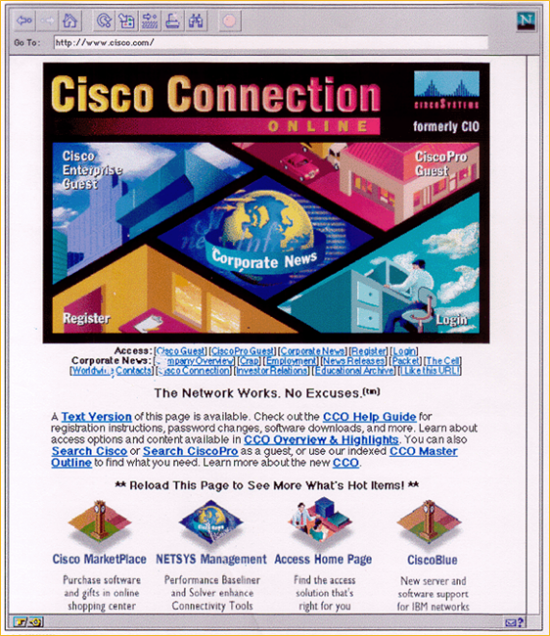
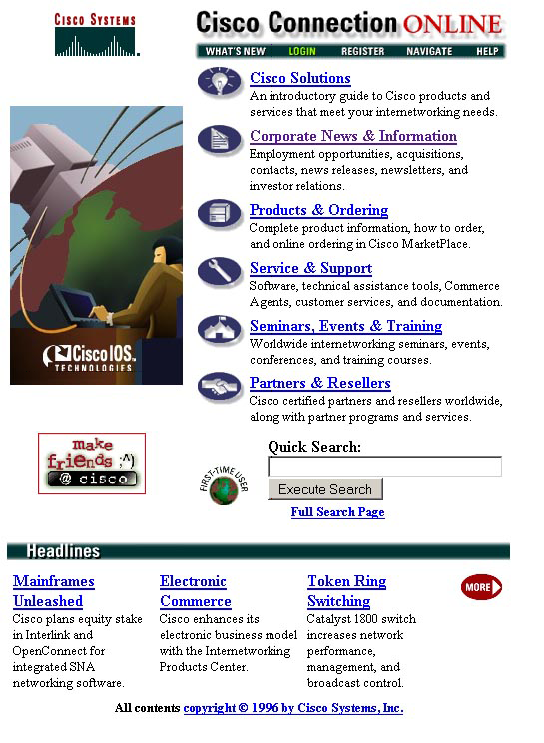
It’s fun seeing some of the quirky examples of home pages on web sites today, including Amazon’s retro “April 1, 1999” page.

I can’t think of a time we’ve ever done anything like that on Cisco.com, mainly because we don’t want to distract customers from the jobs they’re coming to do with us.  But, if you are craving some old school Cisco.com pages, here are a few:

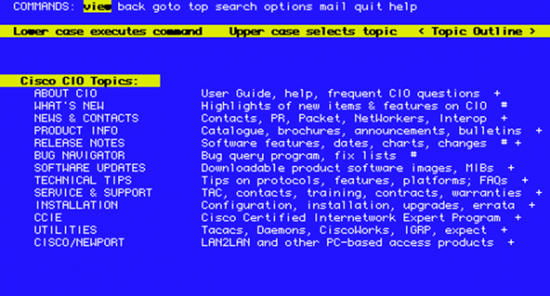
1992: Cisco Information Online (CIO) – Telnet/Modem Only:

Modem-1992

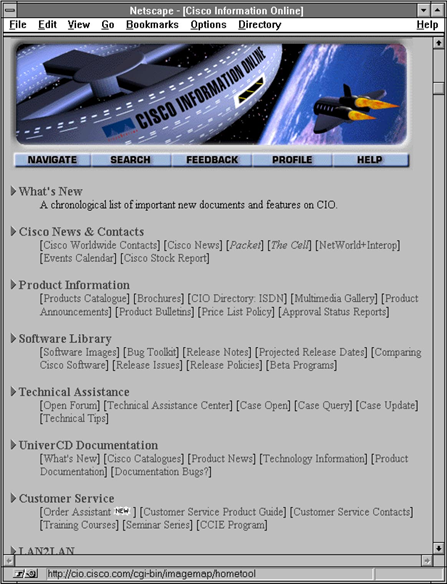
1994: Cisco Information Online Web Site:

CIO-1-1994

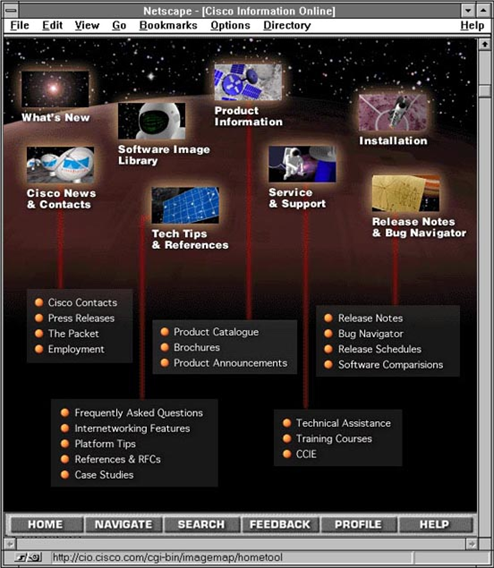
Mid-1994:  Cisco Information Online Web Site Stellar Motif:

CIO-2-1994

1995: Cisco Connection Online (CCO):

CCO-1995

1996: Cisco Connection Online (CCO):

CCO-1996

Prize for the best comment below.

Authors

Martin Hardee

Director, Cisco.com

Cisco.com

Avatar

I was on a weeklong business trip to London last month, and as I made my way to purchase a ticket for Heathrow Express train, I realized that I had left my corporate credit card at home. It was close to midnight in London, and Heathrow Express was the perfect option because I was going to stay at Hilton Paddington.

I reached the hotel rather quickly and, like always, thought to myself, “Why don’t we have something like Heathrow Express in New York?” At check-in, I offered my personal credit card and within seconds of the swipe, I received a text message from my bank:

iphone1iphone2

I responded in affirmative and received a confirmation. I was very impressed that my bank was looking after me. Continue reading “Track the Customer Journey with Cisco Context Service”

Authors

Ibrahim Malick

No Longer with Cisco

Avatar

If you do not know the International Society of Service Innovation Professionals or ISSP, I encourage you to do so.

ISSIP is an amazing organization with very active Cisco engagement; and yes Cisco is a co-founder of ISSIP.

ISSIP defines service “as the application of knowledge for the benefit of others, and service science as the study of diverse, interconnected, complex “human-centered value co-creation systems in business and in society.”

With wonderful colleagues in private industry and academia service science coupled with innovation is core to a service strategy. There are indeed implications to talent such as Continue reading “The Importance of Service Research to Our Industry”

Authors

Monique Morrow

CTO-Evangelist

New Frontiers Development and Engineering