Avatar

OpenStack blended cloud

Some people are perfectly happy buying and eating pre-made microwaveable meals.

These meals are rarely amazing. They’re never innovative. But they’re quick, perfectly consistent, and they get the job done. The only flexibility on the part of the consumer is which pre-made meal to pick. The decisions about what’s inside have been made for them, and there’s almost no risk of food poisoning. It’s a perfect example of “Good, fast, cheap. Pick two.”

Other people however, prefer the farmers’ market. The best chefs in the world are artists. They need selection. Choice. Flexibility. It’s that combination that allows for culinary innovation and creativity.

Continue reading “The Farmers’ Market for Development Teams”

Authors

Avatar

Last week, I was acknowledged by the Alum Rock Counseling Center for my personal commitment to mentoring at-risk students. As I prepared my thank you remarks, I was reminded how much I value youth mentoring nonprofits such as Alum Rock, Big Brother Big Sisters, and Child Advocates. Through mentor-mentee relationships, students are propelled to learn, to grow, and to discover their own genius.

It worked for me.

HCF #2

My parents immigrated to the United States in the early 1970s with little experience on living, working, or educating my sisters and me in this country. As a result, I leaned on mentors to guide me in areas my parents could not. Mentors who connected with my heart and with my mind made all the difference, because literacy and math achievement programs alone were not enough.

Continue reading “Mentoring At-Risk Students Good for Our Hearts and Minds”

Authors

Ricardo Benavidez

Senior Community Relations Manager

Avatar

Since Cisco UCS Mini launched last September, Cisco and our partners (Citrix, EMC, Microsoft, NetApp, Nimble Storage, Oracle, SAP, and VMware) have been hard at work putting together a wide variety of solutions.

On the way to tradeshow week (May 4th), I’ll be doing a brief blog series on UCS Mini tied to these shows.

Continue reading “Cisco UCS Mini – Powering Microsoft Applications”

Authors

Bill Shields

Senior Product Manager

UCS Solutions Product Management

Avatar

Organizations are under relentless attack, and security breaches happen every day. A global community of attackers creates advanced malware and launches it via multi-faceted attacks and through multiple attack vectors into organizations of all sizes.

These increasingly costly attacks against organizations of all sizes place customer data, corporate secrets, and intellectual property at risk. Smaller organizations that form part of the supply chain are targeted not only for their own assets but as an entry point for attacks against larger organizations that they partner with.

We believe the most effective way to address these real-world challenges is with continuous threat protection that is both pervasive and integrated. This goes beyond traditional point-in-time detection and taps into context-rich threat intelligence, dynamic malware analysis, and retrospective security to allow continuous breach detection, response, and remediation across the full attack continuum.

For this reason, we are unveiling new models of Cisco ASA with FirePOWER Services for SMB, midsize organizations, and branch offices. These next-generation firewall (NGFW) models bring integrated threat defense, low total cost of ownership, and simplified security management to smaller and distributed organizations.

Continue reading “A New Way Forward: Continuous Threat Protection for Organizations of All Sizes”

Authors

Bill Mabon

Senior Manager, Security Products

Cisco Security

Avatar

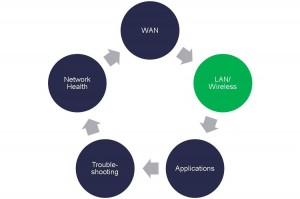
Last week, I shared with you how to set up WAN networking with Cisco Prime Infrastructure. Today, as the second blog of my 5-part blog series, I’m going to discuss with you how to connect your branch site users to the LAN and wireless network with Prime. Before I go further, just as a quick heads up, here’s my weekly blog series plan on how to set up networking with Prime for a new branch site.

WAN deployment – blog 1
Converged wired and wireless  – blog 2 (this blog)
Application performance – blog 3
Troubleshooting – blog 4
Network health – blog 5
 steve song blog 2 pic 1

Your new branch router is up and running. Cisco IWAN is working beautifully. You can’t wait to connect your branch users to their LAN and wireless access network. Mobility is what everyone automatically counts on these days. Cisco forecasts an 18-fold growth in mobile traffic from wearable devices along from 2015 to 2019. Meantime, wired LAN is still critical. IP phones, printing and some business functions depend on rock solid wired LAN access. You want to set up your wired and wireless access for success. A big challenge is how to keep it simple and easy to manage. Continue reading “Bringing Up a New Branch Site the Easy Way with Prime Infrastructure – Part 2”

Authors

Steven Song

Business Manager

Avatar

Last week, I attended a very interesting meeting in San Francisco for a program we call CHILL – Cisco Hyper Innovation Living Labs. The session, facilitated by the Factory, an incubator backed by Skype co-founder Janus Friis, included key leaders from retail, consumer products, and finance industries.

Continue reading “Let’s CHILL… an IoE innovation acronym”

Authors

Wim Elfrink

Executive Vice President, Industry Solutions & Chief

Globalisation Officer

Avatar

Many enterprises today want to build a private cloud to gain efficiencies such as on-demand service delivery and pay-as-you-go use of IT infrastructure services, all while maintaining control, accountability, and data sovereignty. There are two ways an organization can realize the benefits of cloud. One is to build and maintain a private cloud. The other is to have a trusted service provider host and manage your private cloud. The first step in making the decision is to gain a full understanding of business and application requirements.

Start by asking yourself some basic questions:

1. Do you have the right in-house resources to build and maintain a private cloud?

2. Is your company in a position to spend the capex necessary to build your own cloud, or is a pay-as you go model more beneficial?

3. What (if any) regulatory compliance issues does your company need to address regarding security, privacy, and data sovereignty?

Continue reading “Building a Private Cloud: Considerations to Maximize Success”

Authors

Mark Balch

Product Management

Cloud Management Software & UCS Solutions

Avatar

This post was authored by Nick Biasini with contributions from Kevin Brooks

Overview

The use of macro enabled word documents has exploded over the last year, a primary example payload being Dridex. Last week, Talos researchers identified another short lived spam campaign that was delivering a new variant of Dridex. This particular campaign lasted less than five hours and was successful at mutating the subject and attachments to avoid detection. The five hour campaign actually consisted of two separate emails that both had malicious word documents as attachments. A sample of the two different subject lines are shown below.

Campaign One Subject:
Debit Note [97994] information attached to this email

Campaign Two Subject:
48142 – Your Latest Documents from RS Components 822379272

*Note: Italicized text used to identify mutating portions of email subject

Both campaigns centered on invoices being sent as word document attachments. Not only did the attackers use different subjects for every email they also rarely reused an attachment name. Less than five percent of the emails observed contained re-used attachment names.

Continue reading “Threat Spotlight: Spam Served With a Side of Dridex”

Authors

Talos Group

Talos Security Intelligence & Research Group

Avatar

The debate of what we should be learning seems to be a more frequent topic today. For instance, there’s been a long-standing question for each new networker: after learning a little about routing and switching, does a relative newbie dive deep into route/switch? Move on to learn voice? Or security? Data Center? Or for emerging technologies like SDN, should we learn SDN as defined by the Open Networking Foundation, or ACI, or both? Should we build programming skills to become network programmers, or programming for network automation, or stick with traditional config/verify/troubleshooting skills?

So we can talk to coworkers and discuss/argue about what technologies we should learn… but then we all seem to agree that learning throughout our careers is hugely important. (In fact, the day I was wrapping up this blog post, the Cisco Champion podcast included several people making that very same point, in agreement.) And then we stop talking about learning, because we all agree. We agree that learning is important, and don’t talk about how to learn effectively.

Our long-term career prospects depend in part on learning about existing and emerging technology. But how good are our learning skills? Are we happy with the results? How can we get better at learning?

Today’s post begins a 2-part post that offers a top 4+1 list of answering that last question: how do we get better at learning? Rather than us just agreeing that learning is important, and moving on, let’s treat the process of learning as an important process, and learn how to do it better. Continue reading “4+1 Practices for Effective Lifelong IT Learning (Part 1)”

Authors

Wendell Odom

Founder, Certskills