As defenders, one of our key objectives is to help organizations and individual users understand the threat landscape so they can reduce their exposure to cyber threats. Our threat researchers and technology partners watch that ever-changing landscape very closely, as they have for many years now. That’s one reason we are confident when we say that we believe some actors in the shadow economy are making plans to launch cyber attacks that could potentially have a devastating impact that extends far beyond damage to the core target.
This statement is not meant to be sensational. It is only a warning about what we, and others in the security community, sense might be coming. We have no clear insight — yet — into when such an attack might happen or what the targets would be. But as the Cisco 2017 Midyear Cybersecurity Report explains, we find the rapid evolution of threats and the magnitude of the attacks troubling. Based on what we have been observing, we suspect that some adversaries are laying the groundwork for a new type of attack, which we call “destruction of service” or DeOS.
The purpose of such an attack would be to prevent defenders from restoring systems and data. Right now, many security-minded organizations take some comfort in knowing that when they are hit, inevitably, with a DDoS attack, ransomware campaign or other major cyber event, they’ll be able to recover because they have backed up their critical data and systems. DeOS is meant to eliminate that safety net, making it impossible for the business to operate–permanently.
Adversaries know that no business has a contingency plan that outlines how to rebuild all their information technology and operational technology from the ground up. And if a major enterprise would be the target of a DeOS attack, and would suddenly cease to operate, it’s easy to imagine the repercussions not only for that business, its employees, customers, partners, and other stakeholders but also potentially the global economy.
The rise of the IoT botnets
So, what is happening in the threat landscape now that has defenders so concerned about what may come? One thing is Internet of Things (IoT) botnet activity. IoT botnets sound futuristic, but they are definitely real—and not exactly new. The Cisco 2017 Midyear Cybersecurity Report notes that “2016 brought a long-feared DDoS threat to fruition: Cyber attacks launched from multiple connected devices turned into botnets. These attacks propelled us into the 1-TBps DDoS era.”
That is a powerful attack, and it begs the question: What’s next? In the near term at least, we can expect to see more and bigger IoT botnets. According to our partner Radware, whose research on IoT botnets is featured in the midyear report, these botnets are quick and easy to set up and can grow exponentially—and very quickly. Also, IoT botnet malware has a low detection rate.
Radware has been closely monitoring the activity of three of the largest known IoT botnets: Mirai, BrickerBot, and Hajime. Details about their research are featured in the midyear report, as well, but here’s a quick overview of what we know about these botnets:
Mirai, which was involved in one of the highly disruptive 2016 attacks, has been infecting hundreds of thousands of IoT devices and turning them into a “zombie army” that is capable of launching powerful volumetric DDoS attacks.
BrickerBot is known for permanent denial of service (PDoS) attacks, which can damage systems so severely that the hardware must be reinstalled or replaced. (Unfortunately, this type of destructive attack is becoming increasingly popular, according to Radware.)
Hajime, whose author claims to be a white hat hacker, is what Radware describes as “a sophisticated, flexible, thoughtfully designed, and future-proof IoT botnet.” It’s also worrisome, as it hasn’t taken any action yet with the hundreds of thousands of devices it has so far infected. It does some interesting things, too, like cleaning malware (including from other botnets) from the device it wants to infect.
Again, these are just three of the largest IoT botnets out there. Their authors are early movers in the IoT space, which is rampant with vulnerable devices and systems that weren’t built with security in mind. More malicious actors will look to stake their claim in the IoT. And as IoT botnets multiply and grow, so too will IoT-driven DDoS attacks—moving us closer toward the “DeOS era” of cyber attacks.
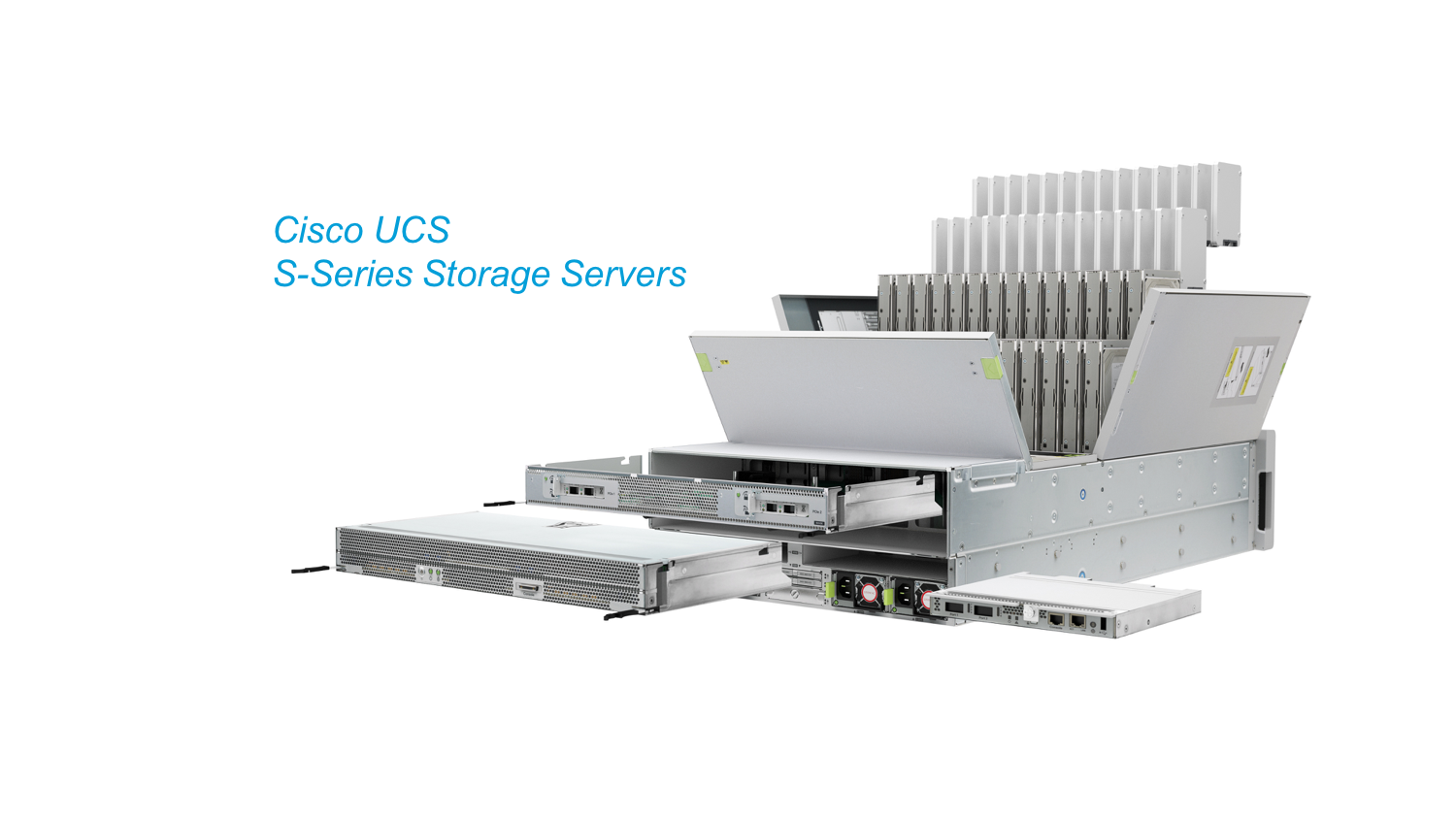
The disruption that cloud has triggered in the marketplace has many organizations looking for a deeper level of expertise and experience from their solution vendors. Cisco has long been known as the top experts in networking, and has grown in reputation as makers of the most robust x86 servers available. Lesser known however are the software solutions available for purchase from Cisco, and the role that Cisco UCS S-series Storage Servers play in a modern storage cloud.
This new approach with a software defined storage architecture may not be top of mind for IT architects and Network Infrastructure experts, but it should be. Storage to many is still imagined as a refrigerator-sized box in a rack with a large door, when a superior architecture for modern applications is actually comprised of a cluster of standard nodes as building blocks. Cisco UCS S3260 is an ideal building block for modern storage clusters, and Cisco has several validated designs with different software offerings to provide customers with freedom of choice.
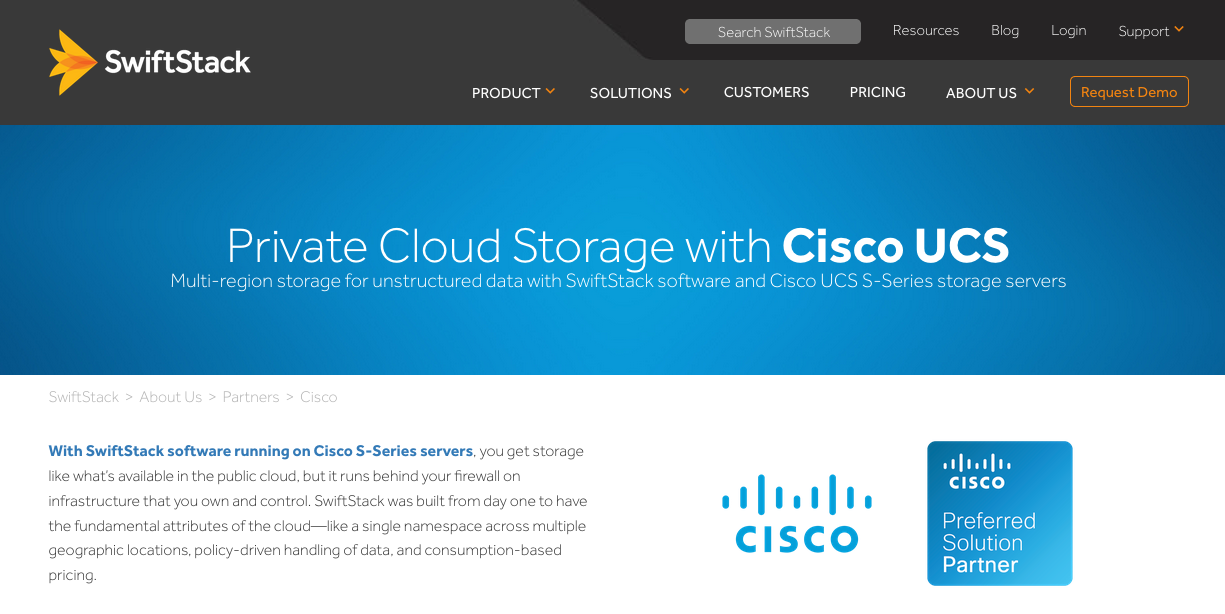
Object Storage is a software solution that is ideal for the networking throughput and storage density designed into the Cisco UCS S3260 Storage Server. As of August 11th, I am happy to share updates to our object storage solution with SwiftStack, a San Francisco based software partner on our global price list for the past year. These are the result of collaboration directly with end users who are looking to Cisco as the top-level experts for data center solutions across networking, compute, and storage.
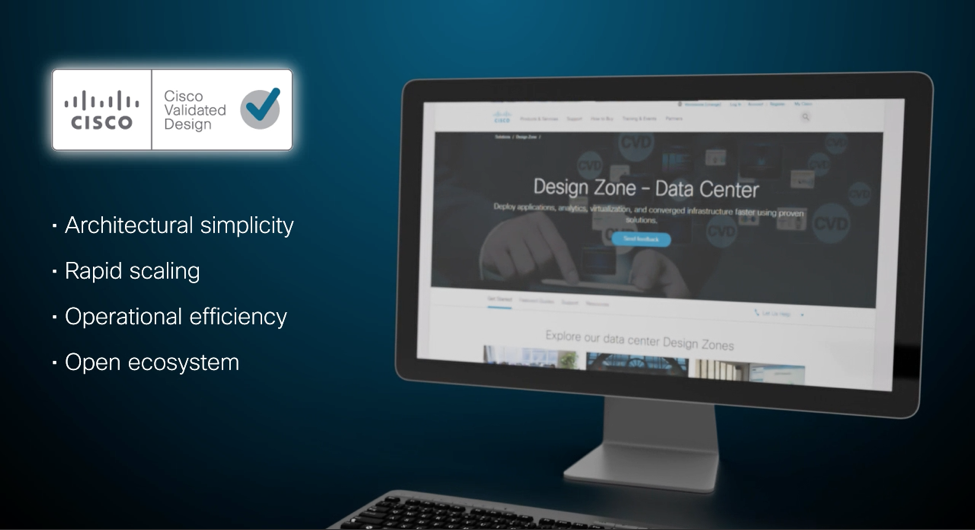
Cisco Validated Design
We have published a full-blown Cisco Validated Design for deploying SwiftStack software on Cisco UCS S3260. If you are not familiar with a CVD, think of it as a blueprint that simplifies the build process and delivers an expected positive outcome. Simply put, we do all the heavy lifting for you to mitigate risk, decrease complexity and speed up deployment times getting you operational faster. For more information the Cisco and SwiftStack partnership, follow this link to a newly released solution brief.
New solution bundle part numbers
In addition to SwiftStack as the only object storage solution on the Cisco GPL, there are new solution bundle part numbers to make ordering even easier. Whether purchasing direct from Cisco or from any of our reseller partners worldwide, selecting the right solution for any data-centric environment has been streamlined to accelerate your deployment, consumption, and time to value.
End to End support with Cisco Solution Support
Managing solutions can be a challenge, especially when working with multiple vendors and products in a single environment. Customers can select centralized support from Cisco solution experts for a single point of accountability for issue management and resolution.
Cisco Solution Support has proven to provide a 43% average decrease in time to resolve solution-level issues using Cisco Solution Support versus product support alone. Click for more information on Cisco Solution Support
Cisco customers with data-centric applications can proceed with confidence, benefiting from a validated solution with easy ordering and Cisco Solution Support to deploy and scale storage infrastructure on-premises and in the public cloud. But why Cisco UCS over other server choices?
Here’s why:
4x 40Gbps of I/O throughput with various network connectivity options. For TBs growing to PBs of unstructured data, this is a big differentiator for pumping large amounts of data across the network, and it provides investment protection as a cluster scales.
The choice between 1 or 2 server nodes per chassis, allowing for smaller initial deployments particularly at remote sites without trading off availability.
Cisco Integrated Management Controller (CIMC) allows pooling of drives and dynamic allocation of these drives to server nodes. In tandem with policy-based data placement built-in to SwiftStack,
If you are interested in learning more about SwiftStack running on Cisco UCS you can go to the Cisco Marketplace or SwiftStack’s Cisco UCS website for quite a bit of information.
If you liked this blog please stay tuned for more on data center storage solutions at Cisco and be sure to follow us on Twitter.
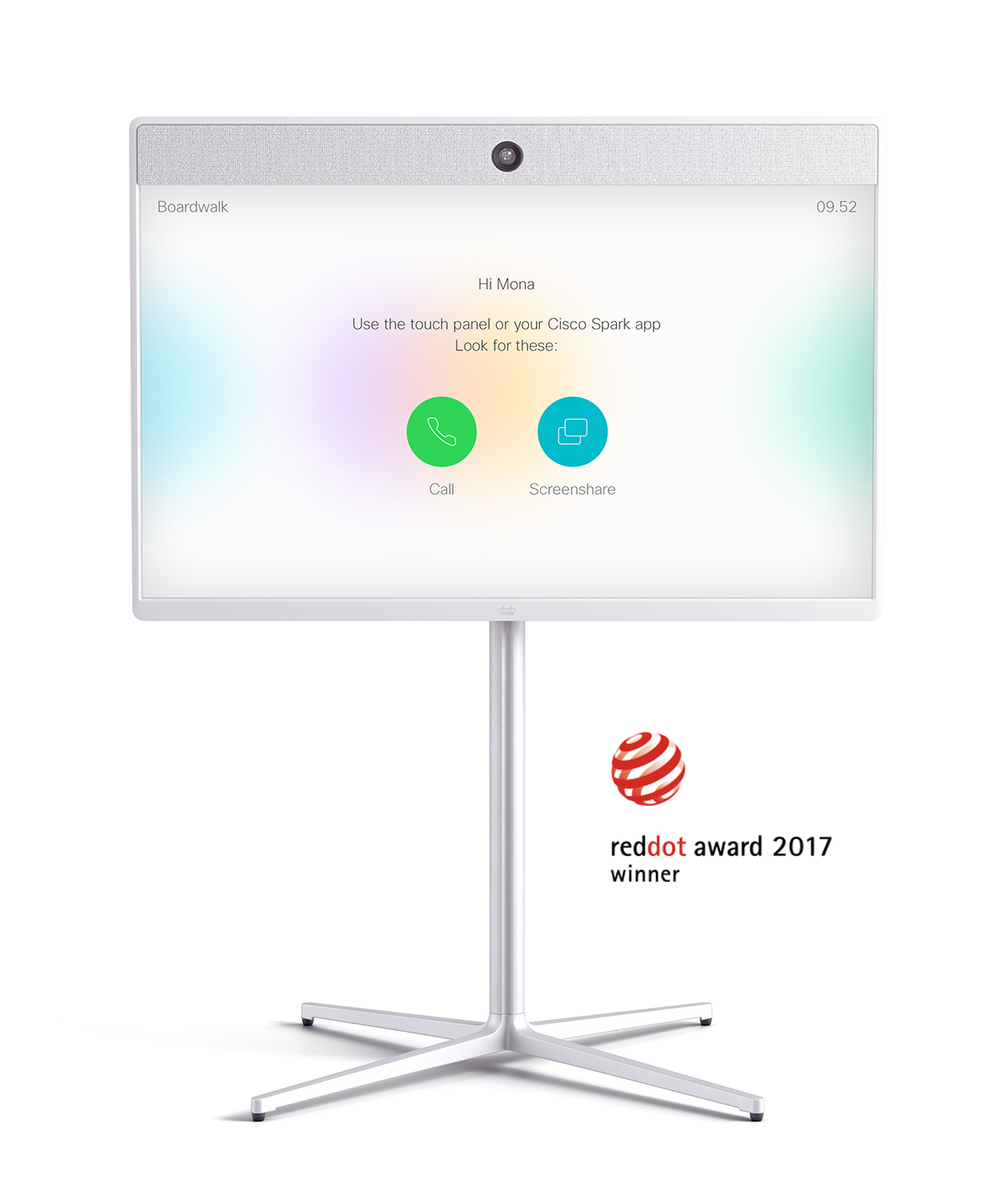
As I was driving to the Oslo office, it struck me how much the latest self-driving cars have in common with our new Cisco Spark Room 55 system.
At first, it seems that it’s all about user experience: Both the cars and the Room 55 pretty much drive themselves. The Room 55 is a high-performance all-in-one video system with customizable capabilities to delight you, including:
Automatic wake-up
Contextual help
One button to push to join a meeting
Automatic video framing of in-room participants
What’s behind this magic is where things align. Both innovations rely on extreme camera technology and machine learning. In a car, this means a seamless 360-degree view for passing slower cars, changing lanes safely, and self-parking. It also means machine learning capabilities for sensing and classifying objects. The Room 55’s integrated digital camera not only provides superior video quality, but detects faces to identify the number of people in the room, and will even be able to recognize those faces – with more capabilities coming in the future.
So, it’s not surprising to learn that the same electronics engine powers both the Room 55 and this new class of cars. Our engineering team harnessed the power of the NVIDIA Jetson platform to develop exciting advanced applications and pioneer a superior meeting experience that includes:
Real-time video image processing using the camera’s state-of-the-art, advanced 5k sensor allows intelligent views, analytics, and full HD encode/decode.
Advanced speech and face recognition pinpoint who’s speaking in the room, allowing the camera to selects the best framing for that person or group. It even tracks the active speakers as they move within the room.
Optimized high-fidelity audio and wireless content sharing with up to 4k resolution.
We’ll continue to innovate on the platform with artificial intelligence (AI) capabilities, future-proofing the Room 55 and making it an outstanding investment. Soon, the system will automatically recognize the faces of attendees and label them on screen. AI-powered natural language processing will understand voice commands and enable voice interaction. For example, you’ll able to use voice commands to start and end meetings.
The Room 55 is built on the same platform as the Cisco Spark Room Kit and Room Kit Plus, which are some of the fastest ramping products in Cisco collaboration history. All Cisco Spark Room systems are Red Dot award winners, recognized for their leading design and welcoming aesthetics.
Like the rest of the portfolio, the Room 55 is ready for on-premises or cloud deployment, with full feature parity with our MX Series and SX Series devices. It’s perfect for the Cisco Spark Flex purchasing plan, providing you the flexibility to migrate to the Spark cloud platform now or in the future.
We’re accelerating delivery of the Room 55. As of today, it’s fully orderable and shipping with standard lead times. Now how about taking one for a spin?
See these capabilities live at IP Expo Nordic, where I’ll deliver a keynote and demonstrate the machine learning capabilities of Cisco Spark Room systems on September 21, in Stockholm.
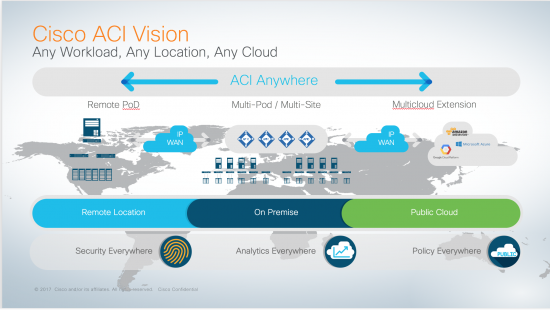
Evolving beyond multi-pod and multi-site deployment models, ACI will soon be available within public cloud environments, including Amazon Web Services (AWS), Google Cloud Platform and Microsoft Azure
At Cisco, we are proud that over 4,000 customers have chosen Cisco Application Centric Infrastructure (ACI), the industry’s #1 Software Defined Networking (SDN) solution, to increase operational efficiencies, deliver network automation, and improve security for their on-premises data centers and private clouds. But we’re not stopping there.
In our mission to deliver ACI anywhere, today I’m excited to announce our plans to extend ACI into the public cloud domain. Key attributes of the ACI solution, such as unified security policy, single-pane-of-glass management, and visibility, will soon be available in Amazon Web Services (AWS), Google Cloud Platform, and Microsoft Azure.
As a result, customers will have the flexibility to run applications across their own private clouds, as well as public clouds of their choice, while maintaining consistent network policies across their entire multicloud domain.
Cloud providers like Amazon, Google and Microsoft have helped enterprises accelerate application development by simplifying operations and making resources available on-demand. While this has allowed rapid innovation and business transformation, most enterprises look for the combination of public cloud and on-premises infrastructure based on their specific applications, as well as business models. This is challenging IT teams to think differently about how to design and manage their unique multicloud environments where application mobility, consistent policy, and rapid provisioning across multiple private and public clouds is of paramount importance.
Our goal with ACI from the early days has been to offer our customers choice in how and where they run applications. Today, ACI supports multiple hypervisors, bare metal servers, and Linux containers on premise. At the same time, we have co-engineered and validated with over 65 Data Center ecosystem partners who have integrated their products and solutions with ACI – making it the most open, flexible and widely deployed SDN solution in the industry.
As our customers look to expand the execution venue of their applications across the multicloud domain, we are extending the same benefits within AWS, Google and Microsoft cloud environments.
Initially, we are focusing on three main approaches in how we will bring this to market:
Extending ACI policy and workflows into public cloud: In this model, policies configured through APIC (our SDN controller) will leverage the native APIs offered by a public cloud provider to uniformly orchestrate changes within both the private and public cloud environments. This approach offers consistent policy and automation using an established ACI interface without compromising performance or access to a rich array of cloud-native public cloud services. An example of this would be mapping Cisco ACI policies to constructs in Amazon Web Services, such as virtual private clouds and security groups.
Integration of public cloud software with ACI to enable hybrid cloud: With this approach, Cisco ACI (on-premises) will integrate with software designed by cloud providers, such as Microsoft, to orchestrate a consistent hybrid cloud experience that balances flexibility and control, while delivering hardware driven performance.
Collaboration in Open Source: Cisco is engaging with public cloud providers to support open source management tools. By running the same open source software with a set of community-defined APIs on premises and in the public cloud, we can offer a seamless application environment in a truly open manner. Working with cloud providers like Google on Kubernetes, an open source project for managing cloud-native applications, is an excellent example of such an effort that is already supported with the most current software release for Cisco ACI 3.0.
We’re incredibly excited to help our customers in their cloud journeys by extending ACI into public cloud environments without compromising security, automation, or control they are used to in their on-premises environments.
Any workload. Any hypervisor. And any cloud. Simply put, ACI Anywhere. Stay tuned.
Last year, one of my colleagues went to a start-up conference with 2,000 people. On stage, someone asked the audience how many were working on consumer apps. Almost everyone raised their hands. Then the person asked how many were working on enterprise apps. This time only three hands went up. Three.
The consumer space seems to get all the cool, new, fun, productivity-enhancing apps that users love. And the enterprise space is left with fairly old tools like email. IT teams know it, trust it, and have the tools to manage and monitor it according to their policies and security needs. While today’s email apps look more modern, the tool itself emerged more than 20 years ago and has changed very little since.
Building a Bridge Between Users and IT
The new digital world is putting our businesses under constant pressure to move faster and be more efficient in order to compete. That is why users bring their newer, next-generation collaboration consumer apps to the workplace.
This often creates a conflict between users and the IT department. When users get to the office, they want the efficiency and productivity of consumer apps. Meanwhile, IT is responsible for important things like content protection, data loss, eDiscovery, retention, compliance, and intellectual property protection.
At Cisco, we’ve worked hard to change the paradigm and create products that both users and IT love.
At Cisco, we’ve worked hard to change the paradigm and create products that both users and IT love. Some people told us it was impossible, so we took on the challenge to make the impossible, possible.
And that is why we created Cisco Spark as one tool that is designed for both users and IT. It delivers powerful collaboration for users with persistent chat, powerful embedded video meeting experiences, white boarding, file sharing, and more. It is built for the modern workforce. It’s easy, intuitive, and fun to use. For IT, it delivers the enterprise controls for deployment, with the security IT requires through end-to-end encryption.
Introducing What’s New with Cisco Spark
Today, we’re making several announcements about Cisco Spark. Check out the press release for the full announcement. But here, I want to focus on innovations specifically focused on adding a suite of advanced enterprise capabilities in the Cisco Spark platform:
End-to-end message encryption plus enterprise-level compliance features: Enterprises need tools like eDiscovery for legal reasons and data loss prevention to keep sensitive information safe. They also need end-to-end message encryption to keep your team’s “next big thing” idea under wraps. Cisco Spark is the first-ever enterprise messaging product that actually does both.
Data security equivalent to on-premises storage: In another industry-first – and the culmination of four years of R&D – enterprises can protect themselves from attacks against the Cisco Collaboration Cloud. We’ve enabled the ability for customers to run an on-premises key server to encrypt and decrypt all content sent to Cisco Spark. This on-prem key server establishes data security equivalent to on-prem data storage. With this new capability, Cisco Spark is the industry’s first end-to-end cloud encryption solution utilizing on-premises key stores.
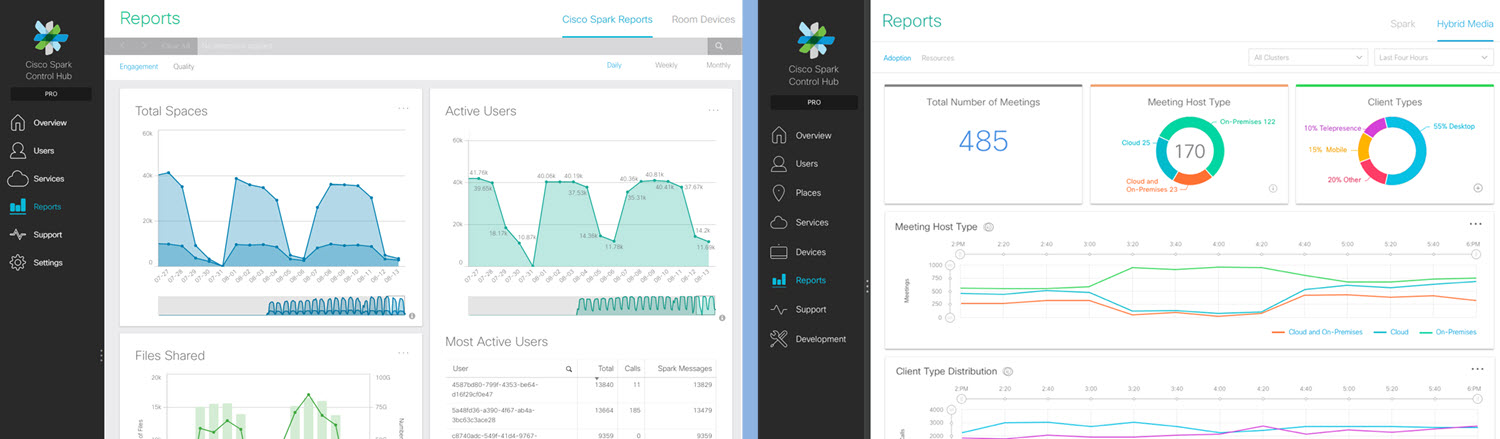
Mind-blowing fluid analytics that simplify insights: With just a few clicks, you can tell who suffered the worst call quality, pinpoint where they are in the world, and see whether the problem is widespread or localized. Data manipulation is so simple that it feels like the entire cloud database is stored in the administrator’s browser. We call this “fluid analytics” and believe it sets the bar pretty high.
Click to enlarge.
Mobile device security on non-managed devices: Bring-your-own device (BYO) programs for PCs and mobile phones can be scary for IT. To simplify things, we have baked in key device and application management features with Cisco Spark. New capabilities include:
Graceful PIN lock enforces device-level PIN lock on any device without sacrificing user adoption
Web Smart Timeouts let the Cisco Spark web app know when it is running outside of the company network and automatically log out the user
Enterprise Certificate Pinning protects from malicious hotspot providers and access networks without requiring the user to actually enable their company VPN client
We are really proud to bring these enterprise capabilities to the collaboration market, without compromising the simplicity and ease-of-use of our Cisco Spark collaboration apps. That is making the impossible, possible.
UPDATE — September 22, 2017: I am pleased to announce we have completed the acquisition of Springpath, Inc. today. A hearty welcome to the Springpath team members!
Our customers and partners in the data center space are frequently asking for solutions that can help them simplify management operations and power more applications. With that in mind, I’m pleased to share that Cisco intends to acquire Springpath, Inc. – a leader in hyperconvergence software.
Cisco’s relationship with Springpath began back in 2012, when we first met Founder and CTO Mallik Mahalingam shortly after he had started the company, together with Krishna Yadappanavar. Mallik and Krishna had a great vision on how Springpath was going to revolutionize the data center through its innovative Springpath data platform. We stayed connected with the team as they executed on this vision and in 2015 decided that Cisco Investments would lead Springpath’s Series C financing round, coupled with a joint go-to-market agreement.
This collaboration with Springpath led to the 2016 launch of Cisco’s HyperFlex product, the industry’s first fully integrated hyperconverged infrastructure system. By co-engineering Springpath’s software with the Cisco Unified Computing System, we have delivered a fully integrated platform with HyperFlex and innovation at all layers of the data center stack. This provides customers with the convenience and benefit of getting all the HyperFlex software and hardware from a single vendor.
The hyperconverged systems market is projected to be a $7.6 billion opportunity by 2021 according to IDC, and is one of the fastest growing segment in the data center space (Source: IDC Worldwide Quarterly Converged Systems Tracker, 1Q17). Cisco has generated significant momentum with Hyperflex over the last year, garnering more than 1800 customers. We are excited to now welcome Springpath to the Cisco team and as one company, we will further accelerate our business in hyperconvergence.
This acquisition is one more example of Cisco’s shift towards providing more software-centric solutions. The Springpath team will join the Computing Systems Product Group led by Liz Centoni. We expect the acquisition to be completed in the first quarter of fiscal year 2018.
I am proud to share that today Cisco announced its intent to acquire Springpath, Inc., a leader in hyperconvergence software based in Sunnyvale, Calif.
Cisco first made an investment in Springpath in 2015. A year later, we jointly co-engineered and developed Cisco HyperFlex Systems, a fully-integrated hyperconverged infrastructure (HCI) solution. Combining Springpath’s distributed file system designed specifically for HCI with the industry-leading Cisco Unified Computing Systems platform resulted in the first deeply optimized hyperconverged solution for our customers. Customers finally got a hyperconvergence solution with much greater operational simplicity, significantly better user interface, and highly flexible and policy-driven scaling.
HyperFlex is the hyperconverged platform of choice for 1800+ customers across a multitude of industries around the globe. The unique approach Cisco has taken to HCI has resulted in the industry’s highest performing HCI system. This has allowed our customers to bring the simplicity of hyperconvergence to mission-critical applications in their data center. In addition, integration with other Cisco assets helps bring the simplicity of hyperconvergence into edge and Remote and Branch Office (ROBO) locations in their operational footprint.
The acquisition of Springpath is strategic to our Data Center portfolio as we transition to delivering software-centric solutions to our customers. As one team, I am excited for the synergistic possibilities ahead to redefine hyperconvergence further and deliver seamless multicloud experiences for our customers. This acquisition will further fuel the incredible momentum we have seen in the adoption and deployment of this solution over the last several quarters.
I look forward to welcoming the Springpath team to Cisco’s Computing Systems Product Group. We expect the acquisition to be completed in the first quarter of fiscal year 2018.
While the concepts of the Internet of Things (IoT) and “connecting the unconnected” are not new, Cisco remains at the forefront of uncovering innovative ways to apply IoT to create value for our customers. With more than 700 IoT products and solutions, we’re enabling data and insights never before available. We’re also ramping our technical support capabilities to help customers capitalize on the opportunities.
In this increasingly connected world, you’ve told us about the tools and resources you need to digitize your business and fix increasingly complex network issues. In response, we continuously look for new ways to help you reduce downtime and increase efficiency when you interact with Services experts in our global Technical Assistance Center (TAC).
Most recently, we’ve been working on proactive, automated ways to help you identify and resolve network problems faster, while helping you ensure business continuity. We’ve been doing this through a new era of connected technical support that allows us to help identify technical issues before they affect your network performance, availability, and security.
I asked Chris Stiles, Sr. Director of Technical Services Product Marketing, to share some of the advances we’re making with these capabilities. Please read on because there’s opportunity for you to participate.
Cisco’s Technical Services (TS) team works hard to free you from focusing on routine tasks such as finding network issues and maintaining existing infrastructure, so you can focus on running and transforming your business. With that, I’m excited to tell you about some of our new automation capabilities and I’m eager to invite you to try them out.
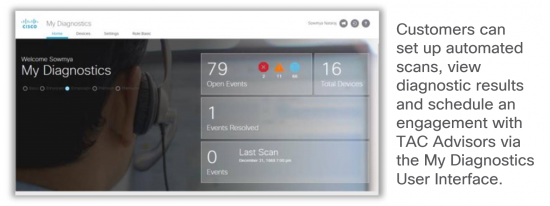
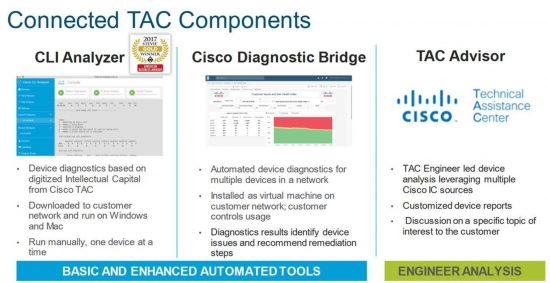
Our Connected TAC initiative combines our product knowledge base with connections to your devices to help identify and remediate issues that could be impacting your network.
When you activate Connected TAC on your devices, you receive automated diagnoses and remediation recommendations for issues that appear. You also receive access to TAC Advisors so they can help you implement recommendations and next steps.
Connected TAC drives strong benefits for you and your network:
Swifter issue identification and resolution
Better network availability and performance
More secure networks
Streamlined engagements with the TAC
Better service coverage management and product lifecycle management
Increased risk mitigation
In short, Connected TAC helps you create a foundation for a more secure, more reliable network.
Are you a customer interested in giving it a try, or a Partner interested in recommending a customer that would benefit? Connected TAC is currently available as a controlled release. It’s available in a tiered services package, with basic, enhanced and premium service levels. Whichever package you choose, don’t miss out because we are recruiting 100 customers to install the Connected TAC software and check out the features and benefits mentioned above. Contact us via email at connectedtac_mt@cisco.com for more information if you are interested.
Be part of these new Connected TAC Service offerings so you can spend more time bringing your business visions to life and less time investigating issues that Connected TAC can identify automatically!
Chuck Robbins, CEO of Cisco, kicked off Cisco Live last month with a look at The Network. Intuitive. The Network. Intuitive. is a complete transformation in hardware, software, and management that will change how networks operate, enabling them to adapt in real time with artificial intelligence (AI), and delivering the secure foundation for our digital world, faster and more securely, all while driving down operational cost. This new era in programmable networking leverages machine learning and analytics to deliver a new level of intelligence at the core of any organization. So, what does that mean for the future of Digital Education?
While at Cisco Live 2017, I spent some time with our Education customers and the Digital Network Architecture (DNA) experts who have re-engineered the foundation of the network to incorporate this new dimension of networking. This provided me a deeper look at the meaning of this big announcement for Education IT departments and beyond.
Surprisingly, the new direction is directly related to the use of intelligence to support human intervention in how we teach and learn—in fact, more than you would probably expect straight off the bat. With the growth in AI in the classroom, including learning analytics, adaptive curriculum, and even student-authored AI, we are seeing a genuine move to this technology to help teachers deliver personal learning to every student and increase student success. The use of machine learning, analytics, and contextual automation is now growing stronger in the network layer too. The ability for the network to LEARN and make real-time decisions based on the INTENT and CONTEXT of traffic/applications/devices/users will deliver a new foundation for Digital Education.
In both cases, the argument that AI is replacing our roles (in teaching and in the IT department) is not true. It actually frees our time to be more impactful, deliver higher levels of value, and ultimately hit our goals faster.
Another synergy is this freeing of valuable resources to focus on vital areas, in both the IT department and in the faculty. Cisco’s The Network. Intuitive. reduces repetitive tasks and enables IT staff to focus on pivotal projects that will more directly deliver strategic outcomes. AI adoption in the classroom gives the teacher the ability to cover more students and more topics, faster and with more accuracy.
In either case, AI should not be feared. AI will not take over the role of IT or replace the teaching staff, but it will enable new levels of competency and efficiency to help educators reach new heights: IT delivers a new user experience, while helping teachers deliver a higher level of student success than ever before. There are a number of ways that AI and analytics can make a teacher appear to have superpowers. (See my previous blog series on teaching superpowers.)
At the heart of Cisco’s Digital Education Platform is the DNA architecture that is the core of The Network. Intuitive. So, it is also the foundation of Digital Learning and Digital Campus practices, and with that, at the heart of these Teaching Superpowers. For example, AI can be used to provide students with a virtual teaching assistant for online distance learning or after class using collaboration. A teacher can use a personally tailored ChatBot to give them the appearance that they can be in multiple places at once. For example, with Cisco Spark, a teacher can enable Cisco Spark BOTs with integrated AI so that students working on a project can get help, speak a different language, and automatically receive relevant and pertinent information, all in addition to the face-to-face teaching they require.
One of our customers at Cisco Live asked how the network can understand the context and the intent of traffic, and learn to be truly intuitive. The answer lies in what is possible to understand from information now, and how we act upon its collection.
For example, in a recent test using Cisco Spark and IBM Watson, 89 percent of questions from engineering students were answered without human involvement. It’s important to know that the 10 percent of questions that weren’t answered led to deeper conversation with the actual expert (teacher) and that, in turn, personalized the knowledge transfer for those students asking, provided feedback as professional development, and led to tweaks in the curriculum to help other students in the future. This is the future of any classroom or course.
The future of our students is intertwined with these new AI and analytical technologies, so it’s important that the evolution of digital teaching is performed over a network that uses these technologies as well. Today, explicit instruction, guided instruction, and collaborative engagement with students are adopting more of these technologies. In turn, we will see their use in new pedagogical models to take advantage of the efficiency benefits. The evolution of digital study means that leveraging data analysis in real time, and affecting change in digital delivery, will change the way we look at the student’s ownership of research. Critical thinking and collaboration are now supported at all times, regardless of the involvement of a teacher, in person or virtually. This drives success for teachers and students, at all levels. This is one of our defined goals of personal learning.
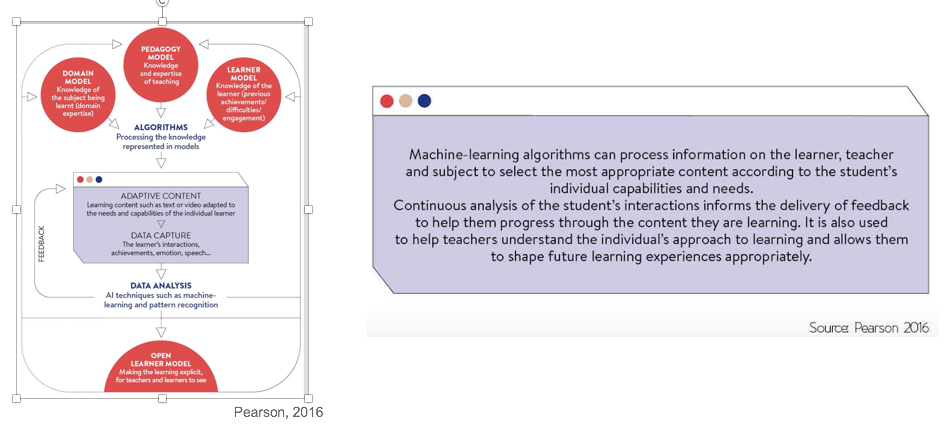
The first step for many to experience the impact of AI in the classroom could be through adopting integrated video and collaboration in the classroom. Teacher and student interactions through tools like Cisco Spark are a perfect gateway to its greater impact. Soon, we will see classroom designs and curriculum designers using AI as a major keystone to student success as was the case with Pearson’s proposed 2016 model for AI in education last year.
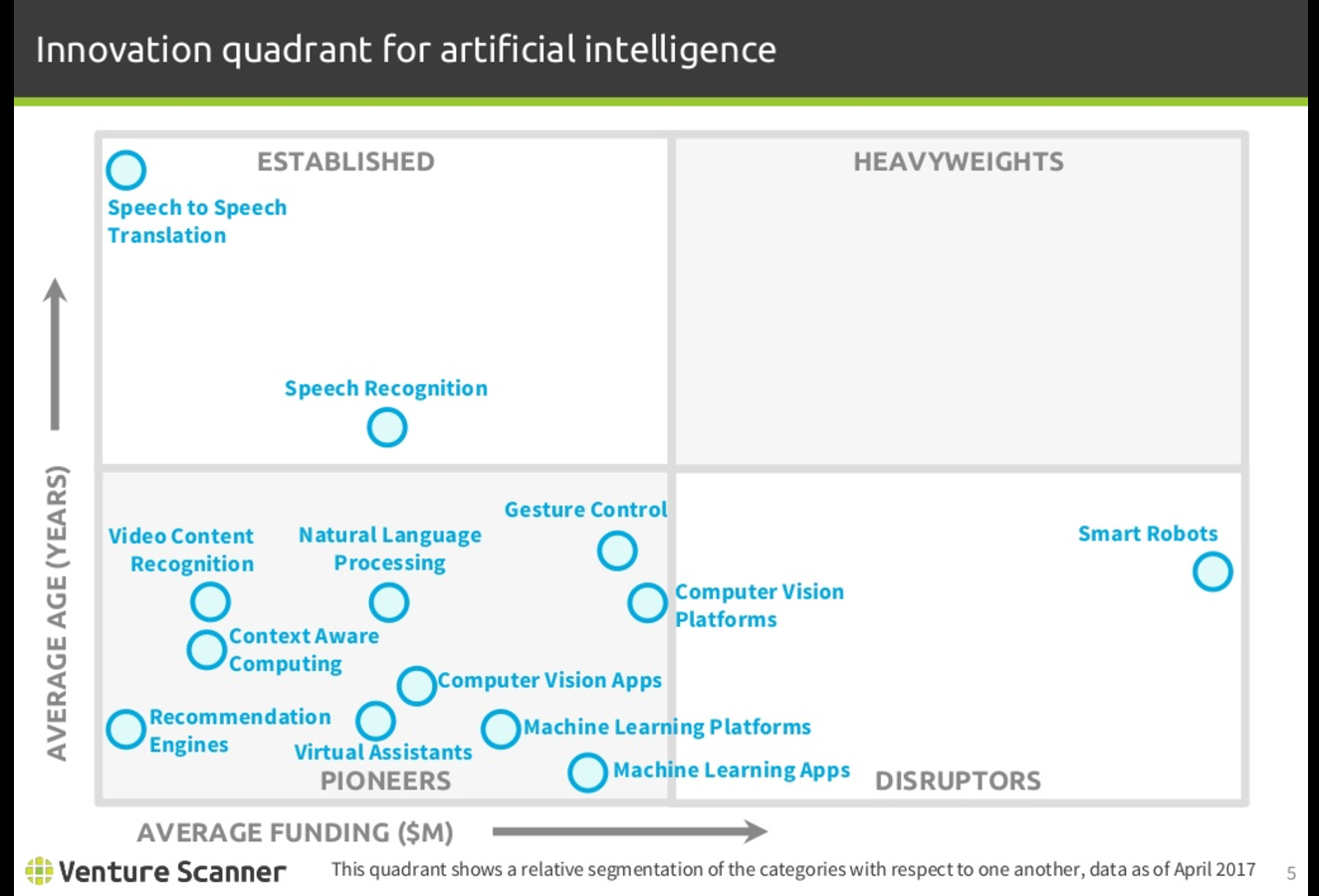
The AI space is only just developing (see Venture Scanner chart below). The number of startups with relevant capabilities for assisted and augmented intelligence means that it is not a question of whether AI comes into the teaching arena, but how soon. Consider that this industry’s growth will also start to factor into the choice future students make in learning and career paths. Although no one venture has yet become a heavyweight in this innovation quadrant (see chart), we are at the cusp of change, a change that will impact the way we utilize this technology in education.
For example, in the future using AI and augmented reality, a teacher will be able to get a “heads-up display” on student progress, whether through early warning tools on devices or live via augmented glasses. Facial recognition could keep a teacher fully informed on every student’s behavior and engagement, not as an invasion of privacy but rather, to assist the teacher in adjusting real-time delivery to better support learning. Today, Cisco has a classroom video solution that already has the potential to enable the use of AI (e.g., Cisco Spark Room Kits), which currently can count the students. In the future, using facial recognition, it will be able to check who is present, integrate with an LMS, and take attendance, allowing the teacher to maximize the time allotted to teach the subject they are paid to deliver.
The collection of data and the analytics of teacher and student’s digital footprints correlated to education activity, ones that relate to a teacher teaching or a student learning, will be critical to the way we make use of the data we collect. Cisco’s continued investment in analytics is at the heart of this new architecture and maps to the many ways education organizations will manipulate and respond to data analysis. AI is even more important when we look to help our teachers utilize student data, evaluate learning and digital footprint information, and get assistance quickly and accurately to monitor the impact success.
In a full circle, this is where The Network. Intuitive. re-enters the discussion. All this data analysis means the network can be aware of all usage, applications, and actions of teachers and students. It now will be able to look at the context and intent, using the same information that a learning analytic collects, or an application buffers. This will revolutionize the speed at which a network will adapt to every scenario it encounters.
Like the Oracle character in a superhero story, real-time access to data analytics is the all-knowing superpower that could benefit every teacher and serves as the pinnacle of the superhero universe. We must put teachers back to the rightful peak of knowledge and inspiration in the classroom.
As we reflect on the Cisco Live 2017 conversations, announcements, and impact of digitization, it’s clear that The Network. Intuitive. announcement is an enabler for Digital Education, one that will bring efficiencies and strengths to the IT department, in areas where it is so difficult to hire, train, and retain staff. Like our desire to make teachers superheroes by using our innovation, we are delivering a new era of networking that will help our education customers deliver education in a new digital era.