Today, Talos is publishing a glimpse into the most prevalent threats we’ve observed between August 11 and August 18. As with previous round-ups, this post isn’t meant to be an in-depth analysis. Instead, this post will summarize the threats we’ve observed by highlighting key behavior characteristics, indicators of compromise, and how our customers are automatically protected from these threats.
As a reminder, the information provided for the following threats in this post is non-exhaustive and current as of date of publication. Detection and coverage for the following threats is subject to updates pending additional threat or vulnerability analysis. For the most current information, please refer to your FireSIGHT Management Center, Snort.org, or ClamAV.net.
This week’s episode of the Cloud Unfiltered podcast features Dianne Mueller-Klingspor, Mike Duarte, and Michael White.
All three of them work on the OpenShift project, and here’s the great thing about listening to them talk: You can tell that they love what they do and they truly enjoy working with one another. Diane is from Red Hat and leads the cross-community collaboration efforts there. Mike White is an architect at Cisco’s Global Infrastructures Services Group and has been working with Red Hat on OpenShift for the past few years. And Mike Duarte is the Lead Design Engineer around container efforts at Cisco. He’s been working with Mike White for the past two years on the company’s OpenShift 3 deployment.
So if you’re interested in what OpenShift is good for, how Cisco is using it, and where it’s headed, you’re in the right place. In addition to those things, Diane and Mike2 also touch on:
Why persistence is critical if you want to change the IT culture at your company
How the CICD mindset is impacting everything from documentation to data center design
The power of open source technologies (and why it’s still hard for enterprises to adopt them)
What will happen to traditional network and security teams as companies transition their cultures and adopt these new technologies
The importance of slapping on that Apache II license if you want to share your code
See the video podcast on our YouTube page, or listen to the audio version on iTunes. And if you like what you hear, we invite you to subscribe to our channel so you don’t miss any of the other exciting podcasts we have scheduled over the next several months.
Intent-based Data Center Solutions for SAP Simplify Business Processes and Expedite Digital Transformation.
Lumen and Cisco have partnered to create Intent-based Data Center Solutions for SAP. Based on Cisco Application Centric Infrastructure (ACI) and Cisco/NetApp FlexPod, our unique converged infrastructure provides clients an end-to-end, dedicated and managed private cloud solution that unlocks the full value of SAP ERP applications and SAP HANA, while simultaneously reducing risk, lowering cost, and enhancing security.
To accelerate their clients’ enterprise digital transformation, Lumen delivers innovative SAP solutions through deep SAP and data analytics expertise. By partnering with Cisco, the #1 preferred SAP HANA server and storage infrastructure vendor (IDC) and leader in SAP policy-driven automated deployment and security, Lumen ensures that their clients benefit from the most agile and secure SAP landscape currently available.
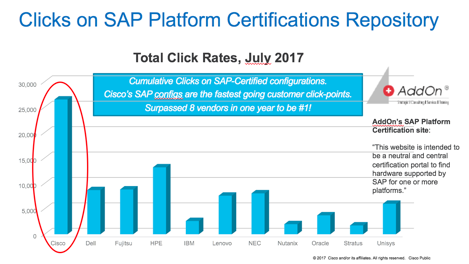
For this reason, Cisco’s converged infrastructure for SAP HANA has become so popular that we receive more views and clicks on SAP’s authorized web repository for certified and supported HANA solutions than any other platform in the industry – nearly doubling the attention generated by the next closest competitor.
Lumen’s offers leverage automated delivery and governance software from Vnomic, tying the power of application modeling with SAP S/4HANA, Business Suite, HANA and Hadoop, to the flexibility of Cisco Unified Computing Systems (UCS), Application Centric Infrastructure (ACI) and NetApp data management to rapidly deploy SAP in days or even hours, and configure applications with programmable, policy-based automation. The policy-driven governance and auditability of the solution automates the delivery of SAP HANA landscapes, while enforcing your company’s specific security and governance requirements, for rapid deployment.
This innovative breakthrough has the power to fundamentally alter the economics of SAP data centers. With this next-generation architecture and a steady stream of advances in SAP-based IoT, end-to-end data protection, SAP Vora-based Big Data designs, and machine learning, it should be no surprise that at their Sapphire conference in June, SAP awarded Cisco their 2017 SAP HANA Innovation Award!
Watch this video to see more about this exciting solution.
As you can tell, we enjoy sports. With Justin Thomas winning his first golf major of his career, the PGA Championship, at Quail Hollow. In tennis, the final major of 2017 will be starting shortly at Flushing Meadow, the US Open. We will see if #1 in the world Rafa Nadal (back to #1 since 2014) or perennial favorite, Roger Federer or any others from the strong field will prevail.
In these times, I feel it is best to look at and point out the positive. So with that, the Product Team is extremely excited to announce two things today: Cisco FindIT Network Management 1.1 and the new WAP581 are now available.
As you all can imagine, the entire Product Team is super excited for our Wireless Team. This product was created, developed, tested and proven for the Small Business. It is truly is purpose-built for the Small and Medium Business.
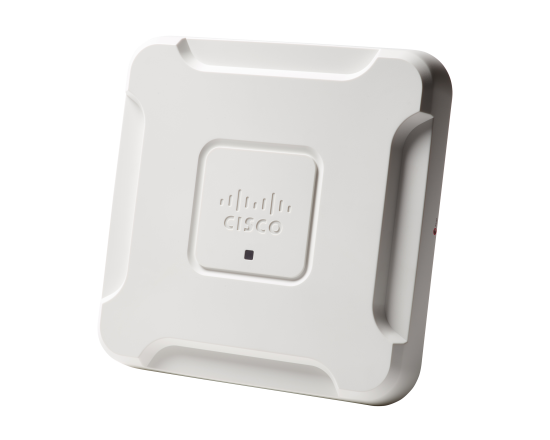
Yes, the Cisco WAP581 is now shipping!
The Cisco WAP581 Wireless-AC Dual Radio Wave 2 Access Point with 2.5GbE LAN is a high performance access point it supports 4 x 4 multi- user multiple-input, multiple-output (MU-MIMO) technology for faster multi user throughput and better overall user experience. It offers two Gigabit Ethernet ports one with 2.5GbE (mGig) and the second with 1GbE PoE to facilitate flexible installation and provide maximum speed. The WAP581 supports business-class features such as RF Spectrum Analyzer to detect and troubleshoot nearby interference. Guest Access Portal which allows for customized roles and rights like limiting bandwith and total data usage. The WAP581 comes with a limited lifetime warranty.
Brian Nicklin, Wireless Product Manager, comments, “The all-wireless office is now a reality and available to SMBs at an affordable cost. The new Cisco WAP581 Access point incorporates new advancements such as Wave 2 and Multigigabit (MGig) technologies to enable a next-gen mobile experience. Now devices can get on and off the network faster, enabling a higher density of device support and greater efficiencies enabling users to achieve new levels of productivity.” Wireless Product Manager, Nasser Tarazi adds, “With the growth of mobile devices, small and medium businesses are now looking for a more secure and reliable WiFi network to support new applications and provide better user experience to their clients and employees. The Cisco WAP581 brings to businesses the latest WiFi technology with high performance and outstanding user experience at affordable price.”
Here is a short WAP Product Video, take a look. This video along with our others are located in our Cisco Video Portal, so please bookmark the webpage.
The next part of our story today is the availability of the Cisco FindIT 1.1.
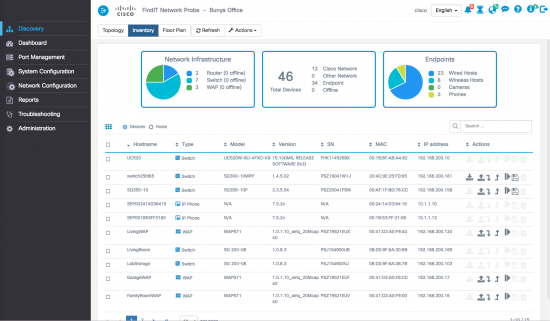
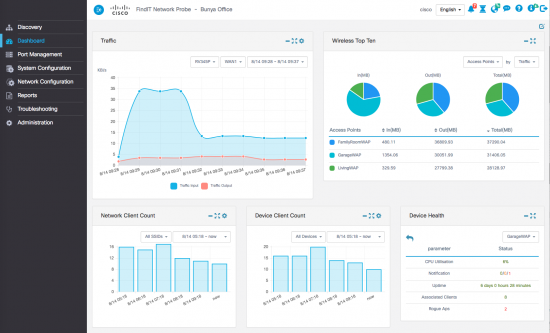
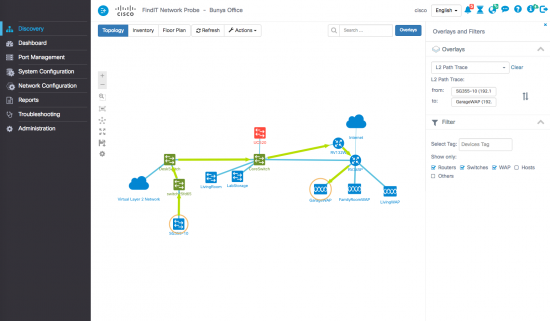
As you know, Cisco FindIT Network Management is purpose-built for managing networks of Cisco 100 to 500 Series devices. It lets you proactively manage the network instead of just reacting to events. FindIT Network Management is the perfect addition to your business’s network.
This new release brings a myriad of new features and functionality including:
New wireless reporting and monitoring capability
Support for Cisco Network Plug and Play (Zero-Touch Deployment)
Many enhancements to network discovery and the topology
Numerous usability enhancements
More options for easier deployment and upgrading
Cisco Smart Licensing support
There is much more to this new release. Please take a look at the Cisco FindIT Product Page to review the entire release. And do not forget to download the software today!
Questions? Please contact your local Cisco Partner! Or feel free to email ask-eng-small-business@cisco.com.
The entire Cisco Small Business is quite proud of these two releases. We hope you do too.
Let’s see if Roger the Great One can make a push to win the final major of the year. Or perhaps Rafa will dominate once more at Billie Jean National Tennis Center.
Thank you for spending some time with us. We greatly value your support.
On one hand, if you’re running virtual desktops you know that modern apps and newer operating systems such as Windows 10 make use of a lot more graphic power than their predecessors. Which means that you need to provide more graphic power when you deliver these apps over a virtual desktop. This is why most modern VDI architectures include virtualized GPUs.
On the other hand, artificial intelligence, machine learning and deep learning projects are on every enterprise’s radar. Most AI or ML/DL applications require powerful GPUs to accomplish their complex calculations in a reasonable amount of time.
What this all means, is that your data center has to evolve in order to keep up with these new requirements.
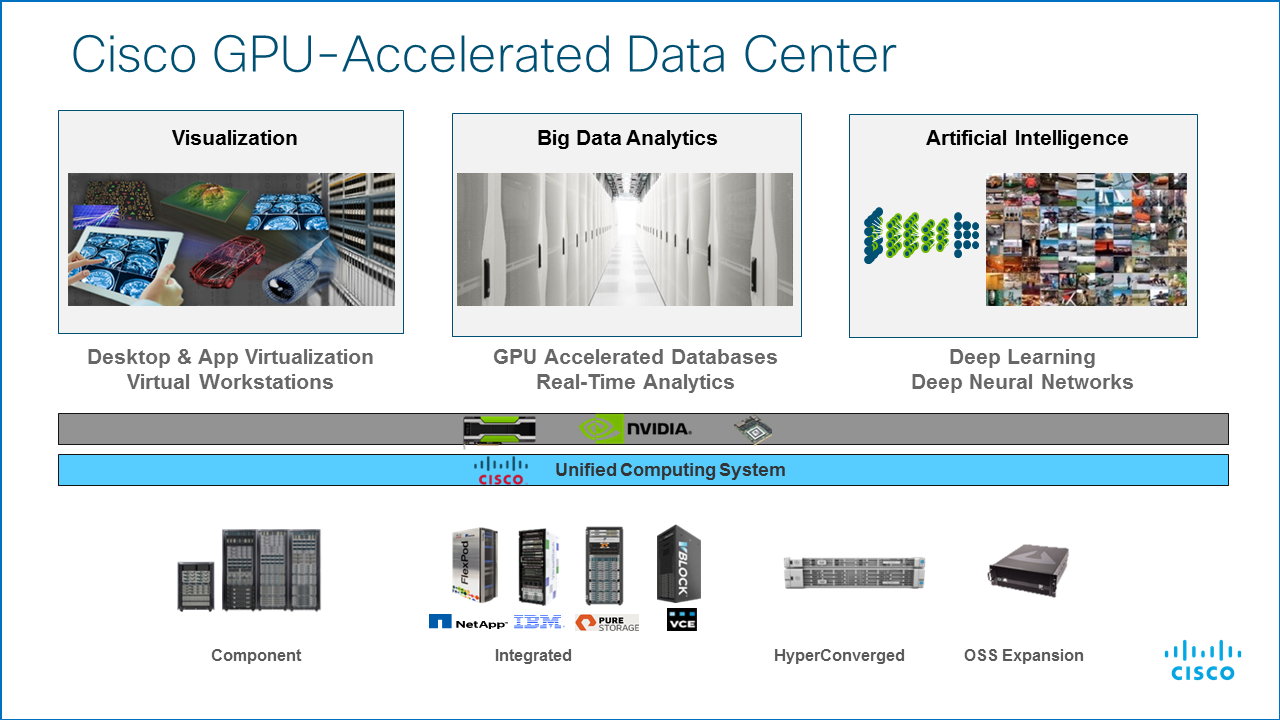
Figure 1: The Cisco GPU-Accelerated Data Center
Cisco recently introduced its 5th generation Unified Computing System (UCS) servers to address evolution in the data center. With this recent release Cisco delivers the highest GPU density in the industry, ready to power workstation and application virtualization with even greater efficiency and end-user satisfaction. At the same time, the versatility of Cisco UCS servers also allow them to run data-intensive and compute-intensive workloads such as real-time analytics and in-memory computing.
Today NVIDIA announced a new generation of virtual GPU software, the Quadro Virtual Data Center Workstation (Quadro vDWS and GRID Virtual PC – GRID vPC) and its latest NVIDIA Tesla Pascal GPU, the P6 for blade servers. The Quadro vDWS turns Tesla GPU-powered Cisco UCS Servers into powerful workstations and allows organizations to virtualize both graphics and compute workloads. The new GRID vPC improves density and manageability to help optimize TCO for the digital workspace. This new generation of NVIDIA virtual GPU solutions provide an even better virtual desktop and workstation experience, which combined with Cisco UCS is cost effective to purchase, deploy and operate.
Cisco supports the new NVIDIA Tesla P6 GPU on Cisco UCS B200 M5 and B480 M5 blade servers.
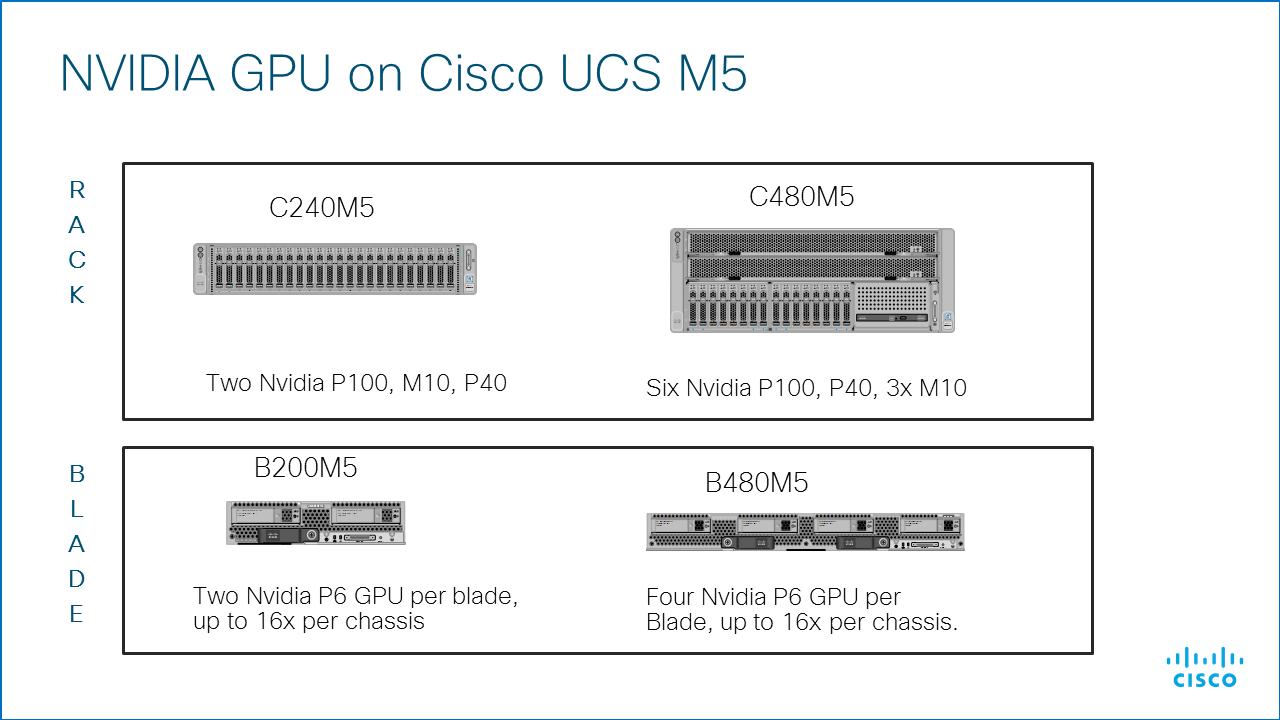
Figure 2: Summary of NVIDIA GPU support on Cisco UCS M5
Blade servers – unmatched GPU density
The Cisco UCS B200 M5 supports up to two NVIDIA Tesla P6 mezzanine adapters. This supports up to double the user density for remote knowledge workers, task workers, and designers doing 3D design modeling and offers the highest density in the industry for a two-socket blade server.
The Cisco UCS B480 M5 supports up to four NVIDIA Tesla P6 mezzanine adapters which is unmatched in the industry for a four-socket blade server.
Rack servers – introducing support for the NVIDIA Tesla P40
The Cisco UCS C480 M5 supports up to six PCIe GPU adapters. We are introducing support for the NVIDIA Tesla P40. The Tesla P40 is for remote engineering workstations and application delivery via the data center. Additional support for the NVIDIA Tesla M10 for VDI and NVIDIA Tesla P100 for deep learning and HPC applications give the C480 M5 a robust GPU portfolio for your data intensive and VDI needs.
The CiscoUCS C240 M5 supports up to two PCIe GPU adapters and supports the Tesla P100, M10 and P40 GPUs. It is very well suited for VDI deployments.
If you need more GPUs but not more processor memory to justify purchasing another rack server, the Magma ExpressBox PCIe expander chassis allows the C240 M5 to support up to nine GPUs. The Magma ExpressBox will also be available for the C480 M5 at a later date.
Maximizing your investments
With the ability to switch profile to run both virtualized, accelerated graphics and compute (CUDA and OpenCL) workloads on the same Pascal GPUs, enterprises can maximize their investments. You could for example run virtual desktops in the day while most of your users need access to their apps and switch to CUDA mode at night to run your HPC projects.
We will be at VMworld Aug 27-31 in Las Vegas. Stop by the Cisco booth and talk to our engineers about deploying virtual desktops or workstations on VMware Horizon in a Cisco GPU-accelerated data center.
From spotty wifi to digital marketing. How Purple digitized pizza.
PizzaExpress is known around the world for its great party food and fun atmosphere. But their restaurants in the Middle East had a problem. Their customer database was stale and small. Only 22k users signed up in seven years.
And, their wifi was patchy – unreliable enough that customers complained. When the wifi worked, it didn’t route any info back to PizzaExpress; no details on how often customers came or their favorite orders. So they reached out to our partner Purple, a wifi analytic expert, for help.
Purple says…
We worked with Cisco and CDW to set up PizzaExpress with a guest wifi that gathered analytics. It was fast and secure. CDW pulled together a solution with hardware, software, and services.
The benefits were clear fast:
First e-shot campaign drove £9,000 in incremental sales, sides and drinks. (Now they’re experimenting with 2-for-1 offers as they didn’t expect so many redemptions.)
10k unique active guest emails collected in the first two weeks
Increased daily sales by £1000
52% increase in Facebook page likes in less than a month
181% increase in page impressions in the first 4 weeks
Analytics from these engagements are used to distribute offers, track social interaction, and monitor customer demographics and frequency of visits. Based on what they discovered, PizzaExpress offered customers incentives – vouchers for drinks, starters, and dessert to increase loyalty. And, they’re looking next at venue tagging to learn more about where their customers are coming from, so they can decide where to open new branches.
Initially it was just a rollout in the UAE, but it was so successful that they installed it in all 450 UK restaurants as well. The rest of the world is next!
Thanks, Purple!
The story doesn’t end there.
Partner with Purple to offer wifi analytics for your customers.
Meet other Cisco partners helping customers around the world.
Humanitarian crises persist around the world. Natural disasters and human conflict displace millions each year. These devastating incidents deprive innocent people access to our most basic human needs: adequate shelter, food, and clean water.
Part of our Corporate Social Responsibility commitment is to empower nonprofits and social change agents worldwide to address these global challenges and positively impact the lives of 1 billion people by 2025.
On World Humanitarian Day—celebrated every year on August 19—we join other organizations to pay tribute to aid workers who risk their lives in humanitarian service and rally support for people affected by crises around the globe.
Here are three ways Cisco celebrates World Humanitarian Day and accelerates global problem solving for people, society, and the planet:
Emergency communications through our Tactical Operations (TacOps) team
Started in 2005, Cisco’s Tactical Operations team (TacOps) responds to disasters like floods, tornados, and earthquakes around the world. A highly-skilled, dedicated team of eight Cisco engineers and 300 global volunteers can deploy in a matter of days to remote locations, setting up emergency connectivity networks to support other first responders and the affected population.
The team is pro-bono, meaning all services provided are entirely for free, and have been since our first deployment to Hurricane Katrina in 2005. Over the years, the TacOps team has responded to more than 40 incidents, including most recently the refugee crisis in Europe.
TacOps first began deployments to Europe in November 2015 and has since sent 10 teams to support the refugee response. Using Cisco’s Meraki technology, team members installed secure Wi-Fi networks at refugee camps and transit areas, providing critical connectivity to aid both workers and affected individuals. More than 600,000 people have used these networks, making it one of the largest humanitarian networks ever established.
Today, TacOps works with more than 35 government and emergency response organizations globally, collaborating in order to most effectively respond to emergencies. Every day, the team leverages Cisco’s core competency in networking technology to help society, applying their expertise to deployments that support life-critical responses.
Supporting nonprofits that provide critical human needs
Solving some of the world’s most pressing issues isn’t a one-company or one-organization job; in the spirit of World Humanitarian Day, it will require the efforts of many global problem solvers.
That’s why we invest in nonprofits and organizations that are actively accelerating global problem solving. Through cash and product grants, business expertise, and human capital, we’re providing the resources to those nonprofits, NGOs, and enterprises who work in the areas of education, economic empowerment, and critical human needs.
We do so by providing early-stage funding to help nonprofits get their ideas off the ground and prove they can work. One of those organizations is the World Food Programme (WFP), which is the food assistance branch of the United Nations (UN) and the world’s largest humanitarian organization addressing hunger and promoting food security.
In 2014, we provided an early-stage cash investment to support mVAM, a project using mobile technology to track food security trends in real-time and provide high-frequency data to enable more effective humanitarian decision-making. The UN uses voice calls and SMS messaging to exchange information, which empowers at-risk communities with up-to-date information on food prices, climatic conditions, and assistance programs.
Today, the tool is available in 23 active countries and generates over 20,000 surveys per month. It has been used in five major emergency responses and helped the WFP provide direct food assistance to 76.7 million people in 81 countries in 2015.
Enabling our employees to contribute through volunteering and donating
We’re not only empowering nonprofits and organizations to make an impact; employees at Cisco can volunteer their time or donate to these humanitarian causes through programs like Time2Give.
As part of Time2Give, Cisco employees have five days of paid time off (PTO) each calendar year to volunteer and make a difference in their community or the world. Agnieszka Jank, for example, boarded a plane for Bucharest, Romania in May 2017 and spent five days building homes with Habitat for Humanity, one of our community partners.
She was joined by 13 of her Cisco colleagues, who spent five days in the remote village of Comanesti mixing cement and laying the foundation for a brand-new home; all made possible through the Time2Give program for employees like Agnieszka.
Cisco also offers matched donations to more than 3600 approved non-profit organizations and U.S. schools, up to $10,000 annually per employee. The Cisco Foundation matches donations dollar for dollar, and volunteer hours at $10 per hour. For those who donate to any disaster relief campaign, Cisco will provide an additional $10,000 to the humanitarian efforts.
In FY17, employees donated $288,559.68 to disaster relief causes, nearly all of which was matched by the Cisco Foundation. Employees also volunteered nearly 4000 hours of their time to such causes, generating nearly $30,000 in matched funds from the Cisco Foundation.
Thanks to all the organizations and individuals who provide humanitarian assistance. We stand proudly with you on World Humanitarian Day.
Imagine your worst nightmare: Your healthcare facility is hit with a ransomware attack (like WannaCry or Nyetya), forcing patient care to come to a grinding halt. Now imagine that you’re unable to recover from this attack, because it also took down every system in your organization, including the ones you thought were your safety nets.
Our security experts warn that newer, evolving exploits will be designed not just to attack but to completely incapacitate their target. We’ve even coined a name for this tactic: DeOS (destruction of service).
You can read all about this threat—including strategies for reducing your risk—in the full midyear report. And while DeOS might be the headline news, the report also holds a wealth of information on other security topics: business email compromise, spyware, Internet of Things (IoT) vulnerabilities, and cloud risks, just to name a few.
Healthcare professionals will want to pay special attention to the section devoted to our industry, starting on page 76. There, you can learn about cybersecurity challenges specific to healthcare, such as traffic segmentation for devices, the prevalence of un-investigated security alerts, and personnel shortages. This section, plus the rest of the report, is can’t-miss reading for any modern defender of the healthcare cyberspace.
I have two jobs here at Cisco! Maybe that sounds odd, but let me explain! One of the greatest things about working at Cisco is that they encourage you to balance your work and your passions. So while my main focus is leading a team of talented employees covering pre-sales for Global Virtual Sales in our EMEAR region – my PASSION is for bees!
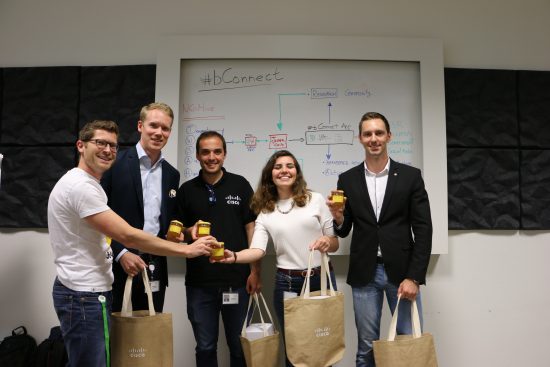
That’s right – I’m a Cisco Bee Keeper!
And since my wife has yet to approve of me keeping bees in our small garden, being a bee keeper through work is wonderful – and it’s great that the bees have a home here at Cisco.
We started our bee keeping journey at Cisco with several colleagues in France. During a monthly sustainability awareness session a co-worker explained the bees’ decline and how pollinating insects play a crucial role in biodiversity. The calls to action were clear: plant bee friendly flowers, ban pesticide usage, buy local honey, and…become a bee keeper!
You want it? You got it! 😀
We started with three bee colonies in 2010 (which is around 100,000 bees), and called the project Connected Bees as we were hoping to “swarm” to other Cisco locations. In 2011, our Reading (UK) colleagues started a bee colony as well, and in 2012, a colony began in Amsterdam (NL) as well – where I then moved for a great work opportunity!
During this time, we also started to explore technologies that would possibly connect bees to scientists – hoping that this would help them identify the culprit for declining bees. Today, the French hives are connected with Cisco technologies, and we would like to do the same in Amsterdam.
Our goal is to raise awareness of the importance of biodiversity by helping to sustain it. One of the ways we do this, is to highlight how important our health is as humans. Many would say that our health is the most important thing in our life, and to be healthy, we need to eat diverse foods.
If pollinating insects were to disappear, we would have to change our diet to a less healthy one, and that would eventually be quite bad for us all.
Imagine a world without apples, almonds, blueberries, or pumpkins – what would we do at Halloween? The horror! Think about how you might feel if cherries, avocados, cucumbers, onions, oranges, and strawberries were to disappear from the planet. Still not convinced? Chocolate and coffee are gone too. Completely wiped out.
Did you know that 71 of the 100 crops that provide 90% of most of the world’s food depend on pollination? And that is just based on human consumption – it doesn’t even account the wild life that depends on these foods! The whole food chain would be under a huge stress if it weren’t for the likes of bees.
Today, we are making sure our Connected Bees are happy on our Cisco rooftops and we use their honey to raise funds for charities. Every event is truly an opportunity to involve our local employees. From helping jar the honey in Amsterdam to running a hackathon on how to best connect the bees to scientists – many of our employees are pitching in to help the bees succeed.
This passion project has not only connected me back to nature and helped me to see how magnificent our earth really is in each new flower every spring, but it has also help me to meet colleagues that I would have never met otherwise. I have many new friends now – 100,000+ bees, bee keepers, and colleagues to be exact! 😀
The Connected Bees project highlights Cisco’s deeply rooted culture in so many ways, and has succeeded so far thanks to a diverse team of employees motivated by technology (helping to connect the bees to scientists) and giving back (helping to connect the honey to charities). Everyone has their own strengths and capabilities – and it really shines here!
In fact, Cisco employees are a lot like bees! When you look at how bees help each other in a colony, you learn a lot about collaboration and can even use that in your day to day work.
Here’s Three Ways Our Connected Bees are a lot like Cisco Employees:
1 – It’s all about collaboration: bees have their purpose and work together to achieve the common goal.
2 – We are working smart: bees are efficient in using resources and energy.
3 – There is no status quo: bees are constantly reinventing their home to survive.
I could never have done this alone, and I’m so grateful that other employees stepped in to make the Connected Bees project a reality. Why do I love where I work? It’s simple, really.
Any employee can take a crazy idea and make it a viable project here at Cisco. We’re encouraged to explore, innovate, and change the world. We always look at how technologies can make a difference, and I’m happy to say that we’ve been making a real impact through Connected Bees.
Last but not least, remember: Plant bee friendly flowers, ban pesticides, buy local honey, become a bee keeper! 😀
Want to join a company that encourages you to follow your passions?We’re hiring!




 Lumen and Cisco have partnered to create Intent-based Data Center Solutions for SAP. Based on Cisco Application Centric Infrastructure (ACI) and Cisco/NetApp FlexPod, our unique converged infrastructure provides clients an end-to-end, dedicated and managed private cloud solution that unlocks the full value of SAP ERP applications and SAP HANA, while simultaneously reducing risk, lowering cost, and enhancing security.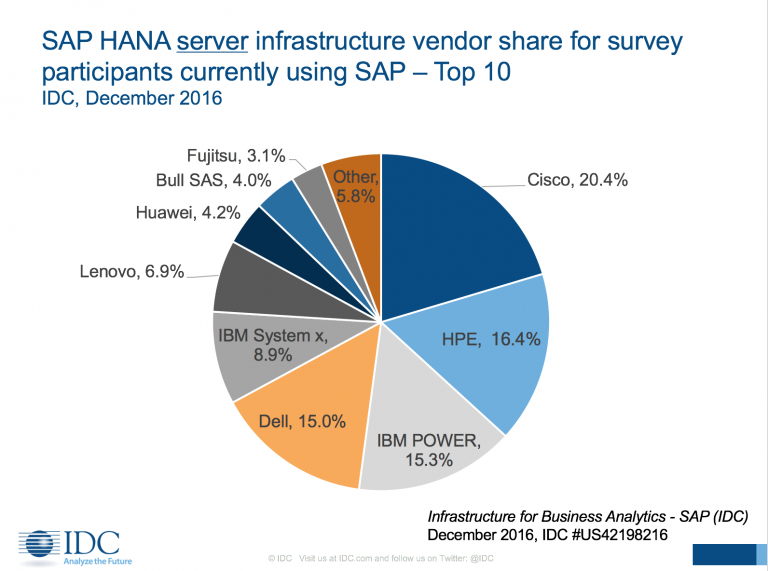
 For this reason, Cisco’s converged infrastructure for SAP HANA has become so popular that we receive more views and clicks on SAP’s authorized web repository for certified and supported HANA solutions than any other platform in the industry – nearly doubling the attention generated by the next closest competitor.
 This innovative breakthrough has the power to fundamentally alter the economics of SAP data centers. With this next-generation architecture and a steady stream of advances in SAP-based IoT, end-to-end data protection, SAP Vora-based Big Data designs, and machine learning, it should be no surprise that at their Sapphire conference in June, SAP awarded Cisco their 2017 SAP HANA Innovation Award!