In 2016, new records were set for online sales across Thanksgiving, Black Friday and Cyber Monday in the United States. In addition, the National Retail Federation reported that total consumers increased with 154.4 million people shopping over Thanksgiving weekend last year.
Are you interested in hearing about what retailers can expect this year? Whether it’s shoppers hitting stores on Black Friday as part of their family tradition or it’s deal crazy consumers looking for new electronics – we will cover a few predictions to help get you through the retail weekend that everyone has been planning for.
Join our next #CiscoChat, “Digital Retail 101: Are You Ready for Black Friday and Cyber Monday?”, on Thursday, October 26th at 1pm EST. In addition to myself, we will be joined by Tim Phillips(@phillips_tim), Retail Strategy Leader at Phunware, Tom Isaksen (@Caliti), Senior Director of Alliances at Phunware, Phil Chang(@RetailPhil), Retail Industry Expert at Hubba, and Jeremy Witikko (@jwitikko), Retail Business Development Manager at Cisco.
To participate in the chat:
Make sure you’re logged into your Twitter account.
Search for the #CiscoChat hashtag and click on the Live tab.
The chat will be moderated by the Cisco Mobility team on Twitter (@Cisco_Mobility). Be sure to follow this account to participate. We will begin welcoming guests at 10 a.m. PST (1 p.m. EST) and posting questions for discussion.
Be sure to use the #CiscoChat hashtag at the end of each tweet so that others can find your contributions to the discussion.
#CiscoChampion Radio is a podcast series by technologists for technologists. In this episode we’re talking to Brandon Carroll and Shawn Wargo about SDA.
Large organizations have a challenge that start-ups don’t have. They have unintended complexity, duplication, old processes, and work that exists simply because it has always been done that way. Most executives of large organizations know they need to embrace Digital Transformation, but they don’t know where to begin. They have operational commitments and responsibilities to stakeholders or shareholders, and no excess operational expense to invest in innovation.
Jeffrey Immelt wrote a phenomenal article “How I Remade GE”. It is a story of his role in transforming GE from a large traditional corporation to a large digital corporation. In his article, he shares his role in determining which lines of business they would exit to make room in their operating budget for investment in transformation. After reading this article, one might suggest that you have to be the CEO to make such radical decisions, but I disagree. Every team in every company must make these decisions to make room for investment in innovation and transformation.
But how do you do that?
My team has been going through a transformation over the last two years, narrowing our focus and making room for innovation within our main objectives. Over that time, we’ve discovered four ways to create what is becoming known as the capacity for innovation.
Projects and initiatives that aren’t directly contributing to your team’s main purpose or goals.
This is the main premise that Mr. Immelt mentioned in his article. Find effort and work that is not driving your main goal that you could shed without causing major disruptions in the business. Start by creating a list of all of the projects and processes your team runs. You might be thinking that everything on that list is vitally important. Truly challenge each one. If you’re in HR, is there a program you’re running that just isn’t getting the result you’ve desired and there would be relatively little backlash if it went away? If you’re in IT, are there applications that you could retire that are offering value to only a few individuals and they could really do without them? Every team has these things they can shed, even if it is only for a period of time to give you some additional capacity for innovation. Be as ruthless as possible in cutting. Worst case scenario, you can always pick it back up.
Duplicative work
Large organizations are notorious for duplicating efforts. There are a few reasons. The most common is that the organization is simply so large, that you’re unaware that you’re doing the same thing as another group. After you created your list of projects and processes in step one, deliberately seek other groups that are doing similar things on your list. If you work together, could the other team incorporate any variations that exist in your project? Can you provide them value in return for taking on your work? We found several processes in which we were duplicating the efforts of other teams. Some short-term efforts allowed us to educate other teams on our unique organization and those teams were able to carry the full project. Just because we are subject matter experts in our organization doesn’t mean we have to take over and duplicate efforts. Spend the time to educate others and allow them to run those projects and processes. When you have greater capacity to innovate, the return will be far higher.
Some teams struggle with letting go of their work. Why should we stop the duplication? Why don’t they stop the duplication? Really think about the work. Is it driving so much value toward your team’s objectives that it supersedes any new value you can bring to your organization?
One more thing on duplicative work. Once you have created the capacity for innovation, and you begin innovating, if your innovation duplicates another effort in your company, you have failed. That is not innovation, that is waste.
Making up for the perceived or real deficiencies of other teams
How many projects or processes are you running because you don’t see another team doing what you need from them? I see this frequently in organizations. One team wants something from another team but isn’t getting exactly what they want, so they duplicate efforts. This one is one of the hardest to deal with because we struggling to have the difficult conversations with other teams and other leaders. Your choices are very simple here. You can have a conversation with the leaders of the other team and try to work out your differences, escalating as needed, you can make the deliberate choice that filling this void (perceived or real) is more valuable than innovating, or you can simply set it aside and live with what you’re getting from another team and focus on innovation. My personal preference is to have the tough conversations to solve the root cause of the issue, and move on with real innovation.
Automation
Once you have rid yourself of some projects, you have made some capacity for innovation. Now look at the rest of your processes that you deem critical to the success of your team’s goals. How many of your processes can be easily described with a flow-chart or a step-by-step explanation? These are prime choices for automation. Use some of that capacity for innovation that you developed and begin automating these processes. Absolutely every organization can automate many of their processes. Worried that you won’t know that they were done correctly? Create automated testing/verification. Be aggressive in your attempts to automate processes. Once you’ve done that, you’ll regain the initial capacity for innovation that you created in the first three steps, and significant additional capacity for investment in truly transformational innovation.
Creating the capacity for innovation in any organization isn’t just the job of the CEO. It’s the role of every manager and every leader within that organization to shed work that isn’t driving toward the objectives of the team and bring innovation to your own portion of the company.
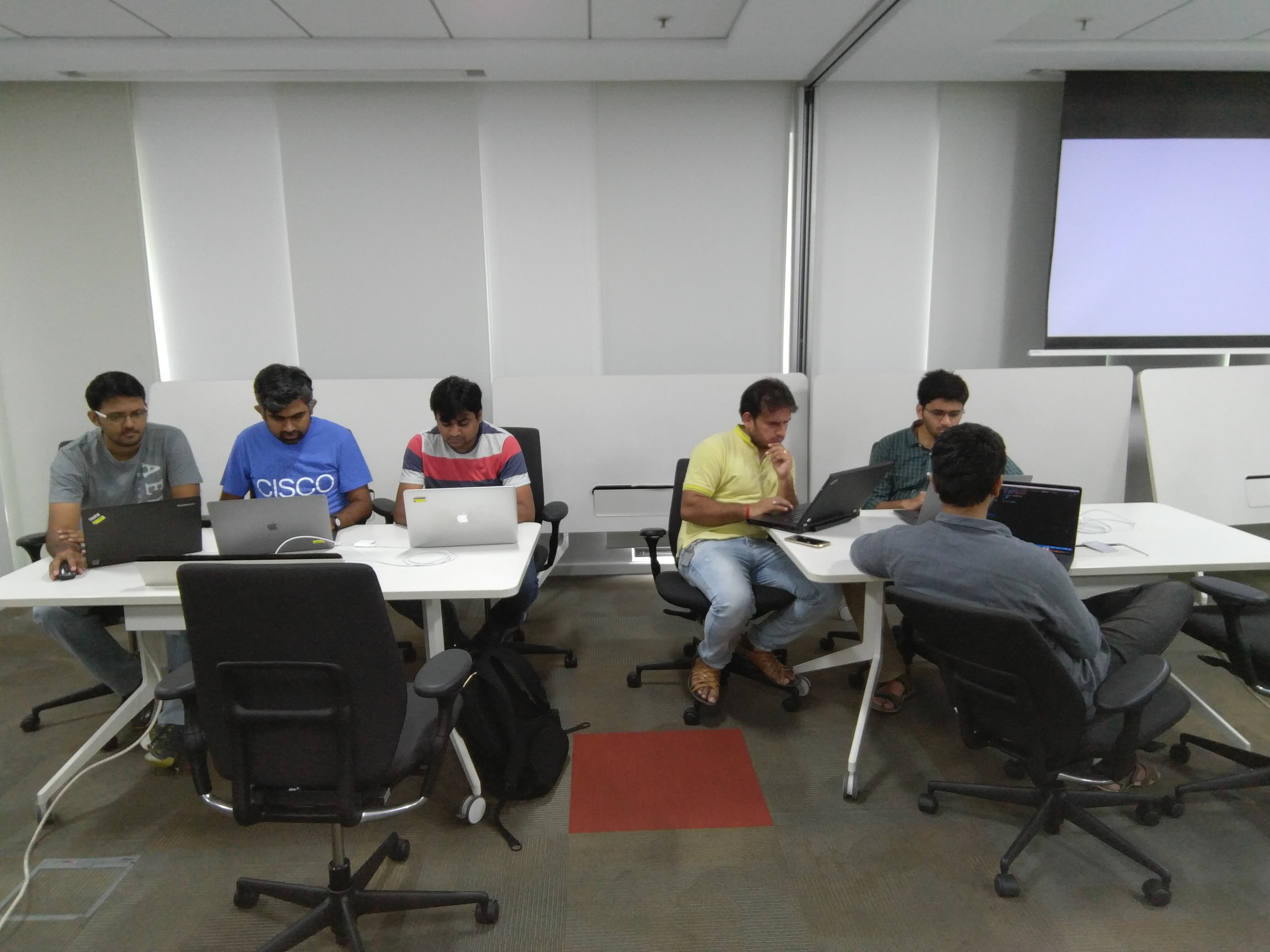
Welcome, welcome, welcome! Here is the first episode of Kareem and Matt’s Code Party where the idea is to video what we usually do, which is sit around, have a beverage, and talk tech (I know…super nerdy right?). This will be a series so keep your eyes open for new episodes, sample code, and blog entries. In each episode, we will have a casual discussion on a particular topic that provides you, the audience, a little interesting information to get started with your code projects.
My name is Matt DeNapoli and I’m a Developer Evangelist for Cisco DevNet. I’m super lucky because I get to travel around the world and tell people about all the cool technologies that Cisco has and how to write software to integrate with them.
My counterpart is Kareem Iskander and he’s much smarter than me. He works on the DevNet Events team, making sure all of the technical bits work for our workshops, demos, learning labs, etc. etc. etc.. So if you’ve attended a Cisco DevNet event, there’s a chance that you had some interaction with Kareem’s work in some way, shape or form.
In this first action-packed episode, Kareem and I hit quite a lot of topics that combine into one solution. We hit Python, REST API usage, chat-bots in Cisco Spark, Meraki, and simple web servers. Specifically, we look at building and deploying a simple bot that allows an administrator to see and manage their Meraki network through Cisco Spark. The code for the example that we work through can be grabbed in the KM-CodeParty github repo.
First things first, let’s take a quick look at what Kareem and I were drinking for this episode. Kareem was having a lovely 2012 pinot noir called Cherry Pie from the Stanly Ranch winery. I’ve had it and it is a nice, easy to drink red that doesn’t fall off at the end in flavor. I was consuming Great Lakes Edmund Fitzgerald Porter which proves to be classic in porter taste but lighter in feel. It’s a great fall beer.
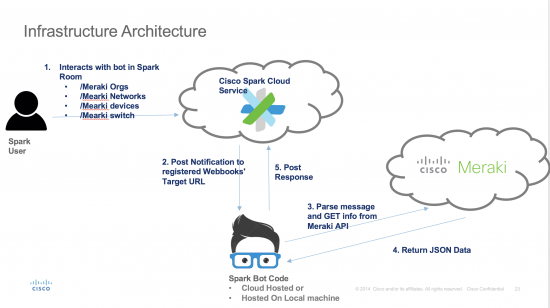
Ok, that’s out of the way…onto the architecture and the code! First off, this is what we’re working with from an architectural standpoint:
Our focus is mainly on the part labeled “Spark Bot Code”. The python file in the link above (botmeraki.py) should be accessible through a public web server of your choosing (for this I used the native python webserver) because Cisco Spark will have to send a webhook to it on the /message event (e.g. someone types a message into the room in which the bot is included). But first, we have to register the bot!
You can setup a bot for spark in the My Apps section of Spark for Developers. Choose a bot, give it a name and an icon and Spark does the rest! Note the token generated because this is the bot’s authorization to interact with the Spark platform and is needed for a few upcoming steps. Onto the webhook!
We setup the webhook through the Cisco Spark documentation (quickest path in my opinion). Now, MAKE SURE to change the authorization token to the bot’s access token, otherwise the webhook will be created under you and the /message event will kick off when you type things into a room. Ok…now we have the Spark bits set, let’s take a look at what’s going on in the code.
First off, we need to make sure our python path is set properly (I have 2 instances of python installed so I have to call out python3 specifically, so please be aware of which version and where python is installed). Secondly we need to make sure we pull in our Cisco Spark python wrapper so we don’t have to do all the heavy lifting in making the API calls. Our first two lines code are setting the table…
#!/usr/bin/python3

import pyCiscoSpark as Spark
Next, we need to make sure we put our Meraki API key in. If you have a Meraki account, you can use the one accessible in your profile. If you want to kick the tires, check out our sandbox by heading to https://meraki.cisco.com and logging in with devnetmeraki@cisco.com/ilovemeraki and heading to the profile for that user and grabbing the API key there.
meraki_key = ""
In the following code, we are accepting the webhook. Since we’re using a bot framework, the first “thing” sent to the webhook is that an event happened. Since this is well-formed JSON (hint: we loaded the json in __main__), it’s easy to parse out the message’s ID so the bot knows what message to go get! It is then the responsibility of the bot code to go out and get the message.
def parse_data(data):
    dataDict = data
    log.info(data)
    decode_msg(dataDict['data']['id'])
And now we can get the message. Note that you have to put the bot’s PERSON ID in the code so that the bot messaging the room doesn’t cause an infinite loop of messages (wheeeeeeeee!). Also, please note that references to accessToken. This the accessToken of the bot that we used to create the webhook. If you do not use the bot access token, there is no way for Spark to know where to put the messages and who sent them!
def decode_msg(msgId):
    uri = 'https://api.ciscospark.com/v1/messages/' + msgId
    resp = Spark.get_message(accessToken, msgId)
    log.info(resp)
    if resp['personId'] != '':  # Bot ID prevents infinit loop
        log.info("doing something")
        do_something(resp)
The next bit of code is our do_something based on what was entered in the message in the room. This is simple prompt-based bot, so we only take action on very specific keywords. This functionality can be expanded to include a natural language processor (NLP) like API.ai (protip: we’ll be doing an episode on that…it’s nuts).
I’ll leave most of the intricacies of the do_spark and do_meraki functions to your code perusal. But let’s take a look at the following in the do_meraki function. Below is just part of the function, but it gives a clue into what we need to interact with Meraki’s Dashboard API. First, we need to set header X-Cisco-Meraki_API-Key” for authorization. Second, we need to set our baseURL. Finally you’ll note the keywords listing and check against the trig array. The trig array are the actual words typed into the Spark room directing the bot, so the message “meraki organization” results in trig[0] being set to “meraki” and trig[1] is “organization”, which “triggers” (see what we did there) there first if in the code below, which kicks off the Meraki API calls.
def do_meraki(resp):
     # Create a list of incoming text
     trig = resp['text'].split()

     # Content type and Authorization information must be included in the header

     header = {"content-type": "application/json", "X-Cisco-Meraki-API-Key": meraki_key}
     endpoint = ''
     keyword = '' # Meraki API resources
     baseURL = 'https://n149.meraki.com/api/v0'
     if trig[1].lower() in ['organization', 'organizations', 'org', 'orgs']:
          keyword = 'org'
          endpoint = '/organizations'
     elif trig[1].lower() in ['networks', 'network', 'net']:
          if len(trig) > 2:
               keyword = 'net'
               endpoint = '/organizations/' + trig[2] + '/networks' ...
Now, this is a grassroots experiment (that we hope works) and the production quality isn’t the best, but since we like to hear our own voices we think it’s ok. We’ll definitely work out the technical kinks as we move on. If you like to hear our voices too, then I’ll think you’ll find this informative, potentially entertaining, but definitely nerdy. Bear with us as we work out our growing pains and please give us constructive feedback (what you want to see, learn about, kinds of drinks we should have, etc.) and we’ll try to work in all the feedback to make this the best for you
Thanks, stay tuned, and (Code) Party On!
We’d love to hear what you think. Ask a question or leave a comment below.
And stay connected with Cisco DevNet on social!
Emmy® Award for HEVC, key tech behind ultra-high definition TV, goes to joint team.
The Emmy Awards celebrate more than the people telling stories on screen. They celebrate the innovative technology that brings you those stories. This year, High Efficiency Video Coding (HEVC) is receiving an Engineering Emmy Award. A Cisco team worked with peers from other leading technology organizations on this breakthrough, and we’re incredibly proud to have been a part.
HEVC is compression coding that enables efficient delivery of ultra-high definition (UHD) content. It’s been adopted by all UHD television distribution channels, from satellite to cable to wireless, and across devices like televisions, mobile phones, and tablets.
HEVC enables larger and more flexible data blocks for greater efficiency
Each frame of video that you see includes multiple pieces of data, or blocks. Compression is based on only sending data that changes from data block to data block within a video frame. In brief, HEVC enables larger and more flexible data blocks for greater efficiency. That enables the higher quality video we all prefer these days. We know this first-hand from our own video collaboration customers.
HEVC was developed by the Joint Collaborative Team on Video Coding (JCT-VC). The team includes a group of engineers from the Video Coding Experts Group (VCEG) of the International Telecommunication Union (ITU) and the Moving Picture Experts Group (MPEG) of the International Organization for Standardization (ISO) and the International Electrotechnical Commission (IEC).
The Emmy Engineering Award goes to an individual, company, or organization for developments in engineering that are either so extensive an improvement on existing methods, or so innovative in nature, that they materially affect the transmission, recording, or reception of television. The awards will be presented October 25, at the Loews Hollywood Hotel.
Learn more about the 69th Engineering Emmy Awards in the Emmy press release.
Less than two years after helping to form the OpenFog Consortium, I couldn’t be happier about reaching an important milestone for Fog Computing—the inaugural industry conference dedicated to Fog technologies, Fog World Congress, coming up next week in Santa Clara, California. The OpenFog Consortium and IEEE Communications Society have been working jointly on the first-ever industry conference dedicated to exploring the technologies and opportunities of Fog Computing and Networking. The conference features:
75+ speakers
55 sessions
4 tracks
“Fog Tank,” where four venture capitalists will take on five startups to find the most game-changing company
As a Diamond Sponsor, Cisco will be there in force, showcasing our Fog strategy and solutions through multiple speakers, panels, and demos.
Cisco will be represented by several keynote speakers: Senior Vice President and Chief Strategy Officer Hilton Romanski will discuss the important strategic connection between Fog and the Internet of Things (IoT). Distinguished Engineer and OpenFog founder Tao Zhang will open the program with a keynote on “Fogonomics: The Coming Era of Fog Computing.” As a Board member of both the OpenFog Consortium and the IEEE Communications Society, Tao has been deeply involved in developing the foundations of Fog Computing and Networking. In my capacity as Chair of the OpenFog Consortium, I will open the second day, along with Robert Fish, VP of Industries and Standards for the IEEE Communication Society, talking about our path forward for developing Fog standards.
Other Cisco speakers will include Marcelo Yannuzzi and Chuck Byers, presenting Technology Track sessions. Our panel speakers include Vice President of Strategic Innovations Maciej Kranz, discussing why IoT needs Fog, and Frank Michaud on Fog security issues.
The Cisco booth will be a hub of activity, including demonstrations of several Fog-oriented solutions:
IoT Fog applications leveraging secure connectivity with Cisco IoS software, and powerful services for rapid, reliable integration with IoT sensors and the cloud
Kinetic innovation, showcasing connected refinery use cases for gas detection, valve alignment and equipment health monitoring
Network device registration using blockchain technology to authenticate hardware and software, provide proof of secure practices, and provide visibility of what is deployed on the network
Interactive map of Cisco’s nine Innovation Centers, showing their global footprint and video examples of innovation activities at each center
In my capacity as a Fog strategist at Cisco and as chair of the Open Fog Consortium, I am extremely proud of the work that this conference represents. This flagship event highlights the maturing world of Fog technologies and the work we have done to accelerate the development and adoption of Fog frameworks and architectures.
Welcome to Cisco Live Cancun 2017! If this is your first time at Cisco Live; fasten your seat belt and be prepared for an information overload. You’ll be able to meet with friends and peers, have fun, and learn from some of the brightest minds in the IT industry.
You may be having a hard time scheduling your sessions since there are so many but, I’d recommend that you dedicate some time to attend the Cloud Day on Monday 6th if you are a customer, or on Tuesday 7th if you are a partner. Here are my top 3 reasons why you should attend:
1. According to an IDC study, more than 84% of organizations worldwide will use multiple clouds
You may have been involved in conversations about IT requests around application agility and fast deployments, IT infrastructure readiness to innovate by supporting new software developments and, perhaps (for sure), security concerns. You are not alone; register and meet with peers that have the same challenges.
2. You might be adding cloud services, managing multicloud environments or evolving your infrastructure to support cloud
The IT landscape has gotten more complex and your infrastructure may be evolving with a new private cloud or deploying container infrastructures. You might be adding new cloud services such as marketing automation or any SaaS offering. On the other hand, you might be looking for visibility into infrastructure and app performance. If you identify your cloud journey into one or the three uses cases mentioned above, you need to attend the Cloud Day.
3. Elevate Expectations for a Multicloud World
Cloud can mean many things and it goes beyond pure cost reduction. What’s true though is that it’s not only one cloud but a multicloud world we are living in. According to IDC, organizations with an optimized cloud strategy achieve significant business benefits such as 77% in cost reduction, 87% in time to provision IT services and an 11% in revenue growth to mention a few. Learn how your organization performs at the Cloud Day.
It doesn’t matter if you are a heavy user of public clouds or just starting to realize the potential that cloud may bring to your organization. You’ll learn how to address the multicloud challenges with the right network, analytics, management and security intelligence.
Register here and elevate your expectations for a multicloud world.
This blog post was guest-written by Faith Lin, Community Relations Manager at Cisco
Whether you’re an engineer or a project manager, you have skills that make you uniquely qualified to work at Cisco, from networking expertise to technology know-how. You use them every day, but they’re skills we can apply outside of the office to make a positive impact on people, society, and the planet.
That’s the message behind Pro Bono Week, a global celebration of professional services for public good, celebrated annually during the last week of October. Cisco employees and those at companies around the world can use their everyday skills to directly help organizations take their impact to the next level.
In honor of this push to support nonprofit and social impact organizations, we’d like to highlight several Cisco pro bono volunteer superstars and their ability to Make Moments that Matter, no matter where they are!
Sankar Balasubramanian, Engineering Technical Leader, app development and coding volunteer; case developed by Rajesh Chandran, Sr. Manager, Business Development — Cisco India, Chennai
In India, nearly 70 percent of the population is literate, meaning more than 900 million people in the country can read and write. For the India Literacy Project (ILP), 70 percent isn’t high enough; the nonprofit’s mission is to act as a “catalyst for achieving 100 percent literacy in India.”
Through programs like Multi-Dimensional Learning Spaces (MDLS), ILP is providing students with an opportunity to explore, experiment, and to learn in a holistic environment. To do so, they offer students access to computer labs, libraries, low-cost math and science labs, smart classrooms, career guidance, and more to improve their reading and writing skills.
Rajesh Chandran, Business Development Manager at Cisco and a long-time volunteer with ILP, helped to define the technological support required by the NGO partner into a tangible problem statement.
To support these efforts, Sankar led a team of 14 employee volunteers as part of a “Code and Give Back: Mobile App Development” event in Chennai, India. Together, they helped ILP develop an application that class monitors can use to track and log activity at project locations. The application makes it easy to assess progress at the school and district level, while providing transparency for all stakeholders.
“‘It was very satisfying to work on a volunteering project where our technical expertise could be utilized to create a unique experience for all of us — compared to conventional volunteering efforts,” Sankar says. “Developing software for ILP enables us to fully leverage our expertise on software development across technologies — Android apps, Web Services, Web UI, etc., and hopefully it gives a big boost to ILP to reach their goals.”
Cross-functional team of volunteers from Cisco Bangalore leveraging their technological expertise to benefit an alternative school in Leh Ladkah, India
Like Sankar and Rajesh, a cross-functional volunteer team–including a group of engineering and IT volunteers from Cisco Bangalore –saw an opportunity in India to volunteer their skills for a local organization, the Student’s Educational and Cultural Movement of Ladakh (SECMOL), using Cisco’s Time2Give benefit, an employee benefit that enables all Cisco employees to take five calendar days per year to volunteer with their causes of choice.
The nonprofit was founded in 1988 to reform the region’s educational system and to build skills to support today’s digital economy. SECMOL’s Alternative School is located in one of Ladakh’s more remote areas, making it difficult for students to access the information needed for their studies.
“Since getting the Internet to this remote school was next to impossible, we provided them with an alternative solution,” said Sukeerth SP, one of the volunteers who was part of this contingent. Madhuri MS, who led this team says. “Offline content! We gave them a dashboard, which was linked to offline content, such as Wikipedia, TedX videos, Khan Academy lite, and high school educational content.”
While on site, Madhuri and a cross-functional team of nine engineers customized the dashboard, cabled the computer lab, networked the office and library, and organized the school’s AV equipment to shift the focus on the learning at hand.
Inspired by these stories? Join Cisco’s culture of giving and volunteer your own time and skills as a Cisco employee. Here’s how:
Taproot+ for Cisco – Cisco’s online platform that connects your skills with nonprofit needs, including projects in business strategy, marketing and information technology
In 1997, I joined Cisco as an IT Voice Services Project Manager. I never imagined I would be staying for 20 years. Two decades ago, I had no idea that working for an IT company would lead to the many roads I’ve travelled within my career. It’s true that Cisco changes and adapts itself continuously to stay at the forefront of innovation. But did you also know that they enable their employees to manage their own career and encourage us to explore other career opportunities we might be interested in within the company?
Often times, when you hear of someone who has been at the same company for many, many years – you think they’ve been doing the same ol’ thing the entire time. At Cisco, that couldn’t be further from the truth in my case! In these past 20 years, I would also come to move around between organizations, obtaining an even broader knowledge of the company with each transition, and at the same I was enabled to bring value to Cisco.
In 2017, to “celebrate” those 20 years with Cisco, I moved for the third time to join the Services Business Development group. But here is where I have been so far:
The First Move: I still remember one of my first review meetings. My manager said, “Donald, I can give you the tools and guidelines to manage your career, but you have to do it.” It led me to think of where I would like to be three years later, and it was the first moment I started to look outside the IT organization for my next career change. I was motivated to make a move towards sales.
For 14 years, I was in different IT roles and got involved in customer meetings to share our Cisco on Cisco programs. It was here that I discovered how much I enjoyed the human interaction. So, I started to work on creating the proper network, analysed my skill gaps, and prepared for my next challenge.
In 2010, I joined the Spanish Sales team as Collaboration Product Sales Specialist. I felt alive and energized by the work here! It felt like I had joined a new company, with new processes, goals and challenges. I was lucky to also have a great mentor who offered to guide me through this new world of sales, and it was one of the best experiences I’ve had here at Cisco.
There were moments of doubt, sure. Sometimes, I’d wonder why I had made the shift to this new path, when I was comfortable with IT all this time. But, it was this change that allowed me to grow again both professionally and personally.
The Second Move: After 6 years in this role, I didn’t want to wait the same amount of time to take my next step. So I began the same process once more of growing my network, analysing my skills, and preparing for the next step. Even being in my fifties, it did not scare me off.
I was ready for the challenge and new opportunities.
Are you thinking of making a career move within Cisco as well? Here’s what I would recommend:
Challenge Yourself! There is no exact time of when to make a change, sometimes you’ll be ready for it – and other times you won’t be as prepared, but that also leads to a lot of new experiences and learning! You will know when the timing feels “right”. Don’t be afraid to take the leap!
Talk to your manager or get a coach if you feel you need some guidance. This can be a peer, a friend, a family member, or even a professional coach. Find someone to talk to about this decision and OWN IT.
Did you know that Cisco also offers what we call Stretch Assignments? This enables employees to learn new skills and work for other teams for a few hours each week to develop their careers further. This is a great way to learn as much as you can about other teams and what they do here – take advantage of that benefit!
You can only grow yourself if you put yourself in front of a new challenge. Yes, it is new. And, yes, it is sometimes scary. But if you don’t swing for the fences – how will you ever know how much more you can add to your career?
20 years, and three careers all at Cisco – take it from me, there is always room to grow here!
Interested in joining a company that encourages you to grow? We’re hiring!







 As a Diamond Sponsor, Cisco will be there in force, showcasing our Fog strategy and solutions through multiple speakers, panels, and demos.