Avatar

Since its FCC implementation in 1997, the E-rate program has successfully evolved in response to a world of limitless digital content and opportunities for personalized learning. And while the “if it ain’t broke, don’t fix it” idiom remains a popular decree for some in government and society alike, the FCC’s most recent E-rate Modernization Order adeptly refocused the program’s transition from legacy services to broadband support via their Category Two service (internal connections, managed Wi-Fi, and basic maintenance). In fact, E-rate has affected millions of students and library patrons across the country.

The advancement of digital teaching and learning in the U.S. has accelerated due in large part to the E-rate program. Since its inception in 1996 as part of the Universal Service Fund, E-rate has helped more than 100,000 schools and libraries connect to the Internet.

If you revisit the July 11, 2014 Modernization Order, you’ll see that the FCC adopted three broad goals for the E-rate program:

(1) Ensuring affordable access to high-speed broadband sufficient to support digital learning in schools and robust connectivity for all libraries

(2) Maximizing the cost-effectiveness of spending for E-rate supported purchases

(3) Making the E-rate application process and other E-rate processes fast, simple and efficient

In additional to the overwhelming usage of the E-rate offering by schools and libraries, you can loosely measure the ongoing success of the program by returning to these goals, now three years and application cycles into the Modernization Order. The 20 to 90 percent E-rate discount (depending on the category of support, a library’s or school’s urban/rural status, and the percentage of students eligible for the National School Lunch Program), as well the vendor evaluation and selection process, has addressed two of these goals, namely affordable access to high-speed connectivity and maximizing cost-effectiveness. The third—making the process fast, simple and efficient—continues to be a moving target for applicants, large and small alike. Fortunately, as the program grows, so too does the wealth of resources intending to benefit both novice and seasoned E-rate applicants.

Cisco’s recent white paper, Understanding E-rate—Get the most out of your E-rate dollars, provides a helpful overview of the program and shares best practices schools can use to shape their network strategy. The whitepaper complements a growing list of collateral aiming to make awareness and navigation of the E-rate process as seamless as possible. (You may also find these “tips from E-rate pros” helpful.) In addition, the FCC’s Universal Service Administrative Company (USAC) site contains beneficial updates and training opportunities.

To learn more about E-rate and how Cisco can help your school or library navigate your digital learning journey, please visit www.cisco.com/go/erate. The site is home to a number of helpful resources, including a link to a recording of our recent webinar, “Discover how you can capture your share of $3.9B E-rate funding,” which offers the perspectives of E-rate experts and educators.

Authors

Vince Siragusa

Public Funding Advisor

Public Funding Office

Avatar

Cisco Talos is disclosing several vulnerabilities identified in Circle with Disney. Circle with Disney is a network device designed to monitor the Internet use of children on a given network. Circle pairs wirelessly, with your home Wi-Fi and allows you to manage every device on the network, tablet, TV, or laptop. It can also pair via ethernet after the initial pairing. Using an iOS or Android app, families create unique profiles for every member of the home and from there, help shape each person’s online experience.

The security team at Circle Media has been exemplary to work with from initial vulnerability discovery to release. They have been responsive and open to communication. Additionally, the Circle with Disney was designed such that software updates are pushed down to customer devices when they become available. Customers who have received these updates are protected against these vulnerabilities.

Read More

Authors

Talos Group

Talos Security Intelligence & Research Group

Avatar

APIs have come a long way at Cisco.  From the days of TAPI, JTAPI and TCL (where they were more designed for eco-system partners to build on-premises applications to sell to customers), to today’s REST-based, easily-accessible-by-just-about-anyone-and-anything APIs  for cloud and premises based solutions.

Easier now to customize solutions
Cisco partners might still have memories of how difficult it was to use those old APIs and SDKs, and the costs involved in purchasing and installing the infrastructure to develop and test with them.  But things are very different now and it merits a second look to try and take advantage of this new business opportunity to go “customize” the solution for the customer without really having to write a lot of code, or having to maintain middleware.

Cisco Latin America Partner DevOps success DevNet Mexico

Getting visibility for partner built integrations or applications was laborious in the past, it involved IVT testing to be listed in the Cisco Marketplace and perhaps eventually even make it to our SolutionsPlus program to be able to be sold using Cisco part numbers.  Cisco Marketplace and SolutionsPlus are still very relevant, but partners now have faster ways to showcase and even deliver custom integrations to Cisco solutions that can help their customers on their digitization journey. One example of this can be seen at the Cisco Spark Depot where integrations can be set up and consumed in minutes by customers and Bots requiring only a quick description on what to do with them when added to Spark spaces.  Another venue is the Meraki Ecosystem Partner Solutions site where integrations can be showcased and shared easily.

Partners can also showcase their solutions and even share code in DevNet Creations.  Sharing code might not always come naturally to traditional Cisco partners accustomed to licensing or selling licenses to production software, but it is a great way to demonstrate their expertise and attract opportunities with simpler applications that can be further customized to meet specific needs.

Speaking of licensing extra software, partners are often challenged with having to make build or buy decisions whenever there is a gap in functionality, when proposing a Cisco solution. These can actually be opportunities to build a longer lasting relationship with the customer and sell professional services.

Cisco Latin America Partner DevOps success DevNet NetAcad Mexico

Getting support is easier too
Since making a decision in a timely manner on his topic can be crucial, partners should leverage the support forums in the DevNet communities to complement the information they obtain from the DevNet documentation and tools, but if they would prefer to discuss the matter more privately, they can work with their Cisco Account team and Partner Helpline to get to the information they need regarding solution APIs and SDKs without discussing it in public.  There are even programmability focused demonstrations for end customers delivered remotely as part of that no-cost pre-sales service that can help explore the functionality. This of course is as a complement to the self-service resources available in the DevNet sandboxes and dCloud in addition to lots of sample code available to get you started on the DevNet GitHub repository.

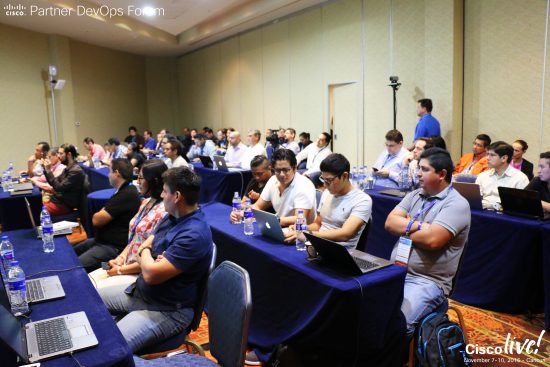
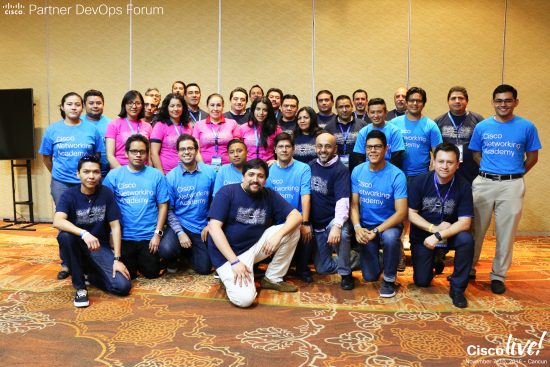
If you are a Cisco partner ready to embrace programmability, there is a lot that DevNet can offer, but we are also very eager to accompany you in other aspects of the journey with events like the DevOps Forum at Cisco Live Cancun – one of the Partner Days  where you can share experiences with and hear from other partners that are increasing their relevancy with their customer base with extensions and custom integrations that are simpler to conceive and maintain.

I am very encouraged by what I am seeing lately coming from our partners in this area: the creativity and innovation reflected in many of the examples of apps, bots, and integrations I have seen truly speaks to how qualified they are to apply customer specific business logic to deliver a richer experience when using Cisco solutions to end users and IT departments alike.

Are you ready to take the plunge? It has never been easier to get started!


We’d love to hear what you think. Ask a question or leave a comment below.
And stay connected with Cisco DevNet on social!

Twitter @CiscoDevNet | Facebook | LinkedIn

Visit the new Developer Video Channel

Authors

Gerardo Chaves

Escalation Systems Engineer, Collaboration Specialist

Global Virtual Engineering, WW Partner Organization

Avatar

SPS IPC Drives 2017 – Nuremberg Germany
November 28-30, 2017 – Location: 10.0-320 (HOPF booth)

I’m excited to announce that Cisco will have a presence at SPS Drives this year to showcase our network solutions with our partner, HOPF.  HOPF is a solution provider based in Germany that offers a range of products and services to industry.  This is Europe’s leading exhibition for electric automation.  See Cisco in the HOPF booth and learn how Cisco, together with partners can deliver “One secure network for Industrie 4.0” from the enterprise to the factory. The event is free, and you can register here.

Cisco is delivering on ALL the cornerstones of Industrie 4.0.  To fully succeed in an I4.0 transformation, industry needs network interoperability (convergence), information transparency, and transformation of IoT data into timely action and relevant insight.  Cisco solutions help aggregate, visualize, and analyze digital data from connected machines and equipment, and assure rapid, secure delivery of data to relevant applications .  Cisco brings the power of real time action and insight from I4.0 data to manufacturing resulting in visibility across your factory, assets and workers with value in four key areas:

  • Simplicity: Simple network management for a more resilient, reliable network.
  • Intelligence: IoT data transformation via distributed intelligence from edge to cloud for timely action and relevant insight.
  • Network Automation: Plug and play network deployment to streamline processes and drive productivity.
  • Security: Visibility and control to reduce risk, protect your IP and ensure production integrity.

Come by the booth to see our Time Sensitive Networking demo, showing how the IE4000 series of switches supports this a new standard for deterministic applications to help our customers converge their industrial networks.

Time Sensitive Networking has achieved rapid adoption across the ecosystem of industrial automation vendors.  Notably, B&R will have some exciting new announcements in this area, including OPC UA integration.  OPC UA is a standard that applies context to data.  By adopting the standard, different machines from different vendors can share valuable real-time data, and that data can be easily interpreted for M2M communication and machine optimization.  I’d recommend you stop by the B&R booth (7-114, 7-206) and TTTech Computertechnik (6-460) to see a number of demos highlighting Cisco’s IE4000 industrial switching solutions.

Cisco will also have industrial switching technology featured in the Profinet booth on the Factory-Automation Wall.  Visit the Profinet International booth at 2-539.  Profinet is supported with Cisco IE switches.

Cisco also works closely with the Industrial Internet Consortium, where our TSN Testbed recently won best Testbed at the IoT Solutions World Congress. The consortium is a group of more than 260 companies.  Special thanks to all those companies for making this a success!

To learn even more, come see us November 28 at 16:45 at the “Shapers” press conference where a prominent group of Industrial and Networking companies are coming together to discuss the progress of an open, unified, standards-based IIoT communication solution between sensors, actuators, controllers and cloud addressing major requirements necessary for industrial automation.  The initiative focuses on Time Sensitive Networks to drive further standards based automation.  It focuses on OPC as the organization which will drive the application convergence through OPC’s adoption of TSN.  OPC and TSN are clearly called out for this reason in Industrie 4.0 output.

Here is an overview of the solutions we will be highlighting in the HOPF booth: 

  • Time Sensitve Networking: Converge your plant networks into one secure network for Industrie 4.0. With TSN, Industrial IoT applications run over the same Ethernet infrastructure as time-critical communications. TSN can eliminate network silos that block reachability to critical plant areas and can help you extract real-time data for analytics and business insights.
  • Connected Factory – Network: Cisco provides a network backbone that can handle the demands and unleash the possibilities of digital technology. Learn how adopting a tested and validated industrial Ethernet architecture, including factory wireless, will allow your manufacturing processes to securely operate at higher levels of performance, efficiency, and uptime.  Easily manage that network infrastructure with Industrial Network Director – also demonstrated in the booth.
  • Connected Factory Security: Manufacturing is the number one targeted Industry for cyberattacks and security breaches. Learn how IoT Threat Defense can protect from the enterprise to the shop floor can lower your costs, improve safety & reduce downtime.

Follow us on Twitter at @CiscoMFG to see the live activity at the show even if you’re unable to make it to Nuremberg.

Authors

Scot Wlodarczak

No Longer with Cisco

Avatar

Over the last few months I’ve been writing posts about a simplified manner in which we can automate solutions on UCS called KUBAM.  Everything we’ve done has been open and available on Github to solicit feedback and let the community know what we are doing.  We haven’t been super vocal about it though as the velocity of how it works has been changing extremely fast.  We are, however, now to a point where the groundwork is laid and we can begin to broadcast the awesomeness of KUBAM.  Please note that the documentation on the KUBAM website hasn’t been updated yet to reflect this.  This is a work in progress.  If you have questions, want to get involved in helping, or get stuck testing, please leave a comment on this post or hit me up on twitter.

Vision

KUBAM aims to let your data center dance.  We want the process of deploying solutions to UCS to be as simple and painless as possible.  We want to remove any friction you may have with deploying a UCS solution.  We can do this because of the following:

  • UCS has the most complete API of any server platform.  With this obscene power, we can automate all aspects of it.
  • Container technologies have become more advanced to allow simple software provisioning and packaging.  This means you can install complicated software using containers that work instantly.  Dependency trenching  is not for you.  That’s for the past.

All solutions on UCS start with deploying an operating system.  You might use VMware ESXi, Microsoft Windows, or your favorite distribution of Linux.  This is the first problem we need to make painless.  Up until now it hasn’t been that awesome.  It’s not just UCS, its every bare metal server on the planet.  You rationalize it though, by saying:  “Well, we only do it once”.  But we think it should be different.

When you provision a machine instance on a cloud or virtual environment the process of installing an operating system is painless.  It’s built in.  You go to the cloud providers website or use an API to accomplish this.  For many people even this step is becoming unnecessary.  As the industry move towards serverless architectures, deploying code on a runtime is the only thing you really care about.   This is what we want to accomplish with KUBAM.  A seamless experiences using advanced software to make these solutions possible.  We’re starting with the Operating System.

KUBAM Today

In the beginning of October 2017 we finished the first docker compose file that includes a front end web interface and an API.  As of this blog post, you can download that, plug it into your environment and deploy CentOS 7.3 or ESXi 6.0/6.5 with lots more coming.

Here are the requirements to get started:

  1. You have an existing UCS environment that has Fabric Interconnects that is connected to either blades or rack mount servers
  2. You have a VM or machine running somewhere that has docker installed as well as docker-compose that can access the UCS.  This can either run on UCS or be stand alone somewhere else in the data center.  This will be the KUBAM node.
  3. You have an ISO image of the required Operating system (CentOS Linux, etc) that is required for your solution.

That’s basically it.  We wanted to make the requirements and the friction as easy as possible.  Now what do you do next to get running?

You simply run:

# curl https://raw.githubusercontent.com/CiscoUcs/KUBaM/master/docker-compose.yml --output docker-compose.yml
# docker-compose up -d

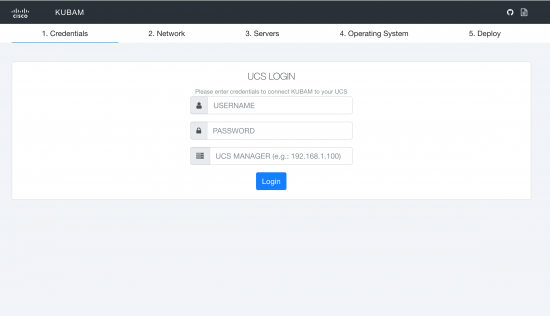
At that point you point your web browser to the IP address of the server you ran the docker compose command on.  (You could even run this on your laptop!).  The picture below is what KUBAM looks like at first glance:

As you can see the first thing it asks you is for the credentials and IP address of your UCS environment.  Today KUBAM only handles one UCS domain.  Once this is entered there are a few more easy steps.

Network Information

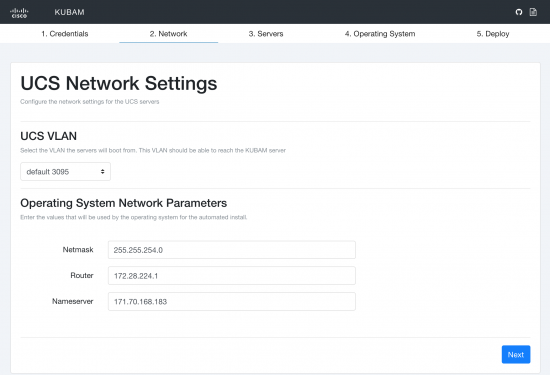
KUBAM asks for the UCS VLAN that you wish to install over.  This is the VLAN the servers will network boot from.  This VLAN can have a DHCP server or other services running on it. KUBAM doesn’t care.  It won’t interfere with any of these settings since KUBAM doesn’t use DHCP nor mapped MAC addresses to deploy the solutions.  KUBAM is a ninja.  These networks can even be in production.  KUBAM could care less.

In this menu KUBAM wants to know what network settings the newly provisioned operating systems will need.  Netmask, DNS, and router information.  We recommend DNS point to OpenDNS name servers 208.67.222.222.  In this way you get even more security built in!

Server Instances

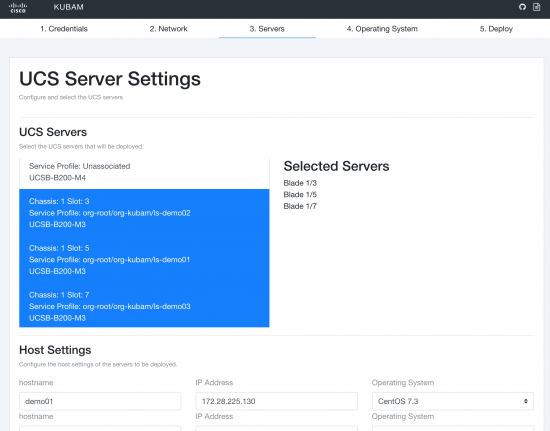
When all the network settings appear to be in place KUBAM wants to know which servers you would like to be provisioned.  Here you select the UCS servers to place in the KUBAM pool.  You are then instructed to give each server an IP address, operating system, and role of what solution should be installed on this server.  KUBAM knows you hate typing IP addresses and sequential hostnames, so it tries to be intuitive by auto populating hostnames and IP addresses for you.  Giddy Up!

Operating System and Deployment

Once the Operating system is extracted and boot images are created, you simply press “Deploy” and KUBAM goes to work.  It creates service profiles automatically and maps the installation media using the automated vMedia policies.  After waiting several minutes, your machines are ready to carry out your inner most desires.  Want to run an app that controls drones?  Create an ICO? Invent something entirely new?  KUBAM is ok with that.  It doesn’t give it a single thought.  It just does what you want and stays out of the way.

At present time KUBAM is pretty slow.  The entire process can take about 25 minutes, including the time taken to download the docker images and deploy.  KUBAM knows you don’t like to wait.  Fortunately for you there’s no extra steps.  You just hang out, grab coffee, or see if your crypto currency is increasing in value while it does it all for you.  Once you press that “Deploy” button you do nothing else but wait.  Soon, whether it be an automated ESX VSAN cluster or a brand new Kubernetes cluster it will be ready for you.  It is the most simple way you could ever deploy a solution like this in your own datacenter.  It is also a process we are constantly looking to further simplify and make life easier for UCS customers.

Under the Hood

KUBAM aims to inject so much lubrication into your data center that you will think you need to strap down your racks to the cage.   KUBAM doesn’t want you to even care about how it works but just know that it works, and works well.  However, KUBAM understands that you are searching for answers and that you can handle the truth.  That is one reason KUBAM is open source.  KUBAM will give you the truth and not tell you to “stay tuned” nor wait any longer.

KUBAM is built with two containers.  One container (the front end) is a simple React-Redux application written in node (javascript, lots of javascript)  This is your easy button view to the world.  By itself the front end container is powerless but sexy.  It gets its power by making calls to the KUBAM api container.  Since you are curious to know, the API container is written in python and uses the UCSM SDK.  It also uses tricks to mount ISO images and make them run.  Things that are not obvious how to do in containers.  You may be interested in learning how to do this yourself, and KUBAM has answers for you there as well.  Go ahead and visit KUBAM’s friend, the UCS Programmable Infrastructure page on DEVNET where you could learn about sample code, learning labs, and sandboxes.

State for KUBAM is kept inside a mounted volume in the ~/kubam directory on the server where the containers run.  A kubam.yaml file is automatically updated when the API server is called with certain POST requests.  In this way, the KUBAM architecture could fit easily into a solution like Cisco Cloud Center, UCS Director, or Cisco Intersight.  KUBAM aims to play nice with its fellow Cisco products.

Future

KUBAM is an open source tool made to allow UCS systems to dance.  KUBAM only supports UCS because only UCS has the APIs that are powerful enough to automate end to end datacenter solutions.  KUBAM will expand to other operating systems as well as other roles.  At present KUBAM is working on simplifying Kubernetes, Docker Data Center as well as ESXi with VSAN.  ACI integration is on the roadmap as well.  While these solutions are currently used by many of our customers today, KUBAM is also looking to deploy more forward looking solutions that might give a public cloud experience in your own UCS datacenter.  KUBAM would love your input.  Version one is rough and raw. KUBAM is scrappy, but is reacting and responding quickly.


We’d love to hear what you think. Ask a question or leave a comment below.
And stay connected with Cisco DevNet on social!

Twitter @CiscoDevNet | Facebook | LinkedIn

Visit the new Developer Video Channel

Authors

Vallard Benincosa

Technical Solutions Architect

WW Data Center and Virtualization

Avatar

These vulnerabilities were discovered by Aleksandar Nikolic of Cisco Talos

Today, Talos is disclosing several vulnerabilities that have been identified in Cesanta Mongoose server.

Cesanta Mongoose is a library implementing a number of networking protocols, including HTTP, MQTT, MDNS and others. It is designed with embedded devices in mind and as such is used in many IoT devices and runs on virtually all popular IoT platforms. The small size of the software enables any Internet-connected device to function as a web server. Mongoose is available under GPL v2 and commercial licenses.

All discovered vulnerabilities are fixed in version 6.10 of the library.

Read More >>

Authors

Talos Group

Talos Security Intelligence & Research Group

Avatar

In the previous blogs of this series, we discussed the importance of building an Innovation Maturity Model (IMM) that properly addresses each organization’s innovation strategy. In this final blog, we will examine the key role that regular assessments play in the maturation process of organizations leveraging the IMM.

As your organization evolves its innovation capabilities, you must update your maturation plan alongside the changing needs of your business strategy. As you adapt your innovation strategy, you can then shift focus to the next set of success criteria to implement. Conducting regular innovation maturity assessments helps to capture key changes and feedback in a timely manner. This ensures that innovation programs stay on track.

Key elements of innovation maturity assessment

To be effective, the assessment must consider feedback from all relevant stakeholders within an organization. A combination of the following approaches can help you see the full picture:

Pan-organizational survey – A survey that spans the entire organization provides an objective overview of current innovation maturity. It isn’t biased by feedback solely from those with a vested interest in it being seen as a success.  Surveys should target all levels of the business and collate as many different viewpoints as possible. Creating tailored surveys for different target audiences (i.e. senior leadership, innovation team, wider employees, customers) will ensure feedback is as insightful as possible.  Each audience should receive only the questions that it is capable of providing feedback on.  What may not be obvious is that rank file employees’ assessments should focus on leadership support and culture; these must be conducive to taking on the risks of innovation work.

Baseline innovation team and executive interviews – The second assessment phase focuses on those leading innovation efforts within the organization, their views on current success and what they see as future priorities. This includes innovation team members, senior leadership, internal line leads and any other critical stakeholders. For maximum insight, use an interview guide built around IMM exemplifiers to guide the conversation, but leave the interviewer free to deep dive into any key topics that arise.

Exception interviews – In situations where significant conflicts of opinions are apparent between survey respondents and interviewees, or specific survey feedback needs further exploration, exception interviews may be required. You can use these investigative interviews to supplement earlier assessment phases and help to build a more complete picture of the current situation inside an organization.

Post-assessment phases and actionable outcomes

Once you complete the initial assessment, analyze the results alongside existing IMM exemplifiers to identify key strengths and gaps in ongoing activity. This will provide an accurate view of the current state of the innovation program.

The innovation team can then work with senior leadership to co-create an innovation maturation roadmap based on assessment findings and business priorities. This maturation roadmap must be reasonable and actionable, and also achievable over time. Finally, develop a communication plan for the wider organization to keep all employees informed of key changes to innovation strategy and goals going forward.

Even outside of the regular assessment process, you should make innovation maturity improvement part of an ongoing, habitual cycle. Regular informal reviews led by the innovation team, combined with more formal updates at key intervals throughout the year can ensure innovation remains front-of-mind for all employees and a central tenet of successful business strategy at every level.

For organizations struggling to innovate effectively, incorporating an IMM can be the ideal way to bring structure and direction to what can often feel like an overwhelming business challenge.  Cisco created a centralized Innovation Excellence Center to develop their IMM and to conduct maturity assessments as a shared service for the company’s many internal innovation programs.  This small team of highly knowledgeable innovation consultants offer mentoring to the innovation program leaders, and vastly reduce the ambiguity they must face as they lead their programs.  We encourage you to set up similar programs.

This blog series was intended to provide an overview of how to successfully build and implement an IMM within any organization, based on challenges faced and the ultimate innovation goals that need to be achieved.

Avatar


Speed, simplicity and agility. These needs are all top of mind as service providers look for ways to maximize their existing optical network while building enough bandwidth overhead to support the massive increase in data driven by today’s digital world.

In the past, network growth and transitions were delivered with new generations of hardware technology. Today, some of the most challenging transitions are operational and are now driven by network software enhancements. In the optical area, we are continuously striving for new enhancements, especially software enhancements. By using a new, flexible control plane, the software-driven network lets service and content providers adjust their bandwidth automatically and take a proactive approach to maximizing the tradeoffs that exist between capacity and distance in the optical network.

Cisco’s Flexible Light Orchestration of Wavelengths (FLOW) is a new software control plane that supports flex spectrum by extending the Generalized Multiprotocol Label Switching (GMPLS) control plane. It is compliant with the Spectrum Switched Optical Networks (SSON) standard and allows operators to provision, protect and restore new bandwidth by simply dismounting the fixed grid network, and replacing it with a flexible grid (aka Flex Spectrum). FLOW incorporates enhanced optical calculation algorithms to manage the new higher bit rate wavelengths and is flexible because it is software configurable and not constrained by a fixed wavelength grid. With the availability of enhanced algorithms integrated into this solution, bandwidth congestion can be easily adjusted on a dynamic basis. This is an important new benefit for optical networking.

The FLOW control plane includes a new optical signal hierarchy called the media channel in order to support flex spectrum capability. This media channel acts as the continuous spectrum portion from the initial source to the final destination. The set of carriers inside the media channel is called a “superchannel.” The media channel includes information about the allocated optical bandwidth as well as the path within the network. It is possible to aggregate several media channels into a Media Channel Group (MCG).

The primary use case is where multiple or many 100G wavelengths have already been deployed in a network. These can now be grouped together, but if one fails, the other waves are not affected. The FLOW control plane is alerted that these wavelengths have been put into a media channel group. The key use case for FLOW is to transport higher bit rate wavelengths that have not been created before, such as 250G, and eventually up to 600G. The FLOW control plane will also use this information to squeeze the media channels into the smallest portion of spectrum required for the end-to-end distance. The media channel group is also defined by the source to destination of the path.

Existing optical networks can benefit substantially from the new Cisco FLOW control plane. Fiber carrying capacity is increased on the existing infrastructure, along with support for next-generation data rates such as 600G, 1 Terabit and higher. With FLOW, the number of bits per fiber is increased dramatically, which in turn decreases the cost per bit by leveraging the advances in silicon. In addition, advances in automation will reduce operational costs and provide more flexibility.

With the agility of a configurable solution, bandwidth congestion can be easily adjusted on a dynamic and automated basis. The capital and operational advantages of FLOW and massive spectral efficiency are obvious: bandwidth on existing platforms can be increased by up to 50 percent while optimizing larger wavelengths within the same spectrum, resulting in significant CapEx and OpEx savings for all network operators.

Learn more about Cisco’s Flexible Light Orchestration of Wavelengths here.

Watch this blog and follow me on Twitter as we continue to discuss how Cisco is helping our customers transform their optical networks.

Authors

Bill Gartner

Senior Vice President/GM

Optical Systems & Optics

Avatar

Imagine you’re a professional hockey coach. You wouldn’t give your players a mix of football, cricket, and badminton equipment and send them out on the ice. You’d make sure your team had the best gear available so the players can focus on scoring points, not figuring out how to use a cricket bat to manage the puck.

In your own business arena, you want to make sure you’re outfitting your teams with the technology that lets them do their best work. When people have the right gear, the tools get out of the way so that the players can play.

There’s growing interest in the league of collaboration technology, especially when it comes to optimizing work among teams. New and long-established vendors alike are focusing on teams, the workspaces they use, and how they communicate. That’s why we have the Cisco Spark platform.

Cisco has twice the share of any competitor in video and web conferencing.

It’s not new territory for us. We have all the positions covered, from telephony to video conferencing to messaging and team workspaces. And we have them covered well. Cisco has twice the share of any competitor in video and web conferencing. And industry experts agree. Gartner positions Cisco as a leader in all five Magic Quadrants focused on collaboration. Going back to the sports theme – that’s an all-star lineup.

The Cisco Collaboration Difference

Successful teamwork depends on connections. Your teams should be able to connect in the ways they need, wherever they are. The right tools matter. That’s one big advantage of Cisco Collaboration solutions.

Our market-leading voice and video calling and meetings capabilities, combined with our award-winning device portfolio, are tightly integrated. That means you get the best and most seamless user experience in the market — from mobile to desk to meeting room.

Quality and reliability: Product and service quality and reliability are a big part of why Cisco holds the #1 market share for telephony and enterprise video. One example: Delivering Cisco WebEx on a global network purpose-built for real-time voice and video ensures speed and performance. Participants join via the WebEx data center closest to them. Shared content comes up instantly and this approach helps ensure high-quality video no matter where attendees are.

From desktop phones and software clients to a deep roster of video systems, Cisco systems have been a major destination for organizations moving away from PBX systems and broadening their collaboration capabilities. In fact, 95% of Fortune 500 companies are using video-enabled Cisco Collaboration solutions.   

Flexible, integrated offerings: Keep things simple for your teams – and the teams that manage the tools they use. Cisco’s broad portfolio provides you with choice. Flexible deployment options mean you can deploy calling on-premises while still leveraging cloud for meetings and messaging and using emerging technologies like artificial intelligence (AI). Integrations and interoperability mean you don’t have to force-fit pieces or migrate to new tools and devices to support something new. Protect your investments by working with what you have, whether that is a legacy PBX, Microsoft or Google calendar, third-party video systems, or otherwise.

Keep things simple for your teams – and the teams that manage the tools they use.

Cisco Spark brings all your work, messaging, and meetings together in one app. And the Cisco Spark Board combines video conferencing, content sharing, and whiteboarding in a single device. Integration with the app means attendees can take part in a meeting or real-time whiteboard session wherever they are, including annotating and contributing to shared drawings.

Unique hybrid architecture: Integrate existing assets with Cisco Spark to protect your investments and provide users with new innovative experiences. Simplify teamwork with instant desktop sharing, directory integration, and the simplest meeting scheduling solution on the market. With Hybrid Media Service you can bring the benefits of cloud and on-premises together for Cisco Spark meetings. By deploying a local instance of Cisco Spark meeting on your network, you get the video quality of on-prem meetings with the simplicity, flexibility, and rapid iteration of new functionality of cloud apps.

The easiest access on the market – for everyone: Even if most of your meetings are internal to your organization, you still need connections to the outside world. Employees need to meet with customers, partners, suppliers, and other people. But a lot of solutions make it difficult to bring “outsiders” in. External participants in Cisco Spark have a simple join experience via a browser or through the free app – no downloads required. Unlike other solutions, we integrate with your directory of choice: There’s no need to have a guest account or separate login for each company with which you message or meet. Because your Cisco Spark account is based around your email address, you can see all your interactions in one place, including those with people in other organizations – or your school, or your mom.

Security: Cisco also is the market leader for security. We use this expertise to drive the most secure experiences across the collaboration portfolio. Cisco Spark’s industry-leading end-to-end encryption ensures all messages, files, and whiteboards remain secure at all times, while still enabling value-add features like search. This is especially important when collaborating with people outside your organization. The encryption and policy architecture allow these users to encrypt and decrypt messages and content with keys that Cisco never sees or holds. Each company can exert its own policy upon its users in shared multi-company space. Our Key Management Server, end-to-end encryption, and policy architecture are unique in this regard.

Cisco Spark’s industry-leading end-to-end encryption ensures all messages, files, and whiteboards remain secure at all times,

Continuous innovation: Our engineers don’t sit still. They continue to innovate with a primary goal of simplifying the experience. We have a strong product offering for cloud, on-premises, and hybrid available today. And we have a robust roadmap designed to provide you with even more flexibility. The platform approach is a key aspect to achieve ongoing evolution. One architecture supports all collaboration workloads, delivers consistent experiences, and provide a basis for you to grow and extend to the cloud (when you’re ready).

Simplified purchasing: Keeping things simple, the Cisco Spark Flex Plan lets you get cloud, on-premises, and hosted collaboration in one user-based subscription, and mix and match between services as your business evolves.

The best team solutions mean you can work with anyone, anywhere, anytime. Consider some of the most basic risks of choosing the wrong tool – reduced productivity, security risks, limited scalability, user dissatisfaction, complex management, your organization’s reputation… Let your competitors send out their teams with cricket bats and badminton birdies. We’ll see who wins in the end.

See why Cisco continues to be recognized for meeting solutions. Download Gartner reports.


Authors

Kim Austin

No Longer with Cisco