Avatar

Cisco commissioned Miercom to conduct an independent performance test on Huawei’s Agile Campus Network architecture. The test report consists of wired and wireless test cases. For the wired test cases, Huawei’s S5720-HI Series Agile Switch was compared and validated against the Cisco Catalyst 9300 and 3850 Series switches. This blog will take a deeper look at a wired network’s resources when implementing policy. This is specific to the section titled “Wired Infrastructure: Optimized and Secure Switching Resources” published in the Miercom Report.

If you want an overview and copy of the full report, see the Cisco Blog here

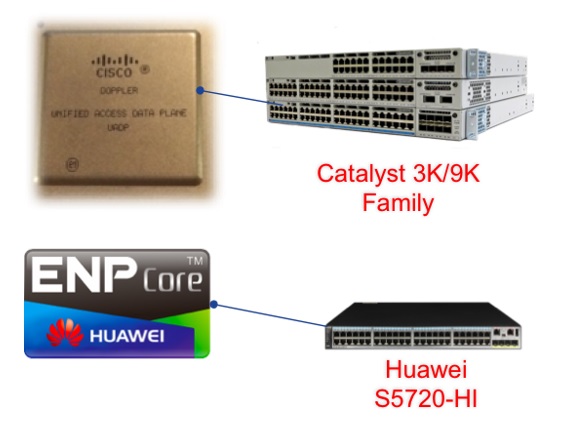
It’s important to note the Huawei S5720-HI switch series are built with Huawei’s custom silicon ENP (Ethernet Network Processor) chip. This compares against Cisco’s Catalyst 9300 and 3850 UADP based switches.
Miercom developed a multi-purpose test to assess the switch policy filter scalability limits and resource management. Additionally, each switch was tested to determine if it would be susceptible to a network security breach during adds/changes/deletes to an existing policy filter.

Why is this important?

With the emergence and growth of IoT markets, there is a critical need for security and segmentation. The network needs to correctively identify and provide controlled-access to what users, devices, and things have access to. Regardless of the communications medium, today’s world consists of dynamic access through automated policy. Without getting too deep into the implementation details of the policy stack, eventually the network infrastructure must support the ability of programming its resources both dynamically and statically. Network policy constructs are used in the form of Security ACLs, QoS Filtering, etc applied to physical and logical ports such as L2 VLANs, or L3 Routed Access interfaces.

An intent-based networking system supports an automated implementation of features. This requires the underlying hardware to be “ready” or in essence fully capable of supporting dynamic manipulation from the controller.

For implementing high-speed lookup functions, switching systems rely on special memory called ternary content addressable memory (TCAM). TCAMs are precious switching resources required to store policy rules and perform lookups based on configuration of the switch. Based on the desired intent, actions will determine the switch’s treatment of packets on the network.

How did they do it?

To investigate the behavior of the hardware capabilities, Miercom performed the following Test Methodology.

Miercom Test Objectives:

  • When applying the same ACL to multiple interfaces, does the ACL consume N x TCAM entries, where N = number of ports to which the ACL is applied?
  • Does the switch support optimized resources – ACL Sharing?
  • How does the switch manage changes to the existing ACL? Is the system Secure?
  • Does the switch allow denied traffic to be forwarded during ACL editing?

Each switch was configured with inbound and outbound policies applied to Layer 3 interface.  A Spirent Test Center was connected to each switch for traffic generation against the ACLs conjunction with PCs connected to each switch to test for access to services such as FTP, ICMP, Telnet, and SSH. The switches were monitored for resource utilization such as TCAM, CPU, acl counters, and system logging.
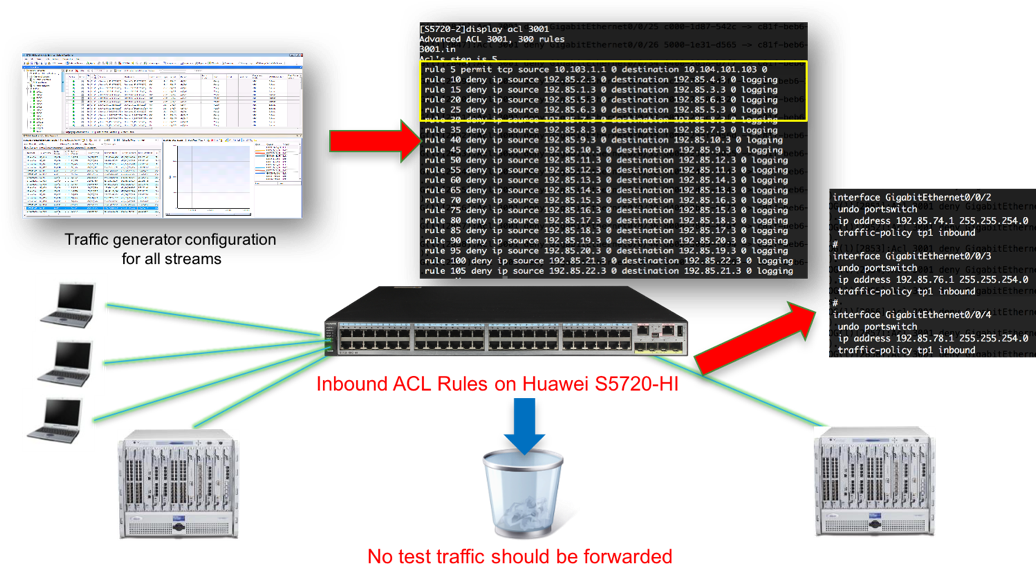
When applying the same ACL to multiple interfaces, the ACL consumed N x TCAM entries, where N = number of ports to which the ACL is applied. For example, on the Huawei S5720-HI, an inbound ACL with 300 rules applied to all ports (48 x southbound interfaces and 4 x uplink interfaces) consumed 15,600 rules. When attempting to apply the same ACL for outbound direction, the S5720-HI was limited to only a subset of interfaces as it completely exhausted the hardware resources of the Huawei Switch. Huawei’s resource allocation was not optimized and did not offer scalability for this test case. Their documentation recommends the user to perform a merge of rules, change of the hardware resource template, or switch to a VLAN based approach.

Miercom observed when applying the ACL to all 48 ports of the S5720-HI, the switch exhibited significant amount of time (minutes) for the ACLs to the become active.

Miercom also observed when editing an ACL on the S5720-HI, the implementation behavior is flawed and unfortunately exposes the network to a security breach. Due to the architecture of the switching resources, the Huawei 5720-HI switch “allowed” denied traffic to forward during an ACL edit. When edits are made, the switch completely removes the old Security Policy from its hardware resources, then reprograms the resources with the revised statements. Not only did this takes a long time, it left the network vulnerable.
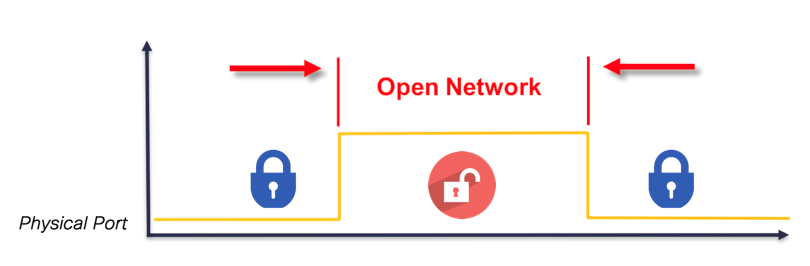
Miercom observed the S5720-HI allowed thousands of denied packets on every switch port. The Spirent system reported that, by the time the ACL change took effect on all ports on the Huawei switch, 70,000 packets had leaked through each switch port –more than 3.3 million packets that should have been blocked. This is a policy violation and creates a window of opportunity for a security breach.

The same set of tests were performed on the Catalyst 9300/3850 Series switches. The Catalyst 9300/3850 switching resources support high-speed policy edits (Adds/Deletes) with efficient resource allocation for scale, and secure implementation. With features such as “ACL Label-Sharing” and “Hitless ACL updates”, the switches demonstrated programming of policy to the network without being compromised. A table-stakes requirement for dynamic policy based automation.
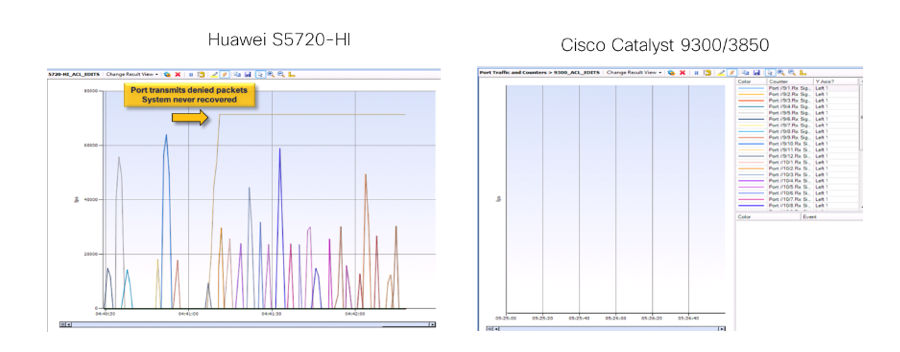

An overlooked yet critical component to support this capability is the implementation of policy programmed in switching hardware. ACLs are one of the most basic mechanisms used for traffic classification. They can be used for multiple use cases such as multicast, QoS, and security. It is critical that modifying entries for a particular use case, does not affect other operational uses cases for customers. And more importantly, for the specific area of security, it is instrumental that non-permitted traffic is not accepted under any circumstance. While Cisco passed this test with great colors, Huawei failed to meet this important requirement.

Download the complete Miercom report here.

Authors

Richard Licon

Principal Technical Marketing, Engineering

Product Management - Competitive Insights

Avatar

#CiscoChampion Radio is a podcast series by technologists for technologists. In this episode we’re talking to Lauren Friedman about the Cisco Champion program.

Get the Podcast

  • Listen to this episode
  • Download this episode (right-click on the episode’s download button)
  • View this episode in iTunes

Cisco Guests

Cisco Champion Hosts

Podcast Discussion Topics

  • The Cisco Champion program mission and goals
  • When the program started
  • Why Justin likes the program
  • How the Champions use the Spark Rooms
  • Types of people who make up the Cisco Champion influencers
  • The people responsible for the Cisco Champions program
  • Where to go and how to join the program

Listen in and provide us feedback, we would love to hear from you!

Resources:

The 2018 Cisco Champion application period is currently open!
Are you tech savvy and passionate about IT? Are you active on social media? You may be eligible for the Cisco Champions Program. Learn more.


Authors

Andi Fisher

No Longer with Cisco

Avatar

Applications open Nov 1 through December 8 apply today!

Do your peers consider you to be a thought leader based on your strong technical knowledge of Cisco products and technologies? Do you maintain an active online or social presence to interact with others and share what you know?

Cisco Champions are regarded as experts in Cisco products and technologies by their peers and actively share their knowledge, expertise, and thoughts in technical forums, communities, user groups, social media and speaking engagements across the social web, IRL and with Cisco. The program has been running for more than 4 years and each year open nominations are held to find and select the best candidates from around the world.

Cisco Champion Applications are Open!

If that sounds like you*, we invite you to apply to the program or nominate someone you know for the 2018 Cisco Champion program. The application form will be open now through December 8, 2017.

Impact: Cisco Champions is an award-winning program that connects a passionate group of technology enthusiasts with Cisco subject matter experts. Participants gain access to a global network of Champions and interact directly with Cisco through technical briefings, podcasts, blogs, and in-person events.

What is a thought leader? Thought leaders are regarded as a community influencer/technical authority via online and offline contributions in social media, third-party technical forums, communities, user groups, speaking engagements, or other venues.

Listen to our Cisco Champion Radio podcast, What the heck is the Cisco Champion Program?

Fill out the application to be a 2018 Cisco Champion.  

Learn more about the Cisco Champion Program at http://cs.co/ciscochampion.

*Applicants must be at least 18 years of age and cannot be a government official or Cisco employee.

Authors

Andi Fisher

No Longer with Cisco

Avatar

Enterprise app developers want to use the power and ease of cloud services with
enterprise-class security, and cloud developers want to reach the information in enterprise
applications and data warehouses.

Cisco DevNet is excited to bring developers a new solution from Cisco & Google. This
solution brings together the power of cloud development and enterprise application
development by allowing developers to quickly combine Google Cloud Platform
services with on-premises applications and services, and solves challenges that
enterprise development teams face today such as:

  • Have you ever wanted to seamlessly deploy, manage and secure applications across
    on-premises environments and Google Cloud platforms?
  • Does your enterprise development team want to work with open source tools such
    as Kubernetes and Istio, but needs to integrate with existing on premises
    applications?
  • Do you need to extend network policy, security and performance monitoring across
    on-premises and cloud deployments?

The Cisco and Google partnership makes these goals possible – with cloud speed and
scale and enterprise-class security and support.

Google Cloud Cisco DevNet Susie Wee

In support of this partnership, DevNet is launching the Cisco and Google Cloud Developer
Center that helps you explore open source technologies such as Kubernetes and Istio,
learn about Cisco platforms, and get hands-on with hybrid cloud solutions.

Cisco DevNet invites developers to explore technologies for developing and deploying modern
apps in a hybrid world and get hands-on with learning labs and running code against live
infrastructure. Developers can get started in the DevNet Sandbox with Kubernetes and
Contiv container networking or take a DevNet Learning Track on Cloud Native
Development.

We will be rolling out more developer resources in the coming weeks and months, so
please do get hands on with code and let us know how DevNet can help your enterprise
development team on their transition to the multi-cloud world. We look forward to seeing
you in the community.


We’d love to hear what you think. Ask a question or leave a comment below.
And stay connected with Cisco DevNet on social!

Twitter @CiscoDevNet | Facebook | LinkedIn

Visit the new Developer Video Channel

Authors

Susie Wee

SVP & CTO

Cisco DevNet Ecosystem Success

Avatar

Doing things right is arguably one of the key skills to develop innovative initiatives. Given the complex and risky nature of these projects, their execution is a mix of art and science. However, as challenging as it may be for companies and institutions to plan an innovative project, doing it right is only one side of the coin. The other side is doing the right things— precisely choosing the right projects. This is the domain of portfolio management.

In an ideal world, resources, both financial and human, would always be available for strategic initiatives, and thus all initiatives would be fully funded. However, as we all know, this is not reality; even strategic initiatives are subject to resource constraints and prioritization. In essence, portfolio management is about making process-based choices. It’s about saying no to a good idea in order to fund a better one1.

When there are multiple options for investment and multiple combinations of those options, choosing becomes complex. Just like the execution of the projects, the decision on the best portfolio of innovation initiatives also becomes a mix of art and science.

Cisco’s Rio de Janeiro Innovation Center is a hub of co-innovation for Latin America

Since 2013 the Cisco Innovation Center in Rio de Janeiro has been involved daily in the process of co-developing innovative solutions with our customers and a diverse ecosystem of partners, including venture capital funds, startupssoftware and hardware vendors, Cisco channel partners, and research institutes. Those projects have been focused on several different verticals such as smart grid, smart cities, education, manufacturing, retail, and financial services, among others.

Throughout these years, in order to better define which initiative we should engage, some practices have stood out as the most relevant in our innovation portfolio management process:

  1. Strategic Alignment – The essential function of a portfolio, whether of financial assets, products or innovation initiatives, is to achieve the objectives of a given strategy. Thus, the first and most important practice is to ensure that is the things we choose to do are aligned with the strategy.
  2. Single Evaluation Model – Ensuring credibility and comparability among project options is essential for the correct selection and prioritization of initiatives. A single model simplifies the evaluation and comparison between various innovation initiatives.
  3. Balanced Innovation Portfolio – Diversifying assets to reduce a portfolio’s overall risk is one of the principles of modern portfolio theory2. A balanced innovation portfolio will allow you to maximize the return on investment.
  4. Iterative Governance and Execution – To appropriately address the inherent complexity and risk of innovation projects, you’ll need an agile approach to governance and execution that fosters cycles of validation and feedback together with iterative development and execution.

In this series of posts, I will share the experience we have acquired at the Cisco Innovation Center in Rio de Janeiro during the last four years. I will address those practices, as well as introduce some of the principles and concepts about innovation portfolio management.

And you, how are you coping with this challenge in your organizations? I would love to exchange information and experiences.


References

1 The Smart Organization – David Matheson and Jim Matheson

2 Harry Markowitz – Modern Portfolio Theory


Authors

Leandro Barbeita

Head of Rio Innovation Center

Corporate Strategic Innovation Group (CSIG)

Avatar

I have been at Cisco for 22 years. In that time, I’ve never felt a transition of this magnitude. We are moving our customers to the cloud and changing the way we do business with you – two radical transformations that promise enormous benefits. You get better user experiences and easier deployment of our products through the cloud. And with subscription purchasing, you get lower CapEx costs along with automatic entitlement to the latest software enhancements.

In the collaboration team, we’re feeling this profoundly as we break through barriers to deliver the meeting experience of the future. One piece of that is our recently announced intent to acquire BroadSoft. Bringing in BroadSoft, the global leader in cloud voice and contact center solutions, is a breakthrough advancement in accelerating the growth of our cloud portfolio.

Get better user experiences and easier deployment of our products through the cloud.

At Cisco Partner Summit this week, we’re demonstrating the new meeting experience, which is built on the tight integration of our software and endpoint portfolio to deliver consistent experiences across devices. We believe our continued innovation and ability to execute are an important part of why Gartner positions Cisco as a leader in its latest Magic Quadrant for Meeting Solutions.

Fastest growing collaboration offer

Customer preference for unified technology from a single vendor is driving the way we sell. The Cisco Spark Flex Plan is our lead subscription offer for buying the new meeting experience. It is designed, frankly, to motivate you to buy our technology together – because together is the best way to bring our vision to life.

It is working. The Flex Plan is the best, easiest, and most affordable way to buy our software. And it’s our fastest-growing offer ever. I’m thrilled with this success because it is helping us get you the meeting experience you need to compete and win today. Our ultimate goal is to reach 1 billion users!

New ways to buy Cisco Spark Board

With the growing popularity of Cisco Spark Board, our all-in-one meeting device, we are offering more flexibility in the ways you can buy it. As with our other collaboration devices – like desktop and room endpoints – you can now buy the Cisco Spark Board in two ways:

  • The subscription option combines a low up-front cost plus monthly subscription for OpEx budgeting
  • Using our up-front global price list (GPL) is based on the full hardware cost plus lower monthly subscription for CapEx budgeting

Cisco Spark Board is a cloud-only solution. You can purchase the required registration to the Cisco Collaboration Cloud through the Cisco Spark Flex Plan (included free to Flex customers) or a la carte. Also, be sure to take advantage of Easy Pay financing options from Cisco Capital. Contact your Cisco collaboration sales specialist for details.

Improving technology access for students

Finally, we are making it easier to get Cisco Spark and Cisco Spark Board into the hands of students and educators around the world. I’m happy to introduce our new “Learn without Limits” education offer, which allows schools to buy our state-of-the-art whiteboard, content sharing, and video conferencing device and a Cisco Spark Enterprise Agreement at a highly competitive price beginning November 27. Contact your Cisco collaboration sales specialist for details.

We will continue to expand and simplify our offers until our world-class enterprise meeting experience is accessible to everyone around the globe.

Learn more about the Cisco Spark Flex Plan.


https://www.youtube.com/watch?v=j7vbXRRAPyg&feature=youtu.be

Gartner Magic Quadrant for Meeting Solutions, Adam Preset, Mike Fasciani, Tom Eagle, 18 September 2017.

Gartner does not endorse any vendor, product or service depicted in its research publications, and does not advise technology users to select only those vendors with the highest ratings or other designation. Gartner research publications consist of the opinions of Gartner’s research organization and should not be construed as statements of fact. Gartner disclaims all warranties, expressed or implied, with respect to this research, including any warranties of merchantability or fitness for a particular purpose.

Authors

Andre Smit

Vice President

Avatar

The traditional corporate data center is still the hub for most enterprises, but increasingly organizations are leveraging the benefits of the multicloud world to drive operational efficiencies, scale and expand growth. While the benefits are clear, securing multicloud environments like SaaS apps, public cloud infrastructure and hybrid cloud environments is complex. Users are increasingly self-selecting which apps to use anytime and anywhere. DevOps teams have more options than ever to deploy new services on Google Cloud, AWS and Azure.

We want to ensure our customers are at the forefront of this business transformation, so Cisco has built a broad set of security solutions for the multicloud world. Today, I’m excited to share with you our expanded multicloud security portfolio.

Protecting SaaS Applications

To reduce the risk of phishing attacks, we are expanding our cloud email security to integrate with Cisco Advanced Malware Protection (AMP). Cisco Email Security already has the ability to retrospectively remove a malicious attachment and delete it from a user’s inbox even if it was originally deemed to be legitimate. In our upcoming 11.1 release, available in December 2017, Cisco Email Security will integrate with the cloud-based AMP Console to give customers a unified dashboard for all malware activity across laptops, mobile devices, firewalls, routers, web email and internet gateways. As a result, security professionals will be able to stay on top of threats and free up valuable time.

We also know that our customers want greater visibility into the cloud services their employees are using. So, in August 2016, we acquired Cloudlock, a cloud access security broker (CASB) focused on securing identities, data and applications in the cloud. Currently, Cloudlock can discover more than 300,000 OAuth connected third-party apps, but to provide visibility into on-network “Shadow IT” cloud activity we are augmenting it to include additional capabilities. The new functionality is currently in beta and will be available in early 2018.

Protecting Public Cloud Environments

Stealthwatch is the industry leading network visibility tool used to identify anomalous traffic flows in the enterprise. But as customers move to the public cloud they need visibility into AWS, Google Cloud and Azure infrastructure. So, we recently acquired Observable Networks to extend Stealthwatch to the cloud. These added capabilities allow customers to deploy Stealthwatch on premise, in the cloud, for the cloud and for huge distributed environments. Rebranded as Cisco Stealthwatch Cloud, the solution monitors public cloud infrastructure and detects threats without the need for software agents. It models traffic and behavior to understand what normal activity looks like and uses this model to detect abnormal and malicious activity in real-time. Stealthwatch Cloud also maintains records of past activity to facilitate forensic investigations at a later date.

Securing Access to the Cloud

Today’s work environment allows employees to work from any device, anywhere and anytime. As remote users work directly in cloud apps, perimeter security appliances and VPNs are no longer always going to protect devices and data. So, we continue to enhance our secure internet gateway, Cisco Umbrella, to protect users when off the network and off the VPN. Formally launched at the RSA Conference in February 2017, Cisco Umbrella now processes more than 120 billion DNS requests per day with more than 85 million daily active users. The recently announced Cisco Security Connector app for iOS enables company managed iPhones and iPads to be protected by Cisco Umbrella whether on Wi-Fi or the cellular network.

Delivering Cloud Security Advisory Services

As customers move further along in their multi-cloud journey, they want to know how they can improve their security posture and measure their effectiveness. To address these needs, Cisco is now offering a cloud security assessment service that includes strategy recommendations, cloud security architectural planning, cloud data protection and user behavioral analysis.

With this expanded portfolio, Cisco now makes it easier than ever for organizations to leverage a complete and holistic solution from a single vendor to obtain full visibility and control over SaaS and public cloud environments. We encourage you to see the simplicity and effectiveness of our cloud security portfolio for yourself. Since of all these solutions are designed for the cloud and delivered from the cloud, it only takes minutes to initiate a trial or assessment. Get started now by clicking here.

Authors

David Ulevitch

No Longer with Cisco

Avatar

Cisco Live is a great platform to learn new technologies, trends, talk to experts about several topics from a technical or business perspective and leverage some of the greatest minds in the IT Industry. You’ll have the opportunity to meet peers from several industries that somehow, share similar challenges as you with regards to IT disruption with cloud and digital transformation.

But…

How mature are they concerning cloud?

Cisco and IDC can help you understand your cloud maturity level.

A brief context-

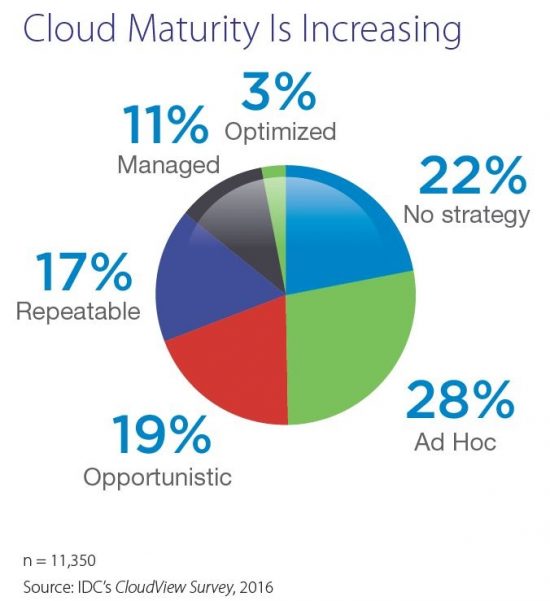
According to an IDC study, there are five maturity levels of cloud adoption and, even though cloud is being highly adopted with more than 80% of worldwide organizations adopting multiple clouds, only as little as 3% of organizations have an optimized cloud strategy. When organizations achieve an optimized cloud strategy though, there are certain key performance indicators that are associated with better business outcomes. Some of the KPI’s that IDC found are, a 77% of IT cost reduction, 72% ability to meet SLA’s, 200% of strategic allocation of IT budget and even 11% of revenue growth.

How does Cisco and IDC have you covered?

1.  We can benchmark your organization according to IDC’s cloud maturity levels. Cisco, in collaboration with IDC, have developed a cloud assessment framework that can help you easily benchmark your organization and, find out how your competitors are doing with cloud.

2. We can tell you how to improve your business outcomes.By advancing cloud adoption levels, IDC can tell you specific percentages of how your    organization can positively influence some of your business outcomes like revenue increase; operations cost reduction or reduce time to market for new services/products.

3. We can help you implement worldwide best practices.

Once you find out what is your level of cloud maturity vs your peers and get some guidance to improve your cloud adoption; request a workshop. We can go in more details and define a strategy, do the proper changes in your existing one or shortcuts to innovate and improve your business outcomes faster.

So, while at Cisco Live Cancun, visit the Business Cloud Advisor and Cloud Services pods at the Data Center & Cloud booth, or click here and benchmark your organization using Cisco & IDC’s methodology. We can provide you a free assessment of your cloud adoption level with vendor agnostic recommendations and guidance.

In the case that you want to see how mature YOU are, well; benchmark your maturity level at the customer appreciation event – now that will give you some insights! 😉


Authors

Sergio Licea

Marketing Manager

Cloud Solutions, Americas

Avatar

In the digital era, every company is considered a technology company. Whether you provide electricity, banking or public transportation, you are increasingly dependent upon the internet and network connectively. If all companies are technology companies, that means all companies need to prioritize cybersecurity as a strategic imperative to ensure they are connected, digitized and successful.

Every organization should focus on two cybersecurity fundamentals: Understand what’s going on, and know the simple actions you can take to facilitate better cybersecurity in your environment. We can leverage the network to enable both of these fundamentals. To do so requires good network hygiene.

At Cisco, we’ve been working to draw attention to the hidden security risks organizations face by not properly maintaining their aging infrastructures and patching vulnerable systems. The trends lead us to believe we should expect to see more of this activity in the future – with widespread attacks that target not only traditional servers and endpoints, but also the network itself. This future activity will bring with it significant consequences affecting not just enterprises but entire industries.

An organization can no longer make the assumption that its network infrastructure is secure. Factors such as TA16-250A, WannaCry, the Presidential Executive Order and the Modernizing Government Technology Act of 2017 make it clear that attacks are escalating and business leaders must be proactive and demonstrate security diligence. Infrastructure of the past was not built to withstand the threats of today’s landscape. It is crucial that every organization – regardless of industry – verifies the security and cyber resilience of their network infrastructure that drives their business and, collectively, our global economy and national security.

Although it’s expensive to incorporate updates, the costs of ignoring aging infrastructure can be potentially devastating – in the form of lost data, revenue and customers, destruction of service and, ultimately, consumer trust. It is crucial to update and regularly patch all hardware and software within a network to enable proper and safe connectivity, communication, operations and overall management. Waiting to take action and hoping that you will not be breached is no longer an option in today’s world.

Systems that were designed, built and deployed in decades past didn’t anticipate the hostile security environment of today. Until now, very few have thought about securing infrastructure because they didn’t think adversaries would target these systems and devices, or they had “higher priorities” to fix. This must change.

Outdated components and software provide an opportunity for attackers to breach networks ‒ increasing risks for unpatched machines and some legacy operating systems at end of support. Be sure to choose trustworthy vendors and technologies that allow the network administrator to verify devices are genuine, unmodified and operating as intended.

Keeping your network up to date provides a place for visibility, policy and control for the things that are coming online. Visibility helps us understand day-to-day behavior. It’s crucial to leverage the network to segment assets and functions in order to reduce exposure and create observations and control points. This helps execute on the second fundamental I mentioned above – know the simple actions to take to facilitate better cybersecurity in your environment. When things are out of the ordinary, the network can enforce security policies that allow the right users and devices to get the right access and contain the impact of a potential attack.

Every organization must assess the overall strength and cyber resilience of their deployed infrastructure and systems. This process likely will be eye-opening, but it’s a necessary reality check. Organizations that proactively improve their security posture will be better positioned to meet today’s threats and prepare for tomorrow’s challenges and opportunities.

October is Cyber Security Awareness Month, and Cisco is a Champion Sponsor of this annual campaign to help people recognize the importance of cybersecurity. For the latest resources and events, visit cisco.com/go/cybersecuritymonth.

Authors

Anthony Grieco

SVP & Chief Security & Trust Officer

Security and Trust Organization