Avatar

Here I am again at another Cisco Live! I’m pretty excited about this one, because I’m not hosting anything…I’m really just here to learn and spread some of that information to everyone else. If you’re interested in what Ruba Borno had to say, which technologies she made mention of, and the general direction Cisco is headed…read on!

As you might imagine, the keynote was really all about analytics and everything that goes along with it. Just like in Berlin she referenced Maslow’s Hierarchy and how it relates to the digitization of the data center. It wasn’t a complete re-hash, though. While she concentrated on Analytics she focused mainly on security for a lot of the discussion. Obviously the more data we have, the more complex it becomes to secure.
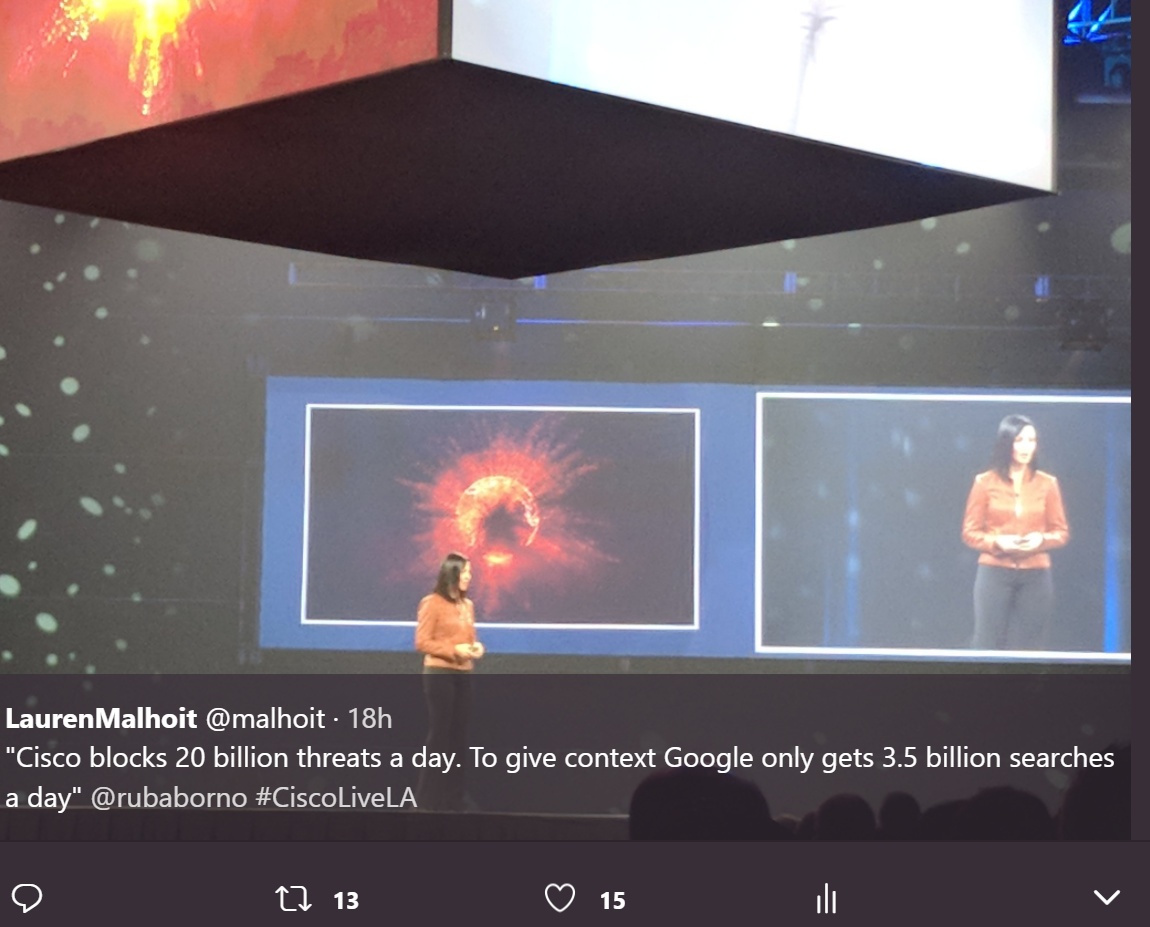
Borno points out that through our (Cisco’s) Talos team and the various security technologies we have available, we’re able to block about 20 billion threats a day. To put that in context, Google receives about 3.5 billion searches a day…so Cisco is blocking about 6 times the amount of threats than Google has searches. Now, that’s all well and good, but the point here is that in order to continue working at this level, because it’s not going to get better, we have to

Let the machines run the machines.

She started in the Enterprise…not surprising given the announcement of The Network. Intuitive. The announcement was based around DNA Center and SD-Access, but actually is starting to incorporate other areas at Cisco as well (Data Center, Security, etc). We’re embracing the Open API now. If you haven’t already heard, Cisco DevNet has become quite the force at Cisco. Engineers in various Business Units (BUs) and in DevNet are working on creating technology with Open APIs from the ground up, meaning it’s not just an add-on with half the functionality of the CLI/GUI.

DNA Center is no exception. If curious about DNA Center check out TechWiseTV. We have a few shows already out, with more coming before February 2018. DNA Center is really the interface that allows us to create network designs, create policy, and finally automatically provision. What this means is that it is the central management for using technologies like SD-Access, ISE, and Assurance for a complete well-rounded enterprise network. <– This is what leads to an Intent Based network. So, I can have automation not only from the initial day 0 provisioning, but I can also create policies and segmentation models and provision those automatically to multiple devices. Intent does not end there, and that’s where Assurance comes in. Now we can use analytics to find anomalies and inefficiencies and at least recommend best steps to fix the network, if not just automatically fix it. It’s a true feedback loop. Of course DNA Center offers monitoring for things like checking health scores easily as well. DNA Center also gives us the ability to manage both wired and wireless networks.

Let’s talk about ETA for a minute. Encrypted Traffic Analytics. ETA is basically in a league of its own. Although encrypted traffic is great, and we should almost always make sure we’re encrypting traffic, the technical (and business) problem with encrypted traffic is that we haven’t been able to analyze it for malicious payloads. Now, using ETA, which is part of the StealthWatch tool we can analyze encrypted traffic flows, or really the metadata associated with these flows, and we can tell if something is malicious. This means we aren’t decrypting anything, or invading any privacy. It’s all done by analyzing the “body language of a packet” as Borno stated in the keynote.

We then moved into the obligatory discussion on multi-cloud. Yes, it’s necessary to have this discussion. Cisco has been making several cloud announcements recently, mainly our new partnership with Google. And while that’s exciting, there are several technologies that have been enabling various partnerships with cloud. For example, ACI Anywhere, Cisco Cloud Center, vEdge Cloud from the recent Viptela acquisition, CSRs, and on the the security front Umbrella. Tetration Analytics, which was originally an on-premises appliance coming in large and small form factors has made it’s way to the cloud as well, in the form of Tetration Cloud currently running on AWS.

An analytics keynote would not be complete without mentioning one of our more recent acquisitions AppDynamics (fondly known as AppD by those in the know). Basically where Tetration leaves off in the data center, telling us everything we never wanted to know about our traffic and how to segment our applications, AppDynamics picks up with the application itself. Actually AppD goes beyond the application to what we’re calling Business iQ now. So, it will help us with our business processes, doing things like comparing revenues (more on AppD in a near future blog).

The keynote was rounded out by talking a bit about Kinetic (anyalytics for all your IoT devices) and finally brought back to the “human experience” and “self-actualization” via Mazlow’s hierarchy by talking about Spark as well as the new services offering available at Cisco. Check out this TechWiseTV episode for more on that.

Phew…that was a lot. As always, if you have any questions or comments, feel free to leave them below or reach out to me via Twitter @Malhoit or @TechWiseTV.

Gracias mi amigos!

Avatar

Innovation is happening everywhere, and last month it was in full flourish at the Maker Games of the University of New South Wales in Australia. Nine leading companies submitted real-world challenges for teams of students to work on in a rapid prototyping competition. The winning team built a working prototype addressing one of three Internet of Things (IoT) challenges from Cisco—gas cylinder tracking and telemetry. Cisco Distinguished Services Engineer Jeff Apcar was the team’s mentor.

Read the full story in Jeff’s blog here.


Authors

Tom Goerke

Director, Innovation Centers Australia

Avatar

Customers, partners and industry leaders are soaking in Yucatan heat and learning about the latest developments in the Industrial IoT market this week at Cisco Live Cancun.

Conference attendees have spent the last several days taking in educational sessions, gaining hands-on experience with the latest development practices and developing deeper understanding of Intent-based networking. The World of Solutions offers line of business and IT professionals the opportunity to explore the full scope of offerings from Cisco and ecosystem partners. The IoT and Industries District includes Industrial IoT demos ranging from ruggedized Industrial IoT networking products to full solutions for manufacturing, energy and transportation initiatives built on the Cisco Kinetic platform.

Manufacturers have been one of the earliest segments to adopt Industrial IoT and the Cisco IoT product portfolio at production scale. With connected factories adopting standard IP networking on the plant floor, it’s not surprising that one of the most popular demos in the IoT District at World of Solutions was the Cisco Industrial Network Director (IND). The management and automation tool is purpose built for operators and technicians on the plant floor with a user experience tuned for rapid deployment and easy troubleshooting. Current customers have shown measurable results in terms of increased system availability and overall equipment effectiveness (OEE).

Another emerging trend is the application of Industrial IoT Networking in the extended enterprise. This extension of Intent-based networking brings the benefits of a holistic closed loop approach to policy, assurance, and automation to areas beyond the traditional enterprise setting and into spaces such as warehouses, distribution centers, kiosks and outdoor environments.

A common topic across the past several days with IT and operations was taking advantage of Intent-based networking initiatives led by IT to increase overall business value and return on investment by extending the reach of the initiative to include existing and planned warehouses and distribution centers. Specific business outcomes in this case include improved customer service levels and shipment cycle times as well as increased ability to reach new markets with an easily deployed, repeatable, centralized managed architecture.

The net result with the attendees spending time in the IoT District at Cisco Live Cancun is a realization that there are many methods to build new business, increase efficiency and create better customer experiences with the Cisco Industrial IoT portfolio.

Check out more photos and Cisco Live Cancun conference happenings by following @Cisco_IoT on Twitter. Learn more about the latest developments with Cisco IoT at Cisco.com/go/iot.


Authors

John Reno

Marketing Manager

Avatar

Winter and ski season is approaching in Norway, and I look forward to going fast again. Going fast is a passion I share with CEOs and CIOs who are under pressure to get to market with better solutions, faster.

We introduced Cisco Spark Board earlier this year to help teams rapidly turn creative ideas into action. And that’s what we have seen happen, from growing companies like AvidXchange that are disrupting the financial software market to large companies known for innovation, like Royal Caribbean Cruise Lines.

Today we are introducing a set of Cisco Spark Board capabilities to improve creative teamwork. We’re adding annotation, improving how attendees see each other, and simplifying deployment.

https://youtu.be/Jo7Dtc_fi1E


Changing the Presentation Game

We’ve added an awesome new capability: annotation on presentation. Cisco Spark Board already lets you create and share whiteboards, plus share presentations and other content. Now teams can also draw on top of – or annotate – what they’re sharing. And we have improved how you save your work to a space for sharing or future iteration.

Annotation increases the speed at which teams can collaborate. Most meetings don’t start with a blank sheet of paper and you rarely deliver a presentation without comment or discussion. Meetings are about discussing and evolving ideas so they can become reality. Attendees may share content like PowerPoint presentations, code, spreadsheets, web pages, and documents. Annotation lets people provide visual feedback and mark up content in real time, whether on the Board itself or using the Cisco Spark app.

The opportunities for improving collaboration through annotation are pretty limitless.

Annotation changes the game no matter your industry. Think about the possibilities, such as:

  • Engineering teams holding scrum meetings
  • Architects and designers collaborating with clients
  • Marketing teams developing campaigns
  • Manufacturers working through process improvement
  • Builders working with suppliers
  • Doctors reviewing scans

We even have a coach of a professional sports team who is excited to use it to demonstrate plays to his players. Personally, I just came back from an offsite meeting with my team where we annotated shared content all the time – extremely useful!

Improving the View

When designing the Cisco Spark Board experience for conferencing, we focused on simplicity. It’s been important for us to remove any unnecessary and complex user input and adapt the experience to fit the meeting type and room.

The Cisco Spark Board already has a fantastic microphone array that picks up the active speaker’s voice and filters out background noise. Now we’ve added an enhancement that we call best overview.

Already introduced on Cisco Spark Room Series, best overview optimizes the video framing of people in the room. The intelligent digital camera evaluates the participants relative to the room space and dynamically crops and positions the image to frame them perfectly for the far-end audience. This is particularly useful, for example, when a few people are in a large room. The best overview feature automatically activates so that participants don’t appear small at the end of a long table. It’s a better experience for everyone in the involved and it doesn’t require anyone to fiddle with camera zooms or presets.

We have also just deployed another important enhancement that we call activity layouts. This adapts the video layout of the participants on the Cisco Spark Board to the nature of the meeting. For example, if the meeting is a lively discussion between you and two other participants, you will see them in equal size side-by-side. If it’s more of a presentation from one person to several others who mostly listen, you will see the presenter in full size and the other participants in smaller views. And of course, nobody has to think about this or manually adjust layouts. 

Simplifying Deployment

In addition to improving the user experience, we’ve also focused on further simplifying the deployment of Cisco Spark Board. It’s already quite easy: Plug in power, connect to the network, activate the device, and you are off to the races.

We’ve further simplified the “connect to the network” step with two enhancements – WiFi and http proxy support. Add Ethernet cables to the pile of wires, screens, phones, and other extraneous hardware that you no longer need in conference rooms. With WiFi, you need only one cable, and that’s the power cable for the Cisco Spark Board.

The http proxy support means you can allow Cisco Spark Boards to access the Internet through your proxy server like all other network traffic. The proxy solution now supports signaling (not media), configured manually, with basic or no authentication.

We introduced Cisco Spark Board with the capabilities teams need most: white boarding, content sharing, and conferencing. We’re continuing to enhance the user experience as we go. Keep watching and letting us know what you think.

Learn more about Cisco Spark Board.

Authors

Tormod Ree

Senior Director and General Manager

Avatar

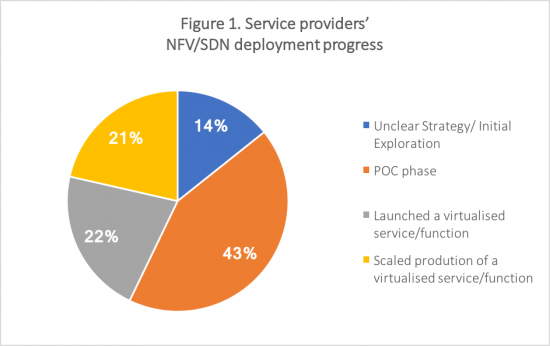
Digitization of communication service providers(CSPs) starts with SDN and NFV. But they are facing a lot of challenges as they transform their network and operations to meet the demands of becoming a digital service provider. Adoption has been slow. Most of them are stuck in proof of concept stage while others are trying to understand how to deliver and scale services as shown in Figure 1. To find out why, we surveyed a number of CSPs around the globe. We compiled the findings into a 200-page playbook. The playbook is based on the approaches and methodologies these service providers used to overcome their challenges.

The transformation is more than a technology shift. As a head of network and IT of one of the European operators highlighted “It is not just a technology project. Our goal is to be more customer-centric with our offerings, with the ability to be agile and create products on the fly”. The playbook provides guidance on what it takes to transform your operations, technology adoption, organization, people, marketing, sales….to meet the demands of SDN and NFV. The plays provide insights to various stakeholders like CMOs, CFOs, CTOs and CSOs within the SP.

   We have developed this playbook to guide you through your transition. Let us jump in and help you win this matchup against the digital economy. Details of  the playbook summary can be found here.


Authors

Ben Bekele

Director Prouduct Management

Avatar

When I was a kid, I used to love dot-to-dot books. I enjoyed formulating a guess of what the picture was, the hunt in finding all the dots, the satisfaction of connecting them all together, and the excitement of the final picture coming into view to either confirm, or deny, my suspicions of what I was drawing.

Connecting the dots for better threat protection

Cisco is taking that same approach in connecting the dots across endpoint, network, and cloud, particularly cloud email, for a more effective security posture that sees a threat once and protects against it everywhere. Connecting these dots enables organizations to develop a true picture of accurate threat protection.

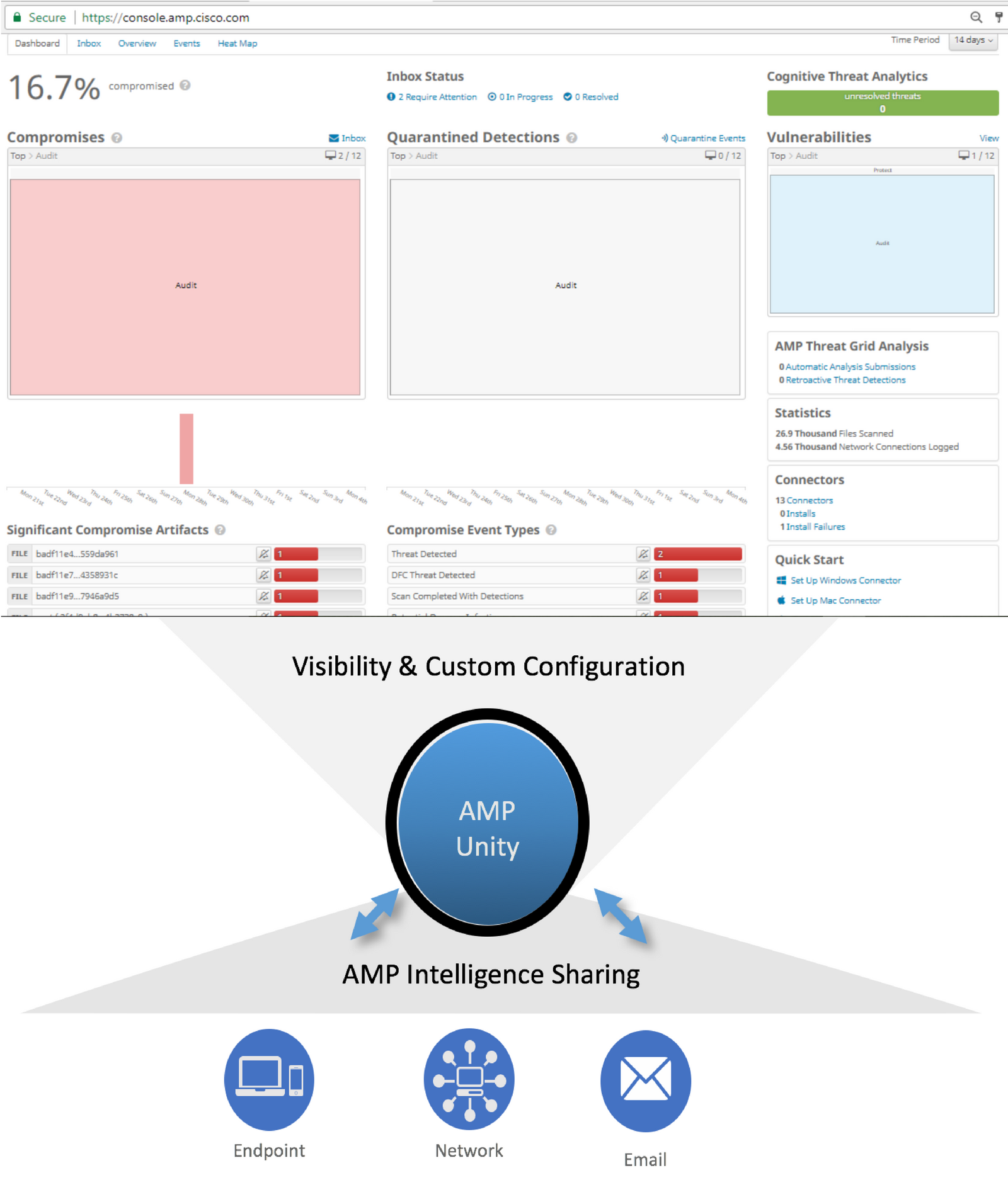
AMP has capabilities that enable a threat seen by a firewall, endpoint or email gateway, to be instantly shared to the AMP cloud. Now, with Unity, AMP has a global view of all of the various threats across all of the threat vectors. Unifying the ability to see the commonality between threat vectors.

Unity is a dashboard within the AMP console that connects all the dots of endpoint, network and cloud email together. It allows shared threat intelligence to be able to be correlated across all of these potential threat vectors. A unified dashboard for all correlated and connected devices automates threat sharing throughout the ecosystem. Unity allows you to see the commonality between network, endpoint and email and create a global block across all of the threat vectors.

All of the queries and data within the AMP Cloud from all enabled devices across endpoint, firewall and email are correlated together. This means that if a file that is a potential threat comes across any of these devices on the network, a global trajectory of the files can be provided as it traverses across the network, for better threat detection and faster time to resolution.

With Unity now you can:

Use global outbreak control to create a custom whitelist and blacklist for endpoint, firewall and email to compare files against and coordinate what is blocked and what is not.

Common file policies around indicators of compromise can also be created and all endpoint, network and email gateways that are AMP enabled can be set to adhere to those lists and policies

Set common file policies around indicators of compromise for enhanced threat defense.

Enhance email threat protection by enabling inbound and outbound file trajectory monitoring. This means you can not only ensure that a threat does not enter an environment, but also ensure a threat does not leave via an outbound email, and protect against any inadvertent data leakage from outbound email.

Connecting these dots within a single management console allows for faster threat detection and identification as the ability to better protect against future threats by coordinating your threat defense across multiple threat vectors. AMP Unity enables deep visibility into potential threats, a clear picture of what happened when a threat is detected, and a wide field of view capturing every aspect of what happened from your endpoint to your email gateway and firewall. Unity connects all the dots to give you a true picture of threat defense for your network.

For more information about Cisco Email Security and AMP go to www.cisco.com/go/cloudsecurity

Watch this video about file trajectory and device trajectory features in AMP:

https://youtu.be/8SHwegqD8bY


Authors

Beth Barach

Senior Manager, Product Marketing, Email Security

Avatar

Cisco Networking Academy has been changing worlds for 20 years. To celebrate this milestone, we are spotlighting some of the 7.8 million students worldwide who have benefited from this IT education and career building program.

Stephanie Krusch

  • Rochester, New York
  • Current occupation: Frontier Internet Help Desk Technician
  • Networking Academy coursework: CCNA 1-2, CCENT (September 2017)
  • One word to describe her Networking Academy experience: Inspiring

Stephanie started the Networking Academy at her parent’s urging, when she was 18 and a senior in high school. Though it involved extra time in the classroom, even after she’d been accepted to Rochester Institute of Technology, she took the course all the same.

The Networking Academy kept Stephanie “on her toes” and familiarized her with the kind of technology only available through the courses. Even though she was “the only girl” in her class, she kept at it, and now, she’s “extremely interested in networking.”

A distance runner, Stephanie says her career is just like running: “It’s about never giving up.”


⬅️ Previous student                                                                Next student ➡️


Authors

Austin Belisle

No Longer with Cisco

Avatar

Cisco Networking Academy has been changing worlds for 20 years. To celebrate this milestone, we are spotlighting some of the 7.8 million students worldwide who have benefited from this IT education and career building program.

Andrew Giddings

  • Phoenix, Arizona
  • Current occupation: Interim Vice President, Information Technology/CIO
  • Networking Academy coursework: CCNA 1-4
  • One word to describe his Networking Academy experience: Life-changing

Andrew’s hero is his father, a long-time high school teacher and coach. “All I ever wanted was to make my dad proud,” Andrew says. Along with everything else Andrew’s father did, he taught a Networking Academy course.

Originally, Andrew wasn’t sure the technology field was right for him; he simply took the Networking Academy course to be closer to his father. But Andrew was quickly hooked. In fact, he says, it set his career on a “different trajectory.”

After graduating, Andrew has held a variety of positions in the IT sector, with increasing levels of responsibility. When Andrew told his father about his current role at Mesa Community College—a large school with an enrollment of over 26,000— his father broke down with pride. Both say the Networking Academy got him where he is today.


⬅️ Previous student                                                                Next student ➡️


Authors

Austin Belisle

No Longer with Cisco

Avatar

This blog was guest-written by Kathy Xiaosi Gong, CEO and co-founder of WafaGames. She’ll be guest-speaking during the “Social Entrepreneurs Using Tech to Solve Global Problems” session of the Women Rock-IT series on November 16th.

As artificial intelligence (AI) shapes our future, technology itself is transforming to become more human and emotional.

In my opinion, emotional technology (ET) will soon be at the heart of a new generation of startups. What is emotional technology? It’s a technological solution that has the capability to intelligently identify, monitor, and adapt by itself from the mass of data created through our social networks.

In today’s hyper-connected world, the way we feel, express emotions, and interact with others has fundamentally changed. These activities now happen instantaneously, intertwined with no clear boundaries or sequence, and they spread at the speed of light.

With these changes, I believe the word ‘product’ will soon be replaced by the idea of an ‘experience.’ The most common things in our life will become various forms of experiences. There will no longer be steps to design, make, market, or sell one’s product; rather, these actions will happen at the same time and impact one another.

Emotional technology will become the core of building an experience and serving users or customers.

The technology applied to make a product is mechanic, yet creating an experience is organic, dynamic, and can be powerful for start-ups. It’s a wonder that the smallest companies have the ability to create an immersive experience for customers, one with built-in emotional technology and customized narratives.

As entrepreneurs, this shift requires a whole new way of thinking about our products and solutions. And as a form of mental exercise, I often ask myself a few simple questions:

What is the purpose of creating this experience?

What experience will I offer to best serve the purpose?

Where/how do I initiate this experience?

What kind of relationship do I need to develop with my audience during the experience?

How do I empower my audience to participate and become an organic part of the process?

How do I build the technical solutions as the fundamental infrastructure to evolve this experience?

Before emotional technology, I’d ask myself to identify target users and their biggest paint points. Then, I’d transition to developing the product to address these issues. However, when we embrace this new thinking, we can completely reshape our approach in finding and designing such solutions.

At WafaGames, the startup I co-founded with my two best friends, Joe Wu and Radwan Kasmiya, we see video games as ‘a digital form of storytelling’ through the collision of art and science; giving voices to the unheard and thus defining our purpose of creating a unique experience for consumers.

No human catastrophe is greater than war, and no tragedy is more painful than the loss of human life. People use games to kill virtual enemies for fun. However, we want to change the purpose of video games. That’s why we’ve chosen the Crusades as the theme for our newest game, which will allow users the opportunity to play out the period’s authentic and historical events. The Crusades serve as one of the darkest times in human history, and our attempt is to invoke thoughts on the consequences of war through our mobile application.

Before designing the game, we had to ask ourselves: How do we create a game with emotional technology, one where players experience a sense of self-expression in which they feel both emotion and moral ambiguity; that every decision they make is also going to affect the outcome?

Here comes the challenging part—the breakthrough to serve a purpose.

In order to remind a player that every decision he or she makes is also going to affect the outcome, we have to give players real-time control and realistic immersed experiences during gameplay. Unfortunately, such real-time strategy (RTS) games have yet to be created for mobile platforms.

Until now, players had no control of their troops or units once “deployed” on the virtual battlefield. The software barriers of real-time path-finding and artificial intelligence (AI), as well as the limitations of mobile devices made the experience impossible for developers and consumers.

To solve this problem, we spent months on research and development (R&D), and breaking through required creative, out-of-the-box thinking, as well as a strong purpose to serve.

With the implementation of new algorithms, we can now simulate realistic steering behaviors and swarm-like movement to support hundreds of moving soldiers in mobile games. Players now have the freedom to control their armies in real-time during the gaming experience. This allows tremendous possibilities for new gameplay, strategies, and previously unimaginable gaming experiences.

But, that is only the beginning of an experience—we need to build a dynamic ecosystem.

We decided again to invest in R&D and build an innovative Map Level Editor (software used to design map & campaign levels; the virtual worlds of a video game). We will soon give this Map Level Editor to players so they can design, evolve, and enrich their entire gaming experience.

Video games are our means to reach massive audiences and transform players into witnesses. History is not necessarily written by conquerors or winners. There is no winner at the end of every battle. Each one of us can be a game changer in today’s digital world, but emotion is the future.


Take your first step in joining us by registering today for our session in the Women Rock-IT Cisco TV series, “Social Entrepreneurs Using Tech to Solve Global Problems.”

Authors

Austin Belisle

No Longer with Cisco