In my last blog, I stressed the importance of migrating to a network that predicts, adapts and protects. Your network infrastructure is the enabler for digital transformation and is crucial to your organization’s success.
Once you have the right network infrastructure in place, what new benefits can you expect to achieve? The possibilities are endless with Cisco Digital Network Architecture. With new capabilities to collect data from users, devices and applications, this new intent-based network can solve issues before they become issues. With proactive network problem solving, you can increase availability and improve user experiences. Let the good times roll!
And, we can help it get even better. Maximize your network benefits with the help of Cisco Services. We offer customized services that can help you use your network foundation to add new digital capabilities to innovate and stay competitive. Finally, it’s time to let your network do the work for you.
Enter, DNA Center, a centralized management dashboard that allows you to manage your end- to-end network from the campus, branch, and WAN to the cloud. Our DNA Center Advise and Implement service provides planning, design, and implementation support to help you quickly get your DNA Center solution up and running. You’ll be saving a significant amount of time by using the DNA Center dashboard to manage and automate your network and by letting Cisco Services to do the strategy and deployment for you. Ready, let the good times roll on.
Now you can enjoy more time innovating to help your business compete in the digital age (or watching home improvement shows, playing golf, or whatever your guilty pleasure is…).
Click here to see the 5 ways Cisco Services enables you to unleash the benefits of intent-based networking.
I am not alone. According to The New York Times, roughly 43% of Americans work remotely at least part of the time. This represents a huge change in traditional work paradigms: Businesses are a lot less rigid because they realize that in most cases, where people work is less important than the actual work people do.
But working remotely can have challenges, especially when it comes to collaborating with others. This is why we continue to drive improvements with WebEx – to bring you the best meetings whether you are working in an office, from home, or anywhere you happen to be. If you’ve been following our recent collaboration posts, you’ve read about some of these enhancements. I want to share just a few more.
The fastest join experience yet
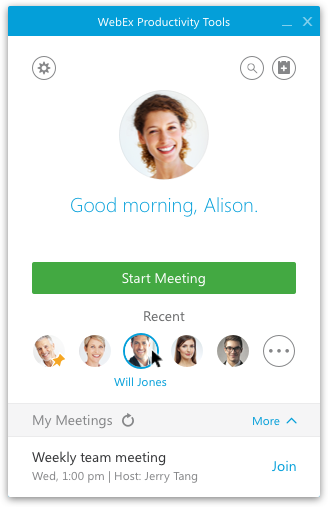
Have you ever been late to join an online meeting, only to have to wait for the meeting to load — making you even later? We’ve solved that. We added “the big green button” to WebEx Productivity Tools, letting you start or join a meeting with just a simple click of that green button.
We’ve improved our meeting join time by 18% over the last six months. All this to make sure you can get started on time.
And unlike other vendors, we have made it super simple to manage upgrades to the WebEx Productivity Tools. If your site is set for automatic updates, IT no longer needs to spend time or energy notifying users to update the app. WebEx notifies users directly, so they get the latest and greatest WebEx version all the time without any effort from IT.
Simple scheduling and fast joining from Google Calendar
https://www.youtube.com/watch?v=N5l6j-cgG5Y
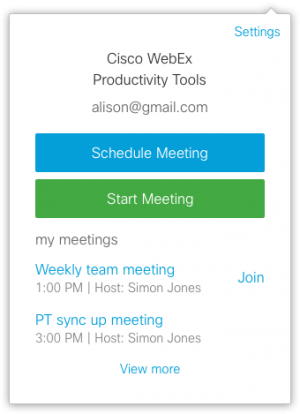
Scheduling meetings can be time-consuming, but we’ve addressed that for Google Calendar users. In addition to IBM Lotus Notes and Microsoft Outlook, Google Calendar now integrates with WebEx. Now, scheduling a WebEx meeting is always easy no matter what calendaring tool you use. Schedule your Personal Room meeting and attach it directly to the Google Calendar event or start and join a Personal Room directly from your Google-linked accounts. All this is enabled with the Cisco WebEx scheduler plug-in, which is essentially the WebEx Productivity Tool, optimized for Google. It’s available in the Chrome Web Store. This is a great tool for those of you in the education industry or other industries adopting Google as your main email tool client.
And remember, you can always add @webex to the location field in your invite to schedule meetings when WebEx is deployed withCisco Spark Hybrid Calendar Service. It supports Google Calendar and Outlook.
Making it personal
Business can often feel impersonal, so providing a degree of personalization can make a positive difference in your workday. As you can see from these examples, personalization and user experience are paramount to our innovation strategy. We’ve been working to create more personal meeting experiences for years. One capability that I most appreciate is the Personal Room. With it, I have my own unique, customizable meeting URL. Simple to remember and easy to share, the Personal Room is one of the most essential WebEx features and one we actively seek to improve. We’ve meticulously woven the Personal Room into our scheduling flows, as you can see with our Productivity Tools improvements as well as our new Google Calendar integration.
We’re continuing to improve on WebEx one feature at a time – continuing to bring you more flexibility and options with every update to make working wherever you are easy. This is how we do collaboration at Cisco.
At last count, Gartner tracks more than 450 IoT platforms in the market. And that’s just today. It’s astounding the number of tools and the amount of technology continuously being invented and reinvented. The impacts and the stakes are extremely high.
Nine out of ten companies will experience a revenue stall—and yet only one of those companies will recover and survive. One. This is the highly competitive world we live in. Think about the time it took Wells Fargo 20 years to get to 25 million online banking customers. Now, compare that to SnapChat. They exceeded 200 million customers in four years.
The real key is in how we innovate, not the tools we use to innovate. As an IT leader, how do you close that gap between tools and outcomes? In other words, how do you innovate in a hyper-innovative environment? The best way is to look at what you want in an entirely different way—beginning with five ways to navigate and ultimately drive innovation.
No. 1: Recognize the Source of Value
Don’t depend on a proof of concept to determine how your organization will create value. POCs have a way of leading you to a POC jail you’ll never escape. Define your source of value up front.
Three are three sources:
Being the lowest cost provider
Drive experiential value
Build a strong ecosystem
If you think about retail, IBOTTA is a great example of cost value. They want you to use their tools for shopping in exchange for discount coupons. They give you cost back, lowest cost provider.
Trunk Club is an example of experiential value. It lets you talk to a “counselor” and they find the clothes right for you, rather you going to the brick-and-mortar store to sift through and select what you want.
For platform value, Shopify comes to mind. It’s all about building the platform and getting partners to provide you with greater and more value.
So before selecting a tool, or launching a POC, identify how you want to create value.
No. 2: Take Action Against Blind Spots
To take actions against your blind spots, you need to know where they are. Having a Kodak Moment used to be a good thing. Blockbuster used to be on every corner. They both lost due to their blind spot.
Don’t let that happen to your organization. Dedicate time and resources to uncover blind spots. I do this once a quarter. I take three people. One from finance, one from sales, and one from operations. Keep it to no more than five people and give them one simple question to answer in 48.
The question is, “How would you put us out of business?” Security has been doing this for a long time with “red teams,” who’re purely focused on the security on how to break the system. You need your own red team for business models. Give it just one quarter. You’ll be surprised the blind spots you discover.
No. 3: Stop Failing Fast
None of us want to fail. So stop failing fast, stop failing slow, and begin to improve your rate of learning. This is how you create value. If you just fail fast all the time, all you’re doing is repeating the same steps over and over again.
How do you determine if you’re failing fast? If you’re having the same conversation every quarter with your leadership team, “We’re not making our revenue numbers. We have to consider downsizing.” That’s failing fast. Failing slow is having that same conversation every year, rather than every quarter.
A better approach is to improve your rate of learning. A great example is Marvel comics. In ’95 and ’96, they filed for bankruptcy. Coming out of bankruptcy in 1999, they were still losing with net income at nearly minus a hundred million dollars. Around 2003, they came up with an idea to apply their comic book characters to movies and began to improve their rate of learning. From 2006 to 2009, net income went from about $60 million to over $205 million before Disney bought them for $4.3 billion.
Remember that in a hyper-innovative environment we have to think differently, act differently. These tips can help you build a foundation to stop sifting through tools and start driving business outcomes. Keep your focus on value, and watch innovation come to life.
Want to learn about No. 4 and 5 in ‘Five to Thrive’? Meet up with me in person at Cisco Live Cancun November 6-9, where I’ll be speaking on Wednesday. Also, don’t miss the CL Executive Symposium. I’ll be free to chat after. For those who aren’t attending, be on the lookout for my next blog.
When you think about IT services for your network, groundbreaking innovation may not be the first thing you think of. Top of mind for most people might be a world-class engineering team with great people skills, deep knowledge, and a long track record of success.
But now, with the launch of Cisco’s new predictive services portfolio, innovation moves to the top of the list. In a world where network downtime can result in losing thousands of customers, we need to do more than respond quickly and effectively to a network problem. We need to prevent the problem from happening in the first place.
That’s exactly what Cisco Services can do with two new suites of predictive services — Business Critical Services and High-value services. With these new services, enabled by AI and machine learning, we’re moving from a reactive approach to a preemptive approach, preventing network impacting events by predicting issues and delivering ongoing optimization services. Yes, you still get the expertise of our highly skilled engineers — but also 20 years of historical data from real-life customer scenarios and advanced machine learning capabilities that use data to predict problems before they happen. We have delivered three major innovations to make this work:
First, a new service called Business Critical Insights compares how your network is performing compared to similar environments. We use machine learning to correlate your network’s performance with our knowledge base from similar deployments and industry best practices. We build a “fingerprint” of each device across the millions that we support, so we can correlate thousands of parameters within the hardware, software, and features you are using. So if, for example, you are suffering from a high number of issues, we can identify anomalies and pinpoint the cause of your problem.
The second innovation, Network Early Warning, studies and learns from patterns of events that lead to major failures, so we can preemptively take action. We recently predicted a scenario in a top U.S. bank’s network 32 hours before it would have caused a major outage. In another case, we analyzed voice log anomalies for a large Internet provider and identified a pattern in random packet drops three days before it led to noticeable call drops. Once we predict an event, we take action to minimize business impact.
Third, we have digitized the detection logic for a large number of known problems, which has created a system that drives automated issue detection. Now all of our Cisco Services engineers have the knowledge and experience of our best engineer—and can detect the cause of problems in a fraction of the usual time, sometimes even identifying issues the customer isn’t aware of. Let’s say your network performance inexplicably starts to degrade. Typically, a service engineer would go through extensive historical information to figure out why. But now, our automation system evaluates the data and can instantly discover the problem that is slowing everything down. The system not only identifies the problem, it automatically generates a trouble ticket with all the problem details and how to resolve it.
These new predictive services will reduce the complexity and cost of your network operations, reduce risk with automated compliance and remediation services, increase business agility, and accelerate the digital transformation of your business.
Check out our new video to see how our new predictive and preemptive capabilities can give you—and every customer—access to our best engineer, years of experience, and technology innovation, every time:
When at University, we all have dreams of where life will take us after graduation. I was no different.
As a third year student working on my graduation project, I remember standing in front of a rack stacked with Cisco routers and switches with my friend, Salman. “What if we work at Cisco one day?” I asked Salman half in a day dream…and, at the time, it was just that. A day dream.
I was asked by many, “Why Cisco?” The answer has always been simple for me. I fell in love with this company back in 2010, when I first learned about Cisco. From the moment I learned about the differences between a router and a switch, The Cisco Network Academy made me passionate about Cisco technologies. It’s been a dream to work here ever since.
Three years later, I sent a text to Salman “Guess what?” – He guessed that I had bought a new car – “No, man, I am joining Cisco! I got the job!” I completed the text with a huge emoji smile. My dream was coming true!
The secret, however, that many of my friends – including Salman – didn’t know, was that since my graduation in June 2014 – I had applied SEVEN different times for SEVEN different roles at Cisco. It took nearly two years for my dream to come true!
Three months later, my first day at Cisco began in Amsterdam at Cisco’s EMEAR headquarters. I’d be joining 59 other people from Europe, Africa, and the Middle East for one year in Cisco Sales Associate Program (CSAP). This opportunity came at a time when I wanted to experience something more challenging, and Cisco has given me that opportunity! I then joined their workforce as an Associate Sales Representative (ASR) to cover a territory – Bahrain – virtually from Amsterdam.
There’s many reasons to #LoveWhereYouWork when you work at Cisco, but since officially joining the team, here are SEVEN (one for every time I applied) of the reasons I’ve come to love the most:
1. Flexibility: Cisco provides us with all the communication and collaboration tools to be able to do our best work from anywhere in the world. I can join meetings from my couch, draw on a virtual whiteboard from the office, and share files and information from the kitchen. Cisco brings the power of technology to empower individuals and groups to collaborate everywhere, at any time, and it is beyond words to get to experience firsthand.
2. Giving Back: Life at Cisco is not just about our work between 9 to 5 – we give back a lot too! In addition to the FIVE days Cisco gives us each year to give back to charities that mean the most to us personally, there are events that Cisco encourages us to participate in with our teams such as the Global Services Month. This is where all Cisco employees across the globe volunteer hours to support different groups and causes.
3. Follow Your Passion: Cisco encourages us to follow our passions. What’s my passion? I love bringing the power of technology to individuals, organizations, and various groups and teaching them about what we do at Cisco and why technology is important for us all. Cisco has done a lot of work internationally to empower different entities with its wide range of technology. That’s what keeps me passionate about working for Cisco.
4. Diversity: It’s no secret that Cisco is dedicated to diversity in the workplace. I am based in an office that has more than 40 nationalities, working side to side, sharing stories, and learning about each other and our varied cultures. I face the biggest challenge every time I have to tell my colleagues about something, because you can’t even spot my country (Bahrain) on the map. But we all come together in our own unique ways and learn together and grow together which, I feel, makes our company and what we do here that much stronger.
5. Supporting Gender Equality: Cisco is one of the biggest supporters for Women in STEM. Across the globe, each year, we host a day-long event – Girls in ITC – that brings young girls to the Cisco offices so that our teams can introduce them to various topics in IT and technology. This helps these young women to grow with a passion for tech and shows them potential career paths. Last year I got to be a part of this event in Amsterdam, and it was an awesome experience to see how passionate the girls were about technology.
6. Team Bonding: Every quarter we gather and organize a fun activity that will help us to bond even further outside the work space. Cisco supports each team to go out and enjoy their time together. We all love these events because we wind up growing as a team even further when we take a few moments to disconnect and recharge.
7. The Power of Mentoring: When I joined Cisco I was assigned a mentor within Cisco. Mentoring is a fundamental characteristic of Cisco’s culture. You can ask anyone to be your mentor at Cisco, and that’s what I like the most. This year I am mentoring two new ASRs and I am excited to help them learn all about Cisco, while acclimating to Amsterdam.
The range of personalities and cultures here at Cisco makes it truly a place that I want to stay at forever. Everyone here comes to the table with new knowledge and new thinking. We are a network of incredible people here at Cisco – before technology, and innovation even come into play.
I know it may seem difficult, and maybe even impossible at times, to land your dream job here at Cisco. But, please, take it from me – it may take many, many tries and maybe even years – but it really is worth the wait to be living your dream!
Cisco Networking Academy has been changing worlds for 20 years. To celebrate this milestone, we are spotlighting some of the 7.8 million students worldwide who have benefited from this IT education and career building program.
Billy T. Anglin
Sarasota, Florida
Current occupation: Senior Security Systems Administrator
Networking Academy experience: CCNA Routing and Switching
One word to describe his experience: Outstanding
Billy was never interested in school — he thought of himself as a hacker. He loved making computers break the rules and do things no one had thought possible, even in the 6th grade when he hacked his first computer.
Luckily for Billy, he was encouraged to take two years of Networking Academy coursework. He found new friends throughout the years, where “there wasn’t that awkwardness” he found in his other classes. Eventually, Billy came to find it far more interesting to work for the good guys, protecting computers from those doing harm.
What was it like to complete a Networking Academy course? “It gave me a new level of superpowers,” he says.
Cisco Networking Academy has been changing worlds for 20 years. To celebrate this milestone, we are spotlighting some of the 7.8 million students worldwide who have benefited from this IT education and career building program.
Raissa Marcon Constante
Florianópolis, Brazil
Current occupation: Network Administrator
Networking Academy coursework: IT Essentials, CCNA Routing and Switching, CCNA Security
One word to describe her Networking Academy experience: Future
Raissa just graduated from university and is now studying to get her CCNP certification. In her Networking Academy classes in Brazil, Raissa was the only woman, but she didn’t let that deter her. Nor did she let learning about complex technology issues get in her way.
“The beginning was hard because I didn’t have any knowledge, technical knowledge,” she says. But Raissa decided she’d never quit. “I wanted to prove that I could do that, you know? I never thought about quitting. Never.”
Today, she feels prepared “to work, to talk to people about networking, and to participate in events.” Raissa’s dream job? It’s something where she can use her skills “to help people.”
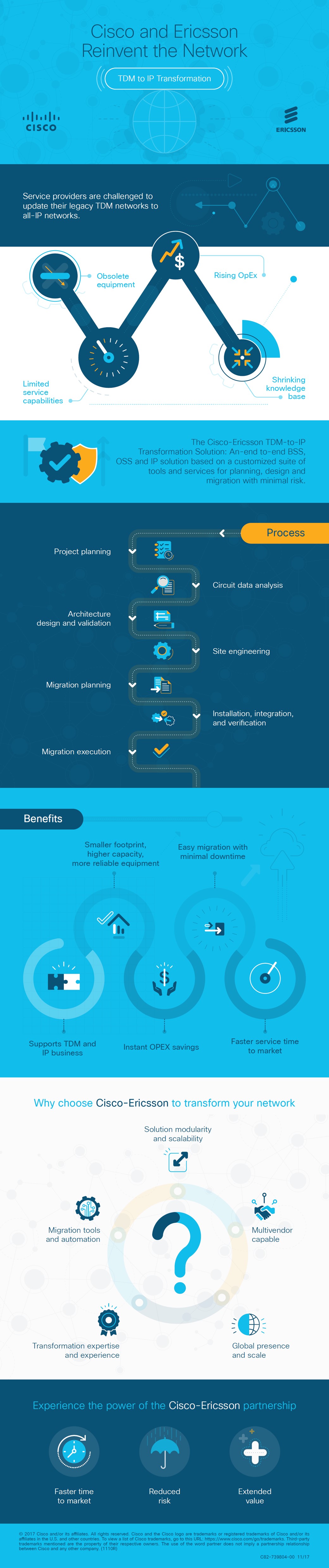
Many Service Providers today are challenged by aging TDM infrastructures with limited service capabilities, high maintenance costs, and increasing operational expenses. And as the equipment is aging out, so too are the skills necessary to maintain and service this equipment. Sooner or later, these Service Providers have to face the hard truth: they have to update their networks in order to reduce costs, increase revenues, and stay competitive.
Over the past decade, Cisco and Ericsson have helped many Service Providers plan and execute a seamless, secure, and successful migration to all-IP, and now the two companies have partnered to develop a customized suite of tools and services for end-to-end planning, design and migration. With advanced automation techniques designed to streamline the migration process, Cisco and Ericsson can now take a Service Provider from planning to implementation in less time, with less risk, and less cost than ever before.
How significant is this advancement from Cisco and Ericsson? Consider the enormous challenge of migrating an entire legacy network to all IP, from project planning, to materials resourcing, to circuit data mining, to OSS integration, and operation management and support, all while maintain service availability and quality. This can be a fairly daunting process to many Service Providers.
Cisco and Ericsson work together with Service Providers to plan, manage, and implement the process end-to-end, from data collection and analysis to migration execution and service implementation, moving the Service Provider to a modern IP network while maintaining TDM service capabilities in parallel.
The TDM to IP Transformation Process
At the end of the process, Service Providers benefit from a network with greater reliability, higher capacity and increased service capabilities. Beyond the instant operational savings, Service Providers can use their IP network to develop and deploy new services quickly and securely, creating new opportunities for growth.
In summary, by working with Cisco and Ericsson on IP network transformation, Service Providers can realize a faster time to market, with reduced risk, and extended value, delivering higher quality, more reliable network services to their customers.
To find out more how Cisco and Ericsson can help transform the Service Provider network, visit our executives in Cape Town at AfricaCom 2017, Nov 7-9, or contact your account executive.
An ounce of prevention is worth a pound of cure, so the saying goes. When it comes to protecting your organization against the imminent threat of a cyber attack, it’s essential to factor in both. Here’s why.
Today’s hackers are motivated and more organized than ever. This past year has shown how vulnerable organizations of all sizes are.
The headlines in the wake of WannaCry, Petya/NotPetya, and, most recently, Bad Rabbit, among other targeted breaches, make a strong case for ramping up your organization’s information security to ensure both business continuity and building customer confidence. While the obvious answer may be to boost your CIO’s resources, there also is the matter of a global cyber skills shortage.
Experts predict a two million global cyber security professional shortfall by 2019.
ISACA
Security breadth
Simply identifying new and evolving threats is a huge job. Cisco Talos, for example, is staffed by over 300 full-time threat researchers who work in collaboration with data scientists and engineers. They use 1,100+ decoy systems and threat traps and millions of telemetry agents to collect information about existing and developing threats.
A sophisticated operation like Talos can’t easily be replicated by most businesses. That’s why thousands of customers trust us to protect their Cisco products and subscribe to our security services. We also supply our insights and expertise to the global information security community.
Identifying threats is only the start though. Applying the latest knowledge and capabilities requires continual focus. In-house infosec teams now are tasked with much more than standard operations management. They must respond to hundreds or thousands of daily alerts all while wrangling with new technology and regulations.
An ounce of prevention
Cisco Services works with customers across public and private sectors to thoroughly prepare them in the event of a cyber attack. Our Incident Response service provides proactive support to adopt a threat-centric design and mind-set, and emergency response when customers need it most.
Using our ‘defense in-depth’ approach, our security specialists team with customers’ in-house infosec teams to help them assess their incident response readiness, test their processes with tabletop exercises, and provide proactive threat hunting to see if a breach has occurred. We provide clear and thorough recommendations on how to improve their response procedures, acquire the right tools, and communicate accurately in the event a breach occurs.
With a proactive approach, our customers gain peace of mind that their architecture and controls create a strong layer of defense while improving their response capabilities.
In the event of an emergency, Cisco’s security specialists can be on-site within 24 hours to provide customers with a clear path for ending a cyber attack, get operations back up and running, and minimize damage.
Every organization, large or small, is a potential target for cyber attackers. There is good news for the proactive company. In the event of an attack, the impact and lasting effects will be less severe than for those who have neglected preventive measures.
For more information on Cisco Incident Response Service, and our Business Critical Security Services, visit our website.









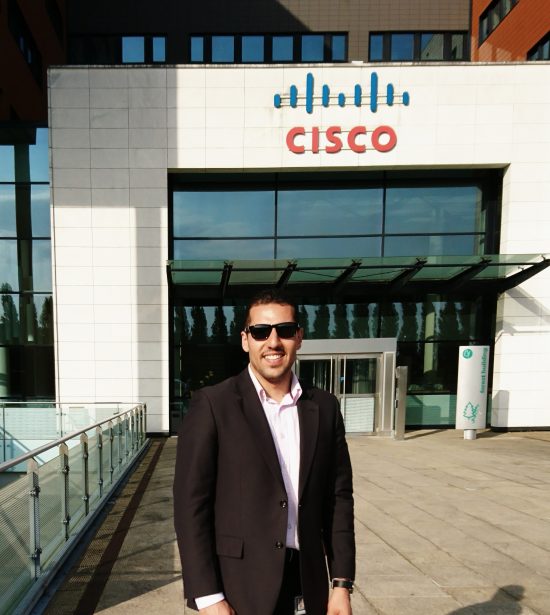 When at University, we all have dreams of where life will take us after graduation. I was no different.
 Three months later, my first day at Cisco began in Amsterdam at Cisco’s EMEAR headquarters. I’d be joining 59 other people from Europe, Africa, and the Middle East for one year in Cisco Sales Associate Program (CSAP). This opportunity came at a time when I wanted to experience something more challenging, and Cisco has given me that opportunity! I then joined their workforce as an Associate Sales Representative (ASR) to cover a territory – Bahrain – virtually from Amsterdam.