
Avatar

Let’s face it. Taking on a major technology migration can be a complete headache. There are so many risks involved—not the least your reputation and job security. If you are concerned about your vendor’s future, your headache may have turned into a migraine as you ponder migrating to a new collaboration platform sooner than you had planned.

As the saying goes, with every cloud, there’s a silver lining. What if you could migrate from your current platform with a proven, cost-effective deployment? Cisco can do that for you.

More than 74% of Fortune 100 customers trust Cisco Services to implement and optimize their enterprise solutions.

Let Cisco Advanced Services make you the hero and deliver the collaboration platform for the way you work today. Today, more than 74% of Fortune 100 customers trust Cisco Services to implement and optimize their enterprise solutions.

Our Advisory Services Strategy and Innovation Workshop can help you map out a migration plan aligned to your goals. Then, take a test drive in a pilot deployment as part of our remote expert hosted trial.

Our Implementation Services team offers proven migration methodologies to help streamline your move to Cisco collaboration. In fact, we recently helped a global insurance agency migrate more than 12,000 agents from a competitor’s contact center to Cisco Unified Contact Center Enterprise within 18 months. Our deep services expertise can help you quickly build a secure collaboration environment, increase team productivity, and realize a faster ROI.

Let Cisco Advanced Services for Collaboration help ease your headache before it turns into a migraine. In the meantime, take two aspirin. We’ll call you in the morning.

Authors

Lowell Johnson

Senior Director

Advanced Services for Collaboration

Avatar

By Giovanna Carofiglio, Distinguished Engineer


Today we announce three important milestones in the path of deployment of Information-Centric Networking technology in 5G mobile networks.

Let’s start by explaining the concepts behind Information-Centric Networking (ICN). It is an approach to evolve the Internet infrastructure to directly support data-centric and location independent communications by introducing named data as a core Internet principle.

Data access becomes independent from location; enabling a more flexible, secure and efficient communication model. It has the potential to address many of the key problems faced by the Internet today, including content distribution, mobility, security, and scalability.

The technology was developed at PARC, a Xerox company, a decade ago, under the name “Content-Centric Networking” (CCN). PARC has a long tradition of inventing networking technologies, going back to Ethernet, through significant contributions to IPv6 and Internet multicast.

Cisco has been working with PARC and other organizations in industry, government and academia for almost a decade to create and improve CCN and today it announces its acquisition of the CCN platform from PARC.

Cisco’s acquisition of PARC CCN has the objective to foster convergence of various dialects of ICN (CCN and NDN) into a single harmonized version of ICN, promoting wider and faster adoption of ICN-based solutions required to solve future networking needs.

Toward the same end, we announce today the creation of an open-source project within the FD.IO community in the Linux foundation, called Community ICN (CICN). Cisco will be contributing its own ICN software, including the CCN software acquired from PARC, to this open-source project. The open-source initiative is intended to accelerate ICN development by means of community contribution at large and to guarantee continued support.

To accelerate ICN insertion in 5G and facilitate incremental deployment into existing IP infrastructure, we also disclose today Hybrid ICN (hICN), our hybrid ICN IP solution. Hybrid ICN enables the deployment of ICN within IP – rather than as on overlay or replacement of IP. It preserves all features of ICN communication by encoding ICN names into IP addresses.

Key features of hICN are that it supports IPv4 or IPv6 RFC compliant packet formats, and guarantees transparent interconnection with standard IP networking equipment, simplifying the insertion of ICN technology in existing IP infrastructure and enabling coexistence with legacy IP traffic.

Recognized as an emerging innovative technology for 5G, ICN adoption may dramatically simplify next generation network architecture by offering a unified content-aware and access-agnostic network substrate for the integration of heterogeneous networks. Cisco will demonstrate ICN benefits over standard TCP/IP solutions for optimized mobile video delivery next week at Mobile World Congress in Barcelona. Demonstrating the goals of 5G are available with deployed technology today.

That’s a quick introduction on why we teamed with PARC to make this important acquisition, and what it means for service providers and OTT content distributors, especially mobile carriers. We’ll have a lot more to say and show at the upcoming Mobile World Congress, in Barcelona. Hope to see you there!

Authors

Dan Kurschner

Marketing Manager, Product/Systems

Avatar

“Patients get the same advanced, sophisticated care they’d get from a modern hospital.”

You have to be tough to live in the shadow of Mount Everest at the top of the world. For the farmers and herders who call Mozhugongka home, pulmonary disease is common and tough to treat… until now. Using Cisco collaboration, our partner Ronghai makes it possible for doctors at a big city hospital thousands of kilometers away can diagnose and treat patients at a tiny village clinic on the Tibetan Plateau.

Ronghai says…

Mozhugongka Hospital is in Mahalangur mountain range, high in Tibet. It is a very remote village of 50,000 farmers and herders. There is only one doctor for every 2000 people, which is much less than in China where there are 2.8 doctors for every 1000 people. Medical staff do not have resources to diagnose and treat common illnesses, such as the high altitude lung disease many people there have.

So, we installed Cisco collaboration equipment in both the hospital in Mozhugongka and in Nanjing which is large and modern. We worked with other Cisco partners to build a remote medical platform so doctors in Nanjing can diagnose and recommend care for patients in Mozhugongka. Also, patients who had to wait weeks or months for test results now only have to wait a few days. Doctors in Mozhugongka use video conferencing for instant access to medical experts and research, so patients get the same advanced, sophisticated care they’d get from a modern hospital.

With Cisco, we can bring care and health 4000km to the high mountains in Tibet.


Thanks, Ronghai!

The story doesn’t stop there.

More info on how Ronghai built the remote medical platform with Cisco.

More stories on what our customers and partners are doing all over the world.

Authors

Julie Colwell

Marketing Manager

Global Partner Marketing

Avatar

The No Strings Attached Show has published a whitepaper on Cisco Flexible Radio Assignment (FRA).  FRA is a feature of the Aironet 2800 and 3800 series access points.  These APs have a flexible radio that can operate in 2.4 GHz, 5 GHz, or monitor mode- this allows for both radios on the AP to be configured for Dual 11ac.  It’s a fun whitepaper that takes an in-depth look at FRA-why it’s useful, how it’s a timesaver, and just what kind of benefits can it offer.  The whitepaper also includes interesting customer references for both 3800i and 3800e deployments.  Hopefully this whitepaper helps to demystify FRA and dual 5 GHz deployments- we want our customers to realize the potential of FRA and how you might use it in your environment!

We invited the hosts of the show to our Richfield Over The Air Test Facility, as we’ve done several times in the past (123), in order to put FRA through its paces.  We first sat the hosts down with the RF engineer who is the mastermind behind the FRA feature on the 2800 and 3800, then we went through things to know when deploying FRA, and finally we did some good old empirical testing.  This test is one I think is most interesting in the whitepaper.  The title image is a teaser of what it looks like on a spectrum analyzer when all the Wi-Fi spectrum is fully loaded.  We setup 25 APs, one for every 5 GHz channel.  We then measured the spectral capacity of 2.4 GHz and 5 GHz (in megabits per second).  In 5 GHz, we measured the capacity using 20, 40, and 80 MHz channels.  We then turned on dual 5 GHz and ran those same tests using half the number of APs.  The point of this testing was twofold; first we wanted to figure out just how much capacity we have in Wi-Fi, second we wanted to see if dual 5 GHz actually works (hint: it does).

Enough of my rambling, check out the whitepaper for yourself!

http://nsashow.com/FRA/

Authors

Wes Purvis

Technical Marketing Engineer

Cisco’s Enterprise Networking Group

Avatar

This blog was authored by Warren Mercer and Paul Rascagneres.

Talos has investigated a targeted malware campaign against South Korean users. The campaign was active between November 2016 and January 2017, targeting a limited number of people. The infection vector is a Hangul Word Processor document (HWP), a popular alternative to Microsoft Office for South Korean users developed by Hancom.

The malicious document in question is written in Korean with the following title:

5170101-17년_북한_신년사_분석.hwp (translation: 5170101-17 __ North Korea _ New Year _ analysis .hwp)

This document was alleged to be written by the Korean Ministry of Unification and included their logo as a footer on the document.

An interesting twist also came within the analysed malicious document as it attempts to download a file from an official Korean government website: kgls.or.kr (Korean Government Legal Service). The file downloaded is a binary masquerading as a jpeg file that is later executed as part of the infection. It’s likely that the website was compromised by the attackers to try and legitimise the HTTP GET attempts for the final payload, this traffic would potentially not have looked unfamiliar for any system administrators.

The attackers’ infrastructure appeared to be up for a few days at a time with no observed infrastructure re-use occurring. Unfortunately, the compromised sites were all either cleaned or removed by the attackers and Talos were unable to obtain the final payload. This level of operational security is common for sophisticated attackers.

Due to these elements it’s likely that this loader has been designed by a well-funded group in order to target public sector entities in South Korea. Many of these techniques fit the profile of campaigns previously associated with attacks by certain government groups.

Read More >>

Authors

Talos Group

Talos Security Intelligence & Research Group

Avatar

Over the last half decade the term sandboxing has become so pervasive, many customers I speak to have forgotten what it’s for!  Sandboxing is a type of malware analysis – dynamic malware analysis to be exact. You execute a sample / file in a virtual environment and see what happens. There are numerous other types of analysis including static analysis, where we look at the code and compilation of the file, forensic analysis of in-memory activity and patterns on disk, as well as pre- and post-execution analysis of the master boot record. In short, Threat Grid is a comprehensive malware analysis engine.

Recently we showed how it can be used for investigations in this blog. But what if you don’t have time for that? What if you just want to have your security tools automatically submit samples to a sandbox and check if it’s good or bad – and block those bad files? It seems so simple! A few years ago most customers I was talking to were deploying a bunch of expensive appliances on each of their network segments. However, as Frank Costanza said “there has to be a better way!”
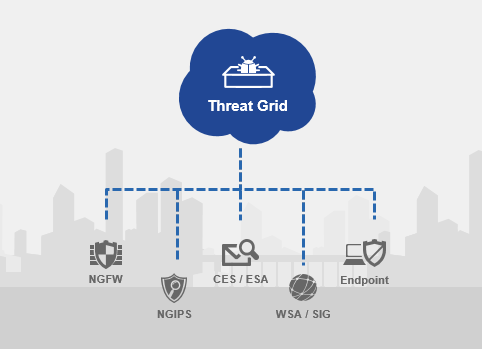


Not all analysis are created equal. On one hand you can use a free open source cloud based sandbox. On the plus side it’s free. The downside is all the malware authors use the same free opens source sandboxes to test their malware against. They are designing their stuff to evade these environments.

Threat grid provides malware analysis and threat intelligence across the Cisco security portfolio. Regardless of a sample’s submission origin, the subsequent intelligence derived informs all integrated products. It also provides a single common view into all the potential malware samples being seen across your infrastructure.

Figure 1: Integrated across Cisco security portfolio

Any Cisco security technology you invest in will provide you with a number of samples that you can submit to Threat Grid on a daily basis. You can set policies on what you want submitted automatically. If you don’t want to deploy a bunch of appliances around your network, we can simply increase the number of samples you can submit from each of those with sample packs. These allow any of your Cisco security devices to send more samples to be analyzed so you don’t get caught with a pile of malware that you weren’t able to inspect.

Don’t use the same engines that malware authors are using to test their code against. Leverage your existing Cisco investments to analyze, detect, and block more malware. More information is available on the Threat Grid web page, or sign up for a free trial account here.

Authors

Joe Malenfant

Director, IoT Marketing

Internet of Things (IoT)

Avatar

Welcome to my Cisco office, the one in Shanghai! You’re going to want to visit for more than a day – as many as you can make time for! Whether you’re here for an interview, for meetings, or to innovate with your China colleagues, here’s what you’ll expect when you get here.

What should I wear?

We call it “engineer style” around here. It’s casual, but keep it clean and nice. Show off your style! If it’s a first impression, perhaps err on the side of more formal but not too formal.

What’s special about Shanghai?

If you are a foodie, you will love visiting us. You could eat six meals a day, have a different cuisine for every meal, and probably not repeat a food style for months. Cisconians like to eat, and that doesn’t change from site to site.

Shanghai office
A little office fun.


Point me to the coffee!

Pantry
Spot the coffee cup!

A good day starts with a cup of coffee. We have professional coffee machine in the pantry room on each level. You can feel free to make your favorite coffee at any time.

Where do employees eat?

Most employees eat lunch in what we call “canteens.” These canteens are in different tech parks nearby. We like to explore all the options, too. Tasting all the options is a normal activity.

Most of the restaurants and cafeterias are really close, 1-2KM around the office. Which will give you a chance to make room for more calories by walking.

What’s the one spot I shouldn’t miss?

Stop in on every floor and go to the pantry. There’s a massage chair in each one! It’s our best “secret” that’s not really a “secret.” Or, play a little pool with us.

Pool table

Where should I stay during my visit?

Most employees that visit stay in Renaissance, which is the nicest hotel that’s closest to the office. But if you’re willing to be further away, the choice is limitless.

Is there a gym nearby?

The Union offers a lot of sports clubs, GYM, swimming, yoga, badminton, etc. The nearest GYM is 2 metro stops from office, our employees like to take noon-time to enjoy themselves and then come back to work refreshed.

Okay, you’ve convinced me to stay extra time. What should I do?

In Shanghai, I definitely recommend a city tour for as many days as you can have.

We have second tallest tower in the world – Shanghai Tower – and the ancient Shanghai YU Garden. The views from both are amazing!

Also, as mentioned, don’t forget to eat. A lot.

I hope you’ll seek me out when you visit so I can say hello! See you soon!


Interested in working at Cisco? Let us know here!

This is part of our series of Cisco site guides. See all of the site guides here.


Authors

Sarah Shen

ASEAN Recruiter

Avatar

Cisco recently announced the availability of a new Cisco Powered services designation entitled Cisco Powered Cloud Managed SD-WAN (software-defined wide area networking) under a new Cisco Powered services category named Cloud Managed DNA Services. This new category of services will enable our Cloud and Managed Services Program (CMSP) partners to make their way into the new cloud-based managed delivery model. The newest service, Cisco Powered Cloud Managed SD-WAN, allows providers the ability to offer the same DNA (Digital Network Architecture) outcomes with the convenience and value of managed services, combined with the power of cloud orchestration.

By 2018, there will be a ten-fold increase in enterprises replacing WAN routing with SD-WAN-based path forwarding. Through the Cloud and Managed Services Program and Cisco Powered services portfolio expansion, Cisco is helping partners capture this growing market opportunity. If you are a provider offering Cisco Powered Cloud, Managed, or Cloud & Managed services to your customers or thinking of becoming a CMSP partner, this offer will help you leverage your Cisco orchestration platform – a key control point as you adopt future DNA services.

Cisco Powered Cloud Managed SD-WAN

Cisco Powered Cloud Managed SD-WAN is a suite of services delivered and managed from service providers’ cloud by using Cisco SD-WAN and service orchestration technologies.

  • Cisco SD-WAN supports intelligent path control, application optimization, visibility and control, secure inter-branch communication and secure direct internet access services.
  • All services are orchestrated by Cisco Network Service Orchestrator (NSO) or Virtual Managed Service (VMS) platform in a large scale, multi-tenant and automated manner.

Provider benefits:

  • Enables you to bring up new branches in minutes, simplifies management and troubleshooting to reduce operational cost.
  • Helps automate service creation, service ordering and dramatically reduce operational costs
  • Expand market reach into SD-WAN and security business

Cisco DNA Differentiation:

  • Complete solution. Cisco has a complete solution including WAN, WiFi, Security, Application Performance, and Optimization enabling full digitization for the enterprise branch
  • #1 Vendor. Cisco holds the #1 spot for SDN/NFV Software Vendors [1]
  • Proven and trusted. Customers trust Cisco for their mission critical WAN

We constantly strive to help our partners offer a rich portfolio of Cisco Powered services that meet your customers’ current business needs, aligned with Cisco’s strategy. Our channel partners are key to our success. With the newly launched Cisco Powered Cloud Managed SD-WAN service, you can differentiate yourself and take on next generation orchestration challenges.

Visit our website to learn more about the new Cisco Powered service and the partner benefits or send your questions to ask-cmsp@cisco.com. Please share your feedback, thoughts on the new category and the new Cisco Powered service in the comments section

[1] Infonetics Research. SDN and NFV Vendor Leadership, Global Service Provider Survey. August 18, 2015

Authors

Grace Lo

Director, Global Partner Programs

Global Partner Organization

Avatar

Any time is a good time to take a fresh look at your business–and technology–initiatives. So why not now? It’s the perfect opportunity for innovation and renewal, getting existing projects back on track and defining your IT resolutions.

To get you going, I’ve identified four technology commitments that can help CIOs truly lead innovation and impact business growth, positioning the entire organization for success.

1. Modernize Your Infrastructure – Like a bad habit, leave behind aging systems. Modern businesses need technology that adapts and grows with your organizations. Sure, this can be a complex, costly undertaking, but so can maintaining outdated custom applications and systems that leave your company at risk and users in the lurch.

Instead, resolve to more closely examine what’s delivering from a technology standpoint and flag what’s not performing or is simply costing too much to maintain–either from a resource or financial perspective. Software or hardware that’s no longer supported or receiving regular security updates can place both the system and the entire enterprise at risk.

2. Make Security a Priority – A benefit of an updated, more agile infrastructure is one that’s potentially more secure. Cybersecurity was at the top of everyone’s list for 2016, and that won’t be changing in 2017 or beyond. In fact, analysts predict IT security spending will top $100 billion by 2018. Protecting your data and networks from intrusion begins with investing in world-class hardware and software that mitigates risk.

While technology is a great defense, don’t discount the role of human error–it has ranked in the top two reasons for security breaches in 2015 and 2016. All it takes is one errant click from an employee to send the entire system into a tailspin and put company–and customer–data at risk. Prioritize cybersecurity training for all employees and make it a part of every conversation, particularly as more devices continue to come online. CIOs should also devote time to changing processes and training to ensure employees are up-to-date on the latest company policies.

3. Think Collaboration – Enterprises are making the shift to implementing tools that make working together as a team and sharing information easier and more intuitive. This rise in collaboration technology helps simplify and streamline real-time communications, erases physical boundaries among teams, reduces operational costs, and enables a more mobile workforce.

Collaboration technology is also an asset to CIOs, IT departments and managers seeking to increase adoption of new technologies or policies. Training employees via video and web conferencing, smart whiteboards, and digital team workspaces among other features can jumpstart worker productivity and enable them to hit the ground running with new solutions.

4. Define Your Cloud Strategy – IDC estimates that spending on cloud IT infrastructure will reach $53.1 billion by 2019, accounting for 46 percent of total enterprise IT infrastructure expenditures. When faced with numbers like these, it’s even more difficult to believe that many companies still don’t have a firm cloud strategy in place.

Embracing the cloud doesn’t require an “all or nothing” approach. With hybrid cloud configurations, you get the best of both private, on-premise and highly secure public cloud solutions. Know what works best for your organization, and create a strategy. The strategy will evolve and change, but put pen to paper for a clearer path to digital transformation, the Internet of Things (IoT), and other business benefits that on-demand cloud computing delivers.

While the IT landscape continues to evolve at a rapid pace, these commitments can help prepare your organization for what might lie ahead and lay the foundation for a successful 2017 and beyond.

Meanwhile, stay connected to the latest business insights with Connected Futures, Cisco’s guide to industry innovation news and articles designed to keep you at the top of your technology game.


Authors

Erin Hatfield

No Longer at Cisco