Avatar

Commercial deployments for 5G are expected to launch in 2020 and to be available in every major global mobile market by 2021. Ovum Informa Telecoms and Media predicts that more than 50 operators will be offering 5G services in close to 30 countries by the end of 2021.

However, the majority of 5G subscriptions will be concentrated in a handful of leading 5G markets, including the U.S., China, Japan, and South Korea. The U.S. will be the largest 5G market in 2021, with more than 10 million 5G subscriptions, followed by China, Japan, and South Korea. Those top four 5G markets will account for more than 80% of the world’s 5G subscriptions in 2021.

5G will rely on a diverse set of radio access technologies, different from previous generations of cellular networking (2G, 3G and 4G) where a new radio access technology replaced the old one. 5G will integrate different radio technologies. 5G technologies are under development and are likely to include both an evolution of existing radio technologies as well as new innovations. New 5G services and applications are currently being considered by global mobile carriers and regulatory bodies. These prospective offerings can be grouped into three different classes (see Figure 1), according to Ofcom (U.K. regulatory commission):

Figure 1:

Source: Ofcom, 2017

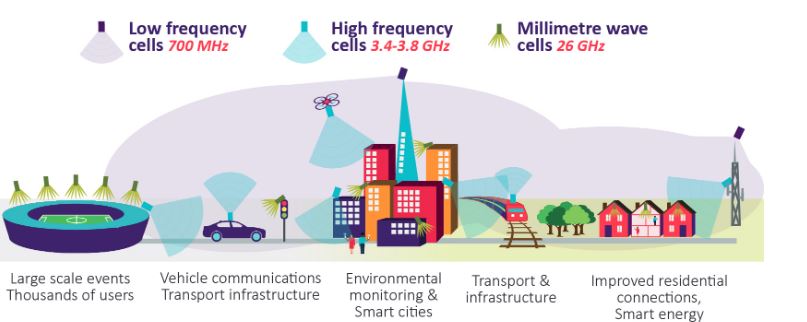
The diverse set of 5G services and applications, will require a diverse set of spectrum bands, with different characteristics, addressing different requirements, and combining both low and high frequencies as shown in Figure 2:

Figure2:
Source: Ofcom, 2017

Looking at the plethora of applications that will be supported or newly enabled, 5G promises to be the mobile networking panacea long sought after by network operators and their subscribers. However, the complete promise of 5G may not be reached with its initial introduction.  There are many “t’s” to be crossed and “i’s” to be dotted before the final form of this revolutionary technology can be fully realized.  And realistically, the experience for early adopters may not be stellar.

At first, there will be coverage issues. Remember how spotty 4G and 3G (and 2G for those who recall) were when they were initially launched? Chances are it will be the case with 5G networks as well until they are built densely enough. Specifics about the range that each 5G tower would cover compared to a 4G tower are still being worked out, so the range of geographic coverage is also yet to be determined.

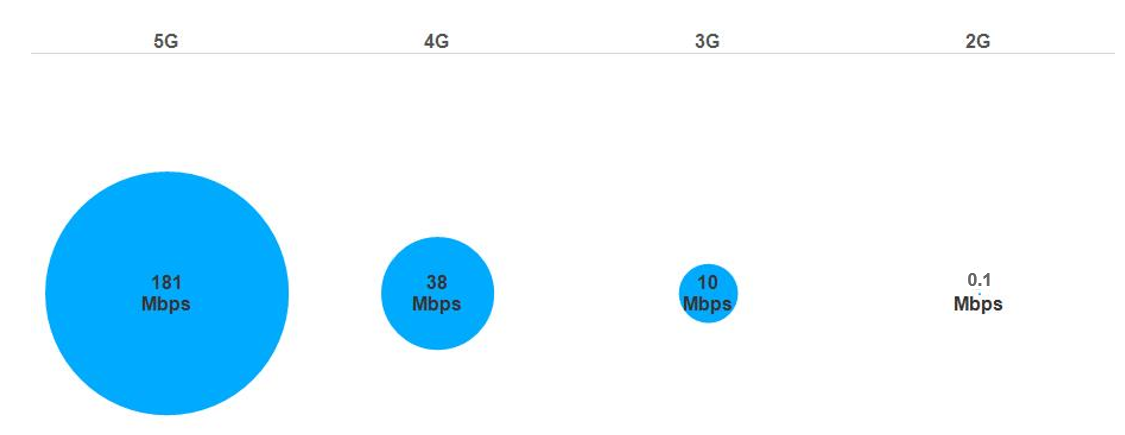
Then there’s the network speeds. Of course, it goes without saying that 5G will be faster than 4G, but the theoretical data rates that are being achieved during trials and testing is one thing, and real-world performance with end users will be a very different thing. If experienced speed trends hold from when 3G and 4G were introduced to when 5G will be commercially deployed, by 2021, 5G speeds will be 5 times greater than 4G.

Figure 3: Mobile speeds by technology, 2021. Experienced 5G speeds will be 5 times greater than 4G by 2021.
Source: Cisco Mobile Visual Networking Index (VNI), 2017

The future, with 5G, will enable higher speeds and ultra-low latencies for emerging applications that bring new mobile requirements (i.e., ultra-high bandwidth, ultra-low latency and ultra-low power). By 2021, 5G will generate 1.5 percent of mobile data traffic, and 4G will be 79 percent of all mobile data traffic and the predominant traffic type. However with the high bandwidth capabilities of 5G, next-generation mobile applications such as connected vehicles, massive IoT connectivity, Internet access for large events, smart cities, smart homes and industrial automation can be easily enabled and the traffic mix can rapidly change. Hollywood’s sci-fi movie makers may be hard-pressed to create computer generated imagery (CGI) that matches the reality of 5G hyperconnectivity. However, those silver screen visionaries may be the impetus for the next wave of mobile innovation – dare I say 6G.

Related Links

Authors

Usha Andra

Leader, Product Marketing

Data Center and Cloud Networking

Avatar

Cisco recently announced the availability of a new Cisco Powered services designation entitled Cisco Powered Cloud Managed SD-WAN (software-defined wide area networking) under a new Cisco Powered services category named Cloud Managed DNA Services.  This new category of services will enable our Cloud and Managed Services Program (CMSP) partners to make their way into the new cloud-based managed delivery model. The newest service, Cisco Powered Cloud Managed SD-WAN, allows providers the ability to offer the same DNA (Digital Network Architecture) outcomes with the convenience and value of managed services, combined with the power of cloud orchestration.

By 2018, there will be a ten-fold increase in enterprises replacing WAN routing with SD-WAN-based path forwarding. Through the Cloud and Managed Services Program and Cisco Powered services portfolio expansion, Cisco is helping partners capture this growing market opportunity. If you are a provider offering Cisco Powered Cloud, Managed, or Cloud & Managed services to your customers or thinking of becoming a CMSP partner, this offer will help you leverage your Cisco orchestration platform – a key control point as you adopt future DNA services.


Cisco Powered Cloud Managed SD-WAN

Cisco Powered Cloud Managed SD-WAN is a suite of services delivered and managed from service providers’ cloud by using Cisco SD-WAN and service orchestration technologies.

  • Cisco SD-WAN supports intelligent path control, application optimization, visibility and control, secure inter-branch communication and secure direct internet access services.
  • All services are orchestrated by Cisco Network Service Orchestrator (NSO) or Virtual Managed Service (VMS) platform in a large scale, multi-tenant and automated manner.

Provider benefits:

  • Enables you to bring up new branches in minutes, simplifies management and troubleshooting to reduce operational cost.
  • Helps automate service creation, service ordering and dramatically reduce operational costs
  • Expand market reach into SD-WAN and security business

Cisco DNA Differentiation:

  • Complete solution. Cisco has a complete solution including WAN, WiFi, Security, Application Performance, and Optimization enabling full digitization for the enterprise branch
  • #1 Vendor. Cisco holds the #1 spot for SDN/NFV Software Vendors
  • Proven and trusted. Customers trust Cisco for their mission critical WAN

We constantly strive to help our partners offer a rich portfolio of Cisco Powered services that meet your customers’ current business needs, aligned with Cisco’s strategy. Our channel partners are key to our success. With the newly launched Cisco Powered Cloud Managed SD-WAN service, you can differentiate yourself and take on next generation orchestration challenges.

Visit our website to learn more about the new Cisco Powered service and the partner benefits or send your questions to ask-cmsp@cisco.com. Please share your feedback, thoughts on the new category and the new Cisco Powered service in the comments section.

Authors

Grace Lo

Director, Global Partner Programs

Global Partner Organization

Avatar

On March 8, Cisco will host its 5th annual Women of Impact (WOI) Conference. Some 12,000 Cisco employees, partners, and customers are expected to participate this year in over 90 sites and 30 countries across the globe. This year’s conference theme is IT’S TIME — time to lead, collaborate and inspire.

On March 1 at 8:00am PST (11:00am EST), Cisco’s Women of Impact Twitter channel will be hosting a #CiscoChat about the conference. This #CiscoChat will focus on topics central to the upcoming conference, such as how to leverage the power of teams for collaboration, how to feel empowered to lead, and how to inspire yourself and others through mentorship. During the chat, we’ll be joined by Maria Medrano (@maria_mamedran), Director of Human Resources, Cisco, Anuja Singh (anujaksingh), Manager of Systems Engineering Sales, Cisco, and Eileen Carey (@eileenmcarey), Founder and CEO, Glassbreakers.


To participate in the chat:

  • Make sure you’re logged into your Twitter account.
  • Search for the #CiscoChat hashtag and click on the Live tab.
  • The chat will be moderated by the Cisco Women of Impact handle (@Cisco_WOI) on Twitter. Be sure to follow the account to participate. We will begin welcoming guests at 8:00am PST (11:00am EST) and posting questions for discussion.
  • For @ replies to specific participants in the discussion, please use a “.” at the beginning of the Tweet, so that your question or comment appears in your public Twitter feed.
  • If you need multiple Tweets to answer a question, preface each tweet with “1A, 2A,” etc., in order to make it easier for others to follow along with the conversation.
  • Be sure to use the #CiscoChat hashtag at the end of each tweet, so that others can find your contributions to the discussion. If you have space, please use the #WOI2017 and #itsTime hashtags as well.

Don’t forget to bring your own questions to the discussion as well. We look forward to seeing you there!

Authors

Avni Baveja

Software Engineer

Data Center Group

Avatar

On a recent trip to Silicon Valley, I stayed at a Marriott near the office. Although it was my first time at this particular hotel, I generally knew what to expect; comforts of the room, consistency of friendly staff, pervasive wireless internet access, and a simple bottle of water upon arrival, having stayed at other Marriott properties in the past.  I count on this familiarity, this experience, to keep my work/life balance in check while I travel. Many well-traveled IT Pros can relate to this scenario as it plays out many times a day, across multiple industries all over the world.

Marriott and other customer-focused organizations are living and learning the benefits of digital transformation on a daily basis in front of every single customer.  However, what was unique for me this time was that it all started with an improved mobile experience.

Efficiency of a Mobile Experience
While waiting for my connecting flight, I used the new mobile app to check in hours before arrival. This activated their intake process and prepped the staff in advance so they could be more efficient when I arrived. I immediately noticed that much of the manual data entry during the “old-school” check-in process was eliminated. Upon introducing myself, the receptionist knew my digital profile, thanked me for using the mobile app and asked for my initial thoughts. This simple question highlighted the exact moment when a digital experience transitions into the traditional human engagement experience.

Only Two Options in Every Digital Experience
A digital experience only has one outcome: you either like it (yeah!) or you don’t (it’s the end of the world, mass hysteria, dogs & cats living together kind of chaos) – there is nothing in-between.  Whether my experience carries forward or not is determined in a split second by the human integration and a streamlined customer-oriented process.  As of May 2016, ~23% of users abandon a mobile app after a single use (source: Localytics)  The stakes are high for brands to get their mobile engagements right.

It was Positive.
It was still early in the morning and I needed coffee.  Instead of keying in customer information, preferences, and waiting for system response, the receptionist used my positive app experience to highlight the new hotel features aligned to my digital profile. She even extended a “3rd Party” partner promotion for a free Starbucks while a room was finalized in a matter of minutes.  Can you imagine your standard IT department offering this level of customer service?  It is simply not possible without reimagining the benefits of a digitally enhanced, cloud-enabled, service-oriented culture.

Reimaging Cloud for a Hybrid IT World

Your IT organization is only as good as the service they provide to the business and their customers. The point of this lengthy story was to highlight the various pieces (modern technology, skilled people, value-added partners and efficient services) that need to be tightly integrated in order to accommodate customers’ expectations in the digital era.  Customers may not always know what they want but they definitely know what they do not like.  Below are seven steps to consider when transitioning a traditional, reactionary IT organization into a customer-driven, value-added service provider to the business.

IT Service Broker Checklist: 

  1. Value Oriented Business Services – Concentrate on ensuring your services contain real customer value and provide an accelerated time to market whether they are delivered in-house or brokered by a cloud service providers.
  2. Define Approved List of Services – Offer your consumers a list of approved, vetted cloud service providers. The value they provide will be transferable to your consumer. Your choices between commodity unmanaged clouds and a managed cloud will be based on the consumer use case.
  3. Relationship Management – Ensure that you provide relationship management with a clear engagement model to collaborate between your consumer, service owner and service provider.
  4. Simplify Consumption – Identify repeatable business services that can be consumed by the broader organization and provide a single pane of glass for the consumer to select them using a self-service or brokerage tool.
  5. Multi-Provider World – Construct hybrid service offerings that span multiple service providers to prevent consolidating all your eggs in one provider.
  6. Know Thy Service – Regularly audit service owners and service providers to ensure the services being brokered are meeting your financial, regulatory and service level expectations.
  7. Sharing is Caring – Provide transparent usage and monitoring for services with policy-based controls to alert the consumer when resources are over- or under-utilized.

Mind the GAP

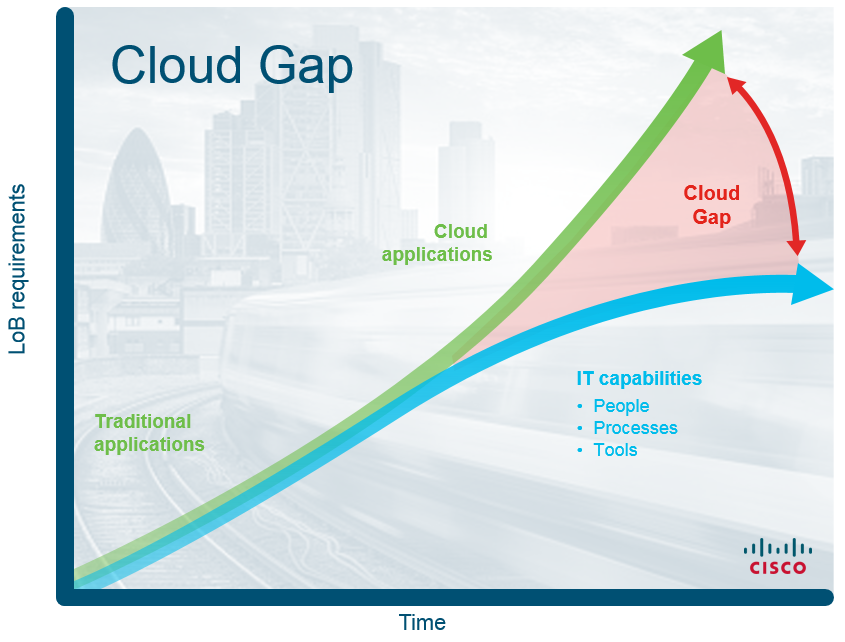
The GAP between what cloud applications require and what IT organizations are capable of reliably and confidently supporting today; is growing exponentially in the digital, customer-centric era. IT organizations that embrace cloud-enable technologies, streamline service processes that focus on efficiency, automation and anticipating the needs of customers will ultimately be successful.

We are all in this digital transformation together. Our position at Cisco is to remain Cloud Neutral and help our customers capitalize on new opportunities to delight their customers, just as Marriott did with their improved mobile app.

Wondering where to Start?  Take a 15 minute Business Cloud Maturity assessment today!

Authors

Scott Whitright

Data Center & Cloud, Marketing Mgr.

Global Partner Marketing

Avatar

We’re having fun now! For weeks leading up to the Cisco Spark launch on January 24, we said we’d leave our mark on the industry. In my last blog, I declared, “The Future Is Now.” As you know, we worked toward that pivotal moment for years. Leave our mark we did, and it is thrilling to feel the momentum and see the demand for Cisco Spark build each day.

  • We are focused on accelerating supply to meet the demand for Cisco Spark Boards
  • Hundreds of partners are already selling Cisco Spark through the new Cisco Spark Flex Plan which continues to expand to make it easier for you to sell more of the portfolio in one licensing package
  • Since the launch just three weeks ago, there has been a 50 percent increase in the number of partners selling Cisco Spark
  • Cisco Spark revenue is accelerating nicely

The response from analysts, press, customers and partners has been nothing short of amazing. There’s tremendous enthusiasm – not just for the Cisco Spark Board, but for the way we’ve revolutionized the meeting experience, and differentiated Cisco collaboration from the competition. There’s also a lot of excitement from partners about how easily the Cisco Spark Board and Spark Room Systems can provide better video conferencing for everyone, in every meeting room, as a service. It’s yet another route to drive recurring revenue with new and existing customers. Selling Spark Board is a way to quickly land new business that you can later expand to other Cisco Spark services through the adoption process.

Spreading the news

We’re continuing to spread the word and the excitement beyond the main and regional launch events to tens of thousands of customers and partners around the world.  

  • ISE2017At this traditional video integration event, Cisco Spark and the Cisco Spark Board were a big hit. Partners and customers alike were able to get first-hand experience and see big opportunities with customers.  One partner told me, “This changes the game and gives me a clear path to take my customers to the cloud.”
  • Cisco Live Berlin– The event just ended, and we rode another wave of enthusiasm with our European partners and customers. Next it’s off to APJ with Cisco Live Melbourne and APJ Partner Connection 2017
  • Enterprise Connect– We’ll not only continue the conversation at Enterprise Connect in late March, but we’ll share even more collaboration innovations. More excitement, and more momentum!

Customers are so excited and clearly see the value. You, our partners, have definitely realized that “The Future is Now.” You have been quickly ordering and exploring the Cisco Spark Board internally so you can use it, know it, and sell it successfully.  We’re hitting full-speed in our collective journey to the cloud with Cisco Spark. It’s fun, it’s profitable, and we’ll only continue to accelerate, together!

Authors

Gary Wolfson

Director, Global Partner Software Sales

Avatar

By all rights I should be exhausted.  But I’m not.  To the contrary, as Cisco Live Berlin 2017 winds down, I’m totally energized.  So much creativity.  So many amazing people, with innovative products and ideas that are truly transforming the way we live and work.  I saw this first-hand in our DevNet Zone and throughout the event. On Tuesday, I was honored to give one of the conference Innovation Talks.  I took the opportunity to look at the growing importance of the relationship between applications and the network infrastructure on which they run.  You can see the replay of my Innovation Talk here.

There was a time, not so long ago, when applications and network/IT infrastructure were managed separately – when applications were the domain of software developers, and infrastructure belonged to network engineers and IT professionals.

Today, applications have become the primary vehicle for reinventing entire workflows that transform (or disrupt) businesses.  The Internet of Things and the Cloud are opening up new pathways for developers to create business value in an increasingly app driven economy, but only if the apps are seamlessly and securely connected to the programmable network infrastructure.  Keeping those apps running and performing well has never been more important.

The world of network engineers and IT professionals is also undergoing rapid and profound change.  To meet skyrocketing expectations for network speed, scale, analytics and security, they are becoming programmers too – creating network infrastructure that is more automated, software-defined, and programmable.

The imperative is clear…applications and infrastructure must meet.  Developers and IT must communicate, and APIs (Application Programming Interfaces) are the medium for that connection.  APIs are how separate software systems talk to each other.  APIs are the vehicle by which network administrators can securely expose the infrastructure to app developers, and developers in turn can build applications that are optimized to run on the infrastructure.

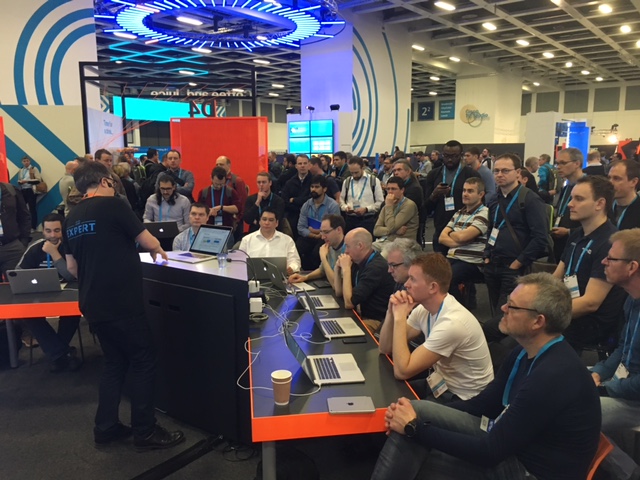
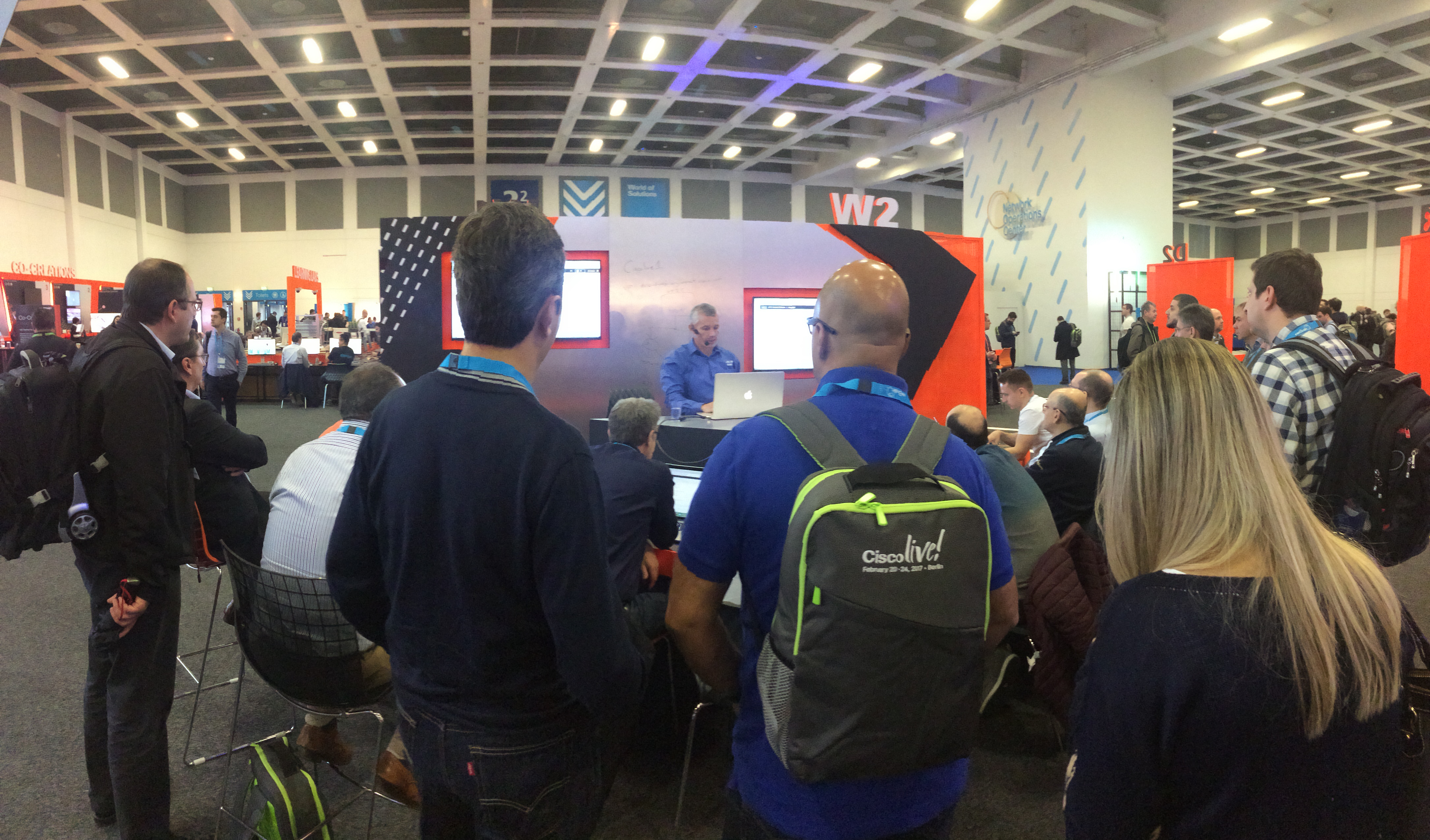
This is the nexus where Cisco DevNet lives – where applications and infrastructure meet.  This week, that meeting has been on full display in the DevNet Zone at Cisco Live in Berlin.  Workshops on using APIs for NETCONF/RESTCONF/YANG, WAN Automation Engine, and APIC-EM have been filled to capacity.  As were developer sessions on using Cisco IoT tools, integrating Spark collaboration into apps, or creating context-aware mobile experiences with the CMX API.  Cloud sessions on continuous development, containers, Docker, blockchain, serverless, and more all played to overflow audiences.  Vince Kelly was his usual Python programming rock star.  With over 120 sessions, I can’t begin to list all that happened…IS HAPPENING!

To everyone who came to see us in the DevNet Zone…thank you.  It was great to meet you in person.  If you weren’t able to be there, you can catch replays of the sessions on the Cisco DevNet YouTube Channel.  And if you don’t find what you’re looking for there, email us at DevNet@cisco.com, and we’ll help you out.

Your input and engagement is important to us.  So if you’re not a member already, please join the DevNet Community.  Whether you’re an app developer, network engineer or IT pro, we’re here to help you learn, code, inspire, and connect.

Now it’s time to get ready for DevNet Create, May 23-24 in San Francisco.  We’re bringing together application developers, infrastructure engineers, designers, technologists, innovators, DevOps engineers and IT Pros who want to define and build this new landscape – where applications meet infrastructure.  Join us!

Authors

Susie Wee

SVP & CTO

Cisco DevNet Ecosystem Success

Avatar

By Giovanna Carofiglio, Cisco Distinguished Engineer 3

By 2020, 82% of all IP traffic will be video and two-thirds of all Internet traffic will be generated from wireless and mobile devices, according to Cisco VNI forecast.

Video services are evolving (UHD 4K-8K video, Virtual/Augmented Reality) and drive future 5G networks design to match mobile usages, very-high bandwidth requirements and ultra-low latency constraints.

In parallel, video consumption is changing: less TV more connected devices usage, less broadcast more streaming, with a larger impact on network end-to-end from the access to the core.

All these factors put pressure on the capabilities of future 5G networks and highlight their critical role in the support of Dynamic Adaptive Streaming (DAS), namely the variety of techniques, in most of the cases relying on HTTP, to realize an efficient multimedia delivery over the Internet.

In the 5G mobile and heterogeneous network access, it seems of utmost importance to consider DAS interaction with the network and to move caching and computing capabilities to the network edge in order to enable efficient mobile video delivery.

This is what Information-Centric Networking (ICN) does by empowering the network with content-aware capabilities for a joint video/network optimization that results in better user experience and traffic cost reduction.

To prove potential for ICN application in adaptive streaming services as an alternative to standard TCP/IP transport, we in Cisco have worked on two directions: the design of Hybrid ICN (hICN), an incremental deployment strategy for ICN that preserves all its benefits while integrating ICN into the existing IP infrastructure and the definition of a virtualized video-centric ICN architecture with containerized ICN router instances to support mobile video delivery over a heterogeneous mobile access.

hICN benefits come from enhanced video rate adaptation, in-network loss recovery, dynamic load balancing, multicast and caching.   If you want to know more, you can read our white paper on “Mobile Video with hICN”.

A live demonstration of ICN benefits over standard TCP/IP solutions for mobile video delivery will be done next week at the upcoming Mobile World Congress, in Barcelona. Hope to see you there!

Authors

Dan Kurschner

Marketing Manager, Product/Systems

Avatar

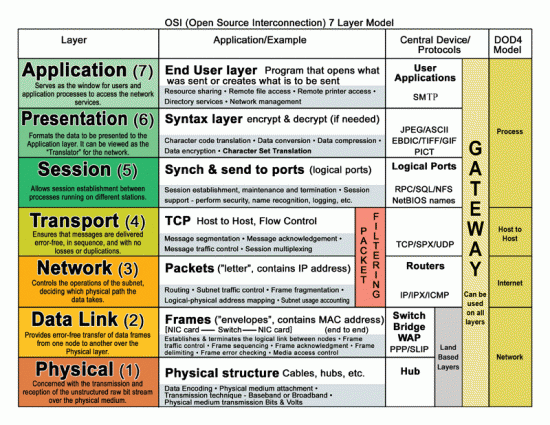
In 1984, after years of having separate thoughts on networking standards, the International Organization for Standardization (ISO) and the International Telegraph and Telephone Consultative Committee (CCITT) jointly published the Open Systems Interconnection Reference Model, more commonly known as the OSI model.  In the more than three decades that have passed since its inception, the OSI model has given millions of technologists a frame of reference to work from when discussing networking, which has worked out pretty well for Cisco.

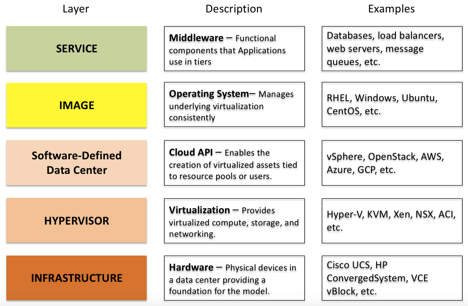
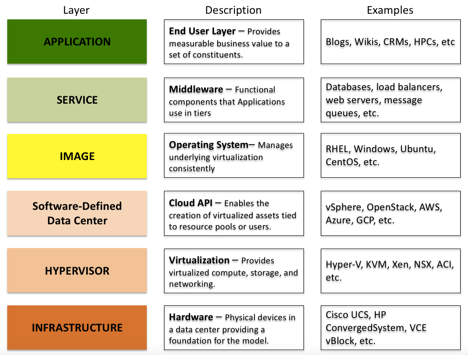
Cloud technologies have progressed in recent years that a similar model is now suitable as different audiences have very different interests in the components that make up a cloud stack and understanding the boundaries of those components with common terminology can go a long way towards more efficient conversations.

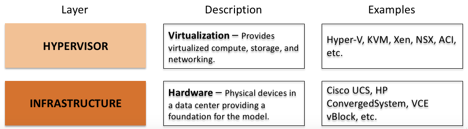
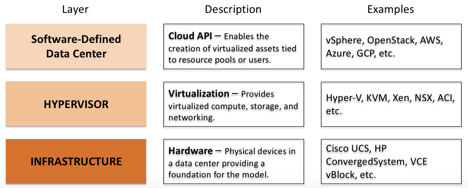
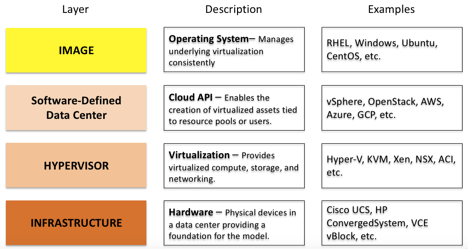
Layer 1: Infrastructure

Analogous to the Physical layer in the OSI model, Layer 1 here refers to the Infrastructure that sits in a data center to provide the foundation for the remainder of the stack.  Corporate data centers and colocation providers have been running this Infrastructure layer for years and are experts at “racking and stacking” pieces of hardware within this layer for maximum efficiency of physical space, heating/cooling, power, and networking to the outside world.

Layer 2: Hypervisor

Commonly installed on top of that Infrastructure layer is some sort of virtualization, commonly provided by a Hypervisor.  This enables systems administrators to chunk up use of the physical assets into Virtual Machines (VMs) that can be bin packed onto physical machines for greater efficiency.  Prior to the advent of the Hypervisor layer, components higher up the stack had to wait weeks to months for new Infrastructure to become available, but with the virtualization provided at this layer, virtualized assets become available in minutes.

Layer 3: Software-Defined Data Center (SDDC)

Resource pooling, usage tracking, and governance on top of the Hypervisor layer give rise to the Software-Defined Data Center (SDDC).  The notion of “infrastructure as code” becomes possible at this layer through the use of REST APIs.  Users at this layer are typically agnostic to Infrastructure and Hypervisor specifics below them and have grow accustomed to thinking of compute, network, and storage resources as simply being available whenever they want.

Layer 4: Image

Here, a bias towards compute resources (as opposed to network or storage) becomes apparent as Image connotes use of particular operating systems and other pre-installed software components.  Format can be an issue here as not all SDDCs support the same types of Images (.OVA vs .AMI, etc.), but most operating systems can be baked into different kinds of Images to run on each popular SDDC.  Developers will sometimes get involved at this layer, but not nearly as much as the two layers yet to come.

Layer 5: Services

Application architectures are typically built on top of a set of common middleware components like data bases, load balancers, web servers, message queues, email services, other notification methods, etc.  This Service layer is where those are defined, on top of particular Images from the layer below.  Sometimes these Services manifest themselves as open source installed on a VM or container, such as MySQL to give a database example.  Other times the SDDC may offer an API for accessing components from a pool of Services such as AWS RDS, but underneath that API those components are still built upon an Image and the other layers that precede it.

Layer 6: Applications

The final layer is where end users interact with the stack through deployed Applications that are comprised of custom code that makes use of various Services defined below it.

Now What?

Whether in a technical conversation or a sales engagement, understanding what layer in this stack a specific person has expertise is important.  Someone who implemented a Hypervisor before the SDDC layer became widely available, for example, has a very different view of the world than someone who has never known a world where the SDDC did not exist.  Experts at each layer in this stack have bias and often lack of understanding for those working at other layers in the stack.  Admitting that and having a framework for all to understand how their part of the world makes up the whole leads to better conversations because everyone understands everyone else’s motivations and places of intersection far better.

Authors

Pete Johnson

Principal Architect

Global Partner Organization

Avatar

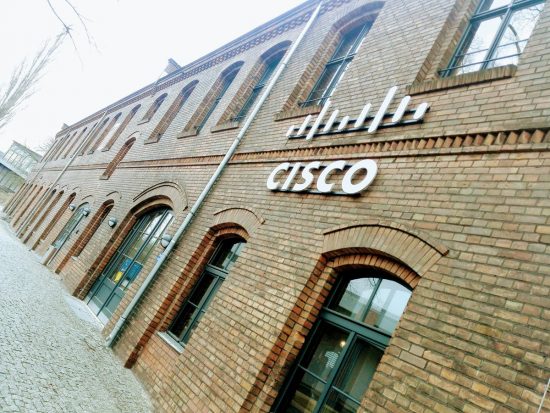
When you think of Berlin, the first things that come to mind could be bratwurst, beer, or the Brandenburg Gate. But in the world of Manufacturing, Berlin is also a hotbed for innovation. And we were right at the center of this during our special Manufacturing conversation earlier this week at our openBerlin Innovation Center, where we connected partners and customers with some of the foremost leaders in the Internet of Things (IoT).

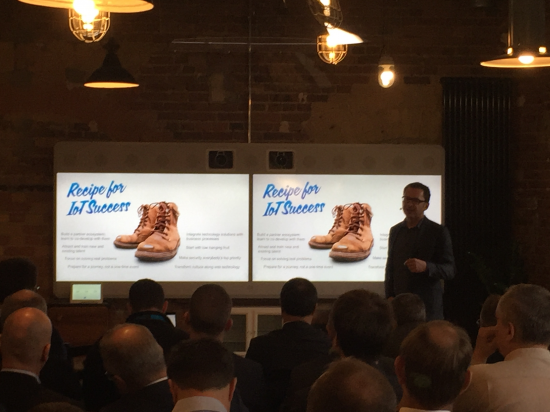
Industrie 4.0 was top of mind, as innovations in digital manufacturing and Industrial IoT drive efficiencies in manufacturing environments. Maciej Kranz, Cisco’s Vice President of the Corporate Strategic Innovation Group, kicked off the conversation with anecdotes about IoT use cases. While smart city solutions such as parking, lighting, and waste management are the most popular IoT implementation cases, we’re also seeing solutions emerging in the healthcare and retail industries. The manufacturing landscape plays a significant role in delivering IoT, and Cisco’s Connected Factory solution helps bring it to life.

Maciej Kranz, author of New York Times Bestseller, “Building the Internet of Things”

For operations teams to reduce downtime and improve overall equipment effectiveness, Maciej emphasized the importance of including predictive analytics using a connected device topology. When implementing an IoT solution, Maciej shared one should “dream big, but start small.” Start with a usable solution and scale it across your environment.

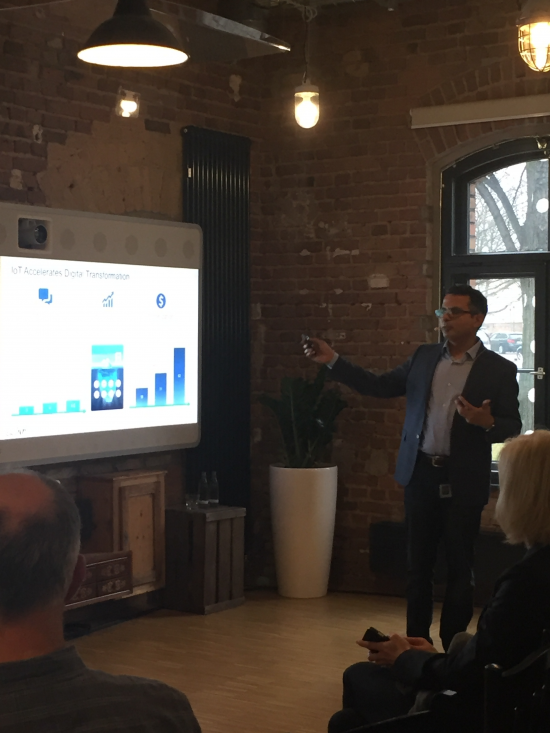
Our guests dove deeper into Cisco’s manufacturing solutions, starting with Vikas Butaney, General Manager of Cisco’s IoT portfolio. Vikas spoke on the importance of using IoT as a foundational technology for accelerating business outcomes and embracing digital transformation using IT, security, and networking infrastructure. While transitioning to IoT can seem daunting, Vikas described simplifying implementation using IoT-ready devices, making it much easier to connect, manage, adapt, and deploy.

Vikas Butaney describes how IoT accelerates digital transformation

We concluded our day with product demos where our customers and partners visualized our Manufacturing and IoT solutions in action. To learn more about starting your IoT Manufacturing journey, check out our Digital Manufacturing website.

Authors

Srinivas Hanabe

Director, Enterprise PSM

Enterprise Networking and Mobility