Avatar

We live in a time when lines in IT are blurring, and the line between security and network operations is just one example. When organizations are breached, their network is imperiled and business can suffer. Resiliency, performance, and threat defense are increasingly intertwined. No one understands this better than Cisco, with our decades of network leadership and our innovation in security.

Cisco is enabling our customers to maintain network performance while they keep their data safe. Our latest Firepower 2100 Series NGFWs are a testament to this, delivering business resiliency through superior threat defense and unmatched price-performance. With Firepower 2100 Series, enabling advanced threat functions does not mean compromised performance – you can maximize throughput while maintaining robust threat inspection.

Business resiliency is job one for network operations teams – but they can’t do their jobs if security is a choke point. On the Cisco Firepower 2100 Series, when you enable advanced threat functions, they won’t become a network bottleneck like competitors. Cisco’s innovative dual, multi-core CPU architecture and software optimizations maximize firewall, cryptographic, and threat inspection performance simultaneously.

From preliminary testing, we’re seeing minimal impact on large packet firewall throughput when enabling intrusion inspection. In fact, with IPS fully enabled, we see with large packets less than 1% throughput degradation to network traffic. Contrast that with the typical 50% or greater impact in competing designs. With Cisco’s design, you don’t have to choose between security and network performance – you get both!

A ‘No Compromises’ Security Architecture

Key to the performance sustaining abilities of the Firepower 2100 Series is a dual, multi-core CPU architecture and software optimization that enables:

  • Sustained throughput performance when threat functions are enabled vs. competing designs
  • Flexibility and future-proofing versus ASIC-based designs that inhibit the ability to add new defenses and functions
  • Fast path accelerates flows not requiring threat inspection, further enhancing performance through the appliance
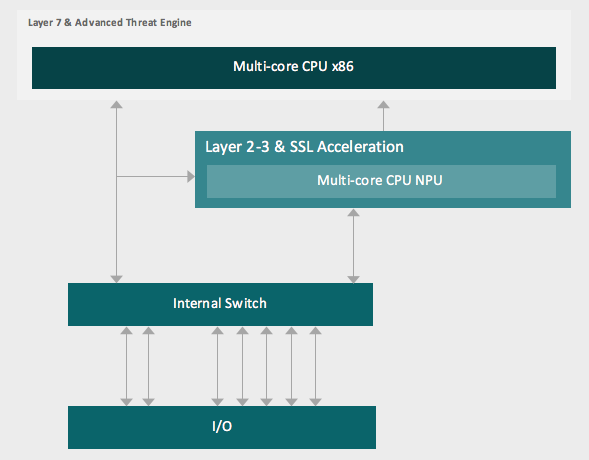
 

By applying purpose-built processing for the tasks at hand, the Firepower 2100 Series NGFWs optimize performance and threat protection, without burdening network operators to architect around security bottlenecks. This reduces the need to overprovision and fosters deeper inspection levels than otherwise might be possible.

The design employs Intel multi-core CPUs for Layer 7 threat inspections (app visibility, intrusion detection, URL filtering, malware and file inspection, user identity, etc.) and a combination of merchant and a Network Processing Unit (NPU) for layer 2-4 traffic (stateful firewall, NAT, VPN-SSL encryption/decryption, and more.).

Traffic first traverses the NPU, and may be blocked based on access controls, obviating the need to inspect further. Flows requiring advanced inspection are copied and sent to the x86 complex – and flow handling is optimized regarding required inspection services, utilizing security group tags as one method to make this determination. In addition, a ‘fast path’ option allows intelligent re-routing of trusted traffic dynamically.

If it isn’t obvious by now, Cisco Firepower NGFW isn’t just another firewall. Across the entire family – and now the new 2100 Series – Cisco Firepower NGFW combines our effective security architecture with the power of the network for superior business resilience and protection.

Watch the video below, visit the Cisco Firepower 2100 Series NGFW product page, and take a virtual tour to learn more about the various form factors, speeds and feeds, and more.

https://youtu.be/R8Do7Q3FlB8

 

Authors

David C. Stuart

Director, Network Security Product Marketing

Security Business Group

Avatar

Business is all about applications.  They run your business. Capture new market opportunities. Drive revenue. What if you could accelerate delivery of new applications? Deploy them across any on premise or public cloud quickly?

That’s exactly what you can do if you are using Cisco CloudCenter.  Part of Cisco ONE Enterprise Cloud Suite, this solution is designed to automate modeling, configuration and deployment of your applications.  You deliver solutions faster. Watch this video to learn more.

https://youtu.be/NDrdS-ZE9_8

Cisco ONE Enterprise Cloud Suite is designed with four key components that work standalone or combined to deliver hybrid cloud. No need to purchase software you don’t need. Rather purchase just the right amount of automation for today.  Then expand.  The components include:

Powered by Cisco CloudCenter, the cloud management component allows both IT and application teams to work together to build a model, known as an application profile.  This profile is cloud neutral. It allows your teams to combine golden images along with middleware, configuration of firewall ports, security and scaling policies into a single profile. Once designed, the profile can be run on any on premise or public cloud platform including AWS, Azure, Google Compute, AWS Government Cloud or vCloud Air, just to name a few.

Without Cisco CloudCenter, things are not so efficient.  Yes, public cloud platforms deliver instances quickly.  But automating them is another matter. Your teams need the knowledge of the proprietary APIs.  Write scripts for each platform.  Test and QA the scripts.  Release to production. But you’re not done.  Applications are dynamic.  Your application teams need to continuously update and maintain these scripts.

Fast is the new mantra in business today.  Cisco CloudCenter is delivering 60% time savings to customers.  Reducing application delivery cycles by 33%.  That’s efficiency that goes right to your bottom line.

See how Cisco can fuel faster application delivery.  Take the next step and learn more.

Authors

Joann Starke

No Longer with Cisco

Avatar

According to Wikibon, only 10% of internal IT workloads represent true private cloud. The private cloud is simply a virtualized environment, lacking the characteristics that we associate with public cloud, such as user self-service, automated deployment and utility billing. This is because private clouds are often built on legacy data center networks, rather than software defined architectures.

Since SDN (Software Defined Networking) first emerged in 2012, there has been a lot of criticism on the networking industry focused on it’s inability to keep up with the automation and virtualization advances that we have seen in the server and storage industries. In my opinion, this seems a bit unfair as the distributed nature of networking makes it more difficult to virtualize and automate than servers and storage. These challenges include:

  • Distributed Configuration – Each individual component of the network needs to be configured in harmony with the others to ensure connectivity. This makes the system very brittle and one bad configuration can take down the entire network.
  • Automation – Even if devices are standardized, many will lack an object model and northbound APIs and this makes automation difficult.
  • Heterogeneous Environments – Many data center environments will have multiple vendors, numerous device types and different code versions. As a result, configurations cannot be templated or automated, so significant effort is required and inconsistency is inevitable.
  • Service Insertion – Middle boxes such as firewalls and load balancers sprawl across many data centre environments. These devices reduce performance, make configuration rigid and impede workload mobility.

Up Until now, I have defended the right of the networking industry to take a little longer to solve these challenges. However, now in 2017, both SDN and NFV (Network Functions Virtualization) have matured and there is no longer an excuse.  If your network is not software defined, then it is legacy. Investment cycles indicate that adoption will continue for several years.  If organizations are building data center networks by 2017 and not considering SDN, NFV and automation, they are placing themselves at least five years behind the curve and closing the door on private cloud.

Remember how we were once told that “software will eat the world”? Well, software has allowed the networking industry to solve the challenges discussed above. With SDN, user intent is captured on a central software controller and pushed as configuration to an underlay network fabric or virtualized end-points, depending on the solution. As well as solving the distributed configuration problem, this also solves the automation problem – the SDN controller will have a northbound API and in some advanced cases the solution will be object-oriented, which significantly aides programmability.

Depending on the SDN solution, the underlay will either be consistently one hardware type or a dumb underlay, so the heterogeneous environment problem is also removed. Finally, NFV has also grown up as the younger sibling of SDN and almost all Layer 4 to 7 appliance vendors now provide their solution in a virtual form factor. This virtualization combined with centralized software control of network policy means that services are be inserted into the network with ease and only where required to improve performance.

At Hutchinson Networks, we adopted SDN early and built our public cloud IaaS platform using Cisco’s market leading SDN solution, ACI. We have also adopted NFV for all Layer 4 to 7 components and only use hardware for the most basic components – physical network connectivity, disk arrays and raw compute (CPU and Memory). Using a Software Defined Architecture and Cisco ACI has allowed us to build a true cloud environment. Find out more here: Diversifying Business with Cloud Services.


Guest Blogger: Stephen Hampton, CTO at Hutchinson Networks 

Stephen Hampton is a Network Architect with a proven track record in the successful delivery of large networks. As CTO, he is driving Hutchinson Networks’ technical progress and solutions selling strategy. Stephen is seeking to improve and expand Hutchinson’s service catalogue, bringing new solution sand innovative products to market. Supported b  expert, certified engineers, Stephen is also strongly focused on building a top-class team of technical engineers and architects. He has the enviable ability to rapidly master new technologies and architectures.


Authors

Christina Grenier

No Longer with Cisco

Avatar

Hello all,

As you can well imagine, the routing team is buzzing with enthusiasm as the new Cisco RV340 Series launches with great anticipation. The idea for the new models started a few years ago, as a blank piece of paper. This piece of paper quickly filled up with what would define these new VPN Routers in what we call a Product Requirements Document, or PRD. Yes, we love acronyms around here.

I started this document around 2013. The program took on different angles at times, even with different Product Managers, but the focus was always to design, create, craft, build, test, validate, and finally launch the best RV Series we have ever produced. Today, I can officially say we have done that. The long journey has almost been completed.

These models have the most powerful processors we have ever used, they have the best-in-class features, and are easily set-up, configured and deployed with our intuitive user interface and set-up wizards.

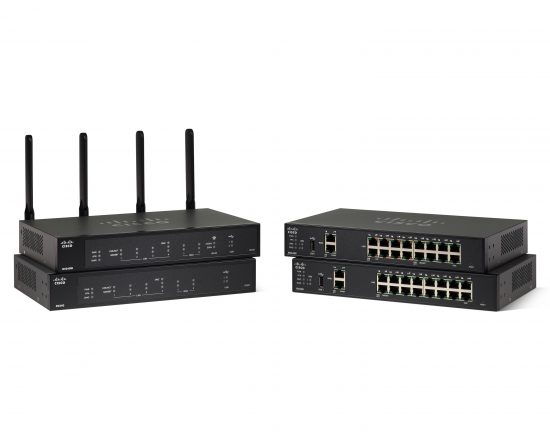
The new models include the RV340, RV345, RV345P, and RV340W. The RV340 and RV345 are launching today, the RV340W and RV345P will be available later this year.

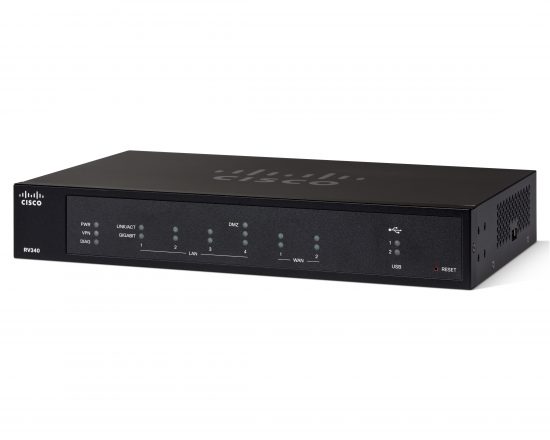
Cisco RV340

The RV340 started as a replacement for today’s RV320. But the  specifications quickly escalated as we push the limits of our portfolio. The RV340 has Dual WAN ports and four LAN ports.

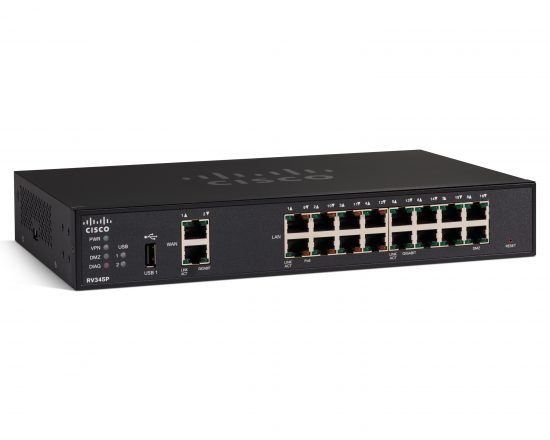
Cisco RV345P

The RV345 and RV345P have Dual WAN ports and 16 LAN ports. The RV345P adds PoE (Power over Ethernet ) ports to power devices such as Wireless Access Points or other devices.

Lastly, the RV340W is the most powerful Wireless VPN Router ever in the RV Series portfolio.  It is also the first 300 Series Wireless model. This all-in-one networking-in-a-box model is all someone looking for the perfect blend of performance, range, security and reliability for their business network. All of the models use the same processor, same switch and same software.

The RV340 and RV340 are launching now, the RV340W and RV345P will launch later this year, stay tuned in here.

Now for the fun. We are doing a little contest where we are giving away some cool prizes for the next three weeks. The Grand Prize is a new Cisco RV345!

Click on the RV340 Series Router Knowledge Quiz to submit your entry.

We will be asking questions based on the product pages and datasheets. Be ready to answer some questions! Feel free to enter everyday and keep coming back here for updates. Sorry friends, this one is the US only. We promise, the next one will be for more regions!

Product Pages:

Cisco RV340 Dual WAN VPN Router

Cisco RV345 Dual WAN VPN Router

The Datasheets are available on the product pages by clicking on “Learn More”.

Questions? Please contact us at ask-eng-small-business@cisco.com.

From our team to your team,

Thank you.

Marc and the rest of the Cisco Small Business Team

Authors

Marc Nagao

Product Manager

Small Business RV Series Routers

Avatar

Vulnerabilities discovered by Talos

Talos is releasing multiple vulnerabilities discovered in the Aerospike Database Server. These vulnerabilities range from Denial of Service to potential remote code execution. This software is used by various companies that require a high performance NoSQL database. These issues have been addressed in version 3.11.1.1 of the Aerospike Database software. 

The Aerospike Database Server is both a distributed and scalable NoSQL database that is used as a back-end for scalable web applications that need a key-value store. With a focus on performance, it is multi-threaded and retains its indexes entirely in ram with the ability to persist data to a solid-state drive or traditional rotational media. 

TALOS-2016-0263 (CVE-2016-9049) – Aerospike Database Server  Fabric_Worker Socket-Loop Denial-of-Service Vulnerability

TALOS-2016-0265 (CVE-2016-9051) – Aerospike Database Server Client Batch Request Code Execution Vulnerability

TALOS-2016-0267 (CVE-2016-9053) – Aerospike Database Server RW Fabric Message Particle Type Code Execution Vulnerability

Read More >>

Authors

Talos Group

Talos Security Intelligence & Research Group

Avatar

In law enforcement, minutes can literally mean the difference between life and death. Time really is of the essence for Public Safety agencies when responding to the daily mix of crimes, accidents and emergency calls. Fortunately, a variety of innovative new technologies are now available to police departments nationwide that can enable officers to respond faster and with higher efficiency through greater information sharing and collaboration. The Danville, New Jersey Police Department is learning this first hand, and as their Chief Christopher Wagner states, this “digital transformation” is changing policing for the better.

“The amount of time and money that (innovative new technology) saves has really been transformational” says Chief Wagner. Through their partnership with Cisco, the Danville Police Department is now benefiting from the use of Cisco’s Jabber and Spark on their squad car computers and even on officers’ smart phones. By using Jabber, personnel in the field and headquarters gain real-time access to instant messaging, voice and video messaging as well as conferencing. And by adding Spark, they can enable a secure and reliable collaborative space to help solve the issues they face.

Instant messaging and secure video networks are also helping the justice system. Judges, prosecutors and defendants can now meet online from multiple locations for bail and other types of hearings. This means removing the need to transport an inmate from the jail, which saves time and money for the agencies involved yet increases safety for everyone.

But many of us in Law Enforcement had to serve without the benefits tools like Jabber and Spark could have provided. For me, personally, instant video messaging would have been a tremendous asset during my 14 years as Chief of Police of the Plattsburgh, NY Police Department.

For example, on one occasion I had to be out of town to take care of a hospital-bound family member. While I was gone, there was a fatal stabbing in our city. And as you probably know, even when a police chief is out of town or away from the office, he or she may still bear responsibility for making critical decisions on major cases. As luck would have it – prior to the fatal stabbing being reported – a police vehicle was driving by the area and the dash cam video caught the suspect running from the scene and tossing a knife to the ground. Unfortunately, I could not see it from the hospital hallway where I was standing. I had to hear about the video from an officer on the scene.

In the best case scenario, I would have been there, either on the scene or at headquarters, supplied with real-time information. Lacking that, I needed my officers to present the scene in the most immediate way possible. Had Jabber and Spark been an available tool for us back then, I could have meet my responsibilities to both department and family by using real-time video conferencing with my officers back home. These technologies could have also let me view evidence, work through the parameters of the case and solve other logistical issues using Spark’s collaborative resources; all while remaining at the side of my family member in the hospital. But we simply lacked the capability back then. So this left me with only one option – a long drive home – and leaving my family behind at the hospital at a time when they needed me. Back then, this was the only way I could have access to all the information, direct the case and help make sure the suspect was caught and convicted, as he was. But that has now changed.

Thanks to Cisco’s innovative technologies I can now do both and stay responsive to my team’s needs and my family’s. And so can your department. Imagine improving response times, increasing situational awareness and aiding better outcomes in such a simple, easy-to-use way. By deploying technologies like Cisco’s Jabber and Spark, your police department can take control of communications and empower real-time video and information sharing, spur collaboration (such as lead sharing) and help drive better decision making. But that is just the tip of the iceberg, as departments adopting Jabber and Spark are quickly realizing that there’s never been a better time to join the digital transformation of Public Safety. And those that wait? Well, they may quickly find themselves wishing they hadn’t.

Check out what Chief Wagner and the Danville Police Department are doing.

Authors

Desmond J Racicot

Senior Public Safety Advisor Cisco Public Safety & Defense

Public Safety & Defense

Avatar

Guest Author: Brad Casemore
IDC Research Director, Datacenter Networks

Whether resident in traditional datacenters or – increasingly – in the cloud, applications remain the means by which digital transformation is brought to fruition and business value is realized. Accordingly, management and orchestration of applications – and not just management of infrastructure resources – are critical to successful digital transformation initiatives.

IDC research finds that enterprises will continue to run applications in a variety of environments, including traditional datacenters, private clouds, and public clouds. That said, cloud adoption is an expanding element of enterprise IT strategies.

Watch Video and Read IDC Paper related to this blog!

In 2016, enterprise adoption of cloud moved into the mainstream, with about 68% of respondents to IDC’s annual CloudView survey indicating they were currently using public or private cloud for more than one or two small applications, a 61% increase over the prior year’s survey.

Within this context, enterprises want cloud-management solutions that allow them to get full value from their existing IT capabilities as well as from their ongoing and planned cloud initiatives. At the same time, enterprises don’t want to be locked in to a particular platform or cloud. They want the freedom to deploy and manage applications in both their datacenter and in cloud environments, and they want to be able to do so efficiently, securely, and with full control. Ideally, they want the application environment to be dictated exclusively by business requirements and technical applicability rather than by external constraints. This is why enterprises are increasingly wary of tools optimized for a single application environment, and why they are equally skeptical of automation that is hardwired to a specific cloud.

To be sure, the greatest benefit of having an optimized cloud-application management system is strategic flexibility. In implementing a hybrid IT strategy with consistent multi-cloud application management, enterprise IT can deliver on the full promise of cloud while reducing the complexity, cost, security, governance, and lock-in risks associated with delivering services across mixed environments. As such, there’s no need to worry about cloud-specific APIs or about the threat of cloud lock-in. Instead, enterprises can focus on a service delivery strategy tailored to the needs of the organization, allowing applications to be deployed in the best possible environments.

An additional benefit is represented by speed and agility. In this respect, enterprises can align operations with agile development, helping accelerate the application development lifecycle. For example, enterprises can boost productivity and decrease time to market by providing developers with self-service portals to provision fully configured application stacks in any environment. Developers can remain focused on customer needs, and not on infrastructure or downstream deployment services.

To learn more about the challenges and benefits of managing applications across hybrid clouds, and to read about how Cisco CloudCenter responds to those challenges, I invite you to listen read an IDC Technology Spotlight titled, “Avoiding Cloud Lock-In: Managing Applications Across Hybrid Clouds.”

Watch Video and Read IDC Paper

Authors

Kurt Milne

Marketing Manager, US

CloudCenter Marketing

Avatar

Recently, I posted a Tweet with a photo of my colleague Melissa Holder and I enjoying a screening together of the blockbuster movie, Hidden Figures. After discussing this film more with other colleagues, I decided to write this blog post – not just because this was an excellent movie (nominated for 3 Oscars this Sunday!) but it’s a great example of why Cisco is a great place to work.

Cisco has EROs, which stands for Employee Resource Organization. These EROs allow Cisco employees to come together in smaller groups who are passionate around certain topics. For this screening of Hidden Figures, several EROs in our Raleigh, NC office partnered together to promote the culture of diversity, inclusivity, and collaboration.

Cisco employees at Hidden Figures Screening
The Tweet photo that I shared from the screening.

Because the movie focused on African American female engineers and mathematicians who were the ones who helped first launch (and retrieve) the first American into space, each ERO thought it was an excellent idea. Between WISE (Women in Science and Engineering), CW (Connected Women) and CBP (Connected Black Professionals) they made the screening happen. And all of the members were excited to come together for this terrific “office perk.”

“We sold tickets for $6.50, and we sold out the screening,” says Melissa Holder, the CBP Co-Lead for RTP. “Over 200 tickets to people of all races, colors, genders and roles. We all sat together, cried together and laughed together.”

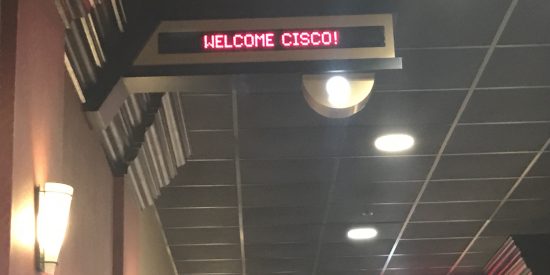
Movie Theater sign: Welcome Cisco!
Ready to watch with my Cisco colleagues!

“The attendee mix was pretty amazing,” says Kate Baldwin, one of the Connected Women leads focusing on Alliance. “It included 3 generations of a family; a Cisco employee, her mom and her children. Even Mike Moore, the youngest grandson of Katherine Johnson, the protagonist of the film (he’s also involved in the tech world) attended the event. We were such an expressive group. On multiple occasions the whole crowd would burst into applause.”

As I looked around the theater, I saw true diversity. I saw us enjoying a story that we all could relate to, even the men that came to support their wives and partners. But probably what touched me most are the young girls who are our future, learning this history, and being able to use it as a catalyst in their lives.

As a woman in my mid-career, I saw myself in all of the main characters. Early in my career, I was a young African American woman that most were shocked to see being an Engineer. I’ve been the smart girl in an all-male organization that people wanted to dismiss, not because I wasn’t capable, but because I was different. And I’ve been the person who was passed over for promotions when I knew that my work was over and beyond my peers.

Because we could identify with the film, we all walked away with something. Here are some more inspirational thoughts from those close to the event.

The movie taught me that no matter how tough the circumstance, no matter who is against you, YOU determine your destiny.
– Melissa Holder, Business Development Manager

Despite the injustices that still exist for women and African Americans today, these women impressed us all for what they were able to accomplish with even more barriers in front of them.
– Kate Baldwin, Program Manager

We all left the theater with a renewed energy to come together to overcome the challenges we face every day. It gave us a great sense of perspective and an appreciation for all the progress we’ve made in the decades between that first manned space launch and now.
– Carissa Lada, Business Operations Manager

My daughter shares Katherine Johnson’s birthday (January 17th), so I spent the evening with her celebrating in our own way. But the fact that everyone was able to come together and put together such a fantastic event makes me even more optimist about future collaborations. As EROs, we serve our community and help to uplift all. And we try to have fun along the way.
– Ruwani Biggers, RP Manager.

Want to get inspired in your career? See job openings here.


Editor’s note: After receiving this employee story, we discovered another Cisconian helping young women in technology through the movie! Belinda Scott, a Cisco high-tech operations manager and a National Society of Black Engineers member chartered the Raleigh chapter of Black Girls Code (BGC) in 2015. 20th Century Fox sent Scott tickets for a screening of the movie with the girls in BGC.

Read more about the emotional day and what the girls had to say!


Authors

Rolonda Goodwin

Program Manager, Acquisitions Integration

Software Supply Chain (SWSC)

Avatar

Retail has one of the highest turnover rates in any industry. The Hay Group reports a median turnover rate of 67 percent for part-time retail employees.[1]

I doubt any of us would be too challenged to list the problems driving this high turnover:

  1. Retail jobs are considered boring and repetitive, with little training and low pay or benefits
  2. Schedules may change without notice and are hard for workers to live with
  3. Associates have few opportunities for advancement

Yet turnover is just as bad for the store as it is for employees.

A study by the Center for American Progress found that it costs, on average, $3,328 (or 16 percent of one year’s salary) to find, hire, and train a replacement for one minimum-wage employee. Of course, the actual costs are much higher, including lost funds for hiring, onboarding and training costs, the cost of errors and lower productivity during the training period, and the impact on the company culture and other employees’ productivity.[2]

Many of these problems are increasingly solvable through today’s workforce experience tech. In fact, a study showed that from 1997 to 2014, companies considered employee experience leaders outperformed the broader stock market, generating an annualized return nearly double the SAP 500 index.[3] And Gartner quotes a 2015 Aon Hewitt study that finds that “a 5 percent increase in employee engagement is linked to a 3 percent increase in revenue growth in the subsequent year.”[4]

4 Ways to Help Your Employees Engage

Retailers need to take four important steps to help employees engage in a way that drives the customer experience:

  1. Invest in Wi-Fi. It’s time– you need to connect your associates to product information. Even today, many retailers hesitate to deploy a wireless network because they’re afraid employees will “play games all day.” But the result is that no fewer than 73 percent of customers believe they’re more informed than sales associates[5] simply because they can jump online at any time. By not giving your employees access to the same data as customers, you lessen their efficiency, lower your reputation, and diminish the chance of a sale.
  2. Bring in the experts (virtually). Take advantage of Wi-Fi in the store to enable new kinds of personalized tools. For example, you can install in-aisle kiosks that give both customers and employees immediate access to virtual experts via video-based, live interactions. A quick conversation with such an expert, usually part of a customer contact center, helps to answer questions, resolve problems, and drive the purchase process.
  3. Encourage online collaboration. Help your associates use new tools to work as a team. Technology can boost customer and employee communications, which not only helps associates do their jobs better, but also lets managers more easily attract, develop, and retain the best talent. In a recent survey, 82 percent of store associates agreed that improving in-store communication between staff and managers positively impacts the consumer shopping experience.[6] Onboarding new employees becomes both more thorough and less costly through interactive or recorded sessions tailored to the practices, duties, and tools experienced on the job.
  4. Focus on developing talent. Perhaps the most important role that the new worker-experience technologies play is in developing employee talent. According to the American Society for Training and Development (ASTD) report “Bridging the Skills Gap,” 41 percent of employees in companies that invest little or nothing in training said they’re likely to leave within one year. By contrast, that number dropped to 12 percent for employers who invested significantly in training and development.[7] Cost-effective, always-available trainings help to identify employees who are ripe to move toward promotion, giving them access to new skills that hone their talents.

All these capabilities make the store a more congenial environment for today’s employees of every age and level. By following these four steps, stores are preparing to drive a better customer experience through a better associate experience.

For more information, take a look at our new white paper, “Transforming Retail Associate Productivity with a Customer-First Experience.”

https://twitter.com/CiscoRetail/status/831556121466904576

Follow me on Twitter: @Digital_Mary


[1] “Hay Group Study Finds Employee Turnover in Retail Industry Is Slowly Increasing,” Korn Ferry/Hay Group (May 2012).

[2] “Employee Retention – The Real Cost of Losing an Employee,” by Christina Merhar, Zane Benefits (February 4, 2016).

[3] “Digital Business Requires an Excellent Associate Experience to Drive Retailer Success,” Gartner.

[4] Gartner, ibid.

[5] “Shoppers Would Rather Consult Smartphones than Consult Store Associates, Survey Finds,” Internet Retailer (December 2010).

[6] “13 Reasons Why You Hate Shopping,” by Gary Ambrosino (2016).

[7] “5 Best Practices for Workforce Productivity,” by Emad Rizkalla.


Authors

Mary Freeman

No Longer with Cisco