Avatar


This year’s UK budget day (23rd November 2017) has been an interesting day for technology. Technology plans were central topics – including a significant government 5G investment.  As my Cisco UK colleague Matt Houlihan blogged earlier, Cisco is already working with Government to ensure that as a country, we have the best foundations in place in terms of digital technical capability and infrastructure. One such area is rail connectivity.  In this part 1, I’ll cover the challenges of rail connectivity and Cisco’s Connected Train solution – and in part 2 in the next week or so I’ll talk about the implications for 5G and the UK.

The Challenges of Rail Connectivity

Service providers can have some real challenges delivering connectivity to trains. Trains are fast moving metal objects – essentially Faraday cages travelling at speeds of 100 mph (and beyond).  Delivering internet connectivity – especially on a crowded rush-hour trains – will significantly exceed people density in a typical office.  Consumption of data could be significant – especially as workers look to be productive on rail journeys, participating in conference calls and even video conferences.  Railway tunnels and cuttings, tree foliage, rail lines in sparsely populated rural areas and other factors add to the train connectivity challenge, as the following diagram illustrates.
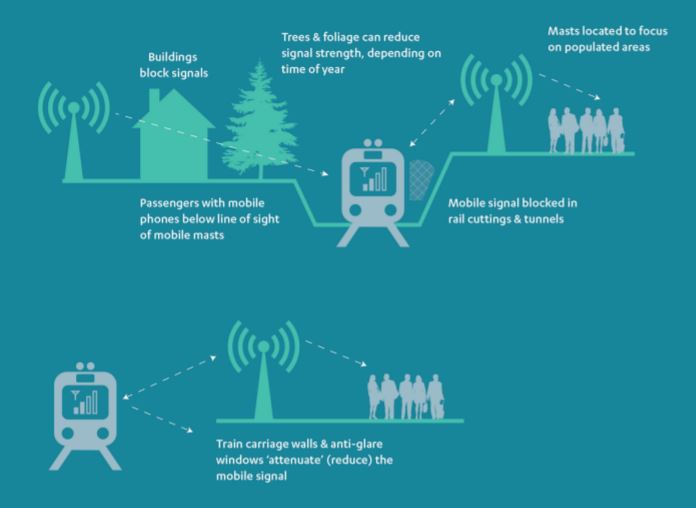
The Challenges of Train Connectivity (Source: UK National Infrastructure Commission)

Regardless of the technology, then, 3G, 4G, 5G … these remain key challenges for rail connectivity and must be solved for 5G to be a success.  And as I’ll describe in this blog, Cisco is solving these today – well in advance of any 5G technologies being rolled out.

The UK Government View

The UK National Infrastructure Commission’s “Connected Future” report (December 2016) is an excellent read on this topic. Some of the key points in this report include:

  1. “Mobile coverage on our rail routes is notoriously poor; making it difficult to carry out tasks taken for granted in many other contexts, such as making a phone call or checking emails”
  2. “Roads, railways and city centres must be made 5G ready as quickly as possible”
  3. “The railway network must rapidly improve connectivity. This will be best delivered in future by a trackside network
  4. “The RAC foundation found that c. 4,600 miles of British roads have no 2G mobile phone coverage from any network provider” [a challenged I noted in a previous blog regarding one of Scotland’s major trunk roads]
  5. “Around 40 per cent of railways are in tunnels or cuttings, causing base station signals to be blocked. These difficult geographies mean that even with near-ubiquitous geographic coverage MNOs would be unlikely to provide sufficient coverage and capacity to deliver a quality service to passengers without trackside infrastructure”
  6. “The mobile market provides few incentives for MNOs to invest in improving rail coverage”
  7. “Ultimately, the government should ensure that the necessary infrastructure is in place on the main rail and key commuter routes by 2025 at the latest if it wants to offer a reasonable level of connectivity on a timescale consistent with the deployment of 5G networks.”

Forgive me, maybe I’m a cynic – but this adds to what I fear is call a growing mythology that (1) 5G will be required to deliver a good rail passenger connected experience, and that (2) 2025 seems to be the timeframe when we can solve this in the UK.  Let me apply Cisco’s “No Technology Religion” philosophy and demonstrate that THIS NEED NOT BE THE CASE!

The World’s Fastest Train WiFi – Coming Soon to Trains in Scotland
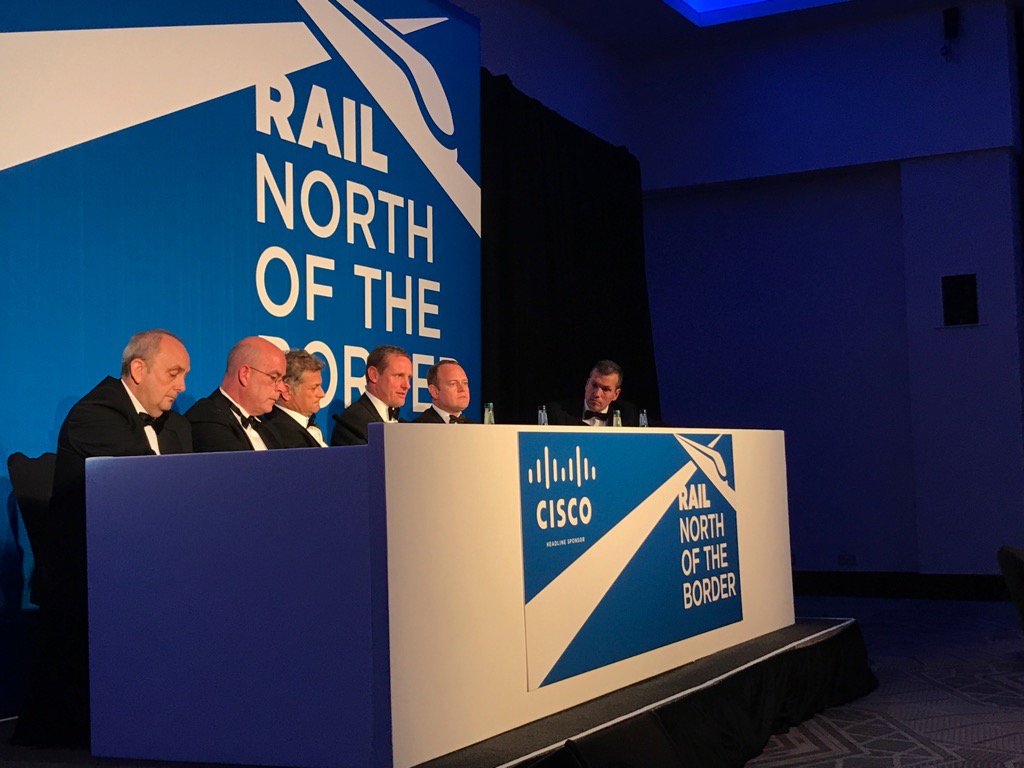
Cisco sponsoring “Rail North of the Border”

Back in September, I was lucky enough to be in the Rail North of the Border conference audience when Cisco UK and Ireland CEO Scott Gardner announced the upcoming trial of the world’s fastest train WiFi in Scotland.

We’ve evolved our solution from the original “Project SWIFT” – Superfast WiFi In-carriage for Future Travel – and adapted for the challenges of the ScotRail network. Starting early in 2018 this trial will go live on the Glasgow – Edinburgh (via Falkirk) rail line and, by leveraging a new trackside infrastructure, will deliver an average of 300 Mbps WiFi onto the ScotRail train (and a little birdie tells me they are already seeing up to 600 Mbps in early trials).  Well before the “Connected Future” report was published, Cisco – as the world leader in networking – had concluded that trackside infrastructure was the optimal approach to deliver super-fast train connectivity.  This delivers the opportunity – in 2018 and not in 2025 – to deliver a high quality connectivity experience to the rail corridor – not only for passengers but also for ScotRail and Network Rail productivity benefits.  As well as passenger entertainment, we expect this high quality WiFi experience will be used for work purposes – delivering a productivity increase to Scotland plc – as well as other benefits that I will cover in part 2 of this blog.

Please then, take some time to view the video below, which describes the passenger experience improvement way better than I can in a short blog:


I’ll wrap here for this part 1 – in part 2, I look forward to telling you more about the challenges Cisco overcame to deliver this solution now – and how we envisage our work, driven by our experts in Cisco UK and my colleagues in Cisco Services, can accelerate the adoption of 5G in Scotland, the UK and beyond. I’ll also talk about the uniquely collaborative environment in Scotland – with Network Rail Scotland, ScotRail, the train operating company (and also Scottish Government groups on 5G planning) – that’s enabled us to deliver this world first in Scotland. And let’s see if Scotland can “grasp the thistle” and deliver super-fast WiFi across the rail network.

PS: Part 2 of this blog is now available here.

Authors

Stephen Speirs

No Longer at Cisco

Avatar

Digitization is driving each of us across all industries to make dramatic changes to how we approach customers, products, services, and the always-on, real-time information rich marketplace.  This digital economy is gender agnostic. And, it is highly dependent on a connected global ecosystem. The message is clear—no one person, enterprise, industry, government or region can stand alone any longer.

Building security across this ecosystem demands flexibility, inclusion and partnership.  Who better to drive security partnership across a global ecosystem than women?  Security is an inherently human challenge. Only a security community with diverse skills and abilities can deliver the necessary pervasive approach to meet the challenge.

My path to security was built on a foundation of protecting intellectual property; enhanced by a legal background and rich engineering and operational leadership roles afforded to me by Cisco.  Each of these opportunities, including leaving a successful legal practice to join Cisco, required faith.  Faith in my own ability to learn an entirely new discipline and trust that my colleagues would support me in that effort.

Examining the diverse skills necessary to holistically address security, it is clear that an integrated and aligned ecosystem of collaborators is essential. From my experience, with women at the table, the view is not simply about technology—but rather includes the integrated web of people, process, and technology working together. This is a far more inclusive way of tackling security. Of course, it is not just women who hold this view. Only by working together can security become the behavioral mandate essential for a digital world.

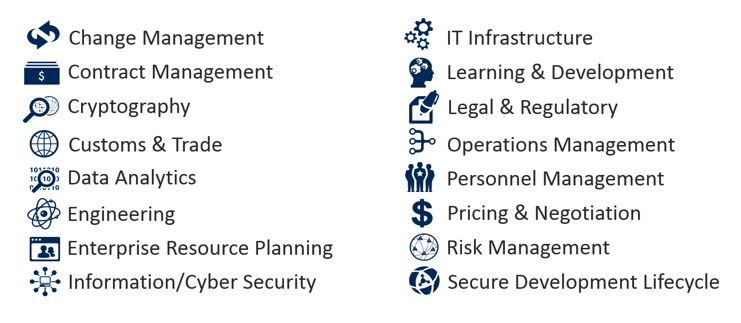
A broad set of skills are relevant to security success. Some are listed below.  Yet, while 50% of professional occupations in the US are held by women today, only 25% work in computing and 11% in cybersecurity.

Clearly, a rich community of skilled women exists. While continued focus on encouraging girls to learn about and join STEM fields is critical, embracing those with adjacent skills will also add to the community of women in security.

Together, we make a greater impact. Madeline Albright so poignantly reminded us that “There is a special place in hell for women who do not help other women.”  As the women of security, we must weave the magic carpet to transport all; regardless of generation, location or background. We must come together to:

What can we do to achieve this imperative? Each of us as individuals can make a difference.

There are ample public-private partnerships, non-governmental organizations (NGOs) and community groups that can serve as a springboard for our individual efforts. These groups span missions as diverse as:

Driving cultural change regarding education and treatment of women

Examples:

Establishing global baselines for sustainability, labor rights, human health and safety, and ethics in the electronics industry

Examples:

Enhancing the skills of and promoting women in Security

Examples:

At Cisco, I have the privilege of serving as an executive sponsor of our efforts focused on ages from five to 13. We as industry leaders, neighbors and experts can contribute to educational systems and support programs focused on opening the minds of and doors for young women. For example, Cisco’s Girls Power Tech program, part of the United Nations sponsored International Girls in ICT Day, takes place every April at more than 100 Cisco locations around the world. During this global mentoring event, we open our doors to young women, striving to inspire them to pursue a career in ICT through hands-on exposure to the latest technology and personal interaction with industry professionals.

In March 2016, I launched a challenge to our security engineering, services, information technology, and sales talent to deliver an introduction to cyber safety course to the youngest elementary students (when boys and girls have equal STEM interest). This unique opportunity allows us to send female role models to teach security awareness into the classroom and inspire young girls.

This clear multiplier effect is one that we, the women of security can deploy and sustain. Please join us!


Authors

Edna Conway

Chief Security Officer

Chief Security Officer, Global Value Chain

Avatar

When it comes to patient care, efficiency and communication are vital. It is critical for hospital staff and doctors to collaborate in real-time in order to deliver the best possible care and treatment – especially when a child’s life is at stake.

A major Virginia children’s hospital saw the value of collaboration technology and wanted to make sure that there was seamless transition so it positively impacted patient care. Meet Me in the Cloud (MMITC) and ePlus were there to help.

MMITC, a Lifecycle Advisor and learning business partner, helps customers embrace Cisco collaboration technology. So, when ePlus, a Cisco Gold reseller, recognized the need for a structured approach to deployment in the hospital, they brought MMITC into the conversation.

MMITC says…

ePlus provided the collaboration infrastructure for Cisco WebEx, video devices, and Cisco Spark. These tools would enable the hospital to increase staff productivity while delivering a better patient experience. MMITC stepped in to develop the deployment strategy to ensure the solution was adopted and the value was immediately seen.

Rather than jumping in, we deployed the solution in three stages…

We started simple with WebEx Meeting Center and a small group of early adopters. Then, we trained hospital administrators and executive assistants on the full solution: WebEx Meeting Center, Cisco Collaboration Meeting Room, and video endpoints. Once we achieved adoption, we delivered training to the remaining nursing and hospital staff.

The result? The hospital grew from four existing WebEx licenses to 2,500 licenses of Enterprise Edition and WebEx usage increased by 54% within the first week. Not only does the hospital plan to purchase Cisco Spark, they expanded the applications into other groups, departments, lines of business, and locations.

The story doesn’t stop there…

Watch the video:

Make your own partner connections with our Partner Locator, and check out the Cisco Marketplace for more solutions from partners.

Discover how our other partners are helping customers with Cisco’s partner ecosystem as the backbone.

Authors

Gioia Ferretti

Partner Stories and Communications

Global Partner Marketing

Avatar

Talos has won this year’s 5th Volatility plugin contest with Pyrebox. Volatility is a well-known open-source framework designed to analyse operating system memory. The framework exists since 2007, for the previous 5 years they have run a plugin contest to find the most innovative, interesting, and useful extensions for the Volatility framework. Pyrebox is an open-source Python scriptable Reverse Engineering sandbox developed by Talos. Based on QEMU, its goal is to aid reverse engineering by providing dynamic analysis and debugging capabilities from a different perspective. In this context, Pyrebox is able to interact with Volatility in order to collect information from the memory of the analysed system.

Read More >>

Authors

Talos Group

Talos Security Intelligence & Research Group

Avatar

When it comes to creating fast, flexible, on-demand services, programmability is key

Programmability is an exciting area of network technology that creates a world of new agile services for service providers.

It’s immensely powerful because it decouples the services themselves from the underlying hardware. This allows providers to model flexible services easily and without manual effort, enabling them to develop exciting new business models.

They can create innovative products. And bring them to market quickly, to keep pace with a fast-changing world.

One company that has benefited from implementing programmability is the data centre provider Equinix. In 2014, we helped the company deliver connections to its cloud provider customers through a self-service portal.

Equinix commissions its cloud service connections from multiple vendors – a process that used to take days or weeks. Using the Cisco Network Services Orchestrator (NSO), part of our suite of programmable network technology, the company created a self-service portal  that enables its customers to provision connections in near real time.

This innovation has cut the time it takes to activate new services to about one tenth of what it was before. And Equinix got the portal to market quickly: an early version was launched within 90 days of beginning the procurement process.

Programmable technology enables bespoke, on-demand services in many other instances, too. Like when a customer wants to spin up a large temporary network for broadcasting a live event online. Or rapidly scale up its network capacity as it grows.

A further advantage is that programmability brings about greater operational efficiency by making networks simpler and more efficient to operate. Service providers can automate processes, manage traffic more intelligently, and get the most out of their hardware.

How our new technology enables more programmability

The possibilities created by programmable networks are certainly exciting. But because adopting the technology is a major investment, service providers haven’t yet realised its full potential. Where programmability is used, it tends to be limited to the core network.

Now new developments are enabling service providers to really capitalise on its benefits across their network.

Cisco has developed a simple but powerful device that can be plugged into routers in the aggregation layer. It means that service providers can converge the IP and optical layers of their network, allowing them to access much more bandwidth.

Instead of having to add more fibres every time they want to increase their capacity, the solution allows them to pass 20 times more traffic down their existing fibres.

This vast increase in capacity makes it simpler and more cost-effective to deploy programmability, without costs getting out of control.

So service providers can now take programmable network paths beyond the core and closer to the customer in the access and aggregation layers. They’ll benefit from greater efficiency, agility and capacity across their network. And that will lead to better performance and stricter service level agreements.

As 5G becomes a reality, it will lead to increased demands on service providers, particularly in their aggregation networks. Our innovative solution allows them to meet customer expectations of capacity and control – both right now, and in the increasingly 5G future.


Do you want to find out more about how our convergence technology can help you benefit from programmability across your whole network? Learn more here.


Authors

Ben Colling

Manager, Sales

Global Service Provider, EMEAR

Avatar

Imagine a storm washing away your ability to communicate by phone, email, or text. Picture it knocking out your electricity and cutting off your supply of food and clean water. If you need help, you have no way to ask for it. If you have loved ones, you have no way to confirm they are safe.

That is what happened to Puerto Rico’s entire population of 3.4 million people when Hurricane Maria devastated the island on September 20.

Even today, two months later, more than 20 percent of residents still do not have access to running water, and more than 50 percent do not have electricity.

But when some people’s lives are turned upside-down, others are eager to help. Many of these heroes work for nonprofit organizations that fill a void when disasters strike. They provide food, shelter, medicine, health care, financial assistance, personal hygiene products, and more.

Restoring communications and critical needs

One of these organizations is NetHope, which is restoring a critical service in Puerto Rico–internet connectivity. Without connectivity, aid organizations can’t easily find out who needs help, where they are, or what they need. Hospitals, utilities, and governments can’t provide essential services that communities depend on.

NetHope is a collaboration of over 50 international nongovernmental organizations (NGOs) that deliver information technology solutions to the developing world, especially during times of crisis. Cisco helped found NetHope in 2001 in collaboration with Save the Children—and has supported the organization with equipment, employee time, and expertise ever since.

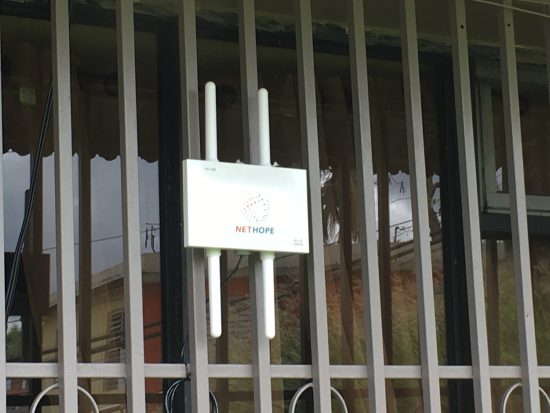
In Puerto Rico, NetHope has played the lead coordination role for connectivity. To date, this amazing team of technologists has installed communications equipment at 37 sites, providing connectivity to:

  • Responding NGOs, like Mercy Corps, Save the Children, International Medical Corps, Oxfam, and Feeding America
  • Emergency operations centers
  • City halls
  • Hospitals and clinics
  • Public wi-fi hot-spots

NetHope has received requests for communications support for 120 sites, and its team anticipates having a strong presence in Puerto Rico for the next several months, slowly phasing out their work and handing over ownership to local providers.

Longer-term impact

NetHope will make another valuable contribution to the island–providing employment opportunities to local residents whose income has been wiped out by the hurricane.

When NetHope first began working in Puerto Rico, 95 percent of its team came from off the island. Several weeks ago, they began employing local contractors, who now account for half of their team. By the end of the year, they expect the team to be 90 percent local residents.

Emanuel Osoria is one of those locals who has joined the NetHope team–and developed new IT skills in the process. He ran a small tourism operation until Hurricane Maria wiped out the tourism industry in Puerto Rico. But Emanuel continued to drive people to and from the airport, eventually picking up a staff member from NetHope.

She later hired him to help transport heavy equipment to hard-to-reach locations. Despite having no formal training, Emanuel started helping with installations—carrying dishes, running cable, and translating for members of the team. Now officially a field tech, he’ll receive more training and continue to provide desperately needed connectivity in communities across the island.

Cisco’s own team of disaster responders is on the ground in Puerto Rico, too, lending their IT expertise to support connectivity efforts.

Since late September, six members of our Tactical Operation Team (TacOps) and five employee volunteers with our Disaster Incident Response Team (DIRT) have deployed to Puerto Rico in two-week rotations. They are committed to supporting NetHope through mid-December. Three local employees even jumped in and volunteered with TacOps in the early days after the hurricane.

Employees pitch in

Even our team of 13 employees in Puerto Rico–despite struggling with their own personal challenges–supported the NetHope and TacOps teams. They helped with transportation, hauled gear, facilitated local contacts, and even transformed the office into a staging area in the weeks immediately following the hurricane.

Re-establishing communications after disasters is critical. Without it, delivering critical human needs like food, water, shelter, and medical care takes longer and reaches fewer people.

We are proud to partner with NetHope and other nonprofits and NGOs that are helping Puerto Rico citizens and communities recover from this catastrophe. But the devastation was massive and there is still more work to be done.


Here in the United States, we are celebrating Thanksgiving this week. It is a to think about what we are thankful for, but also to remember the people who need our help.

In that spirit, please consider supporting our Disaster Relief Fund for the Caribbean and Puerto Rico, which benefits six nonprofit organizations.


Authors

Tae Yoo

No Longer with Cisco

Avatar

To me, innovation is fast, intense, and purpose driven.  It is about adopting an experimental mentality and thinking about what we can do different today to create a better outcome for tomorrow. More than anything, it is about making those ideas happen. I was a physics major in college. Ever the scientist, there are a couple of principles of applied physics that actually help define my view on critical components of an innovation mentality: The first is momentum, the second is critical mass. Indulge me for a moment, as I apply this to one of my team’s crowning achievements from the past year.

One year ago, with such an innovation mentality, the Service Provider Video team set out on an ambitious mission to create a single platform for all devices and move video to the cloud. We devoted our best and brightest engineering talent to develop, build, test, scale, and sometimes fail fast and fix, Infinite Video Platform (IVP). We were striving to make a difference, to do things that created a better outcome for our customers, and challenge the status quo. By improving the solution, evolving our approach, and continuously asking ourselves “how can we make this better?”, we have built momentum and have launched our ‘idea’ in the marketplace.

Momentum:

Momentum, a vector quantity purely grounded in physics, is also sort of magical to me. That magic is exactly what we are seeing right now with IVP, as customers and industry analysts are recognizing the industry disrupting potential and the business opportunities that this solution provides. It all started just a few months ago with Vodafone’s GigaTV launch. And now, subscriber count is growing exponentially, and we have more exciting launches queued up, which will be announced later this year, rolling in close succession.

Critical Mass:

What do you call it when the rate and momentum of adoption begins to fuel further growth? Ah yes, critical mass. We are at that tipping point now, thanks to the addition of several key customers over the last couple of months.

  • We just announced that Envivo, one of the key players in the Nigerian film industry, also know as Nollywood, will develop an OTT Service based on a mix of our solutions, including the Cisco Infinite Video Platform, the Cisco Open Media Distribution for Content Delivery Network (CDN), Virtual Media Packager and Cloud Object Storage.
  • YES in Israel just launched StingTV, a cloud-based solution incorporating Infinite Video Platform, cloud DVR and our Digital Rights Management services, all on an Android-based system.
  • We were honored at IBC in Amsterdam to welcome Sky NZ, one of our premiere customers for IVP, into our booth to share their experiences face to face with potential customers.

These customers have each recognized that we have the ability to transform the way they do business and reach consumers in new ways.

As with any innovation, the work is never done. We will continuously improve and evolve the solution, asking ourselves ‘what can we do different today to create a better outcome for tomorrow?’ That drive, passion, and commitment to innovation has us taking on the next big challenge; making IP Video Better than Broadcast.  Our path forward is simple: innovate, build momentum, achieve critical mass, improve and evolve. Rinse and repeat. We’re well on our way.

Authors

Conrad Clemson

Senior Vice President, SP Platforms & Applications

Service Provider Platforms & Applications

Avatar

I’m thrilled to present the 3rd installment of Ask the IoT Whiz just in time for the holiday season. In this episode, we’ll be talking about retail in the digital age — a particularly pertinent topic with mega shopping events like Black Friday and Cyber Monday already here.

Whether you’re brand new to retail or have been involved in the industry throughout the rise of the digital age, this #CiscoChat podcast has something for you. Our experts this episode, Derek Dykens, Retail Business Development Manager, Daryl Coon, CMX Product and Solutions Manager, and Bill Rubino, Wireless Product and Solutions Manager, start with an overview of retail the last few years, beginning with the pre-Amazon era of shopping and continuing up to present day. Then, the conversation shifts to look at Cisco’s Digital Network Architecture (DNA) for retail platform, the role of wireless investments in retail, and the digital tools in place for today’s retail associates. Join us for answers to the following questions:

  • How is IoT present in today’s retail industry, and how is it influencing the industry as a whole?
  • How can retailers add personalization, relevance, and recommendations for shoppers in brick-and-mortar stores in the same way they’ve done for online shoppers?
  • How can digital-ready networks help retailers improve the in-store shopping experience?

Tune in as we explore emerging retail trends, predictions for the 2017 holiday shopping season, and how the Internet of Things can help retailers better serve customers. Download the episode on SoundCloud, or listen now.

For more information on some of the topics, technologies, and solutions we covered today, check out the links below. If you have questions or feedback, add your contribution to the conversation on Twitter at @Cisco_IoT or by posting in the comments section.

Links

Digital Retail – cs.co/9009D8PNc
Free trial of Mobility Express and CMX Cloud – cs.co/9009D8P4X
CMX Experience for Retail video – cs.co/9005D8Pfb
Mobility in Retail – cs.co/9007D8YUf
Cisco IoT – cs.co/9009D8PfL

Want more of Ask the IoT Whiz? Listen to Episode 2, Defending Your Operations in the Era of IoT.


Authors

Stephanie Gaspar

No Longer with Cisco

Avatar

In just a couple of days, Americans will be sitting down with their friends and families over a meal (where the main feature of the feast is a turkey) to give thanks for each other, for the moments we’ve shared, and for the festivities to come as we ramp up the holiday season.

And while it’s true that Thanksgiving during this time of year is often thought of as an American holiday – did you know that nine other countries have similar festivities that celebrate the autumn harvest or are a celebration of gratitude?

Of course, we love our global community and think every day is a good day to give thanks – Here are just seven blog posts from this past year that showcase why Cisconians are thankful to work at Cisco:

1.We get to work on cool tech! – There isn’t a day that goes by where you know we Cisconians aren’t geeking out about our technology and the incredible things we get to work on. From engineers to marketers, Cisco employees love celebrating the amazing things we’re doing to change the way the world lives, works, plays, and learns.

Read: How was Your Day? The Network Intuitive Comes to Life by  Shivangi Sharma who shares her experience with working on The Network Intuitive.

2. Be You, With Us! – No matter what color your hair is – Purple? Pink? Cool! – to employees who showcase their personalities through tattoos, their favorite high heels, or hobbies that fuel their passions – we love that we get to be ourselves at work and are encouraged to bring who we are and what we love to the office. Every day we’re insanely thankful that who we are outside of the workplace is celebrated in the workplace as well.

Read: Be You, Ink and All by Casie Shimansky who shares the stories of three Cisconians who’s tattoos have been embraced here at Cisco.

3. Family – You often hear that Cisco employees feel more like family to each other, and perhaps that helps us to step up when a teammate needs a helping hand. If there’s one thing we understand it’s that your family always comes first and from good moments to the unexpected, Cisconians have each other’s back. We love celebrating with each other, and supporting one another when life gets tricky.

Read: Cisco Daycare Brings Calm to a Panicked First Time Mom by Tara Fortier who shares her story of how her management (and the Cisco Daycare) stepped in when her son’s nanny become unexpectedly sick.

4. Friendships – It’s more the just Monday through Friday to us. Cisco employees love spending quality time outside the office together, and really enjoy collaborating and growing together. Whether it begins by being paired together during an event at work, or a simple “hello” lifelong friendships are built here.

Read: When Strangers Become Friends and Make an Impact Together by Lori Paschall who shares her story with the friends she made during the HackIT event.

5. Diversity – We grow and thrive through our differences, and Cisconians are constantly thankful that we have such a deep dedication to diversity throughout our global campuses. From cultural events that enable us to learn about each other and come together – like the Diwalloween celebration in Austin where they blend Diwali and Halloween – to our incredible women in tech diversity is always at the forefront of who we are as Cisconians.

Read: I. Am. A. Woman. In. Tech. by Tammy Nguyen

6. Moments That Matter – Moments that Matter to Cisco employees are the critical touch points between the employee and Cisco that leave an imprint – from your first day, the moments that enable you to make a difference, and even transitioning out of the company. These are the moments that have the greatest effect on you. They’re the moments that leave us thankful throughout the year that Cisco is a great place to work!

Read: My Cisco Moments That Matter by Oseas Ramirez Assad as he shares the moments that matter to him throughout his Cisco career and how they’ve matched up to the moments in his life – from getting married to having children – that mattered most.

7. Culture – From getting our birthdays off, to celebrating big wins, being all in, and giving back – Cisco’s culture speaks volumes to how we show up each and every day and why we truly #LoveWhereYouWork. Did you know that Cisco gives employees FIVE DAYS to give back to organizations of their choosing? Or that we have Emergency PTO – for when life happens and you just need to take care of it? These days don’t affect your other PTO days either! We also have Employee Resource Organizations (EROs) that enable our employees to connect with each other to explore their interests and grow their networks.

Read: Cisco Culture in Four Hashtags by Neil Heller as he shares his favorite aspects of Cisco’s culture in four hashtags.

There are many reasons to be thankful, not just in this season, but every day. Why are you thankful to be a Cisco employee?

Want to join us? We’re hiring! Apply now.

Authors

Casie Shimansky

Content Strategist | Provider of Pixie Dust

Employee Storytelling