
Avatar

This blog post was guest-written by Shannon Lappin Davies, Communications Manager, Cisco Community Relations.

Once again, the spirit of the giving season is upon us. The first Tuesday after the U.S. Thanksgiving holiday is now celebrated globally as #GivingTuesday. This is truly a special day for doing good and helping nonprofits around the world through the power of social media, technology, and collaboration.

#GivingTuesday continues this tradition in its sixth year, and at Cisco, we believe that through the power of teams, technology and collaboration, we can multiply our impact to benefit the causes our employees care about.

As part of our Be the Bridge: Annual Giving Campaign, we are launching a 1-day Twitter challenge to recognize and highlight the exemplary work of nearly 20 nonprofit partners in communities around the world.

Both our employees and social media teams will be able to follow along on social channels and proactively “be the bridge” in recognition of the causes of their choice. While we traditionally highlight Be the Bridge during the holiday season, we celebrate a culture of inclusiveness year-round at Cisco, where employees can choose to participate in our giving and matching gifts program to support the causes they care about.

Our Be the Bridge campaign is just one reminder of the many year-round opportunities to give back, and it’s a key component of our Moments that Matter—when all Cisco employees can truly make a difference.
Moving from East to West, we are beginning the #GivingTuesday Twitter challenge in China and ending the day in the U.S; sending Tweets acknowledging donations from employees around the world throughout the day.

For every retweet of the original country-level tweet we post on the @CiscoCitizen handle, we’ll donate an additional US$1 to identified organizations, up to US$10,000 (aggregate total contribution for all participating organizations). The #GivingTuesday retweet challenge closes at 5:00 p.m. local time in all markets.

Below are the nonprofits our global Cisco Citizen Network volunteers have selected in the areas where Cisco has a presence and employee base. These selections were made based on past donation trends and a desire to highlight the excellent work happening in these worldwide communities:

International Locations Organization Handle
 
Belgium Greenlight for Girls @Green4girls
 
Chile Corporacion Red de Alimentos @RedAlimentos
 
Canada TakingIT @takingitglobal
 
Colombia Colombianitos @colombianitos
 
China Shanghai United Foundation
 
France Action Contre la Faim @ACF_France
 
India Akshaya Patra @AkshayaPatra
 
Israel Leket Israel @leketisrael
 
Italy Action Aid Italy @ActionAidItalia
 
Mexico Habitat for Humanity Mexico @HabitatMexico
 
Netherlands Habitat for Humanity Netherlands @HabitatNL
 
Portugal Re-Food @re_food
 
Poland Polish Humanitarian Action @PAH_org
 
Spain Fundacion Capacis @FCapacis
 
Switzerland Save the Children Switzerland @STC_Schweiz
 
United Kingdom Trussell Trust @TrussellTrust
 
U.S. Locations Organization Handle
 
Atlanta, Georgia Atlanta Community Food Bank @ACFB
 
Austin, Texas Caritas of Austin @caritasofaustin
 
RTP, North Carolina Food Bank of Central & Eastern North Carolina @FoodBankCENC
 
San Jose, California Family Giving Tree @FGTweets

Now through the end of December—and for that matter, year-round—we hope to inspire thousands of employees globally to support their causes of choice through donations and matching funds in our Be the Bridge Campaign.

Join us today on #GivingTuesday to help spread the word. Let your social networks see how you are “being the bridge.” We encourage you to share your stories on social media using the hashtags #WeAreCisco and #BetheBridge.


If you’re a Cisco employee and want to make your own Moments That Matter, visit our internal Be the Bridge community and see how you can continue to make a meaningful impact locally and globally.

Whenever and however employees choose to give, Be the Bridge celebrates our culture of giving at Cisco!

Authors

Austin Belisle

No Longer with Cisco

Avatar

This post was authored by Warren MercerPaul Rascagneres and with contributions from Jungsoo An.

Earlier this year, Talos published 2 articles concerning South Korean threats. The first one was about the use of a malicious HWP document which dropped downloaders used to retrieve malicious payloads on several compromised websites. One of the website was a compromised government website. We named this case “Evil New Years”. The second one was about the analysis and discovery of the ROKRAT malware.

This month, Talos discovered a new ROKRAT version. This version contains technical elements that link the two previous articles. This new sample contains code from the two publications earlier this year:

  • It contains the same reconnaissance code used;
  • Similar PDB pattern that the “Evil New Years” samples used;
  • it contains the same cloud features and similar copy-paste methods that ROKRAT used;
  • It uses cloud platform as C&C but not exactly the same. This version uses pcloud, box, dropbox and yandex.

Read More >>

Authors

Talos Group

Talos Security Intelligence & Research Group

Avatar

Do you know how your city makes decisions about adding new public transport, or how many handicap spaces to add to a parking lot? City, County, State, and Federal governments make a lot of decisions – from the city planning to electoral votes – based upon data you provide during Census Surveys. When it comes to Census data, messing-up is not an option.

In 2010, when the US Census survey teams were last out knocking door to door, I was one of those people who did not want to take time to respond to a few questions.  Maybe by saying ‘no’ I also gave the impression to my then 3-year-old that survey teams are scary.  (The perception of scary survey teams in his mind was helpful to make him eat his veggies for some time. But that’s another story.)  Anyway, I had forgotten about it all until recently, when I got an opportunity to work with the amazing team at US Census department on a project.

A few months back, Susie Wee, VP CTO Cisco DevNet developer program and my boss introduced us to The Opportunity Project(TOP) Team – a team that engages the tech sector to create digital tools that expand American economic opportunity.  One of the problems for which the TOP team was looking for help from the tech sector was the issue of low-response rates on Census surveys in certain communities and geographic areas.  Historically, 18% of the U.S. population goes uncounted due to issues including lack of knowledge about the census and mistrust of the federal government. This results in fewer resources allocated, less congressional representation for the communities, and policy recommendations not accounting for the needs of undercounted populations.

For DevNet, we saw this as a great way to give back, and engage our developer community to create solutions for socio-economic issues using open data and Cisco platforms.  The low-response rate problem was interesting enough for us to look at, and we pulled together a small team to start user research and data exploration, working with the local Census user advocates and data dissemination teams.

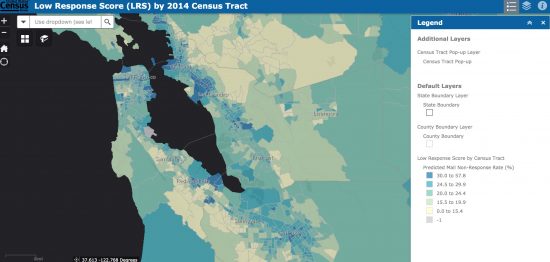
Storymap, from the US Census team, was one of the very first tools we looked at. It showed a large portion of Silicon Valley and San Francisco had low response rates.  This validated the fact that a lot of tech workers and mobile millennials represented in that data needed to pay more attention to US Census survey.

                                             Dark green areas above show 30-57.8% non-response rate from communities.

To help address this low response rate from the tech community, we built DevNet “My City Learning Tool” – a fun, ‘gamified’ way to expose the importance of census data to application developers, mobile millennials, and students. This tool will also be used by the TOP team to drive awareness of Census in student and other communities.  The My City Learning Tool presents a scenario in which there is an emergency and a mission to save lives. There are relevant data sets for the player to find, and some Cisco APIs to explore to help in such an emergency. The tool calls on all data ‘superheroes’ to save the day by finding the hidden data.  Learn more about Census Data by doing the Census Learning Lab and start solving problems in your community, in your city!  It’s fun!  And it’s important.  Give it a try!


We’d love to hear what you think. Ask a question or leave a comment below.
And stay connected with Cisco DevNet on social!

Twitter @CiscoDevNet | Facebook | LinkedIn

Visit the new Developer Video Channel

Authors

Shubha Govil

Director, Product Management

Cisco DevNet

Avatar

On 21 November 2017, Cisco and INTERPOL announced an agreement to share threat intelligence as the first step in jointly fighting cybercrime. In this podcast, I talk about the significance of this global agreement signed out of Singapore and how Cisco’s level of security expertise will help law enforcement in INTERPOL’S 192 member countries combat cybercrime.

Given the borderless nature of cybercrime, it’s never been more important for coordinated teamwork across the research community, private enterprises, and governments to face increasingly sophisticated attacks against private and public organizations.

In my role as President of Cisco, Southeast Asia, I speak with Robb Boyd of TechWiseTV about the state of cybersecurity in this diverse region. Organizations around the world face similar challenges, and they can tackle cybercrime through cybersecurity training and skills development.

Download the episode on SoundCloud or listen here now. I invite you to post your questions or feedback to the comments section below.


Authors

Naveen Menon

VP, Global Strategic Execution

Board Member, Cisco Foundation

Avatar

Located on the eastern banks of the Hudson River, just minutes from Albany, New York’s capital city, Troy, N.Y., is home to some very imaginative and talented educators and students. They’re using video solutions to open a “window to the world,” and they’re seeing some amazing results.

Video technology is changing the way educators teach and students learn in K-12 school districts across the country. Today, it’s possible for outside experts to take part in classroom discussions instantaneously, for homebound students to “join” their classmates in learning activities, for teachers to collaborate across long distances, and for parents to engage with teachers in new ways. In truth, the potential for video in the classroom is limited only by the imaginations of those who use it. And this is certainly the case in Troy.

Troy City Schools struggled through some tough economic times, and as circumstances improved, the entire community focused on academic excellence, supported by a complete overhaul of the technology used in city schools. Today, this “district on the rise” is experiencing sustained growth in proficiency rates in state assessment scores. “We have seen a steady increase of our proficiency rates on state assessments over the last four years,” notes Troy Superintendent John Carmello, “and we were recognized last year as one of the top-ten capital-region schools.”

Of course, we know that academic achievement isn’t attributable to technology alone. In Troy, the community provided a strong foundation on which committed administrators and talented teachers began to build schools of the future. Technologies like video serve as a valuable tool in an educator’s toolbox, but given the possibilities with video—what a powerful tool it is!

To learn more about Troy’s story, watch the short video here.

Authors

Donna Eason

No Longer at Cisco

Avatar

Over Thanksgiving break, I re-watched the movie “Pay It Forward.”

The movie is about a boy who is given a school assignment: to do something that can change the world. The boy researches the number of people living in the world and strategizes how he can make the biggest impact. He decides that instead of paying “back” favors owed, when a person receives a favor, they should then pay a favor forward to three other people. And those three people pay favors to three more people. Quickly, three people turn into hundreds and thousands. The good of one causes a chain reaction that ends up saving lives.

While fiction in nature, it was amazing to see how a thought so simple could impact so profoundly.

I often see this type of noble and simplistic innovation in charitable organizations. One example is Cisco HyperFlex customer, City Harvest.

City Harvest looked at unused food and turned the notion of waste into something good.

After rescuing this good food, they then deliver it free of charge to soup kitchens, food pantries and other community food programs across New York City. Using Cisco HyperFlex technology, they are able to keep drivers on the roads, notifying and rerouting them when a food bank is closed, or full.

This year they will have rescued and redistributed 59 million pounds of food. Talk about paying it forward.

City Harvest is truly helping make the world a better place, one food rescue at a time. Now through the end of December 2017, the Cisco HyperFlex team is matching donations to City Harvest, up to $20,000.

Check out the video below and please consider donating to City Harvest: cs.co/flexit.


https://www.youtube.com/watch?v=uN8DaYQOb4s


How do you plan to help change the world?


To learn more about the City Harvest technology story, visit: Here

To learn more about City Harvest, visit: Here

Authors

Jillian Zimmerman

Marketer

Customer Stories @ Cisco

Avatar

By 2020 it is expected we will see a 4X cloud traffic increase, half of connected devices will be machine-to-machine, and 9X more video traffic flowing across service provider networks. The blending of these dynamics leads to a sizable economic opportunity for service providers over the next decade through new services and operational savings.

Automation, effective use of clouds, software-defined networking (SDN) and network function virtualization (NFV) matter greatly to the future of big networks. As Cisco continues to innovate and reinvent the network, we are working with our service provider customers to help them adopt new digital solutions across their businesses to expand their reach and value into new markets via managed service offerings.

We are happy to share that Verizon Partner Solutions (VPS) recently announced its new Software-Defined Wide Area Network (SD-WAN) solution is now available to Verizon’s wholesale customers. The SD-WAN solution, which utilizes the Cisco Meraki® platform to virtualize hardware across the network, is designed to help Verizon’s wholesale customers better control network operational costs and improve bandwidth efficiency, while also maintaining high levels of performance for critical applications — all without sacrificing security or data privacy.

Key features of Verizon Partner Solution’s SD-WAN offer include:

  • Transport independence: easy-to-configure IPsec overlay and traffic distribution over multiple paths, with built-in load balancing and automatic fail-over capability.
  • Application optimization: centralized network visibility and control, as well as quality of service and bandwidth management with traffic shaping.
  • Intelligent path control: policy-based routing, which assigns a traffic path based on source, destination or application; and dynamic path selection, which chooses a traffic path per-application based on loss, latency and jitter.
  • Secure connectivity that features intuitive, AES encryption to maintain data privacy.
  • Centralized SDN control and policy management that helps Enterprise scale efficiently

We are proud to collaborate with Verizon Partner Solutions to launch this new managed service capability for its wholesale customers– and together offer the enterprise a flexible way to outsource management of their WAN network.

You can read more details about Verizon Partner Solution’ SD-WAN service here.


Authors

Jonathan Davidson

No Longer at Cisco

Avatar

Our new solution is a cost-effective route to reliable 5G connections – and the innovative services they make possible

Over the next years, people will increasingly expect 5G connections and the types of service they can support. And this will lead to increasing demands on service provider networks.

These services will need large amounts of bandwidth that will dwarf the already heavy demands on networks. On top of this, they will also require more in terms of control, latency and agility.

If service providers try to meet this challenge using their existing technology, their costs will spiral out of control. If they aren’t prepared, they could simply become overwhelmed.

But if they can adapt to the new business landscape, there is a great opportunity to create innovative new services that will power the future growth of their business.

Cisco’s new convergence technology – the capacity of DWDM without the cost

Up until now, service providers have had a choice if they’ve wanted to boost their network capacity.

One option was to build new fibres each time they wanted to increase their bandwidth and fill them up with single “grey” interfaces (that’s assuming they would travel far enough for each hop), or add incremental 10G dense wavelength division multiplexing (DWDM) wavelengths.

The other was to invest in 200G coherent DWDM technology – a way of massively increasing the number of different wavelengths that can travel down existing fibres (it enables 96 200GB wavelengths to pass down the same line).

The problem is that until now, introducing coherent DWDM this deep into networks has been prohibitively expensive. To enable it, service providers have had to build out new network infrastructure including a transponder shelf, an aggregation router, and lots of interfaces between them.

But new Cisco technology gives service providers the opportunity to boost network capacity sustainably. We’ve created a streamlined router that integrates the IP and optical layers in the aggregation part of the network. It’s small enough to fit in your laptop bag and works using simple plug-in technology.

Laying the foundations for innovation

This new solution delivers the capacity advantages of DWDM, but at a much lower cost. And it also makes it much more affordable to introduce programmable networking technologies like segment routing throughout the network – not just in the core.   In short, it gives service providers a realistic way of supporting the innovative and agile services of the future.

Like the idea of stepping onto a driverless bus, the future might sometimes seem frightening. But when you build our new solution into your network, you customers can be confident that they’re in safe hands.

Find out more about how our converged solution can get your network ready for 5G.


Authors

Ben Colling

Manager, Sales

Global Service Provider, EMEAR

Avatar

A new solution that uses plug-in technology makes it cost-effective to deploy segment routing across the whole network

The pressure on service providers is rapidly increasing. Globally, demands for bandwidth are doubling every 18 months and the number of devices being used to connect to the internet is doubling every 24 months.

If service providers try to meet this challenge using the same approaches they have used up to now, their costs will soon get out of hand.

Businesses in the sector are increasingly aware that they will need to adapt in order to continue to be viable. That their networks will need to become more automated and streamlined in order to meet new requirements for capacity, control and agility.

But how exactly can they do this? One of the key technologies that service providers are deploying to help them transform their networks is segment routing.

The benefits of segment routing

Segment routing enables data to take more efficient paths through a network, without the need for extensive programming.

This in turn means that the system can function in a more simple, flexible and automated way . It allows service providers to make better use of their capacity, managing traffic with greater control and less supervision.

So as well as being able to provide more flexible services, they can also make big operational savings . And on top of this, segment routing brings about a number of more specific opportunities to provide a better standard of service.

One option is offering specific low latency paths through the network for customers dependent on high speeds. In some areas of business, like high frequency currency trading, this can make all the difference.

Another is improving your reliability by creating two completely distinct paths for data between important points, like data centres . If one connection is disrupted, you know that data will automatically be routed along the other path.

These benefits explain why increasing numbers of service providers are investing in segment routing to support their network transformation. Last year, for example, we announced that we were working with Colt Technology Services  on a system-wide 100 Gigabit per second upgrade to Colt’s pan-European and Asian network. The upgrade will allow Colt to support cloud-scale applications to its customers.

“We are focused on providing customers with world-class, high-bandwidth connectivity services,” said Rajiv Datta, the chief technology officer at Colt, when the deal was announced.

“Our investment in Cisco not only delivers 100Gbps connectivity; we are able to automate the provision of services to meet the exacting demands of our customers and enable businesses of all sizes to future-proof their connectivity.”

Introducing segment routing across the network

Cisco led the way in developing segment routing. And it’s now leading the way in creating technology that will enable service providers to fully realise its benefits.

We’ve created a streamlined router that integrates the IP and optical layers in the aggregation part of the network. It’s small enough to fit in your laptop bag and works using simple plug-in technology.

This means that service providers no longer have to build expensive infrastructure, that uses up a lot of power and space, in order to create new capacity. Instead, our convergence technology allows them to push up to 20 times more traffic along the fibres they already have.

Innovation through programmability

Our solution works by making it much more affordable to deploy coherent dense wavelength division multiplexing 200G (DWDM) down into aggregation networks. And that enables service providers to scale their architecture for 5G and beyond.

At the same time, it’s the ideal opportunity to add segment routing capabilities to this part of the network, and create the opportunity to program application paths and service level agreements closer to the customers who use them. When you introduce programmability across the whole network, you can manage your resources with the efficiency and control needed to support the innovative services of the future.

If they try to build networks that can support future growth using old approaches, service providers are likely to find their plans are full of holes. With our convergence solution, there’s a new way to plug the gap.


Do you want to find out more about how to benefit from segment routing across your whole network? Watch this V.O.D  


Authors

Ben Colling

Manager, Sales

Global Service Provider, EMEAR