Avatar

Cloud Scale Networking software innovations are the outcome of a partnership with some leading innovators to utilize data center ‘DevOps’ principles and techniques to offer new levels of agility, efficiency, and simplicity. Key benefits include:

  • Large-scale automation for provisioning and network changes in minutes vs. hours
  • Real-time visibility and control through streaming telemetry along with Segment Routing
  • Software extensibility, e.g. Application Hosting, to turn the network into an innovation platform

I’m currently witnessing an adoption of these innovations by major Telecom Service Providers and one noteworthy use case is Central Office transformation.

As a quick reminder, Central Offices play a major role in delivering the last mile connectivity to Service Providers’ end users. Every Service Provider has thousands of them and has been investing for many years in maintaining/upgrading these assets.

One more time, Central Offices require a major overhaul to support the new wave of IoT services and be Service Providers’ growth engine of the future.

Let’s see how Cloud Scale Networking innovations are enabling Telecom Service Providers to transform their network infrastructure from Central Offices up to Data Centers.

Service Providers’ networks are composed of multiple domains – Access, Metro, Core and Data Center. Most of the time, these domains have their own architecture roadmap, are operated by different teams and are using different underlay and overlay protocols. As an example, you may find MPLS and L3VPN respectively for underlay and overlay in the Core domain whereas you may find IP and VXLAN in the Data Center domain. As a consequence, cross-domain orchestration is cumbersome and limited.

To deliver new services, Services Providers have heavily invested over years into purpose-built HardWare (HW) appliances, that were rolled out in Central Offices. But, they quickly found out this mode of operation was not sustainable for some obvious reasons:

  • Each new HW appliance requires truck-roll and onsite installation resulting in OpEx increase
  • Every HW appliance comes with its own management system that most of the time does not offer standard APIs leading to complex and costly integration. The impact for Service Providers is long certification cycles and slow Time-To-Market. Moreover, each of these HW appliances have their own lifecycle making the upgrade of the overall Central Office a tedious planning exercise.

To overcome these limitations, Service Providers have started to deliver new services from centralized Data Centers, leveraging compute infrastructure and VNFs. This way, they could speed up service innovation and deliver On-demand service instantiation.

But delivering services from centralized Data Centers comes with its own set of challenges. This new mode of operation requires to construct E2E connectivity across the network – from Central Offices up to Data Centers. Unfortunately, this is a lengthy and complex task:

  • As underlay and overlay protocols are different across network domains, protocol translations have to take place across all domains. This brings complexity and sometimes requires network devices to maintain states hindering cloud scale scalability.
  • These “stitching” operations are still largely manual and require coordination between operations teams.

By and large, you end up having a dichotomy between the on-demand service instantiation in Data Centers and the lengthy procedures required to update the network infrastructure to support those new services.

What Service Providers clearly need is a solution where the network infrastructure facilitates the implementation of new services. This new architecture must be logically centralized, for ease of management, with End-to-End network service orchestration capabilities and must be distributed for scalability.  The distribution contributes to alleviate the traffic load and this is where VNFs come into play. This architecture strikes the right balance between centralized and distributed approaches.

This is where Cloud Scale Networking solution kicks in. It’s a three-pronged approach:

Simplification

Having multiple different underlay and overlay protocols is simply the result of 20 years of networking evolution. At the time you deployed them, that was probably the right decision though. But you don’t have to be entrenched into that complexity.

Two major innovations, EVPN (Ethernet VPN) and Segment Routing, are game-changers here and can make your network infrastructure more simple and agile.

Segment Routing is increasingly adopted by customer. This unified underlay forwarding plane paradigm brings simplicity – by reducing the protocol stack and leveraging routing protocols’ agility- and consistency across network domains but also comes with network services inherent to Segment Routing – 50ms protection (TI-LFA), low-latency path, disjoint path …

Ethernet VPN (EVPN) enables integrated Layer 2 and Layer 3 services over Ethernet with multi-homing in a scalable and simplified fashion. EVPN provides separation between the data plane and the control plane – allowing for the use of different encapsulation mechanisms in the data plane while maintaining the same control plane. It provides a Unified Overlay Control Plane.

“BGP MPLS-based EVPN enables us to reuse our existing MPLS architecture without adding anything else. It is an obvious choice for Service Providers who already have an MPLS forwarding plane, to start collapsing network islands and be able to launch next generation internet services faster, such as vCE” says Daniel Voyer, Technical Fellow, Bell Canada.

Automation

As networks are getting bigger because of relentless Internet growth, Service Providers are trying to automate their Operations. Two important cloud scale networking software innovations contribute to ruthless automation.

First, streaming telemetry provides fine-grained visibility into what’s happening in your network infrastructure. Don’t forget you can only control what you understand!

Second, model-driven programmability helps you move away from manual operations (CLI) to programmatic interfaces (APIs). Our commitment here is to provide the most comprehensive set of data models (IETF, OpenConfig, Native YANG models) along with model-driven APIs and tools to accelerate the adoption of software automation.

Virtualization

By augmenting Central Offices capabilities with compute resources to increasingly deliver virtualized services, you simply turn your Central Offices into distributed Data Centers. These aging Central Offices suddenly become a competitive edge to instantiate services that benefit from being localized closer to End-Users. (latency, delay – sensitive services)

With this last step, the network clearly becomes a fabric connecting Central Offices to Centralized Data Centers enabling Service Providers to instantiate services wherever that makes the most sense.

We call it Unified “Network as a Fabric” and it is powered by IOS XR.

If you want to learn more about Central Office transformation, listen to Dan Voyer’s presentation at MPLS World Congress 2017.

Authors

Frederic Trate

Marketing Manager

Service Provider Business Architecture, France

Avatar

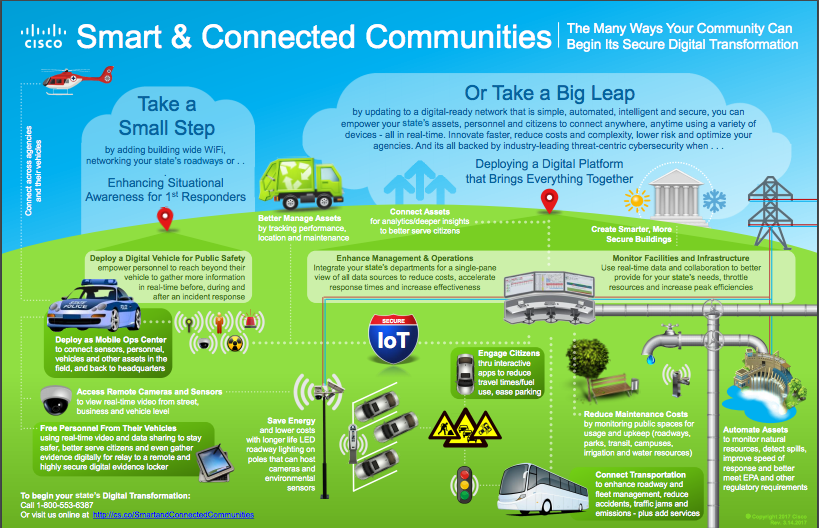
The Internet of Things continues to enable digital transformation for cities, counties and states across America. As a result, residents are reaping a variety of benefits such as improved parking and traffic, enhanced safety due to lighting and cameras, and shortened emergency response times thanks to connected vehicles and video triage systems. Looking in from the outside, it’s easy to see the connectivity, collaboration and creativity in action. But it’s what you don’t see that makes these solutions a viable reality for the public sector. Because behind the scenes of every smart, connected innovation, there is a stable – and secure – network with the ability to efficiently analyze the immense amount of data being collected and processed.

Next week, hundreds of State CIOs will gather in Washington, DC for 2017’s NASCIO Midyear Conference. This year’s theme, “Connect, Collaborate, and Create”, speaks to the rapid digital transformation that the US public sector is experiencing. But I would like to challenge you to look deeper and explore what’s really going on behind the scenes of digitization. Regardless of how you begin your own path toward digital acceleration, you must first develop a reliable, secure network. Just as you build a home first by building a strong foundation, you must also create smart communities, states, and countries with the critical network architecture to support it; one that encompasses security everywhere.

So I encourage you to join us at next week’s conference for a special round table about the impact of security on state digital transformation (Tuesday, April 25 from 1:30 – 2:45 pm). This interactive discussion, featuring Cisco’s Director of Public Sector Engineering and CTO, Dan Kent, will dive deeper into Cybersecurity and What it Means for State. Until then, be sure to check out our latest Digital Transformation Illustration for further insight on how your state can take its first small step or a big leap towards digitization.


Authors

Tony Morelli

Vice President, SLED East

Avatar

When I ask the question of Healthcare CIOs and CISOs “What keeps you up at night?” one of the most common answers I receive – after the usual jokes about indigestion, or the snoring spouse, is the problem of what to do about securing medical devices in our hospitals. Most healthcare executives are acutely aware of the problem (to some degree at least), but very few have an effective or scalable solution at hand to address this ever-growing risk.

It’s hard not to notice a growing collection of medical devices whenever you visit a hospital or clinic. They surround today’s medical bed, almost like a warm scarf around a bare neck on a cold winter’s day. If they weren’t there you would wonder why. They provide all kinds of patient telemetry back to the nurses station: O2 sat levels, pulse rate, blood pressure, etc. They provide automatic and regular administration of medication via pumps and drips and oxygen dispensers. The medical bed itself tracks patient location across the hospital as the patient is wheeled to and from the OR, imaging or other specialties.

What is not recognized however, is that the number of medical devices employed in the delivery of care to patients is currently growing at almost twenty percent per annum globally. What’s more, this growth rate continues to increase. For the BioMed staff that has historically been responsible for managing them, it’s an almost impossible task. One that gets more difficult by the day as more and more devices are plugged in or wirelessly connected to the network.

Medical Pump

The problem as far as risk is concerned, is not just the growth of these standalone devices and the difficulty managing so many, but the fact that these systems, many of which are critical to patient well-being, by and large have ALMOST NO BUILT-IN SECURITY CAPABILITY. Nor can they be secured by standard compute endpoint tools like anti-virus / anti-malware. They are a huge vulnerability, not only to themselves, but also to everything else attached to the network on one side of the device, and the patient on the other side.

Standalone medical devices are designed, built and FDA approved to perform a very narrow and specific function, and to do so reliably for long continuous periods of operation – unlike a Windows PC, which sometimes appears to have been designed to work for a month more than its manufacture warranty! Medical devices tend to stop working when subjected to things outside of their design parameters. Things like multicast network traffic caused by worms, viruses and other malware. Things like ICMP, NMAP and other network traffic used to illuminate, query, or profile devices perhaps by attackers. What’s more, medical devices are rarely retired and withdrawn from service, which means many hospitals are still using devices designed and built twenty years ago – at a time when Windows 95 had just been released and most of us weren’t even on the ‘World Wide Web’ as we called it then! How could they POSSIBLY be secured and prepared to defend against the types of cyber attack we see today?

Many standalone medical devices leave the manufacturing plant with all kinds of security vulnerabilities – many open TCP/UDP ports, and numerous by default enabled protocols like TFTP, FTP, Telnet, etc. – many of which are highly vulnerable to attack. Several popular medical pumps have been exposed in the past year for the ease at which they could be hacked and taken over by an attacker. If one of these pumps were employed to administer at a gradual and regular level, for example, pain medication such as morphine or perhaps insulin to a patient, what damage would be inflicted upon that patient if the pump was hacked and told to administer its entire medication all at once?

While older standalone medical devices were built to run on obscure, custom, often hardened UNIX operating systems, or even eProm, many of today’s mass-produced, quick-to-market commercial devices run on Windows 9 Embedded – nothing more than a cut-down version of the hugely vulnerable and highly insecure Windows XP operating system.

Windows Embedded is subject to many of the same vulnerabilities and freely available exploits as the regular Windows XP operating system. A targeted attack against modern medical devices is thus relatively easy given a mass of known and proven exploits. Yet we continue to attach insecure, unprotected pumps and all kinds of other devices with the potential to do damage to patients, knowing that at any time a nefarious hacker or almost innocent intruder could turn the device into an execution tool.

Just because it hasn’t happened yet, doesn’t mean to say that it won’t happen today… or perhaps tomorrow!

Authors

Richard Staynings

Cybersecurty Healthcare Leader

Cisco Security

Avatar

Are you looking to better understand the current landscape of industrial security? What about best overall practices for securing your plant floor? Or do you want to understand what technology can help you secure your operations for both new and legacy systems?

Over the past month, we’ve covered all of these topics in a series of security webinars that are now available on demand if you were unable to attend the live sessions.

https://youtube.com/watch?v=UKrL_Ke9lmc

Cyber Risk in Manufacturing

We recently collaborated with industry leaders at Deloitte and MAPI on a webinar based on their report on cyber risk in advanced manufacturing. If you haven’t seen the report, take a look here. Some of the key themes from the study include:

  • Executive and board management
  • Talent and human capital
  • Intellectual property
  • Industrial control systems
  • Connected products
  • Industrial ecosystems

A webinar presentation of the report is now available here and presents key findings from the authors as well as their viewpoints on best practices for manufacturers as they assess their current security risks.

Top 3 Security Challenges for Manufacturing

A panel of security experts dove into the critical security challenges that manufacturers are facing. The three topics addressed included:

  • What IT/OT convergence in manufacturing looks like from a security lens
  • How a strategic infrastructure segmentation approach will allow you to reduce risk, simplify your audit profile, protect data, and achieve a defensible position for board-level requirements
  • How to enable simplified management, lowered complexity, and increased consistency – resulting in optimized operational costs

The on-demand recording for this webinar is available here.

ISA 3000: Protecting Critical Infrastructure

As more devices come online within industrial settings, increased security risks become inherent with that connectivity. Adding to the issue is the fact that many of these devices were never designed with security fully in mind. Today’s industrial environments need advanced threat protection and a ruggedized solution like the ISA 3000 firewall that helps to ensure safe, reliable service delivery for industrial control networks.

This webinar reviews how the ISA 3000 industrial firewall can be leveraged to meet these security use cases and includes:

  • Meeting standards
  • Secure remote access
  • Ensuring safe operation of critical infrastructure from cyber attacks

The on-demand recording for this webinar is available here. Thanks to everyone who registered for these sessions. If you’re interested in attending more webinars in the series, please register here.

To learn more about assessing risk and setting a security strategy, visit our interactive security experience:

Authors

Eric Ehlers

No Longer at Cisco

Avatar

When I was in 8th grade, I adopted a child…a sponsor child I mean! Her name was Blessing, and she was a young girl who was living in an orphanage in Kenya and needed help. Her mother died of AIDS when she was born and her father was suffering from the same disease. So, at age 14, I decided to gather my money from birthdays, babysitting, and chores to pay for her monthly necessities.

Blessing and I have had a wonderful pen-pal relationship ever since. I’ve saved all of her letters and love seeing how well she is doing and how much her writing has improved! But there is one thing about her letters that has always made me a little sad – she often asked me to come visit.

I wanted to visit so badly! But with the demands from school and being so young, finding a way there was hard. I always answered that I would visit “one day” – but never knew when that would be.

After school, I accepted my job at Cisco. I watched as my friends backpacked through Europe and go on extravagant spring breaks. I was a little worried that, in a way, I was signing away my freedom by interning (and then coming to work full time) at Cisco. Would I ever have the time to do anything like that?

I didn’t realize that at Cisco, not only was I going to have the time, but I was also going to have the time to give back! Thanks to a new initiative, Cisco designated five days of additional time off (over and above regular paid time off) that I could use to volunteer in any way I wanted.

I knew what I wanted. I was going to meet Blessing, who I’d been sponsoring for nearly 10 years now!

I immediately contacted my church, who makes the yearly trip in January to visit the orphanage. Less than a year later, I packed my bags and was making the 24-hour trip to Kenya!

The first day we went to the orphanage and were welcomed by all of the children and teachers singing, clapping and cheering! The school administrator introduced me to Blessing. I couldn’t contain my excitement and I immediately gave her a huge hug.

Kali meeting Blessing
Meeting Blessing for the first time in person!

Blessing was very shy at first, but each day she warmed up to me more and more. On one of the days I took her shopping for new clothes. She had never been shopping before so I had to help her pick out a few outfits. She loved it and as we walked out of the store she looked up at me with a big smile and reached to hold my hand. My heart completely melted!

During the week that we were there, we handed out backpacks with school supplies for the kids, hosted an ice cream social (a nice change from the porridge and beans that they usually eat), and provided vision screenings. I was shocked to learn that about 75% of the children needed glasses. I can’t imagine going through school unable to see! This is largely due to their lack of nutrition and the intensity of the sun.

The last day of the trip was the most special. I pulled Blessing aside to show her all of the letters she had written me over the years. She absolutely loved it and laid her head on my shoulder as I flipped through them. I pointed out the letters where she asked me to come visit and I explained to her how badly I’ve been wanting to come! To this she gave me the biggest hug and told me how thankful she was and how much she loved me.

Showing Blessing's Letters
I kept all of her letters, and brought them with me to show her.

The trip was exhausting, but I have never felt such joy and fulfillment being with these children. I know without a doubt that I will be returning, and I thank Cisco for the ability to do that.

Cisco often talks about employee “Moments that Matter” and this was exactly that. I’m so thankful to work at a company that empowers its employees to give back to others and shares my passion for helping those in need.

Thank you, Cisco, for allowing me to fulfill my dream of meeting my sponsor child, Blessing!


Work for a company that cares. See jobs at Cisco.


Authors

Káli Pike

HR Representative

Human Resources Talent Brand

Avatar

This post was written by guest blogger Yuji Suzuki, Manager of Japan Manufacturing Operations.
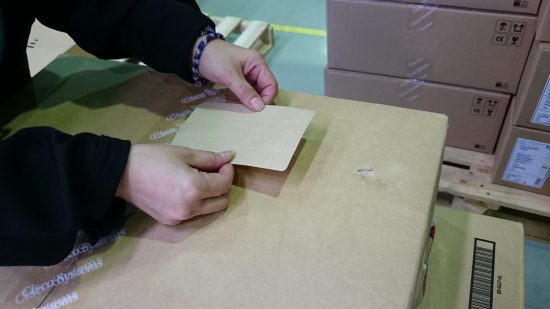
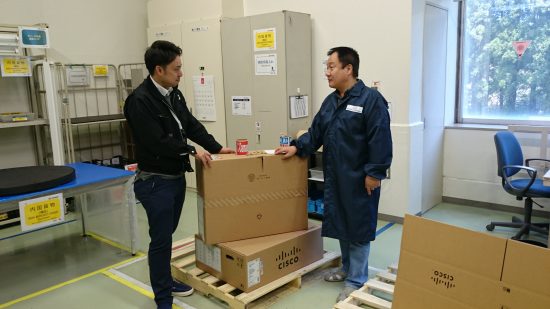
Think of a large piece of Cisco equipment, like a carrier-class router. Now picture the product’s shipping carton: it’s a side carton that’s over seven feet (2220mm) long. Somewhere in transit, this large carton sustains a visible surface tear.

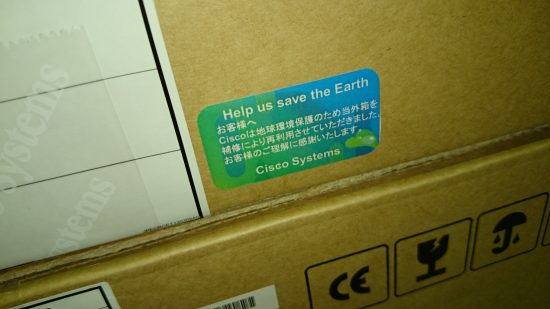
Now imagine a sticker about the size of a shipping label, and sometimes, even smaller. We call this sticker an “EcoPatch.” We place the EcoPatch over that surface tear.

This small EcoPatch seal has saved the enormous carton from the scrapheap (The cartons have to be scrapped and not recycled due to Japan’s Customs House rules for items that have not cleared customs).

Perhaps the EcoPatch doesn’t sound like a remedy with a big environmental impact or business value. But here’s how much the EcoPatch program has saved Cisco in Japan in just the last three quarters (May 2016 to January 2017):

Cartons Saved From Being Scrapped

Total Material Saved (Pounds)

Reduction in CO2e (KG)

2,656

6,314

7,234.81

Improving Relationships with Customers while Reducing Reboxing

Japanese customers have very strong sensibilities about quality. We are grateful for their high standards (it is, after all, the reason they are such loyal Cisco customers!). But one source of customer dissatisfaction is damaged cartons. In fact, Japanese customers will often suggest a product is damaged if the carton is damaged, and request an exchange.

In the past, products were even returned as dead on arrival (DOA), despite the fact that the product had never been unpacked. Imagine the cost, waste, and frustration associated with processing a DOA for a good product.

Twelve years ago, we implemented a process called “reboxing” to help address this challenge. Once we confirm the product is not damaged, the damaged cartons are replaced at a warehouse operated by one of our largest logistics partners at Narita Airport.

Our Japan Manufacturing Operations team developed extremely detailed criteria for carton damage to eliminate subjectivity and variability in judgments. This gave us a framework to determine exactly when a package needed reboxing; our sales partners embraced the new criteria.

It was a good step, even as we worked toward our greater goal of finding and correcting the root causes of damage in the supply chain. We shared the damage criteria with logistics partners to improve the condition of cartons shipped to Narita.

Avoiding Reboxing: Were We Missing Another Piece?

About four years ago, our team started exploring the idea of “repairing” cartons instead of simply reboxing. By studying historical data, it was clear we could save significantly more boxes from being scrapped if we could simply repair them.

A large portion of boxes had the kind of damage that could be sealed with a simple adhesive patch.

That was the origin of the EcoPatch.

Involving Cisco Partners

The EcoPatch program is a local program for the Japanese market. It isn’t written into a contract with our sales channel partners. Rather, we’ve worked with each partner individually to convey the unique value of the program and ask for participation.

In the program’s first year, one partner worked with us. By the second year, five partners were EcoPatch project participants. And today, we have 12 partners; combined, they represent 70 percent of all products sold and shipped into Japan. We continue to reach out to more partners, with the goal of extending the EcoPatch solution to at least 90 percent of Cisco products coming into Japan.

We always want to express our appreciation for the involvement of our partners, as this is a completely voluntary program. Its success depends on their enthusiasm, which is why we thank them every time we send out a box with an EcoPatch.

Next to the patch, we include another label that says:

Other Savings with EcoPatch

One of Cisco’s logistics partners maintains the warehouse at Narita airport, where they handle all product reboxing. In any given quarter, we might see anywhere from 10,000 to 100,000 cartons processed through this logistics partner.

To ensure we’re always prepared to replace any incoming damaged cartons, we have a contract to maintain a large inventory of Cisco cartons of all shapes and sizes.

Over three years, we’ve collected enough data on the EcoPatch program to tell us—with confidence—that we will have a much lower reboxing volume, thanks to the EcoPatch option. This will allow us to renegotiate the contract with this logistics partner for a lower rate that reflects:

  • Reduced warehouse space required to store spare boxes
  • Reduced labor costs associated with unpacking and reboxing products
  • Reduced labor costs and other fees associated with scrapping boxes

Do We Want More EcoPatches?

As you can tell, we track EcoPatch statistics with avid interest. We know we can continue to use the EcoPatch to improve our “avoidance” numbers and reduce the number of cartons we must rebox.

But the future isn’t a graph that shows an endless upward trend in the application of the EcoPatch; the graph we are working towards is the one that shows a downward trend in carton damage until it is eliminated entirely.

I’m extremely proud of our contribution to reducing Cisco’s impact on the environment. But our ultimate goal is to see the EcoPatch become a piece—about the size of a label—of Cisco’s sustainability legacy.

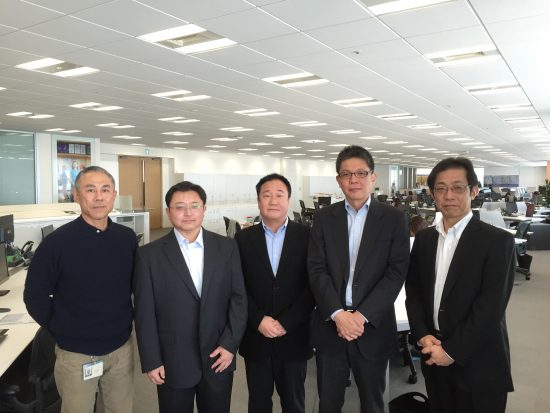
Cisco’s Japan Manufacturing Operations team.

Lastly, I want express my appreciation to the sales partners that participate in the EcoPatch program and also thank my staff members who lead and drive the EcoPatch program. And special thanks to senior quality engineer Hirotaka Miyazawa for his initiative and hard work on the discussions and collaboration with sales partners.


In addition to his role as the manager of Japan’s Manufacturing Operations, Yuji Suzuki is a Business Unit (BU) Champion for Cisco’s “Make IT Green” Program. This is an initiative led by the Cisco global supply chain organization.

The goal of the program is to work with BUs around the world to find opportunities to minimize packaging and product waste, lower our carbon footprint, and think more about sustainability in product design.

Abbey Burns is the sustainability manager for the Supply Chain Value Protection team, which is responsible for the Make IT Green program. The EcoPatch program is one of 62 active Make IT Green projects across 21 BUs.

“The EcoPatch is a triple win: It reduces our impact on the planet, reduces our costs, and improves customer satisfaction,” Abbey says.

“This idea has not only achieved this in Japan, it has also sparked many conversations about how to apply the EcoPatch to other regions. That’s one of the things that is most exciting about employee-led projects: they create a buzz among colleagues and co-workers. It’s a deep reservoir of innovation and ingenuity that comes from one person and inspires many more people.”

As Manager of Japan Manufacturing Operations, Yuji Suzuki is responsible for managing quality engineers and program managers in Japan. He is the primary escalation point for product quality incidents in Japan and interfaces with manufacturing management globally to resolve complex product quality problems. He regularly interacts with major sales partners and executes strategic delivery to customers in Japan.

Subscribe to the CSR Blog for even more stories about global problem solvers like Yuji.

Authors

Austin Belisle

No Longer with Cisco

Avatar

I promised a follow up in my recent blog about Facebook’s new Bryce Canyon storage platform. While the title of this blog may sound like it questions the new platform’s capabilities. It like the previous blog aims to help you understand why it is perfectly suited for Facebook’s unique needs.

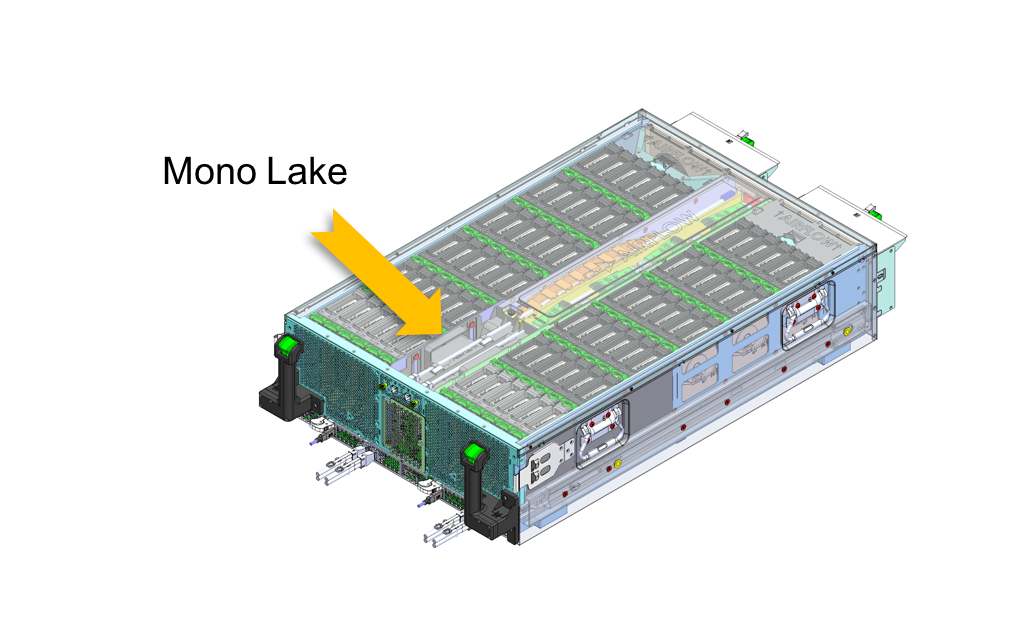
The first blog was focused on storage attributes which is near and dear to my heart. But the other thing I noticed about Facebook’s new storage platform was the use of two Mono Lake micro-servers. This little micro-server is pretty cool because Facebook uses it everywhere to maximize component re-usability. When managing infrastructure at massive scale, component commonality can lower equipment costs and increase your operational efficiency.

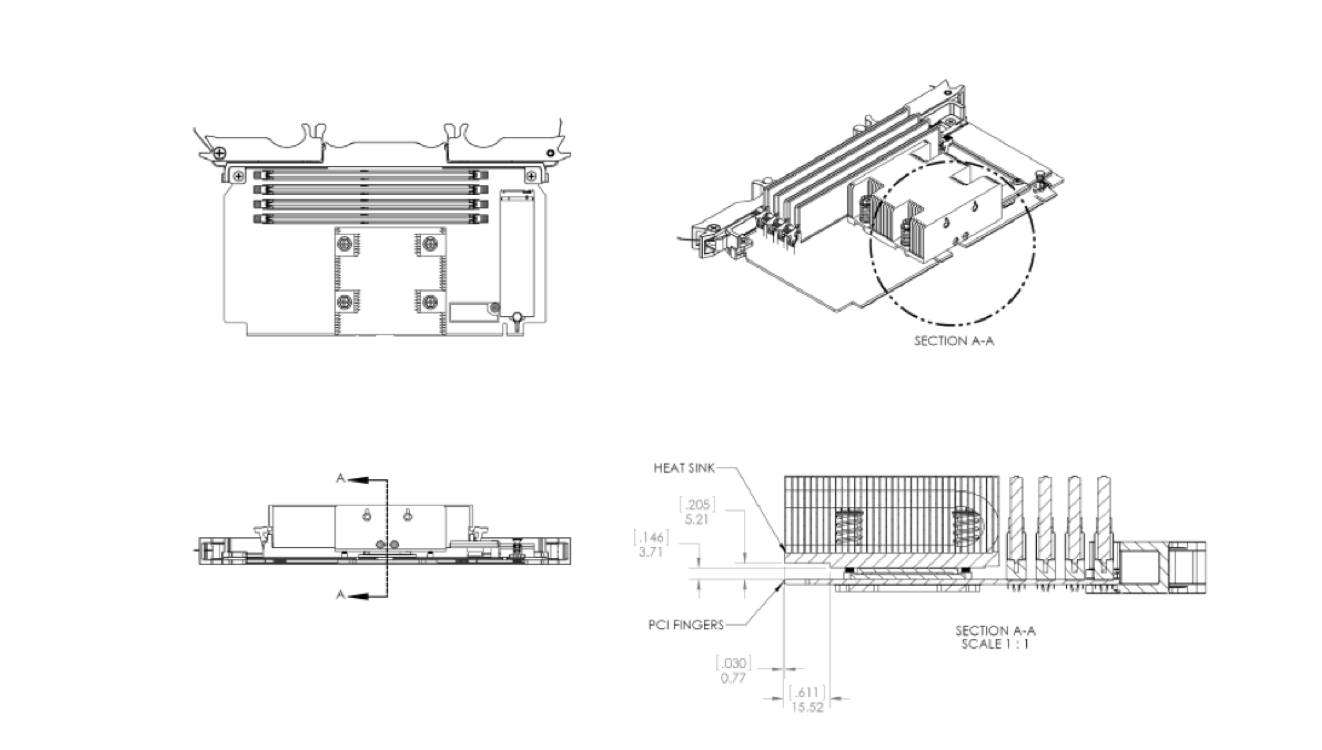
But while the micro-server is cool, it also has tradeoffs. It’s called “micro” for a reason. It’s a small board with limited real estate offering only a single socket configuration for a low power “system on chip” (SoC) processor, up to four DIMM slots and two M.2 SSD boot drives.

The Mono Lake micro-server is designed to accept a purpose built Intel Xeon D-1500 SOC processor with options up to 16 cores and support for up to 128GB of DDR4 memory. This line of processor was actually jointly designed with Intel to reduce power for the massive scale distributed infrastructure providing service to the Facebook web application.

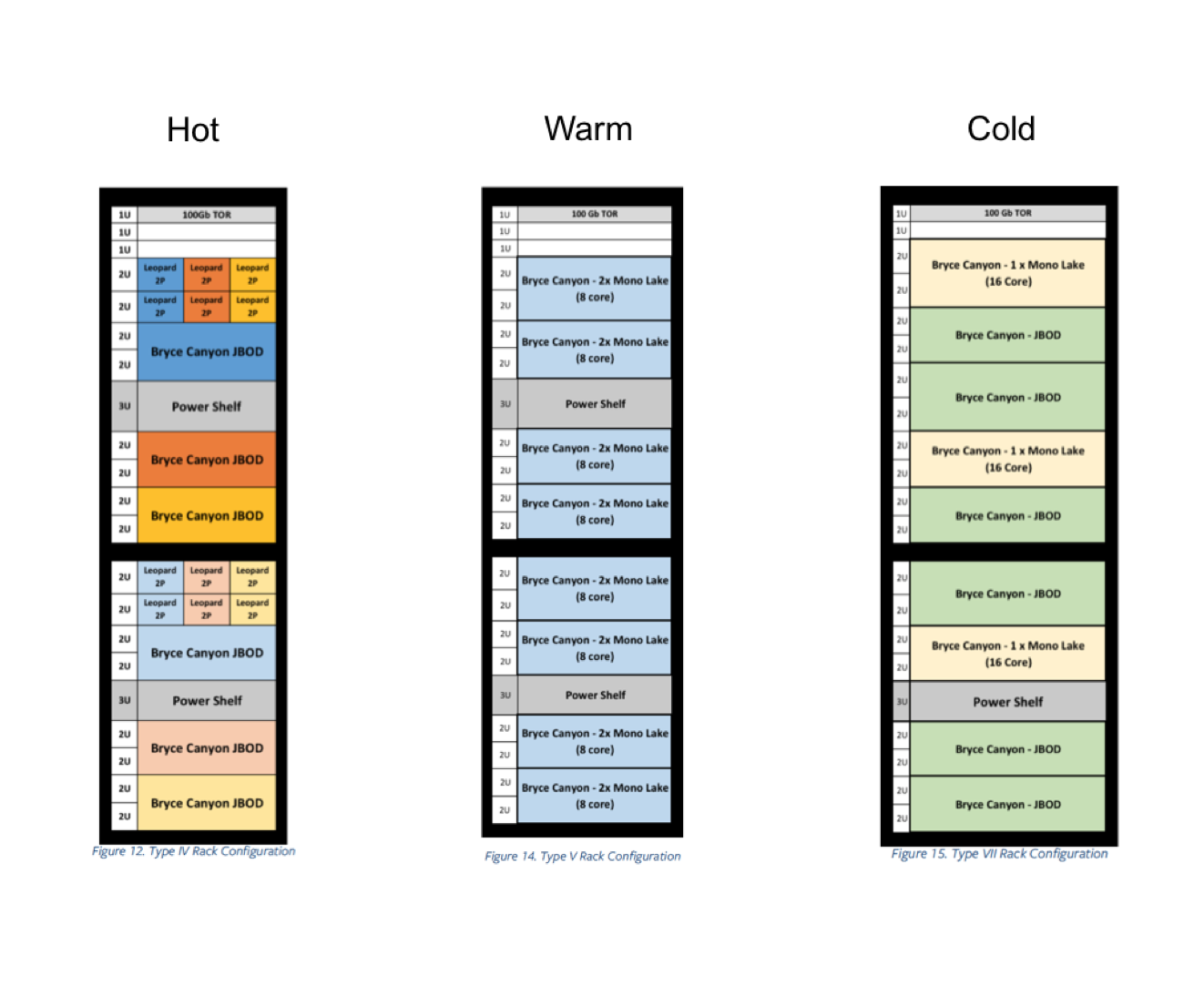
As with most web applications, data at Facebook is tiered across different types of racks depending on how often it’s users need to access that data; i.e hot, warm, or cold. Tim Pricket Morgan details this out quite well in a blog on The Next Platform. These racks are workload optimized for each specific tier utilizing uniquely configured platforms like Bryce Canyon for storage services or their new Tioga Pass server for compute services. The Bryce Canyon hardware specification does a good job showing the various updated rack configurations and their intended deployment scenarios.

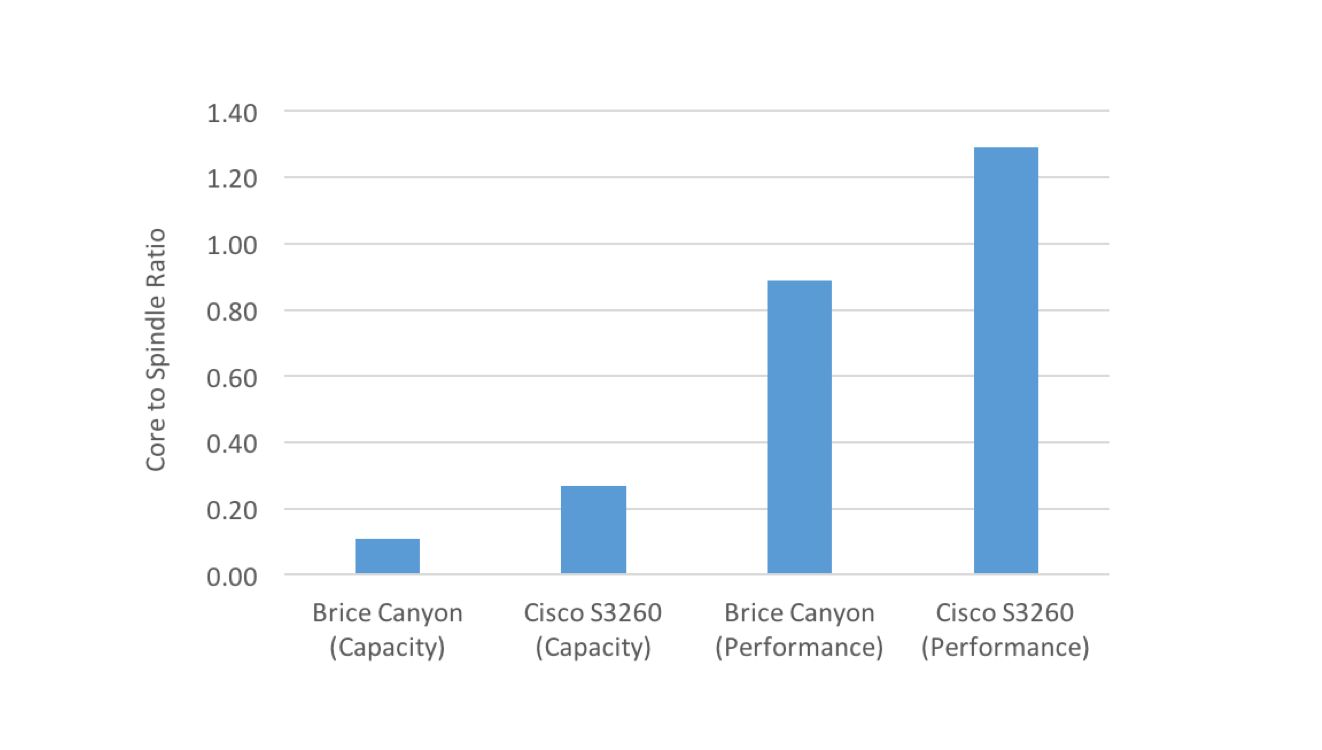
Facebook’s data tiering is far more sophisticated than what you see in general purpose data centers even when you are hosting your own web front end. But the workload right-sizing concept is still important. Especially if you have data intensive workloads that need higher core to spindle ratios like you see for hot to warm data store environments. Or on the other end of the spectrum when data is cooling down and want to retain everything but do so cost effectively and incrementally scalable. Regardless of data temperature, picking the right infrastructure for the right job can help you realize immediate ROI but also deliver tremendous long term value when done right.

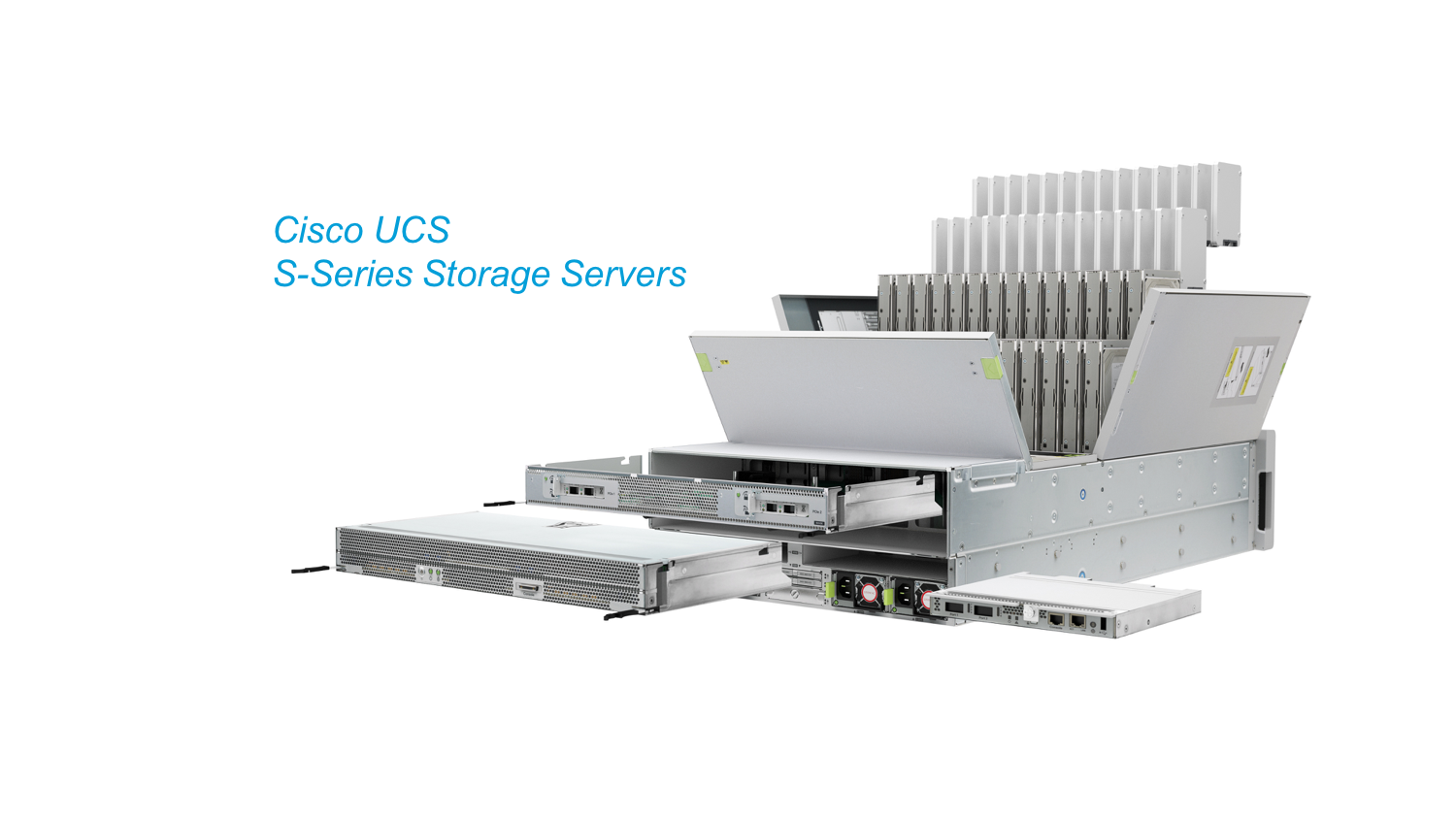
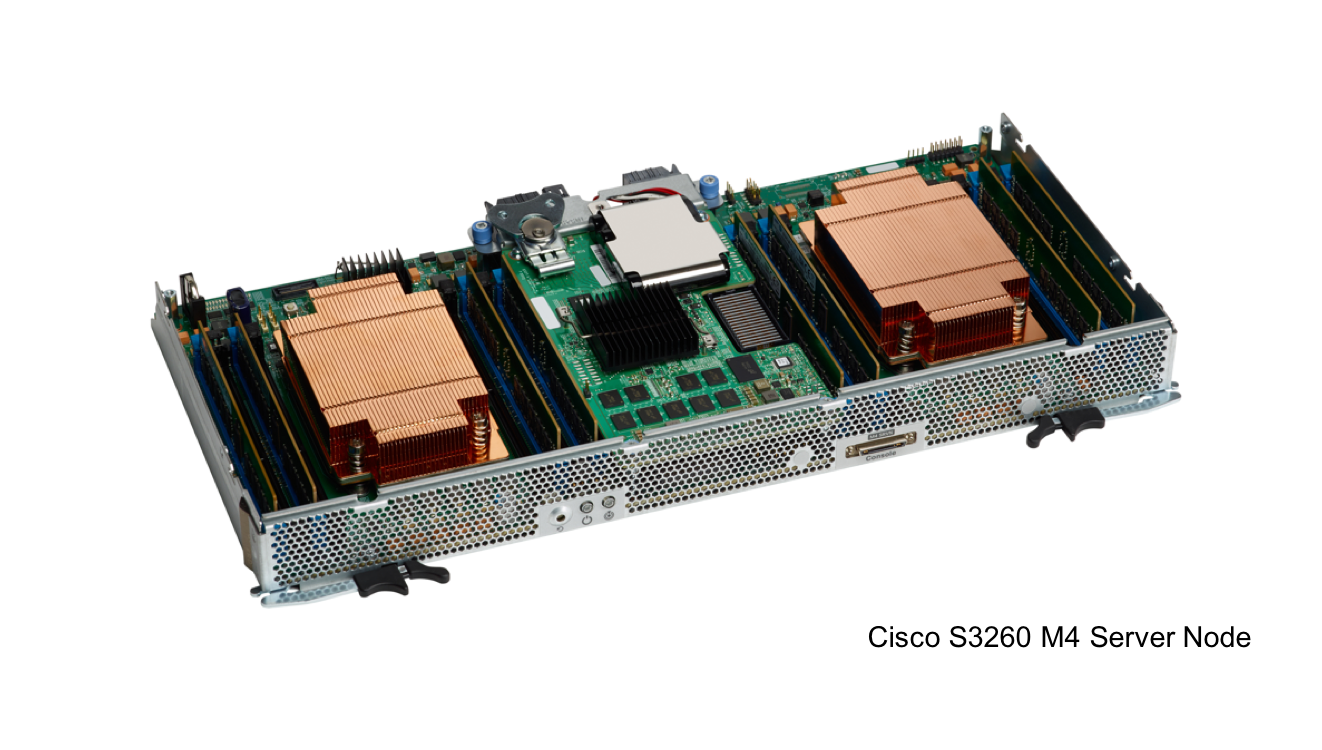
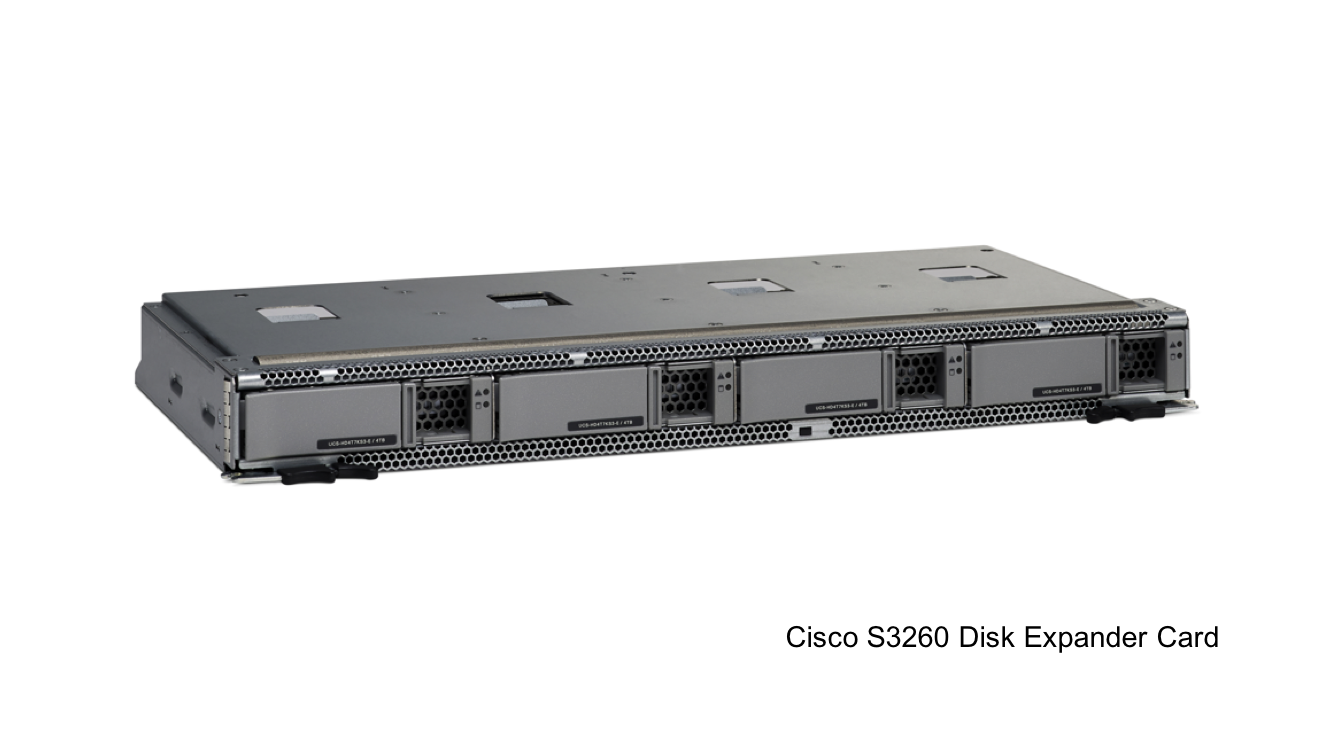
Now comparing Bryce Canyon to the Cisco UCS S-Series. The S3260 similarly is a modular system architecture offering hybrid storage support in single or dual server node configurations. Utilizing dual server nodes, a wide range of processors combined with a big footprint of DDR4 memory enable workload right-sizing support for the most demanding data intensive workloads. In single server node configuration, you can transform the S3260 with expander card options changing it’s functionality for increased storage, I/O connectivity or application acceleration with flash memory. These capabilities combined with the power of advanced compute and storage automation provided by UCS Manager make the S3260 the most versatile storage server in the industry hands down.

Last November we released new M4 server nodes that support Intel’s Xeon E5-2600 v4 processors. These processors are optimized to perform well for a wide range of workloads striking the right balance between performance and power consumption. The S3260 M4 server nodes support processor options ranging from 8 to 18 cores and up to 512GB of DDR4 memory.

A major difference with our S3260 server nodes vs. Mono Lake is form factor. Our dual-socket architecture combined with the current Intel Xeon E5-2600 v4 processors create a total of 36 cores per server node satisfying the most performance hungry use cases. This creates a 1:28.1 core to spindle ratio per server that is attractive for performance hungry workloads like our Big Data and Analytics solutions. As a proof point, check out this great blog from my colleague Rex Backman on recent S3260 big data performance benchmarks validated independently by certified TPC Auditors.

You can also maximize for capacity by scaling down to a single server-node configuration with 16 cores per server node. This particular use case combines a disk expander card to maximize storage capacity and further lowering your $/GB. This flexibility is great for warm storage and active archive use-cases we regularly see from our software defined storage and data protection solution partners.

A great example of this is a recent customer engagement with our data protection partner Veeam. Together we helped Texas Medical Association reduce their backup storage costs by $600K while shortening their backup windows from 12 to 24 hours to 3 to 5 hours by eliminating costly NAS appliances. This disaggregation of legacy storage systems is becoming more commonplace as best of breed storage software is coming together with industry leading data center infrastructure like Cisco Unified Computing System and are delivering more value at much lower cost.

While Facebook being founded as a digital business might be ahead of the game. The rest of us are going through a major digital transformation and are seeking insights from our own data. And to get there we need to start a journey using products that can be easily adopted without throwing the baby out with the bath water.

If you are interested in learning how Cisco Unified Computing System can help you with your data storage needs, here’s a great brochure to get you started. Also be sure to download this free White Paper from Moor Insights & Strategy to learn how active data is creating new business insights.

If you liked this blog please stay tuned for more on data center storage solutions at Cisco and be sure to follow me on Twitter.

Authors

Chalon Duncan

Partner Managed Service Offer Manager

Global Partner Organization

Avatar

It’s April, and that means it’s time to pack back out to Las Vegas for the National Association of Broadcasters convention, scheduled for the last week of the month. And because we’ve lots to talk about, and you probably have limited time, I’m motivated to keep this one tight.

I’ll start with the most important part: Last year at NAB, we unveiled our Media Blueprint. This year, customers are attaching to it. Strongly. They’re attaching to it because it helps them transition their production, post, and distribution workflows to the cloud and Internet Protocol (IP) — without having to jack up existing workflows.

Our plan all along, with the Media Blueprint, was to approach the market as a partner, to our customers, to the ecosystem, even to traditional competitors. Glad to report – it’s working! We’ll share more details closer to the show, but read on for the background, what we’re demoing at the show, and where to find us when we’re not in our booth. Which, by the way, is SU8502CM.

Quick refresher: The Media Blueprint contains the stuff specifically needed by broadcasters and content providers as they (you!) make that daunting-but-doable, triple-whammy transition to 1) cloud-based, 2) viewer-driven, and 3) over-the-top-styled … video. Television. Media. Whatever we’re calling it these days!

Evidence that the triple-whammy transition is ON is fairly clear, even just looking back at what’s transpired from the 2016 NAB. For starters, and on the cloud/IP front, our latest Global Cloud Index indicates that 64% of cloud data center traffic will be video and storage by 2020.

But that’s just us. Marketplace indicators came in line strongly, too, toward a shift to cloud: Netflix shuttered its last data centers, moving the entirety of its infrastructure to cloud. And, a growing roster of networks (NBCU, and Disney) are both moving to cloud and IP infrastructure, for broadcasting and distribution.

On the viewer-driven front, networks continued to innovate in ways that get them directly to viewers … take the BBC’s release of Planet Earth … on Snapchat, or NFL games streaming on… Amazon. That lines up with the 8.4 billion connected video devices that’ll be in our world by 2021, (and here I’m quoting our latest Mobile Visual Networking Index.)

Short version: If it has a screen, it’s a TV.

Unquestionably, the stars are aligning. Our part of it will be to show how content creators, broadcasters, and the whole NAB aficionado scene can move live media production to IP, while preserving quality, reliability and existing workflows. We’ll show you how our customers today are running live production on our IP Fabric, which means, yes, they stepped away from their traditional production infrastructure.

We’ll show how content distribution can migrate from satellite to a less expensive, far more powerful all-IP infrastructure. We’ll show how they can do so much more stuff so much faster, just by virtualizing and using a cloud-based media production environment. All while building in multi-layered approaches to security against cyber-threats and piracy.

We’ll be showing all of these lofty-sounding goals with demos of our products in action — and by that I mean in action, as in, not slideware or lists of nifty ideas. I’ll draw your attention to three in particular:

  • If you only have time for one “thing to see” in our booth, make it our next-gen data center, which, will showcase the efficiency and speed of virtualizing things like news and live sports production, or spinning up a 4K production pipeline, on cloud infrastructure. You can do this!
  • If bandwidth frugality with super-granular content quality metrics are on your to-see list, you’ll want to take a look at our latest smart-streaming approach, which preserves bandwidth and video quality with intelligent controls and aforementioned metrics. (In other words, our super-cool Virtual DCM.)
  • For the security-minded, we’ll be showing real-time detection and elimination of online piracy, informed by data science and machine learning. We call it Streaming Piracy Prevention. It’s all about addressing OTT service credential theft/sharing.

You also don’t want to miss the opportunity to experience #FaceOff at our booth at NAB. In partnership with Syfy, we’ll be live-broadcasting the Face Off makeup artists as they bring new, creative movie characters to life. Come by to see cast members from this season’s All-Star competition showcase their skills — over our IP infrastructure, of course.

And, of course, my Cisco colleagues will be participating in a bunch of sessions — probably too many to list in a blog I promised to be tight. If I could draw your attention to just one of them, it’d definitely be David Ward, our CTO, on a super session titled “The Naked Truth About Media Production In an IT Stack” — and not just because he’ll be there with MIT legend Andrew Lippman, as well as Jim Blakle, GM of Intel’s Visual Cloud Division. Mark that one down (described in the conference materials as a “Super Session”) for Tuesday, April 25 from noon to 1.

The rest of the time, we’ll be over at the Connected Media IP Theater; you can find that schedule here.

And that’s it for my supposedly-brief walk through of what Cisco’s doing at this year’s NAB Show! Hey. There’s a lot going on, and that’s good. Hope to see you there! We are in SU8502CM.

Authors

George Tupy

Market Manager

Service Provider, Video Solutions

Avatar

The Marketing Velocity Live Event (Chicago, April 25-27) is just around the corner. To say I’m excited is an understatement.

This is our 10th year conducting this invitation-only event that challenges and educates our partners about how they think about marketing. While I think Cisco is leading the industry in bringing this value exchange to partners, I like to think we continually bring new thinking to our partners. There is a science and an art to marketing. It’s finding that right balance and engaging your customers with the right mix.

Like our industry, marketing continues to evolve. Looking back 10-years ago SEO and SEM was just gaining steam. Social Media wasn’t really considered a viable business tool, and Web 2.0 was still a conversation topic of what could be. Marketing Velocity has been engaged with it all.

Working with partners. Understanding pain points. All to create an enriching event series that has grown into an always-on program.

I’m sorry, what were you saying?

While I can’t share much about the event, just yet. Be assured, we are focusing on relevant content that will help bring you closer to your customers, and create tighter internal relationships within your company.

There is more opportunity than ever. Yet in the same breath it’s more challenging than ever to entice and capture your customers’ attention. As Cisco CMO, Karen Walker, often says, “Goldfish have a longer attention span than customers.” If you’re curious, goldfish have a 9-second attention span. That’s 12.5% more than what you get from your customers.

Reaching customers at the right time on their terms is crucial. Figuring out how you do that is the direction marketing is going.

Spoiler Alert. This is just a small taste of what we are bringing to the event.

Respect Your Elders

Audience profiles are also changing. There are wholly new ways audiences consume media.

Two words: Digital Natives. They are real and they will fundamentally change the way you market. I am not saying to abandon your traditional marketing methods, but you will need to change your approach.

Matthew Ingram, one of the Millennials on my team, shared some eye-opening insights in his blog on the changing customer landscape: “73% of millennials today are involved in their company’s product/service purchase decisions. As they get older, this percentage will only continue to increase – so all those ladder-climbing connections from my LinkedIn feed aren’t overachievers or anomalies, they’re just following the trend line.” This shift is huge and something you need prepare for.

Yes, you guessed it. Spoiler Alert #2. Another topic du jour during the event. Prepping our partners to intercept a different type of audience, and how to build that into planning.

What? You Didn’t Get a Ticket?

Don’t fret if you won’t be attending the event. While you won’t get to participate in the hilarity, we will be offering access via recordings. Additionally our hands-on workshops will be available through our On-the-Air webcast series.

Unfortunately, we have to limit attendees to a small audience. Please understand it’s our goal to educate and enable our entire Partner base through the Marketing Velocity program. I welcome your feedback. And I would like to hear what marketing topics or training that you would like to see. These are the insights that power the program, as we prepare to continue our journey together.

I urge you to stay informed of the event conversations. Follow the @PartnerVelocity handle, and get in the conversation using #mktgvelocity.