
Avatar

This post was written by guest blogger Pauline Vogl, Project Manager, Sustainable Business Practices at Cisco.

I’m a champion for environmental sustainability. As a member of Cisco’s Corporate Affairs team, I’m constantly looking for ways to be a global problem solver and positively impact people, society, and especially the planet. From employee initiatives like reducing paper cup usage to cross-functional teams like Make IT Green to this month’s Earth Aware activities, there are plenty of opportunities for employees to become champions for the planet.

And off campus, there’s a world of possibility, one I discovered when I began volunteering through Citizen Schools four years ago. The nonprofit organization provides daily science, technology, engineering, and math (STEM) education to underserved middle schoolers in the United States through its Extended Learning Time (ELT) model.

“Citizen Teachers” such as myself lead 10-week, after-school courses on the topics they believe are critical, but aren’t being taught in the classroom; every fall, a few environmentally conscious colleagues and I teach sixth, seventh, and eighth graders about their carbon footprints and how they can reduce them at school and at home.

Students participate in hands-on activities around the benefits of recycling

Many of the students we teach come from low-income families in East San Jose, where high-school graduation rates are just 59%. Those who participate in after-school courses graduate at a much higher rate (71%) and are 25% more likely to enroll in college than their national peers. For me, it’s not only important that these students graduate with the skills they’ll need to succeed in college and beyond, but that they realize the immediate and communal benefits of practicing environmental sustainability.

Our Carbon Footprint course is broken down into four sections: Water, Carbon Emissions, Waste, and Electricity. These are all topics we might understand, but bringing them down to a middle schooler’s level can be challenging. One of my favorite exercises is showing the students side-by-side pictures of Lake Oroville in Northern California from 2010 and 2014. The cartoon-like widening of their eyes when they see the difference tells me they understand the impact of droughts; it’s unlocking this knowledge that brings me the most joy.

One year, a student raised her hand after seeing the images and shared her own example of water conservation. “My grandma saves water from the kitchen and pours it into plants,” she said. If we can teach children that turning off a light, taking shorter showers, or lowering the thermostat in the winter makes a difference, we’re preparing them to be more sustainable later in life.

One of my classes at the end of a successful Carbon Footprint course

Sometimes, all it takes is a field trip to Cisco’s cardboard crusher, a tour of Repo Depot—our Cisco equipment reuse facility—or a hands-on activity transforming household waste into instruments to “turn on” their lightbulbs. My students are the future; they’re the ones inheriting this planet, and I believe it’s important they learn early on that their actions can make a difference in the world.

If I’ve learned anything in my seven years at Cisco, it’s that you can turn something that’s part of your daily job into something you’re passionate about. For me, that’s sustainability.

This April and May, Cisco will host activities, events, and volunteer opportunities across Cisco offices to encourage employees to engage in environmentally responsible behaviors at work and at home. Last year, hundreds of employees around the world volunteered, and more than 425 volunteered from Cisco’s San Jose campus.

They helped local charities and organizations harvest sustainable produce, maintained the San Jose Heritage Rose Garden, learned how to host a Bike to Work Day, recycled electronic waste, picked up litter around Cisco, and planted trees.

Employees this year can:

  • Sign up online to volunteer for over 30 global activities
  • Donate to a number of Cisco Foundation-approved organizations
  • Join our internal sustainability community, Cisco Greenhouse
  • Attend SustainX on May 16th, where you’ll learn how employees turned their passion into business value at Cisco

Whether we’re volunteering through Citizen Schools or finding ways to be more “green” with our fellow employees, we can all be champions for environmental sustainability.


Stay informed about how Cisco is accelerating global problem solving for people, society, and the planet. Sign up for our email list today.


Authors

Austin Belisle

No Longer with Cisco

Avatar

Does corporate compliance have you in a conundrum? Sure, we all dread compliance as we dread doing our taxes every year. It takes time and effort. It and keeps us away from the interesting stuff in our jobs — like innovating, collaborating, and growing the business. After all, employee productivity equals business value.

In fact, a Global Center for Digital Business Transformation study notes that healthcare has the potential to capture $838 billion in digital value from worker productivity using technologies such as mobility and video collaboration. In retail and banking, the potential is $550 billion and $299 billion.

Perhaps you are working to capture all that productivity value from Cisco Spark. And you need to address myriad compliance challenges.

  • If you are in retail, you know Payment Card Industry (PCI) compliance is complex. It is ever-evolving with all the entities involved: the banks, Web hosts, shopping carts, e-commerce, merchants, and so on.
  • In healthcare, you may be facing several daunting hurdles to meet HIPAA compliance with the adoption of digital patient records, increased regulation, and the growing demand for information.
  • Financial institutions have made strides toward improving internal control processes since the Sarbanes-Oxley Act became law 12 years ago. Yet, new challenges emerge as institutions work to comply with evolving regulatory requirements and industry guidelines.

Despite all this complexity, have you considered that compliance may actually be good for your business? Many studies have found that companies with strong governance and compliance cultures outperform their counterparts. Compliance can actually boost the bottom line.

We get it at Cisco Advanced Services. We can help you turn compliance into a business growth driver using Cisco Spark Compliance Services. We want you to realize the full productivity potential you stand to gain from Cisco Spark. We will work with you to operationalize and integrate your Cisco Spark platform so that you can get back to the fun and productive stuff in no time. Our approach uses Cisco Spark APIs to develop and integrate the compliance application into your environment and back-end systems.

Let Cisco Spark Compliance Services help you realize the ROI of effective governance.

Now, if only we could come up with an IRS filing API for Uncle Sam….

Authors

Lowell Johnson

Senior Director

Advanced Services for Collaboration

Avatar

Discovered by Marcin ‘Icewall’ Noga of Cisco Talos.

Talos are today releasing a new vulnerability discovered within the Lexmark Perceptive Document Filters library. TALOS-2017-0302 allows for information disclosure using specifically crafted files.

Overview

The vulnerability is present in the Lexmark Document filter parsing engine which is used across a wide range of services such as eDiscovery, DLP, big data, content management and others. The library is commonly used across these services to allow for the deep inspection of a multitude of file formats to offer conversion capabilities such as from Microsoft document formats into other formats. Lexmark make this library available to compete against other third party and open source libraries used for such activities.

Document conversion represents an important aspect of many businesses as they attempt to move from an unstructured data solution to a more workable structured data solution in order to improve business efficiency.

Authors

Talos Group

Talos Security Intelligence & Research Group

Avatar

Dave Lively is up to his neck in cloud. He’s been with Cisco for 20-ish years, he’s been involved in our cloud efforts for quite a while now, and he’s been involved in the open source community just as long. And the best part is—he really gets it. Gets the inherent value of cloud, as well as the potential value. Gets the enormous variety of deployments out there and the endless array of tools that can tweak the way those clouds are managed for maximum benefit. He understands the legal challenges, the regional challenges, the vertical challenges, and the cultural challenges. He has clear insight into why things have progressed as they have to date, and a pretty good idea of how they can improve as we all move forward in our efforts to squeeze as much benefit out of cloud technology as we possibly can. Specifically, a few of the topics he touches upon during this episode of Cloud Unfiltered are:

  • Who is buying cloud and why
  • How Service Providers are using the cloud
  • How technical debt impacts your ability to implement cloud
  • Why containers remain such a hot topic and how their use is evolving (excellent tutorial for anyone still wrestling with containers)
  • The role of the network in cloud environments
  • How Cisco solutions like Contiv and Meraki can be the difference between loving your cloud and not loving it so much

See the video podcast on our YouTube page, or listen to the audio version on SoundCloud (although note that it is a truncated version). And if you like what you hear, we invite you to subscribe to our channel so you don’t miss any of the other exciting podcasts we have scheduled over the next several months.

Authors

Ali Amagasu

Marketing Communications Manager

Avatar

Later this month, I will be traveling to India to meet with customers and connect with our Cisco Service Provider engineering teams. I always look forward to my trips to India. Each time I return, I find myself in awe of the pace of technology adoption in India, in general, and in particular, the rate of smartphone adoption. The numbers are truly staggering. In 2016, the number of smartphones in India grew 50%, reaching over 359 million. If you want to see how pervasive mobility is disrupting traditional business models, look no further than India as a case study.

Urbanization, advances in technology, and fundamental regulatory transformations are paving the way for greater economic advantage and increased consumerization for the people of India. Mobile phones are ubiquitous, there is a booming content and entertainment industry, and India is at an inflection point for countrywide digitization. We like to use words like revolution, transformation, and disruption when talking about technology adoption. India is experiencing all of this – at breakneck speed – and it is not slowing down anytime soon. Though heavily influenced by layers of policy, local markets, and history, there is no doubt that India is a market that presents tremendous opportunity for video, mobility, and digitization, for those that are agile, invested, and have the right mobile strategy.

Mobile First

In 2016 alone, 119 million smartphones were added to the mobile network in India and mobile data plans are now providing speeds that rival those of some of the best carriers in the U.S.  Reliance Jio, an Indian mobile network operator, made headlines a few months ago when they announced the launch of their 4G network across India, free to consumers for the first few months. As you can imagine, this caused major market disruptions for both consumers and Jio’s competitors. Consumers flocked to Reliance Jio; a record-breaking 100 million new subscribers added in the first 170 days. And Jio is not done yet… Matthew Oomen, President of Network, Global Strategy and Service Development, is committed to extending the Reliance Jio and Cisco partnership to achieve double the current subscriber capacity over the next 6-8 months. This comes as Jio also announced that it doubled download speeds across the 4G network . The average download speed on Jio’s network is a screaming 16.5 Mbps. This is a win for Jio, a win for Cisco, and a win for millions of consumers in India who now have reliable and affordable mobile IP connectivity.

Beyond Bollywood

So what does one do with a smartphone and a great data plan? Watch video, of course.  Entertainment is big business. Video will account for half of India’s mobile data traffic by the end of 2017, and will make up 75% of India’s mobile data traffic by 2021. Consumer attitudes are changing and demand for high quality, relevant content is growing. Currently, there are more content providers in India than anywhere in the world, and demand for high quality, diverse, user-centric content is growing at unprecedented pace. India is still a very long way from market saturation, and competition for subscribers is fierce. Netflix launched in India in January 2016, and there are currently 25 other OTT providers serving this market. Often, OTT applications are bundled into the mobile carrier’s premium data packages, providing an uptick in ARPU for the service provider. The flood of providers into the market is setting the stage for a competitive OTT war and more carrier and content provider partnerships. It is worth mentioning that this market is also currently battling rampant content piracy. Bad news for pirates, DRM is the new black, and Cisco is working in partnership with multiple DRM companies and Service Providers to protect content and ultimately, revenue for the industry.

Cable Digitization: Under Construction

Indian cable providers are in process of transformation as well. The government of India laid out a strategy starting in 2011 to convert all cable television networks in the country from analog to digital in four phases, starting with major metropolitan areas. Moving to digital creates a paradigm shift for Indian cable operators; digital video takes up less frequency space in the spectrum, opens up the opportunity for two-way communication, and creates capacity to add more channels, and higher quality video. The plan was to have the entire country moved to digital by 2014, but delays, litigation and cost overruns have pushed the deadline back considerably. While digitization is ongoing, the push for digital cable has already created more options for premium channels, and is driving incredible growth in digital advertising.

An Eye to the Sky: DTH

Cisco is currently in a dominant position across the Pay TV spectrum – we count three of the top four DTH providers in India as our customers. As the cable conversion continues, we’re seeing that 30% of customers converting from analog are becoming DTH customers. While cable still dominates the pay TV market in India with 70% of subscribers, DTH has a growing number of new subscribers and a higher ARPU.

India is at an inflection point for countrywide digitization and transformation which will forever change how and where Indian consumers access content, creating opportunities for innovation in this rapidly evolving ecosystem. Cisco has been in this market since the beginning of this revolution. Together, with our Indian customers, we will continue to co-innovate to offer consumers high quality experiences in this exciting and dynamic landscape.

Authors

Conrad Clemson

Senior Vice President, SP Platforms & Applications

Service Provider Platforms & Applications

Avatar

#CiscoChampion Radio is a podcast series by Cisco Champions as technologists. Today we’re discussing the Cisco Annual Cybersecurity Report.

Get the Podcast

  • Listen to this episode
  • Download this episode (right-click on the episode’s download button)
  • View this episode in iTunes

Cisco Guest
Kevin Parra (@kparra007), Security Report Program Manager

Cisco Champion Hosts
Jake Gillen (@itsec_jakeg), Sr. Info Sec Engineer
Yasir Irfan (@yasirirfan), Network Security Team Lead

Moderator
Brian Remmel (@bremmel)

Continue reading “#CiscoChampion Radio, S4|Ep. 5: Annual Cybersecurity Report”

Avatar

There continues to be a lot of buzz around digital transformation, but what exactly does it mean in the context of healthcare, and what benefits does it bring to healthcare providers?

Starting with the basics, we know that “digital transformation” simply means organizational change via digital technology and business models. These changes can include the transformation of operations, revenue models, and even the core culture or your organization.

For providers, transformation drivers include significant disruptions in the healthcare industry:

  • Tech-savvy consumers
  • Proliferation of data and devices, including wearables
  • Remote-care options and expectations
  • Security and regulatory requirements

To succeed in today’s healthcare landscape, providers are focusing on specific digital capabilities to bring these benefits across the continuum of care, from home to clinic or hospital—and back home again.

  • Improve population health management and outreach
  • Enhance the patient experience
  • Deliver differentiated services
  • Improve workflows, efficiency, safety, and security

Cisco empowers digital transformation for providers with solutions that enable virtual care, personalized and mobile experiences, and optimized workflows and operations, as well as end-to-end security for people, facilities, data, and devices.

For more information on Cisco comprehensive solution set for healthcare organizations, please visit cisco.com/go/healthcare and connect with us on social media.

Authors

Jessica Kelly

Sr. Communications Manager

Office of the COO

Avatar

Earlier this month, I wrote about the need for a holistic security strategy for the Internet of Things (IoT). It’s more than securing a ‘thing’ within the IoT – it’s about building resilience for the whole system. Cyber resilience is about managing risk; identifying potential risks, evaluating the likelihood of them occurring and their negative impact, and deciding the appropriate actions to take. The challenge is that organizations deploying connected things, or extensive IoT projects, are faced with multiple component vendors that utilize disparate security methods. These inconsistent approaches are giving cyber criminals more opportunity to compromise networks and systems and steal valuable data.

It is time. Customers need to demand resilience practices from their IoT vendors. More specifically, they need to set the bar for a core set of requirements that address critical security, data protection and privacy needs.

The key will be to build this in from the ground up, rather than an afterthought. The following practices will not entirely eliminate cyber risk; but when used together they create awareness to the risks and will build a formidable defensive posture to significantly reduce the impact of threats.

  • Secure Development Lifecycle (SDL) – Building a trustworthy and secure product means starting at the design and development phase so that security does not get left behind in the wake of evolving business needs. A SDL gives engineers the processes and tools to detect, fix, mitigate and prevent design and code weaknesses that could become exploitable. It includes methods like threat modeling, to help understand and prioritize risk within a system. By following the flow of data through the system, it can identify trust boundaries where the data can be compromised. The SDL should also include penetration testing, proactive attempts to break into products and services to identify weaknesses and vulnerabilities in order to develop better protections against attack.
  • Change Default or Weak Passwords – Attackers often use the simplest methods to penetrate a system. Default passwords provide easy entry for an attacker when scanning for targets. Lack of password complexity significantly reduces the search space when trying to guess user’s passwords, making brute-force attacks easier. For this reason, it is important to require all users, including administrator accounts, to have strong passwords. Ideally, multifactor authentication should be used to secure user credentials.
  • Ensure Secure Firmware and the Latest OS Updates – Connected devices within the IoT contain firmware, embedded software that provides control, monitoring and data manipulation of products and systems (i.e. sensors, traffic lights and security cameras). It is crucial that each device in an IoT system has the latest and most secure firmware and OS updates. The method to accomplish the software and firmware updates must also be secure.
  • Data Privacy – As data is a key enabler of IoT success, it must be planned for, managed and responsibly protected just as any other critical business asset. Privacy has to be viewed geopolitically. Each technology vendor needs to understand privacy laws and regulations within the countries in which they operate and make sure all of their products, services and staff comply with proper handling of that data. The SDL process should include “Privacy by Design” principles.
  • Secure Communications and Authentication – As IoT project adoption accelerates, technology vendors need to carefully evaluate and streamline methods for device communication and authentication. One aspect of security is safeguarding the integrity and confidentiality of IoT data and the other is the authentication of each device placed within a network (i.e. verifies the security posture of the devices and authorization levels of the users before they are allowed access).
  • Product Security Incident Response – While all of the above are important, inevitably security risks will arise that need to be mitigated after the fact. In this case, it is critical that every vendor in the IoT system must have a responsive, easily reachable product security incident process. This process must clearly communicate with impacted users, be responsive to security researchers and customers alike, and ensure timely, complete resolution to what are often complex security issues.

All of the above should be considered irrespective of IoT or not. It is the start of good security posture.

What do you think? Join the discussion with questions, comments and suggestions. We’ll continue the topic of resilience for the IoT in upcoming blogs. In the meantime, you can learn more about building trustworthy systems in our Trust and Transparency Center.

Authors

Anthony Grieco

SVP & Chief Security & Trust Officer

Security and Trust Organization

Avatar

What is Cisco Network Plug & Play?

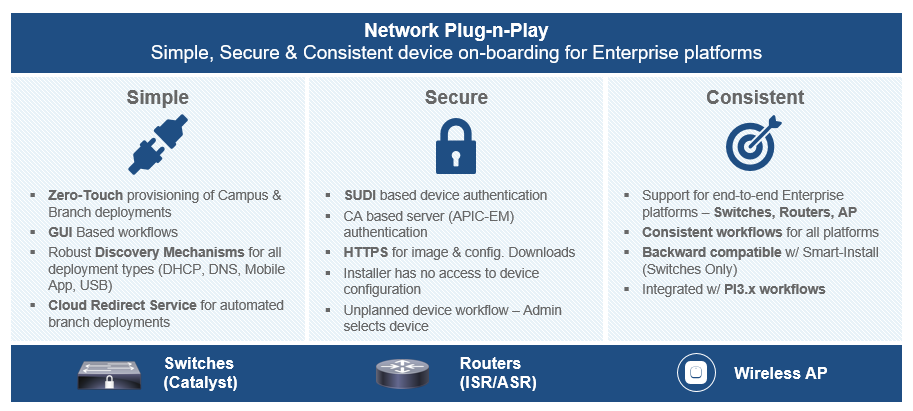
Cisco Network Plug & Play (PnP) is a secure and scalable solution for simple day-zero provisioning across all Cisco Enterprise platforms (routers, switches and wireless access points). The PnP application runs on top of Cisco Enterprise SDN Controller – APIC-EM.

What is PnP Connect?

PnP Connect automates the entire day-zero experience from device procurement to provisioning. It is a new service that acts as a discovery mechanism for a network device to discover its controller. PnP Connect re-directs a network device to its controller (APIC-EM) and eliminates the need for DHCP / DNS discovery mechanisms. PnP Connect, also allows configuration provisioning directly without using APIC-EM (this is beta). By simply assigning a Smart Account while ordering PnP eligible devices in Cisco Commerce, the devices automatically populate in the PnP Connect portal.

PnP Connect allows flexibility of implementation: Customers can choose between on premise and cloud based day-zero provisioning.

Why is PnP Connect important?

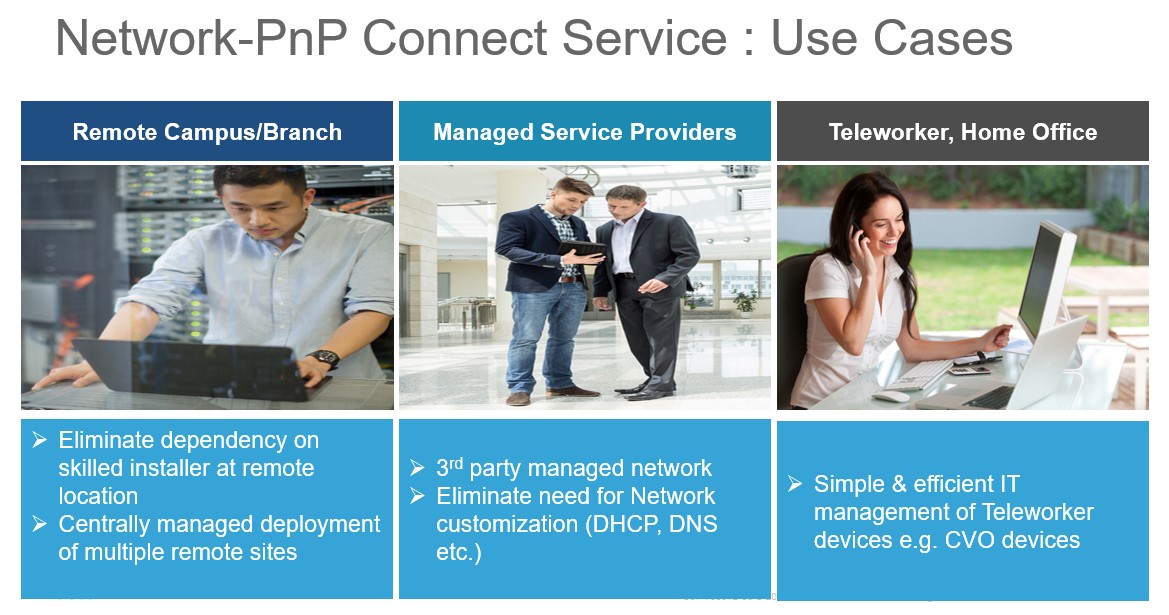
Cisco PnP Connect solves a problem that is top of mind of most CEOs as 18% of a typical product cost goes into day-zero activities. In fact, 57% of CEOs are worried about IT strategy not supporting business growth but with PnP Connect generated cost savings they can be at ease. For example, the entire PnP solution, in general, will lead to up to potentially 70% reduction in operational costs by (1) eliminating pre-staging, (2) minimizing manual configuration errors, and (3) removing the need for a specialized technical installer at the end site.

Just as a reference, a typical average deployment cost for an access switch is $938. If you extend this to a huge network, the cost savings promised through PnP solution become material for the bottom-line!

Important Links:

Learn about Cisco Plug and Play Connect

Manage your Cisco Plug and Play Connect

Release Notes for Cisco PnP Connect

Solution Guide

Release Notes for Cisco Network Plug and Play

Configuration Guide for Cisco Network Plug and Play on Cisco APIC-EM

Authors

Shahrukh Raheem

Product Manager – EMEAR Products & Partnerships Lead